The evening sun cast long shadows across the brick sidewalk.
Hadley Mercer huddled on the cold concrete curb. Her thin frame shivered despite the warm spring air. Her stomach twisted with a familiar emptiness that had become her constant companion over the past five days.
Five days without food.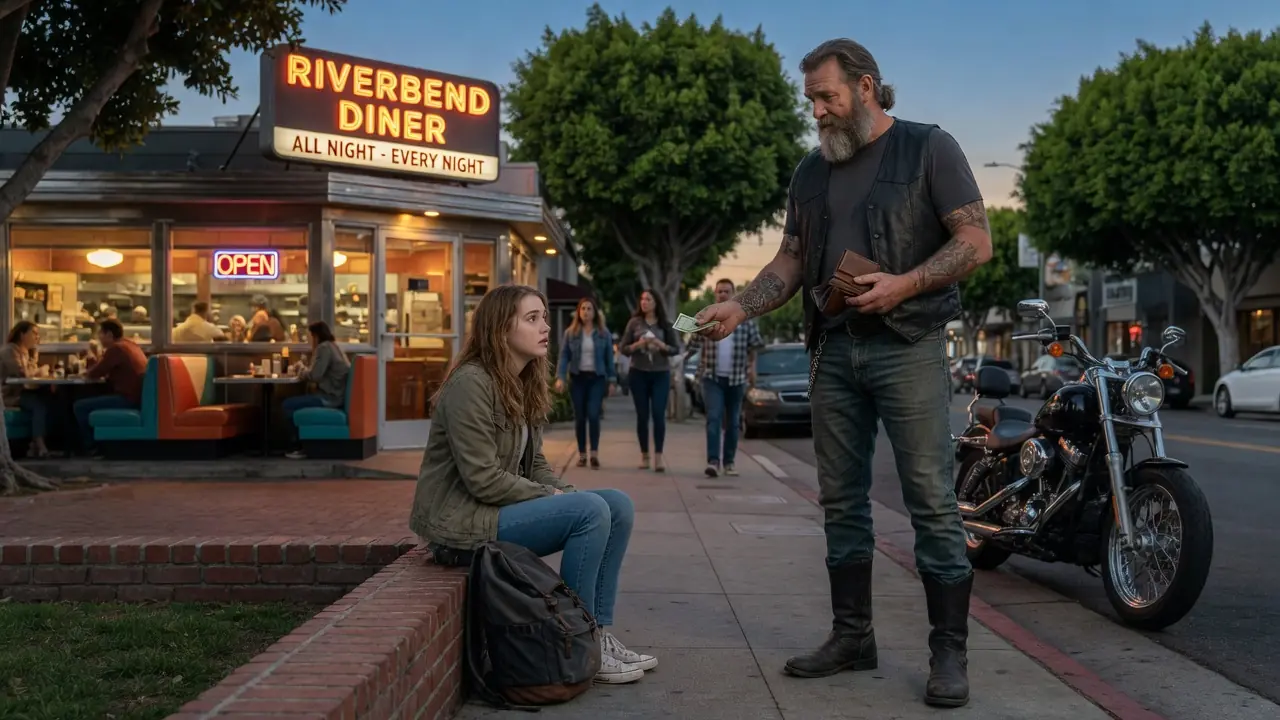
Five days since she had eaten anything more substantial than a half-rotten apple she found behind a grocery store.
Five days that felt like five years.
People rushed past her on their way home from work. Their shoes clicked against the pavement in a steady rhythm that seemed to mock her stillness. A woman in a crisp business suit chatted on her phone about dinner plans, something about reservations at that new Italian place downtown.
A young couple walked hand in hand, sharing laughs as they discussed which restaurant to try that night. The smell of fresh bread drifted from the bakery across the street. It moved through the evening air like a cruel invitation.
Hadley’s mouth watered. Her empty stomach clenched painfully, twisting into knots that sent sharp waves of nausea through her body.
She pulled her worn backpack closer and clutched it like a shield against the indifferent world. Inside was everything she owned in this life: a thin blanket with holes at the corners, a couple of wrinkled T-shirts that had not been washed in weeks, and an old photograph of her mother.
The photograph was creased and worn at the edges from the countless times she had held it, from all those nights when she pressed it against her chest and tried to remember her mother’s warm smile. Her gentle touch. The way she used to brush Hadley’s hair before bed and tell her that everything would be all right.
Everything was not all right.
Hadley watched a mother and daughter walk past on the opposite sidewalk. The little girl skipped and swung her mother’s hand. Her laughter rang out like bells in the fading daylight. The mother looked down at her child with such pure love that Hadley felt her throat tighten.
She quickly looked away and focused instead on a piece of gum stuck to the sidewalk near her feet.
It was easier to stare at garbage than to watch what she had lost.
Two years had passed since her own mother died. Cancer had taken her slowly, piece by piece, over the course of eighteen months. Hadley had watched Catherine Mercer fade away in a hospital bed. She had held her hand as the monitors beeped their steady countdown. She had been there when the final beep stretched into that long, terrible silence.
The pain still felt fresh, like an open wound that refused to heal. Like a hole in her chest that nothing could fill.
Her legs had started to go numb from sitting too long on the hard concrete, but she did not have the energy to move. When was the last time she had eaten something real? The half-eaten sandwich she found behind the deli three days ago? Or was it four?
The days had started to blur together. Time had lost all meaning when every hour was consumed by the simple struggle to survive.
Standing up made her head spin. The world tilted sideways, and she had to grab the brick wall behind her for support. Black spots danced at the edges of her vision.
She forced herself to breathe slowly. In through the nose. Out through the mouth. Just like her mother used to tell her when she was scared.
She could not stay here.
Someone would eventually tell her to move along. A shop owner. A police officer. A concerned citizen who did not want to look at the reminder of society’s failures sitting on their pristine sidewalk.
Hadley had learned it was better to leave before being asked. Better to maintain whatever shred of dignity she had left.
Her legs felt like rubber as she shuffled down the street. One hand trailed along the brick wall for support. The rough texture scraped against her palm, but the sensation kept her grounded. Kept her present. Kept her from drifting away into the darkness that always seemed to be waiting at the edges of her consciousness.
The dumpsters behind the restaurants were her best chance at finding something to eat. She had learned which ones to check, which restaurants threw away the most food, which days the deliveries came, and when the old stock would be discarded.
But her timing was off today. She was too weak to keep track of time properly, too hungry to remember what day of the week it was.
The first dumpster had already been emptied. Nothing but a few scraps of cardboard and the lingering smell of rotting vegetables. The second dumpster was locked, a heavy padlock gleaming in the fading light, keeping its contents safe from desperate hands like hers.
Behind the Chinese restaurant, she found a few containers of half-eaten rice, but they were covered in something that looked like mold. Green and fuzzy, spreading across the white grains like a disease.
Her stomach growled louder, begging her to eat it anyway. Begging her to take the risk.
What was a little food poisoning compared to starvation?
Hadley closed her eyes and fought back the tears that threatened to fall. She could not risk getting sick. Being hungry was bad enough, but being hungry and sick on the streets would be even worse.
She had seen what happened to homeless people who got sick. She had seen them lying in alleys too weak to move, waiting for death or for someone to notice them.
Usually, death came first.
Each step became harder than the last. As she moved deeper into the alley, the world started to tilt and sway around her. The brick wall seemed to lean inward. The ground felt unsteady beneath her feet.
Black spots danced at the edges of her vision, multiplying, growing larger, consuming more and more of her sight with each passing second.
She tried to focus on putting one foot in front of the other. That was all she had to do.
One foot.
Then the next.
Keep moving. Keep breathing. Keep existing.
But her legs would not cooperate anymore.
Her knees buckled without warning. One moment she was walking. The next moment she was falling.
The rough asphalt scraped her palms as she tried to catch herself. The impact knocked the breath from her lungs. Pain shot through her where she struck the ground. She managed to turn enough to land on her side instead of her face.
A small victory.
The only kind of victory she could manage anymore.
The cold from the ground seeped through her thin jacket, through her worn jeans, through her skin and into her bones. She should get up. She knew she should get up. Lying in an alley was dangerous. Lying in an alley was how people disappeared.
But her body refused to move.
Her muscles had given up.
Her bones had surrendered.
All she could do was lie there, watching as the shadows grew longer and darker around her.
A rat scurried past, barely a foot from her face. Its beady eyes glinted in the dim light as it paused to look at her, assessing, evaluating, deciding whether she was food yet.
Hadley did not even have the energy to flinch.
She closed her eyes, too exhausted to keep them open any longer.
The sounds of the city seemed to fade away. The distant traffic. The muffled conversations. The endless hum of a world that kept turning without her.
She was alone in the growing darkness.
Alone with her hunger, her memories, and the cold ground beneath her cheek.
Behind her closed eyelids, images began to form. Memories rose up from the depths of her exhausted mind.
Her mother’s face appeared first. Catherine Mercer in better days, before the cancer diagnosis, before the treatments that made her hair fall out in clumps, before her skin turned gray and her eyes lost their light.
Her mother standing in their kitchen with flour on her apron, teaching Hadley how to make pasta from scratch. The way her hands moved with practiced grace as she rolled out the dough. The way she smiled when Hadley’s attempt came out lumpy and uneven.
Her mother tucking her into bed at night, smoothing her hair back from her forehead, telling her stories about princesses who saved themselves and dragons who were just misunderstood.
Her mother in the hospital bed. Tubes running into her arms. Machines beeping their steady rhythm. Her voice barely a whisper as she said her final goodbye.
And then the other memories came.
The darker ones Hadley tried so hard to forget.
Her father, Richard Mercer, sitting in his armchair after the funeral, staring at nothing for hours. His eyes empty. His face slack, like someone had reached inside him and removed everything that made him human.
The empty bottles that began appearing around the house. First just a few hidden in the kitchen trash, then more and more. Lining the counters. Covering the coffee table. Rolling across the floor when she walked to her bedroom.
The pills that came next. White and small and deadly. Her father’s new companion. His new escape from a world that had taken his wife.
The night she came home from school to find him passed out on the bathroom floor, a needle still in his arm, his face so pale she thought he was dead.
The morning she woke up to find him gone.
The house empty.
No note on the kitchen table. No explanation. No goodbye. Just a scrawled message on a piece of notebook paper stuck to the refrigerator with a magnet shaped like a pineapple.
Two words.
That was all he left her after sixteen years of being her father.
I’m sorry.
Hadley lay in the alley and let the memories wash over her. Let the pain consume her. Let the darkness at the edges of her vision grow wider and deeper until it threatened to swallow her whole.
Maybe that would not be so bad.
Maybe disappearing into the darkness would be easier than fighting to survive another day. Maybe her mother was waiting for her somewhere on the other side.
The thought was almost comforting.
But then another memory surfaced. Her mother’s voice, clear and strong from a time before the sickness took hold.
“You’re stronger than you know, Hadley. Never forget that. No matter what happens, you have the strength to survive.”
Hadley’s eyes snapped open.
The alley swam back into focus. The cold ground. The distant sounds of the city. The rat that had moved on to easier prey.
She was not ready to give up.
Not yet.
Not while there was still breath in her lungs and blood in her veins.
With a tremendous effort, she pushed herself up onto her hands and knees. Her arms shook. Her vision swam, but she kept moving. Kept fighting. Kept existing.
One hand on the wall.
Then her feet beneath her.
Then standing, barely, swaying like a sapling in a storm.
The fluorescent lights from Joe’s All-Night Diner cast a harsh glow on the cracked sidewalk ahead. Hadley did not remember walking there. She did not remember leaving the alley. But somehow she had made it.
The aroma of bacon and hash browns drifted through the diner’s vents. It was the most beautiful smell she had ever experienced. More beautiful than flowers in spring. More beautiful than her mother’s perfume. More beautiful than anything she could imagine.
Her mouth watered painfully. Her empty stomach felt like it was trying to digest itself.
Through the streaky windows, she could see a handful of customers hunched over steaming coffee cups and plates piled high with food. Eggs and pancakes and sausages and toast with butter melting into golden puddles.
Hadley’s thin jacket did little to ward off the evening chill. She hugged herself tightly. Her fingers brushed against her own ribs protruding sharply through the worn fabric.
She had lost so much weight in the past few months. She had become someone she did not recognize when she caught her reflection in store windows.
The diner’s warmth beckoned her, but she knew she could not go inside. Not without money. Not looking the way she did.
The manager would take one look at her matted hair and dirty clothes and call the police.
Instead, she shuffled toward the back of the building where the dumpsters stood like silent guardians. Maybe there would be something edible. Something the kitchen had thrown out that was not too spoiled.
Her hands shook as she reached for the heavy metal lid.
A sharp voice cut through the night air like a knife.
“Hey, get away from there.”
Hadley jumped so hard she nearly fell over. A waitress stood at the back door, dish towel in hand, her face pinched with disapproval. Her apron was stained with grease, and her hair was pulled back in a tight ponytail that seemed to stretch her features even tighter.
Hadley stumbled backward, her legs weak and unsteady, her heart pounding against her ribs.
“I’m sorry,” she mumbled, her voice barely a whisper, her throat dry and scratchy from lack of water. “I’m just… I’m really hungry.”
The waitress’s expression softened for a moment. Something flickered in her eyes. Recognition, perhaps. An understanding of what desperation looked like.
But then her face hardened again.
The walls came back up.
The moment of connection disappeared like smoke in the wind.
“Can’t help you. Boss’s rules. No handouts.”
Hadley nodded, fighting back the tears that burned at the corners of her eyes. She had heard those words before. Had heard them a hundred times in the past few months.
No handouts.
No help.
No hope.
She made her way back to the front of the diner, slumped against the wall beneath the glowing sign, and tried to become invisible. Tried to disappear into the shadows where no one would notice her.
Through the window, she watched a man cut into a stack of pancakes. Syrup dripped down the sides in golden rivers. He lifted a forkful to his mouth without even looking at it, without appreciating what he had, without understanding how lucky he was.
Hadley’s stomach cramped so hard she had to bite her lip to keep from crying out.
The taste of blood filled her mouth.
A sharp, metallic reminder that she was still alive.
A couple exited the diner, bringing with them a wave of warm air and the smell of fresh coffee. The woman glanced at Hadley. Her eyes widened slightly. Then she quickly looked away, clutching her purse tighter against her chest.
Hadley was used to that reaction.
People treating her like she was somehow contagious. Like homelessness was a disease that could spread through eye contact. Like poverty was something you could catch if you got too close.
She pressed her forehead against the cool glass of the window. The warmth from inside felt good against her skin.
She could pretend for just a moment that she was waiting for someone. That she had a place to go. That she had a future.
The thought made her want to laugh, a bitter, broken sound that caught in her throat.
Nobody was coming for her.
Nobody had come for her in a very long time.
The rumble of a motorcycle cut through the evening quiet. It started as a distant growl, a low vibration that seemed to rise up from the earth itself. Then it grew louder. Closer.
The unmistakable thunder of a Harley-Davidson engine approaching.
Hadley kept her eyes down and made herself as small as possible. She had learned the hard way that drawing attention to herself usually led to trouble.
Especially from men on motorcycles.
Especially at night.
Especially when she was alone and vulnerable.
The heavy thud of boots on concrete told her the rider had dismounted. The footsteps approached the diner’s entrance, slow and deliberate, each step carrying the weight of someone who had lived a hard life.
Through her matted hair, she caught a glimpse of worn leather and faded denim.
The man was huge. Tall and broad-shouldered, with a chest like a barrel and arms like tree trunks. Tattoos covered every visible inch of skin, dragons and skulls and words she could not quite make out in the dim light.
A leather vest stretched across his massive shoulders. Patches covered the worn leather.
She recognized the most prominent one immediately.
Hells Angels.
Her heart skipped a beat. Her breath caught in her throat. Every instinct screamed at her to run, to get up and disappear into the night before this man noticed her.
But her body would not cooperate. Her legs had no strength left. Her muscles had given their final surrender.
Hadley felt his eyes studying her, taking in her desperate state. The hollow cheeks. The dirty clothes. The way she huddled against the wall like a wounded animal waiting to die.
She held her breath, willing herself to become invisible, willing him to look away and go inside and forget he had ever seen her.
But he did not look away.
Instead, he let the door swing closed. The cheerful jingle sounded again as the glass settled back into its frame.
He stood there for a long moment, just looking at her. His weathered face was unreadable in the harsh fluorescent light.
Then he spoke.
“How long?”
His voice was gruff, deep, and rough, like gravel being crushed under heavy wheels. But there was something else underneath it. Something that did not match his intimidating appearance.
Hadley did not understand the question. Her mind was too foggy, too weak from hunger and exhaustion to process simple words.
“What?”
“How long since you’ve eaten?”
She blinked.
No one had asked her that before.
No one had ever seemed to care.
“Five days,” she whispered.
The words came out before she could stop them, before she could think about whether telling this stranger the truth was safe.
The man’s jaw tightened.
Something flashed in his eyes. Anger, maybe. But not at her. Anger at something else. At the world, perhaps. At the circumstances that had put a sixteen-year-old girl on the streets with an empty stomach.
He reached into his pocket.
Hadley flinched instinctively, expecting a weapon, expecting pain, expecting all the terrible things that men with Hells Angels patches usually brought with them.
But he pulled out nothing more dangerous than his wallet, a worn leather billfold that had seen better days. He opened it and extracted a twenty-dollar bill.
“Go inside,” he said, holding the money out to her. “Get something to eat. Something hot.”
Hadley stared at the bill like it was a foreign object. Like she had never seen money before. In a way, she had not. Not in weeks. Not since she had spent her last few dollars on a bottle of water and a pack of crackers that had done nothing to fill the emptiness inside her.
She did not move.
Did not reach for the money.
Did not trust that this was real.
The man’s expression softened, just slightly, just enough to show there was something human beneath all that leather and ink.
“I’m not going to hurt you, kid.”
His words were simple. Direct. There was no negotiation in them. No expectation of anything in return. Just a statement of fact from a man who seemed to understand that words meant nothing without action to back them up.
Hadley’s hands trembled as she reached out. Her fingers brushed against the paper.
It was real.
The money was real.
This moment was real.
But something stopped her from taking it.
She looked up at him. Really looked at him for the first time, past the tattoos and the leather and the patches that marked him as one of the most feared motorcycle clubs in America.
His eyes were tired, the kind of tired that came from years of hard living.
But they were also kind.
An unexpected kindness that seemed almost out of place on his rugged face.
“Why?” she asked, her voice cracking on the single syllable. “Why would you help me?”
The man was quiet for a moment. His gaze drifted past her to something she could not see. Some memory, perhaps. Some ghost from his own past.
“Because someone did the same for me once,” he said finally. “A long time ago, when I was too far gone to help myself.”
He tucked the money back into his wallet. Then he made a decision Hadley could see forming in his eyes before he even spoke the words.
“Pack your things,” he said. “You’re coming with me.”
The statement was so unexpected, so completely outside anything she could have imagined, that Hadley could not immediately process it. She stared at him with her mouth slightly open, waiting for the punchline, waiting for the catch.
“I… what?”
“You heard me.”
He crossed his arms over his massive chest.
“You can’t stay out here. You’ll be dead inside a week, maybe sooner.”
He nodded toward her backpack leaning against the wall next to her.
“That’s everything you own, right? Pack it up. We’re leaving.”
Hadley’s mind raced. Every lesson she had learned on the streets screamed at her to refuse. Never go with strangers. Never get in cars with men you do not know. Never trust anyone who seems too good to be true.
But another part of her, the part that was tired of sleeping in alleys and eating garbage, whispered something different.
What did she have to lose?
What was left to protect?
“I don’t even know your name,” she said weakly.
“Garrett,” he replied. “Garrett Calloway. Most people call me Bear.”
She could see why. He was built like one. Moved like one, too, with a lumbering grace that spoke of power held carefully in check.
“And you are?”
“Hadley. Hadley Mercer.”
Garrett nodded as if her name was exactly what he expected. As if this moment had been written somewhere long ago, and they were both just following the script.
“Well, Hadley Mercer, you can either sit here and starve, or you can come with me and get something real to eat. Your choice.”
It was not much of a choice, and they both knew it.
Hadley reached for her backpack, her movement slow and uncertain. Every muscle in her body protested as she pulled the worn straps over her shoulders. The weight, so familiar by now, felt almost comforting.
Garrett waited patiently.
He did not rush her. He did not grab her arm or try to hurry her along. He simply stood there, solid and immovable, giving her all the time she needed to make up her mind.
When she finally stood up, swaying slightly from the effort, he nodded once, satisfied.
“Ever been on a bike before?”
She shook her head.
A hint of a smile crossed his weathered face, the first crack in his stoic exterior.
“Hold on tight, then, and lean when I lean. Like dancing. Just follow my lead.”
The motorcycle sat at the curb like a chrome and leather beast waiting to be awakened. It was beautiful in a dangerous way, the kind of beautiful that made you understand why people were drawn to things that could destroy them.
Garrett swung his leg over the seat with practiced ease. The leather creaked beneath his weight. He looked back at her, still waiting on the sidewalk, and raised an eyebrow.
Hadley hesitated for just a moment longer.
A thousand thoughts raced through her mind. This could be a mistake. This could be the last mistake she ever made.
But the alternative was staying here, starving here, dying here alone and forgotten on a cold sidewalk outside a diner where the food smelled like heaven and the people looked right through her.
She climbed onto the motorcycle.
The leather seat was cold beneath her. She awkwardly placed her hands on Garrett’s sides, barely touching him, trying to maintain some distance between them.
“You’ll fall off that way,” he said, not unkindly. “Grip tighter. Arms around my waist. Don’t be shy. I’ve got a lot of padding.”
She adjusted her grip, wrapped her arms more securely around his broad midsection, and felt the solidity of him, the warmth that radiated through his leather vest.
The engine roared to life beneath them. Hadley jumped at the sound, her grip tightening instinctively. The vibration throbbed through her entire body, through her bones, through her teeth.
Then they were moving.
The wind whipped at her face as they pulled away from the curb. The city became a blur of lights and shadows. Buildings streaked past like ghosts. Street lamps flickered by in a steady rhythm.
Hadley had never felt anything like this before.
The power of the machine beneath her.
The rush of the wind.
The strange sense of freedom that came from leaving everything behind.
They wove through the streets, the powerful machine eating up the miles like they were nothing. Garrett drove with practiced skill, navigating traffic with an ease that spoke of decades on the road.
Hadley found herself holding on tighter as they leaned into corners. Her fear gradually gave way to something else, something she had not felt in a very long time.
Hope, maybe.
Or desperation.
She was not sure which.
The sound of the engine filled her ears, drowning out the voices in her head, the memories, the pain. For the first time in days, she did not have to think about being hungry, or cold, or alone.
She just had to hold on.
The motorcycle rumbled to a stop in front of a single-story house with faded blue paint and white trim. The lawn was neatly kept, if modest, with a few potted plants dotting the concrete path that led to the front door.
Hadley’s legs felt shaky as she climbed off the bike. Her stomach still ached from days without food. The world seemed to spin slightly as she found her footing on solid ground.
Garrett pulled out a set of keys. The metal jangled in the quiet evening air. The sound was so normal, so domestic, that it seemed almost absurd after everything that had just happened.
“It’s not much,” he said, his gruff voice softened somewhat, almost apologetic. “But it’s home.”
The door swung open to reveal a living room bathed in warm light from table lamps. The furniture was well-worn, but clean. A large brown couch dominated one wall. Two mismatched armchairs faced a decent-sized television mounted above a brick fireplace.
But what caught Hadley’s attention was not the furniture.
It was the other teenagers scattered around the room.
A boy with sandy hair was sprawled on the couch reading a dog-eared paperback. Two girls sat cross-legged on the carpet, playing cards spread between them in some complicated game Hadley did not recognize. Another boy stood in the doorway to what looked like a kitchen, holding a glass of water and watching her with curious eyes.
They all looked up as Garrett and Hadley entered.
The room fell silent.
The boy on the couch lowered his book. The girls paused their card game. Everyone stared at the new arrival with a mixture of curiosity and understanding.
“Everyone,” Garrett announced, his voice filling the quiet room. “This is Hadley. She’s going to be staying with us for a while.”
He turned to her, gesturing at the gathered teenagers with one tattooed hand.
“That’s Beckett on the couch. He’s been here the longest. Sloane and Delaney are playing cards. Holden’s by the kitchen.”
The others offered small waves or quiet greetings.
Hadley wrapped her arms around herself, suddenly very aware of her dirty clothes and tangled hair. These kids looked clean, fed, safe. Nothing like the street kids she was used to seeing.
Nothing like her.
“First things first,” Garrett said, heading toward the kitchen. “Let’s get some food in you.”
Hadley followed him without protest. Her legs still felt wobbly. Her mind still struggled to process what was happening, how she had gone from dying on a sidewalk to standing in this warm, bright kitchen with a Hells Angels biker heating up soup on the stove.
The kitchen was small but organized. A round wooden table could seat six. Cabinets painted a cheerful yellow had faded with age. A window above the sink looked out onto a small backyard.
Garrett moved with surprising grace for a man his size. His hands, rough and scarred, handled the pot with practiced care. The smell of chicken soup began to fill the air, and Hadley’s stomach cramped so hard she had to grab the edge of the counter.
“Sit down before you fall down,” Garrett said without turning around. “Been doing this long enough to know what hunger looks like.”
She sank into one of the kitchen chairs. The wood creaked beneath her, but it held. Everything in this house seemed old and worn, but well-maintained. Loved, even.
“I run this place,” Garrett explained as he stirred the soup. Steam rose from the pot, carrying promises of warmth and nourishment. “For kids who need somewhere to go. Some stay a few days. Others longer. Whatever they need.”
He turned to look at her, his weathered face serious but not unkind.
“We’ve got rules. No drugs. No violence. Everyone helps with chores. In return, you get three meals a day, a warm bed, and people who understand what you’re going through.”
Hadley’s throat tightened.
It seemed too good to be true.
A gruff, tattooed biker taking in lost kids like strays, providing for them, asking for nothing in return but basic decency.
“Why?” she managed to ask, her voice barely above a whisper. “Why do you do this?”
Garrett was quiet for a moment. He poured the soup into a bowl, the liquid steaming as it splashed against the ceramic. Then he carried it to the table and set it in front of her along with a spoon.
“Because someone should,” he said finally. “Because I’ve been where you are. Maybe not exactly, but close enough to know what it’s like to think nobody cares. To believe you’re invisible.”
The other teens had drifted closer. They lingered in the doorway, watching with faces that showed a mix of sympathy and understanding.
They had all been new once.
They all knew what it felt like to sit in that chair, too afraid to hope that this was real.
Hadley picked up the spoon with trembling fingers. The metal felt heavy in her weak grip. She took a small sip of the soup, the first real food she had tasted in five days.
It was simple. Just chicken broth with some vegetables and noodles. Nothing fancy. Nothing special.
But to Hadley, it tasted like salvation.
Something warm bloomed in her chest. Not just from the soup, but from the strange sense of safety that surrounded her. The soft murmur of conversation from the other teens. The smell of the kitchen. The weight of Garrett’s attention as he watched her eat.
She ate slowly, carefully, her shrunken stomach protesting even as it begged for more.
The shadows of her past still whispered in the back of her mind, reminding her of all the times hope had led to disappointment.
But for now, in this moment, she let herself believe.
She let herself hope.
She let herself eat.
Moonlight filtered through the thin curtains of the small guest room, casting silver shadows on the worn but clean walls. Hadley lay on her back, hands folded across her stomach, staring at the ceiling.
The bed felt too soft. After months of sleeping on concrete and cardboard, the mattress seemed to swallow her whole. The quiet of the house was almost deafening compared to the constant noise of the streets: the sirens, the shouting, the endless hum of a city that never truly slept.
Her stomach was full for the first time in what felt like forever. Garrett had insisted she eat properly, even bringing her a second bowl of soup and some bread when she finished the first.
But sleep would not come.
Instead, memories flooded her mind, as vivid as photographs, as sharp as broken glass.
Her mother’s face, gaunt but still beautiful in the hospital bed. Her eyes sunken, but still full of love. Her hands so thin that her wedding ring kept slipping off until the nurses finally took it away and placed it in a small plastic bag.
The sound of the heart monitor. That steady beep, beep, beep that had become the soundtrack of Hadley’s nightmares. The way it slowed. The way it stopped. The way the room fell silent except for her own ragged breathing.
Her father sitting in his armchair after the funeral, surrounded by flowers people had sent because they did not know what else to do. Cards with meaningless words about being in a better place.
Richard Mercer had not touched any of them. He had not spoken to anyone. He had just sat there, staring at nothing for hours that stretched into days.
The empty bottles began appearing around the house. First just beer. Then whiskey. Then things Hadley did not recognize but knew were not good. Her father’s eyes grew more glazed each day, his words becoming slurred, his presence fading even as his body remained.
Then the morning she woke up to find him gone.
No goodbye.
No explanation.
No forwarding address.
Just that note on the refrigerator.
I’m sorry.
Hadley squeezed her eyes shut, but the images kept coming.
The foster home she ran away from after two weeks because the other kids stole her things and the adults did not care. The shelter that was full. The soup kitchen where someone tried to grab her arm and she had to run.
The nights she spent hiding in laundromats until the owners kicked her out.
The alleys that smelled like garbage and fear.
She turned onto her side and pulled the clean blanket tighter around her shoulders. The sheets smelled like fresh laundry, like fabric softener and sunshine. It made her think of home. Of when things were normal. Of when her mother would fold warm towels straight from the dryer and the whole house would smell like comfort.
A car passed outside, its headlights sweeping across the ceiling.
Hadley watched the light move, remembering how she used to do the same thing in her old bedroom. Back then, she would make up stories about where the cars were going, imagining exciting adventures and happy endings.
Now she knew better.
Sometimes there were no happy endings.
Sometimes there was just survival.
Sometimes that was enough.
The sound of footsteps in the hallway made her tense. They were heavy but careful, measured, like someone trying not to wake the whole house.
They paused outside her door.
Hadley held her breath. Her heart began to race. Every instinct she had developed on the streets screamed at her to be ready, to run, to fight, to do whatever it took to protect herself.
A gentle knock.
Just two soft taps against the wood.
“You awake, kid?” Garrett’s voice came low and gruff, barely above a whisper.
Hadley did not answer immediately. She was not used to people checking on her. The novelty of it felt strange, almost suspicious.
The door creaked open slowly, just a few inches, enough to let a sliver of light from the hallway spill across the floor.
“I’m not sleeping either,” Garrett said. “Figured maybe you weren’t. Mind if I come in?”
She did not say no.
Could not think of a reason to.
After a moment, she heard the door open wider. Garrett’s massive frame filled the doorway, blocking most of the light behind him.
Despite his size, there was something gentle about the way he moved. Careful. Deliberate. Like he was trying not to startle a wild animal.
He sat down on the edge of the bed. The mattress dipped under his weight, but he kept his distance. Gave her space. Did not crowd her or make her feel trapped.
He did not say anything. Did not ask her to talk or explain herself.
He just sat there, a solid presence in the darkness, patient and still.
The silence stretched between them, but it was not uncomfortable. It reminded Hadley of the quiet moments she used to share with her mother, when words were not necessary, when just being together was enough.
Something about Garrett’s patient stillness made the walls around her heart crack just a little.
Just enough to let something through.
A tear slipped down her cheek, falling silently onto the pillow.
She did not wipe it away.
In the dim light filtering through the curtains, she could see the tattoos on Garrett’s arms. They told stories she did not yet understand. Names and dates. Skulls and roses. Symbols that meant nothing to her, but clearly meant everything to him.
His hands rested on his knees, rough and scarred, the hands of someone who had seen his share of hard times, the hands of someone who had done things he was not proud of.
But also the hands that had offered her food, shelter, kindness.
Another tear followed the first, and another after that.
For the first time in months, Hadley allowed herself to feel the full weight of her grief: the loss of her mother, the abandonment of her father, the loneliness of the streets, the fear that had become her constant companion.
She cried silently, her shoulders shaking, her breath coming in ragged gasps that she tried to muffle with the pillow.
Garrett did not try to comfort her with words. He did not tell her everything would be okay. He did not make promises he could not keep.
He just sat there.
Present.
Steady.
A reminder that she was not completely alone anymore.
Eventually, the tears slowed. The shaking stopped. Hadley’s breathing evened out into something approaching normal.
“It gets easier,” Garrett said finally, his voice soft, almost hesitant. “Not the pain. That never really goes away. But carrying it gets easier with time.”
Hadley did not respond. She did not trust her voice.
But somewhere deep inside, in a place she had thought was dead, a small spark of hope flickered to life.
Maybe he was right.
Maybe, just maybe, things could get better.
The morning sun filtered through the kitchen window, casting warm patches of light across the worn wooden table. Hadley sat across from Garrett, her hands wrapped around a steaming mug of coffee.
The rich aroma filled her nostrils, chasing away the last cobwebs of a surprisingly dreamless sleep. A plate of scrambled eggs sat in front of her, half-eaten. Her stomach still was not used to regular meals, but she was learning to eat slowly, to savor each bite.
Garrett’s massive frame seemed too big for the modest kitchen chair. His leather vest hung on the back of his seat, revealing muscular arms covered in faded tattoos. Some looked professional, crisp lines and detailed shading. Others seemed done by hand, rough and uneven.
“You probably have questions,” Garrett said, setting down his own coffee mug.
He studied her over the rim with eyes that had seen too much and forgotten nothing.
“About who I am. Why I’m doing this.”
Hadley nodded slightly, her gaze fixed on the swirling patterns in her coffee. She had a hundred questions. Maybe a thousand. But she did not know where to start.
“I wasn’t always like this,” Garrett began, leaning back in his chair. The wood creaked beneath his weight.
He rolled up his sleeve, revealing a partially covered tattoo, the distinctive death’s-head symbol of the Hells Angels, a skull with wings grinning up at her like a challenge.
Hadley’s eyes widened slightly, but she remained silent, waiting, listening.
“Twenty years ago, I was running with the club, meanest they come. Violence, drugs, you name it.”
His eyes grew distant, seeing ghosts from a past she could only imagine.
“I was neck-deep in all of it. Thought I was untouchable. Thought I was living the life.”
He paused and took a long sip of coffee. The cup looked tiny in his massive hands.
“But really, I was just as lost as anyone else. Just as scared. Just hiding it behind leather and attitude.”
Through the kitchen window, Hadley could hear the other teens in the backyard. Their voices carried faintly. Laughter and conversation. The sounds of normal life.
“What changed?” she asked, her voice barely above a whisper.
Garrett’s weathered face softened. The hard edges seemed to blur, revealing something more vulnerable beneath.
“Did some time. Eight years in state prison.”
He said it matter-of-factly, without shame or self-pity.
“Lot of time to think when you’re staring at concrete walls. Lot of time to realize you’ve wasted your life hurting people.”
He ran a hand through his graying hair, a gesture Hadley was already learning to recognize as a sign of stress.
“When I got out, I didn’t know what to do with myself. Everyone I knew was either gone, locked up, or still living that life. Didn’t have family. Didn’t have anywhere to go.”
“So what did you do?”
“Found a kid.”
Garrett’s voice grew softer, almost tender.
“Behind a gas station, half frozen. Couldn’t have been more than thirteen. Reminded me of myself at that age. Angry, scared, looking for something to belong to.”
He met her eyes. Something passed between them, an understanding that went beyond words.
“Couldn’t just leave him there. Brought him home. Fed him. Let him sleep on my couch. Next thing I knew, he told another kid about me. Then another. Word got around. Kids like you started showing up.”
Hadley’s fingers tightened around her coffee mug.
The story felt familiar.
Too familiar.
The details were different, but the desperation was the same.
“That kid showed me something I’d forgotten existed,” Garrett continued. “Hope. Made me realize maybe it wasn’t too late to put some good back into the world.”
“So you just left?” Hadley asked.
She could not keep the skepticism from her voice.
“The Hells Angels, that whole life. You just walked away?”
Garrett chuckled, but there was no humor in it. The sound was dry and bitter.
“Nothing ‘just’ about it. Took years. Lost some friends. Made some enemies.”
He gestured around the kitchen at the cheerful yellow cabinets, the stack of mismatched plates in the drying rack, the children’s artwork stuck to the refrigerator with colorful magnets.
“But eventually, yeah. I walked away. Started this instead.”
Hadley studied his face, looking for signs of deception. She had learned the hard way that people who seemed nice usually wanted something. Kindness was often just a mask for darker intentions.
But Garrett’s eyes held steady. Clear and honest. The eyes of a man who had nothing left to hide.
“Why tell me all this?” she asked.
He leaned forward, his elbows on the table, his gaze intense but not threatening.
“Because sometimes knowing someone else made it through the dark helps you believe you can, too.”
He stood up, his chair scraping against the linoleum floor.
“You don’t have to trust me right away, Hadley. Hell, you probably shouldn’t. But you’re safe here. That’s all that matters for now.”
He picked up his empty mug and walked to the sink, his back to her, giving her space to process everything he had said.
Hadley watched him, his words hanging in the air between them. Part of her still wanted to run. It was what she knew. What she was good at.
But another part, a tiny voice she had almost forgotten existed, whispered that maybe she could stay.
Maybe she could trust this man who had walked through his own darkness and come out the other side.
For the first time since her mother died, Hadley felt something inside her shift.
The hard shell around her heart cracked just a little more.
Three days passed.
Then four.
Then a week.
Hadley still was not entirely sure how it had happened, how she had gone from dying on a sidewalk to waking up each morning in a soft bed, how she had stopped looking over her shoulder every time she heard footsteps, how she had started to feel, against all odds, like she might actually be safe.
The house had fallen into a comfortable rhythm around her. Mornings started with breakfast together at the big kitchen table. Everyone helped cook. Everyone helped clean.
It was not fancy, but it worked.
Garrett had established simple rules. Everyone had chores. Everyone pitched in to keep things running smoothly. In return, everyone was fed. Everyone was sheltered. Everyone was treated with dignity.
It was more than Hadley had ever expected.
More than she had dared to hope for.
“Budget lesson time,” Garrett announced one afternoon, setting down a worn notebook on the kitchen table.
Hadley pulled up a chair beside him, watching as he opened to a fresh page. His large hands, covered in faded tattoos, moved carefully across the paper as he wrote.
“First rule of surviving in this world,” he said, “is knowing how to handle money. Even when you don’t have much. Especially when you don’t have much.”
He showed her how to track expenses, how to separate needs from wants, how to save even when there was almost nothing to save. His patience never wavered, even when she struggled with the math.
In the afternoons, he taught her basic cooking skills. Nothing fancy, just simple meals that would keep her alive if she ever had to fend for herself again.
“Everyone starts somewhere,” he would say, showing her how to properly hold a knife or adjust the heat on the stove when she burned the first batch of eggs.
The other kids began including her in their conversations.
Beckett, the sandy-haired boy who had been there longest, started explaining the house dynamics. Which chores were easiest. Which snacks Garrett always kept stocked in the pantry. Which TV shows they usually watched together on Friday nights.
Sloane, the quiet girl with bright red hair, sat next to her during meals without being asked. She did not say much, but her presence was comforting. A silent acknowledgment that Hadley belonged.
Holden and Delaney were louder, more energetic. They drew Hadley into their card games and board game tournaments, refusing to let her sit on the sidelines.
By the fourth day, Hadley felt confident enough to volunteer for dinner duty. Her hands trembled slightly as she chopped onions and crushed garlic, but she remembered her mother’s words.
“Cooking is just love made visible.”
She decided to make her mother’s recipe for pasta sauce, one of the few good memories she had left of home.
The way her mother would hum while she stirred the pot.
The way the kitchen would fill with the rich aroma of tomatoes and herbs.
The smell brought tears to her eyes, but they were not entirely sad.
Some of them were grateful.
Grateful that she had this memory to hold on to.
When dinnertime came, Hadley served the pasta with nervous anticipation. Everyone gathered around the table, which had become a house rule. The wooden chairs scraped against the floor as they sat down.
Garrett twirled some pasta onto his fork and took the first bite.
His eyes widened slightly.
A warm smile spread across his weathered face.
“This is something special, Hadley.”
The others tried it too. Soon the table was filled with appreciative sounds and requests for seconds. Sloane, who barely spoke above a whisper, actually complimented the sauce. Beckett went back for thirds.
Hadley felt warmth spread through her chest.
Not from pride, but from something deeper.
Something she had almost forgotten how to feel.
She was not just taking up space anymore. She was contributing. Creating something that brought people together. Being part of something larger than herself.
Garrett picked up his glass of water and held it high.
“To Hadley,” he said simply.
The others followed suit, raising their glasses, smiling at her with genuine warmth.
The gesture was small. Just a moment around a scratched wooden table with a handful of broken people trying to become whole.
But it meant everything.
Later that night, after everyone had gone to bed, Hadley could not sleep. She wandered out to the back porch wrapped in a blanket and sat on the old swing that creaked with every movement.
The stars were out, scattered across the sky like diamonds on black velvet. She had not noticed them in months. On the streets, she had been too focused on survival to look up. Too afraid to take her eyes off the ground.
The back door opened softly.
Footsteps on the wooden porch.
Garrett lowered himself onto the other end of the swing, making it groan under his added weight.
“Can’t sleep?”
Hadley shook her head.
They sat in comfortable silence for a while, listening to the crickets and watching the stars.
“You’re doing good, kid,” Garrett said finally. “The other kids like you. You’ve got a good head on your shoulders.”
Hadley did not know how to respond to compliments. They felt foreign, like clothes that did not quite fit.
“I’m just trying to figure things out,” she said.
“That’s all any of us are doing.”
Garrett leaned back, the swing rocking gently.
“Some of us have just been figuring longer than others.”
Another silence.
Longer this time.
But still comfortable.
“Garrett?”
“Yeah?”
“Thank you. For everything. For bringing me here. For giving me a chance.”
He was quiet for a moment. When he spoke, his voice was rougher than usual.
“You don’t have to thank me, Hadley. You’re the one doing the hard work. I’m just providing the space.”
She wanted to argue. She wanted to tell him he had saved her life. That without him, she would be dead by now, starved in some alley where no one would ever find her.
But the words stuck in her throat.
So instead, she just nodded.
For the first time in as long as she could remember, the silence felt like peace.
Hadley noticed something strange two nights later.
She had gotten up to use the bathroom, padding quietly down the dark hallway in bare feet, when she heard a voice coming from one of the other bedrooms.
Beckett’s room.
The door was slightly ajar, just enough for a thin sliver of light to escape into the hallway. Through that gap, she could hear his voice.
Low.
Urgent.
Almost desperate.
“I told you I can’t. Not now. Things are different here.”
A pause.
He was on the phone with someone.
“No, I don’t care what he says. He lost that right when he… when he did what he did.”
Hadley knew she should keep walking. She should mind her own business. She should respect Beckett’s privacy the way she wanted others to respect hers.
But something in his voice stopped her.
A fear she recognized.
A pain she understood.
She pressed herself against the wall beside his door, listening, her heart pounding in her chest.
“Stop calling me. I mean it. If you call again, I’ll…”
His voice cracked.
“Just stop, please.”
The phone beeped as he hung up.
Then silence.
Heavy and thick.
Hadley should have walked away. She should have pretended she heard nothing.
But her feet carried her forward instead. Her hand raised to knock softly on his door before she could think better of it.
“Beckett, you okay?”
A long pause.
Then the door opened fully.
Beckett stood there in a wrinkled T-shirt and sweatpants. His sandy hair was mussed from sleep, but his eyes were wide and red-rimmed, and his hands were shaking.
“You heard that?”
Hadley nodded. There was no point in lying.
Beckett let out a long breath. He stepped aside in wordless invitation.
She walked into his room and sat on the edge of the bed, giving him space to decide what to share.
His room was neat, almost obsessively so, everything in its place. A coping mechanism, maybe. A way to control something in a life that had clearly spun out of control.
“It was my dad,” Beckett said finally.
He sat in the desk chair across from her, his knees pulled up to his chest, making himself small.
“My real dad. He’s been calling for weeks. Garrett doesn’t know.”
“What does he want?”
Beckett’s laugh was bitter, too old for a fifteen-year-old.
“He wants me back. Says he’s changed. Says he went to rehab, found God, all that crap.”
He shook his head.
“But I remember what he was like before. When he was drinking. When he got angry.”
He did not elaborate.
He did not have to.
Hadley could fill in the blanks herself. She had seen enough on the streets to know what angry men did to the people who could not fight back.
“Have you told Garrett?”
“No.”
Beckett’s voice was sharp, almost defensive.
“I can’t. What if he thinks I want to leave? What if he decides I’m too much trouble?”
Hadley understood that fear. The terror of being abandoned again. Of finding something good only to have it ripped away.
“Garrett’s not like that,” she said softly. “He wouldn’t kick you out because of your dad.”
“You don’t know that. You’ve been here what, a week? You don’t know anything.”
The words stung, but Hadley let them pass.
She recognized pain when she heard it.
“You’re right,” she said. “I don’t know everything. But I know what it’s like to be scared, to feel like you’re alone. And I know that keeping secrets usually makes things worse.”
Beckett stared at her for a long moment. The anger slowly drained from his face, replaced by something more vulnerable.
“He says he’ll come here,” Beckett whispered. “Find the house. Take me back whether I want to go or not.”
His voice dropped even lower.
“I can’t go back to that, Hadley. I’d rather die.”
The words hit her like a punch to the stomach because she understood. Because she had felt that same desperation on those cold nights when hunger clawed at her insides and loneliness threatened to swallow her whole.
“Then we make sure that doesn’t happen,” she said firmly.
Beckett looked up at her, surprise flickering in his eyes.
“We?”
“You’re not alone anymore, Beckett. Neither am I.”
Hadley reached out and touched his arm, just briefly, just enough to make contact.
“We tell Garrett. Together. He’ll know what to do.”
Beckett did not agree immediately, but he did not argue either.
And when he finally nodded, just once, she felt something shift between them.
An alliance.
A trust.
The beginning of something that might, with time, become friendship.
The conversation with Garrett happened the next morning.
Hadley sat beside Beckett at the kitchen table, her presence a silent support as he told the story about his father, about the calls, about the threats.
Garrett listened without interrupting, his weathered face growing darker with each word, his hands clasped on the table, knuckles white.
When Beckett finished, the kitchen was silent. The other teens had been shooed away, given tasks in other parts of the house.
This was private.
This was important.
“First thing,” Garrett said finally, his voice low and controlled, “is that you’re not going anywhere. Not to your father. Not anywhere you don’t want to go. You hear me?”
Beckett nodded, his shoulders sagging with relief.
“Second thing,” Garrett said, leaning forward, “you should have told me sooner. I know why you didn’t. I understand the fear. But secrets like this, they fester. They grow teeth. Better to face them in the light.”
He turned to Hadley.
Something shifted in his eyes. Respect, maybe. Recognition.
“Thank you for looking out for him.”
Hadley shrugged, uncomfortable with the attention.
“It’s what you do. You look out for each other.”
Garrett nodded slowly, a small smile tugging at the corner of his mouth.
“Yeah,” he said. “It is.”
The peace did not last.
It came without warning.
Two sharp knocks at the front door, the kind of knocks that meant business, that meant authority.
Hadley was in the living room helping Delaney with her homework when the sound echoed through the house. Garrett emerged from the kitchen, wiping his hands on a dish towel, his brow furrowed.
He opened the door.
Two figures stood on the porch. A woman in a dark suit, her badge catching the afternoon light. A man in uniform behind her, his hand resting casually on his belt.
“Mr. Calloway,” the woman said.
Her voice was clipped, professional.
“I’m Detective Brennan. This is Officer Marsh. We need to speak with you about some concerns that have been brought to our attention.”
Garrett’s shoulders tensed, but his voice remained steady.
“Of course. Would you like to step inside?”
The officers exchanged glances before entering.
Detective Brennan’s gaze swept across the room, taking in the teenagers scattered around doing homework or watching television. Her expression revealed nothing, but Hadley could sense the calculation behind her eyes.
“Mr. Calloway, we’ve received reports about your program.”
She said the word like it left a bad taste in her mouth.
“Several concerned citizens have mentioned that you’re housing minors without proper documentation or oversight.”
“I understand your concerns, officers,” Garrett said. “These kids needed help, and I’m providing them with a safe place to stay. Everything here is above board.”
“Are you licensed to run a youth shelter?”
“This isn’t a shelter,” Garrett said, his voice remaining calm. “I’m operating as a temporary guardian while we work with social services to find permanent solutions for each kid. I have all the necessary paperwork.”
Hadley watched as Garrett walked to a desk in the corner and pulled out a thick folder. Her hands grew clammy.
She remembered the stories he had told her about his past. The Hells Angels. The prison time.
Would the officers see past all that?
“Your history concerns us, Mr. Calloway,” Detective Brennan said as she flipped through the documents, her face impassive. “Your association with the Hells Angels. Your criminal record.”
“That was years ago,” Garrett said, his voice firm but respectful. “I’ve turned my life around. These kids need someone who understands what they’re going through. Someone who’s been there.”
The other teens had grown quiet. They watched the exchange with worried expressions, their homework forgotten.
Hadley could feel the tension crackling in the air like static electricity before a storm.
“We’ll need to verify all of this documentation,” Detective Brennan said, handing the folder back to Garrett. “Expect follow-up visits from Child Protective Services if anything isn’t in order.”
She left the threat hanging in the air, unspoken but unmistakable.
“I understand,” Garrett said. “You’re welcome to check everything. These kids’ safety is my top priority.”
The officers left after a few more questions, but their presence lingered like a heavy cloud.
Garrett stood at the window watching their patrol car pull away. His normally confident posture seemed slightly deflated.
Hadley approached him carefully.
“Garrett, are we going to be okay?”
He turned to face her and forced a smile that did not quite reach his eyes.
“Everything’s going to be fine, kid. We just need to weather this storm.”
But Hadley could see the worry in his expression, the same worry she felt growing in her own chest.
The safe haven they had found suddenly felt less secure, like a sandcastle with waves creeping closer to its walls.
That night, Hadley could not sleep. She lay in bed staring at the ceiling, running through everything that had happened: the police, the threats, the uncertainty that now hung over all of them.
Somewhere in the darkness of that sleepless night, a decision began to form.
Not a sudden thing, but a gradual crystallization, like ice forming on a windowpane.
She would not let this place be shut down. She would not let Garrett lose everything he had built. She would not go back to the streets.
Whatever it took, whatever she had to do, she would find a way to protect this house, these people, this fragile, precious thing they had created together.
Hadley did not know how yet. She did not have a plan. She did not have resources or connections or any of the things that usually made a difference.
But she had something else.
Something that had kept her alive through five days without food, through months on the streets, through the loss of everything she had ever loved.
She had survival.
And she was not going to stop fighting now.
The morning after the police visit, Garrett gathered everyone in the living room. Sunlight streamed through the windows, but it did nothing to lift the heavy atmosphere that had settled over the house like a shroud.
Hadley sat on the worn carpet, her back against the couch. She studied the deep creases in Garrett’s forehead, the way his shoulders seemed to carry an invisible weight, the nervous energy that radiated from the other teens.
“Listen up, everyone,” Garrett began.
His voice was gravelly but gentle.
“We need to talk about what happened yesterday.”
He ran a hand through his graying hair, that familiar gesture of stress Hadley had come to recognize so well.
“Two police officers stopped by. They’re concerned about our setup here.”
He paused, letting the words sink in.
“They want to make sure everything is above board.”
The room fell silent. Beckett pulled his knees to his chest, making himself small. Sloane gripped the edge of the couch cushion so hard her knuckles turned white. Even Holden, usually the loudest of the group, had nothing to say.
“Are they going to shut us down?” Delaney asked from the back of the room.
Her voice trembled.
Garrett shook his head slowly.
“Not right now. But we’re under scrutiny. They want proper documentation, licenses, certifications.”
He paced the room, his heavy boots making soft thuds against the carpet.
“Things we’ve been operating without.”
Hadley watched as Garrett’s weathered face showed the strain he was trying to hide. His fingers unconsciously traced the faded tattoo on his forearm, a remnant of his past life that now threatened everything he had built.
“What exactly are they worried about?” she asked, breaking the tense silence.
Garrett sighed. He settled into his favorite armchair, the leather creaking under his weight.
“My background, mainly. Ex-biker taking in troubled kids doesn’t look great on paper.”
He attempted a smile, but it did not reach his eyes.
“They want to see that we’re doing things the right way. That you’re all safe here.”
The room erupted in worried whispers. These kids, like Hadley, had nowhere else to go. The thought of losing this safe haven made her stomach twist into knots.
But as she looked at Garrett’s tired face, something else began to form in her mind.
Not fear.
Not despair.
A plan.
She remembered how he had found her outside that diner. How he had given her hope when she had none left. How he had believed in her when she had stopped believing in herself.
She could not let this place close.
Would not let it close.
Standing up, she cleared her throat.
The room fell quiet.
Everyone turned to look at her.
“What if we showed them?” she suggested.
Her voice was stronger than she felt.
“Showed them what this place really is.”
Garrett raised an eyebrow.
“What do you mean?”
“We could organize something. Like a community event.”
Hadley’s mind raced with possibilities.
“Invite people to see what you do here. Show them how you’ve helped us. Maybe if they understand, they’ll support us instead of trying to shut us down.”
The other teens started nodding. Energy replaced their earlier fear. Hope kindled in eyes that had been dark with worry just moments before.
Sloane raised her hand timidly.
“We could make food,” she offered quietly. “Show them we learn life skills here.”
“And I could talk about how I’m back in school,” Beckett added. “About how this place changed my life.”
“I could show them the budget lessons,” Holden chimed in. “Prove we’re learning real stuff.”
Garrett listened, his expression thoughtful but hesitant. The voices around him grew louder, more excited as ideas built upon ideas.
“It’s risky,” he said finally. “Putting ourselves out there like that. If it doesn’t work—”
“But what if it does?” Hadley pressed, meeting his gaze. “You took a chance on all of us. Maybe it’s time to let others take a chance on you.”
The room fell quiet as Garrett considered her words. His eyes moved from face to face, seeing the hope that had replaced the fear, seeing the determination that had pushed aside the doubt.
Finally, he nodded slowly.
“All right,” he said, his voice rough with emotion. “We’ll give it a shot. But we need to plan this carefully. One week to put it together. That’s all we’ve got before the next inspection.”
Hadley felt a spark of hope ignite in her chest.
Around her, the other teens were already starting to brainstorm ideas.
For the first time since the police visit, Garrett’s shoulders straightened.
A genuine smile crossed his weathered face.
The fight had begun.
The next few days blurred together in a whirlwind of activity. Hadley found herself at the center of it all, coordinating tasks and making decisions she never thought she was capable of making.
Garrett watched from the sidelines, offering guidance when asked, but letting her take the lead.
It was a deliberate choice, she realized. He was stepping back, giving her room to grow, trusting her with something precious.
“You’ve got good instincts, kid,” he told her one evening as they sat at the kitchen table, surrounded by to-do lists and budget spreadsheets. “Better than most adults I’ve known.”
Hadley shrugged off the compliment, uncomfortable with praise.
“I’m just doing what needs to be done.”
“That’s exactly what leadership is.”
Garrett tapped the notebook in front of her.
“Seeing what needs to happen and making it happen. Not everyone can do that.”
He spent hours teaching her about budgeting and organization, how to stretch limited resources, how to prioritize tasks, how to delegate without micromanaging. Skills he had learned, he admitted, not in any classroom, but in the hard school of life.
“Running a motorcycle club isn’t that different from running a household,” he said with a wry smile. “You’ve got people depending on you, resources to manage, problems to solve. The stakes are just different.”
Hadley absorbed everything like a sponge, taking notes, asking questions, applying what she learned immediately to the planning process.
The house transformed into a hive of purposeful activity. Beckett and Holden took charge of the physical setup, measuring the backyard, borrowing tables and chairs from neighbors, stringing up lights they found in the garage.
Sloane and Delaney worked on publicity. They designed posters by hand using markers and poster board from the dollar store. The designs were simple but effective, colorful letters announcing the open house, pictures of smiling faces, and a message that cut straight to the heart.
Give us a chance. See who we really are.
They distributed the posters throughout the neighborhood, tacking them up at the local grocery store, the laundromat, and the community center.
Sloane, who usually barely spoke above a whisper, found her voice as she explained their mission to curious shopkeepers.
“It’s about showing people the truth,” she told a skeptical hardware store owner, “about proving that people can change, that second chances matter.”
The owner studied the poster for a long moment. Then he nodded and pointed to a prominent spot in his window.
“Right there,” he said. “Good luck, kid.”
Meanwhile, Hadley worked on her speech. Night after night, she sat at the small desk in her room, writing and rewriting, crossing out words, starting over, trying to find the right way to tell her story.
It was harder than she expected, putting her pain into words, making her private suffering public. But every time she wanted to give up, she thought about the others, about Beckett and Sloane and Holden and Delaney, about all the kids who might come after them, about Garrett, who had risked everything to give them a chance.
She could not let them down.
“You’re staying up too late,” Garrett observed one night, finding her still at her desk well past midnight. “Speech isn’t going to write itself any better if you’re exhausted.”
“I can’t get it right,” Hadley admitted. “Every time I think I’ve found the words, they sound wrong. Fake. Like I’m trying too hard.”
Garrett pulled up a chair beside her and read through her latest draft. His weathered face was thoughtful in the lamplight.
“You know what your problem is?” he said finally. “You’re trying to be impressive. Trying to say what you think people want to hear.”
Hadley frowned.
“Isn’t that the point?”
“No.”
Garrett tapped the paper.
“The point is to tell the truth. Not the pretty version. Not the version that makes you look good. Just the truth, plain and simple.”
He leaned back in his chair, his eyes distant, remembering.
“When I first started talking about my past, I wanted to make it sound heroic, like I’d overcome these great obstacles through sheer willpower. But that’s not what happened. What happened was I screwed up badly, and someone gave me a chance anyway.”
He met her eyes.
“That’s the story, Hadley. Not that you’re special or strong or brave. Just that you’re human. Just that you needed help. Just that someone helped you.”
Hadley looked down at her pages of carefully crafted words, all the phrases she had labored over, all the emotional beats she had tried to hit.
Then she crumpled them up and threw them away.
“I’ll start over,” she said.
Garrett nodded and stood up to leave. At the door, he paused.
“For what it’s worth,” he said quietly, “I think you’re going to be great up there.”
He left before she could respond, but his words stayed with her as she pulled out a fresh sheet of paper and began to write.
This time from the heart.
The rumble of a motorcycle engine shattered the peaceful afternoon.
Three days before the event, Hadley was in the backyard helping Holden test the string lights they had hung between the trees. The sound made her freeze. Made everyone freeze.
It was not Garrett’s bike. The engine had a different pitch, a different growl. Meaner somehow. More aggressive.
She walked around to the front of the house just as the rider dismounted.
He was big, though not as big as Garrett. Lean and wiry, with a salt-and-pepper beard and cold eyes that seemed to take in everything at once. His leather vest wore the same patches as Garrett’s.
Hells Angels.
But while Garrett had softened his image over the years, this man wore his colors like a warning.
Like a threat.
Garrett emerged from the house.
His face had gone hard, closed off, a mask Hadley had never seen before.
“Ray,” he said.
The single word carried the weight of years, of history, of something complicated and dangerous.
“Bear.”
The other man’s voice was like gravel and broken glass.
“Been a long time.”
“Not long enough.”
The air between them crackled with tension. The other teens had gathered behind Hadley, watching from a safe distance. Even Beckett, usually so quick with a joke, was silent.
“Nice place you’ve got here,” Ray said, looking around.
His eyes lingered on the teenagers. On the posters advertising the upcoming event. On the neatly kept lawn and the fresh coat of paint on the shutters.
“Playing house with a bunch of strays. Never thought I’d see the day.”
“What do you want, Ray?”
Ray Kessler reached into his pocket, pulled out a cigarette, and lit it with a battered Zippo that had seen better days.
“Someone’s been asking questions about you,” he said, exhaling a stream of smoke. “About your past. About the things you did before you went soft.”
Garrett’s jaw tightened.
“Who?”
“Does it matter?” Ray shrugged. “Point is, they’re willing to pay good money for testimony. For someone who was there. Who knows where the bodies are buried.”
The phrase hung in the air.
Metaphorical, Hadley hoped.
But the way Garrett’s face paled suggested otherwise.
“You wouldn’t,” Garrett said quietly.
“Wouldn’t I?”
Ray took another drag on his cigarette.
“You walked away, Bear. Left the club. Left your brothers. Some of us don’t forget that kind of betrayal.”
“I had to change. Had to become something better.”
“Better?”
Ray laughed. The sound was harsh and humorless.
“You think playing daddy to a bunch of throwaway kids makes you better? Makes up for what you did?”
Hadley’s hands curled into fists.
Throwaway kids.
The words burned like acid.
She wanted to scream at this man. To tell him he was wrong. To defend everything Garrett had built.
But before she could speak, something else happened.
She stepped forward and placed herself directly between the two men.
Garrett reached for her arm.
“Hadley, don’t.”
But she shook him off. Stood her ground. Looked up at Ray Kessler with eyes that had seen too much and survived anyway.
“You don’t know anything about us,” she said.
Her voice was steady.
Stronger than she felt.
“You don’t know what we’ve been through. What Garrett has done for us.”
Ray looked down at her with something between amusement and contempt.
“This one’s got spirit. That’s going to get burned out of her soon enough.”
“I was dying,” Hadley continued, ignoring him. “On the street. Starving. Nobody cared. Nobody even looked at me. Then Garrett found me. He didn’t see a throwaway. He didn’t see a burden. He saw a person.”
She gestured to the others behind her. To Beckett and Sloane and Holden and Delaney. To the house with its faded blue paint and warm lights glowing in the windows.
“Look at this place. Really look at it. These kids have somewhere to sleep. Somewhere to belong. Someone who believes in them.”
Her voice cracked, but she pushed through.
“Whatever Garrett did before, whatever mistakes he made, this is what he’s doing now. This is who he is now. And if you can’t see that, then you’re the one who’s blind.”
The silence that followed was deafening.
Ray stared at her, his cigarette burning forgotten between his fingers. Something flickered in his cold eyes. Something that might have been surprise. Or recognition. Or something else entirely.
He looked past her at Garrett. Then back at the teenagers clustered on the porch. At the hand-painted posters. At the string lights waiting to be tested.
Then, without a word, he turned and walked back to his motorcycle. He mounted it. Kicked the engine to life.
He paused for just a moment, looking back at them, his face unreadable.
Then he was gone.
The roar of his engine faded into the distance until silence reclaimed the street.
Garrett let out a breath he seemed to have been holding for hours. His hand came down on Hadley’s shoulder, heavy but gentle.
“That was either very brave or very stupid,” he said quietly.
“Probably both,” Hadley admitted.
He squeezed her shoulder.
“Yeah. Probably both.”
But when she looked up at him, she saw something new in his eyes.
Respect.
And maybe, just maybe, hope.
The day of the community event dawned clear and bright, the kind of perfect spring day that felt like a gift from the universe, like someone up there was looking out for them.
The backyard had been transformed overnight. Tables covered in donated tablecloths. Chairs borrowed from churches and community centers. String lights strung between the trees, waiting for sunset to show their magic.
Hadley had barely slept the night before. Her speech ran through her head on an endless loop. Every word. Every pause. Every moment where she might break down or freeze up or fail everyone who was counting on her.
But as people began to arrive, trickling in ones and twos at first, then in larger groups, something shifted inside her.
The fear did not disappear.
But it moved aside, making room for something else.
Purpose.
Local business owners came, curious about the program they had heard so much about. Teachers from nearby schools. Social workers who had placed kids with Garrett over the years. Neighbors who had watched from a distance but never gotten involved.
And then there were the others.
The ones Hadley had not expected.
Former residents of the house, now grown. Young adults who had arrived as broken teenagers and left as functioning members of society.
They came with stories of their own. Jobs and apartments and relationships. Lives that would not exist without Garrett’s intervention.
One young woman, maybe twenty-five, sought Hadley out before the speeches began.
“You’re the one organizing this,” she said.
Not a question.
Hadley nodded.
“I was you once,” the woman said. “Scared. Angry. Sure that nobody cared.”
The woman smiled.
“Garrett changed all that. Whatever you’re going to say up there, just remember. The truth is enough. It’s always enough.”
The words stayed with Hadley as she made her way to the small platform they had set up at one end of the yard. A microphone stood there waiting for her.
The crowd had grown larger than she expected. Fifty people, maybe more. All watching. All waiting.
Her hands trembled as she adjusted the microphone. Feedback squealed briefly, making her wince.
She could feel their eyes on her. Their judgment. Their doubt.
She thought about running. About hiding. About letting someone else take her place.
Then she saw Garrett in the front row. His weathered face. His hopeful eyes. The slight nod he gave her.
The silent message.
You can do this.
She took a deep breath.
“Five days,” she began.
Her voice trembled slightly, then steadied.
“That’s how long it had been since I’d eaten anything when Garrett found me. Five days without food. Five days without hope. Five days of being invisible.”
The crowd fell silent. Even the rustle of movement stilled.
“People walked past me every day. Dozens of them. Hundreds. They looked right through me like I wasn’t there. Like I was a ghost already.”
She paused, swallowing hard.
“I started to believe them. Started to think maybe I was already dead and just hadn’t realized it yet.”
She looked out at the faces before her. Strangers mostly. People who had never experienced what she had experienced. People who could not imagine sleeping in alleys or eating garbage or praying for death just to make the hunger stop.
“My mother died when I was fourteen. Cancer. It took her slowly, piece by piece, until there was nothing left.”
Her voice cracked, but she pushed through.
“My father couldn’t handle it. He disappeared into bottles and pills until one day he just disappeared entirely. Left me alone with nothing but a note that said, I’m sorry.”
A woman in the third row was crying. Hadley could see the tears streaming down her face.
But she could not stop. Could not comfort her.
Could only keep telling the truth.
“I tried the foster system. Tried the shelters. Tried all the places that were supposed to help kids like me. But there was always a catch. Always a reason I didn’t fit. Always a reason I wasn’t worth the trouble.”
She took another breath.
Steadied herself.
“And then I met Garrett.”
She looked at him. At the big tattooed man who had changed everything. Who had seen her when no one else would.
“He found me outside a diner. Starving. Freezing. Ready to give up. And he said four words that changed my life.”
She paused, letting the moment build.
“Pack your things.”
Murmurs rippled through the crowd.
Some shocked.
Some moved.
Some still skeptical.
“He didn’t ask what I could do for him. Didn’t ask what was wrong with me. Didn’t judge me for being dirty or scared or broken.”
Hadley’s voice grew stronger.
“He just saw me. Really saw me. Not as a problem to be solved. Not as a burden to be managed. Not as a case file. As a person.”
She gestured to the house behind her. To the other teenagers gathered on the porch.
“That’s what this place is about. Not charity. Not pity. Just seeing people. Really seeing them. And believing they’re worth saving.”
She turned back to the crowd. Made eye contact with as many faces as she could.
“I know what you’ve heard about Garrett. About his past. About the Hells Angels. About the things he did before he became who he is today.”
She paused.
“I’m not going to make excuses for any of that. It’s not my place.”
Her voice dropped lower, more intimate.
“But I can tell you this. The man who found me outside that diner is not the same man who made those mistakes. He’s not perfect. Nobody is. But he’s trying. Every single day, he’s trying to be better, to do better, to help kids like me believe that our pasts don’t have to determine our futures.”
She felt tears prickling at the corners of her eyes.
She let them come.
“He didn’t see a throwaway when he looked at me. He didn’t see garbage or a burden or a waste of space. He saw a person who needed help, and he helped me. Simple as that.”
She looked at Garrett one final time and saw the tears streaming down his weathered cheeks. She saw the pride and love in his eyes.
“That’s what this place is. That’s what it means. And that’s why it’s worth fighting for.”
She stepped back from the microphone.
The silence stretched for one heartbeat.
Two.
Then the applause started.
Slowly at first, then building, growing louder and stronger until it seemed to fill the entire world.
People rose from their seats, clapping, crying, reaching for each other.
Hadley stood frozen, unable to process what was happening.
Then Garrett was there, pulling her into a bear hug that lifted her off her feet.
“You did it, kid,” he whispered in her ear. “You really did it.”
For one beautiful moment, everything seemed possible.
Everything seemed right.
The chaos came exactly forty-seven minutes later.
The crowd was still mingling. Local business owners were signing up to support the program. A lawyer had offered pro bono services. A teacher was discussing tutoring possibilities with Garrett.
Then the police cars arrived.
Three of them.
Lights flashing.
Sirens silent, but somehow more menacing for their quiet.
Detective Brennan emerged from the lead vehicle. Her face was stone. Behind her, uniformed officers moved with practiced efficiency, fanning out across the property.
The crowd fell silent.
The joy evaporated like morning dew under a harsh sun.
“Mr. Calloway,” Detective Brennan said, her voice cutting through the stunned silence. “I have a warrant for your arrest and an order to shut down this facility immediately.”
Garrett stepped forward.
His face had gone pale, but his voice remained steady.
“On what grounds?”
“We’ve received a formal complaint.”
Detective Brennan pulled out a folded document.
“A victim from your Hells Angels days has come forward with allegations of assault. Additionally, this facility is operating without proper licensing, putting these minors at risk.”
“That’s a lie.”
Hadley pushed forward, her heart pounding.
“He’s changed. He’s not that person anymore.”
One of the officers held her back, gentle but firm.
“I’m sorry, miss, but you need to stay back.”
Hadley watched helplessly as they handcuffed Garrett. The click of the metal restraints echoed in her ears like a death knell.
His massive frame seemed to shrink. His proud shoulders slumped.
“Don’t fight it,” he said quietly, looking at Hadley, looking at all the kids gathered on the porch. “It’ll only make things worse.”
“No,” Hadley whispered.
Then louder.
“No.”
But there was nothing she could do.
Nothing any of them could do.
Social workers arrived in unmarked cars. They moved through the house with clipboards, making notes, asking questions, preparing to scatter the residents to the four winds.
The other teens were loaded into separate vehicles. Beckett’s face was white with shock. Sloane sobbed quietly, clutching her small bag of possessions. Holden tried to argue with one of the officers and was firmly guided into a car.
Hadley watched it all happen.
Watched her family being torn apart piece by piece.
Yellow police tape went up across the front door.
The cheerful blue paint seemed to mock them.
The string lights they had hung with such hope flickered once in the afternoon breeze.
Then it was over.
The house stood silent, empty, sealed like a tomb.
Garrett was gone.
The others were gone.
The crowd had dispersed, shooed away by police.
Only Hadley remained.
At sixteen, she fell through the cracks of the system, too old to be automatically placed in foster care, too young to be taken seriously. A social worker took her name and told her someone would be in touch.
Nobody was in touch.
Night fell cold and dark.
Hadley walked.
First to the end of the street. Then to the next block. Then farther, without direction or destination. Her feet carried her forward while her mind remained frozen in the moment when the handcuffs clicked shut around Garrett’s wrists.
She found herself at a park as the stars came out. The same park where she had slept during her first weeks on the streets. Before Garrett. Before hope. Before everything.
She sat on a bench.
The cold seeped through her thin jacket. The hunger she had not felt in weeks began to gnaw at her stomach once again.
The night stretched endlessly before her.
Empty.
Dark.
Familiar.
Part of her wanted to give up, to surrender to the numbness that beckoned at the edges of her consciousness, to accept that this was how it would always be, that hope was just a lie people told themselves to make the suffering bearable.
She pulled her worn backpack onto her lap, opened it, and reached inside for the one thing she always kept close.
The photograph of her mother, creased and worn from all the times she had held it.
Catherine Mercer smiled up at her from that faded image.
Beautiful.
Warm.
Full of life that cancer had slowly stolen.
Hadley pressed the photo to her chest, closed her eyes, and let the tears fall.
In that moment of deepest despair, she heard her mother’s voice, clear as if Catherine were sitting right beside her.
“You’re stronger than you know, Hadley. Never forget that. No matter what happens, you have the strength to survive.”
The words cut through the darkness, through the fear, through the hopelessness that threatened to swallow her whole.
Hadley opened her eyes.
The stars still shone overhead. The cold still bit at her skin. The hunger still gnawed at her stomach.
But something had changed. Something had shifted inside her.
She was not the same girl who had collapsed in an alley two months ago, too weak to fight off the rats that circled her. She was not the same person who had given up on life, who had prayed for death just to make the pain stop.
She had been seen.
She had been saved.
She had been loved.
And she was not going to let that mean nothing.
Hadley stood up from the bench. Her legs were stiff from sitting too long in the cold, but they held her weight. Her hands still trembled, but they curled into fists of determination.
Garrett had fought for her when she could not fight for herself.
He had believed in her when she had stopped believing in anything.
Now it was her turn.
She did not know exactly what she was going to do. She did not have a plan or resources or any of the things that usually made a difference.
But she had survived five days without food. She had survived months on the streets. She had survived the loss of everything she had ever loved.
She could survive this too.
And she could fight.
The local news station was a twenty-minute walk from the park. Hadley had seen it before, passing by on her endless wanderings through the city, a modern glass building that seemed out of place among the older brick structures surrounding it.
She arrived at the entrance just as the first hints of dawn began to lighten the eastern sky.
The lobby was empty except for a security guard who looked up from his phone with a raised eyebrow.
“Can I help you?”
Hadley must have looked terrible.
She had not slept. She had not eaten. Her clothes were wrinkled from sitting on a park bench all night. Her eyes were red from crying.
But her voice was steady when she spoke.
“I need to talk to someone about a story. It’s important.”
The guard studied her for a long moment, taking in her disheveled appearance, her youth, her obvious desperation.
“Do you have an appointment?”
“No. But I have something people need to hear.”
She met his gaze without flinching.
“It’s about homeless teens and a man who’s trying to help them, and a system that just destroyed everything good he built.”
Something shifted in the guard’s expression. Interest, maybe. Or sympathy. Or just curiosity.
He picked up his phone, dialed an extension, spoke quietly for a moment, then nodded toward a row of chairs.
“Wait there. Someone will be down to see you.”
Hadley sat.
She waited.
She watched the lobby slowly fill with employees arriving for the morning shift. They walked past her without a second glance, too focused on their coffees and their phones and their ordinary lives.
Twenty minutes passed.
Then thirty.
Hadley felt her resolve beginning to waver.
Maybe this was a mistake. Maybe nobody would listen. Maybe she was just a homeless teenager with a sad story no one cared about.
Then a woman appeared, mid-thirties, with sharp eyes and a no-nonsense demeanor. She wore a press badge that read Sarah Martinez, Reporter.
“You’re the one who wants to talk about homeless teens.”
Hadley stood up and nodded.
Sarah Martinez studied her for a long moment. Then she gestured toward a small meeting room off the main lobby.
“Let’s talk.”
They sat across from each other at a small table. Sarah had a notepad and pen ready. A recording device sat between them, red light blinking.
“Start from the beginning,” Sarah said. “And don’t leave anything out.”
So Hadley told her story.
All of it.
From the beginning.
She told her about her mother’s death, about her father’s abandonment, about the months on the streets, starving and freezing and invisible. She told her about the night she collapsed outside the diner, too weak to move.
She told her about Garrett. About the four words that changed everything. About the house with its faded blue paint and warm lights. About the other teenagers who had become her family.
She told her about the police. About the accusations. About the handcuffs clicking shut around Garrett’s wrists. About watching her family being torn apart while she stood helpless.
Sarah listened without interrupting. Her pen moved steadily across the notepad. Her face gave nothing away.
When Hadley finished, silence filled the room.
The recording device continued to blink its steady red light.
“That’s quite a story,” Sarah said finally.
“It’s not a story,” Hadley said. “It’s my life. And Garrett’s. And all those other kids who have nowhere else to go.”
Sarah set down her pen and met Hadley’s eyes with a directness that felt like being seen for the first time.
“You know this won’t be easy,” she said. “Going public with this. Having cameras in your face. Having people judge you, criticize you, pick apart every detail of your life.”
“I know.”
“And you want to do it anyway?”
Hadley thought about Garrett. About Beckett and Sloane and Holden and Delaney. About the warm kitchen and the budget lessons and the night she finally let herself cry while a former biker sat beside her in silent support.
“He saved my life,” she said simply. “Now it’s my turn to save his.”
Sarah Martinez was quiet for a long moment.
Then she nodded once, decisively.
“Okay,” she said. “Let’s tell your story.”
The piece would air that evening. Sarah had called it compelling. She had said it would make people care. She had promised to do everything in her power to make sure the truth was heard.
Hadley stood outside the news station as the sun climbed higher in the sky. She was exhausted, hungry, terrified, but she was also hopeful.
For the first time since the police cars had appeared at the community event, she believed that maybe, just maybe, things could change.
That the truth could make a difference.
That one voice, even a small one, could be heard above the noise.
She started walking.
Not back to the park.
Not to anywhere specific.
Just forward into whatever came next.
She did not know what the future held. She did not know if Sarah’s story would make a difference. She did not know if Garrett would be freed, or if the house would reopen, or if she would ever see her family again.
But she knew one thing with absolute certainty.
She was not done fighting.
Not even close.
The story aired at six that evening.
Hadley watched it from the window of a coffee shop across the street from the news station. The owner, a kind woman with gray streaks in her hair, had let her stay after hearing a fragment of her story, had even given her a sandwich and a cup of hot chocolate without asking for payment.
The television mounted on the wall showed Sarah Martinez sitting behind the anchor desk. Her voice was calm and professional, but there was an edge to it, a passion that cut through the usual detachment of broadcast journalism.
“Tonight, we bring you an exclusive story about a controversial program for homeless youth and the man at its center, who some call a criminal and others call a savior.”
The screen filled with images Hadley recognized. The house with its faded blue paint. The backyard where they had strung lights for the community event. The faces of teenagers who had found refuge within those walls.
Then her own face appeared on screen.
It was strange seeing herself like that, hearing her own voice tell the story she had lived. The camera had captured everything: the pain in her eyes, the determination in her voice, the tears that fell when she spoke about her mother.
“Five days,” her recorded voice said. “That’s how long it had been since I’d eaten anything when Garrett found me.”
The coffee shop fell silent.
Other customers had stopped their conversations to watch. Some leaned forward in their seats. Others pulled out their phones, perhaps to share what they were seeing.
Hadley watched as Sarah wove together the threads of the story: the interviews with former residents who had gone on to build successful lives, the testimonials from teachers and social workers who had seen the program’s impact, the questions about the accusations that had led to Garrett’s arrest.
“The alleged victim, whose complaint sparked this investigation, has a history of financial troubles,” Sarah reported. “Sources tell us he may have been paid to come forward with his claims.”
The segment ended with a direct appeal.
Sarah looked into the camera with those sharp, knowing eyes.
“Whatever your opinion of Garrett Calloway’s past, the question remains: what happens to these kids if his program closes? Where do they go? Who takes care of them?”
The screen cut to commercial.
The coffee shop remained silent for a long moment.
Then the owner turned to Hadley with tears in her eyes.
“That was you,” she said.
Not a question.
Hadley nodded.
“That man who helped you,” the woman said, “he sounds like a good person.”
“He is.”
Hadley’s voice was thick with emotion.
“He’s the best person I’ve ever known.”
The woman reached across the counter and squeezed her hand.
“I hope he gets out. I really do.”
Hadley hoped so too.
But hope was fragile.
She had learned that lesson too many times to count.
The response was immediate and overwhelming. Within an hour of the broadcast, the news station’s phones were ringing off the hook. People called to express outrage, to offer support, to demand answers.
Social media exploded with hashtags. Second Chance for Calloway trended locally, then regionally, then nationally. Stories and comments and shares multiplied exponentially as the night wore on.
Hadley found a library that stayed open late and used one of their computers to watch it all unfold.
She did not have a phone anymore. It had been confiscated when the house was shut down. But she did not need one to see that something was happening.
Something big.
Local businesses that had attended the community event posted statements of support. The lawyer who had offered pro bono services announced he was taking Garrett’s case. A crowdfunding campaign launched by someone Hadley had never met raised ten thousand dollars in the first two hours.
Then the real story broke.
A journalist at a rival station, perhaps spurred by the attention Sarah’s piece was receiving, dug deeper into the accusations against Garrett.
What they found changed everything.
The alleged victim, it turned out, had been paid.
Not by anyone connected to Garrett’s past.
Not by a grieving family member seeking justice.
By a real estate development company.
The same company that had been quietly buying up properties in the neighborhood for months. The same company that had made repeated offers on Garrett’s house, offers he had refused. The same company that stood to make millions if they could acquire the land.
The story exploded overnight.
Headlines screamed about corruption and conspiracy, about a company so desperate for profit that it was willing to destroy lives to get what it wanted.
Garrett Calloway, once painted as a villain, suddenly became a folk hero. A man who had stood against corporate greed. A man who had protected his kids even when the system turned against him.
The charges were not immediately dropped. The legal system moved slowly, even when the truth was obvious.
But the tide had turned.
Everyone could see it.
Hope, that fragile thing Hadley had learned to distrust, began to grow stronger.
The hearing took place on a Tuesday morning, three weeks after Garrett’s arrest. Hadley sat in the front row of the courtroom.
She had borrowed a clean dress from the coffee shop owner, who had become something like a guardian angel in the weeks since the broadcast. Her hair was brushed. Her face was washed. She looked almost like a normal teenager, not someone who had been sleeping in shelters and libraries.
The room was packed. Supporters filled every available seat. Some held signs, though the bailiffs made them put those away. Others wore buttons that read Free Bear or Second Chances Matter.
Garrett sat at the defense table in an orange jumpsuit that seemed wrong on him. His wrists were no longer cuffed, but the weeks in custody had taken their toll.
He looked thinner.
Older.
The spark in his eyes had dimmed.
But when he saw Hadley in the front row, something shifted. A small smile crossed his weathered face, a nod of recognition, of gratitude.
She nodded back, hoping he could see the message in her eyes.
We’re going to get you out of here.
The prosecution presented its case first. The alleged victim took the stand looking nervous and uncomfortable. His story, which had seemed so damaging weeks ago, now rang hollow.
The cracks showed.
The inconsistencies multiplied.
Under cross-examination, he fell apart completely. He admitted he had been paid to make the accusation. He named the company that had paid him. He confessed that he had never actually been a victim of anything except his own greed.
The courtroom erupted.
The judge banged her gavel, calling for order. The prosecution requested a recess, which everyone knew meant they were preparing to drop the charges.
But before the judge could rule, something unexpected happened.
The courtroom doors swung open.
Heavy footsteps echoed across the marble floor.
A figure walked down the center aisle with the confidence of someone who had nothing left to lose.
Ray Kessler.
He looked different from the last time Hadley had seen him. The coldness in his eyes had thawed somewhat. His leather vest was gone, replaced by a simple button-down shirt.
He looked almost respectable.
“Your Honor,” his gravelly voice filled the room. “I’d like to testify as a character witness for the defense.”
The courtroom buzzed with whispered confusion. The judge raised an eyebrow, but allowed it.
Ray took the stand, was sworn in, and faced the packed room.
“My name is Ray Kessler,” he began. “I was a member of the Hells Angels for twenty-three years. I rode with Garrett Calloway during the worst years of his life. I saw him at his lowest. I saw things that would make most people sick.”
He paused.
His eyes found Garrett’s.
“But I also saw him change. Saw him walk away from everything he knew because he wanted to be better. Most of us thought he was crazy. Thought he’d come crawling back within a year.”
Ray shook his head slowly.
“He never did. He built something instead. Something good. Something that helps kids who have nothing.”
His voice grew rougher, more emotional.
“I came here a few weeks ago ready to destroy him. Someone had paid me to testify against him. The same people who paid that other guy.”
He gestured toward the alleged victim, who seemed to shrink in his seat.
“But when I saw what he’d built, when I saw those kids…”
He trailed off and cleared his throat.
“I couldn’t do it. I’m not a good man, Your Honor. I’ve done things I’m not proud of. But even I could see that what Garrett’s doing matters. That those kids need him.”
He looked directly at the judge.
“Whatever he did in the past, he’s paid for it. More than paid for it. He’s spent the last twenty years trying to make things right. And now someone wants to take that away from him just so they can build some fancy condos.”
Ray’s voice rose with righteous anger.
“That’s not justice. That’s just greed with a better suit.”
The courtroom was silent.
Even the judge seemed moved by Ray’s words.
Hadley felt tears streaming down her face. She had not expected this. Had not imagined that the man who had threatened to destroy everything could become their salvation.
But that was the thing about second chances.
Sometimes they came from the most unexpected places.
The charges were dropped that afternoon.
The judge, in a blistering statement, condemned the real estate company’s tactics and ordered an investigation into their practices. The alleged victim was arrested for perjury and fraud. The lawyers representing the company began a hasty retreat that would eventually end in criminal charges of their own.
But all of that was noise compared to the moment Garrett walked out of the courthouse a free man.
Hadley was waiting for him on the steps.
So were Beckett and Sloane and Holden and Delaney, gathered from the various temporary placements where they had been scattered. So were dozens of supporters who had followed the case.
Garrett stopped at the top of the steps. The afternoon sun caught the gray in his hair, making it shine like silver. His orange jumpsuit had been replaced by his own clothes. The leather vest was back on his shoulders.
He looked out at the crowd, at all the faces watching him with hope and love and relief.
Then his eyes found Hadley.
She ran to him before she could think about it. Threw her arms around his massive frame. Held on like she would never let go.
“You did it, kid,” he whispered in her ear, his voice rough with emotion. “You saved us all.”
Hadley shook her head against his chest.
“I just told the truth. You’re the one who gave us something worth saving.”
They stood like that for a long moment. The crowd cheered around them. The sun was warm on their faces.
The nightmare was finally ending.
Then Garrett gently disentangled himself and turned to face the cameras and microphones that had materialized like magic.
“I don’t have much to say,” he told them.
His voice carried across the courthouse steps, silencing the chaos.
“Just thank you. To everyone who believed in us. To everyone who fought for us. To these kids who taught me that it’s never too late to change.”
He looked at Hadley. At Beckett and Sloane and Holden and Delaney. At all the young faces that represented everything he had fought for.
“We’re going home,” he said simply. “And we’ve got work to do.”
The house looked different when they returned.
Someone had removed the yellow police tape. The front door stood open, welcoming them back. The community had been busy during Garrett’s incarceration. Volunteers had painted the trim, fixed the broken shutters, and planted flowers along the walkway.
A new sign hung beside the front door, professional-looking and permanent.
Second Chance Youth Home.
Licensed and Approved by the State of California.
Garrett stood on the front lawn staring at the sign. His weathered face was unreadable, but Hadley could see the emotion in his eyes. The years of struggle. The moments of doubt. The fear that it would all be taken away.
And now this.
Official recognition.
Legal protection.
A future.
“They did all this while I was inside,” he said, his voice barely above a whisper.
“The community came together,” Hadley explained. “The lawyer handled the licensing paperwork. Local businesses donated materials. People just showed up and started working.”
She gestured at the freshly painted shutters, the new flower beds, the repaired porch railing.
“They believed in what you built, Garrett. They wanted to help protect it.”
He was quiet for a long moment. Then he turned to face her. His eyes were wet, though he would never admit to crying.
“No,” he said softly. “They believed in what we built. This wasn’t just me, Hadley. This was all of us.”
He put his arm around her shoulders.
Together, they walked up the path to the front door.
Home.
The word had never meant so much.
The months that followed were a blur of rebuilding and growth. The publicity from Garrett’s case had put Second Chance Youth Home on the map. Donations poured in from across the country. Volunteers appeared without being asked. Social workers who had once been skeptical now referred kids without hesitation.
The house filled up again. Not just with Beckett and Sloane and Holden and Delaney, but with new faces. New stories. New chances.
Hadley found herself taking on more responsibility. Garrett still ran the program, but he increasingly deferred to her judgment. He let her make decisions. Trusted her with things that once would have been his alone.
“You’ve got a gift for this,” he told her one evening as they reviewed applications for new residents. “The way you connect with these kids. The way you understand what they need. You can’t teach that.”
Hadley shrugged, uncomfortable with praise as always.
“I just remember what it felt like. Being scared. Being alone. Being invisible.”
“Exactly.”
Garrett leaned back in his chair.
“That’s the gift. You remember. And because you remember, you can help them feel seen.”
She thought about his words long after he had gone to bed. About what it meant to be seen. About the power of one person believing in another.
Her mother had believed in her. Even in those final days, when cancer had stolen almost everything, Catherine Mercer had looked at her daughter with unwavering faith.
You are stronger than you know.
Garrett believed in her too. He had believed in her from the moment he saw her huddled outside that diner. He had seen something in her that she had not been able to see in herself.
Now she was starting to believe in herself.
Starting to see what they had seen all along.
And she wanted to pay it forward.
She wanted to be for other kids what Garrett had been for her.
The decision came to her gradually, then all at once.
She was going back to school. Getting her GED. Going to college. Studying social work.
She was going to make this her life.
The years passed like seasons changing.
Hadley earned her GED with honors. She was accepted to the state university on a full scholarship. They had been impressed by her story. Moved by her determination. Eager to support someone who had overcome so much.
She studied social work, just as she had planned. She threw herself into her classes with the same intensity she had brought to surviving on the streets. Aced her exams. Impressed her professors. Earned internships at agencies that usually only accepted graduate students.
Through it all, she never stopped working at Second Chance Youth Home.
Every weekend, she was back at the house with the faded blue paint, cooking meals with the current residents, leading group sessions, mentoring kids who reminded her of herself at sixteen.
Some nights she stayed late, talking with Garrett about the challenges they faced. The funding shortfalls. The difficult cases. The kids who ran away despite everything they tried.
“You can’t save everyone,” Garrett told her once after a particularly hard night.
A boy they had taken in had stolen money from the donation jar and disappeared.
“That’s the hardest lesson. Some people aren’t ready to be saved. Some people have to find their own way.”
“But we keep trying anyway,” Hadley said.
Not a question.
“Always. Because sometimes they come back. Sometimes the seeds we plant take years to grow.”
He paused, his weathered face thoughtful.
“And sometimes one person believing in them makes all the difference, even if they don’t realize it until much later.”
She carried those words with her through her college years. Through the hard classes and the harder internships. Through the moments of doubt when she wondered if she was making any difference at all.
She graduated with honors on a bright May morning.
The auditorium was packed with families and friends. Proud parents snapped photographs. Excited graduates in caps and gowns filled the air with the usual chaos of commencement.
But Hadley only had eyes for one person.
Garrett sat in the front row wearing the same leather vest he always wore. His hair had gone completely gray now. His face was more lined than it had been. He moved a little slower than he used to.
But his eyes were the same.
Warm and proud and full of the same belief that had saved her life outside that diner.
When her name was called, she walked across the stage with her head held high. The dean handed her the diploma. The crowd applauded politely.
But from the front row came a different sound.
Garrett was on his feet, clapping so hard his hands must have hurt, his voice rising above the crowd.
“That’s my girl! That’s my girl!”
Hadley laughed through her tears, held up her diploma so he could see it, and watched as the other residents of Second Chance Youth Home joined him, cheering and whistling like she had just won an Olympic medal.
They were her family.
The only real family she had left.
And she had made them proud.
The conversation happened on a quiet Tuesday evening, six months after graduation. Hadley was in the office at Second Chance Youth Home reviewing applications for new residents.
The house was full now, ten kids ranging from thirteen to seventeen, each one with their own story, their own pain, their own chance at something better.
A knock on the door made her look up.
Garrett stood in the doorway.
He looked tired, she realized. More tired than usual. His broad shoulders seemed to carry an invisible weight.
“Got a minute?”
She nodded, set aside her paperwork, and gave him her full attention.
He walked slowly into the room and lowered himself into the chair across from her desk with a grunt that might have been pain. His movements were careful, deliberate, like a man who had learned to manage chronic discomfort.
“How are you feeling?” she asked.
“Old.”
He chuckled, but there was no humor in it.
“Older every day, seems like.”
He was quiet for a long moment. His eyes moved around the room, taking in the filing cabinets and the bookshelves and the photographs that lined the walls. Pictures of every kid who had come through the program over the years, success stories and hard cases alike.
“You know I’m not going to be here forever,” he said finally.
The words hit Hadley like a punch to the stomach.
She had known, of course. She had seen the signs. The slowing down. The increasing difficulty with stairs. The doctor’s appointments Garrett tried to keep secret.
But hearing him say it made it real.
Made it something she could not ignore or push aside.
“Don’t talk like that,” she said.
Her voice came out rougher than she intended.
“I have to talk like it.”
Garrett met her eyes.
“Because someone needs to keep this place running when I’m gone. Someone who understands what these kids are going through. Someone who’s walked through the dark and found their way out.”
He reached into his pocket, pulled out a ring of keys, and set them on the desk between them.
The keys to the house.
To the office.
To every door and cabinet and lockbox in the building.
“I’m not dying tomorrow,” he said. “At least, I don’t think I am. But I’ve been running this place for over twenty years, Hadley. I’m tired. My body’s tired. And I’ve known for a long time that you’re the one who should take over.”
Hadley stared at the keys, her throat tight, her eyes burning.
“I can’t replace you, Garrett.”
“I’m not asking you to replace me. I’m asking you to continue what we started.”
He leaned forward, his voice intense.
“You’re ready, Hadley. You’ve been ready for a while now. You’ve got the education. You’ve got the experience. Most importantly, you’ve got the heart.”
He tapped his chest.
“These kids need someone who remembers what it feels like to be them. Someone who can look them in the eye and say, I know what you’re going through, and mean it. That’s you. That’s always been you.”
Hadley picked up the keys.
They felt heavier than they should have.
The weight of responsibility.
Of trust.
Of all the kids who would come through those doors in the years ahead.
“What about you?” she asked.
Garrett smiled, a real smile this time, warm and gentle.
“I’m not disappearing. I’ll still be around. Still helping out when I can. Just not running things anymore.”
He paused.
“I think I’ve earned some rest, don’t you?”
She thought about everything he had done, all the kids he had saved, all the lives he had changed, all the years he had spent trying to make up for a past that most people would have used as an excuse to give up.
“Yeah,” she said softly. “You’ve earned it.”
She stood up, walked around the desk, and wrapped her arms around him in a hug that said everything words could not express.
“Thank you,” she whispered. “For everything. For finding me. For believing in me. For giving me a chance when I didn’t deserve one.”
“You always deserved one,” Garrett replied, his voice rough with emotion. “Everyone does. That’s the whole point.”
They stood there for a long moment.
The old man who had found redemption in helping others.
The young woman who had risen from the ashes of her own tragedy to become a beacon for those still lost in the darkness.
Two second chances intertwined forever.
The transition took place over the following months. Hadley officially became the director of Second Chance Youth Home. Her name went on the paperwork, her signature on the checks, her face in the community meetings and fundraising events.
Garrett faded into the background, but he never disappeared entirely. He was there for the hard conversations, the difficult decisions, the moments when Hadley doubted herself and needed someone to remind her why she had started this journey in the first place.
“You’re doing fine,” he told her one evening when a particularly challenging case had left her feeling hopeless. “Better than fine. These kids trust you. The community trusts you. The only person who doesn’t trust you is you.”
“What if I mess up?” she asked. “What if I make a mistake that hurts someone?”
“You will.”
His voice was matter-of-fact.
“Everyone does. The question isn’t whether you’ll mess up. It’s what you do afterward. Do you give up, or do you learn from it and keep trying?”
She knew the answer.
She had known it since she was sixteen years old, starving on a sidewalk with nothing but a worn photograph of her mother and the stubborn refusal to give up.
You keep trying.
Always.
No matter what.
That was the lesson Garrett had taught her, the lesson she would pass on to every kid who walked through those doors.
The years continued to pass.
The house with the faded blue paint became a permanent fixture in the community. Kids came and went. Some stayed for weeks. Others for years. Some thrived. Others struggled. A few disappeared back into the darkness despite everything.
But for every failure, there were a dozen successes. Kids who graduated high school, who got jobs, who found apartments and relationships and purpose, who came back years later to volunteer or donate or just say thank you.
Hadley kept photographs of all of them, a wall of faces in her office just like the one Garrett had maintained. A reminder of why the work mattered. Of why the hard days were worth enduring.
Garrett came by less often as the years went on. His health declined gradually, then more rapidly. The big bear of a man who had once intimidated everyone he met became frail and thin, though his spirit never wavered.
He died on a Tuesday morning in early autumn, peacefully in his sleep in the small apartment he had moved into when climbing stairs became too difficult.
Hadley was with him at the end, holding his hand as his breathing slowed, telling him how much he meant to her, how much he had changed her life.
“You saved me,” she whispered. “You saved all of us.”
His eyes, still warm despite everything, met hers one last time.
“No,” he breathed. “You saved yourselves. I just opened the door.”
Those were his last words.
The funeral was standing room only. People came from all over the country. Former residents who had built successful lives. Supporters who had never met Garrett but felt like they knew him from his story. Community members who remembered when a rough-looking biker had started taking in stray kids and everyone had thought he was crazy.
Hadley spoke at the service.
She told the story of how they met, of the four words that had changed her life, of everything that followed.
“Garrett Calloway was not a perfect man,” she said. “He would have been the first to admit that. He made mistakes. He hurt people. He spent years lost in a darkness most of us can’t imagine.”
She paused, letting the silence stretch.
“But he chose to change. He chose to take everything he had learned about pain and loss and survival and use it to help others. He chose to believe that second chances were possible, not just for himself, but for every scared, lost kid who crossed his path.”
She looked out at the crowd, at all the faces watching her, at the lives that had been touched directly or indirectly by one man’s decision to be better.
“That’s his legacy. Not the mistakes he made. Not the darkness he came from. But the light he created. The hope he gave. The lives he changed.”
She thought about her mother, about Catherine Mercer, who had believed in her even when belief seemed impossible, who had told her she was stronger than she knew.
“We honor him by continuing his work,” Hadley said. “By keeping that door open. By seeing the invisible. By believing that everyone, no matter how lost, deserves a chance to find their way home.”
She stepped back from the podium.
The crowd was silent.
Then slowly, the applause began.
One year after Garrett’s death, Hadley sat in her office at Second Chance Youth Home reviewing the day’s applications.
The house was full again, twelve kids now after they had expanded into the property next door. The waiting list grew longer every month. She had hired staff, real staff with degrees and training and salaries, but she still insisted on being involved in every intake decision.
She still wanted to meet every kid who might join their family.
A knock at the door interrupted her reading.
One of the newer staff members, a young man named Marcus who reminded her of Beckett, stood in the doorway.
“Someone’s here to see you,” he said. “A girl. Fourteen years old. No paperwork. No family. She was found behind a grocery store in the Fourth Street district.”
Hadley’s heart clenched.
She knew that neighborhood.
Knew what it meant to be found there.
“Send her in.”
Marcus stepped aside.
A figure appeared in the doorway.
She was small. Painfully thin. Her clothes were dirty and torn. Her hair was matted and tangled. Her eyes were huge in her gaunt face, darting around the room like a trapped animal looking for escape routes.
Hadley recognized everything about her.
The posture.
The fear.
The desperate hope hiding beneath the suspicion.
She recognized it because she had lived it.
“Hi,” Hadley said softly. “I’m Hadley. What’s your name?”
The girl did not answer immediately. Her eyes continued to scan the room. The photographs on the wall. The comfortable furniture. The warm light from the windows.
“Mia,” she whispered finally.
Her voice was hoarse, unused.
“How long has it been since you’ve eaten, Mia?”
A long pause.
Then, so quietly Hadley almost did not hear it, “Five days.”
Five days.
The same number.
The same story, playing out again a decade later with different faces but the same desperate need.
Hadley stood up, walked slowly around her desk, and knelt down so she was at eye level with the trembling girl.
“Would you like something to eat?”
Mia nodded, just barely.
“Come with me. The kitchen’s this way.”
She led the girl down the hallway to the kitchen.
The same kitchen where Garrett had heated soup for her so many years ago.
The same worn wooden table.
The same cheerful yellow cabinets, repainted but otherwise unchanged.
Hadley moved to the stove, pulled out a pot, and began heating the soup that was always ready, always waiting for moments exactly like this one.
The rich aroma filled the air.
Mia’s eyes went wide. Her thin body swayed slightly, drawn toward the food like a flower toward the sun.
Hadley filled a bowl, set it on the table along with a spoon, poured a glass of water, and pulled out a chair.
“Sit,” she said gently. “Eat. Take your time.”
Mia sat, picked up the spoon with trembling fingers, and brought it to her lips.
Hadley watched her eat. Watched the tears start to fall down her dirty cheeks. Watched the walls begin to crumble just slightly around the terrified heart of a girl who had thought she was invisible.
“I know how you feel, Mia,” Hadley said softly. “I know what it’s like to be alone, to be scared, to think nobody cares whether you live or die.”
Mia looked up at her.
Something flickered in those huge dark eyes.
“But I also know something else,” Hadley continued. “I know things can get better. People can help. There are places where you’re safe, where you matter, where someone believes in you even when you’ve stopped believing in yourself.”
She reached across the table and took Mia’s thin hand in her own.
“This is one of those places. And if you want to stay, you can.”
Mia’s lip trembled. The tears fell faster.
“Why?” she asked.
The same question Hadley had asked Garrett so many years ago.
“Why would you help me?”
Hadley smiled.
A warm, genuine smile that held all the love and hope and hard-won wisdom of her journey.
“Because someone did the same for me once. And now it’s my turn to open the door.”
She squeezed Mia’s hand.
“Pack your things,” she said. “You’re staying with us.”
The words hung in the air.
The same words Garrett had spoken to her on that cold evening outside the diner.
The same invitation.
The same promise.
A new story beginning where another had ended.
Mia’s face crumpled. She began to sob, great heaving sobs that shook her entire body, the sobs of someone who had been holding everything in for far too long.
Hadley moved around the table, wrapped her arms around the trembling girl, held her close, and let her cry.
“It’s okay,” she murmured. “You’re safe now. You’re home.”
Through the kitchen window, the setting sun painted the sky in brilliant oranges and pinks. The same colors that had filled the sky on the evening Garrett found her. The same beauty that existed alongside all the pain and struggle of being human.
Hadley held Mia and thought about cycles, about how pain could become purpose, about how the broken could help heal the broken, about how one act of kindness, one moment of seeing someone who had been invisible, could ripple outward through time and touch lives that had not yet been born.
Garrett was gone, but his legacy lived on in this house, in these kids, in every bowl of soup served to a hungry stranger, in Hadley herself, who had walked through the darkness and emerged with enough light to share.
The door to the kitchen opened. Marcus stood there looking uncertain.
“Everything okay?” he asked.
Hadley looked up at him, then down at Mia, whose sobs had quieted to sniffles, then out the window at the beautiful, terrible, hopeful world.
“Yeah,” she said. “Everything’s okay.”
Mia pulled back slightly, wiped her eyes with the back of her hand, and looked up at Hadley with something new in her expression.
Not just fear anymore.
Not just desperation.
Hope.
Small and fragile, but present.
Like a candle flame in a windstorm.
Like a flower pushing through concrete.
“Really?” Mia asked, her voice barely a whisper. “I can really stay?”
“Really.”
Hadley smoothed the girl’s matted hair back from her face.
“This is your home now. For as long as you need it.”
Mia nodded slowly, turned back to her soup, and began to eat with more purpose now, with more faith that this was real, that this was happening, that maybe, just maybe, things could get better.
Hadley stood up, walked to the window, and looked out at the backyard where string lights still hung between the trees, where kids played basketball on the court Garrett had built, where life continued messy and complicated and beautiful.
She thought about the girl she had been.
Starving.
Desperate.
Invisible.
She thought about the woman she had become.
Strong.
Purposeful.
Seen.
She thought about all the kids who had come through these doors, all the ones who would come in the years ahead, all the second chances that would be given and received and passed along like torches in the darkness.
And she smiled because this was the point.
This was always the point.
Not fixing people.
Not saving them.
Just seeing them.
Just believing in them.
Just opening the door and letting them know they were worth fighting for.
That was Garrett’s gift to her.
That was her gift to Mia.
That was the gift that would keep being given, generation after generation, for as long as there were lost kids who needed to be found.
The flame Garrett had lit continued to burn, passed from hand to hand, heart to heart, life to life.
And it would never go out.