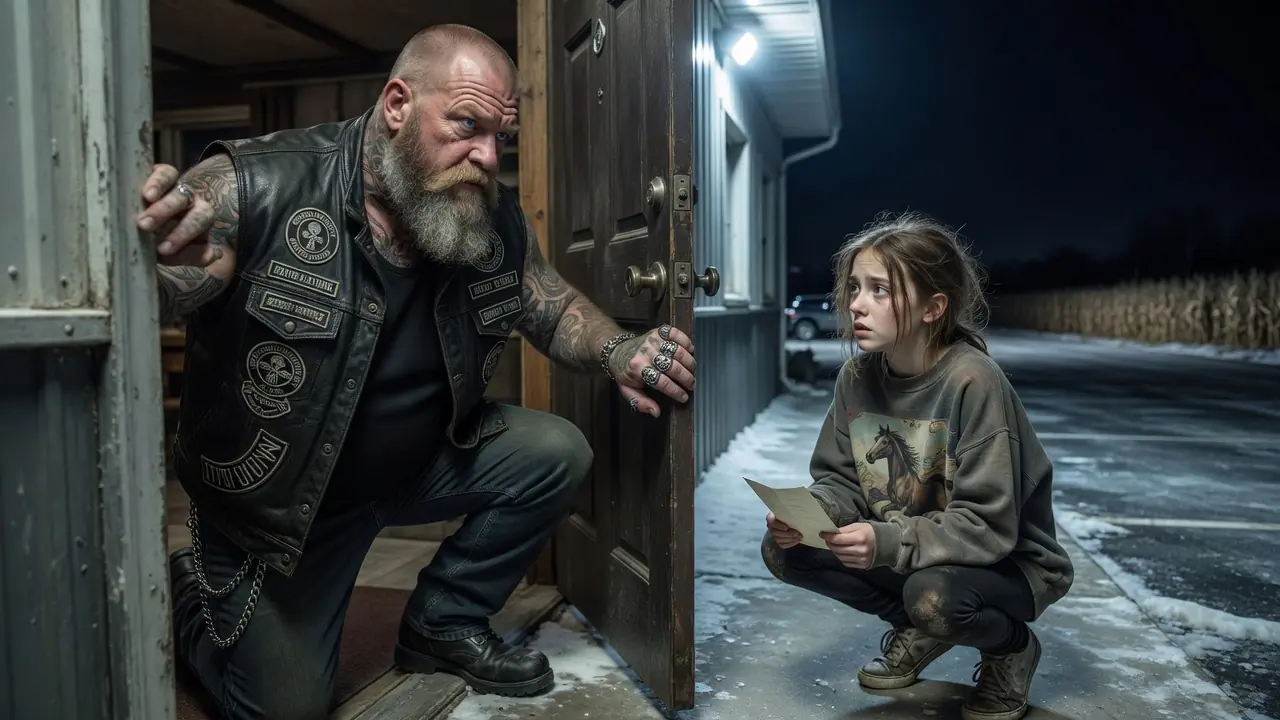
A girl who weighed less than a military rucksack stood in the November rain at 11:47 p.m., pressing a composition notebook to her chest like it was the only thing she owned, because it was. She had been turned away four times in eight days.
Four adults, zero help. But what she had written in those pages had a 72-hour countdown attached to it.
The man she was about to hand it to had not slept in 17 nights, because his daughter was the one running out of time.
“She’s still alive,” the girl said. “I saw her. I wrote it all down.”
Eleven words, flat and clear. No waver in any of them.
Diesel Martinez had heard a lot of voices in his 51 years. Combat veterans, grieving fathers, men making confessions with whatever steady breath they had left. He knew what a voice sounded like when all the emotion had been burned out of it by necessity.
He knew what it sounded like when a person had needed to be believed so many times, and failed so many times, that they had stripped every feeling from their words and left only the facts.
Bare.
Precise.
Like tools laid out on a workbench.
That was what he heard standing in the doorway of the Forge at 11:47 p.m. He stepped back from the door. He turned on the light in the entrance hall before she crossed the threshold. It was a small thing, but she noticed it.
“Come inside,” he said. “Tell me everything.”
Her name was Emma Grace Hayes. She was 14 years old, though she moved like someone who had been 40 for a long time. She was 5 feet 1 inch tall, and he would not know her weight until later. Eighty-nine pounds, when Stitch put her on a scale at the hospital and went very quiet in a way that said everything without needing the number.
She was wearing a gray hoodie that had started its life white, faded now to the color of winter ash. The left sleeve was torn at the elbow and repaired carefully, deliberately, with a hair tie. Her jeans were two sizes too large, held at the waist with a knotted shoelace. One sock was navy blue, one was white, and both were worn through at the heel.
Over her right shoulder was a backpack secured with a carabiner clip where the zipper had given out. That backpack held every possession she had in the world. She walked heel to toe through the entrance hall, back to the wall, eyes moving before her head did. Diesel had served two deployments in the 82nd Airborne, and he recognized survival behavior the moment he saw it.
He recognized it and said nothing about it, because commenting would have made it worse.
There was a faint click with every step. The carabiner on her backpack. Click. Step. Click. Step. That sound would stay with him for years.
What he did not notice immediately, what he would only see when she sat down under the entrance hall light, was her right hand. She held it slightly behind her, angled away from view. A strip of fabric torn from her hoodie lining was wrapped around her palm and index finger, discolored at the edges. The wound beneath it was three weeks old, untreated, and progressing in a direction that had a name Stitch would use later.
And that name would make the room go quiet.
Emma Grace Hayes said nothing about her hand. She was there for someone else.
The Forge was still at that hour. Most of the Harlan Creek chapter had gone home. Through the far door came the muted sound of a television. A dog was barking two streets over. Outside, the rain had picked up, steady and cold, running off the corrugated roof in thin streams.
The temperature that night was 41 degrees. Emma had walked 47 minutes in it, from the tree line to the front door, with her clothing soaked through. But she had stood at the edge of that parking lot for 11 minutes before she moved. Diesel would find that out later from the chapter’s exterior camera footage, which Smoke would pull and timestamp.
Eleven minutes.
She had timed herself.
She had been counting.
Diesel sat down across from her. Not above her. Not standing over her. He put his reading glasses on the table and offered coffee. She took it with her left hand, but she did not put the notebook down.
“Start wherever it makes sense,” he said. “I’m not going anywhere.”
She looked at him, chin slightly down, eyes up, the look of a person calibrating threat level before committing to trust. It lasted three seconds, maybe four. Then she spoke.
“Her name is Sophie Martinez. I think that’s your daughter. There’s a missing poster at the library. The dates match.”
The room changed.
Not the walls or the furniture. Something in the air. The way pressure changes before weather arrives.
Diesel Martinez did not move. Everything in him went still, the way combat-trained men go still. Not frozen, but gathered. Concentrated. Reading.
“Go on,” he said.
She went on.
Her parents, David and Carol Hayes, had been killed eight months ago on I-75 North when a semi-truck ran a red light on a March morning. Emma had been at school. She came home to an officer at the door and a house that would not be hers for six more weeks until the bank came for it.
Her dog, Biscuit, went to a neighbor. Her entire life was dismantled by paperwork, proximity, and the absence of anyone left to fight for her. She had been placed in a foster home. She left after three weeks because of what happened there.
She stated this simply, without detail, with the economy of someone who had already filed the worst parts away and did not intend to retrieve them for an audience.
She had tried to report the conditions in that placement. The complaint was closed in 48 hours, marked unsubstantiated. She had gone to the police. An officer named Bradley had spent nine minutes with her, called the agency, been told Emma had behavioral issues, and noted the case.
Nothing changed.
She had gone back to her old school counselor. DCS sent her back to the same placement. Emma ran again the same night. After that, she stopped trying those doors.
For eight months, she had been living in room 4B of the abandoned Caldwell Textile Mill on Old Mill Road, condemned since 2019. She had a burst pipe she had learned to regulate, a sleeping bag from a donation bin, and a backpack with a carabiner where the zipper used to be.
And she had the public library, where she had read most of the self-help section, checked out a composition notebook she had never returned, and seen Sophie Martinez’s face on a missing person flyer near the front desk.
That was how it started.
What came next was where Diesel’s jaw tightened and stayed that way.
“I found her,” Emma said.
Not I think I know.
Not I heard something.
Not a guess.
“Four days ago, I was watching the building on Cooperage Lane. Number Six. The old tanning works. I’d been watching it for four days before that because I heard something coming from underground. Banging. About eight days before that, I saw a truck parked outside at times that don’t fit an empty building. Dark green F-250.”
She opened the notebook.
She had written down the plate number.
She had written down everything.
“The man who has her is Douglas Farrell. I know his face because his name is on the gymnasium at Ridgeview Elementary. His photograph is in the Chamber of Commerce directory at the library.”
She turned to a page near the middle of the notebook.
“He visits once a day. He changes the time pattern so she can’t predict it. But the entry code on the front door hasn’t changed in two days. I memorized it.”
Diesel said nothing. The muscle in his jaw worked beneath his silver-streaked beard.
The sound Diesel made was not a word. It was a breath he caught before it could become something else.
Because Sophie sang when she was frightened. Not to entertain. Not from joy. She sang because her mother had taught her it was the only way to stay inside yourself when everything outside was trying to take you apart.
Maria.
Gone six years now.
Diesel had thought he was the only person alive who still held that detail.
Until now.
He believed the girl across the table. Without hesitation. Without reservation. He believed her completely.
But she was not finished.
She turned three more pages. The handwriting shifted, printed now instead of cursive. More deliberate. The date was at the top. The time. A physical description of the man she had watched.
“Four days ago,” Emma said. “He made a phone call outside the building. I was behind the dumpster on the south side, 12 feet from the entrance. I wrote down his exact words.”
She read from the page.
“The eighteenth is the deadline. He pays, or the situation changes permanently. Same way Breckenridge resolved. Quick. Clean. Nobody asks questions about a runaway.”
She paused.
Then she continued.
“You signed up the moment you took the first envelope, Kevin. We’re past that conversation now.”
The silence that followed was long enough to hear the rain, the television in the next room, the dog two streets over, and nothing else.
November 18th was three days away.
“I don’t know who Kevin is,” Emma said. Her voice did not waver. “But I know what resolved means. And I looked up Owen Breckenridge at the library. He drowned in 2019. Douglas Farrell was with him.”
She closed the notebook. She held it out across the table.
“I tried to tell people before I came here. Four times.”
She described them plainly, without bitterness, which was somehow worse than bitterness would have been.
The hikers on the trail 11 days ago who decided she had probably heard an animal and walked away faster than they had come. The certainty she had felt before asking them, and the specific quiet violence of watching it collapse.
The gas station clerk who picked up the phone, looked at Emma’s clothes and her face and her backpack, then put the phone down again. The clerk called DCS instead of the police, turned Emma’s emergency into a charity case, and made the girl herself into the crisis to be managed. Emma was gone before anyone arrived.
The patrol officer on Route 9 had listened carefully, checked his dashboard computer, and told her that the Farrell property had been cleared. Cleared, she would later understand, by the same deputy whose name appeared in her notebook. He had been gentle about it, which almost made it worse.
Then there were the women from the church, the ones with the minivan and the food boxes, who had listened to Emma describe a kidnapping and responded by telling her that God was using her troubled young mind to bring her toward help. They said what she was experiencing was not a real girl in a real basement, but a message meant for Emma herself.
Four doors.
Four rejections.
Each one a different variety of the same essential failure.
She was the problem to be solved, not the messenger to be believed.
Then she had stood at the tree line of the Forge parking lot in the rain, counting visible objects in the dark to keep herself steady, the way a library book had once taught her to do. She had decided that one more door was worth trying.
Diesel Martinez set both palms flat on the table. He did not raise his voice. He did not reach for anything.
“You did the right thing,” he said. “Nobody else is going to handle this. We are. Sophie comes home tonight. You have my word.”
He held his flannel overshirt out across the table.
She hesitated.
He waited.
He did not explain. He did not insist.
She took it.
One nod.
Then he picked up his phone.
This was where some people’s expectations would take a hard turn.
Two hundred and thirty bikers. A kidnapper with a three-day countdown. A corrupt deputy. A father who had not slept in 17 days. You might be forming a picture right now. Roaring engines. Fists. The kind of chaos that makes the wrong kind of headlines.
But in a different chapter with a different president, maybe that picture would have been accurate.
Ray “Diesel” Martinez had run the Harlan Creek chapter for seven years with military precision and zero chaos. He was former 82nd Airborne. He understood what uncontrolled response cost, not just legally, but tactically.
He had watched his daughter grow up without a mother, and he had made her a quiet promise the day they buried Maria. He would always be the kind of man Sophie was safe to come home to.
What was coming was not a storm.
It was a deployment.
The call went to Hammer first.
Curtis Webb. Fifty-four years old. Former Knox County Sheriff’s detective. Twenty-two years on the job. He picked up on the second ring.
“Hammer.”
“It’s Diesel.”
One breath.
“I need every brother within a hundred miles at the Forge. Right now.”
A pause. The weight of it moved through the line.
“What’s going on?”
“Sophie’s alive. We have a location, an entry code, and a witness. And we have 72 hours before the man holding her decides to close this permanently. We’re not waiting on anyone else for this one.”
No hesitation came from the other end.
“Say no more. We’re coming.”
The line went dead.
No debate about evidence. No questions about legal exposure. No committee. Just the immediate, efficient language of brotherhood meeting the moment it had always been built for.
Within four minutes, Hammer had activated the chapter’s emergency contact tree. Within nine, Diesel had reached the presidents of the Middlesboro and Corbin chapters personally.
Corbin had 116 members, the largest in the region. They sent their full roster the moment they heard a child was involved. It would become the largest single-night response in the tri-county area’s club history.
By the time Emma had finished a second cup of coffee and a plate of food a prospect had assembled from what was in the kitchen, the flannel overshirt had started to warm her through. Engines were already waking in the dark outside. Distant at first, then building.
The kind of sound that rolls in the way weather rolls in.
Low and certain from the horizon.
Stitch arrived first.
James Roark, 61 years old. Former Army combat medic. Two Gulf War deployments. He came through the door with a bag that looked like a field kit because it was one. He had never broken the habit.
He sat down next to Emma, not across from her, and he said nothing about the notebook or Sophie or Farrell.
He said, “Can I take a look at your hand?”
She stiffened. Chin down. Eyes up.
“It’s fine,” she said.
“I know,” Stitch said. “I’d just like to see it.”
What he saw was not fine.
The cut on her right palm, caused by glass and left untreated for three weeks, had developed into early cellulitis. A red line had begun tracking up toward her wrist.
“Without antibiotics,” he told Diesel quietly a few minutes later, “we were looking at a systemic infection inside ten to fourteen days. Possibly less.”
She had come there and said nothing. Not one word about herself.
She had come for Sophie.
Diesel turned away from the room for a moment. He looked at the wall. Then he turned back and got to work.
Preacher came through the door next.
Donald Oaks, 57 years old, former high school guidance counselor for 14 years before coming back to the chapter full-time. He had the face and the stillness of a man who understood when presence mattered more than words.
He sat near Emma with a quiet word and a cup of hot chocolate that materialized from somewhere. He did not interrogate. He did not analyze. He was simply there, a warm, steady thing at the edge of the room while the operation assembled around them.
He was the only one Emma talked to freely that night.
Smoke arrived 20 minutes after the first call.
Tyler Greer, 29, compact and quiet, with the focused intensity of someone who reads machines the way others read faces. He had his laptop open before his jacket was off. Emma walked him through the notebook page by page, steady, organized, precise. While he recorded every word, he began pulling Douglas Ray Farrell through county property records, state business filings, and financial databases most people did not know existed.
What Smoke would find in the next four hours would change the shape of everything.
But that came later.
Ironside arrived last.
Leonard Fitch, 68 years old, the club’s founding member. Thirty-one years of watching this chapter hold its line. He moved deliberately, not slowly from weakness, but the way men move when they have learned which things actually deserve their energy.
He came through the door. He crossed the room. He looked at Emma Hayes, this girl in the borrowed flannel with the infected hand she had been hiding, the notebook she had been protecting, and the eight months of survival quiet behind her eyes.
And he said nothing.
He sat down.
He stayed.
Because some things do not need words. Some commitments you make by simply not leaving.
Outside, the rain was still falling. Forty-one degrees and dropping. The engine sound had become something you could feel in your chest now, building in the dark around the Forge. Motorcycle after motorcycle turned off the highway, filling the lot, the overflow lot, the street beyond.
And somewhere on Cooperage Lane, in a basement under 40 watts of yellow light, with no window, two locks, and no way home, Sophie Martinez was singing very quietly to herself.
Holding on.
Help was already on the road.
Armed with a composition notebook, a four-digit code, the testimony of a child no system had bothered to believe, and 230 brothers crossing three county lines in the November rain, Ray “Diesel” Martinez was about to introduce Douglas Ray Farrell to the one thing all that community standing, all those donated gymnasium funds, and all those years of careful maneuvering had never adequately prepared him for.
Consequences.
Here is what 230 motorcycles sound like arriving in a town of 4,200 people at 1:30 in the morning.
It starts as something you feel before you hear it. A low vibration in the sternum, the kind that makes dogs go still and sleeping people open their eyes in the dark without knowing why.
Then it becomes sound. A rumble that builds from the direction of the highway like weather deciding to arrive all at once.
Then it becomes undeniable. Windows shaking faintly in their frames. Car alarms registering the vibration and finding nothing to blame. The whole frequency of the town shifting just slightly as something large and coordinated moves through it.
The Harlan Creek chapter’s 41 brothers had staged at the Forge. The Middlesboro chapter’s 73 had come in from the east off Route 9, arriving in two disciplined columns. The Corbin chapter, all 116 of them, had come down from the north in formation that would later be described by a man who watched from his front porch as resembling a military convoy more than anything he had ever seen on a civilian road.
Chrome in the rain.
Headlights in rows.
They parked the way they rode, with the coordinated efficiency of men who had done this together for years. The formation filled the lot at the Forge, spilled into the overflow, and stretched down the block. Engines cut off in sequence until the last one died.
What replaced the roar was a silence that felt somehow louder than the noise had been.
Heavier.
More deliberate.
Two hundred and thirty men in cuts stood in the rain, waiting. Not moving. Not shouting. Simply present. A fact that Harlan Creek, Tennessee, would have to account for.
A man’s daughter had been missing for 17 days. He now knew where she was, who had her, and that a calendar entry reading “HDG final in three days” meant she would not be coming home after that. He had 230 brothers behind him and a name: Douglas Ray Farrell, whose gymnasium plaque hung at an elementary school, whose Chamber of Commerce headshot smiled from a library directory.
Some people might have expected the next part to involve noise. Doors coming off hinges. Something primal and immediate.
That was not what happened.
Diesel Martinez walked to the front of the lot, turned to face his chapter, and spoke in a voice pitched just loud enough for the front rows. Not raised. Not performing.
“This is a rescue, not a riot,” he said. “We move right, we bring Sophie home, and we hand Farrell to people who will put him in a room for a very long time. We move wrong, we give him a lawyer’s argument. We move right.”
That was the entire speech.
Hammer was already on the phone with a contact at the Tennessee Bureau of Investigation. Not the local department. Not Kevin Aldridge’s desk. Not a man inside the system Farrell had already compromised.
The TBI.
Independent jurisdiction.
Agent Sandra Okafor had been sitting on the Sophie Martinez case for 11 days, waiting for local law enforcement to produce documentation that kept arriving clean and kept feeling wrong.
Hammer gave her four things.
The entry code.
Douglas Farrell’s name.
The recording Emma had transcribed word for word.
And the words Owen Breckenridge.
“Look at who responded to that call in 2019,” Hammer told her.
Agent Okafor said, “Give me 45 minutes.”
Hammer replied, “We have 43.”
Smoke had been working for two hours by the time the Corbin chapter arrived, and what he had found had changed the shape of the night from a rescue into something larger.
He started with Douglas Ray Farrell’s business structure. A reasonably clean surface, as these things go. Farrell Development Group LLC. Twenty-three commercial and residential properties across Harlan Creek and Whitley County. Chamber of Commerce board member. Elementary school gymnasium donor.
The kind of civic profile that functions like camouflage.
Not armor against scrutiny.
Camouflage against it.
When people see the plaque on the wall, they do not think to look for the door in the floor.
But Smoke looked for the door.
The shell company appeared first.
HDG Properties.
The initials on Farrell’s calendar entry. The same three letters on the burner phone records Emma had watched him use. It had been incorporated in Delaware in 2020, a year before Sophie disappeared and three years after Farrell lost his development bid on the 34-acre parcel adjacent to the club’s property.
The LLC structure had a registered agent in Nashville, no physical address, and no operating history visible at the surface level. Three corporate layers. Smoke peeled them in four hours.
HDG Properties was wholly owned by a holding company called Ridgeline Capital Partners, which in turn listed a sole manager. The name on that document was not Douglas Farrell. It was a name Smoke had to cross-reference twice before it registered.
Kenneth R. Aldridge.
Kevin Aldridge’s father.
Smoke brought it to Diesel quietly. He showed him the screen. Diesel looked at it for a long time without speaking.
“There’s more,” Smoke said.
The bank records came next, surfaced through a combination of Smoke’s technical knowledge and Hammer’s expedited contacts with investigators. Deputy Kevin Aldridge, 38 years old, Harlan Creek PD, had 11 cash deposits over 11 days, ranging from $1,800 to $2,700 each.
Consistent.
Patterned.
The deposits of a man who had been told to keep amounts below a threshold that triggered automatic flags, and who had been careful enough in most respects, but had used the same branch every time.
Smoke printed the records. He printed the shell company documentation. He printed Farrell’s calendar, the cloud backup accessed through a service account Farrell had connected to a property management platform and never fully secured.
November 18th.
HDG final.
Three days away.
Smoke put it all in a folder.
Then he turned to the next item on his list.
Owen Breckenridge.
Owen Breckenridge, 44 years old, former business partner of Douglas Ray Farrell, had been dead since October 31st, 2019. Official cause: accidental drowning, Lake Cumberland. Experienced swimmer. Owned the lake house for nine years. The life insurance policy had been taken out seven weeks before his death.
Farrell was the listed business partner beneficiary.
Payout: $213,000.
The officer who responded to the initial report and conducted the property review was Deputy Kevin Aldridge, then 34 years old and four years on the force.
Owen’s sister, Patricia Breckenridge, had filed a civil complaint in December 2019. Insufficient evidence. Dismissed. She had been waiting four years for someone to care.
Smoke pulled her contact information from the county directory. Ironside made the call himself at 2:15 in the morning, with the particular authority of a man who had 31 years of meaning exactly what he said.
He told her who he was. He told her what they had found. He asked her to speak to Agent Okafor directly when the TBI contacted her within the next few hours.
Patricia Breckenridge’s voice on that call, Ironside would later say, was the sound of someone who had been holding her breath for four years and finally could exhale.
She told him one more thing before she hung up.
Owen had written her a letter three weeks before he died. He had said Farrell had asked him to sign documents transferring equity in two properties to a holding structure, and Owen had refused. He had said he was worried. He had mailed the letter as “insurance,” she said.
The word insurance used by a man who was dead seven weeks later, with a $213,000 policy naming the man who had asked him to sign the documents.
She had kept the letter.
She had kept it in a lockbox for four years, waiting.
That letter went to Agent Okafor at 2:47 a.m.
Hammer laid out the legal sequence on a legal pad in the Forge’s back room while four brothers stood around the table and Emma sat in the corner with Preacher, counting the tools visible on the pegboard without fully realizing she was doing it.
The charges and the order they would be filed.
Kidnapping, first degree. Sophie Martinez taken from Harlan Creek High School and detained for 17 days, with demands documented through burner phone records.
Extortion, felony level. A $412,000 demand communicated through calls tracing back to the shell LLC.
Criminal conspiracy for the Aldridge arrangement, now connecting two victims across four years and a business structure designed specifically to obscure the payments.
Then the one Hammer wrote last and underlined twice.
Murder.
First degree, probable cause established, pending forensic reinvestigation of Owen Breckenridge’s death at Lake Cumberland, with Patricia’s letter and the insurance timeline as the anchor documents.
“He doesn’t know any of this is coming,” Hammer said. “He thinks November 18th is still his to control.”
He was wrong about that.
November 18th was three days away.
They had everything they needed in one night.
What happened next, people in Harlan Creek would talk about for years. Not the noise of it, though the noise was something. Not the leather and the chrome and the sheer physical fact of 230 men assembled in a single place.
What people talked about was the order of it.
No rushing. No mob behavior. No doors kicked down. A coordinated three-point operation staged with military precision, timed to the minute.
Point one.
Cooperage Lane.
Number Six.
The rescue.
Diesel went in himself with Stitch, Hammer, and four brothers from the Harlan Creek chapter. The entry code was the same as Emma had written in her notebook. The main door opened. They moved through the building in near silence, practiced and measured, the way men move when they have somewhere specific to be and understand that noise costs time.
The basement door had two locks, one keyed deadbolt and one hasp padlock. Hammer had been a detective for 22 years. He had the padlock open quickly using tools he carried as a matter of habit. The deadbolt took force and less than a minute.
The door opened.
Forty watts of yellow light.
A concrete room, 14 by 11 feet.
Institutional gray walls.
A cot.
A bucket.
A water jug.
No windows.
No heat source.
The temperature in that basement, measured by Stitch on the thermometer he always carried, was 44 degrees.
Sophie Martinez was on the cot, wrapped in one blanket, face turned toward the door. She had lost 11 pounds. Her legs had been cramping for days. Her voice, when she spoke, was flat in a way that Stitch recognized clinically and Diesel recognized as a father.
Neither reaction was small.
She said, “Dad.”
One word.
Then she stopped being the person who had been holding herself together by singing quietly in the dark. She became, just for a moment, 16 years old again, which was the age she actually was, and the age no one had allowed her to be for 17 days.
Diesel crossed the room. He did not say anything right away. He simply put his arms around his daughter.
The thing he had been holding for 17 nights, the controlled, military-precise weight of a father who did not know if his child was alive, came out in a single long exhale that he pressed into the top of her head.
Stitch checked her vitals immediately. Pulse, temperature, cognitive responsiveness. He called the hospital ahead while they were still in the building.
“We’re bringing in a minor. Seventeen days, light restriction, hypoglycemic, possible early hypothermia. Have a team ready.”
He looked at her legs while they walked her up the basement stairs, slowly, carefully, one brother on each side. The cramping had been going on long enough to show. He noted it without saying it aloud and filed the number of days in the back of his mind as evidence.
Point two.
Forty-two Willow Brook Drive, the residence of Douglas Ray Farrell.
Agent Okafor and two TBI officers were already parked on the block when the Harlan Creek chapter arrived. The legal groundwork had been laid in 43 minutes. Arrest warrant issued. Judge reached at home. Paperwork filed electronically in the TBI system at 3:08 a.m.
The bikers did not go to the door.
They were present.
They were visible.
They formed a perimeter on the street that said, in language requiring no translation, there is nowhere else for this to go.
The knock on the door at 3:14 a.m. was Agent Okafor’s.
Douglas Ray Farrell answered in a flannel robe, reading glasses pushed up onto his head. He was holding a mug of something hot. Chamomile tea, as it turned out, which the responding agent would note in the official report with the kind of detail that becomes remarkable in retrospect.
The same hands that had padlocked a basement, restrained a teenager for days, and made seven documented calls demanding $412,000 were holding chamomile tea at 3:14 in the morning.
He looked at Agent Okafor with the expression of a man interrupted during a normal night.
Because to him, this had been normal.
For four years.
He said, “Is there some kind of problem, officer?”
He looked past her at the street, at the motorcycles, at the silent, unmoving rows of men. Something shifted in his face. Not guilt, not that visible. The recalculation of a man who had spent years managing information and had just discovered that information had moved without him.
Agent Okafor said, “Douglas Farrell, you are under arrest.”
She listed the charges in sequence.
Kidnapping.
Extortion.
Criminal conspiracy.
And last, the one that made him go very still.
Murder in the first degree in the death of Owen Breckenridge.
She told him he had the right to remain silent.
He used it.
They walked him out in handcuffs at 3:21 a.m., face composed, wedding ring catching the light from the porch fixture. He wore a Carhartt jacket he had grabbed from just inside the door, the working man’s jacket that cost more than it looked.
He walked past 230 men who did not make a sound.
That silence, several people who witnessed it said afterward, was more powerful than any noise could have been.
Point three.
Kevin Aldridge.
He was picked up at his apartment on Cedar Street at 3:44 a.m. by two TBI agents working from Hammer’s documentation. He did not answer the door right away. When he finally opened it, he was already dressed, which Agent Okafor would note in her report as consistent with a man who had been waiting for this knock for some time and had simply not known when it would come.
He said nothing at the door. He said nothing in transport. He would say a great deal later in exchange for an arrangement that reduced his charges, but that conversation happened in a room without motorcycles or flannel shirts or composition notebooks.
It happened weeks later in the language of prosecutors and plea agreements.
What it produced was full corroboration of the shell company structure, full documentation of the 11 payments, and a statement regarding Owen Breckenridge’s death that Patricia Breckenridge, when she read it, said was the first honest sentence Kevin Aldridge had produced in four years.
His bail was set at $350,000.
He did not make it.
Back at the hospital at 4:02 a.m., Stitch was in the hallway outside Sophie’s room talking to the attending physician in the flat, efficient shorthand of two medical professionals exchanging information.
Seventeen days.
Forty-four-degree ambient temperature at night.
No heat source.
Two granola bars per day.
Water every 48 hours.
Eleven pounds of body weight lost.
Vitamin D deficiency developing.
The attending physician, Dr. Renee Walters, would later say that another ten to fourteen days in those conditions and they would have been looking at metabolic complications.
“She came back in time,” Dr. Walters said.
She said it twice, the second time more quietly, as though processing what the alternative meant.
Sophie was on an IV. She had a warm blanket. She had her father in a chair next to her, one hand over hers, his reading glasses folded in his breast pocket.
She asked for a cheeseburger at 4:45 a.m., and Ironside personally went to find a 24-hour place that would make one, because Ironside had founded the chapter 31 years ago, and he had never once delegated the tasks that actually mattered.
In the waiting room, Preacher sat with Emma.
He did not ask how she was doing. He had learned, during 14 years of guidance counseling, that the question “How are you doing?” functions as a social formality that people in survival mode answer automatically and inaccurately.
He asked her, “What does a normal Tuesday look like for you?”
She was quiet for a moment.
Then she told him.
He listened. Not performing patience. Not waiting for his turn. He listened the way you listen when you understand that being heard is not a small thing. For some people, it is the rarest thing. This girl had spent eight months in a town full of people and had been functionally alone in all of it.
When she got to the part about the library self-help section, he smiled.
“You taught yourself anxiety management from a book,” he said.
“Most of the books weren’t very good,” she replied.
He laughed, a real one.
After a moment, carefully, like something fragile she was not sure would hold weight, she laughed too.
Stitch appeared in the waiting room doorway at 4:23 a.m. with a bag from the hospital pharmacy, a prescription for antibiotics, a fresh bandage roll, and the particular expression of a combat medic who had just treated something that had gone further than it should have, and was choosing not to say it in a way that landed badly.
“Left hand, please,” he said.
She gave him her right one.
He waited.
She switched.
He unwrapped her hand carefully, cleaned it, repackaged it with professional precision, and started her on the first antibiotic dose right there in the waiting room with a cup of water.
He said, “You’ve been managing this for three weeks by yourself.”
“It wasn’t that bad,” she said.
He looked at her steadily.
“It was that bad, but you managed it anyway. That counts for something.”
She looked at her newly bandaged hand.
“Okay,” she said quietly.
Douglas Ray Farrell was formally processed at 5:17 a.m. at the Knox County Detention Center, transferred there from Harlan Creek given the scope of the charges and the conflict-of-interest issues at the local department.
Kidnapping, first degree.
Extortion, felony.
Criminal conspiracy, four counts.
Murder in the first degree, one count, pending full forensic reinvestigation of Owen Breckenridge’s Lake Cumberland drowning.
Bail recommendation: $2.1 million.
A man with wealth facing a murder charge and a DA who had just received Patricia Breckenridge’s letter and Aldridge’s corroboration did not have a bail conversation that ended well for him.
He sat down.
His name on the gymnasium wall at Ridgeview Elementary stayed there for 19 more days before the school board voted unanimously and without public debate to remove it.
At 6:09 a.m., as the first gray light came over Harlan Creek, Diesel Martinez came out of the hospital into the parking lot.
The Corbin and Middlesboro chapters had dispersed in the early hours, orderly and quiet, the way they had arrived. Forty of the Harlan Creek brothers had stayed. They were in the lot or on the sidewalk or leaning against their bikes in the cold morning air drinking gas station coffee, not going anywhere.
No one had asked them to stay.
They had simply stayed.
Diesel stood at the entrance, looked at them, and said nothing for a long moment.
Then he said, “She’s okay.”
The sound that went through the lot was not cheering.
It was the sound of 40 people exhaling at the same time.
The sound of something large and held finally being set down.
Justice had been served.
But justice was not the ending.
It was only the beginning.
The first practical problem was simple and immediate.
Emma Grace Hayes had nowhere to go.
Not in the abstract philosophical sense that social workers sometimes use when they mean paperwork has not been processed. In the literal, concrete sense. Her address was room 4B of a condemned textile mill. Her possessions were a carabiner-clipped backpack, a borrowed flannel shirt, and a composition notebook that was now sitting in a folder of evidence documentation.
She had $4.23 in a zip-locked bag.
She had an infected hand that needed twice-daily antibiotics for ten days.
She had not slept in a real bed in eight months.
Preacher handled it.
He made three phone calls from the hospital waiting room while Emma dozed in the chair beside him, the flannel shirt pulled up around her chin.
The first call went to a woman named Carol Tatum, 61 years old, a licensed emergency foster placement specialist with the Tennessee Department of Children Services, and the one person in that system Preacher trusted completely after 14 years of watching how people treated children when no one was looking.
He had her cell number because they had worked together twice before in situations that also could not wait for office hours.
Carol said, “I’ll be there in 40 minutes.”
She was there in 32.
She was a small woman with reading glasses on a beaded chain and the particular brand of calm that belongs to people who have seen enough genuine emergencies that they no longer mistake inconvenience for catastrophe.
She sat across from Emma, introduced herself in plain language, and asked exactly one question before proceeding.
“What would make you feel safe right now?”
Emma thought about it.
“Not going back to where I was,” she said.
“That is not on the table,” Carol said. “I promise you that personally.”
The emergency placement Carol had in mind was a licensed home on Sycamore Ridge Road. A couple named Jean and Ruth Adler, both retired, both background-cleared, both recommended by Carol for exactly the situations where a child needed stillness and consistency above everything else.
No other foster children currently in the home.
A guest room that had been a guest room, not an afterthought.
A dog named Biscuit, as it happened.
A coincidence that Preacher noticed but did not mention until later, because some things land better when they arrive on their own.
The placement was approved at 7:45 a.m. through an emergency court order that Hammer had pre-drafted in the parking lot using a legal template on his phone, drawing on 22 years of knowing exactly which forms moved fastest through which offices and at what hours.
Emergency judge.
Emergency signature.
Filed electronically.
Done before the sun was fully up.
Emma did not go to Sycamore Ridge Road that morning. She asked to stay at the hospital until Sophie was stable. Carol looked at her for a moment, then looked at Preacher, then said that was entirely reasonable and she would come back at noon.
Emma sat back down in the chair next to Sophie’s room.
She counted the tiles on the hallway floor.
Thirty-eight.
She counted them twice to make sure.
Sophie was kept for two days. Hypoglycemia, mild. Vitamin D deficiency, early stage. Muscle cramping from prolonged cold and inadequate nutrition. Eleven pounds under her healthy weight, all of it recoverable with time and food and warmth, Dr. Walters said.
The psychological component was its own category.
Dr. Walters referred Sophie immediately to a colleague, Dr. Patricia Simms, a trauma specialist at the Knoxville clinic who had experience specifically with captivity-related stress in adolescents.
The first appointment was made before Sophie left the hospital.
Not suggested.
Made.
The date on the calendar before discharge.
Diesel sat with Sophie through both nights. He brought the chapter ledger once and set it on the bedside table without opening it. Sophie noticed.
“You’re not working,” she said.
“No,” he said.
“Dad.”
She looked at him.
“She saved my life. You know that.”
He looked at the middle distance for a moment.
“Yeah,” he said. “I know.”
“Is she okay?”
“She will be.”
“That’s not the same thing.”
He looked at his daughter, this girl who had been raised by a man who was also her whole family, and who had inherited from somewhere, probably from Maria, the particular precision of seeing exactly what was true and not accepting a softer version of it.
“No,” he said. “It’s not the same thing. But we’re working on it.”
Smoke’s evidence folder went to the TBI in full on the morning after the arrest. The shell company documentation. The 11 cash deposits in Aldridge’s account. The calendar entry. Patricia Breckenridge’s letter corroborated by Aldridge’s own statement. The burner phone records tracing through three corporate layers back to Farrell. The cloud backup of Farrell’s calendar, obtained through the property management platform’s service account vulnerability, which Smoke documented in a separate technical memo that the TBI’s digital forensics unit verified independently.
The TBI also opened a formal review of the Harlan Creek Police Department’s handling of the Sophie Martinez case from day one. Specifically, they reviewed the falsified property clearance log that Aldridge had submitted on day three and that had traveled up to the state level as authoritative documentation.
Chief Carroll, who had twice assigned the second-look investigation back to Aldridge, was placed on administrative leave pending the outcome of that review.
He was not charged.
Whether he had known or had simply failed to look is the kind of distinction that exists in legal gradations and does not always satisfy the people most affected.
Hammer told Diesel privately that Carroll had probably been comfortable. Comfortable and complicit are not always the same thing, and not always different either.
Diesel did not respond to this.
He filed it in the same place he filed the image of Sophie’s face on the missing person flyer that had been on the bulletin board at the Harlan Creek PD for 17 days, visible every time Aldridge walked past his own desk.
Some things you hold.
You do not put them down.
And you do not let them burn you.
You just hold them.
Marci Tolbert came to the hospital on the second morning.
She was the gas station clerk who had picked up the phone eight days ago when Emma stood at her counter in the rain, who had looked at Emma’s clothes and her backpack and her face and put the phone down, then called DCS instead of the police. She had watched Emma disappear through the door before any response ever came.
She had seen the news. The arrest. The name of the girl who had reported it.
She stood in the hospital lobby for 11 minutes before she asked a nurse which floor the waiting areas were on. Preacher told Diesel later that he had watched her walk across the lobby and recognized the specific gait of someone carrying something heavy they had decided they could not put down by walking away from it.
She found Emma in the second-floor waiting room.
She sat down.
She said, “I should have called the police that night, not DCS. I looked at you and I made a decision about what kind of problem you were, and I was wrong. Because of that, a girl stayed in that basement eight more days than she had to.”
Emma looked at her.
“Eight more days,” Marci said.
Her voice broke on the number in a way she did not try to manage.
“I’m sorry. I know that doesn’t change the eight days. I just needed you to know that I know.”
Emma was quiet for a long moment.
“She’s okay,” Emma said finally. “Sophie’s okay.”
“Because of you,” Marci said.
Emma looked at her bandaged hand.
“I counted to ten before I knocked on their door,” Emma said. “I almost didn’t. I stood there and almost decided it was the wrong place, too.”
She paused.
“I don’t think you’re a bad person. I think you made the same decision everyone else made. I was just a kid who looked like a problem.”
Marci put her hand over her mouth and nodded once, hard.
Then she took a breath. She reached into her bag and set a gift card on the seat between them. A pharmacy card, $100 loaded on it.
“For whatever you need,” she said. “I know it’s not enough.”
Emma did not say it was fine. She did not perform grace she did not fully feel yet.
She said, “Thank you.”
Then she picked up the card.
Emma moved to the Adler home on Sycamore Ridge Road that Thursday afternoon.
The room was on the second floor. It had a window that faced east, which meant morning light, real light, the kind that has a direction and a temperature and a time of day embedded in it. A bookshelf Ruth Adler had partially stocked from the library sale the week before, more by instinct than information, though the selection would later strike Emma as uncanny.
Three titles she had already read and mentally annotated.
Two she had wanted to read but had never found on the library shelves.
The dog was an older beagle who moved slowly and asked nothing except that you sit still long enough for him to assess you.
His name was Biscuit.
Emma sat on the floor the first evening and let the dog put his head in her lap. She said nothing for a long time.
Ruth Adler brought tea, set it on the coffee table, and went back to the kitchen without comment. She had done this long enough to know the difference between a child who needs words and a child who needs someone to simply not leave the room.
The first antibiotic dose had already been working for two days by then. Stitch had given her a ten-day supply, written clear instructions in print large enough to read in dim light, and made her repeat the schedule back to him twice before he let her leave the hospital.
He stopped by the Adler home on day four to check the wound, and again on day seven. The tracking had stopped by day three. The tissue was clean by day eight. He brought a sandwich both times, turkey on sourdough, which Emma would later identify as her favorite, unprompted, and which Stitch would cite as evidence of his diagnostic accuracy.
Diesel came on the Saturday after Sophie was discharged.
He sat in the Adlers’ kitchen with Jean and Ruth and a cup of coffee. He explained, straightforwardly and without performance, that the Harlan Creek chapter intended to be part of Emma’s life going forward in whatever capacity was useful, legal, and wanted by Emma herself.
Not as guardians.
Not as a replacement for the stability she was building here.
As community.
As the kind of presence that means the word not going anywhere.
Jean Adler, 64, retired civil engineer, a man who measured things carefully before committing to them, asked several reasonable questions. Diesel answered all of them.
Then Jean said, “She’s a remarkable young woman.”
“Yes,” Diesel said. “She is.”
He asked to speak with Emma briefly before he left. She came to the kitchen doorway, still wearing the flannel shirt. He had noticed she had washed it and folded it, but she was wearing it again.
He reached into his jacket and placed something on the table.
It was the composition notebook.
Not the original, which was in the evidence folder and would remain there through the trial. A copy. Every page photographed at high resolution, printed, and bound cover to cover. Her handwriting on every page. Her daily records from eight months on the street. Her documentation of Farrell’s phone call. Her notes on Sophie’s location. The date, the time, the physical description.
“The original goes to court,” he said. “This one belongs to you. It always did.”
She looked at it for a long moment. Then she picked it up. She held it against her chest, both arms crossed over it, the way she had crossed that parking lot in the rain.
Some things do not change.
Some things you just carry differently once you are not carrying them alone.
But this story was not really about a kidnapping or a corrupt deputy or a man whose gymnasium plaque came down on a quiet Tuesday in December.
It was about what happens when one person, small, alone, broke, and eight months past the last time anyone asked how she was doing, refuses to decide that the truth stops mattering just because no one will listen to it.
That is the deeper thing.
That is what this is actually about.
Six months later, on a Saturday in May, the Harlan Creek chapter held its annual toy drive kickoff at the Forge.
Emma Hayes was there. She had organized the sign-in table. She had made the spreadsheet tracking donations by ZIP code. Smoke had shown her the platform, and she had mastered it in one evening, then added three columns he had not thought to include.
She was wearing a backpack that had a working zipper.
She had gained back 14 of the 17 pounds. Her hand had a faint scar on the palm, the kind that fades fully over time, Stitch said. Or almost fully, which is usually close enough.
She was enrolled at Harlan Creek High School and on track to graduate a year early.
She was the youngest volunteer at the toy drive by a margin of 22 years.
It had been her idea.
Diesel asked her once, months into all of this, whether she had been scared walking across that parking lot.
She was quiet for a moment. The real kind of quiet. The kind where an answer is actually being considered rather than assembled.
“I was scared of what would happen if I didn’t,” she said.
That is the sentence that lives at the center of this story.
Not the 230 motorcycles, though they matter.
Not the arrest, though it matters.
Not Farrell’s face when the handcuffs went on, though four years of Owen Breckenridge’s sister waiting for that image means it matters more than most.
The sentence that lives at the center is this:
I was scared of what would happen if I didn’t.
That is what courage actually sounds like most of the time. Not the absence of fear. The decision that the fear of inaction is larger than the fear of the door.
Emma Hayes was not exceptional because she was brave. She was exceptional because she was ignored four times by four different people representing four different institutions, and she kept going anyway.
And that is the part worth sitting with.
Every year, hundreds of thousands of children are reported missing in the United States. The cases that go cold, the ones that stretch past those first critical days, often share a pattern investigators recognize again and again. Someone knew something early. Someone said something. And they were not believed in time.
Not because they lied.
Because they were young, or poor, or without parents to make the calls they could not make themselves.
Emma was all three.
There are also hundreds of thousands of children in the American foster care system, and thousands more like Emma in that dangerous gap between a system that failed them and a door that finally opened. They slip through every net, not because they do not exist, but because existing and being visible are not the same thing.
If you know a child in the system, a foster child, a teenager aging out with nowhere to go, or a young person who looks fine from a distance and has learned to look fine because looking otherwise never helped, the most important thing you can do costs nothing.
Learn their name.
Use it.
Ask them questions that do not have predetermined answers.
Not “Are you okay?” Children in survival mode have been trained to say yes automatically, the same way Emma answered every door she knocked on with composure that read as calm but was actually armor.
Ask instead, “What does a normal Tuesday look like for you?”
“Is there anyone you’re worried about?”
“If something felt wrong, who would you call?”
Then listen to what they do not say.
Emma never mentioned her hand that first night. She never said the word hungry. She had learned, the way children without safety nets learn, to make herself small enough that adults would focus on the problem she was presenting, not the one she was carrying.
Stitch noticed her hand before she finished her third sentence.
That was not coincidence.
That was what it looked like when an adult actually looked.
There is also the question of what to do when a report goes nowhere. One compromised officer does not mean a compromised department, but it does mean this: when you report something to local law enforcement and nothing happens, when the same case gets assigned to the same desk and produces the same result, you have the right to escalate.
Always.
State investigative agencies, attorney general offices, federal tip lines, child protection hotlines, and missing-children organizations exist because the people who built them understood that systems have gaps. The gaps have always been widest beneath the feet of children nobody is officially responsible for.
Eleven envelopes over 11 days. A building logged as clear while a living child sat below the floor. Four years of protection purchased with cash deposits kept just below automatic attention. One composition notebook in the hands of one 14-year-old girl who refused to stop writing things down unraveled all of it in six hours.
That is not a fairy tale.
That is documentation.
That is what happens when someone decides that the date, the time, and the exact words they heard are worth writing down even when no one is asking them to.
If something feels wrong to you in a family you know, in a situation you cannot quite explain, in a child who looks fine but has eyes like Emma’s, eyes already still in the way eyes go still when they have learned not to show fear, write it down.
Be specific.
Keep it.
You do not need to be certain. You do not need proof. You need to be able to say, “On this date, at this time, I observed this. And I am saying so on the record.”
That is all Emma had.
A library notebook she had borrowed eight months ago and never returned. A pencil. And the decision, made again and again across four rejections and 47 minutes of rain-soaked walking, that the truth did not stop being true just because no one would hold it with her.
There is one more thing.
The night it was all over, Sophie was safe. Farrell was processed. The TBI’s review was underway. Emma was asleep in the Adlers’ guest room for the first time in eight months, with actual walls and an actual lock, and a dog named Biscuit against the foot of the bed.
Ironside sat alone in the Forge for a while.
For 31 years, he had watched this chapter hold its line. He had seen it tested in ways he would not describe in a room with civilians. He had watched the chapter earn its place in this community not through the absence of its reputation, but through what it chose to do with the weight of it.
He looked at the copy of the composition notebook sitting on the chapter table.
He thought about a 14-year-old girl standing at the tree line of this parking lot for 11 minutes in the rain, counting objects in the dark to keep herself steady, deciding whether one more door was worth the risk.
He decided it deserved to be remembered in a form that did not fade.
Six weeks later, the exact page where Emma had printed Douglas Farrell’s words in careful block letters, with the date and time and location at the top, was framed behind glass and hung on the wall of the Forge.
Underneath it, on a small brass plate, was a single line.
So we never forget what one kid with a notebook and nowhere to go can do.
There are Emma Hayeses in every town. Children carrying information that could matter. Children carrying information that could save someone if one adult would stay still long enough to really hear them. Children who have learned to sound older than they are because sounding young made adults dismiss them.
Children who count visible objects in hospital waiting rooms to stay steady because a library book taught them to, and the library was the only place that never turned them away.
You do not need 230 motorcycles.
You need two things.
The willingness to listen.
And the refusal to look away.
The click of a carabiner on a backpack.
Heel to toe through the rain.
A girl carrying everything she owned toward a door that scared her because every safe door had already been closed.
She knocked anyway.
That is the whole story.
That is all of it.
That is enough.