Lily Moreno’s voice was so small that it should have disappeared beneath the noise of Le Petit Palais, but somehow it reached every corner of the bakery. The room was full of soft piano music, crystal chandeliers, polished marble floors, and the rich smell of butter, sugar, chocolate, and warm bread. Elegant customers sat beneath gold-trimmed mirrors, drinking espresso from porcelain cups and speaking in quiet voices about business, travel, and weekend homes. Then Lily stepped inside carrying her little brother Mateo, and the beautiful room forgot how to breathe.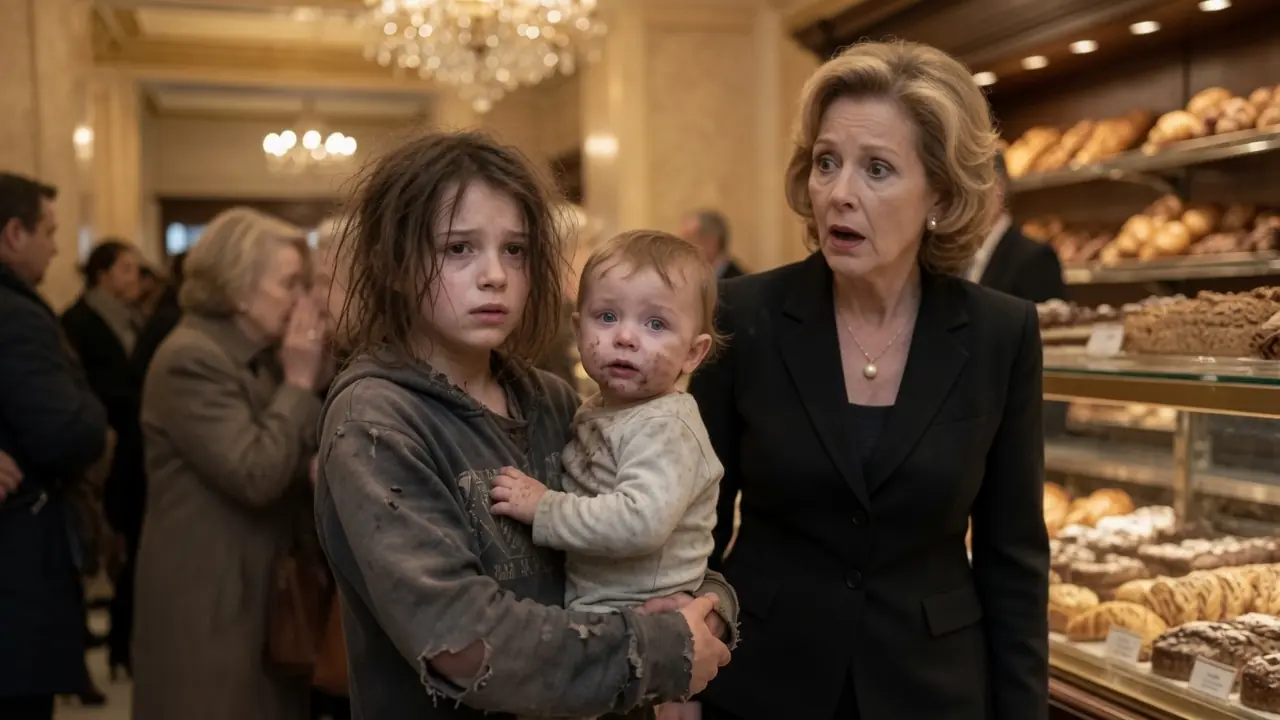
She was twelve years old, though hunger and worry made her look smaller. Her jacket was torn at one sleeve, her hair hung in uneven strands around her tired face, and her sneakers were so worn that one toe showed through the fabric. Mateo clung to her with both arms, his cheeks dirty, his eyes heavy, his small body pressed against her like she was the only safe place left in the world. He stared at the pastry case with the quiet, aching look of a child who had learned not to ask for too much.
The employee behind the counter, Martin Ellis, looked them up and down with immediate disgust. He wore a black vest, a white shirt, and a gold name pin that matched the bakery’s polished logo. To him, the children did not look like customers; they looked like a stain on the afternoon. He stepped around the counter before Lily could say another word.
“Then take him somewhere else,” Martin said coldly. “This bakery isn’t for children with empty pockets.”
Lily’s face turned red. She shifted Mateo higher on her hip and lowered her eyes, already preparing to leave because leaving was easier than begging. She had learned that adults could say no in many ways, but the cruelest ones made you feel wrong for needing help at all. Mateo made a soft sound and reached one tiny hand toward the glass display, where golden croissants were stacked like sunlight.
“I’m sorry,” Lily whispered. “I didn’t want to bother anyone.”
A woman near the window pulled her designer purse closer to her chair. A man in a dark suit shook his head and muttered that someone should call security. Two older customers whispered behind gloved hands while pretending they were not staring at the dirt on Lily’s knees. The whole bakery watched the children like they were a problem to be solved before dessert arrived.
Martin moved closer, blocking the pastry case with his body. “This is a luxury establishment,” he said. “People come here to enjoy peace, not to be disturbed by street children.”
Lily flinched at the words, but she did not argue. She tucked Mateo’s face against her shoulder so he would not see the pastries anymore. “Come on,” she whispered to him. “We’ll find something else.”
But Mateo began to cry.
It was not loud. It was not angry. It was the tired cry of a little boy who had been promised food too many times and was beginning to understand that promises could fail. Lily hugged him tighter, rocking him gently even though her own arms were trembling. “I’m sorry,” she whispered against his hair. “I promised I’d find you something.”
That sentence changed the room.
Some customers looked away in shame. Others stared at their plates as if the pastries in front of them had suddenly become too heavy to eat. Martin’s expression tightened, because the child’s quiet apology made his cruelty sound uglier than he had intended it to sound. Security had already begun walking toward the front, but before the guard reached them, a woman’s voice came from the back of the café.
“Please stop.”
Everyone turned.
Eleanor Whitmore stood near the private dining alcove, one hand resting on the back of a velvet chair. She was sixty-one, elegant, and composed, with silver-blonde hair pinned neatly at the back of her head and a black business suit that made every employee straighten when she entered a room. Most customers recognized her immediately. She was not simply a guest; she owned Le Petit Palais.
Martin’s face changed at once. “Mrs. Whitmore, I was just handling the situation.”
Eleanor did not look at him. Her eyes were fixed on Lily. Something about the girl’s face had caught her so suddenly that her breath seemed to leave her body. The messy hair, the small chin, the dark eyes full of fear and stubbornness — it was like seeing a ghost step into the bakery holding a child.
Eleanor walked toward them slowly. “What’s your name?”
Lily held Mateo tighter. “Lily Moreno.”
Eleanor stopped.
The name struck her with the force of a door opening on a room she had locked for years. Moreno. It had been her name once, before marriage, before money, before the bakery became a palace instead of a family shop. She looked at Lily’s eyes again, and this time she did not see a stranger. She saw her younger sister Elena at twelve years old, standing in their mother’s old kitchen with flour on her cheek and mischief in her smile.
“What did you say?” Eleanor whispered.
Lily swallowed. “Lily Moreno. My mama said that name used to matter here.”
A silence fell so deep that even the espresso machine seemed too loud. Eleanor lifted one trembling hand toward the counter for balance. Behind her, Martin looked confused, then uneasy. Customers who had been whispering leaned forward now, sensing that the little girl they had judged had carried something into the bakery that money could not explain.
Eleanor’s voice shook. “Who was your mother?”
Lily looked down at Mateo. “Elena Moreno.”
Eleanor’s face lost its color.
For ten years, she had not said Elena’s name out loud without pain rising like smoke in her chest. Elena had been her younger sister, fierce, proud, impossible, and full of dreams Eleanor had once mocked as foolish. They had fought after their mother died and the old family bakery was sold to finance Eleanor’s first luxury café. Elena had said Eleanor was selling their childhood. Eleanor had said Elena knew nothing about survival.
The fight became silence. Silence became years. Years became a wound Eleanor learned to cover with chandeliers, expansion plans, magazine interviews, and perfect pastry displays. She had told herself Elena chose distance, that some families broke because they were meant to. Now Elena’s daughter stood barefoot in her bakery with hunger in her brother’s eyes.
Eleanor stepped closer. “Where is Elena?”
Lily’s face changed. It was a child’s face trying to carry an adult answer. “Mama got sick last winter,” she said softly. “She didn’t come back from the hospital.”
Eleanor closed her eyes.
The room blurred for a moment. The chandeliers, the customers, the marble, the gold logo — all of it seemed suddenly cruel in its brightness. Her sister had been gone for months, and Eleanor had not known. Two children with her blood had been wandering hungry through the city, and she had been hosting private tastings for people who complained if the cream was not cold enough.
Martin cleared his throat nervously. “Mrs. Whitmore, I had no idea they were—”
Eleanor turned on him. “No idea they were what?”
He froze.
“No idea they were connected to me?” Eleanor asked, her voice suddenly sharp. “No idea they had a name you should respect? No idea hungry children deserve kindness before you know who their family is?”
Martin’s mouth opened, but no answer came.
Eleanor looked at the security guard. “Step back.”
The guard immediately moved away.
Then Eleanor knelt in front of Lily, not caring that her expensive suit touched the marble floor. Mateo’s crying had quieted into small hiccups, his fingers still curled tightly in Lily’s jacket. Eleanor looked at him, then at Lily. “You are not leaving hungry.”
Lily did not trust the words at first. “We don’t have money.”
“I did not ask for money.”
“Mama said we shouldn’t take what isn’t ours.”
Eleanor’s eyes filled. “Then let me give you what should have been yours long before today.”
She stood and turned toward the counter. “Bring warm soup, milk, soft rolls, fruit, and something gentle for the little one. Now.”
The staff moved fast, but Eleanor could feel the room watching. Some customers looked ashamed. Others looked curious, as if the children had become part of a drama they were privileged to witness. Eleanor hated them for that, then hated herself more, because minutes earlier she had been one of them — comfortable inside beauty while suffering stood just outside the frame.
She guided Lily and Mateo to a small table near the back, away from the stares. Lily sat carefully, still holding Mateo in her lap, as if someone might change their mind and push them out. When the food came, Mateo looked at it but did not reach. He turned to Lily for permission.
Lily nodded. “It’s okay.”
Only then did he take a piece of bread.
Eleanor had to look away.
She remembered Elena at sixteen, sneaking warm rolls from their mother’s oven and saying bread tasted better when it was stolen with love. She remembered the tiny apartment above the first bakery, the flour sacks stacked in the hall, the sound of their mother singing before dawn. She remembered promising Elena, after their father left, that she would always take care of her. Then life became ambition, ambition became pride, and pride became a wall so tall Eleanor forgot who was on the other side.
Lily ate slowly, but not much. She kept giving pieces of her bread to Mateo, tearing them small so he could chew easily. Eleanor noticed and pushed the soup closer to her. “That is for you.”
Lily shook her head. “He needs more.”
“You both do.”
Lily looked at her with old suspicion in young eyes. “Why are you helping us now?”
The question hurt because it was fair.
Eleanor folded her hands together on the table. “Because I should have helped your mother years ago.”
Lily’s eyes narrowed. “You knew Mama?”
“She was my sister.”
Mateo kept eating, too young to understand the sentence. Lily understood enough. Her face went still, and her fingers tightened around the edge of the table. “You’re Aunt Eleanor?”
Eleanor flinched at the title.
Lily reached into the inside pocket of her torn jacket and pulled out a folded paper, worn soft from being opened many times. She placed it on the table but did not hand it over. “Mama wrote your name down,” she said. “She said if things got bad, I should find Le Petit Palais. But she also said maybe you wouldn’t want us.”
Eleanor’s tears finally fell.
The paper was an old recipe card, stained and faded, with their mother’s handwriting on one side and Elena’s on the other. Beneath the recipe for honey almond rolls, Elena had written: If I am ever gone, please find Eleanor Moreno Whitmore. Tell her I tried to forgive her before I knew how to say it.
Eleanor covered her mouth with one hand.
For years, she had believed Elena hated her. It had been easier to believe that than admit she had stopped trying. She read the sentence again, and the bakery around her disappeared. All she could see was her sister writing those words, perhaps while sick, perhaps while frightened, perhaps while looking at Lily and Mateo and wondering whether pride would cost her children the last family they had.
“I did want you,” Eleanor whispered. “I just didn’t know you existed.”
Lily’s expression hardened. “Mama sent letters.”
Eleanor looked up.
“She sent them when Mateo was born,” Lily said. “And when we lost our apartment. She said she didn’t want money. She just wanted to talk.”
Eleanor’s stomach turned cold. “I never received them.”
Lily watched her carefully, searching for a lie. “Mama cried when they came back.”
Eleanor turned toward the hallway where the administrative offices were. Her mind moved quickly through years of staff, assistants, mail handlers, and the former business manager who had hated any reminder of Eleanor’s old family. She did not know yet who had returned those letters or hidden them, but she knew this: her success had built enough walls that her own sister’s voice had not reached her.
“I will find out what happened,” Eleanor said.
Lily looked down. “It doesn’t matter now.”
“Yes,” Eleanor said softly. “It does. Not because it brings her back, but because you deserve to know she was not ignored by choice.”
Lily did not answer. She fed Mateo another small piece of bread.
A woman approached the table from the front of the bakery. She was one of the customers who had whispered earlier, wrapped in a camel coat and holding a gold purse. Her face was wet with embarrassment. “Mrs. Whitmore,” she said, “I’m terribly sorry. I didn’t realize—”
Eleanor stood so quickly the woman stopped speaking. “You did not need to realize who they were to treat them like children.”
The woman stepped back.
Eleanor looked around the room. “All of you should remember that.”
No one spoke.
Martin stood near the counter, pale and rigid. Eleanor looked at him, and he lowered his eyes. “You are suspended effective immediately,” she said. “Leave your keys with Clara.”
His face twisted. “Mrs. Whitmore, I was following the standard policy.”
“If the standard policy tells you to shame hungry children, then the policy is broken and so are you.”
Martin removed his name pin with shaking fingers.
After he left, Eleanor sat down again. Lily was watching her with a cautious expression, not grateful, not relieved, not yet. Children who have survived too much do not give trust away because someone serves soup. Eleanor understood that, and she knew trust would have to be earned in small, consistent pieces.
“Where have you been staying?” Eleanor asked.
Lily looked at Mateo before answering. “Different places.”
“Shelters?”
“Sometimes.”
“Who is responsible for you?”
Lily’s face closed. “I take care of him.”
“I know you do,” Eleanor said gently. “But someone should have been taking care of you.”
“I’m not giving him away.”
The words came out fast and fierce. Mateo looked up, startled, and Lily wrapped both arms around him. Eleanor understood then that the child’s greatest fear was not hunger. It was separation.
“No one is taking him from you at this table,” Eleanor said.
Lily’s eyes filled. “Adults say things.”
“Yes,” Eleanor said. “They do. Then they have to prove them.”
Eleanor called her private attorney, a child welfare specialist, and the family doctor within the hour. She did it carefully, with Lily sitting beside her, explaining every call before she made it. She did not use words like custody or placement until someone trained could explain them gently. What she promised, again and again, was simple: “You and Mateo stay together.”
That night, Lily and Mateo did not sleep in a shelter.
They slept in Eleanor’s guest rooms above the bakery offices, in a warm apartment she had used for visiting chefs and private clients. Mateo fell asleep quickly after a bath, fresh pajamas, and two bowls of soup. Lily did not. She sat on the edge of the bed, clean but still guarded, watching Eleanor fold a blanket across a chair.
“You live here?” Lily asked.
“Sometimes.”
“It’s quiet.”
“It is.”
“Mama said you lived in a castle.”
Eleanor smiled sadly. “Your mama liked dramatic descriptions.”
Lily looked at the floor. “She said you used to make the best honey rolls.”
“Our mother did. Elena was better at stealing them.”
For the first time, Lily almost smiled.
Eleanor sat in the chair across from her, leaving space between them. “Your mother was brave.”
Lily’s chin lifted. “She was.”
“She deserved better from me.”
Lily looked at her for a long time. “Why did you stop talking to her?”
There it was. The question no money could soften.
Eleanor took a slow breath. “Because I thought winning mattered more than forgiving. Because I was proud. Because when she told me I was forgetting where I came from, I hated that she might be right.”
Lily considered this. “Was she right?”
Eleanor looked around the beautiful room, then toward the sleeping little boy who had entered her bakery hungry. “Yes.”
Lily did not forgive her that night. Eleanor did not ask her to.
Over the next weeks, the truth unfolded in painful pieces. Elena had struggled after losing work, then after getting sick, then after the apartment became impossible to keep. She had written to Eleanor three times. All three letters had been returned by Eleanor’s former business manager, who believed Elena would embarrass the brand and possibly ask for money.
Eleanor fired him before sunset the day she confirmed it.
Then she sat alone in her office, holding copies of the letters, and cried for the sister who had reached across years of silence and found only a locked door. In one letter, Elena wrote about Lily loving stories and Mateo laughing at spoons. In another, she admitted she was scared but still too proud to beg. In the last, written in shaky handwriting, she asked only that Eleanor know the children’s names.
Lily did not want to read them at first. When she finally did, she held the pages close to her chest and said nothing for a long time. Then she whispered, “Mama really tried.”
Eleanor nodded. “Yes.”
“She didn’t forget us.”
“No, sweetheart. She never did.”
That was the first time Lily let Eleanor hug her.
The legal process took time, but Eleanor faced every step with patience. Temporary kinship care was approved, then longer-term guardianship while the courts reviewed the family connection and Elena’s records. Eleanor attended every meeting, answered every question, and never once let anyone speak about Lily as if she were a case file instead of a child who had carried her brother through hunger. Mateo began calling her “Aunt Ellie” first, because small children heal in sudden brave leaps.
Lily took longer.
She kept food in pockets for months. Rolls disappeared from plates and later reappeared under pillows. She woke at night to check that Mateo was still in his bed. Eleanor never scolded her. She simply filled a small basket in Lily’s room with snacks and told her, “This is yours. No one will take it away.”
The bakery changed too.
Eleanor removed the velvet rope near the entrance. She ended the policy that allowed staff to push out non-paying visitors without a manager’s review. She created a quiet meal program through the kitchen, no cameras, no publicity, no questions asked. Anyone hungry could receive soup and bread at the side counter, because Eleanor no longer trusted beauty that did not make room for mercy.
Some wealthy customers complained. Eleanor personally invited them to enjoy pastries elsewhere.
A month after Lily entered Le Petit Palais, Eleanor added one pastry to the permanent menu: Elena’s Honey Almond Rolls. The first batch came out uneven because Eleanor’s hands shook while making them. Lily stood beside her in the kitchen, reading the old recipe card aloud. Mateo sat on a stool, licking honey from his fingers.
“These were Mama’s favorite?” Lily asked.
“Yes,” Eleanor said. “And mine.”
“Did you fight over them?”
“Constantly.”
Lily looked at the tray. “Then we should make enough.”
Eleanor laughed through tears. “That is the wisest thing anyone has said in this kitchen.”
On the anniversary of Elena’s passing, Eleanor closed the bakery early. She took Lily and Mateo to the small cemetery where Elena had been buried with help from strangers and no family present. Eleanor brought white roses. Lily brought one honey almond roll wrapped in a napkin. Mateo brought his toy truck because he said Mama would want to see it.
Eleanor stood before her sister’s grave and could barely speak.
“I’m sorry,” she whispered. “I was too late for you.”
Lily reached for her hand. It was the first time she had done it without being scared.
Eleanor looked down at her niece, then at Mateo leaning against her coat. “But I’m here now,” she said. “I promise.”
Years later, customers would still talk about the day the homeless girl walked into Le Petit Palais carrying her brother. Some would tell it like a shocking secret, others like a miracle, and a few like a lesson about never judging by appearances. Eleanor disliked the versions that made her sound heroic. Heroes do not need a child to enter hungry before remembering what family means.
To Eleanor, the story was simpler and harder.
A little girl walked into a bakery because her brother was hungry. A room full of comfortable people looked away. And when Eleanor finally looked closely, she saw not poverty, not trouble, not embarrassment — but her sister’s eyes asking why it had taken so long.
From that day forward, no child who entered Le Petit Palais was ever turned away for being hungry.
And every morning, before the first tray of pastries reached the glass case, Eleanor baked one batch of honey almond rolls from the old Moreno family recipe. She always saved the first two for Lily and Mateo. Not because they needed proof anymore.
Because love, once neglected, must be fed every day.