“Why are you ripping my uniform open, Director?”
The entire emergency training courtyard at Memorial Hartwell Medical Center went silent.
Thirty-three-year-old Evelyn Cross stood perfectly still while Hospital Director Richard Halden gripped the torn shoulder of her navy scrub top in one fist. His face was flushed, his jaw clenched, and he stood so close that Evelyn could smell the coffee on his breath.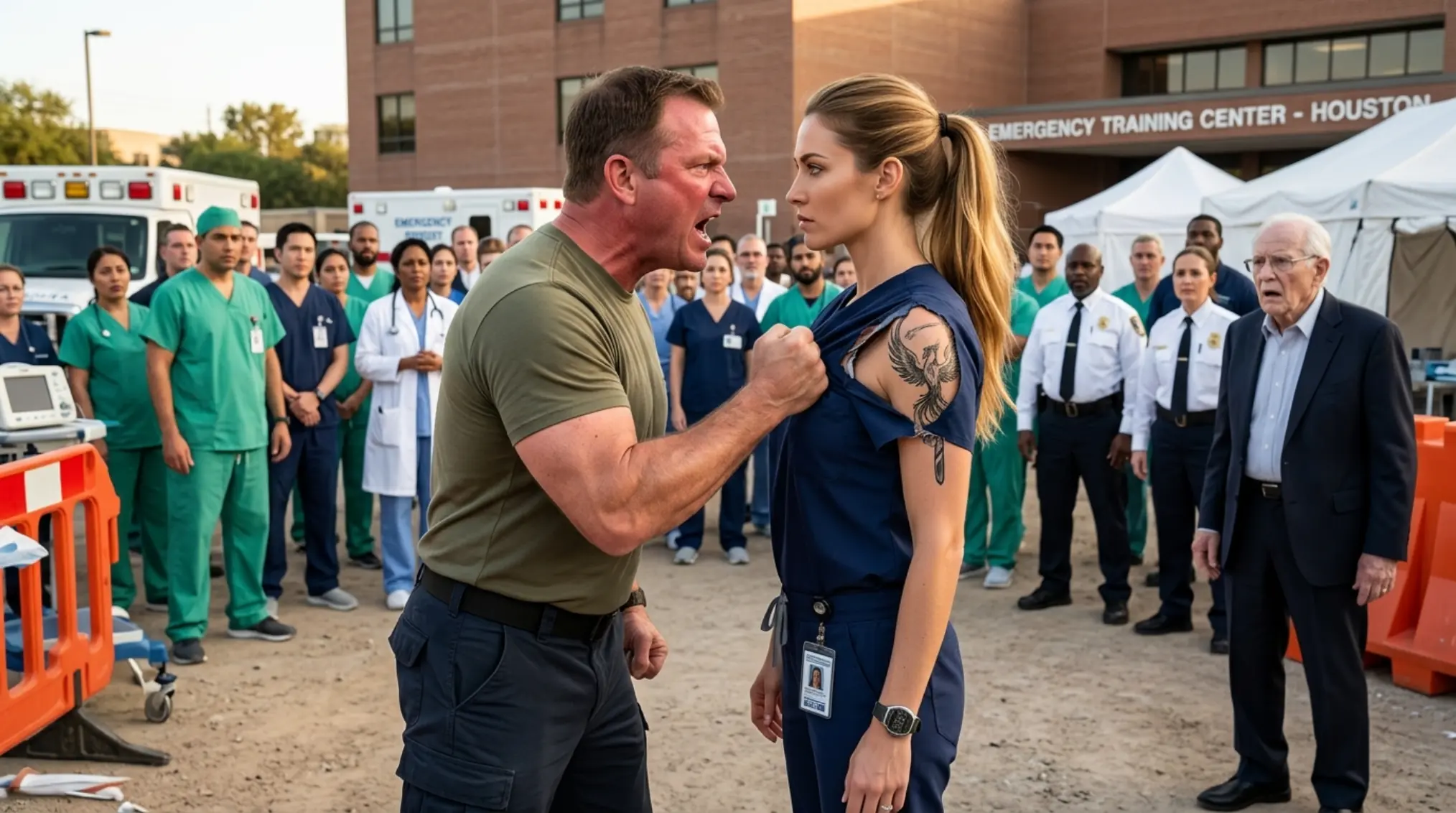
Behind them, nurses, surgeons, administrators, emergency technicians, and hospital security personnel stared in disbelief.
Evelyn did not step backward.
She did not cover the black tattoo exposed across her left shoulder.
The design showed a phoenix rising around a surgical scalpel, its wings sweeping toward three small numbers beneath the feathers.
7-13-19.
Halden pointed at it.
“Because rookies don’t wear that mark in my hospital.”
Evelyn’s hazel-green eyes hardened.
She knocked his hand away from her uniform.
“Touch me again,” she said quietly, “and you’ll learn exactly who survived.”
Halden gave a short laugh.
“You think that tattoo makes you important?”
“No.”
“Then explain it.”
Evelyn glanced at the crowd.
“I don’t owe you an explanation for my skin.”
“You work under my authority.”
“I work for this hospital. That doesn’t make my body hospital property.”
A few nurses exchanged uncomfortable looks.
Halden’s anger sharpened.
The confrontation had started less than ten minutes earlier during Memorial Hartwell’s annual emergency-response exercise.
Evelyn had been assigned to a simulated trauma station with three other nurses. She had been employed at the hospital for only nine weeks and was still considered a rookie by most of the senior staff.
Nobody knew much about her.
Her résumé was unusually simple.
Registered nurse.
Emergency-care certification.
Several years of overseas humanitarian work.
No detailed employment history before that.
No major publications.
No prestigious hospital fellowships.
No obvious reason anyone should pay special attention to her.
Evelyn seemed to prefer it that way.
She arrived early.
Worked quietly.
Never joined gossip.
Never corrected physicians in public.
Never mentioned her past unless directly asked.
But during that morning’s training scenario, something had changed.
A simulated patient began deteriorating according to the drill script.
The senior physician supervising the station ordered one response.
Evelyn immediately said it was wrong.
Dr. Michael Trent stared at her.
“Excuse me?”
Evelyn pointed toward the monitor.
“If this were a real patient, that intervention could make the underlying problem worse.”
Trent frowned.
“We’re following protocol.”
“For the condition you think he has.”
“And you think I’m wrong?”
“I think the pattern suggests something else.”
Several people heard the exchange.
Then Evelyn gave a different interpretation of the simulated vital signs.
The instructor checked the scenario notes.
Evelyn was right.
Not approximately.
Exactly.
She identified the hidden complication before the training team reached that stage of the exercise.
Richard Halden witnessed the entire thing.
Instead of being impressed, he became suspicious.
“How did you know?”
Evelyn answered simply.
“I’ve seen it before.”
“Where?”
She hesitated.
“That doesn’t matter.”
Halden did not like answers he could not control.
Later, while reviewing the training station, he noticed the edge of the tattoo beneath Evelyn’s scrub sleeve.
He stared.
“What is that?”
Evelyn immediately pulled the fabric higher.
“Nothing relevant.”
Halden stepped closer.
“Show me.”
“No.”
“You have visible body markings during a formal hospital exercise.”
“It’s covered by my uniform.”
“Show me the tattoo.”
Evelyn looked directly at him.
“No.”
That was when Halden grabbed her shoulder.
The fabric pulled.
A seam tore.
The tattoo became visible.
And suddenly the confrontation everyone would talk about for years began.
Halden now stood inches from her.
“I can suspend you before lunch.”
Evelyn’s expression barely moved.
“For having a tattoo?”
“For insubordination.”
“Then write the reason exactly as you just said it.”
His eyes narrowed.
“You think you’re clever.”
“No. I think documentation matters.”
That answer bothered him even more.
Halden turned toward the gathered employees.
“This is exactly what happens when inexperienced staff confuse confidence with expertise.”
Evelyn replied, “Interesting choice of words.”
“What is that supposed to mean?”
“You haven’t asked what the tattoo means.”
“I don’t care what it means.”
A voice came from behind the crowd.
“You should.”
Everyone turned.
Dr. Arthur Kingsley, seventy-four-year-old chairman of Memorial Hartwell’s governing board, walked slowly through the stunned employees.
He had arrived only moments earlier.
Arthur was tall despite his age, with silver hair, thin glasses, and the cautious movements of a man whose mind still operated faster than his knees.
He had been one of the most respected cardiovascular surgeons in Texas before moving into hospital leadership.
He stopped several feet from Evelyn.
His eyes fixed on the tattoo.
All color disappeared from his face.
Halden noticed.
“Dr. Kingsley?”
Arthur did not answer.
He moved closer.
“Turn your shoulder toward me.”
Evelyn’s expression changed.
For the first time, she looked uneasy.
Arthur stared at the phoenix.
Then the scalpel.
Then the numbers.
His lips parted.
“No.”
Evelyn said nothing.
Arthur looked at her face.
His voice became barely audible.
“Evelyn?”
Halden frowned.
“You know her?”
Arthur stepped closer.
“Dr. Evelyn Cross?”
The courtyard went silent again.
One nurse whispered:
“Doctor?”
Evelyn closed her eyes.
Arthur looked as though he had seen someone return from a grave.
“I signed your death certificate.”
Seven years earlier, Evelyn Cross had not been a nurse.
She had been one of the most promising reconstructive trauma surgeons of her generation.
By thirty-one, she had already completed advanced surgical training, published research on emergency vascular repair, and developed an unconventional technique for controlling severe internal bleeding in patients who could not immediately reach a full operating theater.
Arthur Kingsley had recruited her personally.
“She was extraordinary,” he later told investigators.
But Evelyn disliked attention.
She preferred operating rooms to conferences.
Patients to interviews.
Results to reputation.
Her closest colleagues formed a small specialist response team that traveled to overwhelmed hospitals after major natural disasters, industrial accidents, and infrastructure collapses.
There were six of them.
They called themselves Phoenix Seven.
The name began as a private joke after they worked seventy-two hours almost without sleep following an earthquake response.
Someone drew a phoenix around a scalpel on a paper coffee cup.
Eventually all six had the symbol tattooed.
The date beneath Evelyn’s tattoo marked their final mission together.
July 13, seven years earlier.
A massive explosion had damaged a remote medical facility where Evelyn’s team was assisting local surgeons.
The official reports were confused.
Communications failed.
Parts of the structure collapsed.
Several members of the medical response team were confirmed dead.
Others were missing.
Evelyn was among the missing.
Search teams recovered personal equipment carrying her identification.
Witnesses reported seeing her enter the damaged surgical wing shortly before a secondary collapse.
No confirmed sighting followed.
Weeks became months.
Eventually, after extensive legal review and family notification, she was declared dead.
Arthur Kingsley signed the final hospital certification acknowledging her death.
Memorial Hartwell held a memorial ceremony.