“You missed a spot.”
Dr. Raymond Hammond did not look up from the chart in his hands. He merely extended one finger toward a streak of dried mud beneath the lowest shelf in the hospital supply room.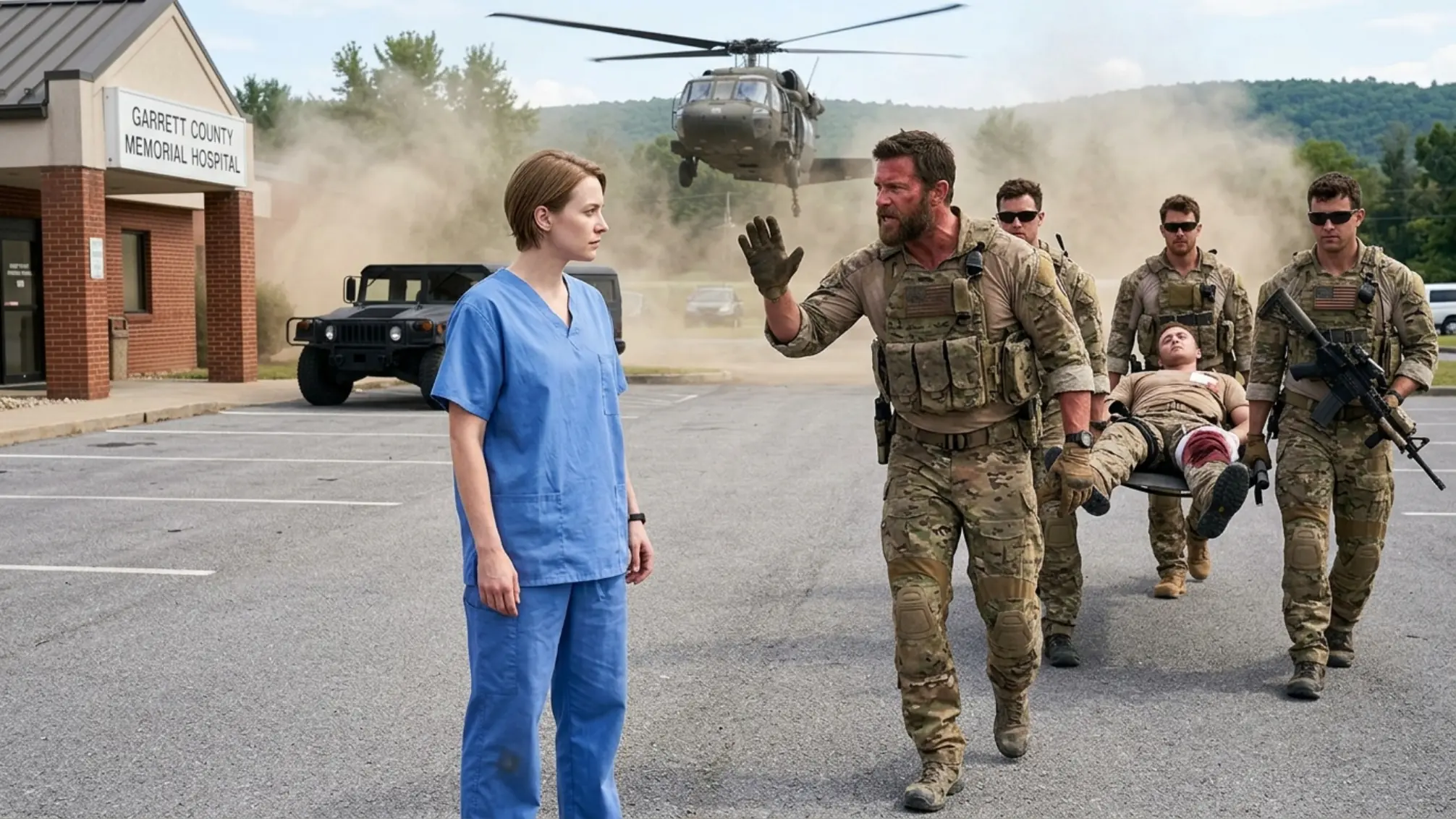
Lee Caldwell followed his gesture. She looked at the mop she had been handed, then at the white identification badge clipped to her oversized blue scrubs.
The badge read NURSING STUDENT.
It did not read janitor.
Still, Lee pushed the mop into the corner, cleaned the mark, and wrung the dirty water into the bucket without saying a word.
“Better,” Hammond said.
He tucked the chart under his arm and walked away without once looking at her face.
Lee remained in the supply room until his footsteps disappeared. Then she carried the mop to the utility sink and ran cold water over her wrists.
Her pulse was sixty-four.
She watched the second hand on the wall clock until it dropped below sixty.
Garrett County Memorial was a twelve-bed hospital buried among the forested hills of western Maryland. The building was small, old, and confusingly arranged, with corridors that turned unexpectedly and storage closets built where treatment rooms should have been.
One attending physician worked most weekday shifts. Two registered nurses handled nearly every patient. A laboratory technician divided his time between drawing blood and maintaining equipment that should have been replaced years earlier.
Students from a nearby nursing program rotated through the hospital for clinical experience.
Lee had been there twenty-three days.
Dr. Hammond still had not learned her name.
“Student, restock room four.”
“Student, bring me the laboratory report.”
“Student, the floor in bay two needs cleaning.”
Every request was delivered with the assumption that she existed only to carry objects, complete inventories, and disappear.
Lee never corrected him.
At thirty-one, she was older than the other students who rotated through the hospital. Her short light-brown hair brushed the line of her jaw, and her pale green eyes appeared gray beneath the fluorescent lights.
She was five feet five inches tall, compact and athletic, though the loose scrubs concealed most of her strength. The right sleeve covered a thin white scar running diagonally across her forearm. The high neckline concealed another scar near her left shoulder.
Nobody asked how she received them.
That was exactly what she wanted.
For three years, Lee had worked to become forgettable.
She had changed careers, used her mother’s surname, and moved into a small rented house forty minutes from the hospital. She ate alone, studied alone, and ignored nearly every number that appeared on her phone unless it belonged to her school.
She did not discuss the five years she had spent as an Air Force pararescue specialist.
She did not mention the people she had treated inside damaged aircraft, burning buildings, flooded valleys, or desert fields.
She never explained why her hands remained perfectly steady during emergencies.
Being overlooked was not an accident.
It was the life she had constructed.
Only one person at Garrett County Memorial seemed to notice that something about her did not fit.
Henry Briggs was eighty-one years old and recovering from a fractured hip after falling from an eight-foot ladder. His daughter had driven down from Pittsburgh, stayed one night, and left after Henry insisted that he did not need anyone watching him sleep.
His room door remained half-open at all times.
Lee entered one afternoon carrying a blood-pressure cuff and found a water glass lying on the floor.
“It slipped,” Henry said.
Lee picked it up and wiped away the water.
Henry watched the way she moved.
“You’re quiet,” he said.
“I try not to disturb patients.”
“That isn’t what I mean.”
She wrapped the cuff around his arm. “Hold still.”
“You move like someone trained not to be noticed.”
Lee inflated the cuff and kept her eyes on the gauge.
“Blood pressure is normal.”
Henry extended his hand when she finished.
“Henry Briggs.”
“Lee Caldwell.”
Their hands met.
His grip was controlled and deliberate. It was not the uncertain grip of an elderly hospital patient. It belonged to someone who had once been taught that a handshake revealed discipline.
Lee noticed the narrow scar near his jaw and the way his free hand rested close to the bedrail without depending on it.
“What branch?” she asked before she could stop herself.
Henry raised one eyebrow. “You want to explain how you reached that question?”
“Korea,” Lee said. “Infantry.”
He stared at her for several seconds.
“Fifty-eighth Infantry Regiment.”
Lee released his hand.
“Your turn,” Henry said.
“I’m a nursing student.”
A faint smile appeared beneath his gray mustache.
“Of course you are.”
Lee lifted his chart and moved toward the door.
“Whatever you’re carrying,” Henry said quietly, “it shows in the way you stand.”
She stopped but did not turn around.
“You cannot hide weight by standing still.”
“Have a good afternoon, Henry.”
Lee stepped into the corridor and pressed her back against the wall.
Her pulse had risen to seventy-two.
She counted each beat until it fell.
The next morning, a seventy-eight-year-old woman named Ruth Prentice arrived with confusion and weakness in her legs. Lee was replacing linens near the reception area when she saw Ruth crossing the waiting room.
The woman walked carefully, as though her legs no longer obeyed predictable commands. Her fingers gripped her purse against her chest, and the skin around her lips appeared unusually pale.
Lee watched from twelve feet away.
Dr. Hammond examined Ruth and ordered blood tests.
When the results arrived, the charge nurse called him to the station.
“Sodium is one eighteen.”
Lee stopped in the hallway.
Severe hyponatremia.
The symptoms assembled instantly in her mind: confusion, unstable movement, weakness, abnormal coloring. Correcting the sodium too quickly could cause catastrophic neurological damage.
Hammond ordered the appropriate treatment and calculated a cautious correction rate.
Lee stood nearby, ready to intervene.
He did not need her.
His treatment plan was correct.
The relief she felt was mixed with something more difficult. She knew exactly what needed to happen, yet her position required her to remain in the background.
That afternoon, Henry noticed the tension in her face.
“The woman who came in this morning,” he said. “Will she recover?”
“The doctor is treating her correctly.”
“That was not my question.”
Lee checked his pulse.
“She should recover.”
Henry nodded. “Good.”
She began folding the blood-pressure cuff.
“I had a commander once,” Henry continued. “He said the most dangerous thing you can do to a capable person is keep them at the back of the room too long.”
Lee clipped his chart to the bed.
“He was not worried about the person,” Henry said. “He was worried about what might happen to the room when that person was needed.”
Lee looked at him.
“Air Force,” she said quietly.
Henry did not press for more.
He simply nodded.
“Thank you.”
Three days later, Lee was completing an incident report at the nurses’ station when she felt a low vibration through the floor.
It arrived before the sound.
Heavy engines.
Multiple vehicles.
Moving quickly.
Her pen stopped.
She crossed to the corridor window and saw three dark transport vehicles racing along the county road. They turned sharply into the hospital parking lot without sirens or flashing lights.
Charge nurse Donna Miller appeared beside her.
“Who are they?”
“Call Dr. Hammond.”
“What is happening?”
“Tell him to prepare bay four for major trauma.”
Donna looked at her. “How do you know?”
“Call him now.”
Something in Lee’s voice made Donna move immediately.
Lee entered the supply room and opened the trauma cart. She checked the airway equipment, chest tubes, large-bore needles, dressings, clamps, intravenous fluids, and emergency medications.
Everything was present.
She pulled on gloves.
Then she stepped backward and put both hands inside her scrub pockets.
She was a student.
She would observe and assist only if instructed.
The front doors burst open less than a minute later.
Four Navy SEALs entered carrying a wounded teammate on a litter. Their camouflage uniforms and tactical equipment were covered in red-brown dust.
The injured man was barely conscious.
A thick dressing covered one side of his chest. A tourniquet had been tightened high around his left thigh, and blood had soaked through the material beneath it.
The team leader entered first.
Decker was about forty, heavily built, with a dark beard coated in dust and a face hardened by urgency. He surveyed the entire lobby before the doors finished closing.
“Clear a bay,” he ordered. “Chest injury and femoral bleeding. We need a doctor now.”
Dr. Hammond appeared at the end of the corridor.
For two seconds, he stared at the wounded man without moving.
“Bay four is open,” Lee said from the supply-room doorway.
Hammond turned sharply. “Nobody asked you.”
Lee did not look at him.
Her attention remained on the patient.
The wounded man’s chest rose unevenly. His neck muscles strained with each shallow breath, and his trachea appeared displaced.
His left lung was collapsing under increasing pressure.
The leg injury was severe, but it was not the first thing that would kill him.
The men rushed the litter into bay four. Donna pushed the crash cart behind them.
Decker swept the hallway again.
His eyes passed across the staff, the exits, and the available equipment.
Then they reached Lee.
He stopped.
His face changed as he studied the oversized scrubs, the short hair, and the unnaturally controlled stillness of the woman standing with her hands in her pockets.
“Angel,” he said.
The name was spoken at an ordinary volume.
It silenced the entire corridor.
Donna stopped pushing the cart. Hammond turned from the treatment-room door. The other men looked toward Lee.
Nobody at the hospital had ever called her that.
Nobody there knew it had once been her call sign.
Lee stared through the glass panel in the bay door.
The monitor displayed a falling blood pressure and dangerously low oxygen saturation.
She looked at her hands.
For three years, she had kept them hidden.
Then she pulled them from her pockets.
“Move,” she said.
Hammond blocked the entrance.
“You are a student. Stay outside.”
“He has a tension pneumothorax,” Lee replied. “He needs immediate decompression.”
“I am the attending physician.”
“And he has less than four minutes.”
Hammond stepped closer. “You are not authorized to diagnose or perform procedures in this hospital.”
Lee’s eyes remained fixed on the patient. “Then perform it.”
“I will decide what is necessary.”
The monitor alarm grew louder.
Decker moved beside Hammond.
“Step back.”
“This is my hospital,” Hammond said.
“That is my teammate,” Decker replied. “And she is the only person in this building I trust to touch him.”
Hammond’s face hardened. “You do not know her qualifications.”
Decker’s stare became cold.
“I watched her keep three men alive inside a wrecked aircraft while the ground beneath us was still burning. Step back.”
For the first time in thirty-one years, Raymond Hammond moved aside in his own emergency department without choosing to do so.
Lee entered bay four.
The wounded man’s identification listed him as Petty Officer Eric Tanner, age twenty-nine. His oxygen saturation had fallen to eighty-one percent. His blood pressure was seventy-nine over forty-four.
“Hold his shoulders,” Lee ordered.
One operator moved instantly. Another stabilized Tanner’s hips.
Lee took a large needle from the trauma cart.
Donna stood near the doorway, frozen.
“I need a chest-tube tray and drainage unit,” Lee said.
Donna continued staring.
“Donna.”
The nurse blinked.
“The tray. Now.”
The register of Lee’s voice had changed. It remained quiet, but every word carried complete authority.
Donna moved.
Lee identified the correct location and inserted the needle.
A violent hiss of trapped air escaped.
Tanner’s chest shifted. His oxygen saturation began climbing.
“Eighty-four,” a nurse reported. “Eighty-six.”
“That only buys time,” Lee said. “Prepare the tube.”
Donna opened the sterile tray. Lee made a clean incision, spread the tissue, confirmed the space, and inserted the chest tube with fast, precise movements.
Dark blood entered the drainage line.
Tanner groaned.
“He’s responding,” one of the men said.
“Ninety-one percent,” the nurse at the monitor called. “Heart rate is coming down.”
Lee secured the tube and turned toward the tourniquet.
“The chest is stabilized. The femoral injury needs surgery. How long until transport?”
“Eight minutes,” Decker said.
“Continuous monitoring. Do not loosen that tourniquet. Check it every ten minutes. If his oxygen falls below eighty-eight, find me immediately.”
“Yes, ma’am,” one operator answered.
Lee stripped off her bloody gloves.
She walked out of bay four as though she had merely completed another assigned task.
The corridor was silent.
Hammond stared at her bloodstained scrubs. Donna stood behind the crash cart with both hands gripping the rail.
Lee entered the utility room and began washing Tanner’s blood from her skin.
Decker appeared in the doorway forty seconds later.
He remained near the entrance, careful not to crowd her.
“I almost did not recognize the name on the hospital list,” he said. “Lee Caldwell. You used your mother’s surname.”
“I have always had both names.”
“You disappeared.”
“I left.”
“You were the best rescue specialist I ever worked with.”
Lee continued scrubbing her hands.
“That person does not exist anymore.”
Decker looked toward the corridor. “She existed five minutes ago.”
Lee turned off the water.
“I left for a reason.”
“I know.”
“Then you know why I cannot return.”
“I did not come to recruit you.”
She looked at him for the first time.
“Then why are you here?”
“Because Tanner would be dead if we had driven to the larger hospital. Dispatch found your service record attached to the student roster, and I took the chance that you might still step forward.”
“You did not know I would.”
“No.”
He paused.
“But I knew you were never as good at hiding as you believed.”
Lee placed both hands on the metal sink.
Decker reached into his vest and set a white card beside the faucet.
“One number,” he said. “People who understand where you came from. Call it someday, or do not.”
He turned to leave, then stopped.
“Tanner is alive because you stopped standing at the back of the room.”
After he left, Lee remained at the sink.
The card weighed almost nothing.
She could not bring herself to touch it.
When she returned to the nurses’ station, Hammond was waiting.
He looked directly at her face for what might have been the first time.
“The decompression,” he said. “Your placement was correct.”
“Yes, sir.”
“And the chest tube.”
“Yes.”
“What were you before nursing school?”
“Air Force pararescue.”
Hammond looked down at the chart in his hands.
“You should have told us.”
Lee’s eyes sharpened. “Would you have asked?”
He opened his mouth but produced no answer.
“You handed me a mop,” she continued. “You called me student for three weeks. You never once asked what experience I had.”
“I did not know.”
“No. You assumed.”
Hammond’s face tightened, but Lee did not lower her gaze.
“You saw loose scrubs and a student badge,” she said. “You decided that was all there was to see.”
“I treated you according to your position.”
“You treated me according to your opinion of that position.”
Donna watched from behind the station, saying nothing.
Hammond finally set the chart down.
“I was wrong.”
The words sounded unnatural in his mouth.
Lee nodded once. “Yes, you were.”
She changed into clean scrubs and walked to Henry Briggs’s room.
The lights were dim. Henry lay against the pillows with a book resting closed on his blanket.
“You saved him,” he said.
“He is stable.”
“I heard the helicopter leave.”
Lee pulled the chair closer and sat beside him for the first time.
Henry studied her expression.
“You took your hands out of your pockets.”
“Yes.”
“How did it feel?”
“Like becoming someone I had buried.”
“Buried people do not save lives.”
Lee looked toward the dark window.
“I left because I could not save someone.”
Henry waited.
“His name was Sean Riggs,” she said. “He was injured during an operation. I kept him alive, but afterward I could not stop thinking about everyone I had failed to reach.”
“You believed leaving would make the memories quieter.”
“It made me unreachable.”
“Those are not the same thing.”
Lee lowered her eyes.
Henry’s voice softened. “You cannot be everywhere. You cannot save everyone. That does not make the people you do save less real.”
The following night, Lee arrived early for her shift.
At 2:17 a.m., the internal phone rang.
Henry was struggling to breathe.
Lee entered his room and found his skin pale beneath the monitor light. His heartbeat was dangerously irregular.
She reached for the phone to request an immediate transfer.
Henry caught her wrist.
“I know what this is,” he whispered.
“It can be treated.”
“Maybe.”
“I am calling the cardiac center.”
“Sit first.”
Lee stared at him.
“Please,” he said.
She lowered herself into the chair.
“My daughter wanted to stay,” Henry explained. “I sent her home because she was afraid of being here when it became difficult.”
“You should let me call her.”
“She loves me. But she does not know how to remain in a room when nothing can be fixed.”
His grip weakened around Lee’s hand.
“You do.”
“I am afraid too.”
“Not of staying.”
Lee held his hand with both of hers.
Henry looked toward the dark ceiling.
“My commander used to say the bravest thing a person could do was remain beside someone even when remaining could not change the outcome.”
Lee’s eyes filled, but she did not look away.
“He was right.”
Henry breathed slowly.
“You are going to be all right, Lee Caldwell.”
“You cannot know that.”
“I know what a broken person looks like.”
His pale blue eyes found hers.
“You are not broken. You are carrying something heavy. There is a difference.”
At 3:04 a.m., the monitor released a sustained tone.
Henry’s hand became still inside hers.
Lee remained in the chair for seven minutes.
She did not run from the silence.
She did not look away.
After completing the necessary reports, Lee entered the utility room. Decker’s card remained beside the sink.
She picked it up.
Tanner was alive because she had stepped forward.
Henry had not died alone because she had stayed.
Neither truth erased the people she had lost. Neither truth repaired the years she had spent hiding.
But together, they revealed something she had refused to understand.
Courage was not always running toward fire.
Sometimes it was allowing another person to see who you truly were.
Sometimes it was putting your hands where they could be used.
Sometimes it was sitting beside a dying man in a dark room and refusing to abandon him simply because there was nothing left to repair.
At sunrise, Lee walked through the hospital parking lot toward her car. The Blue Ridge Mountains appeared beneath pale golden light, and the building’s narrow windows reflected the beginning of another day.
She stopped beside the driver’s door and looked at the card.
Then she called the number.
A familiar voice answered.
“Decker.”
Lee watched the sun climb above the trees.
“This is Angel,” she said.
She had not agreed to return to her former life.
She had not abandoned nursing school.
She had simply stopped pretending that one part of her needed to disappear for the other to exist.
Behind her, Garrett County Memorial remained a twelve-bed rural hospital where staff members had once seen only a quiet student in oversized scrubs.
Now they knew better.
The woman they ordered to clean the floor had carried skills no uniform or badge could reveal.
They had mistaken silence for weakness, humility for ignorance, and invisibility for insignificance.
It took a dying man and four desperate strangers to force everyone in the building to look at her.
But the most important change was not that they finally saw Lee Caldwell.
It was that she finally allowed herself to be seen.