Megan Whitlock, front desk supervisor at the Marlowe Heritage Hotel, looked up from her screen.
“A disabled man like you thinks he belongs in this hotel? Get out.”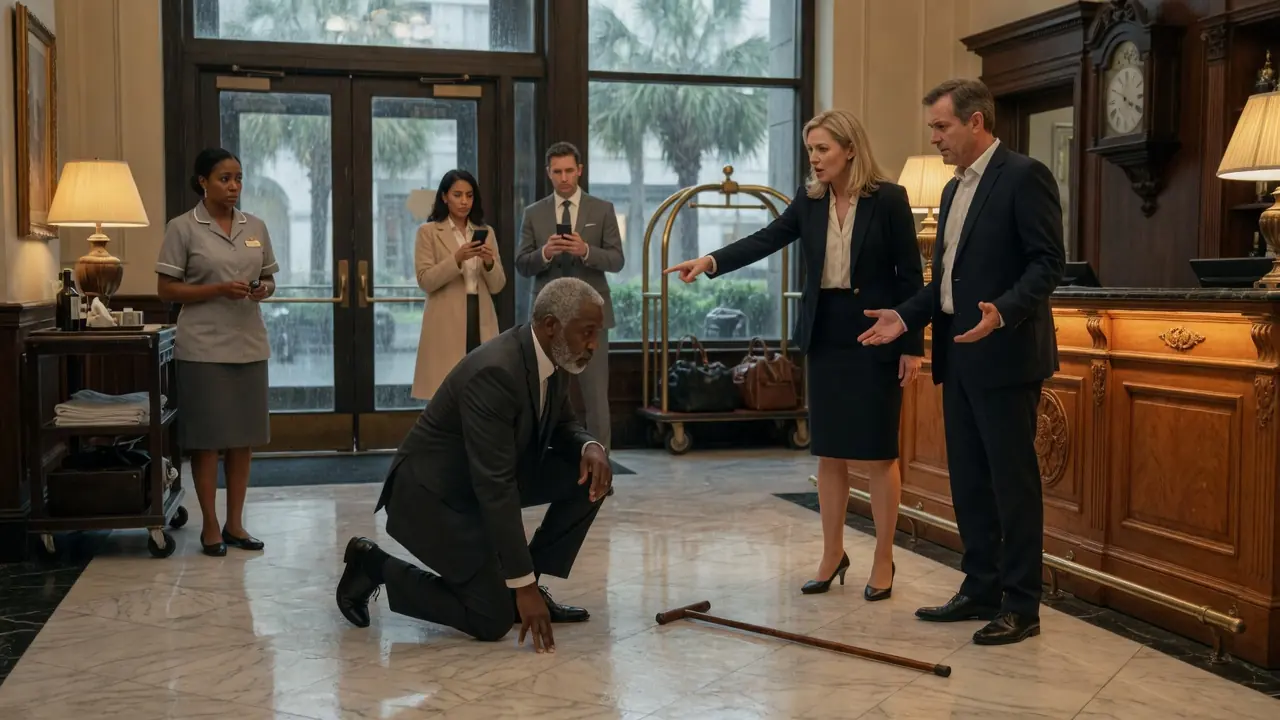
The guest had taken only two steps inside.
Bennett Carter was fifty-eight years old, dressed in a charcoal suit, with a cane in his right hand.
“Ma’am, I have a reservation,” he said. “Bennett Carter. Four nights.”
“I don’t care what your name is. Out.”
Megan came around the desk.
She ripped the cane from Bennett’s grip and kicked it.
It skidded across the marble and clacked against the brass kick plate.
Bennett Carter went down to one knee.
A second voice came from a man in a navy blazer.
Travis Whitlock, assistant general manager.
Megan’s husband.
“Babe, what’s going on?”
“This thing wandered in off the street.”
A guest lifted a phone.
The brass clock ticked.
3:12.
In twelve minutes, security would walk Megan and Travis Whitlock out of this lobby.
The man who opened the door for them would share Bennett’s last name.
Three hours earlier, Bennett Carter was on Interstate 26, driving in from Columbia.
The wipers moved once every four seconds. Rain had been falling since Orangeburg. On the passenger seat was a folded charcoal suit, a small leather case for the cane, and a sealed white envelope with a name written on it in his own handwriting.
The name on the envelope was Caleb.
Bennett was fifty-eight, a retired Army combat engineer with twenty-two years of service behind him. The cane was from Anbar Province, 2006. The engraving near the grip read: B. Carter, ENG BN, Anbar ’06.
He ran his thumb across that line about once a week.
He had done so for nineteen years.
The suit was for his daughter Hannah’s rehearsal dinner tomorrow night. Hannah Carter was twenty-seven, his daughter from his second marriage. The envelope was three months in the writing.
He had not been able to finish the last paragraph.
His phone rang on speaker.
“Daddy? Are you driving?”
“Hands at ten and two.”
“Good. Listen. He said yes.”
“He said yes to what?”
“Drinks. Tonight, after you check in. He’ll come to your hotel.”
Bennett did not answer for a moment.
The wipers moved once.
Twice.
“You told him which hotel?”
“I told him yours. Daddy, he runs the place. Of course he knows.”
“Hannah.”
“He’s been the GM at the Marlowe for five months. I thought you knew.”
He had not known.
He had thought he was checking into a quiet downtown hotel for four nights, walking his daughter down the aisle on Saturday, and slipping the envelope into a coat pocket somewhere between the rehearsal and the toast.
He had not thought he was checking into his own son’s lobby.
The son he had not spoken to face-to-face in twelve years.
Caleb Carter was thirty-four, like his father, raised by his late mother in Boston after the divorce. He carried his father’s last name because his mother had kept it.
He had been the general manager of the Marlowe Heritage Hotel since May.
He had never put a family photograph in his office. He did not do town halls. He ran the property out of the back of the third floor and let the rest of the staff assume the previous general manager, a man named Richard Sterling, was on a long, undefined leave.
Caleb had wanted it that way.
Megan and Travis Whitlock had worked the front desk and the manager’s office, respectively, for three years.
They had never met Caleb.
Most of the staff had not.
There was no photograph anywhere on the property. There had not been one in five months.
Bennett turned onto King Street at 2:58.
The valet took his keys. The bellman lifted his bag from the trunk. Bennett tipped him an extra five dollars because of the rain.
The bellman thanked him by name from the luggage tag and walked ahead to hold the door.
Bennett stepped inside.
The lobby smelled of orange oil cleaner and old cedar. A brass clock above the front desk ticked. The marble was polished to a wet shine.
A housekeeping cart rolled quietly down the corridor.
It was pushed by a woman in her early fifties named Cassandra Reed, who had worked at the Marlowe for eleven years and had, as of that morning, kept a thumb drive in her apron pocket for six months.
Bennett did not see her.
She saw him.
She had seen this before with other guests who looked like Bennett, or moved like him, or both.
She slowed the cart.
She did not look away.
He took one step.
He took a second.
3:12 on the brass clock.
Megan Whitlock looked up from her screen.
The kick had already happened.
The cane was already on the marble.
Bennett was already on one knee.
The guest with the phone was already recording.
Megan Whitlock straightened her blouse and walked back behind the desk like a woman returning from a brief errand.
Travis Whitlock took a position at her shoulder.
They looked, for a moment, like a portrait of management.
“Get up, sir,” Travis said. “You’re embarrassing the lobby.”
Bennett did not get up.
He put one palm flat on the marble. He breathed out once through his nose.
He looked, for the first time, at the cane lying against the brass kick plate.
He looked at the engraving near the grip.
B. Carter.
ENG BN.
Anbar ’06.
Then he picked the cane up.
He placed it back against the front of the counter, exactly where it had been when she kicked it.
He stood.
He did not lean.
“Ma’am,” Bennett said, “I would like to speak to your general manager, please.”
Megan laughed.
It was a dry, short sound.
“Honey, I am the supervisor on duty. He is the manager on property. Mr. Sterling is out of town until Monday. There is no one above us in this building this afternoon. Do you understand?”
“You said Mr. Sterling.”
“I said Mr. Sterling. Richard Sterling, the general manager.”
“Ma’am, Richard Sterling has not been the general manager of this hotel for five months.”
A small pause.
Just half a beat.
Megan did not know this.
Travis did.
The pause belonged to him.
“Sir,” Travis said, “I don’t know where you’re getting your information, but—”
“I’m getting it from your company website,” Bennett said. “Heritagehospitality.com leadership page. Updated in May.”
“Sir, the website is not always—”
“I would like to speak to your current general manager, please.”
A second guest lifted a second phone.
The first live stream had eleven viewers.
The second had six.
Cassandra Reed, in the corridor, had stopped pushing her cart.
She was not pretending to push it.
She was simply standing there.
Bennett pulled his own phone from his inside jacket pocket. He dialed a number printed on the back of his reservation confirmation.
He put the call on speaker because he wanted the lobby to hear it.
“Heritage Hospitality Group guest relations after-hours line. How may I assist?”
“My name is Bennett Carter. I am a prepaid four-night guest at your Marlowe Heritage Hotel in Charleston. The supervisor at the front desk has just kicked my mobility cane out of my hand. I would like to file an incident report and speak to a regional director.”
The line was quiet for two seconds.
“Sir, can you confirm the property name and your reservation number?”
He confirmed it.
He read it off his phone screen slowly, loud enough for the brass clock to hear.
The operator said, “I am required to escalate this. Please hold.”
Travis Whitlock very quietly picked up the desk phone and pretended to answer a call that was not ringing.
Megan looked at her husband.
Megan did not yet know what her husband was doing.
Travis was buying time.
He believed he had three hours.
He was wrong.
The hold music started.
It was a recording of a brass clock recorded three years ago in this lobby, counting itself.
The brass clock above the front desk ticked beside the brass clock recorded inside the phone.
For one moment in this lobby, time was being kept by two clocks at once.
The hold music played.
The lobby listened.
Travis lowered his fake phone call.
He leaned toward Megan and spoke behind his hand.
“Babe.”
“What?”
“Did you kick a man’s cane in front of two cell phones?”
“He was—”
“Did you kick a man’s cane in front of two cell phones?”
“Travis—”
“Look at him.”
“I am looking at him. He’s the one with the lawyer voice and a federal hotline on speaker. We have a problem.”
Megan Whitlock was the daughter of a Marlowe general manager from the 1990s.
She had worked the front desk for three years.
She had thirty-one prior complaints in the internal log over twenty-three months, of which nineteen were filed by guests, disabled guests, or guests who were both.
Twelve of those entries had been edited after submission.
Every single edit was made on her husband’s login.
She did not know any of this was about to come out.
She did not know any of it had been preserved.
She did not know that a housekeeper she had never spoken a kind word to had six months of original lobby footage in an apron pocket fifteen feet away.
Travis Whitlock was the assistant general manager.
He was the one who had edited the log entries.
He turned his back to Bennett.
He pulled his cell phone.
He texted Megan a single line.
GM at airport. 3 hours. Hold the lobby.
It was a lie.
The general manager was not at the airport.
The general manager was on Interstate 26 Northbound, returning from the airport with a colleague in the passenger seat, eight miles south of the city.
Travis knew this because Caleb Carter had texted him personally at 1:52, and the message was still on Travis’s lock screen.
The hold music stopped.
A new voice came on the line.
Female.
Crisp.
Not friendly.
“Mr. Carter, this is the regional director for the Heritage Hospitality Group Southeast Region. I am on a recorded line. I have been listening for the last ninety seconds. I would like the front desk supervisor and the assistant general manager to identify themselves on the record, please.”
Megan looked at Travis.
Travis looked at the floor.
“Megan Whitlock, front desk supervisor.”
“Travis Whitlock, assistant general manager.”
“And you are married to each other, correct?”
A pause.
“Yes.”
“Mr. Travis Whitlock, please put me on hold for one minute. I am calling the general manager of your property.”
The line clicked to hold.
Travis Whitlock’s face did something it had not done in three years of work at the Marlowe.
It paled.
Megan saw it.
Megan did not understand yet what she was seeing.
“Travis, why is she calling Sterling?”
“She’s not calling Sterling.”
“What?”
“Sterling left in May, Megan.”
“What?”
“He left in May. There’s a new GM. He started in May. I told you in May.”
“You said it was an interim guy.”
“He’s not interim. He’s permanent. He’s been here five months.”
“Why doesn’t anyone know that?”
“Because he doesn’t put pictures up in his office. Because he doesn’t do town halls. Because he runs the property out of the back and lets the rest of us think Sterling is on a long vacation. Because that is how he wanted it.”
“Why?”
Travis did not answer.
The hold music returned.
The brass clock recorded in 2022 ticked beside the brass clock ticking now.
Bennett Carter had not said a word for ninety seconds.
He was standing very still with the cane in one hand and the phone in the other.
And he was looking at the front door of the lobby.
He was listening for tires on the wet pavement.
Outside, a sedan turned off King Street into the valet lane.
Cassandra Reed, in the corridor, lifted the rag from her cart and folded it once.
She had been waiting six months for this minute.
The hold music stopped a second time.
The regional director came back on.
She spoke slowly.
She spoke loudly enough for the lobby to hear.
“Mr. Travis Whitlock. Mrs. Megan Whitlock. I have the general manager on the other line. I have read him the timestamps. I have played him fifteen seconds of the bystander livestream that is currently being shared on a public platform. I have his decision.”
The lobby had not held this much silence since the Marlowe opened in 1889.
“Effective immediately, the two of you are to surrender your key cards, your name plates, and your access badges to the senior security officer on duty. You are to leave the property by the front entrance. You are to have no further contact with hotel systems, guests, or staff pending review. Your general manager will be in the lobby within seven minutes to confirm receipt of this order in person.”
Megan Whitlock’s mouth opened.
“Wait. Who is the general manager?”
The regional director answered in two words.
“Mr. Carter.”
The lobby heard it.
The brass clock heard it.
Bennett Carter heard it.
The only person in the room who looked neither surprised nor confused was the man on the marble with the cane in his hand.
He lifted his eyes.
Just an inch.
Just enough.
The sedan in the valet lane had stopped.
The driver’s door was opening.
Caleb Carter, thirty-four, general manager of the Marlowe Heritage Hotel, walked through the front door of his own lobby at 3:21.
He was wearing a dark suit.
He was carrying nothing in his hands.
He was alone.
He did not look at Travis.
He did not look at Megan.
He did not look at the bellman who had straightened.
He did not look at the two guests with phones who were now livestreaming to a combined audience of 1,205 viewers.
He looked at his father.
He walked the length of the lobby in nine steps.
He stopped two feet from Bennett Carter.
He did not embrace him.
He did not say his name.
He looked at the cane in his father’s hand.
He looked at the place on the marble where the cane had skidded to a stop nine minutes earlier.
Then Caleb Carter went down to one knee in the same spot his father had knelt.
He knelt there for one second.
Two.
Three.
The cane was already back in Bennett’s grip, so there was nothing for Caleb to pick up.
He simply knelt in the place his father had knelt, in the lobby of his own hotel, in front of his own staff, and let the marble register the weight of him.
He stood.
He turned to Travis Whitlock.
He spoke at a normal volume.
The lobby heard every word because the lobby had gone quiet enough to hear a brass clock count down a year.
“This is my father.”
Megan Whitlock made a small sound.
It was not a word.
It was the sound a person makes when a floor moves.
“Travis,” Caleb said. “Megan. Key cards, name plates, badges. To Mr. Foster. Now.”
A man at the door stepped forward.
Gabriel Foster, forty-nine, third-shift senior security officer, fifteen years on the property, former South Carolina National Guard.
Foster did not draw anything.
He did not raise his voice.
He extended one open palm.
Megan Whitlock surrendered her badge to Gabriel Foster’s hand.
Travis Whitlock surrendered his.
Caleb Carter walked them personally to the front door.
He did not touch them.
He did not need to.
Foster walked one step behind.
The bellman opened the inner door.
The valet on the sidewalk had already stepped away from the sedan that no longer belonged to anyone in the building.
Caleb opened the outer door himself.
He opened it outward for them.
Megan turned once on the sidewalk.
She looked back into the lobby.
She looked at Bennett, who was still standing where he had stood.
She opened her mouth.
She closed it.
Travis took her elbow.
They walked.
Caleb Carter stood at the open door for two more seconds.
The rain had started again.
He did not feel it.
Then he turned.
He walked back across the lobby.
He stopped in front of his father.
He did not embrace him.
He said quietly, so that only the brass clock and Cassandra Reed could hear, “I’m sorry it took twelve years and a kick to get me to walk across this floor to you.”
Bennett Carter said, just as quietly, “Walk me to the elevator, son.”
They walked.
Cassandra Reed picked up her rag.
She folded it again.
She had been waiting eleven years to fold a rag in this lobby in this particular silence.
She did not say anything to anyone.
She turned her cart and pushed it back the way it came.
By the time she reached the service corridor, she had already decided what she was going to do with the thumb drive in her apron pocket.
She was going to call her cousin at the Charleston Ledger.
At 6:03 the next morning, an attorney named Eleanor Hayes opened her email and found a name she had been waiting eighteen months to see.
Eleanor Hayes was forty-four, an ADA and civil rights litigator.
She practiced out of a two-room office on Broad Street with her name on the door and a filing cabinet behind it that had not closed all the way since 2023.
She had been waiting for a Marlowe file for a year and a half.
She met Bennett Carter at a coffee shop on King Street the next morning.
She did not perform sympathy.
She opened a leather binder.
She set a digital recorder on the table.
She asked him to walk through every minute from 3:12 to 3:28 twice.
He walked her through it twice.
The second time was identical to the first.
She nodded.
She closed the binder.
She said, “You’re going to win, Mr. Carter. The question is who else gets named in the win.”
By the end of the day, she had a federal complaint drafted.
By the end of the week, she had subpoenas out for the Marlowe’s incident log, the Marlowe’s ADA training records, and the Heritage Hospitality Group’s vendor agreements with any third-party software provider used at the property level.
The incident log came back on day three.
Thirty-one entries named Megan Whitlock as the responding employee in the past twenty-three months.
Twelve of those entries had been edited after submission.
Every single edit was made on Travis Whitlock’s login.
The edits softened the language.
“Refused service” became “guest declined to comply with policy.”
“Used profanity” became “was assertive.”
“Kicked” became “redirected.”
Of the thirty-one complainants, nineteen were identified in the log as , disabled, or both.
Hayes read the line twice.
Then she called Bennett.
“Mr. Carter, the pattern is on paper.”
The ADA training records came back on day four.
Both Whitlocks were listed as having completed the chain’s required ADA training for the past two years.
The third-party vendor that issued the certificates had no record of issuing certificates to either of them.
The dates did not match.
The signatures did not match.
The course identification numbers, on close inspection, were reused from a different property in Atlanta.
Hayes flagged this and moved on.
On day five, Nora Bishop, thirty-nine, investigative reporter for the Charleston Ledger, called Hayes’s office.
They divided the work.
Hayes built the legal case.
Bishop built the public record.
Also on day five, Cassandra Reed reached Bishop through a cousin who delivered linen to the Ledger.
Cassandra brought a thumb drive.
The thumb drive contained six months of original lobby footage captured before the property’s routine eighty-nine-day rotation overwrote the system copies.
Cassandra had pulled the spare from a discarded backup unit Travis Whitlock had personally ordered destroyed.
The footage was intact.
The dates were intact.
The metadata was intact.
On the drive, in addition to the footage of Bennett’s cane being kicked, there were clips of three other incidents at the front desk.
A wheelchair user being told the elevator was out of service while two other guests used it.
An elderly woman being told her credit card had been declined for verification while the card was, in fact, charged.
A father with an autistic son being told the lobby was not appropriate for the child’s behavioral situation.
In all three clips, the supervisor on the desk was Megan Whitlock.
In all three clips, Travis Whitlock arrived within four minutes to back her up.
Hayes played the clips for the lead Doe plaintiff candidates over the course of two days.
By the third day, she had three signed retainer agreements.
The eight prior complaint letters surfaced on day seven.
Three from veterans.
Two from wheelchair users.
One from a parent traveling with an autistic child.
Two from elderly women traveling alone.
All eight had been dispositioned as non-actionable by the Marlowe’s HR department.
The handwriting on six of the eight dispositions matched a signature exemplar in Travis Whitlock’s HR file.
Bennett Carter, throughout all of this, refused television.
He sat for one print interview with Nora Bishop.
He answered exactly the questions she asked.
He said, “I am not the story. The pattern is the story. Please cover the pattern.”
Bishop covered the pattern.
Caleb Carter did not strategize with Hayes.
He walled himself off from the case on the advice of his own attorney.
He authorized, through the property’s compliance officer, full lawful production of internal records.
He told Hayes, in a single email with no greeting and no closing:
“Whatever you need that the law lets you have, you get. I will not be in the room.”
Hayes printed the email.
She filed it.
She did not respond.
A phrase began to appear in the internal emails she did receive.
Low friction occupancy.
It appeared in three messages between Travis Whitlock and a regional operations director.
None of the recipients could define the phrase on the record when Hayes asked.
None of them said they had ever heard of it before.
All of them had used it repeatedly.
On day twelve, Hayes amended the complaint.
She named the Marlowe Heritage Hotel, the Heritage Hospitality Group, and three Doe defendants.
She requested a preliminary injunction restraining the property from using a piece of internal software referred to in the emails as the guest profile optimization tool.
She scheduled the injunction hearing in federal court for the morning of day thirty-one.
The receipts had stopped being individual moments.
They had started becoming a structure.
The next document was the one that put a price on a kicked cane.
Cassandra Reed’s hours at the Marlowe were cut to twelve a week the morning after she handed the drive to Bishop.
She did not tell anyone.
She came to work.
She wiped the same mirrors.
She waited.
The Heritage Hospitality Group issued a press release on day fourteen.
The release praised the diversity and accessibility programs at “our flagship Charleston property.”
It did not mention Bennett Carter by name.
It did not mention Caleb Carter at all.
It was signed by an executive vice president nobody at the property had ever met.
On the same day, a one-star review of Eleanor Hayes appeared on three separate legal rating websites within eleven hours of one another.
The reviews used slightly different words.
The syntactic fingerprint was identical across all three.
The same comma splice appeared in each.
The same misspelling of “plaintiff.”
Hayes archived all three.
She did not respond.
Cassandra Reed, on day fifteen, received a written warning at work.
The warning cited unauthorized handling of property equipment.
The warning was dated three days before she handed the thumb drive to Nora Bishop.
The metadata embedded in the document, however, showed it was created the morning after.
Cassandra printed both versions.
She gave them to Hayes.
Hayes flagged it as exhibit ten.
On day sixteen, Bennett Carter’s hotel room door at his backup hotel was knocked on at 11:12 at night.
A man in a windbreaker with no name tag and no clipboard claimed to be from guest relations.
Bennett did not open the door.
He called Gabriel Foster, who was no longer with the Marlowe as of two days ago.
Foster called a sheriff’s deputy he had served with in the National Guard.
The deputy came within fifteen minutes.
The man in the windbreaker had, by then, walked back to a parked car with no plates and driven away.
The deputy filed an incident report.
Hayes filed the report.
On day seventeen, an anonymous online effort began to challenge Bennett Carter’s military record.
Within twelve hours, three veteran organizations had published verifications.
The records held.
The effort died inside a day.
A separate online effort began on day eighteen.
This one suggested, anonymously, that Bennett had engineered the entire encounter because his son ran the property.
The narrative was sophisticated.
It cited timestamps.
It cited a daughter’s reservation.
It implied coordination.
Hayes responded in one filed paragraph.
She attached three timestamps.
The first was Hannah Carter’s August reservation, made when Caleb Carter was not yet the general manager of the Marlowe.
The second was Caleb Carter’s text message to Travis at 1:52 on the day of the incident, alerting him only that a colleague was being picked up at the airport.
No mention of his father.
No mention of Bennett.
No mention of any guest.
The third was the regional director’s call to Caleb at 3:38 after the kick, alerting him to an incident at his own property.
The sequence was documentary.
The smear collapsed by the end of the news cycle.
Cassandra Reed was suspended pending review on day nineteen.
She told Bishop, “I have wiped enough fingerprints off enough mirrors in this building to know what a frame looks like.”
Bishop printed the line.
Bishop did not edit it.
On day twenty, Hayes lost a procedural motion to expedite discovery on the parent company emails.
Her face did not change in the courtroom.
Outside the courthouse, on the steps, she called her office.
She pulled two associates onto the file full-time.
The Heritage Hospitality Group’s outside counsel issued a one-line statement to the Charleston Ledger on day twenty-one.
Through counsel, the Whitlocks denied the characterization and disputed the chain of custody on the recovered drive.
Bishop published the statement in full in a column-three sidebar.
It ran flat.
It ran neutral.
It ran exactly as long as Hayes’s response in column four, which said only:
“We look forward to addressing every claim on the record at the preliminary injunction hearing.”
Bennett Carter, through all twenty-one days, had not appeared on television once.
He had not spoken to any radio station.
He had not posted anything on any platform.
He had gone to his daughter’s dress fitting.
He had gone to the rehearsal venue’s tasting.
He had answered the phone twice a day for Hayes.
He had answered the phone once an evening for Hannah.
He had not yet answered any of the messages on his phone from Caleb.
There were three of them.
They had been sitting unread for nineteen days.
By then, Bennett already knew how the system answered a kick.
It did not answer with another kick.
It answered with paperwork.
With waiting.
With a quiet warning to the housekeeper.
With a knock at eleven at night.
With a press release that praised diversity programs while suspending the only woman on staff who had actually fought for any of them.
But the housekeeper had not used her last receipt yet.
And the general manager had been awake for three nights in a row.
At 11:38 at night on day twenty-one, Caleb Carter knocked three times on a hotel room door across town.
The man inside already knew who it was.
The cane was on the desk in Bennett’s hotel room, parallel to the edge, the way a ruler sits in a drafting kit.
Bennett was fifty-eight years old, sitting in a leased room across town from a hotel that bore his son’s name on a leadership page he had not known existed until three weeks ago.
He was not sleeping.
He had not slept much in twenty-one days.
His daughter’s wedding was in seventy-two hours.
He thought, in a sentence the brass clock above his head would never hear, that the easiest thing he had ever done was carry a sixty-pound pack across loose sand under fire.
The hardest thing was sitting in a hotel room and refusing to disappear.
His phone rang.
Eleanor Hayes.
“Mr. Carter. We lost the discovery motion on the parent company emails.”
“I heard.”
“It is a procedural setback. It is not a fatal one.”
“It will cost us three weeks.”
“Understood.”
“Mr. Carter.”
“Yes?”
“I am not going to soften this for you. I do not soften things. You did not hire me for soft.”
“I know.”
“Get some sleep.”
“I’ll try.”
He did not sleep.
At 11:12, Cassandra Reed sat at her own kitchen table in a small apartment on the north side and counted what was in her checking account.
She counted $612.
She counted it twice.
She closed her laptop.
She did not cry.
She made tea.
She turned the kitchen light off and sat with the tea in the dark, looking at the streetlight outside the window.
And she thought about her grandmother, who had worked for thirty-one years at a hotel three blocks from the Marlowe and had never once been allowed to use the front door.
At 11:20, Nora Bishop’s first piece was pulled from the Ledger’s website by an editor above her for fact-checking.
Bishop did not yell.
She filed an internal grievance.
She opened a new document.
She started on part two.
At 11:38, three knocks landed on Bennett Carter’s hotel room door.
He did not look through the peephole.
He already knew.
Caleb Carter was in the hallway.
He was wearing the same dark suit he had worn at 3:21 on day one.
He looked like a man who had been awake for three days.
He had been.
They did not embrace.
They sat across the small round table by the window.
Bennett’s cane was between them, still parallel to the edge of the desk.
The white envelope was on the desk, too.
It had been on the desk for twenty-one days.
It had not been opened.
For a full minute, neither of them spoke.
Caleb broke first.
“I should have called you, Dad. Not a Christmas card, not a birthday card. Called. Twelve years of ‘I’ll call tomorrow.’”
Bennett did not answer right away.
He pushed the white envelope across the small round table with one finger, the way a man slides a letter under a door he does not have the key to.
Caleb did not open it.
He placed it beside the cane.
He lined up the long edge of the envelope with the long edge of the cane.
He said, “Tonight is not when I read this. Tonight I just sit here.”
They sat.
The brass clock in this hotel room was not as old as the one in the Marlowe lobby, but it ticked at the same rate.
The room had the same orange oil cleaner.
The same wet smell of Charleston in October.
The same silence.
Bennett eventually said, “Hannah’s voicemail.”
“What about it?”
“She said, ‘Don’t forget you said you’d see him tonight.’”
“I thought she meant a friend.”
“She meant me.”
“I know she meant you.”
“I’m sorry, Dad.”
“For what?”
“For the floor.”
Bennett looked at the cane on the desk.
He looked at his son.
“You picked it up, Caleb. You picked it up in the right spot. You picked it up with both hands. The floor is not your apology to make.”
Caleb did not answer right away.
He placed one hand flat on the desk beside the envelope.
He looked at the hand.
He looked at his father’s hand on the cane.
“Twelve years, Dad.”
“Twelve years.”
“I read every one of your letters. I just couldn’t write back. I couldn’t figure out which sentence to write first.”
“I had the same problem with that envelope.”
“Three months on the last paragraph.”
“What’s in the last paragraph?”
Bennett did not answer.
He placed one hand on top of his son’s hand on the desk.
They sat like that for a while.
The brass clock ticked.
The streetlight outside the window flickered once.
Somewhere down the corridor, a luggage wheel squeaked.
At 6:03 the next morning, Eleanor Hayes’s phone lit up with a text from a number she did not recognize.
The message was two words.
Me, too.
The number belonged to a woman in Mount Pleasant.
The Marlowe had relocated her from this property eleven months ago.
She used a wheelchair.
Her name was on a federal complaint by the end of the week.
The first Doe plaintiff was Jane Doe 1, fifty-eight, .
She used a power wheelchair.
She had been a guest at the Marlowe Heritage Hotel eleven months ago.
She had been relocated mid-stay to a sister property in North Charleston.
The relocation was logged as “for the guest’s own accessibility comfort.”
Her statement said the elevator was working when the white couple ahead of her used it, and out of service when she tried to use it.
Her statement said she watched both of them ride up while a bellman told her, with apparent regret, that the lift had just gone down.
The supervisor on the desk that night was Megan Whitlock.
The second Doe plaintiff was Jane Doe 2, thirty-six, mother of a nine-year-old son who used an AAC speech device.
The son’s name was Daniel.
She had recorded the conversation at the front desk on her phone, propped against her purse.
The audio matched Megan Whitlock’s voice in three independent forensic comparisons.
On the recording, Megan told the mother that the lobby was not really set up for “you know, behavioral guests.”
On the recording, the AAC device, in a generated voice, said, “My name is Daniel. I am a person.”
Megan did not respond to the device.
She responded to the mother.
She told the mother that the property had standards, and this was not the right fit.
The third Doe plaintiff was John Doe 1, forty-one, , Iraq War veteran.
He had spent a night in his car after Megan Whitlock, on overnight desk, declined to honor a prepaid reservation, citing verification.
He had the receipt for the prepaid reservation.
He had the photograph of his car in the parking lot of an all-night diner across the bridge.
He had the timestamp on the photograph.
Jane Doe 1 was the woman who had texted, “Me, too.”
By day twenty-six, all three had signed retainer agreements with Eleanor Hayes.
By day twenty-eight, a regional veterans organization had issued a public statement of support and offered to coordinate affidavits.
By day twenty-nine, Bishop’s part one was republished with two new sources by an editor higher than the one who had pulled it.
The editor who pulled it did not respond to a request for comment.
The editor’s name did not appear on any byline at the Ledger that month.
By day thirty, Cassandra Reed was contacted by a hospitality workers’ rights group out of Atlanta.
They offered to pay her bills through trial.
Cassandra accepted.
She was back at work with restored hours by the end of the week.
Caleb Carter, walled off from strategy but not from his fiduciary authority, signed the order personally.
He did not say a word about it on the property.
He did not need to.
By day thirty, the case had become a class.
The defendants’ lawyers began, for the first time, to ask quietly about settlement parameters.
Hayes did not answer.
Hayes was still building the file.
Bennett Carter was asked by Bishop in the second print interview how he felt.
He said, “I feel correctly believed.”
That was the only sentence Bishop printed in column one.
The rest of the column was the names of the three Doe plaintiffs and the two-line description of what had happened to each of them.
The headline was:
Three Strangers, One Front Desk.
Below the fold, in smaller type, the subhead read:
And One Cane That Stayed On The Floor For Nine Seconds.
Bennett read it once.
He folded the paper.
He put it on the desk beside the unopened envelope.
The cane stayed where it was.
Hannah’s wedding was in five days.
A manila envelope arrived at the Charleston Ledger on day thirty.
It was addressed only with Nora Bishop’s initials.
It contained three pages.
The envelope was plain.
The paper inside was corporate stock.
The header read:
Heritage Hospitality Group Board Materials, April.
Nora Bishop read the three pages once.
She read them again.
She walked the envelope in person to Eleanor Hayes’s office on Broad Street.
Hayes read the three pages once.
She closed the binder around them the way a person closes a Bible at the end of a service.
The memo described a vendor agreement.
The vendor sold a piece of internal software called the guest profile optimization tool.
The vendor paid the Heritage Hospitality Group a rebate of twelve cents per room night when a participating property’s low friction occupancy rate exceeded eighty-nine percent in a calendar month.
Low friction occupancy was defined on page two of the memo as the percentage of completed stays that did not generate an incident report, an accommodation request, a complaint, or a refund.
The definition did not exclude denied check-ins.
The definition did not require the guest to have actually stayed at the property.
A turnaway at the front desk counted the same in the math as a completed four-night stay with no complaints.
A footnote on page two, unredacted by what appeared to be a clerical error, named three flagship pilot sites for the vendor program.
The first name on the list was the Marlowe Heritage Hotel.
Page three was the part Hayes read three times.
Page three described the tool’s input parameters.
The list included guest profile attributes contributing to perceived complaint likelihood.
The attributes were listed.
They included declared mobility aids, recorded accessibility requests, prior complaint volume, and zip code of origin demographic indicators.
Hayes read the phrase zip code of origin demographic indicators twice.
She picked up the phone.
“Mr. Carter?”
“Counselor.”
“The system was not asleep at the wheel. The system had a wheel. The wheel paid twelve cents a turn.”
“Then the wheel needs to come off.”
“It will be off by Friday.”
She hung up.
She drafted an amended complaint within seventy-two hours.
The Heritage Hospitality Group was added as a primary defendant.
The complaint cited Title II of the Civil Rights Act, the Americans with Disabilities Act, and a state-level disability access statute.
The complaint requested a preliminary injunction restraining the use of the guest profile optimization tool at every flagship property pending review.
It requested federal monitoring of any successor tool.
It requested sworn certification that no replacement vendor had been engaged.
The receipt was in the file.
The Whitlocks were not the disease.
They were the symptom that corporate paid twelve cents a room night to keep alive.
If a hotel could save twelve cents on a guest with a cane by keeping that guest from completing a check-in, the math would eventually find a Megan Whitlock to do the saving.
The math in this case found two and married them to each other.
Bennett Carter, when he heard this, did not raise his voice.
He did not curse.
He said one sentence.
“The cane was kicked because the math required it.”
Hayes wrote it down.
She entered it into her opening notes for the injunction hearing.
She underlined it twice.
Friday morning.
United States District Court, District of South Carolina, Charleston Division.
Courtroom 3.
The Honorable Patricia Holloway presiding.
The cane was on the evidence table.
Eleanor Hayes placed it there herself.
She did not ceremonialize it.
She laid it down the way a carpenter lays down a tool.
She read the engraving into the record.
B. Carter.
ENG BN.
Anbar ’06.
She entered the VA card as exhibit one.
She entered the lobby footage, angle A, as exhibit two.
She did not narrate.
She let the seven seconds of skid breathe in the courtroom.
The brass clock on the courtroom wall was not the brass clock from the Marlowe lobby.
The two clocks ticked at the same rate.
Nobody in the courtroom knew that but Bennett Carter.
And he did not say it.
Travis Whitlock was called to the stand on day thirty-one.
He was questioned by Hayes for fifty-six minutes.
He attempted twice to attribute the order to remove Bennett Carter from the lobby to his wife.
On the third attempt, Hayes played a fifteen-second segment from the lobby’s internal intercom recording.
Travis’s own voice was on the recording.
The order was in his voice.
The order was, “Get him to the airport property and make it his idea.”
The defense, at that moment, became two defenses.
And they were no longer aligned.
Megan Whitlock, in the second row of the gallery, made the same small sound she had made in the lobby on day one.
The sound a person makes when a floor moves.
Megan Whitlock’s deposition was read aloud by a court reporter.
The phrase low friction occupancy appeared nine times in the deposition.
Megan could not define the phrase on the record.
She said three separate times, “I don’t know what that means. They told me to keep my number up.”
She did not say who “they” was.
The record did not require her to.
The record simply let the absence stand.
A representative of the Heritage Hospitality Group was examined briefly.
He delivered the statement his outside counsel had written for him.
“The rebate program was lawful and was not communicated to property staff.”
Hayes did not argue.
She entered the board memo as exhibit twelve.
The footnote naming the Marlowe as a flagship pilot site was read into the record.
The court reporter paused on the unredacted line.
The judge did not.
Bennett Carter did not testify.
He sat at counsel table with the cane between his knees.
He looked straight ahead.
He did not turn his head once during the entire hearing.
Caleb Carter sat in the second row of the gallery.
He did not testify.
His own attorney, in a one-page filing, had confirmed that the general manager of the Marlowe Heritage Hotel would not be called as a witness, would not strategize with plaintiff’s counsel, and would not benefit financially from any settlement.
When Hayes placed the cane on the evidence table, Caleb closed his eyes for one full second.
He did not open them until the engraving had been read aloud.
Cassandra Reed was in the third row.
Gabriel Foster was in the fourth.
Hannah Carter was in the fifth, in a quiet gray dress, with three days left until her wedding.
The Honorable Patricia Holloway, sixty-one, twenty-eight years on the federal bench, did not perform.
She listened.
She took one set of notes.
She asked one question of Hayes and one question of opposing counsel.
Then she ruled from the bench at 11:12 in the morning, after 112 minutes of hearing.
She granted the preliminary injunction in part.
The guest profile optimization tool was suspended at every Heritage Hospitality Group flagship property pending full review.
Megan Whitlock and Travis Whitlock were barred from any guest-facing role at any Heritage Hospitality Group property in any state, in writing, in perpetuity.
The Marlowe Heritage Hotel was ordered to produce a full ADA training audit within sixty days, conducted by an independent third-party auditor selected by the court.
The class certification motion was set for a hearing in eight weeks.
The gavel came down.
Bennett Carter did not stand.
He put one hand on the cane and one hand flat on the table.
He breathed out once through his nose, the way he had on the marble at 3:21 on day one.
The exhale was the same exhale.
The room was different.
Caleb Carter, in the second row, opened his eyes.
After the courtroom emptied, Caleb walked to the front of the gallery.
He filed a one-page resignation as general manager of the Marlowe Heritage Hotel with his own corporate office, citing irreconcilable conflict between his fiduciary duty to the company and his understanding of what dignity required.
He had, by then, already accepted a position with a hospitality workers’ rights organization out of Atlanta.
The same organization that had paid Cassandra Reed’s bills.
The same organization that had hired Gabriel Foster two weeks ago.
The brass clock in the courtroom ticked.
Outside, on the sidewalk in front of the federal courthouse, Bennett Carter waited for the rain to stop.
It did not.
He put the cane down anyway.
He walked to the car with his son.
Nora Bishop’s phone buzzed with a tip from a Heritage Hospitality Group employee at a property in another state.
The tip named a vendor.
The vendor was not the guest profile optimization vendor.
It was a different one.
Cassandra Reed was reinstated with full back pay on day thirty-three.
She was transferred, at her request, to a property where she did not have to wipe anyone’s fingerprints off any mirror.
She worked there now.
She still kept a thumb drive in her apron pocket.
She said, when asked, that she did not expect to need it again.
She also said that she had not expected to need it the first time.
Gabriel Foster’s new title was Field Operations Director, Hospitality Workers’ Rights Project.
He kept the same badge number he had read into the regional director’s recorded line on day one.
He said it reminded him which lobby he had stopped pretending in.
Eleanor Hayes was asked by Nora Bishop in a follow-up interview what changed.
She answered in one sentence.
“A receipt is not a feeling. It is the law learning your name.”
The settlement framework was announced on day fifty-eight.
The dollar figure was sealed.
The structural reforms were not.
The reforms were eleven pages long.
The first page named the Marlowe Heritage Hotel as the trigger property.
The second page named the guest profile optimization vendor and banned the use of any perceived complaint likelihood parameter at any Heritage Hospitality Group property, in writing, in perpetuity, subject to federal monitoring.
The third page mandated third-party ADA training audits for every flagship property every six months for the next five years.
The eleventh page was a single signature line.
It was signed.
Bishop’s part three ran on the same day.
It named the next three properties under the same vendor program.
The next three hearings were already on Eleanor Hayes’s docket.
She had cleared her calendar through the end of the year.
On day fifty-eight in the late afternoon, Bennett Carter walked his daughter Hannah down the aisle of a small ceremony at a venue eleven blocks from the Marlowe.
The cane was in his right hand.
He had polished it.
The engraving caught the light once when he turned.
Hannah did not cry.
She smiled.
She squeezed her father’s arm at the second pew.
Caleb Carter was in the front row on the bride’s side.
For the first time in twelve years, he and his father were in the same row.
He was wearing the same dark suit he had worn at 3:21 on day one, at 11:38 on day twenty-one, and at counsel table on day thirty-one.
The suit had been to a tailor.
It fit him better now.
The white envelope was finally open.
Caleb read it on the small balcony of the venue between the ceremony and the reception.
The letter was between a father and a son.
Caleb read it once.
He folded it.
He slid it into the breast pocket of his suit, heart side.
He kept it there for the rest of the night.
Hannah danced with her father once.
The song was short.
Bennett did not lean on the cane during the dance.
The cane was on a chair at the head table.
Hannah led.
Bennett followed.
He had, in fact, been following her lead since she was four years old.
When the brass clock above the venue’s reception desk ticked past nine, Hayes left early.
She had a motion to file in the morning at a different courthouse, in a different city, for a different family that had not yet heard her name.
She picked up her coat.
She did not say goodbye.
That was how this kind of work moved.
The file left one question on the table.
A hotel paid twelve cents a room night to keep certain guests from finishing a check-in.
A receptionist kicked a man’s cane because the math required it.
A husband edited the record because the bonus required it.
A corporation wrote a parameter into a tool because a vendor offered a discount.
Where in that chain does dignity live?
The answer the federal court entered into the record on day thirty-one was the answer this file lived by.
Dignity is not discretionary.
It is just inconvenient until somebody writes it down.
And sometimes, until somebody you raised picks the cane up for you.
What stayed with Bennett Carter was not only the kick.
It was not even the courtroom.
It was the nine seconds the cane stayed on the floor, and what nobody in the lobby did about it.
Nine seconds is a long time when you are on one knee.
Bennett Carter did not win because he raised his voice.
He did not win because his son ran the building.
He won because he kept the receipts.
Quiet ones.
A reservation number.
A hotline call.
An engraving on a cane he had carried since 2006.
The system was built to outwait him.
He simply wrote things down faster than it could erase them.
That was not luck.
That was discipline.
Bennett’s story was not only about a hotel.
It was about the receipt someone wishes they had kept.
The name someone wishes they had written down.
The minute someone wishes they had documented.
And in the end, the pattern did not break because one man was humiliated on a marble floor.
The pattern broke because the receipts stacked high enough for the law to learn every name.