“Oh, no. Did you seriously just walk in here looking like that?”
The words slammed across the hotel lobby.
Every head turned.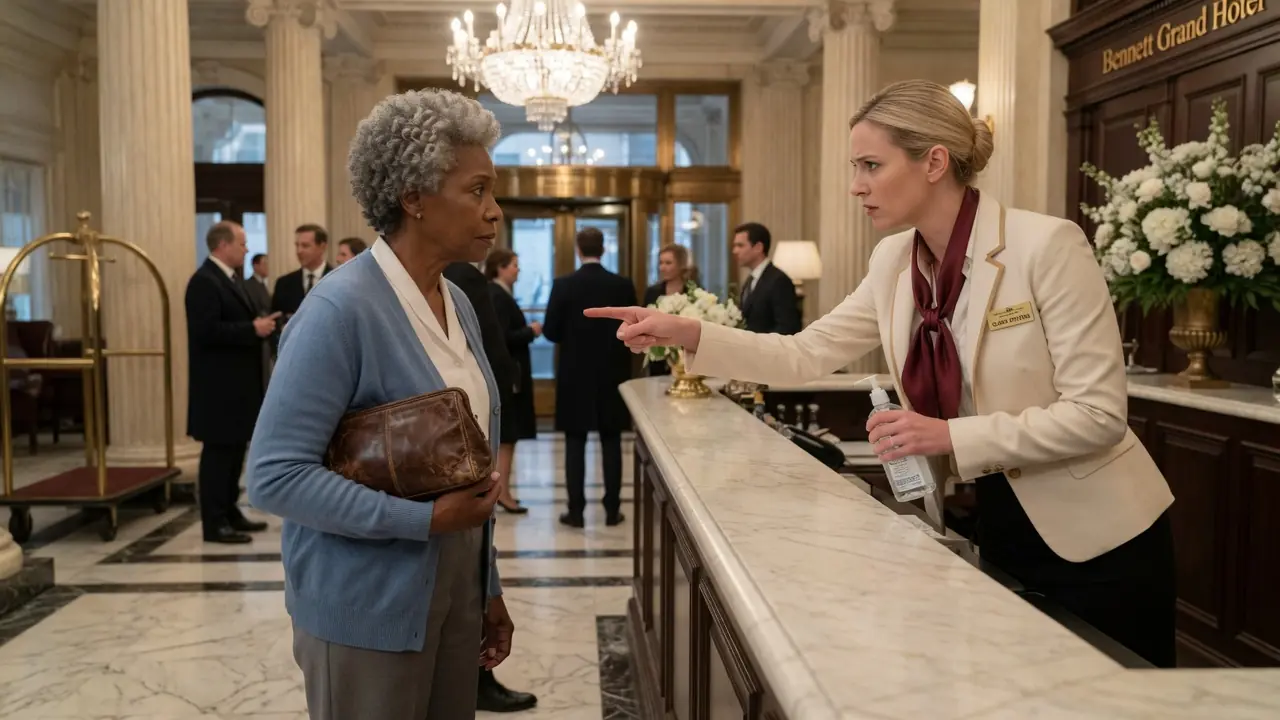
The clerk’s face twisted with pure disgust as she glared at the elderly Black woman in the faded cardigan.
“Are you deaf? I said get out.”
The old woman’s hands clenched around her purse. Her shoulders stiffened, but her feet did not move.
The clerk snatched up the hand sanitizer and slammed it on the counter.
“Here. You might want to clean yourself up before you touch anything else.”
Then she turned to a white guest and said loudly, “I’m so sorry you have to witness this.”
She had no idea she had just insulted the woman who owned every brick in that building.
Six hours earlier, the sun barely touched the horizon over the city skyline.
Margaret Bennett stood on her penthouse balcony watering African violets. The soil was damp. The leaves were deep green. She touched one gently, remembering Samuel’s hands doing the same.
The cat meowed behind her.
Solomon, sixteen years old and gray, wound between her ankles. She bent down, knees protesting, and scratched his ears.
“Good morning, old friend.”
Inside, the apartment was quiet.
Too quiet since Samuel died three years ago.
The walls held forty-two years of memories. The kitchen still smelled faintly of his coffee.
Maggie walked to the mantel. The photograph sat in a silver frame. She and Samuel stood before their first hotel, a small motel in 1982.
They were young, hopeful, and broke. Samuel wore his only suit. She wore a yellow dress from Sears. They held oversized scissors, ready to cut the red ribbon.
“We did it, baby,” she whispered.
Forty-seven hotels now.
Her phone buzzed.
A text from Trish, her assistant.
“Mrs. B, are you sure about today? Maybe wear the Armani?”
Maggie smiled and typed back, “If they only respect expensive clothes, they’ve already failed.”
She walked to her closet, past the designer suits and silk blouses, past shoes that cost more than monthly rent. She pulled out a soft blue cardigan with a loose button Samuel had never fixed.
Comfortable slacks.
Orthopedic shoes from her doctor’s orders after knee replacement.
She looked in the mirror.
A sixty-eight-year-old Black woman. Gray hair cut short. Laugh lines around her eyes. Hands showing every year of hard work.
Perfect.
The Bennett Grand Hotel rose thirty-two stories downtown, glass and steel catching morning light, flags snapping in the wind, doormen in crisp uniforms greeting guests.
Eight years ago, Maggie had watched construction crews break ground there. Samuel had squeezed her hand.
“This one’s our legacy,” he had said. “The crown jewel.”
Three hundred and forty million dollars. Two years of construction. Sixteen hundred employees. Forbes five-star rating three years running.
Inside, everything gleamed. Italian marble. An Austrian crystal chandelier worth more than most houses. Fresh flowers delivered daily from the city’s best florist.
The walls displayed art from local Black artists. Maggie had insisted on that. Samuel had insisted on the grand piano in the corner, where musicians played classical music and jazz.
On the third floor, a portrait hung in the executive conference room. Maggie and Samuel at the grand opening, older, successful, still holding hands.
Employees walked past it daily.
It was in the handbook, page one.
Our founders believed every guest deserves dignity and respect, regardless of appearance, background, or bank account.
Claire Stevens had been hired six months ago.
Young. Ambitious. Her resume sparkled with luxury hotel experience. References praised her attention to detail and commitment to excellence.
During her interview, she said all the right things.
“I believe in white-glove service. Every guest is a VIP. First impressions matter.”
The hiring manager loved her. James Holland, the general manager, approved immediately.
Maggie had seen the file.
Something about Claire’s smile bothered her.
Too perfect.
Too practiced.
Like she was performing kindness rather than living it.
But Trish had said, “Mrs. B, you can’t reject candidates based on feelings.”
So Maggie signed off.
Now Claire worked the flagship hotel’s front desk. She greeted wealthy guests with charm. She remembered names and preferences. She made people feel special.
The right people, anyway.
The neighborhood told two stories.
Old brick buildings mixed with glass towers. Family shops sat beside chain stores with minimalist logos. The barber shop where Maggie’s father used to get haircuts was now an organic juice bar.
Longtime residents, mostly Black and brown, still walked these streets, but fewer each year.
Priced out.
Pushed out.
Maggie fought to keep the hotel rooted in the community. Hiring initiatives for locals. Scholarships for hospitality students. Partnerships with Black-owned suppliers.
But she knew the truth.
Programs meant nothing if your front desk treated people like trash.
That was why she did these inspections.
Unannounced.
Underdressed.
Unrecognized.
Trish had called that morning.
“Maybe just this once, wear the suit.”
Maggie had laughed.
“If they treat me differently in Chanel versus a cardigan, then we’ve built nothing Samuel would recognize.”
She picked up her worn leather purse, the one Samuel gave her for their twentieth anniversary. The stitching was frayed. The leather was cracked.
She had carried it to business meetings with billionaires, to ribbon cuttings with mayors, to Samuel’s funeral.
She would carry it today too.
At 11:15 a.m., Maggie stepped out of her building. The doorman hailed a cab. She could have taken the town car. She could have called her driver.
Instead, she rode in silence, watching her city pass by the window.
Today, she would see what the Bennett Grand Hotel really stood for.
The revolving door spun smoothly as Maggie entered the Bennett Grand Hotel at 11:23 a.m. Cool air hit her face immediately. The lobby smelled like jasmine and money.
Her shoes clicked softly against the marble floor.
The doorman, a young Black man named Deshawn, held the inner door open.
“Good morning, ma’am. Welcome to the Bennett Grand.”
His smile was genuine.
Warm.
Exactly what she trained her staff to be.
“Thank you, sweetheart.”
Deshawn’s eyes crinkled at the corners. He did not see her clothes. He saw a person.
Maggie made a mental note.
Deshawn gets a commendation.
She walked toward the front desk.
Three stations.
Two were busy with guests. At the third stood Claire Stevens.
Claire was scrolling through her phone. Her nails were painted blood red. Her blonde hair was pulled so tight it lifted her eyebrows. She wore the hotel uniform, but somehow made it look like a fashion statement.
Maggie approached slowly.
She could see Claire’s eyes flick up, scan her from head to toe, then return to the phone.
One second.
Two seconds.
Five seconds.
Ten seconds.
Maggie stood directly in front of the desk.
Claire kept scrolling.
Fifteen seconds.
“Excuse me,” Maggie said quietly.
Claire’s finger paused mid-scroll. She looked up with the expression of someone who had just stepped in something unpleasant.
“Yes?”
The word was flat.
No “How may I help you?”
“I have a reservation.”
Claire’s eyes did another sweep.
The cardigan.
The slacks.
The worn purse.
Her nose wrinkled slightly.
“Name?”
“Bennett. Margaret Bennett.”
Claire turned to her computer. Her fingers moved slowly across the keyboard. Deliberately slow, making Maggie wait.
The seconds stretched.
Maggie could feel other guests glancing over. The couple at the concierge desk. The businessman waiting for the elevator.
Claire squinted at the screen.
“Hmm. I’m not seeing anything.”
“I have the confirmation email.”
Maggie pulled out her phone. Her hands were steady. She opened her email and turned the screen toward Claire.
Claire barely glanced at it.
“That could be photoshopped. People do that all the time.”
“Photoshopped?”
“Yeah. Fake reservations. Trying to scam free rooms.” Claire leaned back in her chair. “It happens more than you’d think.”
Maggie’s jaw tightened.
“I assure you it’s real.”
“Uh-huh. Do you have a credit card?”
Maggie reached into her purse. She pulled out her American Express Centurion card, the black card, the one that required enormous spending just to keep.
She placed it on the counter.
Claire’s eyebrows shot up. She picked up the card like it might be contaminated, held it to the light, turned it over, examined the signature.
“This is yours?”
“Yes.”
“Really?”
It was not a question.
It was an accusation.
Claire set the card down and picked up the desk phone. She pressed a button without taking her eyes off Maggie.
“James? Yeah, can you come to the front desk? I need you to verify something.”
She hung up, then looked at Maggie with a smile that did not reach her eyes.
“Just a moment. Standard procedure.”
Around them, the lobby continued its rhythm. A family checked in at the next station. A couple laughed near the elevator. Someone played Chopin on the piano.
But at Claire’s desk, time had frozen.
A businessman walked past pulling a suitcase. He glanced at Maggie, then at Claire, then hurried away.
An elderly white woman in a fur coat approached the desk, then saw the scene and moved to a different station.
But she kept looking back, frowning.
Claire drummed her red nails on the counter.
“So, where are you visiting from?”
“I live here, in the city.”
“Oh, really? What neighborhood?”
The question was loaded.
Maggie heard it clearly.
What kind of neighborhood?
“The Heights.”
Claire’s smile widened.
“The Heights? Interesting.”
The Heights was the most expensive neighborhood in the city. Penthouses started at five million.
Claire did not believe her for a second.
James Holland appeared from the back office. Mid-forties, salt-and-pepper hair, expensive suit. He looked professional, polished, and completely unaware of what was happening.
“Claire, what’s the issue?”
Claire gestured at Maggie like she was exhibit A in a crime scene.
“This woman has a reservation, but I can’t find it in the system. And this credit card…”
She held up the black card.
“I need you to verify it’s legitimate.”
James took the card, then looked at it, then looked at Maggie.
His expression remained neutral, but something shifted in his eyes.
“Ma’am, may I see your identification?”
Maggie pulled out her driver’s license and handed it over.
James examined it carefully.
“And the purpose of your stay?”
“I’m sorry?”
“Business or pleasure?”
The question hung in the air.
James had not asked that question to the white businessman who checked in ten minutes earlier.
“Does it matter?”
“We like to ensure our guests’ needs are met appropriately.”
Translation: We need to make sure you can afford this.
Maggie’s voice stayed level.
“Personal business.”
James handed back her license and credit card. He turned to Claire.
“Run the card. If it processes, give her the room.”
He walked away without another word to Maggie. No apology. No “Welcome to our hotel.”
Nothing.
Claire swiped the card through the machine. Her eyes stayed on the screen, waiting, almost hoping it would decline.
The machine beeped.
Approved.
Claire’s face fell for a fraction of a second. Then she recovered, that plastic smile returning.
“Well, it went through.”
She said it like she was disappointed.
She printed out paperwork and slid it across the desk.
“Sign here and here. Initial here.”
Maggie signed.
Claire took the papers back and began typing slowly. Her fingers moved across the keyboard like they were wading through mud.
Two minutes passed.
Three minutes.
At the next desk, a guest checked in completely, received keys, and walked away.
Claire was still typing.
Finally, she pulled two key cards from a drawer. She programmed them one at a time. The machine beeped for each one.
She moved like she had all day.
“You’ll be in room 847.”
She slid the key cards across the desk, not into Maggie’s hand, just onto the counter, making her reach for them.
“Checkout is at 11:00. Breakfast ends at 10:00. Don’t lose these, or there’s a fifty-dollar replacement fee.”
She said it like Maggie could not afford fifty dollars.
Maggie picked up the key cards.
“Thank you.”
Claire was already looking at her phone again.
But as Maggie turned to walk away, Claire’s voice cut across the lobby.
“Oh, one more thing.”
Maggie turned back.
Claire leaned forward over the desk. Her voice dropped low, but not low enough. Other guests could still hear.
“The spa and pool are for hotel guests only. So is the executive lounge. We’ve had problems with people trying to use facilities they haven’t paid for.”
She looked pointedly at Maggie’s clothes.
“Just wanted to make sure you understood.”
A woman nearby gasped softly.
The elderly lady in the fur coat said loudly, “Excuse me, that’s incredibly rude.”
Claire ignored her.
“Also, housekeeping comes daily, but if you need extra towels or toiletries, there’s a charge. We’re not a…”
She caught herself.
Almost said it.
Almost revealed exactly what she was thinking.
Maggie waited.
“You’re not a what?”
Claire’s smile turned icy.
“We’re not a budget motel. We don’t give things away for free.”
The businessman with the suitcase had stopped near the elevator. He was recording on his phone.
Maggie felt heat rising in her chest.
Forty-two years of building this empire, teaching her staff to treat every human being with dignity, and here stood Claire, destroying it all with her contempt.
But Maggie kept her voice calm.
“I understand.”
She turned toward the elevator.
Claire called after her, “Oh, and ma’am, the lobby dress code is business casual after 6:00 p.m. So if you’re planning to use the restaurant…”
She did not finish.
She did not need to.
Maggie stopped walking.
Her hands gripped her purse tighter. The leather creaked under her fingers. She could feel every eye in the lobby on her, watching, judging.
Some with pity.
Some with disgust.
A few with anger on her behalf.
She turned back one more time.
“Young lady, do you enjoy your job?”
Claire blinked.
“What?”
“Your job. Working here. Do you enjoy it?”
Claire’s smile faltered.
“I… yes. Why?”
Maggie looked at her for a long moment, memorizing her face, her name tag, her badge number.
“Just curious.”
She walked to the elevator and pressed the button. The doors opened immediately.
Inside, she finally allowed herself to exhale. Her hands were shaking. Her heart pounded against her ribs.
The doors began to close, but before they shut completely, she heard Claire’s voice one last time.
“Some people really don’t know their place anymore.”
Someone laughed.
The elevator doors closed.
Maggie leaned against the wall, closed her eyes, and counted to ten.
Tomorrow, she had planned to schedule a quiet inspection. Look at housekeeping. Check the maintenance log. Maybe have lunch at the restaurant.
That plan had just changed.
She pulled out her phone and texted Trish.
“Clear my afternoon. I need James Holland in my office, and pull every piece of footage from the lobby cameras for the past hour.”
Three dots appeared.
Trish was typing.
“Mrs. B, what happened?”
Maggie stared at her reflection in the elevator’s polished doors.
A sixty-eight-year-old Black woman in a cardigan.
Invisible.
Disposable.
Until she wasn’t.
“Just get me the footage. All of it.”
The elevator climbed toward the eighth floor.
Below in the lobby, Claire Stevens returned to scrolling through her phone.
She had no idea the earthquake was coming.
Maggie never made it to room 847.
She stood in the elevator, finger hovering over the button.
Then she pressed L for lobby.
The doors opened.
She stepped back into her own hotel.
Claire was at the desk laughing with a co-worker.
“Girl, did you see her purse? My grandma had one like that in 1987.”
The co-worker giggled.
“How’d she get a black card?”
“Probably stole it. Should have called the cops.”
Maggie walked to the concierge area and sat near a potted palm.
From here, she could observe.
Fifteen minutes passed.
A young Black couple approached Claire’s desk, well-dressed. The woman wore a pencil skirt. The man wore slacks and a button-down shirt.
“Hi. Reservation under Thompson.”
Claire did not look up.
“ID and credit card.”
No greeting.
No smile.
The man handed over his license and Visa.
Claire examined the license like she was checking for forgeries.
“This address current?”
“Yes.”
“You sure? Says Riverside.”
“That’s correct.”
Claire’s lips pressed thin.
Riverside was a mostly Black neighborhood.
“How many nights?”
“Two. Anniversary weekend.”
Claire ran the card. When it approved, she seemed annoyed.
“Room 1203. Checkout’s 11:00 sharp. Late checkout costs seventy-five extra. Breakfast ends at 10:00.”
She handed them the keys without eye contact.
“We requested a view room,” the woman started.
“All booked.”
“But the confirmation—”
“Things change. Want it or not?”
The couple exchanged glances.
“We’ll take it.”
They walked away.
The woman’s eyes shone with tears.
Five minutes later, a white couple approached in jeans and sweaters.
Claire transformed.
A brilliant smile.
“Good afternoon. Welcome to the Bennett Grand.”
The contrast was staggering.
Maggie pulled out her phone and started recording audio.
Twenty minutes passed.
A Hispanic family checked in. Claire’s warmth vanished. She made them wait while verifying their reservation.
Then a white businessman.
Claire glowed and upgraded his room without asking.
This was systematic.
Maggie’s phone buzzed.
Trish texted, “James in meetings until 3:00. Footage being pulled. Are you okay?”
“Stay close,” Maggie replied.
She stood, ready to go upstairs.
Then the police arrived.
Two officers walked in. Both white. Hands near their weapons.
Maggie’s stomach dropped.
They approached the desk. Claire’s face lit up.
“Officers, thank God.”
Officer Martinez pulled out a notepad.
“You reported a suspicious person?”
“Yes. She claimed a reservation, but something was off. Fake credit card. Aggressive behavior.”
Maggie’s hands went cold.
“Where is she?” Officer Johnson asked.
“Room 847. She might be casing the hotel.”
A lie.
The Bennett Grand had almost no theft.
Martinez spoke into his radio.
“Dispatch, at the Bennett Grand. Might need backup.”
Maggie stood. Her legs felt unsteady. She walked toward the desk.
The officers saw her. Their posture shifted. Hands moved to belts.
“Excuse me. I’m who she called about.”
Claire’s eyes widened.
“What are you doing here?”
“Clearing this up. I’m a guest. Everything was legitimate.”
Martinez stepped close.
Too close.
“Ma’am, identification?”
Maggie handed over her license. He examined it slowly.
“Margaret Bennett. The Heights.”
He said it like disbelief.
“Correct.”
“Your business here?”
“I’m a guest.”
“Why this hotel?”
“I wanted to stay here.”
Johnson moved to her other side, surrounding her.
“Staff has concerns about your card. Where’d you get it?”
“It’s mine.”
“Prove it.”
“I showed ID. My name is on it.”
“Cards get stolen.”
Claire leaned over.
“She had a fake confirmation email too. Photoshopped.”
Spiraling.
“Officers, I haven’t committed a crime.”
“We need to verify,” Martinez said. “Other ID?”
“I showed my license.”
“Passport? Work ID?”
Her work ID would end this. It said CEO, Bennett Hospitality Group.
But it was in her purse.
Reaching for it now seemed dangerous.
“I have other ID in my bag.”
“We need to see inside.”
“You need a warrant.”
Know your rights.
Samuel’s voice.
Martinez’s jaw tightened.
“We’re being peaceful.”
“I’m not resisting. I’m stating my rights. You need probable cause.”
“We have a suspicious activity report.”
“Standing in a lobby isn’t suspicious.”
Johnson stepped closer. She smelled his cologne.
“Are you refusing to cooperate?”
“I’m asserting my Fourth Amendment rights.”
A crowd gathered.
Phones came up.
The young Black father was recording.
The elderly white woman pushed through.
“Officers, I witnessed everything. She did nothing wrong. The clerk was rude.”
Martinez did not look at her.
“Ma’am, step back.”
“I will not. This is harassment.”
“Step back or face obstruction charges.”
The woman’s mouth opened. Then she stepped back.
Claire’s voice rang out.
“Officers, search her bag. I saw her looking around, planning something.”
Another lie.
Sweat gathered on Maggie’s lip.
“I do not consent.”
“We have reasonable suspicion.”
“Of what crime?”
“Fraud. Trespassing.”
“I have a room key.”
Johnson reached for her purse.
“Hand it over.”
“No.”
His hand grabbed the strap.
“Let go.”
Martinez moved behind her.
“Don’t resist.”
“I’m refusing an illegal search.”
Claire’s phone rang. She answered.
“Front desk. Yes, Mr. Holland. Now? Yes, sir.”
She hung up, confused.
“My manager wants you upstairs. His office.”
The officers exchanged glances.
“We’re in the middle of—”
“Immediately.”
Johnson’s radio crackled.
“Stand down on backup at Bennett Grand. Called off.”
Martinez was frustrated.
“Ma’am, come speak with management.”
“Am I arrested?”
“Not currently.”
“Then I’m free?”
“We’re asking for cooperation.”
The father called out, “I got everything on video.”
Martinez snapped, “Put the phone away.”
“It’s my right.”
“Private property.”
“Public accommodation.”
A nightmare was unfolding.
James Holland appeared, pale, carrying a folder. He walked to the officers.
“Gentlemen, there’s been a misunderstanding. A significant one.”
“We’re responding to your employee.”
“I need to speak with you privately. Now.”
There was panic in his voice.
James looked at Maggie.
Really looked.
His eyes moved to her face, then the folder, then back again.
The color drained from his face.
“Oh my God.”
Claire frowned.
“James!”
“Shut up, Claire.”
The lobby went silent.
James turned to the officers.
“My office. Now.”
He walked to the elevator. The officers followed, confused.
Claire froze at her desk. Maggie stood surrounded by witnesses with cameras, hands shaking, but something had shifted.
She felt it.
The earthquake beginning.
Then Martinez’s radio crackled again.
“Dispatch to unit forty-seven, code ten-ten, suspect may be armed.”
A complete lie.
Broadcast to all units.
Claire had called 911 again while James was walking away and made another false report.
Armed suspect at Bennett Grand Hotel.
Black female.
Late sixties.
Acting erratic.
Martinez and Johnson stopped, then turned back.
Their whole energy changed.
Hands went to weapons.
“Ma’am, put your hands where we can see them.”
Maggie’s heart stopped.
“What?”
“Hands up now.”
“I’m not armed. I’m sixty-eight years old.”
“Hands up.”
Martinez pulled his gun.
The lobby erupted.
People screamed, ran for exits, and dove behind furniture.
Maggie slowly raised her hands, purse dangling from one wrist.
“Drop the bag.”
She let it fall. It hit the marble with a thud.
Johnson moved behind her and grabbed her wrists. Metal bit into her skin.
Handcuffs.
She winced as arthritis flared.
“You’re under arrest for obstruction and suspected fraud.”
Claire watched from the desk, arms crossed, smiling.
The young father was still recording.
“This is wrong. She didn’t do anything.”
Other voices joined.
“Let her go.”
“This is profiling.”
But the officers ignored them.
Martinez began reading her rights.
“You have the right to remain silent—”
James Holland’s voice cut through.
“Stop. Stop right now.”
He was running back, the folder open in his hands.
“Release her immediately.”
Martinez looked annoyed.
“Sir, step back. We’re making an arrest.”
“That is Margaret Bennett.”
“I don’t care if she’s the Queen of England.”
“She owns this hotel. She owns the entire chain.”
Time stopped.
Martinez’s hands froze on the handcuffs. Johnson’s face went white.
Claire’s smile crumbled.
James held up the folder, a quarterly report. The cover page showed a professional photo.
Margaret Bennett, Founder and CEO, Bennett Hospitality Group.
Martinez looked at the photo, then at Maggie in handcuffs, then back at the photo.
“Oh, God.”
The handcuffs came off.
Maggie rubbed her wrists, red marks already forming.
Claire backed away from the desk.
“No. That’s not… she can’t be…”
James pulled up the hotel website on the desk computer and turned the monitor.
About Us.
Maggie’s biography.
Margaret Bennett established Bennett Hospitality Group in 1982. Forty-seven properties. Two point three billion dollars in annual revenue.
The lobby was dead silent.
Every phone was still recording.
Claire’s legs gave out. She grabbed the desk.
“I didn’t… I thought…”
Maggie’s voice came quiet, steady, deadly.
“You thought what, exactly?”
Claire could not answer.
Maggie turned to the officers.
“Badge numbers. Now.”
Martinez stammered, “Ma’am, we were responding to a call.”
“You drew a weapon on an unarmed elderly woman. Badge numbers.”
They recited them, voices shaking.
The young father stepped forward.
“I have eighteen minutes of video. Everything.”
The elderly woman said, “I’m a witness. A lawyer. I saw it all.”
More voices rose.
“Me too.”
“I recorded it.”
“This was disgusting.”
James looked like he might be sick.
Claire slid down the wall behind the desk, sobbing.
Maggie stood in the center of her lobby, wrist marks visible, dignity intact.
“Security footage. Every camera. Last two hours. My office in thirty minutes.”
James nodded mutely.
Maggie looked at Claire.
“You’re fired.”
Two words, said softly, but they landed like a gavel.
The lobby remained frozen.
Nobody moved.
Claire was on the floor behind the desk, mascara streaking down her face.
“Mrs. Bennett, please. I didn’t know—”
“You didn’t know what, Claire? That I was human? That I deserved respect?”
“That’s not what I meant.”
“Then what did you mean?”
Silence.
Maggie turned to James.
“Call HR. I want Claire’s personnel file. Every complaint. Every review. Everything.”
James pulled out his phone with shaking hands.
Officer Martinez stepped forward.
“Ma’am, we apologize.”
Maggie held up one hand.
He stopped.
“You handcuffed me, a sixty-eight-year-old woman with arthritis. You drew your weapon. For what crime?”
“We received a report.”
“A false report from her.” Maggie pointed at Claire. “And you escalated. You violated my rights. You put me in handcuffs.”
Her voice never rose.
That made it worse.
Martinez looked at the floor.
Johnson’s face was gray.
“We were following protocol.”
“Protocol for seeing a Black woman in a luxury hotel lobby?”
The words hung like smoke.
The young father spoke up.
“I got it all. Every word. Already uploaded.”
Maggie nodded.
“Thank you. I’ll need your contact information.”
“Yes, ma’am. Absolutely.”
The elderly white woman stepped forward.
“I’m Dorothy Anderson. Retired attorney. I saw everything. That clerk was vicious.”
She turned to Claire.
“You should be ashamed.”
Claire’s sobs got louder.
More people stepped forward. The Thompson couple. The Hispanic family. White guests.
“We saw it too.”
“She treated you horribly.”
“We’ll testify.”
Maggie felt something crack in her chest.
Not breaking.
Opening.
These strangers saw.
They cared.
James returned with his phone to his ear.
“Yes, she’s here. No. Yes, sir.”
He held the phone out.
“Corporate counsel. Richard Hayes.”
Maggie took it.
“Richard.”
“Mrs. Bennett, I don’t like what I’m hearing.”
“You’ll like it less when you see the video.”
“How bad?”
“Racial profiling. False report. False arrest. Drawn weapon. All on camera. All on social media.”
Richard was quiet.
“Jesus Christ.”
“That’s right.”
“What do you need?”
“Claire Stevens terminated. Officers reported to internal affairs. I want their captain called. I want all footage, and I want James’s explanation for how this culture developed.”
“Done. All of it. And Mrs. Bennett?”
“Yes?”
“I’m so sorry.”
Her throat tightened.
“Thank you.”
She handed the phone back.
Claire pulled herself up using the desk, face blotchy and red.
“Mrs. Bennett, please. I made a mistake. I’m sorry. I have student loans. Rent. I need this job.”
“You need this job?”
Maggie stepped closer.
“Did you think about that before you humiliated me? Before you lied to police? Before you said I might be armed?”
Claire’s eyes widened.
“I didn’t say—”
“Dispatch recordings. Everything you said to 911 is recorded.”
Claire crumpled.
Maggie turned to the crowd.
“I apologize you witnessed this. The Bennett Grand stands for dignity and respect. Today, we failed catastrophically.”
Dorothy shook her head.
“You didn’t fail, dear. Your employee did.”
“I hired her. That’s on me.”
“And you’re fixing it. That’s leadership.”
Tears threatened.
Maggie pushed them down.
Daniel Green approached.
“Ma’am, I’m Daniel Green. This video has six thousand views already.”
He showed his phone, the counter climbing.
Seven thousand.
Eight thousand.
Nine thousand.
Comments flooded in.
“This is disgusting.”
“Sue them all.”
“That clerk should be in jail.”
Maggie watched the numbers, her private humiliation becoming public.
But this was necessary.
How many experienced this without cameras? Without power to fight back?
She looked at Claire.
“How many others?”
Claire said nothing.
“How many people did you treat like this?”
“I don’t… I never…”
The Thompson couple stepped forward. The wife spoke quietly.
“She treated us terribly too. Twenty minutes ago.”
The Hispanic father nodded.
“Same. She made my kids feel unwelcome.”
Maggie’s jaw clenched.
Pattern and practice.
James looked sick.
“I didn’t know.”
“You should have. That’s your job.”
Security guards appeared.
James turned to them.
“Escort Ms. Stevens off property. She’s terminated. Ten minutes for personal items. Stay with her the entire time.”
Claire’s face went white.
“You can’t.”
“We can. We are. Leave.”
The guards moved to Claire’s sides. She looked at Maggie.
“I’m sorry.”
Maggie’s voice was quiet and final.
“No. You’re sorry you got caught.”
Claire was led away. Her heels clicked across the marble, got quieter, then stopped.
Elevator doors closed.
Gone.
Maggie turned to the officers.
“You’re done here. Leave. Your captain will contact you.”
They looked at each other.
At the crowd recording.
At the door.
Then they left.
The lobby began emptying. People were still whispering, still recording.
Daniel approached.
“Mrs. Bennett, twenty thousand views now. News stations are calling.”
Dorothy handed over a card.
“Call me. I’ll testify pro bono.”
The Thompson couple, the Hispanic family, and five other witnesses all gave their information.
Finally, only Maggie and James remained.
He looked at her.
“I failed you.”
“Yes.”
“How do I fix this?”
“I don’t know if you can.”
His face crumbled.
Maggie walked to the elevator and pressed the button. The doors opened. She stepped inside and turned around.
James stood in the empty lobby, broken.
“My office tomorrow. 8:00 a.m. Bring everything.”
The doors closed.
Maggie leaned against the wall, hands shaking, wrists throbbing. She pulled out her phone and texted Trish.
“It’s worse than we thought. Clear my calendar for the week.”
Three dots appeared.
“Oh no. Are you okay?”
Maggie looked at her reflection.
An elderly Black woman. Red marks on her wrists. Tears she refused to let fall.
“No,” she typed. “But I will be.”
The elevator climbed.
Outside, news vans were already arriving.
The earthquake was not beginning.
It was here.
By 6:00 p.m., the video had gone viral.
Three million views, climbing every minute.
Daniel Green’s eighteen-minute recording showed everything. Claire’s contempt. The hand sanitizer. The police. The handcuffs. The gun. And the moment everything changed.
Hashtags exploded.
#BennettHotel.
#RacialProfiling.
#JusticeForMargaret.
News vans surrounded the hotel, reporters broadcasting live.
Behind me, the Bennett Grand Hotel, where today the owner of this luxury chain was racially profiled and arrested in her own lobby.
Inside, James Holland sat in his office, head in hands.
The phone would not stop ringing.
Corporate.
Board members.
Lawyers.
How did this happen?
He had no answer.
A knock.
His assistant’s voice was shaky.
“Mr. Holland, reporters are in the lobby, protesters outside, Mrs. Bennett’s lawyer on line three.”
James picked up.
“Richard?”
“Say nothing to the press. Nothing. Refer all calls to me. Mrs. Bennett is preparing a statement.”
“When?”
“Tomorrow morning. Press conference.”
James closed his eyes.
“Am I fired?”
“That’s not my decision, but you better have answers.”
The line went dead.
Across town, Claire Stevens sat in her apartment.
She had been crying for six hours. Her phone was off after the thousandth notification. Messages poured in from strangers. People called her racist. Someone found her Instagram, Facebook, Twitter, everything.
Screenshots of old posts circulated.
Jokes she had made.
Comments she had forgotten.
All of them damning now.
Her landlord called.
“I’m getting complaints. People know you live here. You need to leave.”
Her mother called crying.
“Claire, what did you do? It’s on the news.”
Her college roommate called, then blocked her.
She was alone.
Her doorbell rang.
She froze.
It rang again, longer.
She crept to the peephole.
Two police officers.
Her heart stopped.
She opened the door, chain still on.
“Claire Stevens?”
“Yes.”
“You’re being charged with filing a false police report. You need to come with us.”
Her legs nearly gave out. She grabbed the door frame.
“What?”
“You called 911 and reported an armed suspect. That was false. That’s a crime.”
The officer held up a warrant.
Claire’s world tilted.
“I want a lawyer.”
“You can call one from the station. Let’s go.”
Twenty minutes later, Claire sat in an interrogation room.
Cold metal table.
Fluorescent lights.
Camera in the corner.
A detective entered.
“Ms. Stevens, you have the right to remain silent.”
She already knew.
She had watched it happen to Maggie hours ago.
Now it was happening to her.
At the police station downtown, Officers Martinez and Johnson sat in separate rooms, both suspended pending an internal affairs investigation.
Their union rep sat with Martinez.
“Tell me what happened.”
Martinez explained.
The call.
The response.
The handcuffs.
The rep winced.
“You drew your weapon?”
“Dispatch said armed suspect.”
“Did you verify before pulling your gun?”
Silence.
“Martinez, there’s video. Millions have seen it. You handcuffed a sixty-eight-year-old woman for standing in a lobby.”
“We were following—”
“You were profiling, and now it’s national news.”
In the other room, Johnson had the same conversation.
“How many times did she assert her rights?”
“Three? Four?”
“And you kept pushing?”
“We had reasonable suspicion.”
“Of what? Being Black in a nice hotel?”
Johnson’s face flushed.
His rep sighed.
“This is going to be bad.”
The police chief held a press conference at 8:00 p.m.
“We take these allegations seriously. Officers Martinez and Johnson are suspended without pay pending investigation.”
A reporter shouted, “Chief Williams, was this racial profiling?”
“We’re investigating.”
“The video shows them drawing a weapon on an unarmed elderly woman.”
“I understand the concern.”
“Is that protocol?”
The chief’s jaw tightened.
“No. It is not.”
The conference lasted twelve minutes.
The chief looked exhausted.
At Bennett Hospitality Group headquarters, the board held an emergency meeting. Virtual screens showed faces nationwide.
“We need damage control. Stock dropped four percent. Boycotts are being organized.”
One board member, Patricia Hughes, spoke up.
“This isn’t about stock prices. This is about what Margaret experienced, what she has experienced while building this company.”
Silence.
“We need to support her publicly, completely, and examine how this culture developed.”
Murmurs of agreement.
“I recommend we give Margaret full authority to handle this however she sees fit.”
A vote followed.
Unanimous.
Margaret Bennett sat in her penthouse, alone, Solomon curled in her lap. The bruises on her wrists had darkened to deep purple.
She stared at her phone.
Messages from friends.
Family.
Strangers.
Her daughter called.
“Mama, I’m flying in tomorrow.”
“You don’t have to.”
“Yes, I do.”
Her son texted, “I always told you to wear fancy clothes, but I understand why you didn’t. I’m proud of you.”
Maggie’s eyes filled with tears.
Trish sent the final count.
Video views: 8.2 million.
Tomorrow, she would face cameras, tell her story, and demand change.
Tonight, she was tired.
She looked at Samuel’s photo on the mantel.
“I hope I’m doing this right, baby.”
The photo did not answer, but she knew what he would say.
Fight.
Always fight.
She would.
The press conference was scheduled for 10:00 a.m. By 9:30, the hotel’s grand ballroom was packed. Cameras lined the back wall. Reporters filled every seat. The overflow crowd stood against the sides.
Maggie arrived at 9:45.
She wore a navy suit this time. Pearls Samuel had given her for their fortieth anniversary. Her hair was perfect. Makeup flawless.
But she kept the same purse.
The worn leather one.
The one Claire had mocked.
Trish walked beside her.
“You ready?”
“No,” Maggie said. “But let’s do it anyway.”
They entered through a side door.
The room fell silent.
Maggie walked to the podium, adjusted the microphone, and looked out at the sea of faces.
Cameras flashed like lightning.
She took a breath.
“My name is Margaret Bennett. I am the founder and CEO of Bennett Hospitality Group. And three days ago, I was racially profiled, humiliated, and falsely arrested in my own hotel.”
Her voice was steady.
Clear.
“I’m not here for sympathy. I’m here because what happened to me happens to countless Black Americans every single day. The only difference is that I own the building. I have lawyers. I have resources to fight back.”
She paused.
Let that sink in.
“Most people don’t. And that’s why this matters.”
For the next twenty minutes, Maggie told her story.
Every detail.
Claire’s comments.
The hand sanitizer.
The police.
The handcuffs.
The room was silent except for her voice and the click of cameras.
“I built this company on one principle: dignity for every person who walks through our doors. Yesterday, we failed that mission catastrophically, and I take responsibility.”
A reporter raised her hand.
“Mrs. Bennett, what actions are you taking?”
“I’ve ordered a complete audit of all forty-seven properties. Independent civil rights organizations will conduct reviews. We’re implementing mandatory bias training for every employee. We’re revising hiring practices, and we’re creating an anonymous reporting system for discrimination complaints.”
Another reporter asked, “What about Claire Stevens?”
“Ms. Stevens has been terminated. She’s also facing criminal charges for filing a false police report.”
“And the officers?”
“Officers Martinez and Johnson are suspended pending investigation. I’ve filed a formal complaint with the Department of Justice’s Civil Rights Division. I’m also pursuing a civil lawsuit against them personally and the police department.”
The questions came faster.
“Are you suing the hotel?”
“I own the hotel, but I’m holding management accountable. James Holland, the general manager, is on administrative leave pending review.”
“How much are you seeking in damages?”
“This isn’t about money. Any settlement I receive will be donated entirely to civil rights organizations and legal defense funds for people who experience discrimination but can’t afford to fight back.”
The room erupted.
More questions shouted over each other.
Catherine Wells from Channel 7 stood.
“Mrs. Bennett, some people are asking why you didn’t just identify yourself immediately. Why let it escalate?”
Maggie looked directly at her.
“Because I shouldn’t have to be the CEO to be treated with respect. Every human being deserves dignity, whether they’re a billionaire or someone struggling to make rent. The color of my skin, the clothes I wear, the purse I carry, none of that should determine whether I’m treated like a human being.”
Her voice rose slightly.
“And if I, with all my privilege and power, experience this, imagine what happens every day to people without those protections.”
The room fell silent again.
“That’s what we need to fix. Not just in my hotels. Everywhere.”
The press conference lasted forty-five minutes.
When it ended, Maggie walked out through a hallway lined with hotel employees.
They applauded.
Some were crying.
A young Black housekeeper approached.
“Mrs. Bennett, thank you. This happened to me last year at a different property. Nobody believed me.”
Maggie stopped.
“What’s your name?”
“Jasmine.”
“Jasmine, I believe you, and I’m sorry. Will you help me? I need people who’ve experienced this to guide our reforms.”
Jasmine nodded, tears streaming.
“Yes, ma’am. Absolutely.”
Six months later, the criminal trial began.
Federal courthouse.
Judge Helen Morrison presiding.
The prosecution’s case was overwhelming. Daniel Green’s video played on screens throughout the courtroom. Eighteen minutes of undeniable evidence.
Gasps when Claire made her comments.
Murmurs when the officers drew weapons.
Shocked silence during the handcuffing.
The defense attorneys tried everything.
“Ms. Stevens made an error in judgment, not a crime.”
The prosecution presented her 911 calls.
Audio recordings.
“Black female acting erratic, possibly armed.”
Complete fabrication.
All on tape.
“Officers Martinez and Johnson were following protocol,” the defense argued.
The prosecution showed their body camera footage. Maggie clearly stating her rights. Them ignoring her.
Expert witnesses testified about racial profiling, statistics, and patterns.
Dorothy Anderson took the stand and gave powerful testimony about what she had witnessed.
“I’m seventy-three years old,” she said. “I’ve been practicing law for forty-eight years. I have never seen such blatant, cruel discrimination in my life.”
Daniel Green testified, showed the full video again, and explained how he had felt watching it happen.
“I have a mother, a grandmother, aunts. Seeing that woman treated like that, I was terrified. If it could happen to her, it could happen to anyone.”
The Thompson couple testified about Claire’s pattern of behavior toward them.
The Hispanic family told the same story.
Hotel employees came forward. Stories of Claire’s comments. Her biases. Things she had said when she thought nobody was listening.
Emails were presented.
Text messages.
Social media posts going back years.
Claire’s defense crumbled.
The officers’ defense tried to claim good faith.
They believed they were responding to a legitimate threat.
The prosecution showed dispatch recordings, timeline analysis, and body language experts.
“They made assumptions based on the victim’s race,” the prosecutor said. “That’s not police work. That’s profiling.”
The jury deliberated for four hours.
Guilty on all counts.
Officers Martinez and Johnson: violation of civil rights under color of law, false imprisonment, and assault.
Claire Stevens: filing a false police report with a hate crime enhancement.
The courtroom erupted in applause. Judge Morrison allowed it for ten seconds, then gaveled for silence.
Sentencing came two weeks later.
Officers Martinez and Johnson received eighteen months in federal prison each, a permanent ban from law enforcement, and three years supervised release.
Judge Morrison’s statement was scathing.
“You swore an oath to protect and serve. Instead, you terrorized an innocent woman because of the color of her skin. You drew a weapon on a sixty-eight-year-old grandmother. You handcuffed her. You violated her rights repeatedly. This court will not tolerate such abuse of power.”
Claire Stevens received six months in county jail, three years probation, five hundred hours of community service at a civil rights organization, and mandatory bias training.
The judge looked at Claire directly.
“Ms. Stevens, your actions weren’t just cruel. They were criminal. You weaponized the police against an innocent woman. You could have gotten her killed. The only reason this sentence isn’t harsher is because Mrs. Bennett herself requested leniency. She has more grace than you deserve.”
Claire sobbed in her seat.
The civil lawsuit settled three months later.
Two point four million dollars from the police department.
Maggie donated every penny.
The money was split between the NAACP Legal Defense Fund, the ACLU, and a new scholarship program for students of color studying hospitality management.
She held another press conference.
“This money doesn’t undo what happened, but maybe it can prevent it from happening to someone else.”
The story became a case study at Harvard Business School, Stanford Law School, and police academies nationwide.
The video had been viewed fifty-three million times.
Three major hotel chains implemented similar reforms: mandatory bias training, independent audits, anonymous reporting systems.
The conversation had shifted.
People were paying attention.
But Maggie knew the work was just beginning.
Real change took time, effort, and constant vigilance.
She was ready for all of it.
One year later, Maggie stood in the lobby of the Bennett Grand Hotel.
Same marble floors.
Same crystal chandelier.
But everything had changed.
The front desk gleamed with new energy. Three clerks worked the morning shift, all smiling, all genuine.
A young Latina woman named Sofia Rodriguez greeted an elderly Black man in work clothes.
“Good morning, sir. Welcome to the Bennett Grand. How can I make your stay wonderful today?”
No judgment.
No hesitation.
Just warmth.
Maggie watched from across the lobby. Her heart swelled.
This was what she and Samuel had dreamed of.
The wall behind reception now displayed a large bronze plaque.
The Dignity Pledge.
Every person who enters these doors deserves respect, kindness, and excellent service, regardless of appearance, background, or circumstances. No exceptions. Ever.
Below it was a photograph.
Maggie in her blue cardigan and comfortable shoes.
The same outfit from that day.
The caption read:
Everyone deserves dignity.
Margaret Bennett, Founder and CEO.
New employees stood before that plaque on their first day, read it aloud, and signed a commitment.
The hotel had hired Dorothy Anderson as a consultant. She reviewed policies, trained staff, and shared her testimony.
Daniel Green joined the diversity advisory board. His voice mattered. His experience counted.
Jasmine, the housekeeper who had shared her own story, was now a supervisor.
Promoted.
Empowered.
Trusted.
Deshawn, the doorman who had treated Maggie with kindness from the start, received a commendation and a raise.
The changes went deeper than staffing.
Every Bennett Hospitality property now had a Chief Dignity Officer, someone whose only job was ensuring every guest felt respected.
Quarterly audits by independent civil rights organizations.
Surprise inspections.
Anonymous feedback systems.
Any complaint of discrimination triggered immediate investigation.
Zero tolerance.
The scholarship fund had grown to fifteen million dollars.
Forty-three students of color were studying hospitality management on full rides. Three had already graduated. All three now worked for Bennett Hospitality Group.
The industry noticed.
Other chains followed.
Marriott.
Hilton.
Hyatt.
All implementing similar programs.
The conversation spread beyond hotels.
Restaurants.
Retail stores.
Banks.
People were paying attention to how they treated others.
Maggie walked to the hotel cafe, ordered her usual tea, and sat by the window. She pulled out her journal, the same one she had been writing in for forty years.
She wrote:
Samuel, we did it. Not perfectly, but we’re trying. Every single day, we’re trying.
Her phone buzzed.
A text from her daughter.
“Mama, saw the news story about the scholarship recipients. So proud of you.”
Another from her son.
“Dad would be so proud. We all are.”
Trish sent an update.
“Stock price is up twelve percent from last year. Guest satisfaction scores highest ever.”
The metrics that mattered.
Maggie looked around the cafe. Diverse guests. Diverse staff. People from every background sharing space, sharing respect.
An elderly white couple sat near a young Black family, chatting and laughing together.
A businessman in an expensive suit held the door for a woman in a housekeeping uniform.
Small moments.
But they added up.
Maggie finished her tea, stood, and walked through the lobby one more time.
She wore jeans today, a simple sweater, her comfortable shoes, and the same worn purse.
Nobody looked at her sideways.
Nobody judged.
Sofia waved from the front desk.
“Have a wonderful day, Mrs. Bennett.”
Maggie waved back.
She stepped outside. The sun was warm on her face. The city hummed with life around her.
She thought about that day one year ago.
The humiliation.
The handcuffs.
The fear.
It had hurt.
God, it had hurt.
But it had also opened a door, started a conversation, and created change.
Not just for her.
For everyone who came after.
Real change does not come from comfort. It comes from confronting ugly truths, from refusing to accept the unacceptable.
What happened to her was not unique. It happens every single day to people who do not have her resources, her platform, or her privilege.
Those are the people worth fighting for.
Maggie walked toward her car. Behind her, the Bennett Grand Hotel stood tall, windows reflecting the sky.
Inside those walls, people of every color and background were being treated with dignity.
That was the legacy.
That was the victory.
Not perfect.
But better.
And tomorrow, they would work to make it better still.
Claire Stevens was in jail. Both officers were in federal prison. Margaret Bennett donated every penny of that two-point-four-million-dollar settlement, not to herself, but to the people who could not fight back.
But here was the part Maggie could not stop thinking about.
She had built forty-seven hotels. She had built a company with billions in revenue. And she still had to stand in her own lobby, hands up, with a weapon pointed at her, proving she belonged there.
She could have walked in wearing Chanel. She could have flashed her CEO badge and ended it in five seconds.
But she did not, because she knew if they only respected her when she looked powerful, they did not respect her at all.
And that was the part that hurt.
Not the handcuffs.
Not Claire.
It was knowing that every single day, someone walks into a store, a hotel, a restaurant, dressed just like Maggie was, and there is no name on the building to save them.
Dignity is not something earned with designer clothes.
It is something every person is born with.