The silence inside the Halcyon Grand felt heavier than the crystal chandelier hanging over the marble lobby. Marcus Reed remained on the guest side of the reception counter, his phone still recording while the black executive key card rested beneath his fingertips. Behind him stood a uniformed security officer who had arrived less than four minutes after the front-desk manager reached for her radio. Around them, porters had stopped moving luggage, guests had lowered their conversations, and a woman near the elevators watched with one hand pressed against her mouth.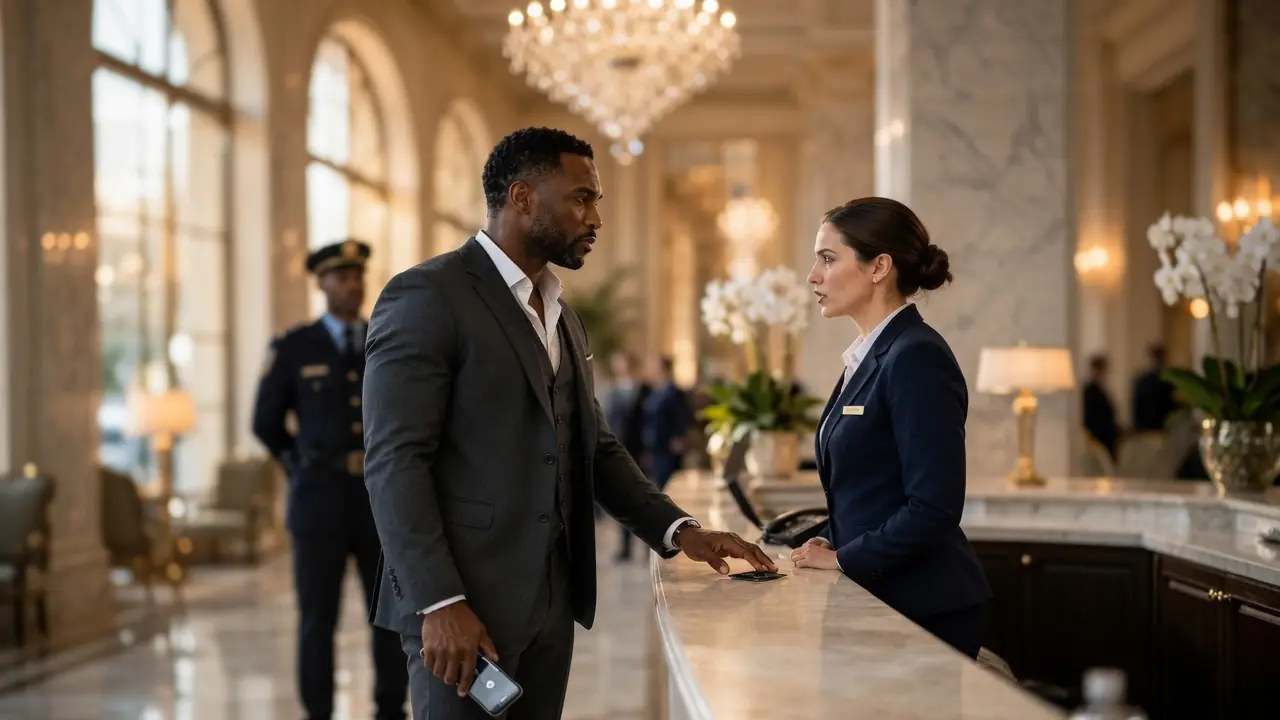
Vanessa Clarke stared at Marcus as though she could force the moment backward through willpower. At thirty-six, she had worked inside luxury hotels for more than a decade and had mastered the controlled smile employees used when they wanted a guest to feel corrected without appearing openly hostile. Her dark hair was pulled into a perfect bun, her navy uniform had no wrinkle, and her name badge identified her as the evening front-office manager. Yet the calm professionalism she usually wore had begun cracking around her eyes.
“Mr. Reed,” she said after finally reading the name displayed on the reservation screen, “there appears to have been a misunderstanding.”
Marcus did not lower his phone. “You did not know my name when you called security.”
“Our penthouse floor has enhanced verification requirements.”
“You didn’t verify anything.”
“I asked to see your reservation.”
“After the officer was already walking toward me.”
The security officer shifted behind Marcus. His name was Andre Lawson, and he had worked at the Halcyon for seven months after leaving the transit police. He had responded to Vanessa’s radio call expecting an aggressive trespasser, not a well-dressed guest standing motionless beside a valid key card.
Andre looked toward the radio clipped to his shoulder. “The call described a suspicious male refusing to leave the desk.”
Marcus turned slightly. “Did she mention that I had shown her a penthouse key?”
Andre hesitated. “No, sir.”
Vanessa’s jaw tightened. “Officer Lawson, this is not the time to discuss internal communications.”
“It became the time when you used those communications to turn me into a danger,” Marcus replied.
Before Vanessa could answer, the private elevator opened behind him. A gray-haired man in a tailored navy suit stepped into the lobby, followed by the hotel’s legal counsel and two executives carrying leather portfolios. Thomas Bell, the Halcyon’s general manager, had been waiting upstairs for Marcus for nearly twenty minutes.
Thomas saw the security officer first.
Then he saw Marcus’s phone.
His face lost color.
“Mr. Reed,” he said, moving quickly across the lobby. “We were expecting you in the penthouse conference suite.”
Marcus looked toward the wall clock. “Your manager was expecting someone. She simply didn’t believe that someone could be me.”
Thomas stopped beside the desk. “What happened?”
Vanessa answered immediately. “There was a reservation-verification concern. Mr. Reed became confrontational when I requested identification.”
Marcus turned the screen of his phone toward Thomas.
The recording began with Marcus approaching the desk and placing his black key card on the marble. He greeted Vanessa, explained that the penthouse elevator had failed to recognize the card, and asked whether she could reset it. Vanessa glanced at him, looked toward the lobby entrance, then quietly pressed the security button beneath the counter.
She never asked his name.
She never placed the card against the reader.
She did not open the reservation system until Andre entered the lobby.
Thomas watched the video without speaking. Vanessa’s voice continued from the recording, telling Marcus that private floors were restricted and suggesting he wait near the entrance until security confirmed why he was there. Marcus had remained calm throughout the exchange.
When the video ended, Thomas looked toward Vanessa.
“Step away from the desk.”
Her expression sharpened. “Thomas, I followed the security guidelines you approved.”
“I said step away.”
Vanessa removed her hands from the counter but did not move. “Before you make a decision based on appearances, you should know that several unauthorized visitors have attempted to access the penthouse floor this month.”
Marcus almost laughed at the irony.
“Appearances?” he asked.
Vanessa realized the word too late.
Thomas closed his eyes briefly. “Ms. Clarke, go to my office and wait there.”
She looked toward the guests watching from across the lobby. Public humiliation had replaced the authority she had exercised minutes earlier, and resentment hardened her voice.
“You are treating me like a criminal for protecting this property.”
“No,” Marcus said. “You treated me like a criminal because you decided I could not belong inside it.”
Vanessa walked toward the administrative corridor without answering. Andre remained near the counter, uncertain whether he had been dismissed.
Marcus stopped him before he left.
“You responded to the call you received.”
Andre nodded slowly. “That doesn’t make the call right.”
“No. But what you do next matters.”
Andre unclipped his radio. “The original transmission is recorded in the security system.”
Thomas looked at him. “Preserve it.”
“I already flagged it.”
That decision would later matter more than anyone in the lobby understood.
Marcus picked up his key card. He had traveled from Atlanta to Manhattan to complete the largest acquisition his company had attempted since its founding. Reed Hospitality Capital was scheduled to purchase a controlling interest in the Halcyon Grand at ten the following morning.
The hotel’s current owners needed the sale.
The Halcyon had once represented the height of old New York luxury, but revenue had fallen for three consecutive years. Guest complaints had increased, employee turnover had reached nearly forty percent, and two major corporate clients had moved their events elsewhere without giving public explanations.
Marcus believed the property could recover.
His board was less certain.
The final purchase agreement allowed Reed Hospitality to withdraw if any undisclosed legal, financial, or reputational liability appeared before closing. Until that evening, Marcus expected to sign without invoking the clause.
Now Thomas led him toward the private elevator while the acquisition lawyers followed in silence. The doors closed on the lobby, but the tension entered with them.
Thomas spoke first. “I cannot apologize strongly enough.”
“You can begin by not calling it an isolated misunderstanding.”
“I have never received a complaint accusing Vanessa of racial discrimination.”
Marcus looked at him. “Have you received complaints about her?”
Thomas did not answer immediately.
The elevator rose toward the penthouse floor. Marcus watched the numbers change above the door, thinking about how often institutions hid behind the exact wording of complaints. A guest might write that an employee was rude, suspicious, dismissive, or demanded unnecessary identification. Unless the guest used the word racism, management could pretend the pattern did not have one.
“Show me every complaint involving the front desk,” Marcus said.
“Our team already provided due-diligence records.”
“You provided formal legal claims.”
“That is standard.”
“I am no longer asking for the standard package.”
Thomas’s mouth tightened. “Some complaints contain private guest information.”
“My attorneys can review them under the acquisition agreement.”
The elevator opened into the penthouse conference suite. City lights stretched beyond the windows while a long table waited beneath recessed ceiling lights, prepared with contracts, financial reports, and an unopened bottle of champagne. Marcus had expected the evening to end with handshakes and a final review before signing.
Instead, he placed his phone in the center of the table.
“I want the complaint archive, security reports, employee exit interviews, and all guest incidents involving identity verification for the past five years.”
Thomas sat slowly. “You are considering delaying the closing.”
“I am considering whether your hotel has been hiding a liability.”
“We have never hidden a discrimination claim.”
Marcus leaned forward. “You keep choosing the narrowest possible sentence.”
The hotel’s legal counsel, Evelyn Shaw, opened one of her portfolios. “Mr. Reed, the purchase agreement requires disclosure of material litigation and regulatory investigations. There are none.”
“Then gathering the records should be easy.”
Evelyn looked toward Thomas.
That glance told Marcus there was more.
At eleven thirty, the first files reached the penthouse. They came from three systems that had never been compared: guest-service complaints, security incidents, and employee discipline records. Each department classified events differently, making patterns difficult to detect unless someone searched across all of them.
Marcus’s acquisition attorney, Daniel Kim, began building a timeline.
Within an hour, they found seven complaints involving Black guests questioned near elevators despite holding valid room keys. Four involved Latino guests asked to prove they were registered while waiting in the lobby. Two involved Middle Eastern families followed by security after entering through the restaurant.
Vanessa’s name appeared in nine of the reports.
Thomas read them with increasing discomfort. “I was told these were customer-service disputes.”
“Who told you?” Marcus asked.
“The previous director of operations.”
“Who reported to you.”
Thomas lowered his eyes.
One complaint came from Dr. Naomi Ellis, a Black cardiologist who hosted a medical conference at the Halcyon. Vanessa challenged her near the executive lounge and asked whether she was accompanying a registered guest. Dr. Ellis showed identification, a room key, and conference credentials before security allowed her upstairs.
The hotel offered her complimentary breakfast.
Another report involved a Black British couple celebrating their anniversary. They were questioned three times in two days while white guests passed the same checkpoints unchallenged. Management refunded one night and classified the complaint as “service inconsistency.”
The most recent incident occurred only three weeks earlier.
A Black father waiting for his teenage daughter near the ballroom was escorted outside because Vanessa said he made guests uncomfortable. His daughter had been inside receiving a scholarship from the hotel’s charitable foundation.
No one had told Thomas the full story.
Or perhaps, Marcus thought, Thomas had never asked questions that might force him to know.
Shortly after one in the morning, Andre arrived at the penthouse with the security audio. He placed a tablet on the table and played Vanessa’s call.
“Possible unauthorized individual at front desk,” her recorded voice said. “Male, approximately forty, refusing to explain his presence. Send someone before he attempts elevator access.”
Marcus listened twice.
He had explained his presence clearly.
Vanessa had rewritten reality before security arrived.
Andre placed another file on the screen. “This is not the first time she used that description.”
The radio system allowed searches by phrases. Andre had searched “unauthorized individual” and found twenty-six calls from Vanessa during the previous year.
Twenty-one involved people of color.
In fourteen cases, the guest possessed a valid reservation or was attending a registered event.
Thomas stood from the table and walked toward the windows. “Why did security never raise this?”
Andre’s expression remained controlled. “Some officers did.”
“What happened?”
“One transferred. Two resigned. I was told Ms. Clarke had management’s confidence and that questioning her judgment could be considered insubordination.”
Thomas turned. “Who told you that?”
Andre named the hotel’s security director.
Daniel added the name to his timeline.
The hidden problem was no longer one manager’s bias. It was a system that protected her decisions, discouraged employees from questioning them, and reduced injured guests to discounted meals and quiet refunds.
Marcus looked at the unsigned purchase agreement.
He had spent twenty-three years building a company because of a moment his father experienced in another hotel. Marcus was fourteen when his family drove to Washington for his sister’s graduation. His father entered the lobby first, carrying everyone’s bags while wearing work clothes from the factory.
A receptionist assumed he was a delivery driver.
Even after seeing the reservation, she directed him toward the service elevator. Marcus remembered his father’s face more clearly than the hotel itself—the controlled dignity, the refusal to give strangers the satisfaction of seeing the wound.
That night, his father said something Marcus never forgot.
“Luxury is often just comfort guarded by people who decide who deserves it.”
Marcus built Reed Hospitality around the opposite principle. His properties trained employees to verify behavior rather than belonging. Security could intervene when someone threatened others, entered restricted areas, or refused reasonable requests.
They could not treat someone’s identity as evidence.
At two fifteen, Vanessa entered the penthouse accompanied by hotel counsel. She had changed out of her uniform and wore a dark coat over plain clothes.
“I have been told you are reviewing incidents without giving me an opportunity to respond,” she said.
Marcus gestured toward an empty chair.
Vanessa remained standing. “I admit I should have asked your name first. I was under pressure, and your key card did not work.”
“You pressed the security button before testing it.”
“The penthouse level contains high-profile guests.”
“And I did not look like one?”
“I did not say that.”
“You didn’t have to.”
Vanessa looked toward Thomas. “Are you going to allow an outsider to destroy my career over one mistake?”
Marcus answered before Thomas could.
“I am not an outsider. At ten this morning, I was supposed to become the controlling owner of this hotel.”
For the first time, Vanessa appeared genuinely shocked.
Her eyes moved from Marcus to the purchase documents spread across the table.
“You’re the buyer.”
“I am the man whose name you decided you didn’t need.”
She sat down.
Thomas placed several complaint reports before her. “Did you handle these guests?”
Vanessa glanced through them. “I handled security concerns.”
“These people had valid keys.”
“Keys can be stolen.”
“Did you apply that suspicion equally?”
Her expression became defensive again. “Luxury hospitality depends on awareness. Guests pay to feel safe.”
Marcus opened a security report. “Dr. Ellis paid twelve thousand dollars for her conference suite. Did she deserve to feel safe from you?”
Vanessa’s lips parted, but no answer came.
“The father removed from the scholarship event,” Marcus continued. “Was his daughter safer watching security push him onto the sidewalk?”
“You are reducing complex situations to race.”
“No. You reduced people to race before the situations even began.”
Vanessa looked toward Andre. “He is providing incomplete information because he resents my authority.”
Andre did not react.
Marcus turned his phone toward her. “The recording is complete. Your radio calls are complete. The complaints were written by guests who never met one another, yet they describe the same treatment.”
“I followed what this hotel expected.”
The room became quiet.
Thomas stared at her. “What does that mean?”
Vanessa realized she had said too much.
She folded her hands. “It means management constantly emphasized protecting the brand, controlling lobby access, and preventing the property from attracting the wrong environment.”
“The wrong environment,” Marcus repeated.
“That phrase came from executive meetings.”
Thomas denied it immediately. “I never instructed anyone to profile guests.”
“You told us the lobby had to feel exclusive,” Vanessa said. “You praised managers who removed people before wealthy guests complained. You demanded fewer incidents and cleaner spaces but never asked how we achieved that.”
Thomas looked as though she had struck him.
Marcus believed both of them.
Vanessa had made biased decisions and defended them. Thomas had created pressure without examining how his vague demands were interpreted. Senior leaders preferred language such as exclusivity, standards, atmosphere, and brand protection because those words allowed discrimination to operate without announcing itself.
Responsibility did not belong to only one person.
At four in the morning, Marcus called an emergency meeting of Reed Hospitality’s acquisition committee. He recommended postponing the closing for thirty days while an independent civil-rights audit examined the Halcyon’s practices.
Two board members wanted to abandon the purchase entirely.
Marcus disagreed.
“If we walk away, the current ownership cuts costs, hides the files, and sells to someone who does not care,” he said. “The employees who spoke up lose their jobs, and the system survives under another name.”
“What are you proposing?” Daniel asked.
“We purchase only if the sellers fund restitution, accept independent monitoring, and remove every executive who suppressed complaints.”
“And Vanessa?”
“Suspended pending investigation.”
“What about Thomas?”
Marcus looked toward the general manager seated at the far end of the room. “Accountability cannot stop at the person standing behind the desk.”
By sunrise, the acquisition had changed.
The sellers agreed to reduce the purchase price and place fifteen million dollars into a restitution and reform fund. The hotel would contact guests whose complaints had been minimized, reimburse affected events, and offer independent mediation rather than silence agreements.
Thomas resigned before the announcement.
He did not claim innocence. In his resignation letter, he admitted that he valued the absence of public scandal more than understanding why complaints kept occurring. That failure allowed harmful behavior to become procedure.
Vanessa’s investigation uncovered more than bias against guests.
She had altered incident summaries, pressured employees to change reports, and rewarded security officers who removed people without documenting the reasons. She was dismissed and later faced a civil claim from several guests.
Andre became interim director of guest safety.
He replaced vague calls such as suspicious person with a required description of observable behavior. Employees could no longer request security intervention based solely on someone’s appearance, clothing, or perceived social status. Every identity-verification request was logged and reviewed for patterns.
Marcus did not name himself general manager or fill the lobby with executives from headquarters. He appointed Dr. Naomi Ellis—the physician once challenged outside the executive lounge—to chair an independent guest-equity council.
She accepted on one condition.
“No ceremony pretending the hotel has been cured.”
Marcus agreed.
The Halcyon reopened under Reed Hospitality management six weeks later. The chandeliers remained, the marble still gleamed, and the penthouse continued costing more per night than many people earned in a month.
But the meaning of luxury had changed.
Employees were trained to greet before judging, ask before assuming, and document before escalating. Security officers learned that protecting guests included protecting them from humiliation created by the hotel itself.
The woman who had watched from across the lobby during Marcus’s confrontation returned on opening day.
Her name was Patricia Grant. Two years earlier, another hotel questioned whether she belonged at her own daughter’s wedding reception. No one recorded the incident, and management dismissed her complaint because the employee denied making an insulting remark.
Patricia approached Marcus near the orchids.
“I saw what happened to you,” she said. “I kept thinking about how calm you were.”
“I wasn’t calm.”
“You looked calm.”
“That is something many of us learn to perform.”
She nodded slowly. “I wish someone had recorded mine.”
Marcus looked around the lobby. “You shouldn’t have needed a recording to be believed.”
Patricia joined the guest-equity council that afternoon.
Three months later, Marcus stood at the reception counter where Vanessa had called security. A new employee greeted him, asked how she could help, and tested his key card before requesting identification.
The card had expired.
She apologized, confirmed his reservation, and issued another without fear, suspicion, or unnecessary attention. It took less than sixty seconds.
Andre watched from across the lobby but never approached.
Marcus placed the new card in his wallet.
The hotel had not become perfect. Complaints still occurred, mistakes were still made, and bias did not disappear because a company printed new rules.
The difference was that nobody could bury the pattern anymore.
Every incident created a record. Every guest received an answer. Every employee had the right to question an order that treated identity as danger.
Marcus returned to the penthouse elevator, then paused before entering.
On the wall beside it hung a small plaque containing the Halcyon’s new service principle:
Ask who a person is before deciding where they belong.
There was no mention of Marcus, the acquisition, or the recording that forced the hotel to confront itself. He had refused to turn the incident into a monument to one powerful man.
The lesson mattered precisely because most people treated that way could not purchase the building afterward.
They should not need wealth, status, a recording phone, or a pending acquisition to receive dignity.
The elevator doors opened.
Marcus stepped inside, holding the black key card that had once failed to prove he belonged.
This time, no one tried to stop him.
More importantly, the hotel had finally begun asking why anyone had stopped him in the first place.