“The penthouse is for VIPs only,” Gerald Whitmore said, closing his hand over the key packet on the marble counter. “You need to leave.”
Naomi Ellison stood across from him in a tailored camel blazer, cream silk blouse, and dark-brown trousers, her structured leather briefcase resting beside the reservation documents. She had flown overnight from Singapore, crossed Manhattan traffic in the rain, and arrived twelve minutes before the check-in time printed on her confirmation. Yet the senior hotel manager had spent less than five seconds looking at her before deciding she did not belong. “I am the VIP,” she said.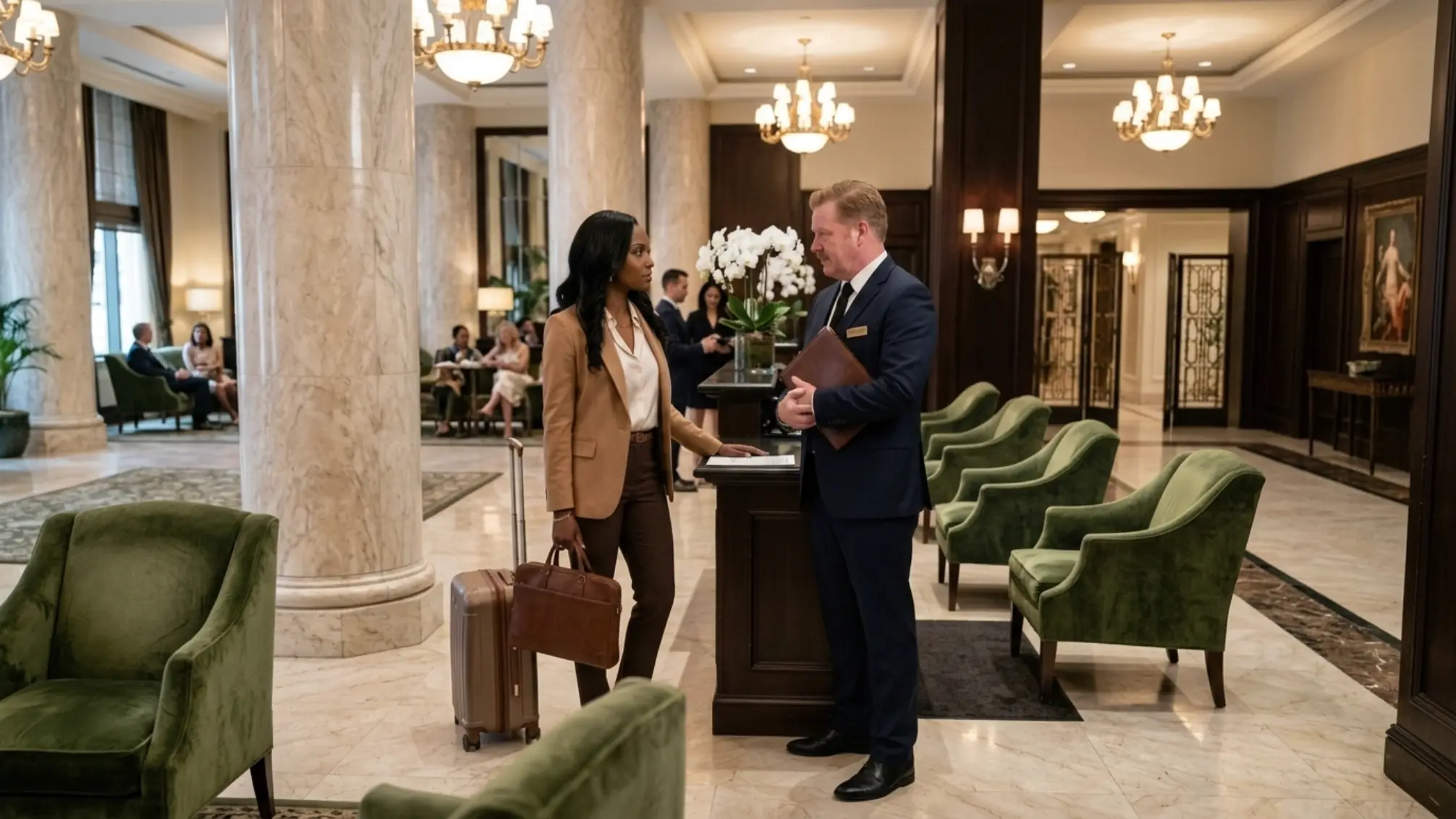
Gerald gave her a thin, contemptuous smile. “I’ve worked here twenty-two years. I know every VIP, and you’re not one.”
Naomi turned toward the young receptionist frozen behind the computer. “Call security. Have them remove his luggage, wine collection, and personal files from my penthouse. I’m the CEO.”
The receptionist’s fingers stopped above the keyboard.
Gerald stared at Naomi, waiting for the joke to reveal itself. Around them, the marble lobby of the Royal Hawthorne Hotel remained elegantly quiet, with crystal chandeliers glowing above velvet-green chairs and pale orchids arranged in silver urns. Wealthy guests continued drinking afternoon tea, though several had stopped speaking.
Then Gerald laughed.
It was not amusement. It was the nervous, dismissive laugh of a man who had built his authority around the belief that confidence could replace verification. He glanced toward Naomi’s briefcase, then at the simple gold earrings she wore, as if searching for evidence that her claim was ridiculous.
“You are not the chief executive officer,” he said. “Our CEO is arriving next week.”
Naomi looked at the reservation document lying between them. “Read the name.”
“I already did.”
“No, you looked at it. Read it.”
Gerald’s mouth tightened. He pulled the paper toward himself and glanced at the first line.
Guest: Naomi Elise Ellison.
The color beneath his fair skin changed slightly.
Naomi had become chief executive officer of Hawthorne International Hotels seventeen days earlier. She was also the largest individual shareholder in the company after leading a private investment consortium that acquired a controlling interest from the hotel group’s founding family.
The transition had been announced internally.
Her name, biography, and arrival schedule had been sent to every regional director, general manager, and senior department head. A confidential executive briefing instructed the Royal Hawthorne to prepare its penthouse for a seven-night operational review.
Gerald had received that briefing.
He had opened it at 8:14 on Monday morning.
Company records would later prove he deleted it twenty-three minutes afterward.
“I know the name,” Gerald said. “That doesn’t mean you are the person attached to it.”
Naomi’s expression remained calm. “Ask for identification.”
Gerald folded his arms. “Executive guests do not arrive without assistants, security, or advance staff.”
“I arrived without an audience because I wanted to see how this hotel treats people when no one important appears to be watching.”
“That sounds convenient.”
“It will be much less convenient for you.”
The young receptionist looked between them. Her nameplate read Maya Torres, and her face carried the strained expression of an employee who had seen Gerald behave this way before but understood the cost of challenging him.
Naomi met her eyes. “Please open the executive arrival file.”
Gerald turned sharply. “Do not access confidential records for an unidentified visitor.”
Maya lowered her hands.
Naomi noticed the reaction. Gerald had not simply given an instruction. He had reminded the receptionist that her employment depended upon obedience.
“Mr. Whitmore,” Naomi said, “where is the penthouse key?”
“The suite is unavailable.”
“My confirmation says it was inspected and released at eleven this morning.”
“There was a maintenance issue.”
“What issue?”
“Private guest matters are not your concern.”
“You just said it was maintenance.”
Gerald’s impatience became visible. “The details are irrelevant. Your alleged reservation cannot be honored.”
“Then why did you arrange an escort to remove me before checking my identification?”
Maya’s eyes widened.
Gerald had already pressed a silent service button beneath the counter. Two hotel security officers were walking across the lobby toward them.
“I arranged assistance because you refused to leave,” he said.
Naomi looked toward the approaching officers. “Perfect timing.”
The first security officer, Marcus Lane, was a broad-shouldered Black man in his forties who had worked at the hotel for nine years. The second was a younger white officer named Peter Doyle. Both stopped several feet from the counter.
Gerald pointed toward Naomi without introducing her. “Escort this woman to the street. She is impersonating an executive guest and attempting to access the penthouse.”
Marcus did not move.
He had attended the staff briefing three days earlier.
Unlike Gerald, he had read the entire document.
“Ms. Ellison?” Marcus asked.
Naomi nodded once. “Good afternoon.”
Gerald turned toward him. “You know her?”
“I recognize the CEO from the security file.”
The silence in the lobby became complete.
Maya slowly opened the executive arrival folder on her screen. Naomi’s official photograph appeared beside a biometric verification code, passport information, and a red banner identifying her as the chief executive officer and majority shareholder representative.
Gerald looked at the screen.
For the first time, his certainty disappeared.
“This information was not available earlier,” he said.
Maya’s voice trembled. “It has been active since Tuesday.”
“You were instructed not to open it.”
“No,” Naomi said. “You instructed her not to open it thirty seconds ago.”
Gerald looked toward the guests watching from the lounge. Humiliation was becoming public, and he understood public appearances better than honesty.
He changed his tone immediately.
“Ms. Ellison, there has obviously been a serious misunderstanding. We should continue this conversation privately.”
“You told security to escort me to the street publicly.”
“I was following established safety procedures.”
“Which procedure permits you to refuse identification?”
“You did not present yourself in the expected manner.”
Naomi’s eyes hardened. “What manner did you expect?”
Gerald did not answer.
She opened her briefcase and removed a slim black folder bearing the Hawthorne International seal. Inside were her executive credentials, the signed acquisition documents, and a temporary operational authorization approved by the board.
She placed the CEO identification card on the counter.
Gerald stared at it without touching it.
Naomi looked toward Marcus. “Is the penthouse occupied?”
The security officer hesitated.
That hesitation told her more than an immediate answer would have.
“Marcus,” she said quietly, “I am asking you directly.”
“Yes, ma’am.”
“By whom?”
“Mr. Whitmore’s sister and her husband arrived yesterday. Their luggage was taken upstairs through the service elevator.”
Gerald’s face tightened. “They are temporary guests.”
“Under whose reservation?”
“The suite was placed under management hold.”
Naomi turned toward Maya. “Was my booking canceled?”
“No, ma’am. It still shows confirmed.”
“Was another guest registered in the penthouse?”
“No.”
Gerald interrupted. “This is an internal hospitality arrangement. Senior managers have discretionary use of unoccupied premium inventory.”
“The suite was not unoccupied.”
“I believed your arrival had been postponed.”
“You deleted the executive briefing.”
His eyes flickered.
Naomi saw it.
She had spent twenty years negotiating acquisitions, identifying concealed liabilities, and watching executives react when conversations moved toward records they believed no one had examined. Gerald’s face had just admitted what his mouth had not.
“My office sent you three confirmations,” she said. “One came from corporate operations, one from the board secretary, and one from me.”
“I receive hundreds of emails.”
“You replied to mine.”
Gerald said nothing.
Naomi removed her phone and opened the message.
His response appeared beneath her executive signature:
Penthouse preparation confirmed. We look forward to welcoming you personally.
Maya covered her mouth.
Marcus lowered his eyes.
Gerald’s sister was not staying in the suite because of confusion. Gerald had knowingly taken the penthouse after confirming Naomi’s arrival, then decided he could remove her when she appeared without the entourage he expected.
Naomi turned toward Marcus. “Please have your team escort the unauthorized occupants to a standard room while the hotel determines whether they paid for their stay.”
Gerald stepped forward. “You cannot humiliate my family because of an administrative mistake.”
“I am not humiliating them. I am moving them from a suite they were never entitled to occupy.”
“They have unpacked.”
“Then pack their belongings carefully.”
Gerald’s voice rose. “That penthouse has been under my control for twelve years.”
The words escaped before he could stop them.
Naomi looked at him. “Your control?”
Gerald realized what he had said.
He clutched the leather guest folder more tightly. “I manage suite allocation.”
“You manage it on behalf of the hotel.”
“I built the VIP program in this property.”
“You do not own the guests, the rooms, or the building.”
“Without me, this place would collapse in a month.”
Naomi looked toward Maya. “Please call our regional compliance director.”
Gerald struck the counter with his palm. “Nobody calls anyone until I speak to corporate.”
Maya flinched.
Naomi did not.
“Mr. Whitmore, step away from the desk.”
“This is my lobby.”
“No,” Naomi said. “That is the mistake beneath every other mistake you made today.”
Marcus moved slightly closer, not threatening Gerald but making the shift in authority clear.
Gerald looked around the room for support. Several employees were watching from the concierge station and lounge entrance. None approached him.
He had ruled the Royal Hawthorne through seniority, intimidation, and the myth that twenty-two years of service made him more permanent than anyone above him. Department heads learned not to question his complimentary upgrades. Receptionists knew certain suites could never be offered without his approval, even when the reservation system showed availability.
He described the practice as relationship management.
In reality, Gerald had created a private business inside the hotel.
The penthouse was its center.
For years, he had provided unofficial stays to wealthy acquaintances, visiting politicians, luxury-brand representatives, and corporate executives who paid him through gifts, consulting fees, or favors. Some received free rooms in exchange for event contracts. Others paid discounted amounts to a separate company registered in his brother’s name.
The hotel absorbed the costs.
Gerald controlled the records.
Naomi had suspected something before she arrived.
Hawthorne International’s New York property reported unusually low penthouse occupancy despite frequent maintenance, housekeeping, and food-service charges. Complimentary stays were nearly three times higher than comparable hotels in the group. Several premium reservations had been downgraded without documented guest requests.
The financial loss exceeded $2.4 million over four years.
Yet the money was not Naomi’s only concern.
Guest complaints revealed a pattern.
A Black surgeon celebrating her anniversary was told the penthouse booking had been entered accidentally. A Nigerian energy executive was redirected to a standard suite despite providing confirmation. A Latina film producer received an escort to the lobby after Gerald accused her assistant of using a stolen corporate card.
Meanwhile, guests personally known to Gerald received premium rooms without proper authorization.
The complaints were closed internally.
Gerald signed most of the closure reports himself.
Naomi chose to conduct the inspection without advance staff because she wanted to observe the lobby before everyone prepared a performance for the new CEO.
She expected inefficiency.
She did not expect Gerald to provide the entire case within ten minutes.
Maya connected the regional compliance director through the hotel’s secure video system. Alana Brooks appeared on the monitor behind the desk, wearing a dark suit and a deeply concerned expression.
“Ms. Ellison,” Alana said, “we have been monitoring since security authenticated your arrival.”
Gerald looked toward the camera. “This is being misrepresented.”
Alana ignored him. “Your executive suite was overridden yesterday at 2:17 p.m. The override came from Mr. Whitmore’s credentials.”
Gerald’s mouth opened.
Alana continued. “The housekeeping note identifies his sister as a personal guest. No payment method is attached.”
Naomi asked, “How many suite overrides have used his credentials during the past twelve months?”
“We are running the report now.”
Gerald stepped toward the screen. “Those stays were approved relationship expenses.”
“Approved by whom?” Naomi asked.
“Previous leadership.”
“Name one executive.”
He named former regional president Charles Merrill.
Alana checked the archive.
“Mr. Merrill denied authorizing personal use of the penthouse in a sworn statement obtained during the preliminary audit.”
Gerald went still.
He had not known an audit was already open.
Naomi had begun it before accepting the CEO role. During acquisition due diligence, her team identified the New York property as a possible source of undisclosed financial and legal risk. Charles Merrill cooperated after investigators found his electronic signature on documents he said he had never seen.
Gerald had copied it.
Alana’s screen filled with new data.
“Forty-three management overrides in twelve months,” she said. “Twenty-eight lack payment records. Eleven correspond with guests connected to Whitmore Hospitality Advisory.”
Naomi looked at Gerald. “Your company?”
“It provides independent consulting.”
“From the hotel’s penthouse?”
“That is an absurd accusation.”
Alana continued. “The registered owner is Gerald Whitmore.”
Employees near the concierge desk began whispering.
Gerald’s face reddened. “This is confidential financial information. End the call.”
Naomi turned toward Marcus. “Please collect Mr. Whitmore’s company phone, access cards, keys, and hotel-issued computer.”
“You cannot seize my personal property.”
“Only company property.”
“I will not surrender anything without my attorney.”
“You may call your attorney after your access is disabled.”
Alana spoke from the monitor. “It already has been.”
Gerald pulled his phone from his pocket and attempted to open the management system. The screen displayed an access-denied message.
The man who had controlled the Royal Hawthorne for twenty-two years could no longer open his office door.
He looked toward Maya. “Give me your card.”
She stepped back.
“No, sir.”
It was the first time she had openly refused him.
Something inside Gerald broke.
“You ungrateful little receptionist,” he snapped. “I hired you when nobody else would. One call from me and you will never work in a luxury hotel again.”
Naomi moved between them.
“Threaten her again,” she said, “and the termination meeting becomes a security removal.”
Gerald stared at her. “You think buying shares makes you a hotelier?”
“No. Listening to employees does.”
“You know nothing about this property.”
“I know a guest with a confirmed reservation stood at your desk while you judged her face instead of checking the system.”
“I made one mistake.”
“You made forty-three overrides.”
“Numbers without context.”
“You redirected paying guests, closed complaints against yourself, forged approvals, and placed relatives inside my reserved suite.”
“Your suite?” Gerald repeated bitterly. “You haven’t slept one night here.”
Naomi looked around the lobby. “Neither have many guests who paid because you decided they were not important enough.”
Security officers arrived from the elevators with two rolling suitcases, three garment bags, a wooden wine case, and several personal storage boxes.
Gerald’s sister followed them, furious and confused.
“What is happening?” she demanded.
Gerald rushed toward her. “They are staging a corporate takeover.”
Naomi addressed the woman calmly. “The penthouse was reserved for an executive arrival. Your brother placed you there without registration or payment.”
“He said it was his private apartment.”
Every person nearby heard her.
Gerald closed his eyes.
Naomi looked at Marcus. “Please place the belongings in a secure room until ownership is documented.”
Gerald’s sister turned on him. “You told us the company gave you the suite permanently.”
“Not here,” he muttered.
“You made us fly from Boston for this.”
“Stop talking.”
The command only confirmed the abuse everyone had watched him direct toward employees.
His sister stepped away from him.
Compliance officers entered the lobby carrying sealed evidence bags. They secured Gerald’s laptop, management tablet, and guest-allocation folder. A forensic specialist began preserving the reservation system and camera recordings.
Naomi did not terminate Gerald immediately.
She suspended him pending investigation.
That distinction mattered because she wanted evidence, not revenge. A dramatic firing could feel satisfying but might allow him to claim the hotel acted before understanding the records. She wanted every altered booking, missing payment, forged signature, and buried complaint reconstructed.
Gerald was escorted from the building through the same lobby he had intended to use for Naomi’s humiliation.
He refused the side exit.
Perhaps he believed walking beneath the chandeliers would preserve some dignity. Instead, he passed employees who had spent years lowering their eyes when he approached.
This time, they watched him leave.
The investigation lasted ten weeks.
Whitmore Hospitality Advisory had received $1.3 million from individuals and companies that later stayed in premium rooms without payment. Gerald disguised the arrangements as marketing partnerships, executive familiarization visits, and service recovery.
Several guests testified that they paid him directly for access to suites officially listed as unavailable.
Others exchanged gifts.
One fashion executive provided Gerald’s wife with designer clothing. A wine distributor supplied more than $80,000 in rare bottles, some discovered inside the penthouse storage room. A real-estate developer paid for Gerald’s family vacation after receiving twelve complimentary nights during a major conference.
The personal benefits were extensive.
The discrimination was even harder to excuse.
Investigators recovered internal messages in which Gerald described certain guests as “unlikely luxury clients,” “misplaced bookings,” and “image risks.” He instructed receptionists to verify some customers repeatedly while allowing familiar white guests through without identification.
A message concerning Dr. Angela Morris, the Black surgeon, read:
Move her from the penthouse before regular clients see the assignment.
Another concerning the Nigerian executive said:
He may have money, but the optics are wrong for the upper floor this weekend.
Gerald denied racial prejudice.
The words remained in his own account.
Maya provided copies of complaints she had secretly preserved after Gerald ordered her to delete them. Other employees came forward once they learned the records were protected. Housekeepers described being told to clean the penthouse without logging occupancy. Bell staff carried luggage through service corridors to hide unauthorized guests.
A former receptionist named Leah Ford explained that Gerald fired her after she challenged a downgrade involving an Asian family.
He described her dismissal as performance-related.
Her employee evaluations had been excellent until the week she questioned him.
Naomi offered Leah reinstatement with restored seniority and compensation. Leah accepted a role in the group’s new guest-protection office instead.
Gerald was terminated for fraud, discrimination, records falsification, retaliation, and misuse of company property. Hawthorne International referred the findings to law enforcement and filed a civil action seeking repayment.
He eventually pleaded guilty to fraud-related charges after prosecutors presented financial transfers, falsified records, and testimony from former clients.
The hotel recovered part of the losses through seized accounts, insurance, and settlements with companies that had knowingly participated in the scheme.
Naomi made broader changes.
No single manager could override premium reservations without a second approval. Complimentary stays required written business justification and automatic quarterly review. Guest complaints involving discrimination or security removal went directly to an independent team outside the property.
Employees could report abuse anonymously.
Every security escort had to state a documented reason before approaching a guest, except during an immediate safety emergency.
The company also reviewed five years of downgraded reservations across all Hawthorne properties. Some cases reflected ordinary errors. Others revealed behavior resembling Gerald’s, though on smaller scales.
Naomi refused to describe the problem as one bad manager.
Systems that depended upon one person’s character needed redesign.
Maya became assistant front-office manager six months later. She initially declined the promotion because she feared colleagues would believe it was a reward for witnessing Gerald’s collapse.
Naomi told her it was not a reward.
“You protected a guest record after your manager ordered you not to open it,” she said. “Then you refused to give him your access card when he tried to misuse your authority. That is judgment under pressure.”
Maya accepted.
Marcus Lane became director of hotel security after helping create the new escort policy. He trained officers to approach conflicts as neutral fact-finders rather than instruments of whichever manager spoke first.
The Royal Hawthorne’s penthouse reopened after a complete inventory and forensic inspection.
Naomi stayed there for the remaining six nights of her original reservation.
She found personal photographs, clothing, wine, and financial files hidden behind a locked cabinet that Gerald had treated as private storage. After those items were removed, the suite felt strangely empty despite its size.
On her final evening, Naomi stood beside the windows overlooking Manhattan. Below, traffic moved between towers while the city reflected against the glass.
Maya delivered a handwritten letter from Dr. Angela Morris.
The surgeon had learned about the audit through the hotel’s apology team. Her former penthouse payment had been refunded, and the Royal Hawthorne invited her to return.
She declined the free stay.
Instead, she wrote:
I did not need a penthouse to prove I belonged. I needed the hotel to understand that its employee had no right to decide I did not.
Naomi placed the letter on the desk.
That sentence became part of the company’s leadership training.
One year later, the Royal Hawthorne lobby looked almost unchanged. The orchids remained beside the marble counter, the chandeliers still glowed above green velvet chairs, and guests continued arriving with expensive luggage and private drivers.
But the desk operated differently.
A young Black couple entered wearing jeans and carrying backpacks. They had saved for three years to spend their honeymoon in a junior suite. Maya welcomed them, verified their reservation, and congratulated them without assessing whether their clothing matched the price.
An elderly man arrived without identification and claimed to know the owner. Staff politely explained the verification process and applied it exactly as they would to anyone else.
No assumptions replaced records.
Naomi visited without advance notice.
She stood near the orchids for several minutes before Maya recognized her. The assistant manager smiled but continued helping the couple until their check-in was complete.
Naomi approved.
Leadership did not mean everyone abandoning guests when the CEO entered.
Before leaving, she walked past the reception counter where Gerald had closed his hand over her penthouse key.
He believed the suite belonged to people he recognized.
He believed twenty-two years inside the hotel gave him ownership over every room, employee, and guest who crossed the lobby. When Naomi arrived without an entourage, he decided she was an intruder and arranged an escort before checking her identification.
“The penthouse is for VIPs only,” he told her.
“I am the VIP,” she answered.
He laughed because he believed authority always looked familiar.
Three minutes later, security was carrying his possessions from the suite he had stolen, compliance was locking him out of the systems he had abused, and the employees he once frightened were finally watching the truth reach the lobby.
Naomi had booked the penthouse for one week.
Gerald booked her an escort to the street.
In the end, she kept the reservation.
He never entered the hotel again.