“Cole… is that really you?”
Eleanor Whitaker’s voice trembled so badly that she almost did not recognize it as her own.
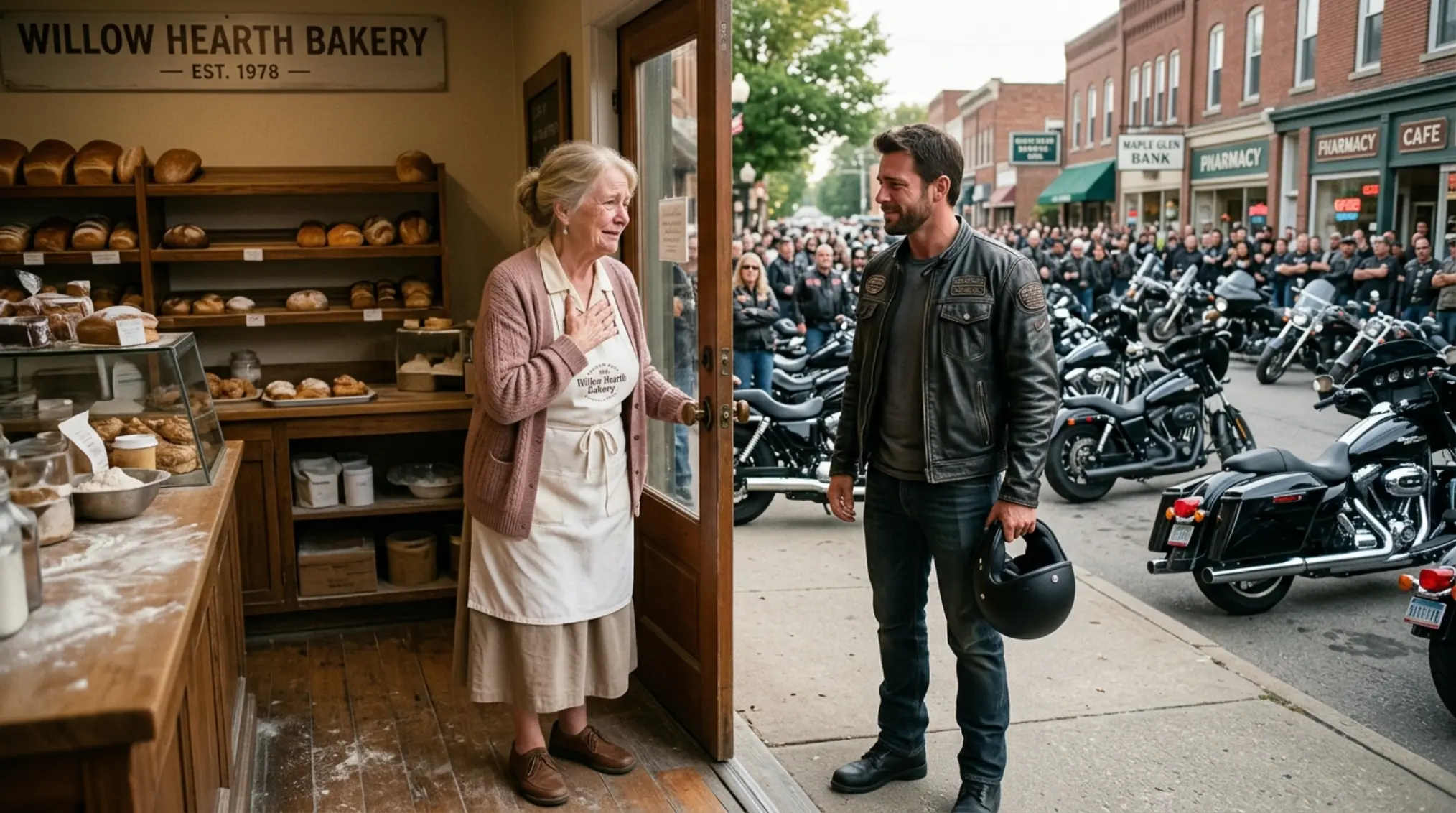
She stood just inside the open doorway of Willow Hearth Bakery in Maple Glen, Indiana, one hand pressed against the soft dusty-pink cardigan covering her chest. Morning sunlight spilled across the old wooden floor behind her, illuminating trays of cinnamon rolls, loaves of bread, and butter cookies she had arranged before sunrise as she had done nearly every morning for twenty-five years. Yet for once, Eleanor was not thinking about dough, ovens, customers, or the coffee she had forgotten to turn off.
She was staring at the man standing outside.
He looked nothing like the sixteen-year-old boy she remembered.
The frightened teenager had been painfully thin, wrapped inside an oversized coat with torn cuffs, his hair dirty from days without proper shelter, his eyes hollow from hunger and exhaustion. This man was thirty-seven now, broad-shouldered and strong, with short dark-brown hair, a neatly trimmed beard, and an old black leather jacket fitted across an athletic frame.
A black motorcycle helmet hung from one hand.
Behind him, Main Street had almost disappeared beneath motorcycles.
Rows of them.
Black touring bikes, cruisers, old custom machines, polished chrome reflecting morning light.
Eleanor had counted them through the bakery window before anyone stopped moving.
Ninety-seven.
And around those motorcycles stood riders in leather jackets and denim, men and women ranging from their twenties into their seventies. Some had gray beards. Some wore patched vests. Some held helmets under their arms.
All of them were silent.
Waiting.
The man outside the bakery looked directly at Eleanor.
Then he smiled.
“You told a hungry kid he mattered, Mrs. Whitaker,” he said softly. “I never forgot it.”
Eleanor’s breath caught.
Twenty-one years disappeared.
Suddenly she could see him again exactly as he had been.
Sixteen.
Cold.
Hungry.
Standing outside her bakery before sunrise.
The memory began on a bitter January morning when Maple Glen was buried beneath snow.
Eleanor had been forty-five then.
Her husband, Daniel, had died five months earlier after a sudden heart attack while repairing a loose railing behind the bakery. They had been married twenty-three years. Willow Hearth had been their dream, built from savings, borrowed money, and years of twelve-hour days.
After Daniel died, Eleanor nearly sold it.
Every corner reminded her of him.
The wooden front counter had been built by his hands.
The brass bell above the entrance had been something he found at an antique market.
The heavy wooden window frame overlooking Main Street still carried a tiny dent where he once dropped a hammer during renovations and blamed “structural personality.”
Even the bakery’s name had been his idea.
“A hearth is where people come when they need warmth,” Daniel had told her.
After his funeral, the word warmth felt cruel.
Still, Eleanor kept opening the bakery.
Not because she was brave.
Because she did not know what else to do.
Every morning at five-thirty she turned on the ovens.
At six-thirty she unlocked the front door.
And for hours she served everyone except herself the comfort she no longer knew how to feel.
Then, one morning in January, someone knocked at 5:48.
The front door was still locked.
Eleanor was alone behind the counter arranging cinnamon rolls.
The knock came again.
Softly.
Almost apologetically.
She looked toward the window.
A boy stood outside.
He wore a dark green coat several sizes too large and sneakers wet from snow. His hands were shoved beneath his arms because he had no gloves.
Eleanor approached cautiously.
The boy immediately stepped backward.
“I’m not looking for trouble,” he said through the glass.
She unlocked the door but did not open it completely.
“What do you want?”
The boy swallowed.
“I just haven’t eaten for a while.”
There was something about the way he said it.
No demand.
No performance.
No attempt to frighten her.
Only embarrassment.
Eleanor opened the door.
“Come inside before you freeze.”
The boy hesitated.
“You sure?”
“No, but come in anyway.”
That almost made him smile.
He entered carefully and stood on the mat as melting snow gathered beneath his shoes.
Eleanor looked him over.
He was perhaps sixteen.
Maybe seventeen.
His cheek was bruised.
His lower lip was cracked.
He looked exhausted enough to fall asleep standing.
“You aren’t going to ask questions?” he said.
“Not yet.”
“Why?”
Eleanor turned toward the kitchen.
“People need warmth before they need explanations.”
She cooked him eggs.
Not bakery food.
Real breakfast.
Three eggs scrambled with cheese.
Potatoes fried with onions.
Two thick slices of fresh bread with butter.
A bowl of vegetable soup left from the previous evening.
And one cinnamon roll.
The boy stared at the plate.
“This is for me?”
“Unless you see another freezing teenager sitting at that table.”
He sat.
At first he tried eating slowly.
That lasted less than a minute.
Then hunger took over.
Eleanor pretended not to notice.
She poured him coffee with more cream than coffee because she suspected he had never learned to like it properly.
When he finished his eggs, she added more potatoes.
When the bread disappeared, she sliced another piece.
Only after he had eaten most of the meal did Eleanor sit opposite him.
“What’s your name?”
The boy hesitated.
“Cole.”
She could tell instantly it was probably not his real name.
But she smiled.
“Then Cole it is.”
He looked surprised.
“You believe me?”
“I believe you want me to call you Cole.”
That answer seemed to confuse him.
For almost an hour, they spoke around the truth.
Eleanor learned he had been traveling.
He would not say from where.
He claimed he had friends somewhere south.
She doubted it.
He said he could handle himself.
She doubted that too.
Eventually he reached into his pocket and pulled out three crumpled dollar bills.
“For the food.”
Eleanor pushed his hand back.
“No.”
“I don’t want charity.”
“Good. This isn’t charity.”
“What is it?”
“Breakfast.”
He looked irritated.
“I can pay.”
“So can half the people who complain about my coffee.”
His mouth twitched.
“Take the money.”
“No.”
“Why?”
Eleanor studied him.
Because five months of grief had changed her.
Before Daniel died, she might have worried about the boy’s story, called someone, asked more questions, considered whether letting him inside was sensible.
Now she looked at this exhausted child and wondered how many adults had already decided he was somebody else’s problem.
“Because someday,” she said, “you’ll have more than three dollars.”
Cole looked down.
“And when that happens?”
“You help somebody else.”
He said nothing.
Eleanor leaned slightly closer.
“I don’t know what you’ve been through.”
His jaw tightened.
“I don’t need pity.”
“I didn’t offer any.”
That made him look up.
She continued.
“But I want you to remember something.”
“What?”
“You matter.”
The boy stared at her.
“Even if life has convinced you otherwise.”
For several seconds, he did not move.
Then he looked away so quickly Eleanor understood he was trying not to cry.
She let him.
Some wounds required privacy even when they happened directly in front of you.
Before leaving, Eleanor packed two sandwiches, three rolls, an apple, and another cinnamon bun into a paper bag.
Cole protested.
She ignored him.
At the door he turned.
“Why are you doing this?”
Eleanor looked toward the dent Daniel had left in the window frame.
“Because somebody should.”
Cole disappeared into the snow.
Eleanor never saw him again.
For twenty-one years.
At first she wondered about him often.
During the first winter, she watched for him whenever a teenager entered the bakery.
After a few years, the memory softened.
Eventually Cole became one of those stories she carried privately, a face attached to a question with no answer.
Did he survive?
Did he find somewhere safe?
Did he ever stop being hungry?
She hoped so.
That was all.
Until the motorcycles arrived.
Now the grown man standing outside Willow Hearth took one step toward her.
Eleanor whispered, “You came back.”
“I promised myself I would.”
“Twenty-one years is a long promise.”
“I had some things to fix first.”
She looked past him.
At the motorcycles.
At the riders.
“You brought all these people just to see me?”
Cole smiled.
“No, ma’am.”
His voice cracked slightly.
“I brought ninety-six people whose lives changed because you saved mine first.”
Eleanor covered her mouth.
Then Cole stepped inside the bakery.
For one second they simply looked at each other.
Then Eleanor threw both arms around him.
Cole froze.
The leather jacket, the beard, the motorcycles, the years vanished.
His eyes closed.
He hugged her back carefully.
“Thank you,” he whispered.
Eleanor began crying.
“You disappeared.”
“I know.”
“I worried.”
“I know.”
“You could have called.”
“I was ashamed.”
She pulled away.
“Ashamed of what?”
Cole looked toward the bakery tables.
“Can we sit?”
The ninety-six riders remained outside.
Nobody complained.
Inside, Eleanor poured coffee neither of them touched.
Cole placed his helmet on the table.
“My real name is Cole Mercer.”
Eleanor smiled faintly.
“So you actually told me the truth.”
“Only about that.”
He stared at his hands.
His mother had died when he was fourteen.
His father, already struggling with alcohol, disappeared months later after eviction notices began arriving.
Cole moved between relatives.
Then shelters.
Then friends’ couches.
Eventually those couches disappeared too.
At sixteen, he ran.
The bruise Eleanor had seen came from an older teenager at a temporary camp who tried stealing the little money Cole carried.
“I had eaten crackers the day before,” he said. “Nothing before that for almost two days.”
Eleanor’s eyes filled again.
“You should have told me.”
“I didn’t trust anybody.”
“But you came inside.”
“You had cinnamon rolls.”
She laughed.
He smiled.
Then his expression became serious.
“Your breakfast bought me another day.”
Eleanor shook her head.
“It was eggs.”
“No.”
He looked directly at her.
“It wasn’t.”
Cole left Maple Glen that morning and eventually reached Indianapolis.
There he found a mechanic named Samuel Price who owned a struggling motorcycle repair shop.
Sam caught Cole sleeping behind the building.
Instead of calling police, he offered him two options.
Leave.
Or sweep floors for breakfast.
Cole swept floors.
One breakfast became a week.
A week became a job.
By eighteen, he was rebuilding engines.
At nineteen, Sam helped him earn his GED.
At twenty-two, Cole became a certified mechanic.
At twenty-seven, he bought into the business.
When Sam retired, Cole took over.
But something else happened during those years.
“I started looking for people who reminded me of myself.”
Eleanor tilted her head.
“Hungry teenagers?”
“People who thought they didn’t matter.”
Cole began giving small jobs to teenagers leaving foster care.
Then men recovering from addiction.
Then former inmates trying to find legitimate work.
Then veterans struggling to rebuild normal lives.
Some stayed.
Some failed.
Some disappeared.
But enough succeeded that Cole kept doing it.
The shop expanded.
He opened a second location.
Then a third.
Eventually riders began gathering there, not as a formal club at first but as people connected by Cole’s habit of helping whoever arrived broken.
“You told me if I ever had more than three dollars, I should help somebody else.”
Eleanor stared at him.
“You remembered that?”
“Word for word.”
Outside, a motorcycle started briefly and then stopped.
Cole looked toward the window.
“The man standing beside the blue touring bike is Aaron. He showed up at my shop eight years ago after sleeping in his truck for three months.”
Eleanor followed his gaze.
“He works for you?”
“He owns one of the shops now.”
Cole pointed toward another rider.
“Woman with the gray helmet? Denise. Her son died. She stopped leaving her house. Aaron convinced her to ride with us. She now runs a grief-support program.”
Another.
“Big guy near the streetlamp is Malik. I gave him his first job after prison when nobody else would.”
Another.
“Old man with the red bike is Tom. He’s the one who gave Malik a place to stay.”
Eleanor looked across the street.
Connections.
One kindness creating another.
Then another.
Then another.
Her throat tightened.
“All because I fed you breakfast?”
Cole shook his head.
“Because you looked at me when I thought I was invisible.”
He reached into his jacket.
“I brought something.”
From an interior pocket he removed an old folded piece of paper protected inside a clear sleeve.
Eleanor recognized it immediately.
Willow Hearth Bakery’s old brown paper bags had once carried a small printed logo near the bottom.
This was a torn section of one.
Across it, in Eleanor’s handwriting, were five words.
YOU MATTER. DON’T FORGET THAT.
Her hand flew to her mouth.
“I wrote that?”
“You put it inside the food bag.”
She did not remember.
Cole did.
“I carried it in my wallet until it nearly fell apart.”
Eleanor touched the plastic sleeve.
“You kept this twenty-one years?”
“Every day.”
That broke whatever restraint remained.
Eleanor cried.
Cole moved beside her.
For several minutes there were no motorcycles, no bakery customers, no curious townspeople.
Only an elderly woman and the hungry boy who had finally returned.
Eventually Eleanor wiped her face.
“You still haven’t explained ninety-seven motorcycles.”
Cole laughed.
“That part is their fault.”
Two weeks earlier, he told Aaron he planned to return to Maple Glen.
Aaron asked why.
Cole told him about Eleanor.
Then Aaron told Denise.
Denise told Malik.
Malik told Tom.
By the following evening nearly everyone connected to Cole’s shops and riding community wanted to come.
“I told them this was supposed to be quiet.”
Eleanor looked outside.
“You are apparently terrible at quiet.”
“That’s what they said.”
Cole stood.
“There’s another reason.”
Eleanor narrowed her eyes.
“What did you do?”
“Why does everyone ask me that?”
“Experience.”
He led her outside.
Main Street had transformed.
Residents lined the sidewalks.
Shop owners stood in their doorways.
Children stared at motorcycles.
The ninety-six riders formed a loose semicircle around Willow Hearth.
Cole walked Eleanor toward the bakery’s brick side wall.
For several years, Eleanor had struggled financially.
Big chain cafés had opened near the interstate.
Ingredient prices rose.
The bakery roof needed repair.
One oven failed twice that winter.
Eleanor had never told Cole any of this.
But he had researched the bakery before coming.
And discovered Willow Hearth was quietly approaching closure.
A contractor stepped forward.
Eleanor looked suspicious.
“Cole.”
“Before you say no…”
“No.”
“You don’t even know.”
“I know your face.”
The riders laughed.
Cole continued.
“These people pooled money.”
“No.”
“We aren’t giving you cash.”
“No.”
“You cannot reject something until I finish the sentence.”
“Watch me.”
He smiled.
“The roof is being replaced.”
Eleanor stared.
“Both ovens are being serviced.”
“Cole.”
“The front windows are being repaired.”
“Cole Mercer.”
“And the landlord accepted payment for the next year.”
Eleanor looked ready to hit him.
“You had no right.”
“You fed me without permission.”
“I fed you eggs.”
“And ruined my entire philosophy of minding my own business.”
Everyone laughed.
Eleanor tried staying angry.
She failed.
Then Aaron rolled forward a large wooden sign.
Freshly carved.
WILLOW HEARTH BAKERY
PEOPLE NEED WARMTH BEFORE THEY NEED EXPLANATIONS
Eleanor stared at the words.
“You remembered that too?”
Cole smiled.
“Some mornings change your entire life.”
The renovation took three days.
The riders did much of the work themselves.
Roofers among them replaced shingles.
Painters restored the faded rear wall.
Electricians repaired old wiring.
A carpenter rebuilt the damaged window frame while carefully preserving Daniel’s hammer dent because Eleanor insisted it stay.
The town joined them.
Someone brought lunch.
A local hardware store donated supplies.
High school students helped clean.
By Friday, Willow Hearth looked renewed without losing what made it Eleanor’s bakery.
But Cole saved one surprise for last.
Early Saturday morning, before opening, he arrived alone.
Eleanor was placing cinnamon rolls into the display.
“Sit.”
“No.”
“Please.”
“That depends on whether you brought another contractor.”
He laughed.
“No contractor.”
From a bag he removed a small framed photograph.
Eleanor frowned.
It showed Willow Hearth twenty-one years earlier.
Snow covered the sidewalk.
A sixteen-year-old Cole stood near the doorway holding a paper bag.
Eleanor was visible behind the glass.
She stared.
“Who took this?”
“I spent years wondering.”
He flipped the frame.
Written on the back:
Daniel Whitaker — January 17
Eleanor stopped breathing.
“That’s impossible.”
Cole looked confused.
“Daniel died before I met you.”
Eleanor took the frame with shaking hands.
Then she understood.
Daniel had owned an old automatic street camera he occasionally used to photograph seasonal storefront displays. Before he died, he had positioned it behind the bakery window, intending to create a time-lapse project of winter mornings.
Eleanor had forgotten completely.
Months after his death, she packed his photography equipment into storage.
Cole’s appearance that morning must have triggered one of the automatic photographs.
Eleanor stared at Daniel’s handwriting.
For twenty-one years, the image had apparently remained inside a box of undeveloped film later donated during a storage cleanout. Cole had located it only because a retired photography-shop owner recognized the bakery and contacted him after hearing why the riders were coming to town.
Eleanor traced Daniel’s name.
The coincidence felt impossible.
Her husband, gone before Cole arrived, had somehow left behind a picture connecting the two people his bakery had brought together.
Cole sat beside her.
“Your husband built this place to give people warmth.”
Eleanor cried quietly.
“I stopped believing that mattered after he died.”
Cole looked toward the renovated bakery.
“It mattered to me.”
At six-thirty, Eleanor unlocked Willow Hearth.
Ninety-seven riders were waiting outside.
She served every one of them breakfast.
Nobody was allowed to pay.
Cole tried.
Eleanor slapped his hand.
Some things never changed.
Before leaving, he stood at the door.
“You know I’m coming back.”
“You better.”
“Next month.”
“Bring fewer motorcycles.”
“I’ll negotiate.”
Eleanor smiled.
Then she pressed a paper bag into his hands.
Two sandwiches.
An apple.
Three rolls.
And one cinnamon roll.
Cole looked inside.
“You know I have money now.”
“I heard.”
“I own three shops.”
“Congratulations.”
“I can buy lunch.”
“I’m sure you can.”
He smiled.
“Then what’s this?”
Eleanor looked at the man he had become.
“For the road.”
Cole hugged her.
Outside, engines began starting one by one.
The sound rolled through Maple Glen like thunder.
But Eleanor was no longer frightened by it.
She stood in the doorway wearing her pink cardigan and white apron as ninety-seven motorcycles pulled slowly onto Main Street.
Each rider raised a hand.
Eleanor waved back.
Cole left last.
He stopped in front of the bakery.
For a moment, neither spoke.
Then he touched two fingers to his chest.
The old message.
You matter.
Eleanor did the same.
Cole rode away.
Years later, Maple Glen still told the story of the morning ninety-seven bikers arrived outside Willow Hearth Bakery.
People remembered the motorcycles.
The renovations.
The strange sight of tough-looking riders carrying lumber and fixing windows.
But Eleanor always corrected anyone who said Cole had returned to repay a meal.
“He didn’t owe me anything,” she would say.
Because the truth was larger.
Twenty-one years earlier, Eleanor believed she had given a hungry teenager breakfast.
What she had really given him was one morning in which the world did not reject him.
Cole carried that morning forward.
Into a motorcycle shop.
Into dozens of jobs.
Into second chances.
Into ninety-six other lives.
And eventually back to the little bakery where it began.
A kindness Eleanor barely remembered became the foundation of a community she never knew existed.
That was what amazed her most.
Goodness did not always return quickly.
Sometimes it disappeared down a snowy road carrying sandwiches in a paper bag.
Sometimes twenty-one years passed.
Then one quiet Tuesday morning, it came roaring home.