Three-year-old Sophia Lopez stood barefoot in the middle of the marble kitchen, holding an empty white bowl with both tiny hands. Her dark hair was tangled from sleep, her pink shirt was wrinkled, and her eyes carried the quiet fear of a child who had learned not to ask too loudly. The kitchen around her was larger than the entire apartment she shared with her mother, full of polished counters, shining copper pans, fresh flowers, and food she had been told not to touch. Morning sunlight poured through the tall windows, but Sophia looked cold under it.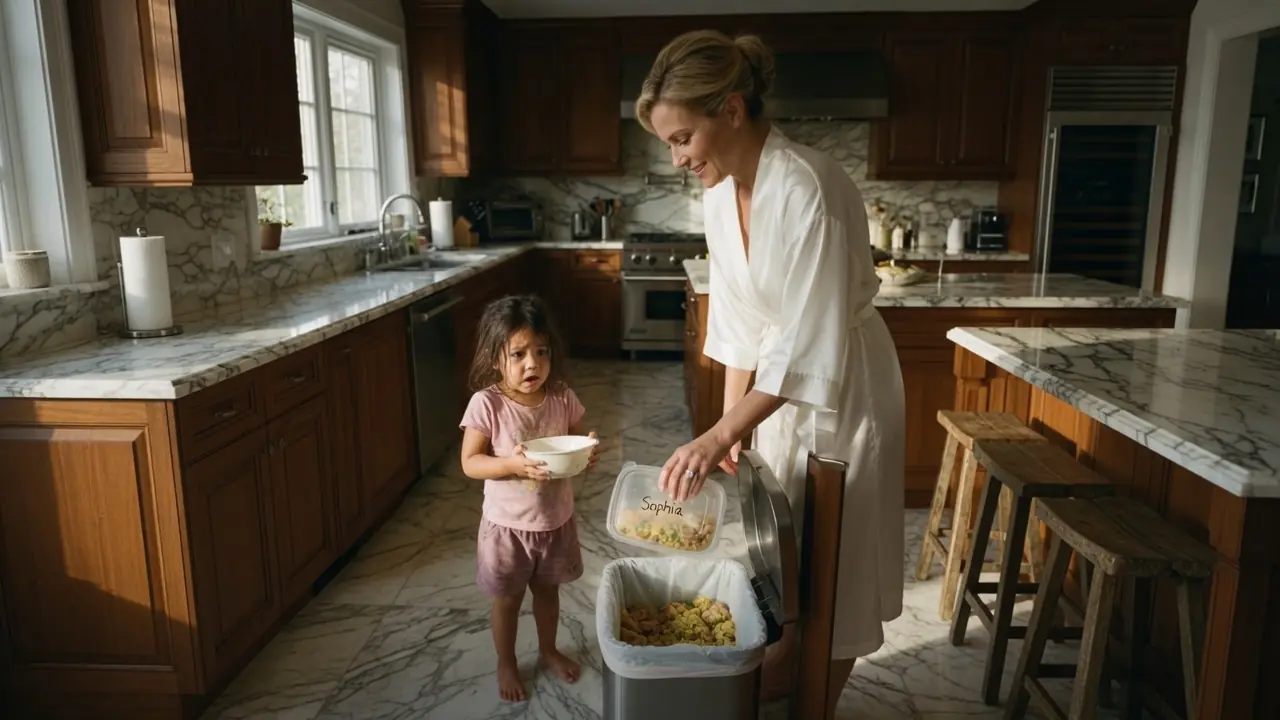
Vanessa Cole turned slowly from the refrigerator, wearing a white silk robe, diamond earrings, and a smile that never reached her eyes. In her hand was a small plastic container with Sophia’s name written across the lid in black marker. Maria Lopez had packed it before sunrise, just like she did every morning before starting work in the mansion. Inside were rice, vegetables, and a few pieces of chicken, saved carefully from the night before.
Vanessa looked at the container, then at the little girl. “This food is for people who belong here,” she said coldly, “not a maid’s child begging in my kitchen.”
Sophia’s fingers tightened around the bowl. “Mama packed that for me…”
Vanessa stepped closer to the trash bin and lifted the lid with one perfectly manicured hand. “Then let your mother feed you somewhere else.”
The container dropped into the garbage with a dull, final sound. Sophia stared at it as if she could not understand how something with her name on it could disappear so easily. Her lower lip trembled, but she did not cry. Crying made adults angrier, and she had learned that lesson far too young.
Across the hallway, Maria Lopez was scrubbing a stain from an expensive linen tablecloth, unaware that her daughter’s lunch had just been thrown away. She worked in the laundry room with sleeves rolled up, her hair tied back, and her hands cracked from soap and hot water. Every few minutes, she glanced toward the hallway, listening for Sophia’s voice. The mansion was beautiful, but lately it had begun to feel like a place full of closed doors.
Maria had worked for billionaire Daniel Hayes for almost two years. When he hired her, she had been honest from the beginning: she was a single mother, she could not afford daycare, and she had no family nearby to help. Daniel had listened quietly, then looked down at Sophia sleeping in Maria’s arms and said, “A child should never pay for an adult’s struggles.” From that day, he allowed Sophia to stay in a small staff sitting room while Maria worked.
For a while, the mansion had felt safe. The chef sometimes gave Sophia fruit. The gardener let her watch butterflies near the roses. Daniel himself would smile when he passed her in the hall and ask if she was guarding the house for him. Sophia, too shy to answer, would hide behind Maria’s skirt and nod.
Everything changed when Vanessa Cole moved in.
At first, Maria told herself she was imagining things. Vanessa would complain that Sophia’s shoes made noise, even when the child was sitting still. She would ask why Maria needed “special treatment” just because she had a daughter. She would smile sweetly whenever Daniel was home, then turn sharp and cold the second his car left the driveway.
Then Sophia’s food began disappearing.
The first time, Maria thought she had forgotten to pack it. The second time, she blamed herself for leaving it in the wrong refrigerator. By the fifth time, she knew. Every container with Sophia’s name was gone before lunchtime, and every afternoon Sophia came to her with a pale little face and whispered, “Mama… I’m hungry.”
Maria started hiding crackers in her apron pocket. She packed extra food in two containers instead of one. She placed one in the staff refrigerator and one behind a cleaning basket in the pantry. Somehow, even those disappeared, and Vanessa always seemed to be nearby afterward, smiling as if she had won a private game.
Maria wanted to confront her, but fear held her tongue. She needed that job. Rent was due every month whether Sophia ate well or not. The tiny apartment they lived in had bad heating, a broken window latch, and a landlord who had already warned Maria not to fall behind again.
So Maria worked harder. She arrived earlier, stayed later, polished floors until they reflected the chandeliers, and folded towels so perfectly even the house manager praised her. At night, she carried Sophia home on the bus while the child slept against her shoulder, lighter than she should have been. In the dark apartment, Maria would sit beside her daughter’s bed and whisper apologies no child should ever need to hear.
Daniel Hayes did not know any of this. He was overseas in London, closing the largest medical technology acquisition of his career. At forty-six, Daniel was known for being controlled, disciplined, and almost impossible to surprise. He had built Hayes Global Holdings from a small software company into a business empire, but people close to him knew his public calm came from a private rule: protect those who depend on you.
That was why his chief financial officer, Rachel Kim, hesitated before calling him.
Daniel had just stepped out of a conference room overlooking the Thames when his phone rang. Rachel rarely called unless something mattered, and her voice was tight in a way that made him stop walking. “Daniel,” she said, “there are financial irregularities connected to Vanessa’s charity account.”
He frowned. “What kind of irregularities?”
“Large transfers. Questionable invoices. Personal expenses routed through foundation vendors.” Rachel paused. “But that is not the biggest problem.”
Daniel’s grip tightened around the phone. “Then what is?”
“You need to watch your home kitchen security footage.”
The sentence made no sense at first. Months earlier, after an attempted burglary at a neighboring estate, Daniel had quietly installed hidden cameras throughout the mansion. They covered entrances, hallways, service areas, storage rooms, and the kitchen. He rarely reviewed the footage, and the system was meant for safety, not suspicion.
Rachel sent him a secure link.
Daniel stepped into a private office and opened the video. The timestamp showed that morning, 8:17 a.m., inside his kitchen. At first, all he saw was Sophia standing with her empty bowl. Then Vanessa entered the frame, took the container from the refrigerator, and spoke.
Daniel turned up the volume.
“Ma’am… I’m hungry,” Sophia whispered on the recording.
Vanessa’s answer came clearly through the speakers. “This food is for people who belong here, not a maid’s child begging in my kitchen.”
Daniel did not move.
He watched Vanessa throw the container away. He watched Sophia stare at the trash bin. He watched the child stand frozen, clutching the bowl, while Vanessa bent down and said something that made the little girl lower her head.
The video continued for another minute. Vanessa left the kitchen. Sophia remained there, silent and small beneath the high ceiling, then slowly walked toward the hallway with her empty bowl still in her hands. Daniel paused the footage, but the image stayed on the screen like an accusation.
Rachel’s voice came through the phone. “Daniel?”
He swallowed once. “How long?”
“I checked random dates from the last three weeks,” Rachel said quietly. “It happened more than once.”
Daniel closed his eyes. He thought of Maria working quietly in his house, never asking for more than a fair paycheck and a safe place for her daughter. He thought of Sophia hiding behind her mother’s skirt, shy and gentle. He thought of Vanessa smiling at charity dinners, speaking about compassion while denying food to a three-year-old in his own kitchen.
“Cancel my meetings,” he said.
“Daniel, the acquisition closes tomorrow.”
“No,” he said. “This closes today.”
He boarded the first flight home.
By the time Daniel’s plane landed in New York, Vanessa had already ordered the staff to prepare for his return dinner. She moved through the mansion as if she owned it, giving sharp instructions, rearranging flowers, criticizing table settings, and telling the chef not to “overfeed the staff.” Maria kept her head down and worked, but anxiety pressed against her ribs. Sophia had been quiet all afternoon.
In the staff sitting room, Sophia sat on a small chair holding a stuffed rabbit Daniel had given her months earlier. Maria had managed to sneak her a piece of bread and banana, but the child still seemed tired. Every time footsteps passed the door, Sophia flinched. Maria saw it and felt something inside her harden.
She had once believed silence was protecting them. Now she wondered if silence was teaching Sophia that cruelty was normal.
At 6:12 p.m., Vanessa entered the kitchen again. Maria was wiping the island counter, and Sophia stood near the pantry door with her rabbit tucked under one arm. Vanessa’s eyes went straight to the child.
“Why is she still here?” Vanessa asked.
Maria set the cloth down. “I’m almost finished, ma’am.”
“That is not what I asked.”
Maria took a breath. “She is with me until my shift ends.”
Vanessa smiled thinly. “This is a mansion, Maria. Not a shelter.”
Sophia stepped closer to her mother.
Maria’s voice remained respectful, but it no longer trembled. “Mr. Hayes allowed her to be here.”
“Daniel is too generous with people who confuse kindness for entitlement.”
Maria looked down, fighting the urge to answer. She thought of rent, bills, bus fare, Sophia’s shoes, and the little envelope of savings hidden under her mattress. Vanessa saw the hesitation and enjoyed it. Power, to her, was making someone swallow words they had every right to say.
Then Sophia whispered, “Mama, I’m hungry.”
Vanessa turned her head slowly. “Again?”
Maria’s face changed. “Sophia, come here.”
But Vanessa had already opened the refrigerator. She took out a fresh container Maria had packed and placed it on the counter. For a second, Maria saw proof in plain sight. Her daughter’s name. The food she had prepared. Vanessa’s hand resting on it like she had a right to decide whether Sophia deserved it.
“Please don’t,” Maria said.
Vanessa smiled. “Please don’t what?”
“Please don’t take her food.”
Vanessa lifted the container. “Then perhaps you should feed your child at home instead of bringing her hunger into Daniel’s house.”
Maria stepped forward. “That food is mine. I brought it.”
“And this kitchen is not yours.”
Sophia began to cry softly, not loudly, not dramatically, just a small broken sound that made Maria’s heart twist. Vanessa turned toward the trash bin again.
That was when Daniel Hayes appeared in the doorway.
He was still wearing his travel coat. His tie was loosened, his face pale from the long flight, and his phone was in his hand. On the screen was the paused security footage from that morning. His eyes moved from Vanessa’s hand to the container, then to Sophia’s empty bowl sitting on the counter.
“Pick it up, Vanessa,” Daniel said.
Vanessa froze.
Maria turned so fast she nearly dropped the cloth. “Mr. Hayes…”
Daniel did not look away from Vanessa. “Pick it up, and explain why my cameras watched you treat a three-year-old this way in my home.”
The kitchen went silent.
Vanessa recovered quickly, or tried to. She lowered the container onto the counter and gave a shaky laugh. “Daniel, you misunderstood. I was just trying to keep boundaries. Maria has become too comfortable bringing her child into staff areas.”
Daniel stepped fully into the kitchen. “I watched the footage.”
Her smile faltered. “A clip can look worse than it is.”
“I watched three weeks.”
The color drained from Vanessa’s face.
Daniel walked to the trash bin and opened it. Inside, beneath a paper towel, was Sophia’s container from that morning. He lifted it out carefully, not because the food could be saved, but because evidence deserved to be treated with more respect than Vanessa had shown the child. He placed it on the counter beside the fresh one.
Sophia hid behind Maria’s leg.
Daniel crouched slowly, lowering himself to Sophia’s level. His voice changed completely when he spoke to her. “Sophia, I’m sorry.”
The little girl looked at him with frightened eyes.
“No one should have taken your food,” he said. “Not in my house. Not anywhere.”
Sophia’s lips trembled. “I didn’t touch the big food.”
Daniel’s eyes filled with anger, but he kept his voice gentle. “You did nothing wrong.”
Maria covered her mouth with one hand. For weeks, she had been waiting for someone to say those words, but she had not realized how badly she needed to hear them until they were spoken. Daniel stood slowly and turned back to Vanessa.
“You knew she was hungry.”
Vanessa straightened. “Daniel, you’re being emotional.”
“No,” he said. “I am being clear.”
She lowered her voice. “You cannot seriously take the side of the housekeeper over me.”
Daniel’s expression turned colder than Maria had ever seen. “That sentence tells me everything.”
Vanessa’s eyes flicked toward Maria with hatred. “She probably staged this. You know how people like her are when they see money.”
Maria flinched.
Daniel stepped closer to Vanessa. “Do not finish that thought in my kitchen.”
Vanessa looked genuinely stunned, as if she had never imagined Daniel’s kindness could become a wall against her. “I am your fiancée.”
“You were.”
The word struck harder than a shout.
Vanessa stared at him. “Excuse me?”
Daniel removed the engagement ring box from his coat pocket. Maria had not even noticed he was holding it. Perhaps he had brought it from London, intending to finalize wedding plans after the acquisition. He placed it on the counter without opening it.
“This engagement is over,” he said.
Vanessa laughed once, high and panicked. “Over? Because of a maid’s child?”
“Because you showed me who you are when you thought no one important was watching.”
The kitchen door opened behind him. Rachel Kim entered with Daniel’s head of security, the house manager, and the family attorney. Vanessa looked at them, and for the first time, fear replaced arrogance.
Rachel placed a folder on the counter. “We have preserved the footage and documented the financial transfers.”
Vanessa’s mouth tightened. “This is absurd.”
Daniel looked at the head of security. “Escort Ms. Cole to the west sitting room. She may collect personal belongings under supervision. She is not to enter staff areas again.”
Vanessa’s voice rose. “Daniel, you will regret humiliating me.”
Daniel glanced at Sophia, then back at Vanessa. “No. I regret not seeing sooner who you were humiliating.”
Security led Vanessa out.
The kitchen seemed to breathe again after she was gone. Maria stood rigid, unsure whether to apologize, explain, cry, or ask if she still had a job. Sophia clung to her skirt with one hand and held the stuffed rabbit with the other. Daniel turned to them, and his voice softened.
“Maria, I failed you.”
She shook her head quickly. “No, sir. I should have told you.”
“You were afraid.”
Maria looked down. “I need this job.”
“I know,” Daniel said. “That is why fear should never have been used against you here.”
He asked the chef to prepare a warm meal for Sophia immediately, then had Rachel call a pediatrician to check on the child privately and gently. Maria tried to protest, saying it was too much, but Daniel stopped her with a raised hand. “It is not too much,” he said. “It is overdue.”
Sophia ate at the small kitchen table while Maria sat beside her. She ate slowly at first, watching the adults as if someone might take the plate away. Daniel saw that and had to turn toward the window for a moment. Money had given him houses, planes, staff, influence, and every convenience imaginable, but none of it had stopped cruelty from entering his kitchen through someone he trusted.
Later that night, after Sophia fell asleep in a guest room with Maria beside her, Daniel sat in his study with Rachel and the attorney. They reviewed the footage, the financial records, and the complaints staff members had quietly made but never pushed forward. Vanessa had not only targeted Maria. She had mocked the gardener, delayed overtime payments through petty disputes, blamed broken items on staff, and used Daniel’s absence as permission to rule the house through fear.
Daniel listened without interrupting.
When Rachel finished, he said, “Every staff member receives back pay for any withheld overtime. Every complaint is reviewed. Anyone Vanessa threatened is protected. And Maria’s employment record is cleared of every false note Vanessa placed there.”
The attorney nodded. “Understood.”
“And set up an education fund for Sophia.”
Rachel looked at him. “Daniel…”
“Not as charity,” he said. “As responsibility.”
The next morning, Maria woke in a guest room larger than her entire apartment. For a few seconds, she did not know where she was. Then she saw Sophia sleeping beside her, one hand curled around the stuffed rabbit, her face finally peaceful. Maria sat up slowly and cried without making a sound.
A soft knock came at the door.
Daniel stood in the hallway with a tray of coffee, juice, toast, eggs, and fruit. He looked uncomfortable holding it, like a billionaire who had never delivered breakfast in his own house before. Maria rushed to stand, but he shook his head.
“Please,” he said. “Sit.”
She wiped her face. “Mr. Hayes, I’m sorry for all of this.”
“I don’t want to hear you apologize for being mistreated.”
Maria lowered her eyes.
Daniel set the tray on a small table. “I spoke with my attorney. Vanessa is gone. She will not be allowed back here. Her foundation accounts are frozen pending review.”
Maria nodded, still unable to trust good news all at once.
“And if you still want to work here,” Daniel continued, “you will receive a raise, a formal childcare stipend, and paid time each week to handle Sophia’s needs. If you do not want to stay, I will provide six months of severance and a strong reference.”
Maria stared at him. “You would still let me work here?”
Daniel’s face tightened with sadness. “Maria, you did nothing wrong.”
Sophia stirred and sat up, rubbing her eyes. When she saw Daniel, she hid slightly behind her mother’s arm. He gave her a small smile.
“Good morning, Sophia.”
She looked at the breakfast tray. “Is that for us?”
“Yes.”
“All of it?”
Daniel’s throat tightened. “All of it.”
Sophia looked at her mother for permission. Maria nodded, tears rising again. The little girl reached for a strawberry, then paused and looked at Daniel.
“Will the lady throw it away?”
Daniel knelt beside the bed. “No. She will never take food from you again.”
Sophia considered this with the seriousness only a hungry child can bring to food. Then she ate the strawberry.
In the weeks that followed, the mansion changed. Not in its furniture or chandeliers, but in its atmosphere. Staff spoke more freely. The house manager posted new rules for staff meals, child visitors, and reporting concerns. Daniel ordered the staff refrigerator moved from the service corridor into the main kitchen area, where no one could pretend not to see what happened to it.
Maria stayed, though it took time for her not to flinch when someone called her name. Sophia began spending part of the day in a sunny breakfast nook with books, crayons, and toys Daniel ordered without telling anyone. At first, she asked before eating anything, even snacks set directly in front of her. Slowly, with patience, she stopped asking every time.
Daniel also changed.
He worked from home more often. He ate in the kitchen twice a week instead of alone in the formal dining room. He learned the names of every staff member’s children. He asked questions not as a performance, but as a man ashamed that he had needed hidden cameras to see pain inside his own walls.
One afternoon, he found Sophia drawing at the kitchen table. She had drawn a big house, a small girl, and a tall man standing near a trash bin with an angry face crossed out in red crayon. Daniel sat across from her.
“Is that me?” he asked.
Sophia nodded.
“Why do I look angry?”
“Because the food went in the trash.”
Daniel looked at the drawing. “I was angry.”
Sophia picked up a yellow crayon. “But not at me.”
“No,” Daniel said softly. “Never at you.”
She added a yellow sun above the house. “Now it’s better.”
He smiled. “Yes. Now it’s better.”
Months later, Daniel hosted a private charity luncheon at the mansion. This time, the event focused on childcare support for domestic workers, fair household employment practices, and food security for children of low-income workers. Reporters wrote about the initiative, but Daniel refused to share Sophia’s name or turn her pain into publicity. He simply said, “A home is judged by how it treats the people with the least power inside it.”
Maria watched the speech from the kitchen doorway, holding Sophia’s hand.
Sophia looked up at her mother. “Is Mr. Daniel talking about food?”
Maria smiled through tears. “He’s talking about kindness.”
Sophia thought about that. “Kindness means nobody throws lunch away?”
Maria knelt and kissed her forehead. “That is a very good place to start.”
Vanessa tried to repair her reputation through friends, statements, and carefully worded excuses, but the footage and financial records ended her influence in Daniel’s life. Some people said Daniel overreacted. He did not answer them. Anyone who thought humiliating a hungry child was a small matter had already told him their opinion was worth nothing.
A year later, Sophia turned four in the mansion garden. Maria had planned a small cake, but Daniel surprised them with balloons, music, and a picnic table full of food for staff families. Sophia wore a yellow dress and ran across the grass with other children, laughing so loudly Maria had to cover her mouth to keep from crying. The sound was too beautiful after months of whispered hunger.
Daniel stood beside Maria, watching the children play.
“She looks happy,” he said.
Maria nodded. “She is.”
“I wish I had known sooner.”
Maria looked at him. “You know now.”
He accepted that, though forgiveness for himself came slower. He watched Sophia pick up a cupcake, take one bite, then hand the rest to another child without fear that there would never be more. That small gesture told him more than any doctor, report, or apology could. A child who once guarded crumbs now trusted abundance enough to share.
Years later, Sophia would not remember every detail of that morning in the kitchen. She would remember the white bowl, the cold voice, and the sound of the container hitting the trash. But she would also remember Daniel kneeling in front of her, telling her she had done nothing wrong. She would remember her mother’s arms around her. She would remember that the bad lady left and never came back.
Maria remembered everything.
She remembered fear. She remembered silence. She remembered the first time her daughter asked for food without whispering. And whenever she packed Sophia’s lunch after that, she wrote her daughter’s name on the lid not because she feared it would vanish, but because Sophia liked seeing proof that something belonged to her.
Daniel remembered the footage most of all.
Not because it exposed Vanessa, but because it exposed him too. It showed him the danger of assuming kindness existed simply because he intended it. It showed him that protection was not a speech, a policy, or a generous rule made once and forgotten. Protection had to be watched over, renewed, and strong enough to reach the smallest person in the room.
The mansion remained grand, with marble floors, tall windows, and chandeliers that sparkled at night.
But after Sophia, Daniel understood that a house was not made noble by what it cost.
It was made noble by who felt safe enough to eat there.