I came home from Hendersonville with a brown suitcase, tired knees, and the foolish comfort of believing my house had waited for me. Fifteen days away did not seem long enough for anything important to change. The hydrangeas Louis planted still leaned beneath the front windows, the porch swing still creaked in the afternoon air, and the brass key still turned in the lock the way it always had. For one brief second, I thought I was returning to peace.
Then I saw my bedroom.
The door was open, but the room behind it was not mine anymore. The walnut bed Louis and I had saved for during the first years of our marriage was gone. The cream walls I had painted after his funeral were covered in a flat gray that made the whole room feel colder. My wedding photo, my mother’s quilt, the small jewelry dish Lenora made in seventh grade, and the framed picture of Darien holding his first fish had vanished like they had never mattered.
I stood in the doorway with my suitcase still in my hand, staring at a white upholstered bed I had never seen before. Silver lamps sat on both nightstands, stiff curtains hung over the windows, and a glass desk stood where Louis’s old reading chair used to sit. The room looked expensive, clean, and empty in the way hotel rooms are empty. It had style, but it had no memory.
“What did you do to my room?” I asked.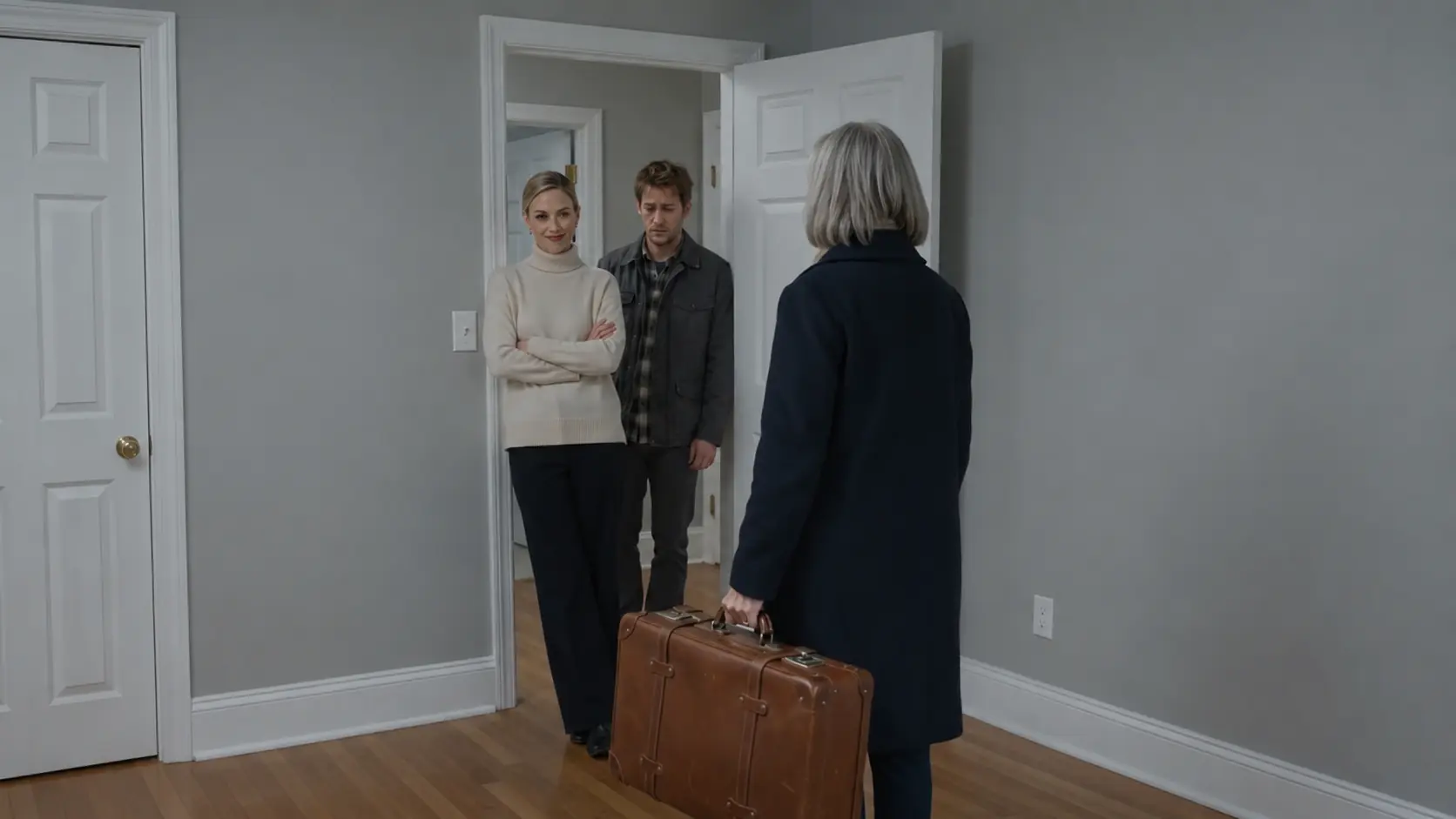
Sabine leaned against the hallway wall with her arms folded, smiling as if she had been waiting for that exact question. She wore a cream sweater, black slacks, and the kind of pleasant expression that never reached her eyes. Behind her, my son Darien stood half in the doorway of the hall, one hand on the stair rail, his face pale and tired. He did not look at me.
“We moved your things to the garage,” Sabine said. “This room is ours now.”
I turned toward Darien first. It surprised me how quickly a mother’s heart still reaches for her child, even after the child has been standing beside the person hurting her. I waited for him to say something, anything, even my name. He looked down at the floorboards I had paid to refinish after Louis died.
“Darien,” I said quietly.
He swallowed. “Mom, Sabine thought it would be better.”
That was when the house became silent in a new way. It was not the soft silence of an old home resting around you. It was the silence of walls listening while someone you raised chose cowardice. I set my suitcase upright and placed my purse on top of it with both hands.
Sabine gave a small laugh. “Coralie, let’s not be dramatic. The downstairs room will be easier for you anyway. Less stairs, less space to keep clean. At your age, you should appreciate that.”
“My knees work fine,” I said.
“For now,” she replied.
Darien closed his eyes as if her words pained him, but pain without action meant nothing to me anymore. I looked past Sabine into the room again, trying to find one thing they had left behind. Not one photograph. Not one book. Not Louis’s robe still hanging behind the closet door, where I had kept it for eleven years because grief has strange little rituals no one else gets to judge.
“You threw my life into the garage,” I said.
Sabine’s smile tightened. “We stored your belongings. That’s not the same thing.”
“No,” I said, looking at her fully now. “You erased my room because you thought I was too old, too tired, and too grateful for company to stop you.”
Darien finally lifted his face. “Mom, please. We can talk about this.”
“Now you want to talk?”
He flinched.
I remembered Darien as a boy with jam on his mouth and mud on his shoes, standing in my old apartment kitchen after Louis died. He used to ask whether I had eaten dinner, and when I lied, he split his grilled cheese and pushed half onto my plate. That boy had once noticed my hunger. The man in front of me had watched another woman empty my bedroom.
Sabine straightened, losing patience. “We live here too.”
“You live here because I let you.”
“We’re family.”
“Family does not move a widow’s marriage out of her bedroom and into a garage.”
The words landed harder than I expected. Darien looked as if I had struck him across the face. Sabine’s eyes flickered, but only for a second. She recovered quickly, because women like Sabine always do when they think charm is armor.
“You’re being emotional,” she said. “We were trying to make the house work for everyone.”
I looked at my son. “Is that what you told yourself while carrying your father’s photograph downstairs?”
Darien’s mouth opened, then closed.
That was answer enough.
I walked past them before either could stop me. Sabine stepped aside, startled by how steady I was. I went down the back hallway, through the kitchen, and out the side door to the garage. The air smelled of dust, old paint, cardboard, and gasoline from the mower Darien had promised to service months earlier.
My life was stacked along the back wall.
The walnut bedframe leaned against the freezer. My dresser drawers were piled unevenly, one half open with scarves spilling out. Boxes labeled “Coralie” in Sabine’s neat handwriting sat beside the recycling bin. Louis’s reading chair had a trash bag over it, and my mother’s quilt lay folded on top of a plastic storage tub like an afterthought.
For a moment, the steadiness left me.
I walked to the quilt and touched the faded blue fabric. My mother had sewn it before arthritis bent her fingers and made every stitch a small act of courage. She made it from scraps of dresses, curtains, and old shirts, pieces of a family stitched into warmth. Sabine had put it beside motor oil.
Darien appeared in the doorway behind me. “Mom.”
“Don’t,” I said.
He stopped.
I lifted the quilt carefully and held it against my chest. It smelled like dust now, but beneath that, I imagined I could still find lavender soap and time. My eyes burned, but I did not cry. Crying would have given Darien something to comfort, and comfort was too easy a job for him now.
“Who carried the bed?” I asked.
He did not answer.
“Who took down the wedding photo?”
His voice was barely audible. “I did.”
I turned then. “Did you look at your father’s face when you removed it?”
Darien’s eyes filled, but he looked away again. “Sabine said we needed to move forward.”
“Your father is not clutter.”
“I know.”
“No, you don’t.” My voice stayed calm, and that seemed to frighten him more than shouting would have. “You know the words. You don’t know the meaning.”
Sabine came into the garage behind him, arms folded again. “This is exactly why we didn’t ask first. You would have turned it into a memorial argument instead of seeing the practical side.”
I looked at her. “This house is in my name. You can leave today.”
The color drained from Sabine’s face.
Darien stepped forward. “Mom, wait.”
“No,” I said. “I waited when you stayed past three months. I waited when groceries became my responsibility. I waited when your friends came over without asking, when my bathroom became her vanity, when my driveway became your parking spot, and when my house became something you both spoke about as if I were only visiting. I am done waiting.”
Sabine laughed once, but it came out thin. “You can’t just throw us out.”
“I can begin the process.”
Darien’s face changed. He knew Lenora well enough to know I had not spent my life careless with papers. My daughter had made me organize every deed, policy, will, and account after I bought the house. She said generosity needed locks. I had smiled then, but I had listened.
I reached into my purse and took out my phone.
“Mom,” Darien said, panic rising now. “Who are you calling?”
“Your sister.”
Sabine’s expression sharpened. She had never liked Lenora, because Lenora did not soften truth to make selfish people comfortable. My daughter answered on the second ring.
“Mom? Are you home?”
“I’m home,” I said. “They moved my bedroom into the garage.”
There was a silence so complete I could hear Lenora stop breathing. Then her voice came back low and controlled. “Put me on speaker.”
I did.
“Darien,” Lenora said, “tell me she misunderstood.”
Darien swallowed. “Lenora, it’s complicated.”
“No,” Lenora replied. “Complicated is a property dispute with three cousins and no recorded deed. This is Mom’s house, Mom’s bedroom, and your wife’s arrogance. Which part did I miss?”
Sabine stepped forward. “You don’t know what it’s like living here.”
Lenora’s voice turned colder. “I know exactly whose name is on the deed.”
Sabine blinked.
Lenora continued, “Mom, take photos of everything in the garage, the bedroom, and any damaged property. Do not argue. Do not threaten. I’m driving from Charlotte now. Until I arrive, no one moves a single item without your permission.”
Sabine scoffed. “This is ridiculous.”
Lenora ignored her. “Darien, if you touch one more box before I get there, I will personally make sure every receipt, every unauthorized change, and every bit of property damage becomes part of the record. Do you understand me?”
Darien stared at the phone like he was twelve years old again. “Yes.”
“Good,” Lenora said. “Mom, go sit down. I’ll be there in two hours.”
I ended the call and looked at them both.
Sabine’s confidence had cracked. “You’re really going to let Lenora turn this into a legal mess?”
“You turned my bedroom into one.”
Then I picked up my suitcase, carried my mother’s quilt into the living room, and sat on the couch that Louis and I had chosen in a furniture store outside Hendersonville twenty-two years earlier. Darien stood in the hallway for a while, saying nothing. Sabine went upstairs, and I heard her moving around the room that used to be mine.
For the first time since I arrived, the anger rose hot in my chest.
“Sabine,” I called.
The movement stopped.
“If you remove one item from that room before Lenora arrives, I will call the police and report property damage.”
The house went quiet again.
Darien came into the living room and sat in the chair across from me. He looked smaller than he had an hour earlier. Not younger exactly, but reduced, as if the life he had borrowed from my patience had begun shrinking around him.
“I didn’t think you’d react like this,” he said.
I looked at him. “How did you think I would react?”
“I thought you’d be upset, but then maybe you’d see it made sense.”
“Made sense for whom?”
He rubbed both hands over his face. “Sabine said the bigger room was wasted on one person. She said you weren’t using the space right.”
“The space,” I repeated.
He winced.
“That room held thirty-eight years of marriage, widowhood, motherhood, sleepless nights, folded laundry, prayer, and grief. You let her call it space.”
He leaned forward, elbows on knees. “I know I messed up.”
“No, Darien. You followed. That is worse.”
His eyes lifted.
“When you mess up, there is still a chance you acted without thinking. But you followed her through my drawers, my closet, my photographs, and my bedframe. You had time to think. You chose not to.”
His eyes filled then, but he did not cry. Maybe he thought tears would anger me more. Maybe he had finally understood that tears would not protect him.
“I’m sorry,” he whispered.
“Are you sorry because you hurt me,” I asked, “or because you’re afraid you have to leave?”
He did not answer quickly enough.
I nodded. “That’s what I thought.”
Lenora arrived in one hour and forty minutes. She came through the front door still wearing her navy suit from court, hair pinned back, eyes sharp enough to cut glass. She kissed my cheek, touched my shoulder, and then walked straight upstairs without hugging Darien or greeting Sabine. I followed because I wanted to see what my daughter saw.
My old bedroom looked even colder with Lenora standing in it.
She photographed the new furniture, the gray walls, the missing fixtures, the empty nail holes where my pictures had hung, and the closet where Sabine had already filled the shelves with shoes. Sabine stood near the window, arms folded, trying to look offended rather than frightened. Darien stayed by the door.
Lenora opened the closet and looked inside. “You moved into this room completely.”
Sabine lifted her chin. “We needed a proper bedroom.”
“You had a bedroom.”
“It was small.”
Lenora turned toward her slowly. “So you stole one.”
Sabine’s mouth tightened. “That word is dramatic.”
Lenora smiled without warmth. “Good. We’ll use unauthorized occupation, property removal, and possible damage instead.”
Darien looked ill.
Lenora went downstairs next and inspected the garage. She found a scratch across the top of my dresser, a cracked corner on Louis’s framed photograph, and moisture gathering near two boxes placed too close to the garage door. She took photos of everything. With each camera click, Sabine’s face grew tighter.
Finally, Lenora stood in the kitchen and placed a folder on the table.
“Here is what happens now,” she said. “You will move out of Mom’s bedroom tonight. You will return her property to a safe interior room under her supervision. You will not sleep in her room again. Then you will receive written notice to vacate.”
Sabine stared. “We have nowhere to go.”
Lenora looked at Darien. “You should have thought of that before turning your mother’s life into storage.”
Darien whispered, “Lenora.”
“No,” she said sharply. “You don’t get my softness today. Mom gave you a home when your lease ended. She gave you months that became years. She gave you utilities, food, parking, patience, and dignity. You repaid her by helping your wife drag Dad’s memory into the garage.”
The mention of Louis broke something in Darien’s face.
Sabine looked at him, annoyed by his weakness. “Darien, say something.”
He turned toward her slowly. For once, he did not look away.
“What do you want me to say?” he asked.
“That this is insane. That we live here. That your mother is overreacting.”
Darien’s voice shook. “We moved her bedroom.”
“We improved the house.”
“We moved Dad’s photo into the garage.”
Sabine rolled her eyes. “It was one picture.”
Darien stepped back from her as if he had finally heard the sentence fully. One picture. His father’s face. His mother’s grief. His family’s history. One picture.
Lenora watched him with no pity. I watched with something more painful than pity, because part of me still loved the boy who had once split his sandwich with me.
Darien sat down at the kitchen table and covered his face. “What have I done?”
Sabine let out an angry breath. “Fine. Be weak. Both of you. I’m not apologizing for trying to make this house livable.”
I looked at her then. “This house was livable before you mistook welcome for ownership.”
Sabine’s eyes flashed. “You lonely old women love power once you realize nobody needs you.”
The room went still.
Darien’s head lifted. Lenora stepped forward, but I raised one hand. I wanted to answer myself.
“You are wrong,” I said quietly. “I was needed long before you arrived. I was needed by children who had no father, by a house that had to be built from grief, by bills that did not care I was tired, and by a life that kept asking me to stand up. What I no longer need is someone who benefits from my kindness and insults me inside my own kitchen.”
Sabine had no quick answer for that.
That night, Darien moved their belongings out of my room while Lenora supervised and I sat in the hallway holding Louis’s cracked photograph. He carried each box silently. Sabine packed with sharp movements, slamming drawers until Lenora warned her once, and only once. By midnight, my bedroom was empty of their things, but it was not mine yet.
The gray paint remained. The white bed remained. The room had been returned physically, but emotionally it still felt occupied by betrayal. I slept in the downstairs guest room that night with my mother’s quilt over me and Louis’s photo on the nightstand. I did not sleep much.
The next morning, Lenora made coffee in my kitchen like she had as a teenager before school. Darien came downstairs alone, wearing the same clothes from the day before. Sabine had left before sunrise to stay with a friend, taking two suitcases and all her anger with her. She had not said goodbye.
Darien stood near the table. “Mom, can I talk to you?”
Lenora looked at me. I nodded.
He sat across from me, hands folded tightly. “I don’t know how I became this man.”
I took a slow breath. “One choice at a time.”
He nodded, eyes wet. “I told myself I was keeping peace. Sabine wanted things, and it was easier to let her have them. The room, the driveway, the bathroom, the house rules. Every time you looked hurt, I told myself you’d understand because you’re Mom.”
“That is not understanding,” I said. “That is using.”
“I know.”
“Do you?”
He looked at me then. “I think I’m starting to.”
Starting was not enough to undo what he had done, but it was more honest than the excuses he had given before. I studied his face and saw exhaustion, shame, and fear. I also saw the faint outline of my boy, the one who once cared whether I had eaten.
“You have to leave,” I said.
His face crumpled slightly, but he nodded. “I know.”
“Not because I don’t love you.”
“I know.”
“Because if I let you stay after this, I teach you that hurting me has no cost.”
He wiped his eyes with one hand. “I’ll find a place.”
“I’ll give you thirty days formally. Lenora will put it in writing. During that time, you will pay something toward utilities, you will help restore my room, and you will not bring Sabine into this house unless I invite her.”
He looked down. “I understand.”
“Do you?”
He swallowed. “Yes.”
Restoring the bedroom took three weeks. The gray walls were primed and painted cream again. The walnut bed came back upstairs with help from two men from the church. Louis’s photo was reframed, the dresser scratch was repaired as best it could be, and my mother’s quilt was professionally cleaned by a woman who treated it like museum fabric after Lenora explained what had happened.
Darien did most of the carrying. He did not complain. He did not ask for praise. Some days he worked with his head down and tears slipping quietly along his cheeks when he thought I could not see. I saw, but I did not comfort him every time.
A mother can love her son and still let him feel the weight of his own choices.
Sabine came once, on the twelfth day, standing on the porch in sunglasses though the sky was cloudy. She asked to speak to Darien. I let him step outside, but I stayed near the window because this was still my house and I was done pretending not to notice things.
Her voice carried through the glass.
“Are you really letting them throw us out?” she demanded.
Darien stood with his hands in his pockets. “We threw Mom out of her own room first.”
Sabine scoffed. “You sound like Lenora.”
“No,” he said. “I sound like someone who finally heard himself.”
She stared at him, then looked toward the window where she knew I stood. “Your mother is ruining your marriage.”
Darien shook his head. “No. We did that when we treated her house like she was already gone.”
Sabine left without coming inside.
I did not ask what would happen between them. That was not my marriage to manage, and I had spent too many years managing pain that belonged to other people. Darien moved into a small rental near Hendersonville before the thirty days ended. It was not fancy. It had old carpet, a narrow kitchen, and a view of a parking lot instead of mountains.
The day he left, he carried the last box to his car and came back to stand on the porch.
“I’m sorry, Mom,” he said.
I nodded. “I believe you’re sorry.”
He looked at me carefully. “But not ready to forgive me?”
“Forgiveness is not a light switch, Darien.”
“I know.”
“No,” I said gently. “You’re learning.”
His eyes filled again. He stepped forward like he wanted to hug me, then stopped, finally asking without words instead of assuming. I opened my arms. He held me carefully, as if I were something breakable, and maybe for the first time in years, he understood that mothers are not made of endless room.
After he drove away, the house felt enormous.
Not empty. Enormous.
There is a difference.
Empty is what I felt when Louis died, when the other side of the bed stayed cold no matter how many blankets I used. Enormous is what I felt after Darien left, standing in a house that belonged to me again, realizing I could decide what every room meant. I walked upstairs slowly, one hand on the rail, knees working just fine.
My bedroom door stood open.
The walls were cream again. The walnut bed was back in place. Louis’s photograph sat on the dresser, and my mother’s quilt lay across the foot of the bed, clean and folded with dignity. It was not exactly the room it had been before. Betrayal changes the air even after furniture returns.
But it was mine.
Lenora visited the next weekend with flowers, legal paperwork, and the kind of hug that made me feel both protected and embarrassed. She walked through the house, checked the locks, reviewed the updated documents, and placed a new folder in my cabinet. Then she stood in the bedroom doorway with me.
“I’m sorry I didn’t push harder when they moved in,” she said.
“You pushed enough. I didn’t want to hear it.”
She gave me a sad smile. “That sounds like us.”
I laughed softly, the first real laugh I had allowed in weeks. Then I looked at the bed, the walls, and the quilt. “I thought keeping the peace meant keeping my family.”
Lenora took my hand. “Sometimes peace is just the sound people enjoy while you disappear.”
That sentence stayed with me.
Months passed. Darien came by every Sunday afternoon. At first, he brought groceries I did not need, trying to repay me in canned soup and paper towels. Eventually, he understood that I wanted honesty more than errands. We drank coffee on the porch, talked carefully, and rebuilt something smaller than before but sturdier.
He separated from Sabine by spring. He did not give me details, and I did not ask for them. One Sunday, he looked toward the hydrangeas and said, “I kept choosing the person who demanded the most over the person who gave the most.” I let the words sit between us because they were true, and truth deserves room.
“I loved you badly,” he said.
I looked at him. “Then learn to love better.”
He nodded.
The house changed too. I turned the downstairs guest room into a sewing room, even though I had not sewn seriously in years. I replaced the glass desk Sabine had bought with Louis’s reading chair. I hung my wedding photo back on the wall, not because I lived in the past, but because the past had earned its place in my home.
On the first anniversary of the day I came back from Hendersonville, I invited Martha and Lenora for dinner. Darien came too, carrying a lemon cake he had made himself, uneven and slightly sunken in the middle. We ate in the dining room with the windows open and the Blue Ridge air drifting in. No one sat where they had not been invited.
After dinner, Darien helped clear the plates. He paused near the doorway and looked up the stairs. “Do you ever wish I hadn’t moved in?”
I thought about lying kindly, the way mothers do. Then I remembered the gray walls, the garage, the quilt, and the look on his face when he finally understood. Kindness without truth had already cost me too much.
“Yes,” I said. “Sometimes.”
He nodded, accepting it.
Then I added, “But I’m glad you moved out before I lost you completely.”
His eyes shone. “Me too.”
That night, after everyone left, I walked through my house turning off lights. In the hallway, I stopped outside my bedroom and placed one hand on the doorframe. The room glowed softly from the lamp on Louis’s side of the bed. My suitcase was in the closet, my purse on the chair, my quilt where it belonged.
Fifteen days had been enough for them to show me who they were.
But it had also been enough to show me who I still was.
I was not a burden to be moved downstairs. I was not an old woman waiting quietly to be erased. I was not a guest in the home I had built from grief, labor, and love.
I was Coralie Whitaker.
The house was in my name.
And from that day forward, so was my peace.