Will Hadley stared at Rose Callahan’s outstretched hand as though it were something too precious for a working man to touch. The Wyoming wind stirred the white sheets behind her, filling them like sails beneath the vast October sky. He had spent six years greeting her across store counters, church aisles, and dusty streets without once allowing himself to imagine that her smile meant more for him than it did for anyone else. Now she stood beside the clothesline with sunlight catching in her loose golden curls, waiting for him to make the smallest courageous movement of his life.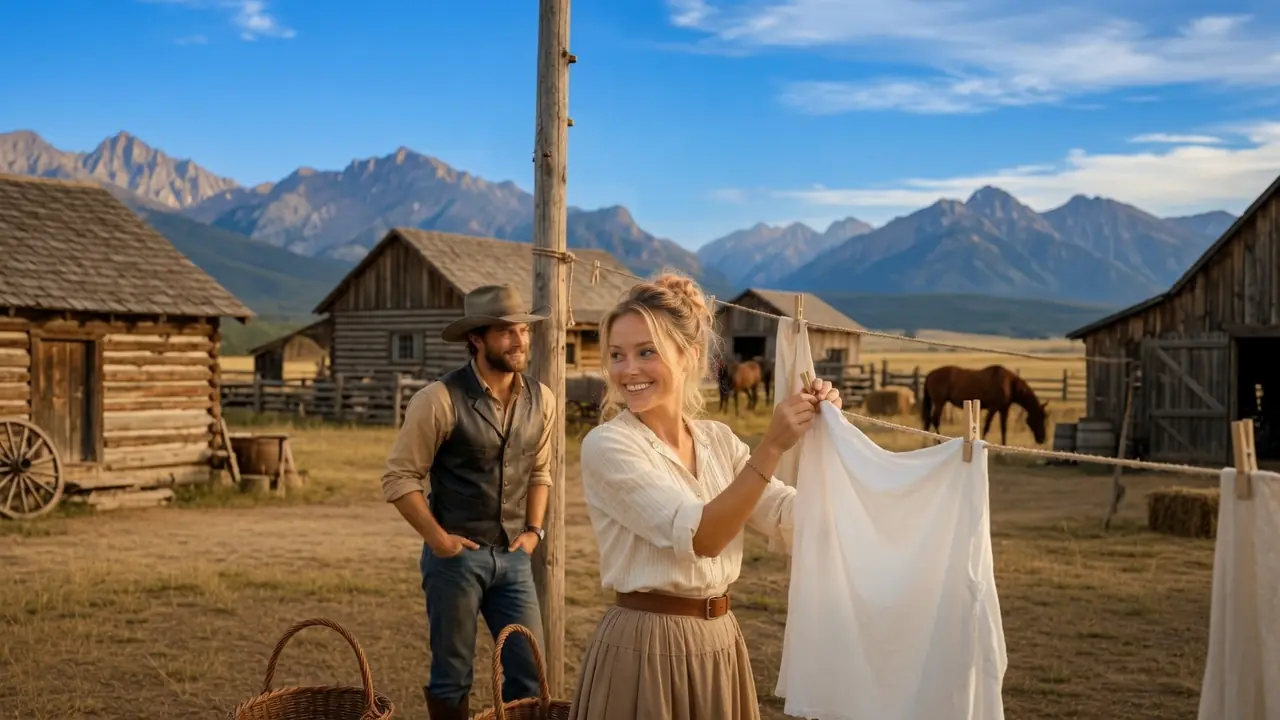
Will slowly took her hand.
Rose’s fingers closed around his with immediate certainty. There was no hesitation in her touch, no polite softness designed to spare him embarrassment. She had been patient with him for years, but patience had finally reached its end. If Will still believed she belonged to someone richer, bolder, or more important, she intended to remove that belief one truth at a time.
They walked away from the clothesline toward the narrow path leading behind the Callahan ranch house. Will kept glancing down at their joined hands, unable to reconcile the moment with the life he knew. He owned a modest livery stable in Crestfall, three reliable horses, an aging wagon, and a one-room cabin that leaned slightly whenever winter winds came from the west. Rose had received marriage offers from men who owned thousands of acres.
Edward Marsh alone controlled more cattle than Will had handled in his entire life.
“You should know what people will say,” Will murmured.
Rose looked toward him. “People have been speaking for years.”
“They will say you settled.”
“They already say I’m proud, difficult, foolish, and too particular.”
“They don’t say those things to your face.”
“No. They wait until I leave the store.”
Will frowned. “Who said you were foolish?”
Rose smiled despite herself. “You heard every other word and chose that one?”
“I can ask around.”
“That is not the courtship I imagined.”
He almost laughed, but the fear inside him remained. Will had watched wealthy men arrive at the Callahan house carrying flowers, polished boots, and futures large enough to impress an entire county. Rose had rejected them with such grace that several continued praising her afterward, though their wounded pride often produced less generous comments once whiskey loosened their tongues.
Will never joined those conversations.
To him, Rose was not the town beauty, though nobody denied she was exactly that. She was the woman who carried broth to sick families, remembered which children feared thunder, and kept a box beneath the general-store counter filled with buttons, ribbons, and penny sweets for customers unable to pay. She laughed with her whole face, argued without cruelty, and could tell when Will was tired before he admitted it.
Those qualities made her seem even farther beyond him.
The path ended at a small hill overlooking the ranch. Rose stopped beside an old cottonwood tree where a weathered wooden bench faced the mountains. Someone had carved initials into the trunk years earlier, though time had softened them until only faint lines remained.
“My mother brought me here when I was sixteen,” Rose said. “She told me I would receive many offers because men notice what they can see first.”
Will leaned against the tree. “She was right.”
“She also said the man worth marrying would notice what I did when nobody praised me.”
He lowered his eyes.
Rose stepped closer. “Do you remember the Halpern barn fire?”
“Of course.”
“Who brought lumber before sunrise?”
Will shrugged. “They needed it.”
“You refused payment.”
“They had lost half their winter feed.”
“You repaired Mrs. Vale’s wagon after her husband died.”
“The axle was dangerous.”
“You gave Thomas Bell work when every rancher in town called him a thief.”
“He was twelve when he stole that saddle blanket.”
“He is now your most trusted employee.”
Will looked uncomfortable beneath the weight of her examples. He had never considered these things evidence of character. They were simply tasks that needed doing, and he had possessed the hands to do them.
Rose touched his sleeve. “Edward Marsh sent me roses from Denver.”
“I heard.”
“They died within a week.”
“That happens to cut flowers.”
“You brought my father a replacement gate hinge because you noticed the old one dragging.”
“It was ruining the post.”
“I still have the first nail you handed me when I was seventeen.”
Will blinked. “Why would you keep a nail?”
“Because you asked whether I wanted to learn how to fix the loose shelf instead of telling me to stand aside.”
The memory returned slowly. Rose had been helping in the store when a wall shelf began pulling free. Will entered for rope, saw the problem, and showed her how to set the bracket properly. He had forgotten it before reaching the livery.
Rose had not.
“I fell in love with you in pieces,” she said. “A hinge. A nail. A sack of grain left outside a widow’s door. Six years of watching you give away the best parts of yourself while believing nobody saw.”
Will’s throat tightened.
“I saw,” Rose whispered.
He turned toward the mountains because looking directly at her became too difficult. No one had ever described him as a man worth studying. His father measured worth through profit and acreage, both of which Will possessed in modest amounts. Crestfall respected him, but respect given to a dependable liveryman was different from admiration granted to men like Edward Marsh.
Marsh entered every room expecting it to rearrange around him.
Will usually entered through the side door.
“What if I cannot give you what you deserve?” he asked.
Rose moved beside him. “Who decides what I deserve?”
“You do.”
“Good. I choose you.”
The answer should have ended his doubt, but fear had been living inside him too long to surrender after one conversation. Will loved Rose enough to imagine every hardship she might face beside him. His cabin was small, the livery consumed long hours, and winter income depended on travelers continuing through mountain passes that often closed without warning.
Rose could marry Edward and never worry about money.
She could have servants, imported dresses, and a house overlooking thousands of acres. Will could offer early mornings, hay in her hair, and a man whose hands always smelled faintly of leather and horse liniment. He had spent so many years comparing those futures that he forgot Rose had already compared them herself.
“I need time,” he said.
Pain crossed her face before she concealed it. “How much?”
“I don’t know.”
“Edward is coming tomorrow.”
Will’s body went still.
Rose had not intended to frighten him with the information. Her father told her that morning that Edward planned to visit formally, accompanied by his mother and a family attorney. In Crestfall, such preparation meant only one thing.
“He is proposing?” Will asked.
“Yes.”
“And what will you say?”
“What I have always said.”
Will finally faced her. “No?”
“Yes, Will. No.”
“Even if I cannot—”
Rose withdrew her hand from his. “Do not make my choices for me.”
“I’m trying to protect you.”
“From what?”
“Regret.”
Her green-gray eyes sharpened. “The regret I fear is standing before you now and watching you remain silent because you have decided another man’s money knows my heart better than I do.”
Will had no answer.
Rose stepped away from the cottonwood. “I waited because I believed you needed time to see me. I did not realize you saw me clearly and still believed I belonged to whoever offered the largest house.”
“That is not what I think.”
“It is what your fear keeps saying.”
She walked toward the ranch without asking him to follow.
Will remained beside the tree until the sunlight left the mountains.
He returned to the livery after dark and worked without purpose. He brushed horses already clean, reorganized tools that did not need moving, and repaired a harness strap Thomas had finished that afternoon. Every task gave his hands something to do while his mind replayed Rose’s words.
Shortly before midnight, George Callahan entered the stable.
Rose’s father was a broad, silver-haired merchant who had built Crestfall’s general store from a wagon and two crates of supplies. He had always treated Will fairly, though never with the familiarity of a man expecting him to become family. That night, George closed the stable door and stood beside an empty stall.
“You spoke to my daughter.”
Will set down the harness. “She told you?”
“She did not need to.”
“I hurt her.”
“Yes.”
Will accepted the judgment.
George studied him. “Edward Marsh will arrive at ten tomorrow.”
“I know.”
“He intends to offer Rose a home, two hundred acres in her name, and a financial settlement substantial enough that she will never depend on anyone.”
Will’s chest tightened. “That is generous.”
“It is calculated.”
“Rose will refuse him.”
“She says she will.”
“You don’t believe her?”
“I believe Rose. I’m not certain she should continue waiting for a man who treats her love like an error she hasn’t recognized yet.”
Will looked down.
George stepped closer. “Do you love my daughter?”
“Yes.”
The answer came so quickly that both men heard its truth.
“Would you treat her kindly?”
“With everything I have.”
“Would you ask her judgment before making decisions that shape her life?”
Will remembered the hill. “I am learning.”
“Would you permit pride to make her lonely?”
“I hope not.”
“Hope is a poor roof in winter.”
Will looked at him. “Do you want her to marry Marsh?”
“I want her to marry a man she loves. Unfortunately, that man has spent six years behaving as if love were a luxury he cannot afford.”
George left before Will could respond.
At sunrise, Will saddled his horse and rode beyond town. He followed a ridge where the grass turned pale beneath the autumn wind and stopped at the small grave of his mother, buried beside a low stone wall. She had died when he was twenty, leaving him with his father and a farm already drowning in debt.
Will’s father responded to loss by becoming harder.
He told his son that poor men had no business dreaming above their station. When Will once mentioned marrying a teacher’s daughter, his father laughed until Will stopped speaking about her. The lesson remained long after the farm was sold and the old man moved west.
Wanting less became Will’s protection against humiliation.
Rose threatened that protection because she wanted him back.
He sat beside the grave for nearly an hour before understanding that humility and fear had become tangled inside him. He called his silence respect, but Rose experienced it as rejection. He claimed he wanted her happiness while ignoring the happiness she named plainly.
By nine, Will was riding toward the Callahan house.
Edward Marsh’s carriage was already outside.
Will dismounted near the gate but stopped when voices carried through the open parlor window. Edward spoke confidently about the eastern pasture, the house he planned to build, and the social advantages Rose would enjoy as his wife. His mother described servants, winter travel, and the new piano arriving from Chicago.
Rose remained silent.
Will nearly turned away.
Then Edward asked whether she accepted.
“No,” Rose said.
The room went quiet.
Edward’s voice changed. “May I ask why?”
“I do not love you.”
“Affection grows.”
“Sometimes. Mine grew elsewhere.”
“With Hadley?”
Will closed his eyes.
Edward laughed once, not kindly. “The stableman?”
Rose answered with a calmness more dangerous than anger. “The man who knows my character without needing a ledger to value it.”
“He cannot provide for you.”
“He provides dignity to everyone working beside him.”
“You would trade comfort for a man too timid to court you?”
That accusation landed because part of it was true.
Will stepped onto the porch.
George opened the front door before he knocked. The older man looked at him for a long second, then moved aside.
Inside, Edward stood beside a velvet ring box. He was thirty-six, handsome, polished, and accustomed to receiving respect before earning it. Rose sat near the window in a pale blue dress, her hands folded in her lap. When she saw Will, hope appeared so quickly that he nearly lost his courage again.
Edward closed the ring box. “This is a private matter.”
Will removed his hat. “It concerns the woman I love.”
Rose stood.
Will looked only at her.
“I was wrong yesterday,” he said. “I told myself I was protecting you, but I was protecting myself from believing I could be chosen.”
Edward exhaled impatiently. “Is this your proposal? An apology delivered in work clothes?”
Will continued without acknowledging him. “I cannot offer two hundred acres today. I can offer half ownership of the livery, a house we choose together, and every honest dollar my hands can earn.”
Rose’s eyes filled.
“I can also promise something harder,” he said. “When fear tells me you are too good for my life, I will ask what you want instead of deciding for you.”
Edward looked toward George. “You will permit this?”
George folded his arms. “Rose does not require permission.”
Will stepped closer to her. “You told me not to make you wait.”
“I did.”
“I cannot return the years I wasted.”
“No.”
“But I can begin now.”
He reached inside his coat and removed a small ring wrapped in cloth. It had belonged to his grandmother, plain silver with a tiny blue stone worn smooth at the edges. He had carried it for three years without admitting why.
Rose stared at it.
Will lowered himself to one knee.
“Rose Callahan, I love you. Will you be my wife?”
Her answer came before he finished drawing breath.
“Yes.”
Edward left without shaking anyone’s hand.
His mother followed, visibly offended that wealth had been rejected in favor of a liveryman’s silver ring. The story spread through Crestfall before noon, though several versions included a fistfight, a duel, or Edward throwing the ring into the fireplace.
None of that happened.
The truth was quieter and more important.
Rose chose openly, and Will finally believed her.
Their courtship lasted until the first heavy snow. Will brought wildflowers when the season allowed and pine branches when it did not. Rose joined him at the livery twice each week, learning accounts, feed prices, and the habits of difficult horses.
She discovered Will was terrible at planning meals.
He discovered Rose could negotiate with suppliers more effectively than he could. Within a month, she reduced their winter grain cost and convinced a hotel owner to hire the livery for all guest transportation.
They did not become equals merely by promising it.
They practiced.
When Will tried to refuse Rose’s investment in the business because he feared appearing dependent, she reminded him that partnership required accepting what each person brought. When Rose volunteered for every struggling family in town until exhaustion made her ill, Will reminded her that kindness without limits could become self-neglect.
They argued.
They apologized.
They learned that being chosen once did not remove the responsibility to keep choosing each other.
They married in Crestfall’s small church three days before Christmas. Rose wore a cream dress made by her mother, and Will wore a dark coat Thomas had secretly purchased with money saved from his wages. George walked Rose halfway down the aisle, stopped, and let her complete the final steps alone.
“That was her request,” he told anyone who questioned it.
Rose reached Will with snow melting in her golden hair.
“You still think I’m too beautiful for you?” she whispered.
“Yes.”
Her eyebrow lifted.
Will smiled. “But I’ve learned that is your problem to judge.”
“Improvement.”
Their first home was not grand.
It stood behind the livery with two rooms, a narrow stove, and windows that rattled during every storm. Rose decorated it with dried flowers, blue curtains, and the polished horseshoe Will had been holding when George first told him the truth about her feelings.
The following spring, they expanded the stable.
Within five years, Hadley Livery became Hadley Transport and Feed, serving ranchers across the county. Rose managed contracts while Will handled animals, equipment, and workers. Thomas became their first partner rather than remaining an employee.
Edward Marsh married a banker’s daughter from Cheyenne.
He and Rose remained civil, though never close. Years later, when a wildfire threatened Marsh’s eastern pasture, Will organized the crews that saved half the herd. Edward attempted to pay him generously.
Will accepted only the cost of supplies.
“I misjudged you,” Edward admitted.
“You weren’t the only one,” Will said.
At home that evening, Rose found him repairing a gate hinge.
She leaned against the fence with their young daughter sleeping against her shoulder. “You know we can afford a carpenter now.”
“The post is still good.”
“You said that about my father’s gate eight years ago.”
“It was true.”
Rose smiled. “That hinge changed my life.”
“No. The nail did.”
She laughed, remembering the small piece of iron hidden inside her keepsake box.
Will crossed the yard and kissed her forehead. Time had added lines beside his eyes and confidence to the way he carried himself, but some part of him still looked surprised whenever Rose reached for his hand.
She never stopped doing it.
Years later, their children asked why their mother had refused the richest rancher in the county. Rose told them wealth was useful, but it could not replace being seen clearly. Will told them courage did not always mean facing gunfire or crossing mountains.
Sometimes courage meant believing another person’s love without demanding they prove it forever.
The old cottonwood bench remained above the Callahan ranch. On their twentieth anniversary, Will and Rose returned to it as evening light moved across the mountains.
“You’re too beautiful for me,” he said.
Rose rested her head on his shoulder. “That line caused enough trouble the first time.”
“I thought it worked out well.”
“It nearly sent me into Edward Marsh’s parlor alone.”
“You rejected him before I arrived.”
“Of course.”
Will looked toward her. “You truly would have waited?”
Rose considered the question.
“No,” she said.
He blinked.
“I loved you, but I would not have spent my entire life waiting for you to become brave. Love deserves patience, not endless postponement.”
Will nodded slowly. “Fair.”
“I would have gone east to help Aunt Margaret with her school.”
“You never mentioned that.”
“You never asked what happened if you stayed silent.”
He took her hand.
The answer did not diminish their story. It made their choice more meaningful. Rose had not been a prize preserved indefinitely for the moment Will finally claimed her.
She had possessed her own road.
Will reached her before she chose another direction because he finally understood that love left unspoken was not noble. It was merely invisible.
Rose had saved her heart for him, but she had never surrendered ownership of it.
When she offered him her hand beside the clothesline, she was not promising to wait forever.
She was giving him one honest chance to walk beside her.
At last, Will took it.