We saw the patrol car turn before its emergency lights came on. Richard checked his speed, I started recording, and neither of us expected the officer at the window to be someone I had once defended. What began as a question about a flashlight became a dispute about speeding, then a dispute about a license plate. By the time his supervisor arrived, the most important thing in our car was no longer the document he wanted—it was the recording he could not take back.
“He’s flying up on us.”
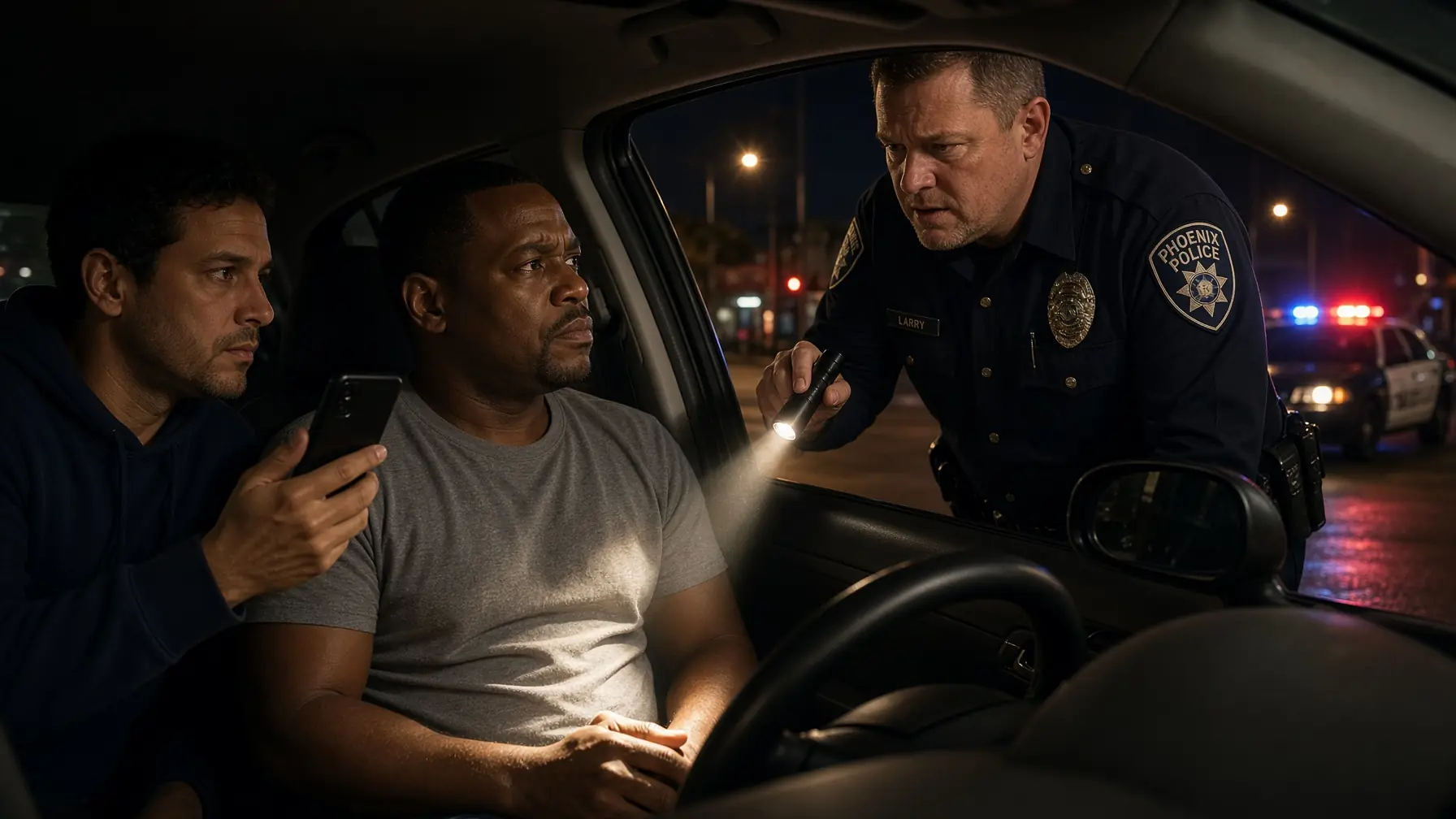
Richard glanced into the rearview mirror.
I had already turned around in the passenger seat.
The patrol vehicle was closing the distance quickly, headlights moving through the darkness behind us. A few moments earlier, the officer had been near a gated entrance, angled away from the road.
Now he was following us.
Richard looked down at his speedometer.
Then at the mirror again.
“What for?”
I took out my phone.
“Let’s find out.”
It was May 20, 2023, in Phoenix. We had been out recording public encounters, the kind of work that some people called accountability and others called looking for trouble.
I knew what both descriptions sounded like.
I also knew they could both contain uncomfortable pieces of truth.
We filmed police.
We asked questions.
Sometimes we were polite enough to make the questions easier to hear. Sometimes we were annoyed before the conversation began. We had posted good encounters and bad ones, and every recording seemed to attract people determined to decide which it was before watching the whole thing.
That night, I had used a bright handheld flashlight from inside the car.
I wasn’t going to pretend later that the light had somehow turned itself on.
I had directed it toward the officer near the gate.
I wanted him to notice us.
What I did not expect was that noticing us would become a traffic stop whose explanation kept changing at the window.
The emergency lights flashed.
Richard exhaled.
“There it is.”
He signaled, moved to the side of the road, and stopped in a place where the car was clear of moving traffic.
I started the recording before he put the transmission in park.
The dashboard camera was already running.
It had been recording the road, the turn, the patrol vehicle coming behind us, and the speed information displayed with the footage.
Richard looked toward it.
Then back at me.
“Keep yours going.”
“I am.”
Behind us, the patrol vehicle stopped.
For several seconds, neither of us spoke.
Those first seconds always felt strange.
Before the officer reached the window, there was still room for the encounter to become ordinary. A question. An explanation. A misunderstanding corrected.
Then the person approached, and you discovered which kind of night you were having.
Richard lowered his window.
The officer came into view.
I recognized him before I could place where I had seen him.
His face.
His posture.
The way he stood slightly back from the open window while looking inside.
Then it clicked.
Larry.
Phoenix police.
I had filmed him before.
The memory arrived with an unexpected flicker of relief.
That earlier encounter had been good.
Not perfect. Nothing on a street happened as neatly as people wanted when they watched it later.
But he had listened. He had taken time. He had done something I thought deserved credit.
I had said so afterward.
Now he stood at Richard’s window and began with a question.
“Any weapons inside the car?”
Richard looked at him.
“What does that have to do with why you stopped me?”
“During a traffic stop, I can ask whether there are weapons.”
I kept the phone pointed toward the driver’s window.
The officer’s face was clear enough to see.
So was Richard’s.
I wanted the recording to capture both sides, not just the moments that would make us look good.
Richard asked, “What’s the traffic violation?”
“License, registration, proof of insurance.”
“For what?”
The officer repeated the request.
He had not yet explained the stop.
I leaned slightly toward the center of the car.
“Why aren’t we starting with what happened?”
Larry looked at me.
Then back at Richard.
“Your speed.”
Richard’s expression changed immediately.
“My speed?”
“I saw you.”
There was a pause.
Not a long one.
Long enough to become important.
Then the officer continued.
“And the bright light. I wanted to make sure everybody was okay in the car.”