After I paid almost five hundred thousand dollars for his life, my son told me to pay rent or get out.
I just smiled and made one phone call.
Within hours, everything he thought he controlled began to crumble.
He had no idea that his mother still owned every key to his comfort. He had no idea how quietly a woman can prepare when she finally stops begging to be respected.
My name is Arlene Matthews. I am sixty-eight years old, and for most of my life, I believed love meant giving until the people you loved felt safe. I believed motherhood was a kind of quiet architecture, one built from tuition checks, late-night worry, second chances, and forgiveness nobody saw.
But I learned, late in life, that some people do not see love as shelter. They see it as property. They move into it, decorate it, rename it, and then try to charge the owner rent.
It began on a late Sunday afternoon while I was pruning the last of my roses. The sun was slipping behind the neighbor’s oak tree, turning the garden soft and amber. This garden had been my sanctuary for more than thirty years, every rosebush carrying a memory of my husband David, my son Paxton, and the life I thought we had built.
From the living room, I could already hear laughter. Maisie’s voice rose above the soft hum of Paxton’s laptop, bright and polished the way it always sounded when she was excited about something expensive. “Babe, look at this one. Coastal minimalist chic. Exactly the vibe I want when we get our own place.”
I smiled faintly at the words “our own place.” Paxton and Maisie had been living with me for almost a year by then. Just until they were settled, they had said, and because mothers are trained by love to hear promises in hopeful tones, I had believed them.
When they first arrived, I told them not to worry about rent or bills. Save for your down payment, I had said. That is what family does. I meant every word, because I remembered how hard it had been for David and me in our early years, counting grocery money at the kitchen table and pretending not to be scared.
A year passed, but instead of saving, they upgraded. A new leased car appeared in the driveway, glossy and impractical. New furniture arrived for the guest room they had gradually started calling their suite, and then came the espresso machine that cost more than my first car.
Maisie’s online life bloomed like a carefully watered plant. Curated breakfasts. Intentional living. Minimalist luxury. Quiet wealth aesthetic. She posted morning routines from my kitchen as if the marble counters, the window light, and the rosemary plants outside belonged to her.
I said nothing and kept paying the bills. I told myself they were young, even though Paxton was thirty-eight and Maisie was thirty-four. I told myself they would grow out of the performance, settle down, save money, and remember gratitude.
That night, I made roast chicken with rosemary and lemon. I mashed potatoes the way Paxton liked them when he was a boy, with a little extra butter and a pinch of garlic. They ate distractedly, eyes fixed on their screens, Maisie editing a video and Paxton scrolling through something with that furrowed brow he had inherited from David.
“Dinner is lovely, Mom,” he murmured without looking up.
“Thank you,” I said.
My hands folded in my lap, I waited for conversation that never came. I watched my son chew, swipe, nod at his screen, and vanish into the kind of silence that exists even when people are sitting three feet apart. Maisie looked up suddenly, as if remembering I was not part of the furniture.
“Arlene,” she said, “I was thinking we should really install a smart thermostat. The electricity bill was a bit high this month.”
I blinked, surprised by the word we.
“The bill?” I asked softly.
“Yes.” She smiled with that influencer warmth that never quite reached her eyes. “If we automate the temperature, we’ll save energy. It’s more sustainable.”
Paxton nodded. “It’s efficient, Mom. You’ve got to think long term.”
I wanted to laugh. Efficient had never been a word that belonged in our home. David and I had run this place on open windows, sweaters, soup, and common sense, but I only smiled and cleared their plates when they were done.
A few days later, Maisie dropped another suggestion while sipping an oat milk latte in my kitchen. She stood by the window, looking out at my roses like a woman evaluating a property listing. “You know, this neighborhood is really hot right now. The rental potential of this house is just incredible.”
She said it casually, but her eyes flicked up to gauge my reaction.
“Rental potential?” I echoed.
She gave a small laugh. “Oh, nothing serious. Just saying. If you ever wanted passive income, this property could do wonders.”
Paxton grinned from the counter, half distracted. “She’s not wrong. Mom, real estate is all about leverage. You’re sitting on an underperforming asset.”
I turned back to my teacup and stirred slowly so they would not see my hands tremble. I was not sure when my home, the place where David and I had built every memory worth keeping, had turned into an asset. I was not sure when my son had learned to say underperforming while standing barefoot in the kitchen where I had packed his school lunches for twelve years.
In the days that followed, they began calling rooms spaces. Maisie wanted to repaint to attract better light. Paxton talked about reinvesting equity, optimizing layout, and unlocking value. I told myself it was just talk, young people mistaking borrowed language for wisdom, but something in my gut told me otherwise.
That Thursday evening, Paxton knocked on my bedroom door.
“Mom, can we have a quick family meeting?”
He said it like a manager summoning an employee.
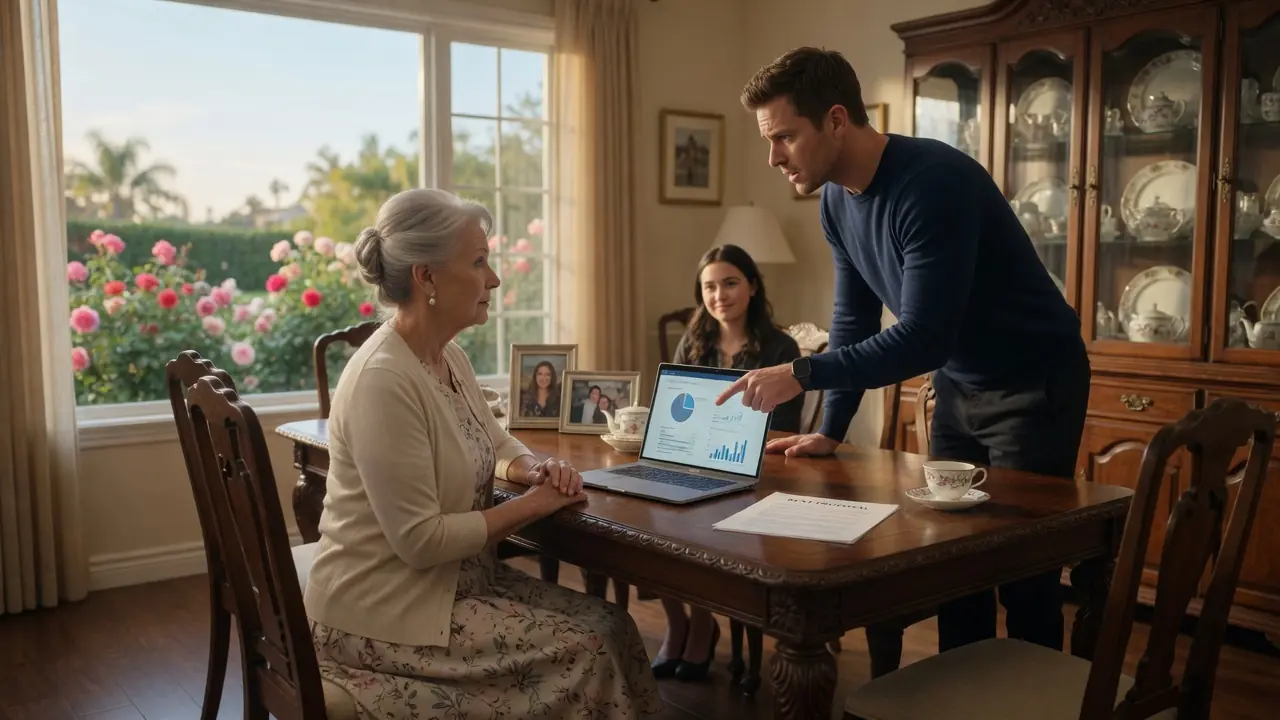
I dried my hands and followed him to the dining room, where Maisie sat beside an open laptop wearing a practiced smile. On the screen, a slide read, “Matthews Family Financial Restructuring.” My stomach tightened so hard I had to place one hand on the back of a chair.
Paxton straightened in his seat. He had always done that when he wanted to sound older than he felt. “Mom,” he began, “Maisie and I have analyzed the family’s financial situation.”
The word hit me like cold air under a door.
“To optimize this asset and ensure everyone is contributing responsibly, we need to implement a clear structure,” he continued.
Maisie nodded eagerly. “Exactly. It’s about fairness and boundaries.”
Paxton held up one hand, taking over. “We believe that starting next month, your rent for the master bedroom should be twenty-five hundred dollars. That’s the fair market rate for a primary suite in this area.”
For a moment, I did not breathe.
The dining room, with its old walnut table and framed family photographs, seemed to tilt slightly around me. I looked at my son, the child I had nursed through fevers, the boy whose college applications I mailed myself because he was too nervous to do it. He looked back at me with the calm confidence of a man presenting a business proposal.
“My rent?” I asked quietly.
Paxton leaned forward, misreading my calm as confusion. “It’s not personal, Mom. It’s just about structure. You’ve been here rent-free, and that’s not sustainable.”
I stared at him.
Rent-free.
In my own house.
“You’d still have full access to the house, of course,” he added. “We’d just be balancing responsibilities.”
Maisie smiled sweetly. “It will actually help you, Arlene. You’ll feel more independent. Empowered, even.”
Empowered.
The word nearly made me laugh.
I looked at them, and for the first time, they did not look like family sitting across from me. They looked like strangers who had studied the language of care and removed the heart from it.
“Let me understand this,” I said slowly. “You are asking me to pay rent to live in my own home.”
Paxton hesitated, then nodded. “It’s fair, Mom. You’ve had it good here. It’s time we all contribute equally.”
Maisie reached across the table and touched his arm. “It’s just business, Arlene. Don’t take it the wrong way.”
I folded my hands together.
“Business,” I repeated softly.
The silence that followed was not awkward. It was absolute. Paxton shifted in his chair, and Maisie’s smile finally faltered.
I stood, my voice steady and almost gentle.
“All right,” I said. “I’ll need some time to consider your business proposal.”
Paxton exhaled in relief, mistaking my composure for compliance. Maisie smiled again and reached for her planner as if we were about to schedule my humiliation. But as I walked back to my room, something inside me settled into place.
For the first time in a long while, the house no longer felt fragile.
It felt like it was waiting for me to remember whose name was on the deed.
The next morning, I woke before dawn. Dew shimmered on the roses outside as I sat at the old dining table with a cup of plain coffee. Paxton’s laptop still sat there, closed now, but in my mind I could still see the slide title glowing from the screen.
Matthews Family Financial Restructuring.
After breakfast, I dialed a number I had not used in nearly a decade. The line clicked twice before a familiar voice answered, low and steady. “Well, I’ll be damned. Arlene Matthews. Thought you retired from calling lawyers.”
I smiled despite myself. “Morning, Bill.”
“You still know how to make a man nervous before nine o’clock. What’s going on?”
“I need some advice,” I said quietly. “About my house. And about my son.”
There was a long pause.
“That is not a sentence I like hearing from clients,” Bill said. “Come by at noon.”
By noon, I was sitting in his office downtown, the same office David and I had visited years earlier when we rewrote our will. The carpet was newer, the chairs were different, but Bill Henderson looked mostly the same, older around the eyes and sharper in them. He read my notes with an expression that told me he was choosing his words carefully.
“So,” he said finally, leaning back. “Your son wants you to pay rent in your own house.”
“He calls it structure.”
“And your daughter-in-law calls it empowerment.”
“Yes.”
Bill removed his glasses and rubbed the bridge of his nose. “That is creative. Disgusting, but creative.”
We spent the next hour mapping out a plan. His voice was patient but firm, and it steadied me in a way I had not realized I needed. “First, you gather proof of what you have invested in that boy. Every check, every transfer, every dollar that left your hands and went toward his comfort.”
I nodded.
“Then we move the property into an irrevocable trust,” Bill continued. “If they ever try to play games with your assets, they will learn quickly that you are not as helpless as they think.”
“An irrevocable trust,” I repeated.
The words felt strange and powerful, like armor.
Bill nodded. “You will be the sole trustee. No one touches that house without your signature. Legally speaking, it becomes iron.”
When I left his office, the air outside felt lighter. I had not won anything yet. Nothing visible had changed. But I had stopped standing in the path of a train pretending it was only wind.
The next few days blurred into paper and memory. I went through David’s old folders, all of them neatly labeled in his steady handwriting. Tuition. Vehicles. Wedding. Medical. Loans. Miscellaneous support. I traced the record of my love in numbers, and each receipt seemed to carry a memory with it.
Four years of tuition at the University of Southern California. Housing and meals. The car after graduation. Insurance payments. Wedding help. The emergency credit card balances I paid when Paxton was too embarrassed to ask directly and sent me vague messages about cash flow instead.
By Friday night, the total stood at nearly half a million dollars invested in my son’s life.
I slid the last page into a folder and wrote across the front, “The Family Ledger.”
On Saturday morning, Bill called.
“It’s done, Arlene. The trust is active. The deed is transferred. You are now sole trustee of the Matthews Family Trust. They can huff and puff all they want. Legally, they own nothing.”
“Thank you,” I said softly.
He hesitated before adding, “I’ve seen a lot of cases like this. Most parents cave before they protect themselves. You didn’t.”
I swallowed.
“David would be proud,” Bill said.
That sentence nearly undid me. I ended the call before my voice could break.
By evening, I was back in the garden, pruning a stray branch that had grown too far over the fence. From the kitchen window, I could hear laughter again. Paxton’s baritone. Maisie’s bright giggle. They were planning something. I could tell by the tone.
At dinner, they were unusually cheerful.
Maisie had set the table with my best china, the set David bought me for our twenty-fifth anniversary. She poured water into crystal glasses and smiled as though she had not spent the week trying to turn my home into a rental unit.
“Mom,” Paxton said with exaggerated warmth, “we thought it would be nice to have a family dinner this weekend. Just us, Aunt Susan, Uncle Mark, and the cousins. Everyone has been saying we should get together more.”
I nodded slowly. “That’s thoughtful of you.”
Maisie smiled wide. “We thought so too. It’s just… well, Susan mentioned she’s been a little worried about you.”
“Did she?”
“You’ve seemed stressed,” Maisie continued. “Maybe it will be good for everyone to talk. Clear the air.”
“Clear the air,” I repeated, setting down my fork. “You mean convince them I’m losing my mind.”
Paxton blinked. “What? No, Mom. That’s not…”
“I’ve known your aunt longer than you’ve been alive, Paxton,” I said quietly. “I can hear a setup before it starts.”
His face reddened. He glanced at Maisie for support.
“We just want what’s best for you,” he said.
“Of course you do,” I replied, rising from the table. “Just make sure you have all your facts ready. If we’re having dinner with family, it’s only fair that everyone gets to see the numbers.”
Maisie tilted her head, smiling tightly. “Numbers?”
“Oh, yes,” I said. “The ones that tell the story of who has really been paying the bills.”
The silence that followed sliced through the room. Maisie’s smile faltered. Paxton opened his mouth, then closed it.
I did not give either of them the chance.
That night, I placed the freshly signed trust papers and the Family Ledger in my desk drawer. Then I locked it. The house felt different again, not colder, but steadier.
The storm was coming.
They did not know it yet, but every move they made from that moment on was part of a game.
I had already learned how to win.
By Sunday evening, the house felt staged for a performance. Maisie polished the silver and arranged my best china as if preparing a lifestyle shoot. Candles flickered, jazz played softly, and beneath the perfume, roast beef, and forced elegance hung a charged tension waiting to spark.
Susan arrived first with her husband, Mark, and their two grown daughters. She hugged me warmly, but her eyes searched mine a little too long, as if trying to read between the lines of whatever Paxton had told her. My sister-in-law had always been sharp, but she loved my son, and I knew Paxton was counting on that.
“You look wonderful, Arlene,” Susan said, kissing my cheek. “Paxton told us you’ve been under a lot of stress lately.”
I smiled faintly. “Did he? I must have missed the stress part.”
Before she could respond, Maisie appeared in the doorway, smiling wide and camera-ready. “Dinner is ready. Everyone, please come in.”
We sat around the table, and I studied them. Paxton’s nervous glances. Mark’s avoidance. Maisie’s poised hands and perfect curls. Susan’s careful concern.
For half an hour, the conversation was hollow chatter and forced laughter. Then Maisie set down her wine glass with careful precision.
“You know,” she began, her tone bright and practiced, “I’ve been thinking a lot about how different things are for our generation compared to our parents.”
Susan looked intrigued. “Oh?”
Maisie nodded earnestly. “We live in a time where financial literacy is everything. Sometimes, as families, we have to make tough decisions for the good of everyone, even when they’re uncomfortable.”
Her words hung in the air, coated in sweetness but sharp underneath.
Paxton reached over and squeezed her hand, picking up where she left off. “What Maisie is trying to say is that Mom has always been the heart of this family. But things change. It’s important for her to adapt to new economic realities.”
“New economic realities,” Susan repeated.
Paxton nodded, looking every inch the concerned son. “Mom has been carrying the household on her own for years. We just think it’s time everyone contributes fairly. It’s not about money. It’s about structure and respect.”
Maisie turned toward me with a gentle smile. “Arlene, you’ve done so much for all of us. Truly. But if we don’t start organizing things properly, it can become unhealthy. Dependency isn’t good for anyone.”
I could feel Susan stiffen beside me.
Mark looked uneasy. One of Susan’s daughters lowered her fork and stared at Maisie.
Paxton leaned forward, his tone low and reasonable. “Mom, we’ve already talked about it. Starting next month, you would pay rent for your suite. Twenty-five hundred dollars. It’s the fair rate for this area. We’d handle the management details. You wouldn’t have to worry about anything.”
A murmur moved through the table. Susan’s eyes widened. One of her daughters choked on her wine.
I let the silence stretch. I wanted everyone to sit inside the discomfort Paxton and Maisie had built.
Then I smiled. Not with anger. With certainty.
“Since you both want to talk business,” I said, my voice calm and clear, “let’s show the family some real numbers.”
“Mom,” Paxton started.
I was already standing.
From the sideboard, I retrieved the thick blue binder I had prepared. The front was labeled in clean black ink.
The Family Ledger.
I placed it on the table with a solid thud that cut through the awkward air.
“Before we continue,” I said, “I want everyone to understand exactly where we stand.”
I opened the binder to the first section and laid out a crisp legal packet.
“Document one,” I said evenly, “is the trust paperwork. As of this week, this house is the property of the Matthews Family Trust. As sole trustee, I make every decision regarding this property. Paxton, you have no authority to manage anything.”
The color drained from his face.
“You what?”
Maisie forced a small laugh. “Wait. What trust? Arlene, I don’t think you understand how complicated those things can be.”
“Oh, I understand perfectly.”
I flipped to the next section.
“Now, document two. This one is my favorite.”
I slid out a stack of neatly typed pages.
“It is called the Ledger of Affection. A record of what I have invested in my son since he turned eighteen.”
I glanced at Paxton. He sat frozen, hands clasped in front of him.
“Four years of tuition at the University of Southern California, including housing and meals. One hundred sixty-two thousand dollars. The car I bought after graduation. Thirty-five thousand. Insurance for the first three years. Six thousand. Wedding down payment. Fifteen thousand. Various loans never repaid. Sixty-five thousand.”
I turned one page.
“In total, the figure comes to four hundred eighty-seven thousand three hundred fifty dollars, give or take a few cents.”
The room went dead silent.
Susan’s daughters exchanged shocked glances. Mark leaned back in his chair and whistled softly under his breath.
Susan spoke first, her voice cutting.
“Paxton, is that true?”
He looked cornered. Defensive. Smaller than he had looked five minutes earlier.
“Mom, this isn’t necessary.”
“I think it is,” I interrupted. “Because you wanted structure. Accountability. Fairness. Those were your words.”
Maisie shifted uncomfortably. “Arlene, you’re overreacting. We were just trying to have a responsible conversation.”
“Good,” I said. “Then you’ll appreciate the final document.”
I turned the page and revealed a professional lease agreement printed on thick ivory paper. I slid two copies across the table toward them.
“This is my counterproposal. If you wish to continue living here, you will pay the trust three thousand dollars per month in rent, plus a three-month security deposit. Naturally, you will need to pass a credit check.”
Maisie’s mouth fell open. “You’re joking.”
“I never joke about business.”
Paxton’s voice rose and cracked. “You can’t just… Mom, this is insane.”
I met his eyes.
“No, son. This is structure. The very thing you wanted.”
He pushed back his chair, the legs scraping hard against the floor.
“You went behind our backs. You actually hired a lawyer.”
I tilted my head slightly. “It’s what responsible adults do when they are managing an asset.”
The remark hit him like a slap.
Maisie looked around for support, but all she found was Susan’s furious stare.
“I can’t believe this,” Maisie stammered. “We were trying to help.”
Susan’s hand slammed onto the table, startling everyone.
“Help?” she snapped. “By charging your mother-in-law rent for her own house? Have you lost your minds?”
Paxton tried to speak, but Susan cut him off.
“You should be ashamed. Arlene put you through college. She kept this family afloat after David passed. And this is how you repay her? With slides and invoices?”
Paxton’s mouth opened and closed without sound.
Maisie sat rigid, her cheeks flushed with humiliation.
I closed the binder and folded my hands on top of it.
“I don’t expect an apology,” I said softly. “But from now on, the terms are clear. You are either tenants of this house, or you find another one.”
No one moved.
Then Susan stood, shaking her head.
“You deserve better than this, Arlene. Truly.”
She turned to her husband.
“We’re leaving.”
They gathered their things in silence. Their daughters followed. The front door closed behind them with a solid, echoing click.
At the table, Maisie’s mascara had begun to smudge. She stood abruptly.
“I can’t. This is too much,” she whispered, then stormed down the hall.
Paxton stayed seated, his eyes fixed on the binder.
When he finally spoke, his voice was low.
“You really did all this, didn’t you?”
“Yes,” I said. “And I would do it again.”
He swallowed hard. Disbelief replaced anger. Then he followed his wife without another word.
The house fell silent, the scent of candles fading. I put the binder away, turned off the music, and stood amid the remains of their little performance.
I felt no triumph.
Only the calm certainty of someone done begging for respect.
By morning, the house was too quiet. From the kitchen window, I saw Maisie pacing the porch with her phone in hand. She held it in front of her face, lowered it, adjusted her hair, and lifted it again.
That afternoon, the storm hit.
A neighbor texted me first.
Arlene, is everything all right? You’re all over Instagram.
I frowned, clicked the link she sent, and there it was.
Maisie sat framed perfectly in soft light, tears glittering against her blush. Her voice broke at careful intervals, the way she had learned from watching other women sell sorrow online.
“I never thought I’d have to share something this personal,” she began. “But sometimes the people who are supposed to love you most become toxic. We tried to help her. Truly. We just wanted to teach her to manage her finances responsibly. And now she’s kicking us out for caring too much.”
Behind her, I could see my living room. The corner where David’s old armchair still sat. Seeing my home used as a backdrop for her performance made my stomach turn.
Maisie dabbed at her eyes.
“I guess you can do everything right and still be treated like the villain. But we’ll be okay. God sees the truth.”
She ended the video with a deep sigh, clutching Paxton’s hand for effect. He sat beside her, silent and sullen, a supporting actor in his wife’s production.
Within hours, the video spread.
Comments flooded in. Sympathy. Outrage. Strangers offering prayers for the abused couple. Maisie reposted snippets to her stories, tagging phrases about toxic parents and boundaries.
But then the tide turned.
It began with Susan.
She commented under the video with words sharp as glass.
Funny how you forgot to mention that you tried to charge your mother-in-law $2,500 in rent for her own house, or that she paid for Paxton’s college, his car, and your wedding. Maybe post that part too, sweetheart.
The replies came fast.
Another cousin chimed in.
Maisie, this isn’t a boundary issue. It’s greed. Arlene has been nothing but generous. We all saw the receipts.
Then strangers joined in.
Comment after comment called them entitled. Spoiled. Performative. Influencers pretending to be victims while living off the woman they were trying to exploit. Someone dug through Maisie’s public posts and found designer handbags, first-class vacations, sponsored brand deals, expensive brunches, and that shining leased car in my driveway.
Screenshots were placed side by side with the crying video.
The contrast was brutal.
By evening, Maisie deleted the post.
But screenshots live longer than shame.
Within a week, they were packing. There was no apology. Just boxes scraping floors, doors slamming, and Maisie’s sharp whispers whenever she thought I could not hear.
When they left, the house felt lighter.
The silence was heavy, yes, but it was honest.
For the first time in nearly a year, my home breathed.
Days passed before Paxton knocked.
He stood on my porch unshaven, his eyes hollow. He looked younger and older at the same time.
“Mom,” he said quietly. “Do you know any landlords who would rent to us?”
“Us?” I asked.
He hesitated. “Maisie and me.”
I shook my head slowly. “I don’t, Paxton. But you may want to check your credit score first.”
He looked away.
“We already have. It’s bad. Every place we apply turns us down.”
I did not have to ask why. I already knew.
A few days later, word reached me through Susan. The truth had spilled out. The luxury car was leased. The credit cards were maxed. The online fame was mostly illusion. They had not wanted structure because they valued fairness. They had needed my rent money because their lives were built on debt.
It did not make me angry.
Only sad.
They had built a house of mirrors. All reflection. No walls.
The final collapse came a month later. I heard it from a mutual friend who did not realize no one had told me.
Maisie had left.
Apparently, the stress became unbearable. The rejections, the debts, the public humiliation. She blamed Paxton for everything.
“Your plan ruined everything,” she reportedly shouted before slamming the door with a suitcase in hand.
As for my son, he stayed behind in the wreckage of what they had built. He tried to repair his reputation, but the internet is a cruel archivist. It remembers everything people hope will fade.
Potential clients dropped him. Friends distanced themselves. Co-workers avoided him, afraid the drama would stain them by association.
I did not hear from him directly.
Occasionally, I saw his name appear in small ways. An updated LinkedIn headline. A comment on someone’s post. But the bravado was gone. The polished confidence that had filled my dining room had been replaced by silence.
One evening, I saw Paxton’s car parked down the street. The engine was off. His silhouette sat still behind the wheel.
He never came to the door.
He only stared at the house he once tried to price.
I watched from behind the curtain, feeling only sadness for what pride can ruin. By morning, he was gone.
The roses bloomed again beneath the San Diego sun. Life kept pruning itself, removing what had grown diseased so something healthier could have room. I turned toward my quiet house and prayed my son would learn the same.
Six months passed before I saw Paxton again.
The roses had bloomed and faded twice, and the house had settled into a calm rhythm. The hum of the refrigerator. Wind in the curtains. David’s old wind chimes tapping softly near the patio. The silence was no longer hollow. It was gentle.
One evening, Susan called me.
“He’s doing all right,” she said carefully. “Not great, but different. He’s working two jobs. Doesn’t complain. Doesn’t talk much either.”
The image of my once-polished son quietly rebuilding his life stayed with me. I no longer saw only the man who had demanded rent. I saw the boy who used to wash cars with David on Saturday mornings and leave notes on my pillow saying, “You’re the best mom ever.”
One Sunday, instinct led me to his apartment near the freeway.
It was a modest building with cracked stucco, a tired stairwell, and a view of traffic instead of gardens. I stood outside his door, unsure whether to knock or walk away. Before I could decide, the door opened.
Paxton stood there.
He was thinner than I remembered. His hair was longer, and dark circles sat beneath his eyes. He froze when he saw me.
“Mom.”
“Paxton,” I said quietly. “May I come in?”
He stepped aside without a word.
The apartment was small. One room, a kitchenette, and a folding table doubling as a desk. The faint smell of takeout lingered in the air. On the wall hung a single framed photo of David and me from our wedding day.
My chest tightened when I saw it.
“I didn’t think you’d come,” Paxton said finally.
“I wasn’t sure I would,” I admitted. “But Susan told me you’re trying.”
He gave a short, humorless laugh. “Trying. That’s one word for it.”
He motioned for me to sit at the small table. On it lay a stack of papers, neatly organized. Handwritten notes, spreadsheets, a few receipts, and a page covered in calculations.
He slid them toward me.
“This is for you.”
I frowned as I glanced through the pages.
“What is this?”
“A repayment plan,” he said.
I looked up.
He swallowed. “I wrote down everything you’ve done for me. Everything I could remember. Tuition, the car, the wedding help, all of it. I know I can’t pay it all back. Not even close. But I want to start.”
His fingers tapped nervously against the edge of the table.
“Fifty dollars a week for now. I’ll increase it when I can.”
I stared at him.
His voice was not defensive. It was not rehearsed. It was steady and almost humble.
“Paxton,” I said softly. “You don’t owe me money.”
He shook his head.
“I do. Not because you asked for it. Because I need to do this for me.”
His voice cracked.
“I was wrong, Mom. I was wrong to think love had to be transactional. I was wrong to act like value was something you measure in dollars. You gave me everything, and I treated it like an investment I could control.”
He looked down at his hands.
“I don’t know why I did it. Pride, maybe. Stupidity. Maisie’s influence, but I won’t blame her for what I chose. I wanted to feel powerful. I wanted to feel like I was building something. Instead, I tried to take what you already built.”
I listened, my throat tightening.
The words came slowly, but they came from somewhere real. The performance was gone. The gloss had finally peeled away. This was not the man with the laptop presentation and the business vocabulary. This was my son, humbled and stripped of the arrogance he once mistook for confidence.
“I don’t expect you to forgive me,” he said. “I just needed to say it out loud. I need to own it.”
I stayed silent for a while, watching the slump of his shoulders and the nervous turn of the pen in his hand.
Finally, I reached across the table and covered his hand with mine.
“Paxton,” I said, “I forgave you the moment you left. Forgiveness isn’t the hard part. Trust is. And that is something you will have to earn back slowly.”
He nodded, eyes wet.
“I understand.”
I smiled faintly.
“But I’ll make you a deal. You can keep your repayment plan if it helps you feel responsible. But instead of sending the money to me, put it in a savings account.”
He blinked. “A savings account?”
“Yes. Name it the Matthews Future Fund. Maybe someday, if you have a child, you’ll use it for them. Or maybe you’ll use it to build a life that doesn’t depend on someone else’s generosity.”
He laughed softly through tears.
“You’re still trying to teach me lessons?”
“It’s what mothers do.”
That evening, we shared simple takeout at his folding table. It was not elegant. It was not easy. But it was honest enough. We talked about small things first because small things are often the safest bridge back. Work. Weather. His second job. My roses. The apartment’s terrible water pressure.
Each word felt like a brick in something new.
Not the old house. That one had fallen.
Something smaller, humbler, and perhaps stronger.
As the sun set in red and gold beyond the freeway, Paxton walked me to my car. He looked tired, but lighter.
“Mom,” he said softly. “Thank you for coming.”
I looked at him for a long moment.
“You’re welcome, son. Keep growing.”
Driving home, I passed a florist with roses in every color displayed near the window. I thought of my own garden and how, after every harsh pruning, the roses always returned stronger.
Maybe redemption is like that.
Time. Light. The courage to grow again.
I still cannot believe I went through all of it. The betrayal, the heartbreak, the public performance, and the long road back to peace. But looking back now, I understand something I did not understand before.
Forgiveness does not mean handing the keys back to people who broke the locks.
It does not mean pretending cruelty was confusion or calling manipulation a mistake. It does not mean letting someone move back into your life without earning the right to stand there.
Forgiveness means choosing peace over pride.
Boundaries mean making sure peace has a door.
I still live in the house David and I built together. The roses still bloom. The master bedroom is still mine, and no one has ever charged me rent for sleeping beneath my own roof.
Paxton visits sometimes now. Not often enough to make things easy, but often enough to make them possible. He brings coffee, trims the hedges without being asked, and never once mentions the word asset.
Sometimes, when we sit in the garden, I catch him looking at the house with a different expression. Not ownership. Not hunger. Memory.
That is progress.
And I have learned to accept progress without demanding perfection from it.
My son once tried to turn my home into a business proposal. I turned it back into a home. Then, slowly and carefully, I left one light on for him, not because he deserved easy forgiveness, but because mothers know something about pruning.
You cut away what is sick.
You protect the roots.
And if there is still life beneath the damage, you give it room to grow.