The day I moved into my new house, a woman in a pastel tracksuit and wedge sandals was already standing on my lawn with a clipboard.
She looked like the kind of person who only left home to complain about the weather or someone else’s fence. I had not even finished backing the U-Haul into the driveway when she marched toward me like she owned the street. 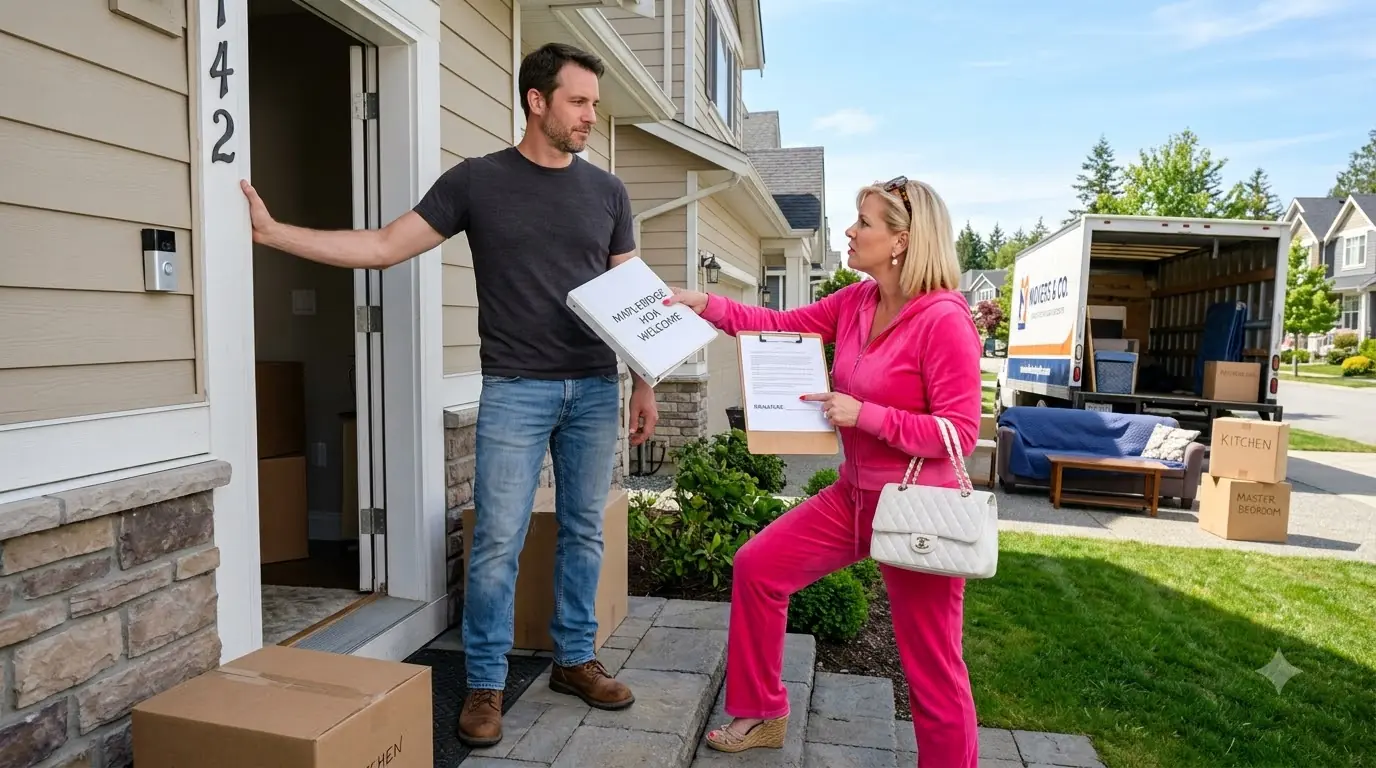
“You must be Walter Zayn,” she said, her voice sharp enough to cut drywall.
“I’m Cheryl, vice president of the Maple Ridge HOA.”
I gave her a nod and pulled the parking brake. “Nice to meet you, Cheryl, but I’m not joining the HOA.”
Her jaw dropped.
“I’m sorry, what?”
“I bought this house directly from the original owner. I never signed HOA paperwork. I checked with my lawyer before closing. This property was annexed before the HOA was formed, so I’m not legally obligated to join.”
Her eyes narrowed.
“That’s not how we do things here, Mr. Zayn. Everyone on this street is part of the HOA.”
“Not me.”
I opened the back of the truck.
“I like my freedom too much.”
Cheryl puffed up like a balloon about to burst. She muttered something about community standards, dangerous precedents, and maintaining neighborhood values. I ignored her because I was more interested in unloading my tools and finding the box containing my coffee maker.
That night, someone knocked on my front door.
Cheryl stood outside holding a thick folder and wearing a smile that looked painfully rehearsed.
“We drafted your welcome packet.”
She opened the folder.
“It includes monthly dues, lawn regulations, approved paint colors, trash schedules, and community guidelines.”
She flipped to the final page.
“Signature goes here.”
I leaned against the doorframe.
“Cheryl, I told you this morning. I’m not joining.”
“You need to understand—”
“I don’t owe dues. I don’t need permission to paint my house, and I definitely don’t want an HOA newsletter.”
Her smile disappeared.
“If you refuse to cooperate, I’ll have you evicted.”
I laughed before I could stop myself.
“You can’t evict someone who owns his home outright.”
“That’s not how this works.”
She leaned closer.
“We’ll see about that.”
The next morning, I found a violation notice duct-taped to my truck.
UNAUTHORIZED VEHICLE ON FRONT LAWN.
The truck was parked squarely in my driveway.
The following day brought three more notices.
One claimed my house numbers were nonconforming.
Another accused me of improper trash-bin storage.
The third cited me for failure to display an HOA welcome flag.
There was no HOA welcome flag.
At least, none that I had ever seen.
That was when I started documenting everything.
Photographs.
Dates.
Times.
Copies of every letter.
Screenshots of emails.
Security-camera footage from my doorbell.
I noticed Cheryl had begun sending neighbors and HOA board members past my house to take photographs of my yard. They would walk slowly along the sidewalk, stop, aim their phones toward my property, then pretend they had not been doing anything when I looked at them.
It was like being followed by the world’s least intimidating surveillance team.
Then came the certified letter.
The HOA claimed I owed more than two thousand dollars in unpaid fines and warned that a lien could be placed against my house if I failed to “remedy ongoing violations.”
I took the letter straight to Dean, the real-estate attorney who had handled my closing.
He read the document twice.
Then looked at me.
“You are not a member of this HOA.”
“I know.”
“They have no contractual authority over your property.”
“I know.”
Dean tapped the letter.
“But if they knowingly try to enforce these fines anyway, that can become harassment, attempted fraud, or worse depending on what they do next.”
“So what do I do?”
“Document everything.”
I smiled.
“Already doing it.”
“Every call?”
“Yes.”
“Every letter?”
“Yes.”
“Every fake violation?”
“Yes.”
Dean leaned back.
“Good. Then let them keep making mistakes.”
That weekend, Cheryl and the HOA board scheduled a mandatory neighborhood meeting.
I did not attend.
Instead, I spent the evening installing two more security cameras.
One faced the front gate.
The other covered the street and driveway.
By Monday morning, the investment had already paid off.
At 12:43 a.m., one of Cheryl’s board members walked onto the edge of my property carrying a garbage bag.
He emptied a pile of leaves onto my lawn.
Then he hurried away.
The footage was clear enough to identify him.
Craig.
Cheryl’s most loyal board member.
I saved the video to a private folder and named it HOA CLOWNS.
By the end of the week, Cheryl appeared at my door again.
“You don’t want this to get ugly, Walter.”
I looked at her.
“If you won’t play by our rules, we can make it very difficult for you to live here.”
I gave her the same expression I used to give my old boss when he scheduled meetings during football games.
“Good luck with that, Cheryl.”
She left without another word.
On Tuesday morning, I stepped outside and found my mailbox lying in pieces near the curb.
The post had been snapped cleanly in half.
Nothing else on the street had been touched.
I stood there for several seconds.
Then looked toward the camera mounted beneath the corner of my garage.
Inside, I pulled up the footage.
At exactly 2:13 a.m., someone wearing a hoodie and gloves had approached the mailbox carrying a heavy metal tool.
Three swings.
The post broke.
The figure jogged away.
The face was partially hidden.
But the walk was familiar.
The posture was familiar.
It was the same person who had dumped leaves on my property.
Craig.
I did not call Cheryl.
I called the police.
Detective Ramirez watched the footage in my living room.
He replayed it twice.
“You have any recent problems with this guy?”
“His HOA has been trying to pressure me since the day I moved in.”
Ramirez raised an eyebrow.
“Pressure you how?”
I showed him the fake fines.
The certified letter.
The photographs.
The violation notices.
The video of Craig dumping leaves.
Ramirez started taking notes.
“Sounds like harassment.”
“That’s what my lawyer said.”
“You still working with him?”
“Absolutely.”
“Keep him close.”
Ramirez stood.
“We’ll bring Craig in for questioning. If we can establish that this is connected to HOA leadership, the situation gets more serious.”
The next afternoon, Cheryl parked her Lexus across the end of my driveway.
Not beside it.
Across it.
She paced back and forth along the front of my yard while talking loudly on her phone.
I could hear her from inside.
“I don’t care what the police say. He’s a threat to the community.”
She paused.
“He’s filming people without consent. That’s surveillance. He’s violating privacy laws.”
Nice try.
Every camera I had installed covered my own property or areas visible from public spaces.
Dean had already checked.
I stepped onto the porch and leaned against one of the columns.
Cheryl continued talking.
“If the lien doesn’t scare him, we’ll find something else. Code enforcement. Zoning violations. Anything.”
Then she turned.
Saw me.
Her voice did not even falter.
“Oh, he’s right here.”
I smiled.
“How’s Craig doing?”
Cheryl ended the call.
She stared at me for several seconds, then stormed toward her Lexus.
The following morning, someone had scratched the side of Cheryl’s car from front to rear.
I had nothing to do with it.
But I knew exactly what was coming.
Two hours later, a patrol car stopped in front of my house.
Officer Kramer stepped out looking uncomfortable before he even reached the porch.
“She says you vandalized her vehicle.”
“Did she mention the cameras covering my driveway?”
Kramer sighed.
“I figured you’d say that.”
“Want to see the footage?”
“Yes.”
I invited him inside.
We pulled up the overnight recording.
Cheryl’s Lexus had sat exactly where she left it.
No one approached from my property.
No one came from my house.
No one touched it while it was visible to my cameras.
Kramer watched in silence.
Then shook his head.
“If she knowingly blamed you without evidence, that’s a problem.”
“She did more than blame me.”
I pointed toward the report he was holding.
“She filed a police complaint.”
“I’ll document the discrepancy.”
Cheryl was getting desperate.
Two days later, I came home from work and found the word TRASH spray-painted across my garage door in bright red.
Again, no other house had been touched.
Again, my cameras captured everything.
This time the person was easier to identify.
Linda.
Another HOA board member.
The same woman who had once stood near my driveway holding a ruler because she apparently believed my grass needed to be measured with laboratory precision.
I sent the footage to Detective Ramirez.
He called twenty minutes later.
“They’re not even trying to be subtle anymore.”
“Nope.”
“This isn’t just neighbor harassment now.”
He sounded exhausted.
“We’ve got repeated coordinated property damage involving multiple people connected to the same board.”
“What happens next?”
“I’m bringing it to the district attorney.”
That was when Dean decided it was time to stop simply reacting.
“We’re filing a civil suit.”
I sat across from his desk.
“Against Cheryl?”
“Cheryl, Craig, Linda, and the association where appropriate.”
He began listing claims.
“Harassment. Property damage. Defamation. Attempted fraud. Abuse of HOA authority.”
He looked at me.
“And we’re subpoenaing internal communications.”
The paperwork was filed the following Monday.
That was when the situation exploded.
About a week later, someone from inside the HOA leaked internal emails.
I never asked who.
But I had a strong suspicion.
There was an older couple on the board who had always looked uncomfortable whenever Cheryl spoke publicly. One of them must have finally decided enough was enough.
The emails revealed everything.
Cheryl had been directing the campaign from the beginning.
She described me as a “rogue element.”
She wrote about forcing me into compliance through “strategic enforcement.”
She instructed board members to create additional violations whenever existing ones failed.
She encouraged increased documentation of my property.
Some messages suggested using complaints to pressure city agencies into investigating me.
One email from Craig read:
If we can get him cited for something criminal, he’ll lose credibility in the neighborhood. People will beg the board to intervene.
Another discussion floated the idea of leaving prohibited material on my property and reporting it.
Dean read that email twice.
Then looked at me.
“This is no longer just petty harassment.”
The leak went public within hours.
A local blogger published a long investigation under the headline:
HOA GONE WILD: SUBURBAN POWER CAMPAIGN EXPOSED
The neighborhood changed overnight.
Residents who had avoided eye contact with me began waving from their porches.
One woman walked over carrying a pie.
“I always hated Cheryl,” she whispered.
I laughed.
“You could have mentioned that sooner.”
At the next HOA meeting, attendance was almost triple normal.
The community center was packed.
Nobody wanted to discuss lawn height.
Nobody cared about paint colors.
They wanted answers.
Cheryl stood at the front with her gavel.
“Order.”
People shouted over her.
“You’ve cost us thousands in legal fees!”
Another homeowner stood.
“You lied about lien authority!”
Someone else yelled, “You tried to frame a neighbor!”
That one got applause.
Cheryl banged the gavel harder.
She claimed I was a toxic element.
She insisted everything had been done to protect the community.
Nobody believed her.
Then Harold Becker stood.
Harold was a retired judge who lived near the end of the neighborhood.
He spoke quietly.
The room became quiet anyway.
“The only toxic element I see is the rot in this board’s leadership.”
Cheryl stared at him.
Harold continued.
“I move to dissolve the current board pending a full investigation and appoint an interim board under the association’s emergency governance provisions.”
The vote was not close.
That night, Detective Ramirez called.
“Cheryl is facing charges connected to the false reports and coordinated vandalism.”
I sat down.
“Craig and Linda?”
“Also being charged.”
Ramirez paused.
“And there may be more once the district attorney finishes reviewing everything.”
By the end of the month, Cheryl had disappeared from regular neighborhood life.
Her house quietly went on the market.
Several remaining board members resigned.
Harold Becker became interim HOA president.
At the first meeting under his leadership, he stood in front of the same room where Cheryl once threatened residents.
“We are here to serve the community.”
He looked around.
“Not control it.”
The room stayed silent.
“And this association will never again be weaponized against a homeowner.”
Applause followed.
I still did not join the HOA.
I had never planned to.
But for the first time since moving in, I felt like the fight might actually be ending.
I was wrong.
Three weeks after Cheryl’s resignation, I was drinking coffee on the back porch when a city inspector appeared.
He wore a reflective vest and carried a clipboard.
“I need to inspect your property line.”
“For what?”
“There’s a complaint about an illegal fence extension into protected green-belt land.”
I looked toward my backyard.
There was no fence.
Not one post.
I pointed.
“You’re welcome to look, but I think someone gave you the wrong address.”
The inspector checked his paperwork.
“It specifically lists this property.”
“What does the complaint say?”
“Recent construction violating city easement rules.”
I walked the property with him.
Grass.
Flower beds.
A few shrubs.
No construction.
No fence.
No new structures.
The inspector took photographs.
Then scratched his head.
“Someone is filing bogus complaints using your address.”
“You sure?”
He looked at the empty yard.
“Pretty sure.”
He lowered his clipboard.
“If someone is intentionally making false statements to trigger enforcement actions, that can become a criminal matter.”
I did not need to guess where it came from.
Cheryl might have been gone from the neighborhood, but someone was still working on her behalf.
Later that afternoon, Dean forwarded information from a contact at City Hall.
More anonymous complaints had been filed against my property.
Sinkholes that did not exist.
Illegal pesticide use.
An unlicensed daycare supposedly operating in my basement.
I did not have children.
Much less a daycare.
Dean came to the house that evening carrying another folder.
His expression looked like a man who had discovered termites inside a load-bearing wall.
“They weren’t just trying to annoy you.”
“What were they doing?”
“Building a record.”
He sat down.
“If enough code complaints accumulate, even false ones, they can trigger broader review procedures. Someone was trying to create the appearance that your property had persistent health, safety, and zoning problems.”
I stared at him.
“So they wanted the city involved.”
“Yes.”
“To do what?”
Dean leaned back.
“At minimum, pressure you to sell. At worst, create conditions for more aggressive enforcement.”
“That’s not harassment.”
“No.”
He looked at me.
“That’s a conspiracy.”
Dean had already contacted the district attorney.
That night, I installed two more cameras.
One covered the alley.
Another pointed toward the rear property line.
Maybe it looked paranoid.
I did not care.
If someone was still working for Cheryl, I wanted evidence.
It took three nights.
Shortly after three in the morning, a hooded figure entered the alley carrying a container of industrial weed killer.
The person leaned over the rear boundary and sprayed a thick line across my vegetable garden.
Then left.
The camera captured the clothing.
The vehicle.
And, more importantly, the license plate.
Dean sent the footage to Ramirez.
The detective called the next morning.
“We identified him.”
“Who?”
“Cheryl’s nephew.”
I sat up.
“He lives two towns over. Prior trespassing history.”
Ramirez paused.
“Walter, there’s more.”
“What now?”
“We executed a search warrant related to Cheryl’s records.”
I waited.
“Her computer contained spreadsheets tracking fines, fabricated complaints, and various enforcement strategies.”
I said nothing.
“There are notes about city inspectors.”
Ramirez continued.
“And drafts of legal complaints labeling you a public nuisance.”
I leaned back.
“She wasn’t done.”
“Not even close.”
“What was she trying to do?”
“We’re still sorting through it.”
Then Ramirez said something that changed the entire case.
“She wanted your land.”
I frowned.
“What?”
“There’s a file referencing a developer trying to assemble multiple parcels around the cul-de-sac for a future commercial or residential redevelopment project.”
He paused.
“Your house was the only property in that section not under HOA authority.”
Everything went quiet.
The fake fines.
The liens.
The code complaints.
The threats.
It suddenly fit together.
Dean expanded the civil suit to include attempted fraud involving municipal systems.
Cheryl’s nephew was arrested and charged in connection with the property damage.
During questioning, he admitted Cheryl paid him two hundred dollars to damage the garden and “keep the pressure on.”
The district attorney expanded the criminal investigation.
Charges involving conspiracy, harassment, fraud, and attempted misuse of municipal enforcement procedures followed.
But when officers went to arrest Cheryl, she was gone.
Her Lexus was found abandoned near a regional airport.
She had boarded a flight two days before the warrant.
She used a different name.
For nearly a week, nobody knew exactly where she had gone.
Then federal authorities located her at a rental property in Nevada.
She had been staying under her maiden name and using false identification.
She was returned to face the charges.
The case became local news.
Then regional news.
For the first time, people began seeing how deep the scheme had gone.
Cheryl had fabricated violations.
Pressured residents.
Manipulated association records.
Used people on the board to target homeowners.
She had even convinced an HOA accountant to backdate several questionable fines.
And I was not the only resident affected.
A woman named Samantha lived three blocks away.
She came forward after reading the court filings.
Cheryl had forced her to repaint her entire house three shades lighter by threatening escalating fines and possible legal action, even though Samantha’s original color had been within the written rules.
Another resident named Henry admitted he paid nearly six thousand dollars in fines simply because he did not have the energy or money to fight.
“I figured paying her was cheaper than hiring a lawyer,” he said.
At the first phase of the criminal case, Cheryl claimed everything was a misunderstanding.
She said she was trying to restore order.
Protect property values.
Maintain community standards.
The emails said otherwise.
The financial records said otherwise.
The messages to Craig and Linda said otherwise.
The fake complaints said otherwise.
The evidence showed a clear pattern of targeting residents and using HOA authority to pressure people who resisted.
Cheryl was convicted on the initial counts tied to harassment, fraud, false reporting, and coordinated property damage.
The judge imposed a substantial prison sentence.
The courtroom stayed silent while her lawyer packed his papers.
Outside, Dean put one hand on my shoulder.
“This case is going to scare every HOA board in the county.”
“That good?”
“Accountability usually is.”
Under Harold Becker’s leadership, the Maple Ridge HOA began rewriting its charter.
The vague language disappeared.
No more broad references to “community harmony” being used as a blank check for enforcement.
Fine limits were established.
Review panels became mandatory for serious disputes.
Board actions required documentation.
An independent ombudsman position was created.
The role would rotate among residents with no direct ties to the board.
I had no interest in taking it.
I nominated Samantha.
She accepted.
For a while, life finally seemed normal.
I rebuilt the vegetable garden.
Tomatoes.
Squash.
Peppers.
The cameras stayed up.
The fence line stayed clear.
Neighbors stopped walking past my property to photograph it.
Instead, people stopped to talk.
Ask about gardening.
Borrow tools.
Complain about weather like normal neighbors.
Whatever tension Cheryl had created began to disappear.
Then Harold Becker pulled into my driveway one afternoon in his old Buick.
I was repairing an irrigation line behind the garden.
He stepped out holding a manila envelope.
“Walter.”
I wiped my hands on a rag.
“You look worried.”
“You need to read this.”
We sat on the porch.
Harold handed me the envelope.
Inside were copies of real-estate agreements.
County assessor documents.
Planning memoranda.
And records from a law office I did not recognize.
One name appeared repeatedly.
MAPLE RIDGE DEVELOPMENT GROUP.
I looked at Harold.
“What is this?”
“The real reason Cheryl needed you gone.”
I flipped through another page.
Harold leaned forward.
“She signed a preliminary agreement with this development group two years ago.”
“For what?”
“The cul-de-sac.”
I stopped.
“They wanted to acquire the entire section.”
Harold nodded.
“The long-term plan was redevelopment.”
“Condos?”
“Mid-rise residential units, according to the documents.”
I stared at the papers.
“But they didn’t own the properties.”
“No.”
“So how—”
“The HOA gave Cheryl leverage over most of the owners.”
Harold pointed toward my name.
“You were different.”
“My property predates the association.”
“You were the final holdout.”
That phrase appeared inside one of the memos.
FINAL HOLDOUT PARCEL.
Without my lot, the plan could not be assembled cleanly.
“That’s why she wanted me in the HOA.”
Harold nodded.
“And when you refused, she needed another way to make you leave.”
I continued reading.
“Caldwell and Lauren.”
The law firm name looked familiar.
“Why do I know that?”
“Raymond Lorn.”
Harold waited.
“Lead partner.”
“Cheryl’s cousin.”
I looked up.
“She hid the relationship.”
Harold nodded.
“But the financial trail connects them.”
I stood and paced the porch.
“So she wanted to force me out, acquire the property, and feed it into a development deal tied to her family.”
“That’s what the investigators believe.”
Harold had not finished.
“The HOA had an emergency reserve.”
“How much?”
“About twenty thousand dollars.”
“For infrastructure?”
“Supposedly.”
“What happened to it?”
“Gone.”
I stopped pacing.
“Legal retainers. Consultant fees. Administrative expenses.”
Harold held up another sheet.
“Most appear tied to questionable invoices.”
“So she used HOA money to finance the scheme.”
“That’s what the new treasurer suspects.”
I looked toward the garden.
A neighborhood had nearly been reshaped around one woman’s private deal.
Harold stood.
“There’s a community meeting next week.”
“I’ll be there.”
That night, I read the documents again.
Dean confirmed they were authentic.
The development group had even filed a preliminary zoning variance request months earlier.
Architectural concept plans already existed.
They were so confident Cheryl would gain control of my property that they had planned around it.
But the project could no longer move forward.
Not with Cheryl facing charges.
Not with the HOA under investigation.
Not with the documents exposed.
The following Thursday, Detective Ramirez called again.
“We added financial fraud and conspiracy counts.”
I waited.
“There’s another wrinkle.”
“Of course there is.”
“One of the city planning officials was involved.”
I sat down.
“Who?”
“Dennis Hackett.”
I knew the name.
He had worked in planning for years.
Ramirez continued.
“We found unexplained financial transfers connected to people associated with the development plan.”
“Bribes?”
“That’s what prosecutors are investigating.”
“What was he supposed to do?”
“Fast-track zoning review once the properties were assembled.”
I looked toward my backyard.
“My lot.”
“Your lot was the obstacle.”
Ramirez exhaled.
“This is becoming a public-corruption case.”
The next community meeting was packed beyond capacity.
Residents filled every chair.
People stood against the walls.
Reporters waited near the back.
A representative from the mayor’s office attended.
Harold stood near a projector screen.
When I entered, several people turned.
I sat near the back.
Harold began.
“I know recent events have shaken trust in this organization.”
The room quieted.
“Transparency starts tonight.”
He advanced the first slide.
“We are going to walk through what happened, what records exist, and what we know so far.”
For the next hour, Harold laid out the timeline.
The secret development agreements.
The suspicious invoices.
The emails between Cheryl and board members.
The correspondence involving the developer.
Then he displayed one email where Cheryl referred to my property as “the final domino.”
People began murmuring.
Harold moved to the next subject.
Dennis Hackett.
The city planning official.
He had reportedly approved or accelerated questionable requests involving multiple neighborhood associations.
Investigators were now examining whether he accepted improper payments.
When Harold finished, he opened the floor for questions.
A woman in the front row raised her hand.
“What happens to our dues?”
Harold nodded.
“They’re frozen until the audit is finished.”
Another resident asked, “What happens to the HOA itself?”
“We’re holding elections next month.”
Harold looked around.
“No lifetime positions.”
“No backroom appointments.”
“No unilateral enforcement.”
Thomas, a contractor who lived two houses away from me, stood.
“What about Walter?”
Everyone turned.
“He’s the reason any of this came out.”
Harold looked toward me.
“That’s up to Walter.”
I did not stand.
“I just want to live in peace.”
The room stayed quiet.
“No fake fines.”
I looked around.
“No made-up flags.”
A few people laughed.
“No neighbors acting like overseers.”
There was a long silence.
Then someone began clapping.
Another joined.
Within seconds, the room filled with applause.
Not wild.
Not theatrical.
Just solid.
Genuine.
Afterward, Thomas met me in the parking lot.
“I’ve got a crew.”
“For what?”
“We’re rebuilding the community garden Cheryl bulldozed last year to make room for that useless gazebo.”
I laughed.
“You serious?”
“Completely.”
“You need help?”
He held out his hand.
“I was going to ask you.”
I shook it.
“Count me in.”
A week later, I received a certified letter from the district attorney’s office.
Restitution claims were being established for residents affected by Cheryl’s conduct.
My name was near the top.
I knew I would never recover everything.
The legal fees.
The damage.
The time.
The stress.
But the acknowledgment mattered.
The city also announced a new oversight committee for neighborhood associations.
Harold was selected as one of the founding members.
He called me after the announcement.
“Wouldn’t have happened without those cameras.”
I laughed.
“Guess they finally paid for themselves.”
As the larger case developed, the final sentence Cheryl faced changed from the earlier trial outcome because additional charges were consolidated into a plea agreement.
She ultimately accepted a deal that included several years in prison, restitution, and a lifetime prohibition against serving on an HOA board in the state.
Her cousin, Raymond Lorn, faced professional discipline connected to the undisclosed development arrangement.
Dennis Hackett resigned from the planning department while his case moved toward trial.
Several other people connected to the old board entered agreements with prosecutors or cooperated with investigators.
The Maple Ridge Development Group abandoned the project.
No condos.
No forced parcel assembly.
No secret zoning plan.
The cul-de-sac remained exactly what it had been.
Homes.
Driveways.
Trees.
Families.
I replaced my broken mailbox.
Steel post.
Concrete base.
Not because I was paranoid.
Just because I did not feel like buying another mailbox if somebody got nostalgic.
The cameras stayed.
But I stopped checking them every morning.
That felt like progress.
Kids started playing basketball in the street again without anyone appearing with a noise meter.
Neighbors held barbecues.
People left garage doors open.
The new HOA board published every expense online.
Every policy went through a recorded vote.
Fine disputes required independent review.
Nobody was allowed to invent emergency rules because they disliked somebody’s truck.
I finally built the rain-barrel system I had been planning.
The garden thrived.
Tomatoes the size of softballs.
Squash everywhere.
Peppers hot enough to make your ears ring.
By midsummer, I had more produce than I could eat.
So every Saturday morning, I left a box near the sidewalk.
TAKE WHAT YOU NEED.
One afternoon, a boy about ten years old stopped with his mother.
He picked up a cucumber almost as long as his forearm.
His eyes widened.
“Did you grow this?”
“Every bit of it.”
He stared at the garden.
“Cool.”
His mother smiled.
“Thank you.”
“No problem.”
They walked away.
She looked back once and gave me a small nod.
I stood beside the garden and watched them disappear down the street.
The sun was warm.
The breeze moved through the trees.
For the first time in months, everything felt exactly the way a neighborhood was supposed to feel.
No clipboards.
No fake notices.
No threats.
No strangers photographing my grass.
Just people living next to one another.
Soil.
Sweat.
Peace.
The Maple Ridge HOA still existed.
I still was not a member.
I never needed to become one.
That had always been the point.
Community and control were never the same thing.
Cheryl believed belonging meant obedience.
She believed enough fines, letters, threats, and pressure could turn ownership into permission.
She was wrong.
I had not defeated her by becoming more powerful than she was.
I had not needed some secret title.
I had not needed political influence.
I had simply owned my property, understood my rights, called my lawyer, saved every letter, and refused to let intimidation become authority.
The rest came from evidence.
A mailbox camera.
A doorbell recording.
A neighbor who finally got tired of staying silent.
A retired judge willing to stand up in a meeting.
A detective willing to keep digging after the first vandalism report.
An accountant who noticed numbers that did not make sense.
One fact connecting to another until the entire thing came apart.
Sometimes people imagine corruption as something sophisticated.
Secret rooms.
Complicated codes.
Men carrying briefcases in parking garages.
What happened in Maple Ridge started with something much smaller.
A clipboard.
A fake fine.
A woman who believed nobody would ever tell her no.
That was all it took.
Once a person gets comfortable using small amounts of authority without accountability, the boundary keeps moving.
First, Cheryl wanted my signature.
Then my dues.
Then compliance.
Then fear.
When fear did not work, she wanted leverage.
When leverage failed, she wanted me gone.
And beneath all of it was money.
My property had never been offensive because my truck was in the wrong place.
The truck was in my driveway.
My grass was never the problem.
My house numbers were never the problem.
The imaginary welcome flag definitely was not the problem.
The problem was that my house existed outside her control.
And my refusal kept an entire development scheme from moving forward.
That was why the pressure never stopped when the first board collapsed.
That was why fake complaints kept reaching the city.
That was why someone poisoned my garden.
It was never really about community standards.
It was about ownership.
Theirs.
Mine.
And Cheryl’s belief that one could somehow become the other if she generated enough paperwork.
She nearly succeeded because most people were afraid of confrontation.
Henry paid thousands because fighting felt harder.
Samantha repainted her house because legal threats scared her.
Other residents stayed quiet because each problem looked isolated.
That was Cheryl’s greatest advantage.
Everyone thought they were the only target.
Once people started comparing stories, the system stopped working.
One fake fine became ten.
One suspicious invoice became twenty.
One vandalism case connected to another.
Emails tied board members together.
Financial records connected the HOA to the development group.
The development group connected to Cheryl’s cousin.
Planning records connected the scheme to City Hall.
The truth was not dramatic when it appeared.
It was cumulative.
Page after page.
Camera after camera.
Witness after witness.
That was what finally destroyed the thing she built.
Not rage.
Documentation.
Harold once told me something during one of the new board meetings.
He said the law can be surprisingly patient when facts are preserved properly.
I asked him what that meant.
He smiled.
“It means people lie fast.”
He tapped a folder.
“But paper remembers.”
I thought about that whenever I walked past my security cameras.
Craig probably thought nobody would recognize him dumping leaves.
He was wrong.
Linda probably thought red spray paint in the middle of the evening would simply become another mystery.
Wrong.
Cheryl believed a stack of fake code complaints could eventually become more real than my actual property.
Wrong again.
And when the whole thing ended, I realized something else.
The cameras had protected me.
But the neighbors ultimately changed everything.
Tom recorded.
The older board members leaked emails.
Harold challenged Cheryl publicly.
Samantha spoke.
Henry admitted what happened to him.
Thomas rebuilt the community garden.
People who once stood silently on their porches started talking.
That was the part Cheryl never understood.
She spent years talking about community.
But community was the one thing she had never actually built.
Fear is not community.
Compliance is not community.
Uniform house colors are not community.
Perfect lawns are not community.
People looking out for one another?
That is.
People warning a neighbor when something is wrong?
That is.
A retired judge spending his evenings rewriting HOA rules because he does not want another homeowner targeted?
That is.
A contractor offering his crew to rebuild a garden?
That is.
A kid walking away from my sidewalk carrying a ridiculous cucumber?
That might be community too.
One evening, months after the final court proceedings, I sat on the porch with a cup of coffee.
Harold’s Buick moved slowly down the street.
He saw me and waved.
I waved back.
Across the road, Samantha was arguing with her sprinkler system.
Thomas helped his daughter adjust a basketball hoop.
Somebody farther down the block was grilling.
Nobody was measuring the smoke.
Nobody was checking whether the grill matched an approved color palette.
I laughed to myself.
My phone buzzed.
A message from Dean.
Final documents filed. Case closed.
I read it twice.
Then put the phone down.
For almost a year, part of my life had revolved around defending something that should never have needed defending.
The right to own my house.
Use my driveway.
Grow vegetables.
Choose whether I wanted membership in a private association.
Live without someone manufacturing reasons to remove me.
Now it was over.
The house was still standing.
The garage door had been repainted.
The mailbox was stronger.
The garden had recovered.
And the HOA that once threatened to take everything from me had become almost boring.
That might have been the best outcome of all.
An HOA should be boring.
Budgets.
Drainage.
Common landscaping.
Maybe an argument over a pool schedule.
Nobody should fear receiving a letter from a volunteer board.
Nobody should wonder whether disagreeing with the vice president means waking up to vandalism.
Nobody should need six cameras and a lawyer because somebody does not like being told no.
I finished my coffee.
Then walked into the yard.
The evening light stretched across the garden beds.
I checked the tomatoes.
Picked two peppers.
Pulled one weed.
Nothing important happened.
And I loved that.
Because after everything Cheryl tried to turn Maple Ridge into, ordinary life felt like victory.
I never joined the HOA.
I never planned to.
I did not have to bend to live there.
All I had to do was stand my ground long enough for the truth to catch up.
Eventually, it did.