For seven afternoons in a row, Michelle Voss saw the gray van.
It parked on Elm Street, two blocks from Lincoln High School, always between 3:10 and 3:15. It never pulled close enough to look obvious.
It never stayed far enough to look accidental. The engine stayed running. The driver’s window stayed cracked. And the man behind the wheel never took his eyes off the same girl.
Michelle was twelve years old, small for her age, with a worn-out jacket, split shoes, and the kind of quiet that children learn when the world teaches them not to be noticed. She had lived in four foster homes since she was six. She knew how to read rooms, faces, footsteps, doorways, voices, and danger.
Adults called it being observant.
Michelle knew better.
It was survival.
The girl being watched was older, maybe sixteen. She had dark hair, a green backpack, and a fast walk that said she did not like being outside longer than necessary. Every day, she came out of Lincoln High at 3:22, turned left, crossed near the Walgreens, and disappeared down Birch Avenue.
Every day, the van followed.
Michelle waited for someone else to notice.
A teacher.
A crossing guard.
A parent.
A police officer.
Nobody did.
On the seventh day, she stopped waiting.
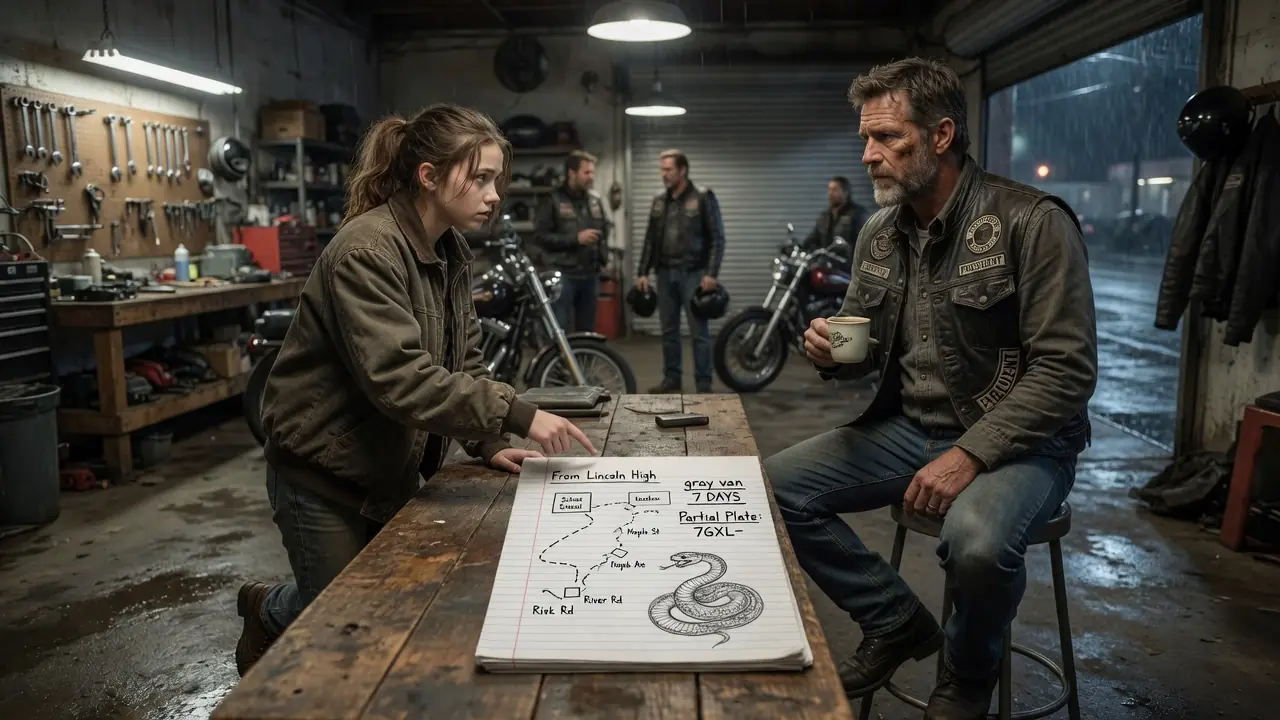
That evening, under a sky bruised purple with October rain, Michelle walked forty minutes from her group home to a motorcycle garage on the edge of town. She had seen men wearing the Iron Circle patch at a gas station before, and she remembered the symbol: a silver wheel wrapped in iron links.
She did not know if they were safe.
She only knew they looked like people who did not scare easily.
The garage smelled like oil, coffee, wet leather, and cold metal. A flickering fluorescent light buzzed over the third bay. Six men sat inside, some fixing bikes, some drinking coffee, some simply existing in the heavy silence of men who had carried too much for too long.
At the far end sat Aiden Cross, president of the Iron Circle.
He was forty-four, though grief had aged him more than years ever could. His face was lined, his beard dark with gray at the edges, and his eyes always looked as if they were measuring exits. He wore his leather cut like a burden, not a trophy.
Michelle stood in the bay doorway for almost a full minute before anyone noticed her.
A biker named Roach looked up first.
“Aiden,” he said quietly.
The room stilled.
Aiden turned.
Michelle kept both hands in her pockets and lifted her chin.
“I need to tell somebody something.”
Aiden studied her. His voice was flat, but not cruel.
“You lost?”
“No,” Michelle said. “I know exactly where I am.”
Something in that answer made the men listen.
So she told them.
The gray van.
The seven days.
The same time.
The same parking spot.
The same girl.
The man with the scar along his jaw and the old tattoo on his forearm, a snake wrapped around a dagger.
Michelle described everything with careful precision. Not because she wanted to sound brave, but because she knew foster kids were often believed last, if they were believed at all.
When she finished, the garage was so quiet she could hear rain ticking against the metal roof.
Aiden’s coffee sat untouched beside him.
“Dark hair. Green backpack. Band patch on the front pocket. Walks fast. Looks angry even when nobody’s talking to her.”
Aiden’s jaw tightened.
“That’s my daughter.”
Nobody moved.
The girl was Sadie Cole. Sixteen years old. Junior at Lincoln High. She used her mother’s last name because her mother was gone, and grief had turned her father into someone who lived in the same house but not the same life.
Aiden and Sadie had not spoken like father and daughter in fourteen months.
They shared walls, bills, and silence.
But when Michelle described the tattoo, every man in the garage understood something else.
The driver was Calder Vance.
Four years earlier, Calder had been a patched member of the Iron Circle. Charming when he wanted something, cruel when charm failed, and dangerous in ways decent men did not forgive. The club had cast him out after he hurt someone connected to their family. His patch was stripped. His name became something nobody said out loud.
Now he was back.
And he was watching Aiden’s daughter.
Aiden turned to Michelle.
“How did you find us?”
“I followed the bikes,” she said. “I saw two of your guys last week. Remembered the patch.”
“You walked here alone in the dark?”
“Yes.”
“To tell strangers that a man is watching a girl you don’t know?”
Michelle looked around the garage.
“Nobody else was going to do it.”
The sentence landed hard.
Every man in that room understood it.
Aiden looked at Roach.
“Get her something hot to eat.”
Roach moved immediately.
Michelle followed him toward the kitchen, but before she disappeared, she looked back at Aiden. Her eyes did not ask for praise. They asked one question.
Now what are you going to do?
The answer came before sunrise.
The Iron Circle began watching.
Quietly.
No noise.
No warnings.
No grand gestures.
Roach followed Sadie’s morning route from three blocks back. Dutch watched the school from a laundromat parking lot. Harlan, the club’s old sergeant-at-arms, checked the van’s plates. Others mapped every street around Lincoln High.
For three days, they confirmed everything Michelle had said.
At 3:12, the gray van arrived.
At 3:22, Sadie walked out.
Calder followed.
Every time.
By the third night, the garage wall held photographs, time notes, and a map marked in red. Calder’s path circled Sadie’s life like a tightening rope.
The question was no longer whether he was watching.
The question was why.
The answer seemed obvious.
Revenge.
But something about it bothered Aiden. Calder was cruel, but he was also careful. Too careful. He had waited four years. He had rented a van under a false name. He had chosen a school route, not Aiden’s house. He was not acting like a man who only wanted chaos.
He was acting like a man following orders.
While the men watched Calder, Michelle kept returning to the garage.
She arrived every evening around six, always in the same too-big jacket, always with careful eyes. She sat on a milk crate in the corner and observed everything. She noticed Roach’s sore shoulder and brought him ice. She noticed Harlan misplacing his glasses and moved them to the right bench. She noticed who drank black coffee, who took sugar, and who acted tough until a child entered the room.
The bikers did not know what to do with her.
So they fed her.
Protected her.
Gave her space.
It was the closest thing to tenderness most of them knew how to offer.
Aiden noticed her most of all.
Michelle reminded him of Sadie when Sadie was younger, before grief built a wall through the center of his house. Before his daughter learned to stop asking him questions. Before he mistook providing money for being present.
On the fourth evening, Aiden drove Michelle back to the group home.
They said nothing on the ride.
When they arrived, Michelle opened the truck door, then paused.
“Your daughter is lucky,” she said.
Aiden looked at her.
“She doesn’t know it,” Michelle continued. “But she is.”
Then she walked inside.
Aiden sat there long after the door closed.
That night, he went home and waited in the kitchen for Sadie.
She came in at 4:38, dropped her backpack by the door, and stopped when she saw him sitting at the table.
“What?”
Aiden’s throat tightened.
“Sit down.”
“I have homework.”
“Please, Sadie.”
The word please made her pause.
She sat.
Aiden told her everything.
The van.
Calder.
Michelle.
The surveillance.
The danger.
Sadie listened without blinking. First confusion. Then disbelief. Then anger.
“You knew for four days?”
“I had to be sure.”
“You had to be sure?” she repeated, standing so fast the chair scraped. “That’s what you always do. You wait. You waited when Mom was sick. You waited when she was getting worse. You waited until there was nothing left to say, and then you kept waiting.”
Aiden flinched.
Sadie’s eyes filled, but her voice stayed sharp.
“You don’t get to disappear for fourteen months and then act like warning me makes you a father again.”
She grabbed her backpack and walked out.
The door closed.
Not slammed.
Closed.
That was worse.
Aiden sat alone under the yellow kitchen light, knowing every word she had said was true.
The next morning, Sadie opened her school locker and found a folded note inside.
Six words.
I can get to you anytime.
She did not scream.
She did not run.
She folded the note, put it in her pocket, finished the school day with hands that would not stop shaking, and walked straight to the Iron Circle garage at 3:22.
When she stepped into the bay, every man turned.
Aiden came out of the office.
“What happened?”
Sadie held out the note.
He crossed the floor and took it from her fingers.
The moment he read it, something in his face emptied.
Harlan stepped closer.
“He got inside the school.”
Roach shook his head.
“He got inside a locked locker.”
The difference mattered.
This was not only watching.
This was preparation.
That night, the Iron Circle voted.
Not everyone agreed.
Teague, the vice president, argued that Calder was baiting them. He said the club had stayed clean for years. No investigations. No outside trouble. If they moved wrong, they could lose everything.
“She is not just Aiden’s daughter,” Harlan said from the end of the table. “She is a child being hunted.”
Teague’s face hardened.
“And if the whole club burns because one man’s family becomes everyone’s fight?”
Dutch leaned forward.
“Then maybe we finally find out whether we’re a club or just men wearing the same patch.”
The vote passed.
Seven to four.
The Iron Circle would protect Sadie.
But Aiden made one thing clear.
“No reckless moves. No street war. We gather proof. We expose whoever is behind this. And if Calder makes a move, he walks into us, not the other way around.”
Then the missing piece arrived.
A prospect working nights at a motel called the Ridgeline reported that Calder had made a short call at 1:45 in the morning.
Less than two minutes.
No conversation.
A report.
The next day, a black sedan visited Calder’s motel room. A rider photographed the plate. The registration led to Linden Property Holdings, a shell company connected to Ward Sable, a wealthy developer who had tried to force the Iron Circle off their garage property eight years earlier.
Sable had failed then.
Apparently, he had not forgotten.
The truth assembled itself slowly.
Calder wanted revenge.
Sable wanted land.
Each man was using the other.
Calder was the threat.
Sable was the money behind it.
And Sadie was the pressure point.
Aiden gathered the club at an old farmhouse outside town, away from the garage. There, under one swinging kitchen bulb, he laid out the facts.
The shell company.
The motel.
The sedan.
The old land dispute.
Teague stared at the table.
“So this was never just Calder.”
“No,” Aiden said. “It was a play.”
“And we were moved into position.”
“Yes.”
The men sat with that.
Nobody liked being used.
Especially men who had built their whole lives around never being controlled.
Then Collis, one of the youngest members, spoke quietly.
“What if we give up the garage?”
Every head turned.
“The building,” Collis said. “Not the club. If Sable wants the property, we relocate. Sadie stops being useful to him.”
Dutch’s eyes darkened.
“My father helped pour that foundation.”
“I know,” Collis said. “But Sadie is sixteen. Michelle is twelve. I care more about them breathing than I care about a building.”
The room went silent.
Aiden looked around the table, then shook his head.
“We are not surrendering. And we are not using Sadie carelessly. We use the route, not the girl. Calder expects her to walk the same path. So we choose the ground. We control the street. We control the exits. We document everything. When he moves, he moves where we can stop him.”
Teague’s voice was low.
“You want your daughter to walk into a trap.”
Aiden’s face tightened.
“I want my daughter to trust that this time, I will be there.”
No one spoke after that.
One by one, the men placed their hands on the table.
Even Teague.
Even the four who had voted no.
Broken or not, the brotherhood held.
Friday came cold and gray.
By dawn, every rider had a position. Eleven bikes spread across a six-block industrial stretch near Miller and Caldwell, hidden in alleys, behind closed shops, beside loading docks, and under old warehouse awnings.
Michelle watched from the roof of an empty warehouse with binoculars and a radio.
Aiden had driven her there himself.
“If anything goes wrong,” he told her, “you leave. Down the ladder, out the back, straight to the gas station. You call 911.”
“I know.”
“Michelle.”
She looked at him.
“I know.”
At 3:22, Sadie walked out of Lincoln High.
Green backpack.
Dark ponytail.
Headphones in.
Same route.
Same pace.
Same cold expression hiding a storm underneath.
The gray van pulled out three blocks behind her.
Michelle’s voice came through the radio, steady but tight.
“He’s following.”
Sadie reached the industrial stretch and kept walking. The streets were wider there, emptier. Warehouses stood with blank windows. Old fences rattled in the wind. The world felt abandoned.
But it was not.
At 3:41, Sadie reached Miller and Caldwell.
She stopped.
Behind her, the gray van slowed.
Then stopped.
For nearly a minute, nothing happened.
“He’s reading the street,” Teague said through the radio.
“He won’t see us,” Aiden replied.
The van rolled forward.
The driver’s door opened.
Calder Vance stepped out.
He was larger than the photographs suggested, with the old tattoo showing under his sleeve and a scar trailing along his jaw. His eyes stayed fixed on Sadie.
He took one step.
Then another.
Aiden lifted the radio.
“Now.”
Eleven engines came alive at once.
The sound shook the street.
Headlights snapped on from every direction, blazing across wet asphalt and rusted fences. Bikes rolled out of alleys, garages, and loading docks, forming a wide iron circle around Calder and the van.
Calder froze.
For the first time, the hunter understood he had been led.
Aiden stepped off his bike twenty feet away.
“You remember this feeling?” he asked. “You should. You felt it four years ago.”
Calder looked around, counting exits that no longer existed.
“This all for me?”
“No,” Aiden said. “You’re not important enough. I want who sent you.”
For half a second, Calder’s face shifted.
Aiden saw it.
So did Harlan.
So did Teague.
Before Calder could answer, Michelle’s voice cut through the radio.
“Black sedan. East on Miller. Moving fast.”
The second piece arrived.
The sedan stopped at the edge of the street. A man in a dark coat stepped out, polished, clean, and completely wrong for that neighborhood.
“My name is Garrett Penn,” he said. “I represent Ward Sable’s interests.”
Aiden looked at him.
“Your client hired Calder Vance to stalk my daughter.”
Penn’s expression barely moved.
“That is a serious allegation.”
“We have photographs. Plates. Motel records. A threatening note. Witness statements. And a twelve-year-old girl who noticed what every adult missed.”
Penn’s jaw tightened slightly.
Then, from far away, sirens began to rise.
Michelle spoke again.
“Police dispatched. Eight minutes.”
Aiden stepped closer to Penn.
“When they arrive, they’ll find Calder. They’ll find the note. They’ll find the connection to Linden Property Holdings. Your client can keep hiding behind paperwork, but he is not invisible anymore.”
Penn’s eyes narrowed.
“You don’t want a courtroom, Mr. Cross. Courtrooms ask questions. They look into old property rulings. Old disputes. Old signatures.”
Aiden went still.
The words told him enough.
Sable knew more than he should.
Maybe enough to threaten the Iron Circle’s claim to their garage.
Maybe enough to destroy the old foundation completely.
Calder saw the hesitation.
He moved.
Not toward an exit.
Toward Sadie.
Sadie froze.
Aiden did not.
He crossed the distance like a man whose whole life had narrowed to one purpose. Dutch and Roach moved too. Within seconds, Calder was on the ground, restrained before he could reach her.
No one celebrated.
No one shouted.
The sirens grew louder.
Sadie stood trembling in the cold.
Aiden turned toward her, breathing hard, face pale with fear he could no longer hide.
“Dad,” she whispered.
The word broke him.
Not Calder.
Not the threat.
Not the sirens.
That word.
The first time she had called him Dad in more than a year.
Aiden stepped toward her.
“I’m here,” he said.
Sadie’s eyes filled.
“For once,” she whispered.
He nodded, accepting the wound because it was true.
“For once.”
When the police arrived, Officer Ruiz took control of the scene. The Iron Circle raised their hands, not in surrender, but in cooperation. Calder was taken into custody. The note was turned over. The photographs were logged. Michelle climbed down from the warehouse roof and gave a statement so precise that Ruiz stopped writing twice just to look at her.
“You noticed all this yourself?” Ruiz asked.
Michelle shrugged.
“Somebody had to.”
By morning, charges were filed against Calder for stalking, criminal threatening, and attempted assault. Linden Property Holdings was flagged. Ward Sable’s name entered an investigation he could no longer bury with money.
But Aiden did something none of the men expected.
He told the truth about everything.
Even the old land dispute.
Even the legal secret that had helped the club keep the garage years before.
Harlan, the oldest member, had carried that secret alone. He had believed he was saving the club. Maybe he had. But the foundation was not clean, and Aiden refused to protect his daughter with one truth while hiding another.
The cost came fast.
The old ruling was reopened.
The Iron Circle lost the garage.
Ward Sable got the building he had wanted for years.
But he did not get the brotherhood.
Two weeks later, the Iron Circle moved to the old farmhouse outside town. It was smaller, colder, and farther from everything. The barn became the new garage. The kitchen table became the new meeting table. The road turned to mud when it rained and dust when it dried.
But nobody had to lie to keep it.
On the first night, Teague looked around the old barn and said, “It smells like dust and bad decisions.”
Roach nodded.
“So did the old place.”
For the first time in weeks, the men laughed.
Aiden and Sadie did not heal all at once.
Real families rarely do.
He started by cooking dinner. Badly.
He burned rice. Oversalted soup. Once made chicken so dry Sadie picked it up and said, “This could qualify as construction material.”
Aiden looked at it and said, “That may be my best work.”
Sadie laughed before she could stop herself.
It was small.
It was everything.
Some mornings, he drove her to school. Some mornings, she still walked. But now, when she walked, he watched until she turned the corner, and she no longer hated him for it.
Michelle’s life changed too.
Officer Ruiz made calls. A social worker named Danielle Price opened a file that should have been opened years earlier. Two months later, Michelle moved in with a foster couple named Gil and Pam.
Gil was a mechanic with quiet hands.
Pam was a school librarian who asked Michelle about her favorite books before asking about her past.
When Aiden drove Michelle to the new house, she sat in his truck staring at the freshly painted porch railing.
“They painted that for me,” she said.
Aiden looked at the railing.
“How do you know?”
“The paint doesn’t match the steps. The steps are old. The railing is new.”
He nodded.
“Someone knew you were coming.”
Michelle held her small bag in her lap.
“I’m not used to that.”
“I know.”
She opened the truck door, then paused.
“Aiden?”
“Yeah?”
“Thanks for not making this a big speech.”
He almost smiled.
“You hate speeches?”
“I hate when adults talk so much they cover up what matters.”
She stepped out, walked to the porch, and entered the house where someone had left a light on.
Spring came late that year.
The trees along Route 11 finally budded. The river thawed. The old farmhouse filled with the sounds of tools, engines, coffee cups, and men learning that home was not a building unless people made it one.
One Saturday in April, the Iron Circle hung a new barn door. It took twelve hands, three arguments, and Roach dropping a hinge bolt into the grass twice.
When it finally swung straight, Dutch crossed his arms.
“That door might be the best thing you’ve ever done, Roach.”
Roach wiped sweat from his forehead.
“It is the only door I’ve ever done.”
“Exactly.”
Laughter moved through the yard.
Aiden sat on the porch steps as the sun lowered over the scrub grass.
Sadie’s truck came up the driveway. She had passed her driver’s test two weeks earlier. He had left a hand-forged keychain on the counter the next morning, a simple metal S, uneven at one curve because his hands had shaken while making it.
Sadie had never mentioned it.
She sat beside him now, keys in her hand.
“Michelle called,” she said. “She wants to come next Saturday.”
“Good.”
“She’s reading seven books this month.”
“That sounds like her.”
Sadie turned the keychain between her fingers.
“I know you made this.”
Aiden looked down.
“Saw the file marks on the workbench,” she said.
He said nothing.
“It’s not perfect.”
“I know.”
“But it’s good.”
Aiden swallowed.
“Thanks.”
They sat in silence.
Not the old silence.
Not the one built from grief and avoidance.
This silence had room inside it.
Room for pain.
Room for repair.
Room for the slow, awkward work of coming back to each other.
After a while, Sadie said, “I’m not ready to say everything is okay.”
“I know.”
“But I’m here.”
Aiden nodded.
“That’s enough for today.”
Inside the farmhouse, someone turned on an old radio. Men’s voices mixed with guitar music and the clink of coffee mugs. The new barn door stood solid in its frame. The bikes rested in a line, chrome catching the last light.
The Iron Circle had lost its old home.
But it had kept what mattered.
A daughter.
A foster girl.
A truth.
A brotherhood rebuilt on ground no one had to hide.
Family is not always the place you are born into.
Sometimes it is the twelve-year-old girl who walks through the dark because nobody else will.
Sometimes it is the sixteen-year-old girl brave enough to stand still while everyone who loves her closes ranks around her.
Sometimes it is a father who finally understands that protection is not only standing in front of danger.
It is standing beside the people you love after the danger is gone.
And sometimes, it is eleven motorcycles in the cold, their engines roaring like thunder, telling one frightened girl the thing she had waited her whole life to hear.
You are not alone anymore.