I was sitting at a bar in Oklahoma City with my buddy Toby when my marriage began to crack in front of me.
At the time, I did not know that was what was happening.
I thought I was celebrating.
Toby and I had just spent three long months negotiating a manufacturing agreement between our companies. I was head of product development at Rer Industries in Denver, Colorado, and my team had designed a new line of air conditioning controls for energy-efficient smart homes.
Toby’s company had the production capacity, the technical experience, and the kind of facility that could take our design from prototype to real product.
The deal mattered.
It mattered to my company.
It mattered to my career.
It mattered to me personally because I had spent years trying to prove that I was more than the quiet engineer who kept his head down and solved problems no one thanked him for.
So when Toby raised his beer glass that night and said, “To future profits and fewer lawyers,” I laughed and clinked my bottle against his.
“To fewer lawyers,” I said.
That joke would feel different later.
We were at a place called Red Stallion Bar and Grill, a noisy bar near our hotel with old neon signs on the wall, country music playing low under the sound of conversations, and enough smoke from the kitchen to make every jacket smell like grilled onions. It was the kind of place where traveling salesmen, oil workers, contractors, and people with nowhere better to be all ended up at the same time.
The deal had been sealed over beer.
For one hour, I felt like a lucky man.
Then a loud burst of laughter erupted from the other end of the bar.
Toby turned his head.
“What is going on over there?”
I shrugged.
“No idea.”
But I looked anyway.
At first, I saw only a booth filled with large men, the kind who took up more space than they needed and knew it. They were laughing, leaning back, drinking too loudly, and speaking with the casual confidence of people who were not worried about anyone asking them to quiet down.
Then I saw the woman.
Young-looking from where I sat.
Blonde.
Slim.
Laughing loudly with her head tilted back.
She wore a short skirt, a sleeveless top, and had a small rose mark on her shoulder. Her hair fell in bright waves that caught the bar light. She looked tipsy, comfortable, and surrounded by men who seemed to know her well.
For one strange second, my stomach tightened.
She looked like my wife.
Not exactly.
Not in the obvious way.
Donna Carson had dark brown hair, not blonde. She wore practical suits when she traveled for work, not bar outfits. She carried herself with clean professional confidence, not the loose, loud energy of a woman holding court in a booth full of men.
But something about the shape of her face, the way she moved her hand when she laughed, the curve of her mouth when she smiled, sent a cold line down my spine.
I told myself it could not be her.
Donna was in Houston.
She was supposed to be working with factory management for four days, selling security equipment to industrial plants. Her job kept her on the road constantly, and that was one of the reasons I had taken this quick trip to Oklahoma City without worrying about disrupting our home life.
She had called Monday morning from Denver International Airport.
“Kiss me through the phone,” she had said playfully before boarding.
I had laughed.
“I’ll save the real one for Friday.”
“Deal,” she said.
Now it was Wednesday night, and a blonde woman with a rose on her shoulder was laughing in an Oklahoma City bar.
Toby noticed me staring.
“Bob, you know her?”
“No,” I said too quickly. “She just looks like someone.”
“Like who?”
I took a drink of beer and looked away.
“No one.”
But I kept watching from the corner of my eye.
The woman leaned toward one of the men, said something, and the whole booth laughed again. One man put his hand lightly on her back. She did not move away. Another man held up a phone as if showing her something, and she leaned close enough that her hair brushed his shoulder.
The room seemed to grow narrower around me.
Toby kept talking about production estimates, tooling costs, delivery windows. I nodded when necessary, but my mind was no longer in the conversation.
Then the woman stood.
The men stood with her.
There were five of them, maybe six, broad-shouldered and loud, moving as a group toward the exit. As they passed near our table, she walked between two of them, and for half a second, her eyes met mine.
Dark blue eyes.
Donna’s eyes were dark blue.
The woman smiled.
Not kindly.
Not nervously.
Strangely.
Like she recognized me and did not care.
Then she turned away and left with the men.
The door closed behind them.
The noise of the bar returned around me, but I felt as if something had gone silent inside my chest.
“Bob,” Toby said. “Are you all right?”
I nodded.
I was not all right.
My name is Bob Carson.
I was forty years old then, married to Donna for six years, and up until that night, I believed I understood the life I was living. Donna and I did not have children. We had talked about it early in the marriage, then put the conversation off because her travel was heavy and my work demanded long hours. Later, it became one of those subjects that sat between us without being mentioned much.
But I thought we were solid.
Not perfect.
Solid.
We had a comfortable home in Denver, two decent incomes, vacations when schedules allowed, and a marriage that looked stable from the outside. Donna was beautiful, driven, and independent. I had always admired that about her. She did not need anyone to carry her through life. She chose me, or so I believed, and that had always made me feel lucky.
Now I could not stop seeing that blonde woman’s eyes.
Toby leaned closer.
“Isn’t Donna supposed to be in Houston?”
“Yeah,” I said. “She is.”
“But?”
“But there was something about that woman.”
Toby looked toward the exit, then back at me.
“Could have just been a resemblance.”
“Maybe.”
But I did not believe myself.
When the waitress came by, I ordered two more beers. Then I stopped her before she walked away.
“Can I ask you something?”
She looked at me with the weary caution of a woman who had heard too many bad questions from men in bars.
“Depends.”
“The blonde woman who just left with those guys. Do you know her?”
The waitress’s expression changed slightly.
Not much.
Enough.
“Local?”
“Not sure.”
“What’s her name?”
The waitress looked toward the door, then back at me.
“I don’t ask many questions about people who come in with that crowd.”
“What crowd?”
She lowered her voice.
“Men you probably don’t want to get mixed up with.”
“I’m only curious.”
“Curiosity is usually how people get mixed up.”
Then she walked away.
Toby gave me a look.
“That was comforting.”
I tried to laugh.
It came out wrong.
After we finished our beers, we called it a night. Toby had an early flight. I had a later one the next day and planned to sleep in. At least, that had been the plan.
In my hotel room, I sat on the edge of the bed with the television on mute and called Donna.
Voicemail.
I called again ten minutes later.
Voicemail.
That was strange.
Donna usually kept her phone close while traveling. Even if she was at dinner with clients, she texted back quickly. She liked being reachable. She said clients expected it.
I sent a message.
Hey, hope your day went okay. Call when you can.
No answer.
I stared at the phone for almost fifteen minutes.
Then, feeling foolish and not foolish at the same time, I looked up the number for the Houston hotel where she was supposed to be staying.
A front desk clerk answered.
“Good evening. This is the Westbridge Houston. How may I help you?”
“Hi,” I said. “I’m trying to reach my wife, Donna Carson. She’s a guest there. Could you connect me to her room?”
“One moment, sir.”
Keyboard sounds.
Then a pause.
“I’m sorry, sir, but Mrs. Carson checked out this morning.”
The room changed around me.
Not visibly.
But everything felt different.
“She checked out?”
“Yes, sir.”
“Are you sure?”
“Yes, sir. The room was released around ten-thirty this morning.”
“Did she leave a forwarding hotel?”
“I’m not able to provide additional guest information.”
I thanked him and hung up.
That was the first real crack.
Donna sometimes handled multiple clients during one trip, but she always told me when her plans changed. She had an organized mind. Calendar invites, travel emails, hotel confirmations, rental car numbers. She was the kind of person who color-coded folders at home and packed toiletries in labeled bags.
She did not casually change hotels and forget to mention it.
I texted her again.
Everything okay? I called the hotel and they said you checked out.
Her reply came quickly this time.
Too quickly.
Long day. I’m exhausted. Getting ready for bed.
I stared at the message.
Then typed:
Where are you?
At the hotel, she replied. Where else?
My mouth went dry.
I typed slowly.
The Houston hotel said you checked out this morning.
Three dots appeared.
Disappeared.
Appeared again.
Finally:
There was an issue with the room. I switched hotels. I’ll explain tomorrow. Too tired now. Love you.
I looked at those words for a long time.
I wanted to believe them.
That was the dangerous part.
A person who wants to believe can build a whole bridge over a hole in the ground and call it trust.
I typed:
Love you too.
But for the first time in my marriage, those words felt like something I was sending into darkness and hoping it found the right person.
I flew home the next day.
Donna came home Friday evening, exactly as planned.
Her car was already in the garage when I arrived from work. I walked into the house and heard the shower running upstairs. Normally, after days apart, that sound would have made me smile. I would have taken off my tie, gone upstairs, and greeted my wife with the easy affection of a man who believed his marriage was safe.
That was exactly what I tried to do.
I went into the bathroom and opened the shower door.
Donna screamed.
Not startled.
Terrified.
She turned sharply, pressing herself away from me as if I had been a stranger breaking in.
I froze.
“What is wrong?”
She stared at me with wide eyes, water running over her face.
“You scared me half to death.”
“I live here.”
“I know, Bob. I just didn’t hear you come in.”
I stepped closer, wanting to embrace her, wanting to erase Oklahoma City from my mind through closeness. She recoiled again.
The movement was small.
It cut deeply.
“I haven’t seen you in days,” I said. “And you’re acting like I’m some kind of stranger.”
Her face softened too quickly.
“I’m sorry. I really am. I’m just exhausted. Please let me take a quick shower, and I’ll be out in a few minutes.”
I backed away.
“All right.”
“I missed you,” she added.
The words arrived late.
I nodded and closed the shower door.
Downstairs, I grabbed a beer from the refrigerator and turned on the news without watching it. The house looked exactly as it always had: clean kitchen, polished countertops, framed vacation photos, Donna’s travel bags near the stairs. The ordinary details made the growing suspicion feel almost absurd.
Thirty minutes later, Donna came down wearing shorts and a T-shirt, her damp hair loose around her shoulders.
“I’m sorry for yelling,” she said. “I really did miss you. The trip was awful.”
I turned the bottle slowly in my hand.
“I called you Wednesday.”
“I know.”
“Where were you?”
“In my hotel room.”
“Then why did they say you checked out that morning?”
She sighed, as if this were an inconvenient misunderstanding.
“There was a bathroom leak. They couldn’t move me to another room because they were full, so they arranged another hotel. I should have told you, but I didn’t want to bother you while you were working.”
That sounded reasonable.
Too reasonable.
“What was the new hotel?”
She hesitated for half a second.
“Marston Suites.”
I nodded.
“And you checked in there Wednesday morning?”
“Yes.”
I knew she was lying.
I did not know how I knew.
Maybe it was the way she looked toward the kitchen window instead of at me. Maybe it was the half-second pause. Maybe it was the fact that I had been married to her long enough to hear when her voice stopped belonging to the truth.
“I was worried,” I said. “I had good news too.”
She sat beside me.
“What good news?”
“I went to Oklahoma City and closed the deal with Toby’s company.”
Her face changed.
Not dramatically.
Not enough for a stranger to notice.
But I was not a stranger.
“You were in Oklahoma City two days ago?”
“Yes.”
“Why didn’t you tell me?”
“It came together fast. Spur-of-the-moment trip. I tried calling you, but you didn’t answer.”
She looked down at her hands.
“I’m sorry. I was probably with clients.”
“Probably.”
She looked up.
“What does that mean?”
“Nothing.”
But it meant everything.
She moved closer then, touched my arm, and smiled in a way that once could have undone me.
“I’m glad the deal went well.”
“Me too.”
Then she changed the subject.
“My sales territory is expanding.”
I looked at her.
“What?”
“Management wants me to cover more accounts. It means more travel for a while, maybe four or five days a week.”
“You already travel constantly.”
“I know.”
“For how long?”
“Just a few months, hopefully.”
“You didn’t mention this before.”
“I found out during the trip.”
The lie sat between us neatly dressed as career news.
On Monday morning, Donna flew to Miami.
At least, that was what she said.
For the next few weeks, our marriage became confusing in a way I still struggle to describe. When Donna was home, she was passionate and attentive, almost too attentive. She kissed me more. Cooked dinner twice. Sat close on the couch. Asked about my work. Called me handsome in a tone that felt like performance.
When she traveled, she called every evening.
She told me she was okay.
She asked what I had eaten.
She said she loved me.
A man who wanted to be reassured could have accepted all of it.
But I could not forget the dark blue eyes of the blonde woman in Oklahoma City.
Then came the doctor’s office.
Donna had left for New York on a Sunday, saying the trip might last at least five days. I went to work Monday and tried to focus on production schedules, engineering revisions, supplier estimates, and everything else that normally occupied my mind.
By ten-thirty, I felt a sudden pain that frightened me badly.
I will not describe the symptoms in detail.
There are some humiliations a person does not need to relive for an audience.
I left the office and went straight to my doctor.
Dr. Brown had been my physician for years, going back to my Army days. He was blunt, careful, and not easily rattled. That day, after running tests and asking questions, he returned to the exam room with a look that told me the problem was not simple.
“Bob,” he said, sitting on the rolling stool, “we need to talk.”
The diagnosis made my blood go cold.
It was an infection that could only mean one thing.
Dr. Brown asked about recent partners.
I told him the truth.
“One person in the past seven years,” I said. “My wife.”
He watched me carefully.
“You’re certain?”
“I’m certain.”
“You and Donna have been married how long?”
“Six years. Together seven.”
His expression softened slightly.
“Then Donna needs to see a doctor immediately.”
I laughed once.
Not because anything was funny.
Because my body had reached a point where shock needed somewhere to go.
He gave me instructions, treatment, and a warning to avoid intimacy until everything was resolved.
“That won’t be a problem,” I said.
He looked at me with pity.
I hated pity, but I understood why it was there.
Once I left the clinic, I sat in my car for ten minutes.
The dashboard clock read 12:17.
Outside, people walked in and out of the medical building carrying purses, insurance cards, coffees, ordinary problems. Inside my car, my life had divided itself into before and after.
Before the diagnosis, I could still pretend.
After it, pretending became self-harm.
I called my boss and gave him a brief explanation. Not the details. Enough. He had been through a painful divorce himself years earlier and understood more from my tone than my words.
“Take a couple of days,” he said. “Do what you need to do.”
What I needed was truth.
I contacted a private investigator that afternoon.
The office was called Hammer Investigations. I expected something run-down, maybe a dusty storefront with blinds and a receptionist who sounded bored. Instead, the office was professional, clean, and surprisingly calm. A friendly woman at the front desk offered coffee and told me Mr. Hammer could see me immediately.
James Hammer was a large, solid man with a direct manner and the kind of eyes that made lying feel pointless.
He invited me to sit.
“What can I do for you, Mr. Carson?”
I told him everything.
Oklahoma City.
The blonde woman.
Donna’s supposed Houston trip.
The hotel checkout.
The strange behavior when she came home.
The expanded travel story.
The diagnosis from Dr. Brown.
James listened without interrupting, occasionally making notes on a yellow pad.
When I finished, he asked, “Have you spoken to a lawyer?”
“Not yet.”
“You should.”
“I need to know what she’s doing first.”
“You need both.”
He leaned back.
“Where is she supposed to be now?”
“New York.”
“Do you know her hotel?”
“She said near Times Square. I don’t have the exact address.”
“Call her office.”
I frowned.
“Now?”
“Yes. Ask for her travel schedule. Say you misplaced it.”
It felt strange to do it in front of him, but I called Donna’s company and asked for her assistant, Patricia.
Patricia had a warm voice and had helped me send flowers to Donna once after a big sale. When she came on the line, I tried to sound normal.
“Hi, Patricia. It’s Bob Carson. I’m trying to confirm Donna’s travel schedule. I misplaced the details.”
There was a pause.
Not long.
Long enough.
“I’m sorry, Mr. Carson,” she said. “Mrs. Carson doesn’t work here anymore.”
The room went silent around me.
“She what?”
“She resigned about a month ago.”
I gripped the phone harder.
“That’s impossible.”
“I’m sorry. I thought you knew.”
“No,” I said slowly. “I did not.”
Patricia’s voice became quieter.
“She said she had an opportunity to make more money. I don’t know where. She didn’t give many details.”
I thanked her and ended the call.
For a few seconds, I could not speak.
James waited.
That was one of his skills.
He knew silence often pulled the next truth out better than questions.
“She quit her job,” I said finally.
“When?”
“A month ago.”
“But she has been traveling for work.”
“That’s what she told me.”
James nodded once.
“This is not an ordinary affair case.”
“No.”
“She’s hiding income, travel, and identity. Maybe more.”
That reminded me of something.
Months earlier, Donna had lost her phone during a trip. Hotel staff eventually found and returned it, but after that, I installed a tracking app with her permission because she said losing it had scared her. We never used it much. I had almost forgotten it existed.
I opened the app with shaking fingers.
It took a moment to load.
Then the location appeared.
Courtyard New York Manhattan.
Not the hotel near Times Square she had described.
Not even the right area.
I showed James.
He looked at the screen, then at me.
“You said she wore a disguise in Oklahoma City?”
“I don’t know. The woman was blonde. Donna’s hair is dark brown. But the eyes were the same, and there was a rose mark on her shoulder.”
“Temporary tattoo?”
“Maybe.”
James accepted the photos I sent him of Donna. I paid a substantial deposit. Before I left, he handed me a card for a lawyer named Robin Hawkins.
“She’s the sharpest legal mind around,” he said. “Call her today.”
I did.
Her office gave me an appointment for the next morning.
When I got home, I did not call Donna.
I wanted her to believe I knew nothing.
Instead, I went into her home office.
Donna’s desk had a locked drawer. She had one key, and I had the other, just as she had access to my desk. Under normal circumstances, I would never have gone through her private files.
Those circumstances no longer existed.
Inside, everything was arranged neatly.
Donna was always organized.
That made the betrayal worse somehow.
Folders.
Statements.
Receipts.
Contracts.
A life hidden in tabs and paper clips.
The first folder contained bank statements from an unfamiliar bank. I quickly realized Donna had maintained a separate account since before our marriage. I had assumed she closed it when we opened our joint account.
She had not.
The latest statement showed a balance of more than half a million dollars.
I stared at the number until it stopped making sense.
Large deposits came regularly from a company called Stanton Enterprises.
Withdrawals showed expensive clothes, jewelry, wigs, hotels, flights, and services I did not recognize at first. Then the pattern became obvious.
One airline ticket caught my attention.
Houston to Oklahoma City.
Purchased just before my meeting with Toby.
My hands went cold.
The blonde woman in the bar had been Donna.
I sat back in her chair and looked around the office.
The room smelled faintly of her perfume. A framed photograph of us from our trip to Santa Fe sat on the shelf. In the picture, she leaned against me with both arms around my waist, smiling as if we belonged to the same truth.
I kept searching.
Another folder contained medical receipts and clinic records that suggested Donna had hidden several serious personal decisions from me throughout our marriage. Some were dated years apart. Others were recent. I read enough to understand the pattern, then stopped reading for details because pain does not need decoration to be real.
Then I found tax documents from the years she had insisted we file separately.
At the time, she said it was because of commissions, deductions, and complicated bonus structures.
Now I saw the real reason.
She had income I knew nothing about.
Another folder contained a contract between Donna and Stanton Enterprises.
The legal language was dense, but the meaning was clear enough.
Donna had agreed to participate in adult entertainment productions and private promotional events for a number of years. The contract was signed by Donna and Harold Stanton, president and CEO of Stanton Enterprises.
I read the signature line three times.
Donna Carson.
My wife’s name.
Not a mistake.
Not a rumor.
Not a lookalike.
Her name.
Her hand.
Her choice.
I copied everything.
I scanned the most important papers, saved them onto a flash drive, and sent copies to James Hammer.
Then I went into Donna’s dressing room.
Her closet had always been partly private, partly theatrical. She had more clothes than I could track, most of them for sales meetings, client dinners, conferences, and travel. I had never questioned it.
Now I looked behind garment bags and storage boxes.
There, tucked in the back, I found clothes I had never seen her wear.
Wigs.
Blonde.
Red.
Black.
Colored contact lenses.
Temporary tattoos.
One was a small rose.
The exact rose I had seen on the blonde woman’s shoulder in Oklahoma City.
I sat on the floor holding that tattoo sheet in my hand while the last pieces of denial fell away.
Then I found a DVD labeled with Donna’s initials and a title that made my stomach twist.
I should not have watched it.
I know that now.
But a betrayed person does not always act with wisdom. Sometimes he reaches for proof even when proof has already become a blade.
I watched enough.
Not all.
Enough.
Donna wore a disguise. She participated in something that shattered the last part of the woman I thought I knew. Worse, in a short interview segment, she claimed that I knew what she was doing and approved because I supposedly could not satisfy her.
She said my name without saying it directly.
She turned my marriage into a prop.
Humiliation flooded me so quickly I could barely breathe.
I shut the video off and sat in the dark room, the screen black now, my reflection faintly visible in it.
Whatever love I still had for Donna died in that room.
Not because of one act alone.
Because of the contempt beneath the lie.
It is one thing to betray a husband.
It is another to use his trust as part of the performance.
I left the house.
I drove to a bar and grill where I often ate after long workdays. The waitress knew my usual order and brought a beer before I asked. I ordered a burger too, but I could barely taste anything.
I kept asking myself the useless question all betrayed people ask.
What did I do wrong?
I had loved her.
Respected her.
Stayed faithful to her.
Surprised her with flowers, cards, affection, and loyalty. I thought we had a solid marriage. I thought her travel was work. I thought her tiredness was effort. I thought her separate filing was tax planning.
I had not been stupid.
I had been trusting.
At four o’clock, I called Robin Hawkins’s office and asked if there was any way to move my appointment sooner. A cancellation had opened. She could see me at eight the next morning.
I accepted immediately.
Shortly after that, Donna called.
I looked at her name glowing on the screen.
For six years, seeing that name had meant home.
Now it looked like evidence.
I answered.
“Yeah.”
“Bob?” she said. “Are you okay?”
“Rough day.”
“What happened?”
“Just work.”
She paused.
“You sound strange.”
“I’m tired.”
“I’m in New York,” she said, slipping into her polished travel voice. “Heading out to dinner with clients. The deal looks promising.”
Clients.
Deal.
Promising.
The language of business wrapped around a secret life.
“That’s good,” I said.
“I’ll call you later.”
“Sure.”
“I love you.”
I closed my eyes.
“Me too.”
I did not say the words back.
The next morning, I met Robin Hawkins.
Her office was on the eighth floor of a downtown building with a view of Denver’s gray morning skyline. She was in her early fifties, with sharp eyes, silver-streaked hair pulled back neatly, and a voice that made every sentence sound prepared for court.
I placed the thick folder of evidence on her desk.
“I want Donna out of my life,” I said.
Robin did not react dramatically.
She opened the folder and read.
Page after page.
Bank statements.
Travel records.
The Stanton contract.
The clinic records.
The hotel receipt.
Photos from the closet.
Notes from James Hammer.
Her expression tightened as she went, not with shock exactly, but with professional concern.
When she finished, she folded her hands.
“First, you need to understand that this is not just a divorce case.”
“I know.”
“No,” she said. “I need you to really understand. There may be criminal exposure here. Financial concealment, tax issues, possible connection to broader unlawful activity. I cannot advise you to confront her alone.”
“I don’t plan to.”
“Good.”
“I want to protect my home, my pension, my income, and my assets as much as possible.”
“The financial picture helps you,” Robin said. “She has hidden substantial income. That changes support claims. Her separate assets and undisclosed earnings matter. Infidelity can also affect strategy, depending on how it connects to marital funds and health consequences.”
I nodded.
“She has half a million dollars hidden.”
“At least.”
The words at least landed heavily.
Robin continued.
“I want to coordinate with James Hammer. We need to document everything correctly and avoid contaminating evidence. Do not destroy anything. Do not threaten her. Do not move money recklessly. Do not let emotion make you careless.”
I listened.
By then, careful was all I had left.
For the next two days, I kept working because staying home with my thoughts felt unbearable. Every room in the house had changed. Donna’s closet became a crime scene in my mind. Her desk became a vault of lies. Our bedroom became somewhere I no longer wanted to stand.
On Thursday, Robin called and asked me to meet her and James at her office the next morning.
When I arrived, two federal agents were there.
A man named Agent Mark Jones and a woman named Agent Carla Reyes.
I stopped in the doorway.
“What is this?”
Robin stood.
“Bob, sit down. They’ll explain.”
James placed a thick report and a stack of DVDs on the table. Then he showed me a photo of Harold Stanton.
Stanton was a heavy man in his late fifties with slicked-back gray hair, expensive taste, and dead eyes. James explained that Stanton had a long history in adult entertainment, private clubs, and event networks across multiple cities.
Donna had been involved for years.
Years.
She had hidden it during supposed business trips, using wigs, temporary tattoos, colored contacts, different hotels, and false stories.
James explained that about three years earlier, Stanton’s operation had shifted. More recording. More online promotion. More organized private events. Donna had signed deeper contracts over time. More recently, she had allegedly become involved not just as a performer, but in recruiting and training other women.
That was why the FBI was involved.
Agent Reyes spoke carefully.
“We cannot disclose everything at this stage. But we believe Stanton Enterprises may be connected to criminal activity beyond consensual adult production, including coercion, financial exploitation, and interstate racketeering.”
I felt sick.
Agent Jones added, “Your wife may be a witness, a participant, or both. We need to determine her role.”
I stared at the table.
This had moved beyond adultery.
Beyond humiliation.
Beyond divorce.
My marriage had been a doorway into something much darker than I had imagined.
“What do you need from me?” I asked.
They explained.
Donna was expected home Sunday afternoon. James would serve her divorce papers. The agents wanted to speak with her after service, and if conditions were right, they would take her into custody. They needed me calm. They needed access. They needed her not to vanish.
Robin looked at me.
“Can you do that?”
I thought of the blonde woman smiling at me in Oklahoma City.
Donna recoiling in the shower.
The hidden account.
The video.
The infection.
The lies.
“Yes,” I said. “I can do that.”
Before I left, Robin handed me a card.
Dr. Jamie Bronson.
“Call her,” she said.
“I’m not sure I need therapy.”
“You need someone whose job is not evidence.”
That was the first thing anyone said that made me feel seen as a person rather than a witness.
I made the appointment.
Sunday came slowly.
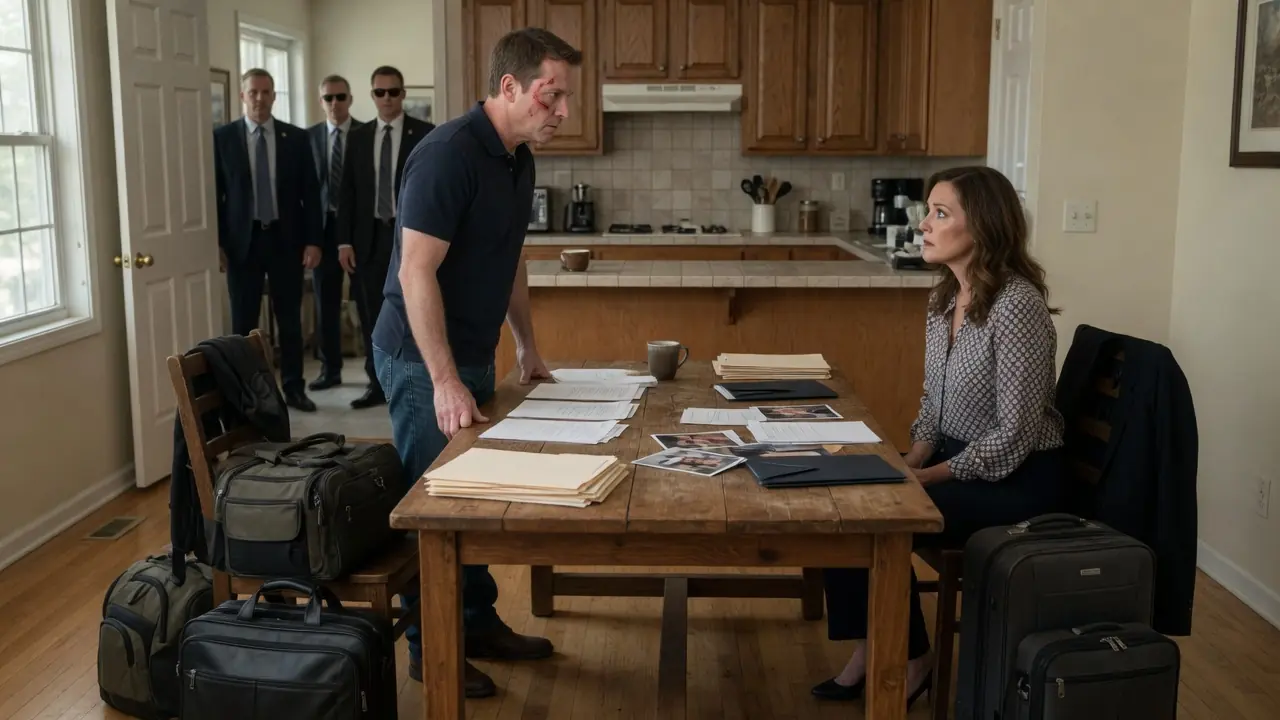
I cleaned the kitchen that morning because I needed something to do with my hands. Then I laid the documents across the table: bank statements, photos, contract copies, divorce papers. Not everything. Enough.
James and the agents arrived before Donna and waited in my home office. Robin was present too, not as a participant in the arrest, but as my attorney, making sure I did not say or do anything foolish. Donna’s parents, Ralph and Denise, arrived separately. Robin had contacted them with limited information, telling them only that a serious legal and family matter required their presence.
They waited in the guest room.
No one spoke much.
At 1:12 p.m., Donna came home.
She carried a suitcase, a briefcase, a rolling duffel bag, and a garment bag. She looked polished and tired in the exact way she always looked after travel. Dark hair neat. Makeup clean. Wedding ring on her finger.
A wife returning from work.
Or the performance of one.
She smiled when she saw me in the kitchen.
“Hey, you.”
Then she saw the table.
The smile faded.
“What is all this?”
“Sit down, Donna,” I said. “We need to talk.”
Her eyes moved over the papers.
“I need to shower first.”
“No.”
She flinched.
I had never spoken to her that way.
“We talk now.”
Slowly, she sat.
For a moment, she looked confused. Then she recognized one of the bank statements. Then the Stanton contract. Then the hotel receipt. Her face changed, not into guilt exactly, but calculation.
“What is this supposed to mean?” she asked.
I ignored the question.
“Were you the blonde woman I saw in Oklahoma City?”
She stared at me.
Then, to my surprise, she smiled faintly.
“Yes.”
The admission landed with strange quietness.
“You knew I saw you?”
“I suspected.” She leaned back. “I was surprised you didn’t do anything that night.”
Her calm disgusted me.
“You were supposed to be in Houston.”
“I know.”
“You checked out that morning.”
“Yes.”
“You lied to me.”
“Yes, Bob. I lied.”
There was no apology in it.
Only irritation that the lie had become inconvenient.
I looked at the woman across from me and understood that she was already done pretending to be the wife I had known. The mask had not cracked. She had removed it because she no longer saw value in wearing it.
“How long?” I asked.
She sighed.
“Before we got engaged.”
The room tilted.
“What?”
“It started before we got engaged.”
I gripped the edge of the table.
“At first it was occasional,” she said, as if discussing an old hobby. “Then monthly. Then it became tied to travel. Stanton paid well.”
“You were doing this our entire marriage?”
“Not all the time.”
“That is your defense?”
She looked annoyed.
“It had nothing to do with you.”
I stared at her.
“You exposed me to medical consequences.”
Her expression shifted slightly.
“Is that what this is about?”
“That is one part of what this is about.”
“I was careful.”
“You were not careful. I am sitting here because you were not careful.”
She looked away.
I pushed the contract toward her.
“You hid income. You filed separately. You quit your job and kept pretending to travel for it. You let me believe our life was real while you built another one.”
“Our life was real,” she snapped.
“No. Parts of it were real. That is what makes this worse.”
For the first time, anger flashed across her face.
“You think you were perfect? You think being decent makes you exciting? You were comfortable, Bob. Safe. Predictable. I needed more.”
I almost laughed.
Not because it was funny.
Because there it was.
The truth dressed as cruelty.
“You could have left.”
She rolled her eyes.
“And give up the house? The stability? The clean little husband at home?”
The clean little husband.
The phrase cut through me.
Whatever grief remained hardened.
I looked at her calmly.
“The divorce papers are complete.”
She laughed then.
Actually laughed.
“You don’t have the courage to divorce me.”
I stood.
“No?”
“You’ll be furious for a while. Then you’ll calm down. You love being steady. You love doing the right thing. You won’t blow up your life.”
I looked toward my home office.
“You can come out now.”
The door opened.
Five people stepped into the room.
James Hammer came first, holding a manila envelope.
Robin followed.
Then Agent Jones and Agent Reyes.
Donna’s eyes widened.
Then her parents stepped from the hallway.
Her mother’s hand flew to her mouth.
Her father looked as if his body had turned to stone.
James walked to Donna and placed the envelope on the table.
“Donna Carson,” he said, “you have been notified.”
I placed a pen in front of her.
“Sign the acknowledgment of receipt.”
She stared at me.
“No.”
Robin stepped forward.
“You are acknowledging receipt of service, not agreeing to every term. Refusal does not stop the process.”
Donna looked around the room.
“You brought my parents?”
Ralph’s voice broke.
“Donna, what have you done?”
Donna’s face twisted.
“Don’t act shocked, Dad.”
Denise began crying.
“I am ashamed of you,” she whispered.
Donna turned on her mother then, eyes bright with venom.
“Of course you are. I was only following your footsteps.”
The room went silent.
Ralph looked at Denise.
I looked at Denise too.
Her face had gone white.
That one sentence opened another wound in their family, one none of us had expected.
“Donna,” Denise whispered.
“Don’t,” Donna snapped. “You taught me early that men only respect what they think they own. I just learned to charge more.”
Ralph staggered slightly as if he had been struck.
Robin’s voice cut through the moment.
“Donna, sign the acknowledgment.”
Donna’s hands trembled now.
Not from remorse.
From the sudden understanding that her control was gone.
Agent Jones stepped forward.
“Mrs. Carson, we also need to speak with you regarding your relationship with Stanton Enterprises.”
Her face went pale.
“What?”
Agent Reyes identified herself.
Donna looked at me.
“You called the FBI?”
“I didn’t have to,” I said. “You were already on their list.”
That was the first time she looked truly afraid.
James explained that signing would at least allow the divorce process to move while she focused on her legal defense. Whether he said it for strategy or practicality, I did not know.
Donna picked up the pen.
Her hand shook as she signed.
James witnessed the signature and affixed his notary seal.
Agent Jones then said, “Donna Carson, you are under arrest on charges tied to conspiracy, racketeering, and exploitation. Stand up, turn around, and place your hands behind your back.”
Donna stared at him.
Then at me.
Her expression changed again, this time into pure hatred.
“You’ll regret this,” she said.
“No,” I replied. “I already regret you.”
She stood.
Agent Reyes cuffed her while Jones read her rights.
Donna did not cry.
Not then.
She walked out of my house with her wrists behind her back, still dressed like a business traveler, still wearing the wedding ring I had given her six years earlier.
After they took her outside, the house became terribly quiet.
Ralph sat down at the kitchen table and covered his face with both hands. Denise stood by the wall, crying silently. Robin gathered the documents. James watched me with concern.
“Bob,” he said. “Are you okay?”
I looked toward the front door.
I had expected satisfaction.
Victory.
Relief.
Something clean.
Instead, I felt hollow.
“I’ll be fine,” I said.
I did not fully believe it yet.
Donna’s parents stayed for almost an hour.
Ralph apologized to me again and again.
“I had no idea,” he said. “No idea.”
I believed him.
Denise did not say much.
The thing Donna had said had split something between them, and I could see both of them trying not to look directly at it.
Before they left, Ralph touched my shoulder.
“We brought some of Donna’s things from storage. She can collect them whenever she is able. If you need anything, Bob, you call me.”
I nodded.
“Thank you.”
After they left, I stood alone in the kitchen.
The table was still covered with papers.
The chair where Donna had sat was pushed back.
Her suitcase remained in the entryway.
For six years, that house had been ours.
In one afternoon, it became evidence.
The next six months were a blur of legal filings, criminal updates, therapy appointments, work, anger, and exhaustion.
The divorce moved forward with surprising speed. Robin Hawkins was relentless, and Donna’s criminal charges weakened any attempt she might have made to paint herself as a financially dependent spouse. The hidden account, the undisclosed income, and the contract records changed everything.
She tried once to claim I had known about her work.
Robin destroyed that claim with timelines, messages, and the video where Donna’s statement clearly contradicted every piece of our financial life.
Federal authorities arrested several people connected to Stanton’s operation, including Harold Stanton himself. The press covered the case for a while because scandal sells. Names were not always printed, but enough details circulated that I stopped reading articles after the second week.
Donna was considered a flight risk and denied bail.
By the time her trial discussions began, most of her savings had gone toward her defense.
I spoke to Donna once after her arrest.
It was after the final divorce papers arrived.
I visited her in the county jail because there was one thing I needed, though Dr. Bronson had warned me that closure is often a door people build in their imagination.
Donna looked thinner, tired, and worn down when she entered the visitation room. Her hair was darker at the roots, her face bare, her eyes still sharp.
Even then, she tried to smile like she knew something I did not.
“Hello, Bob.”
I sat across from her.
“Donna.”
“You look tired.”
“So do you.”
Her smile faded.
I placed the final divorce papers against the glass.
“You received these?”
“Yes.”
“It’s done.”
“So it is.”
I studied her.
For years, I had loved this woman. Shared a bed with her. Planned trips. Paid bills. Held her when her grandmother died. Laughed with her over burnt pancakes. Believed her.
Now I looked at her and felt as if love had belonged to someone else’s life.
“I saw enough of the videos,” I said.
Her eyes flickered.
“I figured you might.”
“You said things about me.”
“It was part of the act.”
“No,” I said. “Some of it was too specific.”
She looked away.
I leaned closer.
“Were those humiliating scenes meant to represent me?”
She was quiet.
“Donna.”
Her eyes returned to mine.
“Yes.”
The word landed, but it did not destroy me.
That surprised me.
Maybe because I had already been destroyed in stages.
Maybe because some truths arrive after the wound has become scar tissue.
I nodded slowly.
“That was the last piece I needed.”
She looked almost disappointed that I did not explode.
“You came here for that?”
“I came here to see if there was anything left worth mourning.”
“And?”
I stood.
“There isn’t.”
For the first time, her expression faltered.
“Bob.”
“No. You twisted our marriage into something ugly because it made your secret life more exciting. You lied, hid money, exposed me to consequences, humiliated me, and then sat in our kitchen like I was the fool for believing my wife.”
Her jaw tightened.
“I did love you.”
I looked at her for a long moment.
“Maybe in the way a person loves a locked door that keeps the weather out. But you still walked through other doors every chance you got.”
Her eyes filled then, or perhaps she only wanted me to think they did.
It no longer mattered.
“I hope whatever you gained was worth it,” I said.
Then I left her there.
Not long afterward, Donna cooperated with authorities and pleaded guilty to lesser charges. She received a five-year sentence. Stanton received a much longer sentence, and several others involved in his operation were also punished.
The legal outcome did not heal me.
People think justice heals.
Sometimes it only stops the bleeding.
Healing came much later, in quieter rooms.
Donna’s parents struggled afterward.
Ralph and Denise separated for a while after the confrontation at my house. Denise eventually admitted there had been secrets in her own past, nothing like Donna’s full life of deception, but enough to explain the poison Donna had thrown at her. They chose counseling, but their relationship remained strained.
Ralph stayed in contact with me.
At first, I did not understand why.
Maybe guilt.
Maybe grief.
Maybe because losing Donna as he had known her left him needing someone else who understood the shock of discovering a stranger inside a loved one.
We met for coffee once every few months.
We talked mostly about ordinary things: weather, work, sports, home repairs. Sometimes, without warning, he would say, “I’m sorry, Bob,” and I would say, “I know.”
As for me, I sold the house.
I could not keep living inside rooms where every closet had become suspicious. I bought an apartment closer to work with clean walls, a small balcony, and enough space for one man trying to become whole without rushing the process.
I started going to the gym again.
Not dramatically.
Not to become someone new overnight.
Just to feel my body belong to me again after the humiliation of the diagnosis and everything that followed.
I dated a few women eventually, but nothing serious. Trust did not come back easily. I had to learn not to study every pause, every phone notification, every travel plan as if betrayal were hiding under all ordinary life.
Dr. Jamie Bronson helped with that.
She was patient, direct, and very good at letting silence do its work.
In one session, I told her, “I feel stupid.”
She asked, “For trusting your wife?”
“Yes.”
“Trusting your spouse is not stupidity. The betrayal belongs to the person who misused that trust.”
“I know that in my head.”
“And the rest of you?”
I laughed sadly.
“The rest of me is taking longer.”
She nodded.
“That is often how healing works.”
Unless you have been betrayed by someone you loved and trusted for years, you cannot fully understand that pain.
It is not only jealousy.
It is not only anger.
It is the collapse of memory.
Every business trip becomes suspicious in hindsight.
Every sweet text becomes contaminated.
Every photograph becomes evidence you did not know how to read.
The mind goes back and back, searching for the first clue, the first lie, the first moment when you could have protected yourself if only you had been smarter, less trusting, less in love.
Dr. Bronson taught me to stop calling trust blindness.
I had trusted my wife because marriage requires trust to breathe. Donna chose to poison that. I could examine my choices without taking ownership of hers.
That distinction saved me.
Two years after Donna’s arrest, I returned to Oklahoma City for another meeting with Toby.
Same company.
Different project.
Toby met me at the airport and asked if I wanted to avoid the Red Stallion.
I thought about it.
Then said, “No. Let’s go.”
He studied me.
“You sure?”
“Yes.”
We went back.
The bar looked smaller than it had in my memory. Same neon signs. Same smell of grilled onions. Same type of crowd, though none of the faces matched the ones from that night.
Toby and I sat at a table near the middle.
For the first twenty minutes, I could barely focus.
Then the waitress came by. Not the same one. Younger. Chewing gum. Uninterested in our personal histories. She took our order, brought two beers, and left.
I looked toward the booth where I had seen the blonde woman.
Empty.
Just a booth.
Vinyl seat.
Wooden table.
Salt shaker.
Nothing supernatural.
Nothing waiting to hurt me.
Toby raised his beer.
“To fewer lawyers?” he asked gently.
I laughed.
A real laugh this time.
“To better paperwork.”
We clinked bottles.
For the first time, Oklahoma City returned to being a place on a map instead of the beginning of the end.
That is what recovery sometimes looks like.
Not forgetting.
Reclaiming.
Donna’s betrayal changed me, but it did not end me.
I still had my job.
I had my new place.
I had my health back.
I had my freedom.
And I had a future that no longer depended on pretending I did not see the truth.
I do not know what became of Donna after prison. I heard through Ralph that she served part of her sentence and entered some kind of supervised release program later. He did not offer details, and I did not ask.
There was a time when I needed to know everything.
Where she was.
Who she saw.
Whether she regretted it.
Whether she ever understood what she had done.
I do not need that anymore.
Her regret, if it exists, belongs to her.
My healing belongs to me.
Sometimes people ask what hurt most.
The bar?
The infection?
The hidden money?
The contract?
The video?
The arrest?
No.
The thing that hurt most was realizing Donna had lived beside me for years while treating my trust as something she could spend without limit.
She spent it on lies.
Hotels.
Airline tickets.
Secret accounts.
Performances.
False stories.
Every time she came home and kissed me with another life still on her skin, she made a withdrawal from something she had no right to use that way.
Eventually, the account emptied.
And when it did, there was nothing left for her to take.
Tomorrow was another day.
That sounds simple.
Maybe too simple.
But after a betrayal like that, simple truths become important.
Tomorrow meant I could wake up in an apartment where no one was lying in the next room.
Tomorrow meant I could go to work and build things that made sense.
Tomorrow meant I could sit across from Toby in Oklahoma City and raise a beer without seeing Donna in every blonde stranger who laughed too loudly.
Tomorrow meant I could become a man who had been betrayed, not a man defined by betrayal.
And that was enough.
For a while, enough was everything.