I told him, “I don’t need you.”
And in that moment, I truly believed it.
Or at least I thought I did.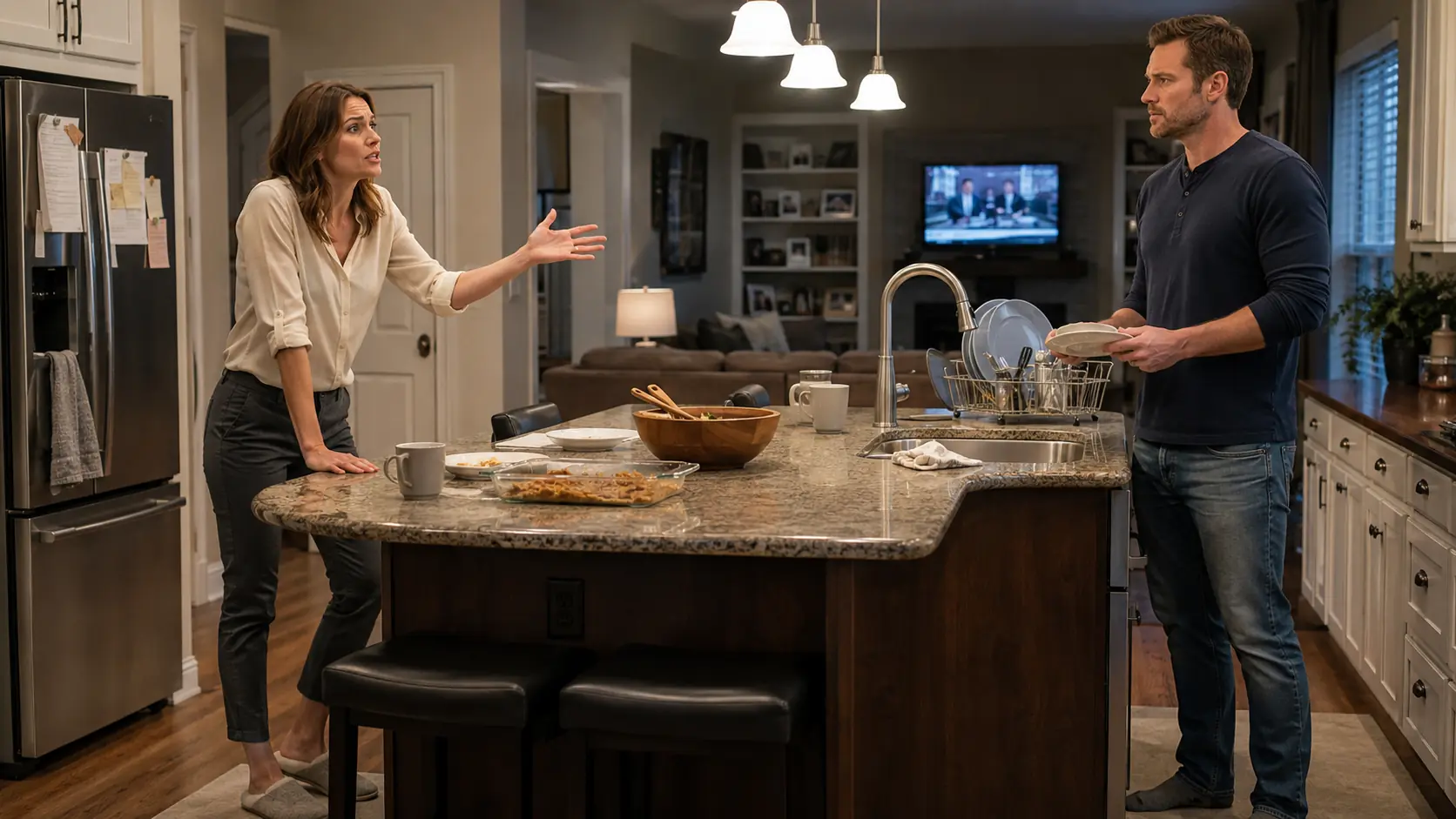
It came out of my mouth during one of those ordinary arguments that had become too familiar in our marriage.
Nothing shattered against the wall. No doors slammed. No screaming filled the house.
It was not the kind of fight neighbors hear and later pretend they didn’t. It was quieter than that, smaller on the surface, and somehow far more dangerous.
We were standing in the kitchen after dinner. The dishes were half done. The TV murmured from the living room, some crime show neither of us was really watching. The dishwasher was open.
A towel was slung over Mark’s shoulder. I remember the yellow light above the sink, the smell of lemon soap, and the way steam fogged the window over the counter.
My name is Claire.
For most of my life with Mark, I equated independence with never admitting how much someone mattered to me.
I told myself that needing people made you weak. I told myself depending on someone gave them the power to disappoint you. I told myself love was best when held with one hand slightly open, ready to let go before anyone else could. I had learned that lesson early, or at least I thought I had.
My father left when I was twelve.
Not in one grand dramatic moment, but slowly, piece by piece, until one day he was just gone. Fewer dinners. Fewer phone calls. More excuses. Then a new apartment, a new woman, a new life where my mother and I became obligations he remembered only when paperwork demanded it.
My mother never recovered cleanly.
She survived. She worked. She paid bills. She raised me. But something in her hardened after he left, and I inherited that hardness like a family heirloom. She used to say, “Never build your life around someone who can walk away.” I heard it so many times that by adulthood, it sounded less like advice and more like scripture.
Then I met Mark.
Mark was not exciting in the way people write about excitement.
He did not sweep into rooms. He did not make promises with wild eyes. He did not chase attention or collect admiration. He was steady, gentle, dependable, the kind of man whose love did not announce itself loudly because it was too busy showing up.
When we first started dating, I thought that steadiness was sweet.
Then, after years together, I began to mistake it for dullness.
Bills paid on time.
Appointments remembered.
The oil changed before the warning light came on.
The trash taken out without discussion.
The porch light fixed the same day it went dark.
My favorite tea restocked before I noticed we were low.
A text before every big meeting: You’ve got this.
At first, I found those things comforting.
Later, I started treating them like background noise.
Mark and I had been together for nine years, married for six. He was the calm side of our marriage, the one who slowed down when I sped up, the one who listened when I spiraled, the one who could sit beside me in silence without making the silence feel like judgment.
He never raised his voice.
He never stormed out.
When I grew upset, he listened, or at least remained quiet long enough for me to feel acknowledged. I used to mistake that for agreement, never realizing it was more often him choosing peace over conflict.
That was one of the things I understand now.
Mark had boundaries.
He simply did not weaponize them.
He had feelings.
He simply did not throw them across the room to prove they existed.
I worked in project management for a consulting firm, and that season had been brutal. Deadlines moved constantly. Clients changed their minds and expected miracles. My boss praised me in public and overloaded me in private. I had begun carrying stress like another organ inside my body.
That night, I came home already angry.
Not at Mark.
Not really.
But he was there, and sometimes the person closest to you becomes the easiest place to drop everything you refuse to carry honestly.
He had made pasta because he knew I would not have eaten otherwise. He had saved me the last piece of garlic bread. He had asked how my day went, and I had launched into a long, bitter rant about my team, my boss, the client, the deadlines, the incompetence of everyone around me, and the impossible pressure I was under.
Mark listened while rinsing plates.
Then, gently, he said, “Maybe you could ask Dana to take over part of the client update. She offered last week, didn’t she?”
It was a reasonable suggestion.
A kind one.
I heard it as criticism.
I turned toward him, exhausted and defensive.
“So now you think I can’t handle my own job?”
He looked surprised.
“That’s not what I said.”
“It’s what you meant.”
“No, Claire. I meant you don’t have to carry everything alone.”
Something inside me snapped.
Not loudly.
Not visibly.
But I felt the old reflex rise in me, the one that translated help into danger and tenderness into control. I did not want to be seen as overwhelmed. I did not want to admit that I was tired. I did not want to need anything, especially from the man who had been quietly holding pieces of my life together for years.
So I laughed.
Sharp.
Dismissive.
Ugly.
“I don’t need you, Mark,” I said. “I’ve been handling life just fine on my own.”
The room changed.
I felt it immediately.
The air seemed to go still around us. Water dripped from a plate into the sink. The television kept murmuring from the other room, suddenly absurd against the silence between us.
Mark did not react the way I expected.
No argument.
No hurt expression.
No attempt to defend himself.
He simply looked at me, long and steady.
There was something in his eyes I did not understand then.
Not anger.
Not shock.
Recognition.
As if I had finally said out loud what he had been feeling for a long time.
Then he nodded slightly and said, “Okay.”
That was it.
He finished rinsing his plate, set it on the rack, folded the towel neatly over the counter, and went to bed.
I remember standing there with my arms crossed, my heart beating fast, feeling a strange sense of triumph. I told myself I had finally made my point. I told myself he needed to understand that I was not fragile, not dependent, not some woman who needed her husband to rescue her from ordinary life.
I told myself he would forget by morning.
He always did.
At least, that was what I believed.
But the next day, something had changed.
Not in a way anyone else would have noticed.
Mark still made coffee. He still fed the dog. He still asked whether I had slept well. He still kissed the top of my head before leaving for work, but the kiss was lighter somehow, careful, like something done from memory rather than warmth.
At first, I ignored it.
That was another talent of mine.
Ignoring emotional weather until it became a storm.
Over the next few days, Mark became polite in a way that felt almost formal. He no longer reached for my hand while we watched TV. He no longer wandered into the bathroom while I brushed my teeth just to tell me something funny he had read. He no longer texted me random pictures of dogs he passed on the street because he knew I loved them.
He answered when I spoke.
He smiled when appropriate.
He did everything a good husband was supposed to do.
And somehow, he was no longer fully there.
I noticed.
Of course I noticed.
But instead of asking him what was wrong, I grew irritated.
I told myself he was being sensitive. I told myself men always complained that women were emotional, then punished you with silence when their feelings were hurt. I told myself he was making too much out of one sentence said in frustration.
That was easier than admitting I had meant the sentence when I said it.
Or worse, that part of me still wanted it to be true.
In the following weeks, life seemed the same on the surface, but beneath everything, it felt heavier.
Mark stopped offering help before I asked.
That was the first thing I resented, though I would not have admitted it then.
Before, if I came home carrying too many grocery bags, he would appear at the door and take half without asking. Now he opened the door, smiled politely, and let me carry them in unless I asked for help.
Before, if I mentioned a work deadline, he would offer to make dinner or pick up dry cleaning or handle the laundry. Now he said, “That sounds stressful,” and went back to whatever he was doing.
Before, if my car made a sound, he would ask about it, listen to my terrible attempt at describing it, and then check it himself. Now, when I mentioned a noise, he said, “You should probably call the mechanic.”
It was maddening.
I had told him I did not need him, and he was giving me exactly what I had demanded.
I hated him for it.
I hated myself more, but I had not learned how to aim that anger honestly.
One evening, after a long day, I came home to find him reading in the living room. The dog was asleep near his feet. The lamp beside him cast a soft circle of light over the page. He looked peaceful in a way that annoyed me because I felt anything but peaceful.
I dropped my bag onto the chair.
“You didn’t start dinner?”
He looked up.
“I wasn’t sure what you wanted.”
“You usually make something on Wednesdays.”
“I can still make something.”
“That’s not the point.”
He closed the book slowly.
“What is the point?”
I heard the calm in his voice and felt my frustration spike.
“I don’t know. You’ve been acting weird for weeks.”
His expression did not change.
“Weird how?”
“Distant.”
He looked down at the book in his hands.
Then back at me.
“You told me you don’t need me,” he said. “I’m just respecting that.”
I rolled my eyes.
“You’re overreacting. You know that’s not what I meant.”
For the first time, something like pain crossed his face.
It was gone quickly, but I saw it.
“No,” he said quietly. “I don’t know that.”
“Mark.”
“Words matter, Claire. Especially when they come from someone I choose every day.”
That should have scared me.
It should have stopped me.
It should have made me sit down beside him, take his hand, and tell him the truth: that I was scared, tired, proud, and terrible at receiving love without feeling indebted to it.
Instead, I crossed my arms.
“So what? You’re going to punish me forever for one sentence?”
He stood then.
Slowly.
Not dramatically.
Just tired.
“I’m not punishing you.”
“It feels like it.”
“I’m tired of begging to matter in my own marriage.”
That sentence landed, but I pushed it away before it could sink in.
“You’re being dramatic.”
He nodded once.
Maybe he agreed.
Maybe he was simply done trying to explain.
He walked past me into the kitchen and started making dinner.
I stood alone in the living room, furious that I had not won and terrified that I had.
After that, the house became a place full of unsaid things.
We still functioned.
That was what made it easy to pretend.
We went to work. We paid bills. We attended a neighbor’s barbecue and smiled when someone joked that we were the stable couple everyone envied. We watched a movie on Friday and sat on opposite ends of the couch. We spoke about groceries, the dog’s vet appointment, a leak under the sink, his mother’s birthday, my work schedule.
We did not speak about us.
There were moments when I almost did.
Once, I woke at two in the morning and found his side of the bed empty. I walked into the hallway and saw him sitting at the kitchen table in the dark, hands wrapped around a glass of water he had not drunk.
I should have gone to him.
Instead, I stood unseen in the doorway, watched the curve of his tired shoulders, and went back to bed before he noticed me.
Another time, he came home from work looking exhausted, his tie loosened, his eyes shadowed. I almost asked if he was okay. But I was still angry, still proud, still waiting for him to be the one to cross the distance.
So I said, “There’s leftover soup in the fridge.”
He said, “Thanks.”
That was all.
Looking back, our marriage did not break when I said I did not need him.
It broke in all the moments after, when I had the chance to repair it and chose pride instead.
The evening he left was ordinary.
That almost feels cruel now.
No storm.
No final fight.
No warning music.
Just a Tuesday in March, cold enough for a coat but warm enough that the snow had begun melting into dirty piles along the curb.
I stayed late at work because a client presentation had gone badly. When I came home, the house was quiet. Not unusual. Mark often read in the bedroom or worked in the garage. The dog greeted me at the door, wagging softly, then looked down the hallway as if expecting someone else to appear.
“Mark?” I called.
No answer.
I set my bag down.
The first thing I noticed was his jacket missing from the hook.
Then his shoes.
Then the strange neatness near the door.
I walked to the bedroom.
His side of the closet was half empty.
Not fully empty.
That detail undid me more than it should have.
He had not taken everything.
Just enough.
Work clothes.
Jeans.
The blue sweater I bought him two Christmases earlier.
The duffel bag from the top shelf was gone.
His toothbrush was gone from the bathroom.
The drawer where he kept his watch, wallet tray, and old receipts was open and bare.
On the kitchen counter was a single note.
Short.
Simple.
No accusations.
No long explanation.
No cruel final sentence.
Just Mark.
Claire,
I need space. Not because I want to punish you, and not because I stopped loving you. I need to understand who I am when I am not trying to prove I am necessary to someone who keeps insisting she doesn’t need me.
I hope you take care of yourself.
Mark
I read it once.
Then again.
Then a third time, standing in the middle of our kitchen with my coat still on.
My first feeling was not grief.
It was disbelief.
A strange, stubborn voice in my head said, He’ll come back.
He always came back.
He was steady Mark.
Dependable Mark.
The man who did not leave.
The man who stayed through my moods, my stress, my sharpness, my silence, my apologies that were more like resets than accountability.
He was not the kind of man who disappeared.
Except he had.
I called him.
It went to voicemail.
I texted.
No answer.
I called again.
Nothing.
That night, I slept on top of the covers with my phone in my hand, waking every hour to check whether he had responded.
He had not.
The first week was strange.
Not unbearable yet.
Just strange.
I told myself it was temporary. I told myself he needed time to cool off. I told myself I would give him space because mature people gave each other space, and because if I seemed too desperate, it would prove something about me I was not ready to face.
So I did not call for two days.
On the third day, the kitchen sink clogged.
Mark always fixed the sink.
Not because I could not, but because he did it before the problem became large enough for me to notice. He kept a small plastic bin under the sink with tools, plumber’s tape, spare washers, and things I did not know the names of.
I opened the cabinet and stared at the bin.
Then I searched online for instructions.
Then I made everything worse.
By the time I admitted defeat, dirty water had backed up into the sink, my sleeves were wet, and I was crying with rage over a plumbing issue that should not have felt like abandonment.
I almost called Mark.
Instead, I called a plumber.
He fixed it in twenty minutes and charged me $180.
I paid him, closed the door, and sat on the kitchen floor staring at the cabinet.
That was the first time I understood that Mark’s presence had not been one large thing.
It had been hundreds of small things quietly preventing life from becoming harder.
The next week, my car made a strange noise.
A clicking sound when I turned left.
I ignored it for three days because Mark was not there to tell me gently that ignoring car sounds did not make them disappear.
On the fourth day, the sound became worse.
I took it to the mechanic.
The repair cost more than it would have if I had gone earlier.
The mechanic said, “You’re lucky it didn’t fail on the highway.”
I sat in the waiting area with bad coffee in a paper cup and felt Mark’s absence beside me like a person.
Not because he would have magically fixed it.
But because he would have sat next to me.
He would have made some dry comment about the terrible coffee.
He would have reminded me that money could be replaced and that I was safe.
Without him, I had only the bill and my own thoughts.
The house became louder in its quiet.
At night, the refrigerator hummed like a machine in an empty hospital room. The heater clicked on and off. The dog paced sometimes, confused by the missing rhythm of Mark’s footsteps.
I began noticing all the things Mark had done without requiring applause.
The porch light stayed burned out for two weeks because I kept forgetting to buy bulbs.
The mail piled up because he had been the one who sorted it.
The trash went out late.
The laundry backed up.
The plants in the dining room started to droop because he had watered them every Sunday morning while I slept in.
One night, I opened the pantry and found the tea I liked.
Three unopened boxes.
Mark had bought them before he left.
I stood there holding one box, and the grief hit so suddenly I had to grip the shelf.
He had been preparing for my comfort even while preparing to leave me.
That was the kind of man he was.
That was the kind of man I had told myself I did not need.
After two weeks, I called.
This time he answered.
“Hi,” he said.
Just that.
Hi.
His voice was familiar enough to break me.
“Mark,” I said, and then I could not speak.
There was silence on the line.
Not cold.
Not warm.
Waiting.
Finally, I said, “I’m sorry.”
He exhaled softly.
“I know.”
“No, I mean it. I shouldn’t have said what I said.”
“I know you’re sorry you said it.”
The distinction stung.
“What does that mean?”
“It means I don’t know if you’re sorry for hurting me, or if you’re sorry because I left.”
I wanted to defend myself.
The impulse rose immediately.
Of course I’m sorry for hurting you. How could you say that? Why are you making this harder?
But something stopped me.
Maybe the quiet house.
Maybe the tea in the pantry.
Maybe the note on the counter I had read so many times the paper had softened at the folds.
“I don’t know,” I admitted.
My voice shook.
“I want to say the right thing, but I don’t know.”
For a moment, neither of us spoke.
Then Mark said, “That might be the first honest thing you’ve said to me in a while.”
It hurt.
Because it was true.
“Where are you?” I asked.
“With Daniel.”
His brother.
Across town.
“Are you coming home?”
Another silence.
“I don’t know.”
Those three words terrified me more than anything else he could have said.
Not no.
Not yes.
I don’t know.
It meant the ground had shifted under us, and for the first time, Mark was not offering to steady it for me.
“I miss you,” I whispered.
“I miss you too.”
“Then why—”
“Because missing you doesn’t fix what happened.”
I closed my eyes.
He was right.
We spoke for eleven minutes.
Polite.
Careful.
Like two people standing on opposite sides of broken glass.
When we hung up, I did not feel better.
I felt awake.
Over the next month, I apologized several times.
Badly at first.
I’m sorry, but I was stressed.
I’m sorry, but you know how I get.
I’m sorry, but I didn’t mean it that way.
Each apology contained an escape route.
Mark saw every one.
He answered politely, sometimes not at all.
Then one night, after he stopped responding to my texts for three days, I sat at the kitchen table and read through our old messages.
Years of them.
Small things.
Pick up milk?
Don’t forget your umbrella.
Big meeting today. Breathe.
Dog threw up on the rug. I handled it. Don’t ask.
Your mom called. I told her we’d come Sunday.
I’m proud of you.
Drive safe.
I love you.
There were hundreds of messages where Mark had reached for me in small ways, and hundreds of ways I had accepted that reaching without recognizing it as love.
I saw my replies too.
Busy. Later.
Okay.
Thanks.
Can’t talk.
Not now.
I had not been cruel every day.
But I had often been careless.
Carelessness, repeated long enough, becomes its own kind of cruelty.
The next morning, I found a therapist.
Her name was Dr. Patel.
On the intake form, under reason for visit, I wrote: My husband left because I told him I didn’t need him.
During our first session, I tried to explain logically.
I talked about work stress, my childhood, my father leaving, my mother’s warnings, my belief in independence. Dr. Patel listened without interrupting, occasionally writing notes in a small blue notebook.
When I finished, she asked, “What does needing someone mean to you?”
I answered too quickly.
“Vulnerability.”
“And what does vulnerability mean?”
“Risk.”
“And what does risk mean?”
“Loss.”
She nodded.
“So when Mark tried to help you, your body did not experience help. It experienced the possibility of future loss.”
I stared at her.
“I guess.”
“And how did you protect yourself from that feeling?”
I looked down at my hands.
“By acting like I didn’t care.”
“Did it work?”
I laughed once.
Not because it was funny.
“No.”
Week after week, I went back.
I learned things I did not want to know about myself.
That I confused being loved with being trapped.
That I withheld tenderness because I feared dependence.
That I treated Mark’s steadiness as if it were guaranteed because admitting its value made me feel exposed.
That my independence had not been strength in our marriage.
It had often been armor.
And armor, worn constantly, does not just keep pain out.
It keeps love from getting in.
Months passed.
Mark and I met for coffee twice.
The first time, I talked too much.
I apologized, explained, cried, explained again, and exhausted both of us. He listened with the same patient sadness that had become almost unbearable to see.
At the end, he said, “I believe you’re starting to understand. I don’t know if I can come back to being the person who waits while you learn.”
I went home and sobbed in the shower because the sound of the water made it easier to fall apart.
The second coffee was different.
I had practiced saying less.
Not because I wanted to manipulate him, but because I was learning that remorse was not measured by how many words I could pour over the wound.
We sat near the window of a small café we used to visit after grocery shopping. He looked thinner. His beard was a little longer. He seemed tired, but also calmer in a way that frightened me.
“I’m not going to ask you to come home today,” I said.
He looked surprised.
“I want to. But I’m not going to.”
He wrapped both hands around his coffee cup.
“Okay.”
“I have spent a lot of time thinking about what I said. Not just that night. Everything around it. The way I made you feel unnecessary. The way I accepted your love as maintenance instead of love.”
His eyes lowered.
“I don’t know how to fix it,” I admitted. “And I’m scared that maybe I can’t. But I need you to know that I see it now. I see you now. Not because you left. Because I should have seen you all along.”
Mark’s jaw tightened.
For a moment, I thought he might cry.
He did not.
“I wanted to be seen by you for a long time,” he said.
“I know.”
“No,” he said softly. “You don’t. Not fully.”
He was right.
I did not.
But I was trying.
Summer arrived.
Then fall.
We remained separated.
Not divorced.
Not reconciled.
Separated.
There is a particular kind of grief in living between endings.
People did not know what to ask.
Friends tried to comfort me.
“You’re strong.”
“You’ll be okay.”
“You never needed a man anyway.”
They meant well.
But every time someone said that, I felt the old lie trying to dress itself as empowerment.
So I began answering differently.
“I know I can live without him,” I would say. “That was never the lesson.”
The lesson was that being able to survive alone does not mean love is disposable.
The lesson was that needing someone emotionally is not the same as being helpless.
The lesson was that partnership is not weakness unless you are committed to misunderstanding it.
I learned to fix some things.
The sink.
A loose cabinet handle.
The porch light.
I learned to take my car in before sounds became expensive.
I learned to sort the mail, water the plants, manage the house, carry my own groceries, eat dinner alone, sleep through the quiet.
I proved, over and over, that I could manage life without Mark.
That was the cruel joke.
I could.
I had to.
But capability did not comfort me the way his hand on my back once did.
Independence did not laugh at my terrible jokes in the grocery aisle.
Self-sufficiency did not know that I hated sleeping with the closet door open.
Strength did not sit beside me after bad days, saying nothing because silence was enough.
I missed Mark in ways that were not practical.
That was how I knew I finally understood.
I did not miss him because the sink clogged.
I missed him because he would have made tea afterward.
I did not miss him because the car needed repairs.
I missed him because he would have looked over at me in the waiting room and said, “At least the coffee is aggressively terrible,” and I would have laughed despite myself.
I did not miss him because I could not live.
I missed him because life had been softer with him in it.
One evening in November, almost eight months after he left, Mark came by the house to pick up some winter clothes.
He texted first.
That hurt too, the politeness of needing permission to enter the home we once shared.
When he arrived, the dog lost his mind with joy.
Mark knelt in the entryway and held him for a long time.
I stood near the stairs, watching.
“You fixed the porch light,” he said.
“I did.”
“And the cabinet.”
“I did.”
He smiled faintly.
“Good.”
The old me would have said something sharp.
See? I can handle things.
The new me only said, “I wish I had learned without making you feel unneeded.”
He looked at me.
There was a softness there, but also caution.
“I do too.”
He went upstairs to pack his sweaters.
I made coffee because I did not know what else to do with my hands.
When he came down, he paused in the kitchen doorway.
The house smelled like cinnamon because I had been baking badly, an activity Dr. Patel encouraged after I admitted I did not have hobbies that were not productivity in disguise.
Mark looked at the lopsided loaf cooling on the counter.
“Banana bread?”
“Attempted banana bread.”
“Dense?”
“Like a brick with emotional issues.”
He laughed.
It was small.
But real.
The sound moved through me so painfully I had to grip the counter.
He stayed for coffee.
We sat at the kitchen table where everything had begun.
For a while, we talked about safe things.
His work.
The dog.
His brother’s new apartment.
My therapy.
Then he looked toward the sink.
“I replay that night a lot,” he said.
My stomach tightened.
“So do I.”
“I don’t think it was just the words.”
“I know.”
“It was the relief on your face after you said them.”
I closed my eyes.
He had seen that.
Of course he had.
“I thought I had won,” I whispered. “I thought I had proved I was strong.”
“To who?”
I looked at him.
The answer came from somewhere deep and old.
“My father. My mother. Myself. I don’t know.”
Mark nodded slowly.
“I was never trying to make you weak, Claire.”
“I know that now.”
“I wanted to be your partner.”
Tears blurred my vision.
“You were.”
“No,” he said gently. “I was your support system. Your emergency contact. Your quiet place. Your handyman. Your listener. Sometimes your husband. But I don’t know if I was your partner.”
That hurt.
It also clarified everything.
Partnership required mutuality.
I had accepted his care, but resisted offering him my need honestly. I had wanted the benefits of being loved without the vulnerability of admitting love had power over me.
“I want to learn how,” I said.
Mark looked at me for a long time.
“I believe you.”
Hope rose in me so quickly it frightened me.
Then he added, “But I don’t know if I can be the person you learn with.”
The hope broke.
Not completely.
But enough.
“I understand,” I said, though I barely did.
He left an hour later.
This time, when he walked out, I did not call after him.
Not because I did not want to.
Because love, real love, had finally become less about my panic and more about his peace.
Winter came again.
The anniversary of that kitchen argument passed without ceremony.
I remembered it anyway.
By then, Mark and I had begun talking more often. Not every day. Not like before. But honestly, carefully, without pretending the damage had been smaller than it was.
We went to counseling twice together.
The first session was awkward.
The second was harder.
Mark said things there he had never said at home.
That he had felt lonely beside me for years.
That he had begun to dread my bad days because my stress often turned him into either a target or furniture.
That he loved me deeply but did not know how to live in a marriage where being steady meant being taken for granted.
I cried.
I apologized.
Not perfectly.
But honestly.
I told him that I had confused needing him with losing myself. That I had spent years defending against abandonment so intensely that I had created the very distance I feared. That I did not expect forgiveness just because I finally understood the wound.
Dr. Patel, who led the session, asked Mark what he needed.
He was quiet for a long time.
Then he said, “I need to know that if I come back, I’m not just returning to the role Claire misses. I need to know she wants me, not just the comfort I provided.”
That sentence became the center of everything.
Did I want Mark?
Or did I want the life Mark made easier?
At first, I hated the question.
Then I respected it.
The answer, once I stripped away panic, was clear.
I wanted him.
Not as a repairman.
Not as a safety net.
Not as proof that I had not ruined everything.
I wanted the man who hummed old songs while making pancakes. The man who cried quietly during documentaries about lost dogs. The man who pretended not to care about birthdays but saved every card. The man who chose peace until peace began to erase him.
I wanted Mark.
And wanting him meant accepting that he was free to choose something else.
That was the hardest part.
In February, almost a year after he left, Mark invited me to dinner.
Not at our house.
Not at his brother’s apartment.
At the small Italian restaurant where we had gone on our third date.
I arrived early and nearly turned around twice before reaching the door.
He was already there, sitting in the back booth, wearing the blue sweater he had taken when he left.
The sight of it made my chest ache.
Dinner was careful at first.
Then warmer.
We talked about books, work, the dog, Daniel’s terrible cooking, my failed banana bread experiments, his new habit of running in the mornings. We laughed more than I expected.
Near the end, he set his fork down.
“I miss you,” he said.
My heart stopped.
“I miss you too.”
“I don’t want to go back to what we were.”
“I don’t either.”
“I mean it, Claire.”
“So do I.”
He looked at me for a long time.
“I’m willing to try again. Slowly. Not move back in tomorrow. Not pretend the last year didn’t happen. But try.”
I covered my mouth.
Tears filled my eyes.
“Okay,” I whispered.
“Counseling continues.”
“Yes.”
“No more using independence like a weapon.”
I laughed through tears.
“Yes.”
“And I need to be able to tell you when I feel small without you turning it into an argument.”
I nodded.
“You can.”
He reached across the table.
I took his hand.
For the first time in almost a year, his hand was warm in mine.
Not guaranteed.
Not owed.
Chosen.
That was the difference.
Mark did not move home immediately.
He came for dinner on Sundays.
Then stayed late to watch movies.
Then slept over once when snow made the roads bad.
Then, slowly, some of his clothes returned to the closet.
Not all at once.
A sweater.
Running shoes.
A coat.
His toothbrush.
The day I saw his toothbrush back in the bathroom cup, I cried so hard the dog became concerned and brought me a sock.
We built different routines.
Not perfect ones.
Different ones.
I asked for help before resentment turned me sharp.
He offered help without disappearing into usefulness.
I learned to say, “I need you,” and survive the vulnerability of those words.
He learned to say, “I feel taken for granted,” and trust that I would not punish him for having needs.
Sometimes we failed.
Of course we failed.
Healing did not transform us into saints.
There were still hard days, defensive moments, old patterns waiting like traps. But now, when I felt myself reaching for the old armor, I tried to pause. Not always in time. But more often than before.
One night, months after he moved back fully, we stood in the kitchen again.
Dishes half done.
TV murmuring in the background.
Yellow light above the sink.
The scene was so similar that I felt my body remember the old argument before my mind did.
I was venting about work again.
Overwhelmed again.
Tired again.
Mark listened, drying a plate.
Then he said gently, “Do you want advice, or do you want me to just listen?”
Such a simple question.
Such a different life.
I looked at him.
The old Claire might have snapped.
The new Claire took a breath.
“Listen first,” I said. “Then maybe help me figure out what to do.”
He nodded.
“I can do that.”
I smiled.
“I know.”
Then, after a moment, I added, “And Mark?”
“Yeah?”
“I do need you.”
He grew still.
I forced myself not to look away.
“Not because I can’t survive without you,” I said. “I can. I know that now. But because my life is better with you in it. Because I love you. Because you matter to me. Because I don’t want to confuse strength with loneliness anymore.”
His eyes shone.
For a second, neither of us moved.
Then he set the plate down, crossed the kitchen, and pulled me into his arms.
I held him tightly.
Not like someone clinging to a crutch.
Like someone finally brave enough to hold what she loved with both hands.
I wish I could say every story like ours ends this way.
It does not.
Some words cannot be taken back.
Some people leave and do not return.
Some lessons arrive only after the door has closed for good.
For a long time, I thought saying “I don’t need you” made me strong.
It did not.
It made the person who loved me feel useless.
It taught him how to stop reaching.
It showed him a life where his absence might hurt less than his presence being dismissed.
That is what careless pride can do.
It can turn love into labor.
It can turn kindness into expectation.
It can turn a devoted partner into a ghost standing right beside you.
Now, when people talk about independence, I think of that night in the kitchen. I think of Mark’s face. I think of the way he said “Okay,” not because he agreed, but because something in him had finally gone quiet.
I still believe in independence.
I believe every person should know how to stand on their own, pay their own bills, make their own choices, and survive the storms life brings.
But I no longer worship independence as emotional distance.
I no longer mistake love for weakness.
Because needing someone does not mean you are helpless.
It means you are human.
And if someone chooses you every day, if they show up in small quiet ways, if they make life softer without asking for applause, do not wait until the house is empty to understand what they were.
Do not confuse their steadiness with permanence.
Do not make them prove their value by leaving.
Because sometimes, when you tell someone enough times that you do not need them, they finally believe you.
And sometimes the strongest thing you can say is not “I don’t need you.”
Sometimes it is, “I love you. I choose you. And I am grateful you are here.”