"I didn't sign no papers and I ain't going to."
"It is a legal requirement, Caleb. You have no choice."
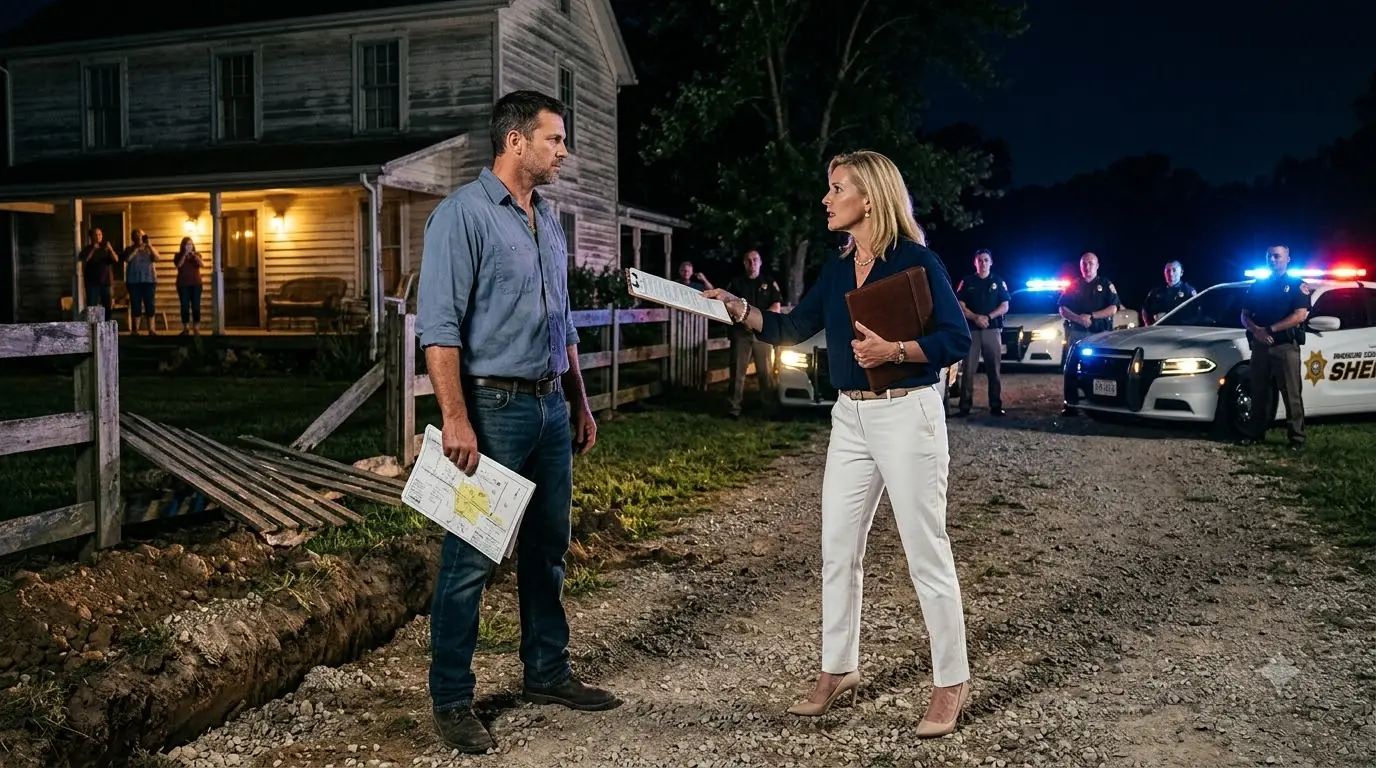
"Ha! You are trespassing. Get out!"
"They can't just redraw the property lines."
At 11:00 that night, the HOA president had me on my knees in front of three police cars telling everyone I was trespassing in her neighborhood.
Then one officer checked the property records and discovered she had just called the cops on her own landlord. The first patrol car came around the corner so fast its tires chirped against the pavement.
Then came the second, then the third. Red and blue lights washed across the Maple Creek clubhouse, the swimming pool, and the row of expensive homes behind me.
Curtains opened. Porch lights came on.
Within seconds, half the neighborhood seemed to be standing outside with their phones raised. It was just after 11:00 at night and I was standing beside a freshly dug drainage trench with my phone in one hand and a survey map in the other.
The HOA's contractor had removed two boundary stakes, torn down part of my fence, and buried a concrete drainage pipe almost 12 feet inside land owned by my family trust. I had already photographed the tire tracks, the displaced markers, the contractor's logo, and the permit posted beside the excavator.
That permit was missing one important thing, the landowner's signature. "Put the phone down and keep your hands where I can see them," a young officer shouted.
I placed my phone slowly on the pavement. Before I could explain, Vanessa Klein stepped out from behind the patrol cars.
She wore white slacks, a navy blouse, and the calm expression of someone who believed the police had arrived to confirm her authority. "That's him," she said.
"He's been trespassing around the clubhouse and interfering with our drainage project." I stared at her.
"Your contractor crossed my property line." Vanessa shook her head and turned toward the officers.
"He doesn't live in our community. He has no business being here after hours."
"He's been photographing residents, threatening board members, and trying to sabotage HOA property."
None of that was true, but the young officer did not know that yet.
"Sir, get down on your knees." The asphalt was still warm from the September heat.
I lowered myself carefully while neighbors gathered along the sidewalk. Someone called me a land thief.
Another person shouted that I was trying to steal their homes. Vanessa stood 10 feet away, arms folded, watching as though she had finally solved a problem that had been irritating her for months.
I looked toward the older deputy standing beside the second cruiser. His nameplate read Cruz.
"I'm not a member of this HOA," I said. Vanessa gave a small laugh.
"Then you have even less reason to be here." Deputy Cruz studied me for a moment.
"Do you have documentation showing you're allowed on this property?" "Yes."
"Where?" "In the county records."
"Look up parcel 18-447." Vanessa's smile faded slightly.
I continued, "Then check who owns the ground beneath this clubhouse." Cruz walked back to his cruiser and began typing.
The crowd kept murmuring behind me. Phone cameras remained pointed in my direction.
Vanessa whispered something to one of the board members, but she was no longer smiling. A minute passed, then another.
Cruz looked at the screen, leaned closer, and checked the parcel number again. When he returned, his expression had changed.
"Mr. Mercer, are you the acting trustee of the Mercer Family Land Trust?" "I am."
He turned toward Vanessa. "Ma'am, this man is not trespassing."
Vanessa blinked. "What are you talking about?"
Cruz held up the tablet. "The clubhouse, pool, playground, internal roads, drainage system, and approximately 128 acres beneath Maple Creek Preserve are owned by the Mercer Family Land Trust."
Silence spread through the crowd. Then Cruz added the part that changed everything.
"Your homeowners association leases this land from him." Vanessa stared at me as if I had changed shape in front of her.
I slowly stood and brushed the dust from my knees. "You called the police on your own landlord."
That should have ended the argument. Instead, it started a war.
Because Vanessa knew something the homeowners did not. Their HOA had been collecting ground rent every month, but for 18 months not $1 of it had reached my family.
To understand how an entire neighborhood ended up leasing its land from my family, you have to go back almost 30 years. My name is Caleb Mercer.
I'm 46 years old and I work as a structural engineer. For most of my adult life, I lived in St. Louis inspecting bridges, parking structures, and commercial buildings.
I came back to Maple Creek after my father, Arthur, suffered a stroke.
He survived, but he lost much of his speech and could no longer manage the family trust on his own. So I moved into the old Mercer farmhouse, took over the paperwork, and became acting trustee of the land my family had owned since 1964.
My grandfather, Walter Mercer, bought 140 acres when this area was mostly soybean fields and gravel roads. In 1997, a developer approached him with plans for a suburban neighborhood.
He wanted to purchase the entire property, build houses, and turn the old farm into something called Maple Creek Preserve. My grandfather refused to sell, but he was willing to lease most of the land under a 30-year master ground lease.
The arrangement was simple. The developer could build homes, roads, a clubhouse, and a swimming pool.
The buyers would own their houses, while my family trust continued to own the ground beneath them. The HOA would collect a modest ground payment from each household and send quarterly payments to the Mercer Trust.
Six acres surrounding our farmhouse were excluded completely. That meant our home was not part of the HOA.
Their rules, fines, liens, and architectural restrictions had no authority over us. The lease also contained another important protection.
The HOA could not sell development rights, expand the neighborhood, or renew the lease without written approval from the Mercer Trust. Today, that arrangement might sound unusual for a neighborhood filled with detached family homes.
But in 1997, it was the reason Maple Creek was built. Because the developer did not have to purchase the land, the first home sold for nearly 30% less than comparable houses in the county.
That made the neighborhood affordable for teachers, firefighters, young police officers, and couples buying their first homes. The original buyers knew exactly what they were purchasing.
They owned the house. My family owned the ground.
The lease was clearly disclosed, the rent was low, and increases were limited by a fixed formula. For years, the system worked.
The trouble came later. Homes changed hands.
Original owners moved away. Closing documents grew thicker.
Realtors began describing the ground payment as just another community fee. Eventually, the HOA renamed it the land stability fee.
Most newer residents had no idea what that phrase actually meant. They assumed the money paid for landscaping, road repairs, or pool maintenance.
They did not know it was supposed to be sent to my family. After my father's stroke, I opened the trust records and began reviewing the accounts.
The last complete ground rent payment had arrived 18 months earlier. Six quarterly payments were missing.
Three certified default notices had been mailed to the HOA. Vanessa Klein had personally signed for every one of them.
Yet, the neighborhood was still collecting the land stability fee from all 96 families every month. At first, I assumed the HOA was disorganized.
Then I added up the missing payments. With interest and late fees, the association owed the Mercer Trust almost $400,000.
And that raised a question I could not ignore. If the homeowners had been paying Vanessa every month, where had all that money gone?
Vanessa Klein came to my house 4 days after I sent the HOA a formal demand for the missing rent. She arrived at 9:00 in the morning in a white luxury SUV carrying a leather folder and a clipboard thick enough to stop a bullet.
I was repairing a loose porch rail when she walked up the driveway without asking permission. "Mr. Mercer," she said, "we need to discuss your compliance problems."
She handed me seven violation notices. My work truck was visible from the road.
The cedar fence was not an approved color. The generator behind my garage created a visual nuisance.
My mailbox did not match the Maple Creek standard. The native grass along the creek was over the permitted height.
My storage shed had never been approved by the architectural committee. Even the American flag beside my porch was supposedly too large.
I looked through the notices twice. Then I looked at Vanessa.
"You know this property isn't part of the HOA," I said.
"The house is surrounded by Maple Creek," she replied.
"That makes your property part of the community." That isn't how deeds work.
I went inside and returned with a copy of the recorded exclusion. The language was clear.
The Mercer homestead and the 6 acres surrounding it were not subject to HOA covenants, assessments, liens, or architectural control. I held the document out to her.
"I'm not a member. Your rules don't apply here."
Vanessa barely glanced at it.
"That language is almost 30 years old. Communities evolve."
Recorded property rights don't expire because a board president dislikes them.
Her expression tightened. Then she opened the leather folder.
That was when the violation notices stopped mattering. Inside were three documents.
The first would make my property a voluntary member of the HOA, the second would move the legal boundary and allow Maple Creek to widen its access road across nearly an acre of my land. The third would extend the master ground lease for another 40 years.
The proposed rent increase was barely enough to match inflation. It also gave the HOA broad authority to transfer development rights without future approval from the Mercer Trust.
I read the last page twice. "Who drafted this?"
"Our attorneys."
"For what project?"
Vanessa hesitated for half a second. That was all I needed.
My lawyer, Elise Park, found the answer later that afternoon. Meridian Ridge Development had submitted preliminary plans for 70 additional homes on the undeveloped western portion of the Mercer property.
The project included townhouses, a second entrance, and a commercial strip near the highway. Meridian had already spent money on surveys and engineering.
Their investor materials claimed that Maple Creek controlled the development rights. It did not.
Without my signature, the entire expansion was worthless. Elise leaned back in her chair after reviewing the documents.
"This isn't about your mailbox," she said. "Vanessa promised Meridian something she doesn't own."
I called Vanessa and told her I would not sign. Her voice remained calm.
"You may own six acres, Mr. Mercer, but you're surrounded by our community. We control everything around you."
"You manage it," I said. "You don't own it."
The next morning I found a large sign planted beside my driveway, "Non-compliant property. Legal review pending."
I removed it and saved the security footage. By the end of the week, county inspectors had received complaints about illegal electrical work and hazardous chemicals on my property.
A towing company removed my work truck from a private access road my family had used for decades. One of my largest clients received an anonymous email claiming my engineering license was under investigation.
Then Vanessa posted a warning in the neighborhood group advising parents to keep their children away from my property. I could have argued with her online.
Instead, I started a file. Dates, photographs, names, invoices, police reports, every letter she sent, every lie she told.
Vanessa wanted my signature. I was going to make sure the only thing she received from me was evidence.
Elise sent the HOA a formal demand for its financial records. Vanessa ignored the first letter.
She claimed the second had gone to the wrong office. After the third, Elise threatened to ask a judge to compel production.
Two days later, a delivery truck left 23 cardboard boxes on my front porch. There was no index, no digital backup.
Some folders were missing labels. Others contained duplicate invoices, blank pages, or documents arranged in no obvious order.
Several boxes smelled like mildew, as if they had been stored in a damp basement. Vanessa had technically provided the records.
She had also done everything possible to make sure no one could understand them. Elise brought in Frank Dobbins, the former HOA treasurer.
Frank was 72, retired from a regional bank, and had the cautious manner of a man who checked every number twice. He had resigned from the board 2 years earlier.
Vanessa told residents it was because of his health. Frank told us the truth.
"She kept bringing me checks without contracts," he said. "Whenever I asked questions, she said I was slowing down community business."
For three nights, the three of us worked at my dining room table. We sorted bank statements, invoices, meeting minutes, lien notices, management contracts, and property sale records.
My father sat in the next room watching old westerns with the volume low. The house smelled like coffee, paper dust, and the tomato soup I kept reheating because none of us wanted to stop long enough to eat.
The first major discovery was the land stability fee. Every one of Maple Creek's 96 households paid roughly $240 a month.
Not all of it was ground rent, but enough was supposed to be transferred to the Mercer Trust to keep the master lease current. The homeowners had paid.
The trust had not been paid. That money had gone somewhere else.