When a Hells Angels president opened his door at two in the morning, a six-year-old in pajamas was standing on the porch.
She had been locked outside since the day before.
Forty-six degrees.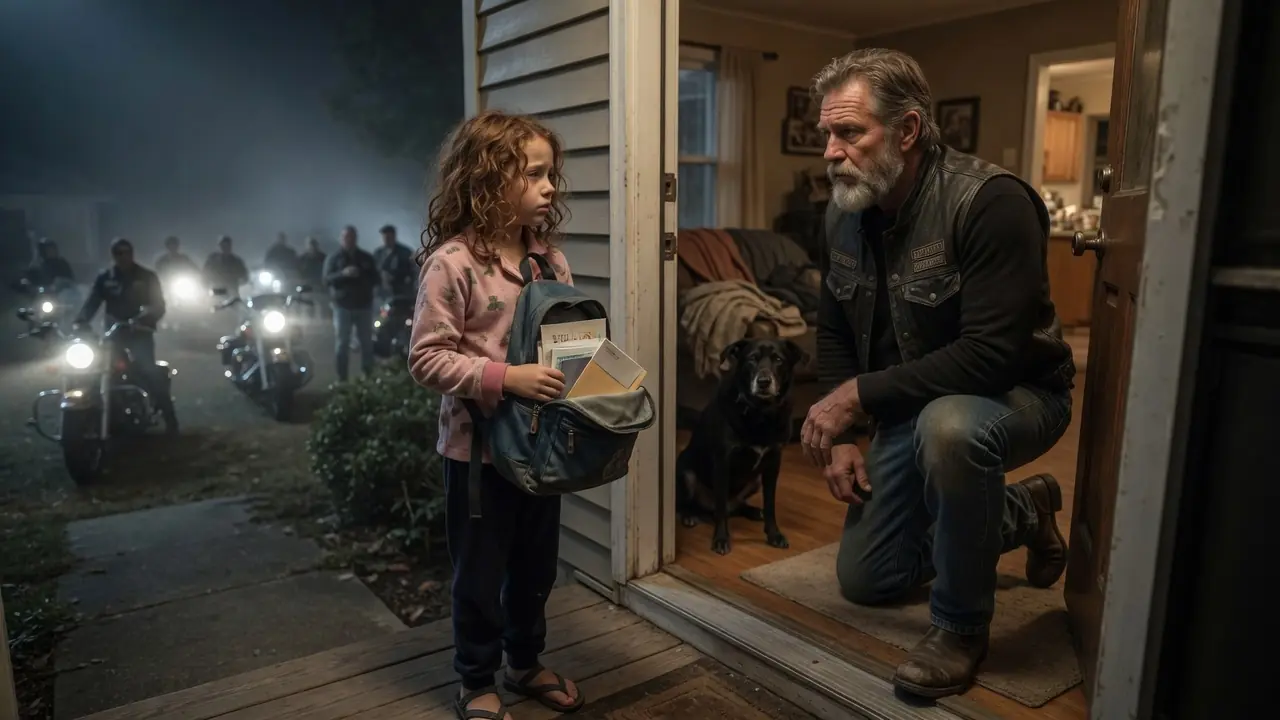
No coat.
Three blocks alone in the dark.
In the backpack she was gripping against her chest were her dead father’s estate documents, a rain-damaged birthday card, and evidence that would expose a county official who had already done this once before.
Thursday.
Nine in the morning.
Six hours away.
After that, the filing was irreversible.
What one hundred forty-seven Hells Angels did before sunrise was the part nobody saw coming.
Now let me take you back to Wednesday morning.
Seventeen hours before Dottie knocked on Reaper’s door.
To the first person who saw her and kept driving.
“I’ve been outside since yesterday. My uncle locked me out. I didn’t know where else to go.”
She said it the way a child says something she has rehearsed.
Careful.
Complete.
Like she wanted to get the facts right on the first try because she was not sure she would get a second chance.
But we are not at the door yet.
To understand what it took for Dottie Calloway to knock on that door, what it took for a six-year-old to cross three blocks of dark road alone in October carrying a backpack full of papers she did not fully understand, you have to understand the seventeen hours that came before it.
The three times someone had the chance to help her.
And the three times no one did.
Wednesday.
9:15 in the morning.
Dottie had been sitting on the front porch steps since breakfast.
Her uncle, Foster Graves, had unlocked the door long enough to set a bowl of cereal on the kitchen table and tell her to eat quickly. Then he had taken his keys and his briefcase and his pressed County Services polo, the one with the department logo on the chest, and gone to work.
To the office where he spent his days deciding which homes were safe for children.
The front door locked behind him with a click she had learned to dread.
She was wearing her pink fleece pajama top, the one with the bears on it, the left sleeve torn at the cuff from the last time the door had closed before she got all the way through. She wore navy cotton pajama pants, indoor rubber sandals, and her backpack.
Always the backpack now.
Ever since Tuesday night.
Ever since she had heard the phone call.
The mail truck came at quarter past nine.
She watched it slow at the end of the driveway. She watched the carrier, Dale Whitaker, fifty-eight years old, twenty-two years on this route, lean forward and pull back from the mailbox.
He looked up the drive.
He saw her.
She watched him look at her.
She did not wave.
She was not sure if she was supposed to.
He looked back at his clipboard.
Then he drove on.
Later, he would tell investigators, “I figured she was just playing.”
He would say it quietly, looking at his hands, as though he already understood that the words did not hold up under examination.
She was wearing pajamas at nine in the morning.
She was six years old.
She was sitting alone on a porch with a backpack in her lap, and she watched him drive away, and she did not run after him.
Not because she had given up.
Not yet.
Because she had learned in eleven months that adults were usually in a hurry to be somewhere that was not here.
By 2:40 in the afternoon, the temperature had dropped to fifty-one degrees.
The school bus stopped at the corner of Blackwater Road, and she heard the doors open and the rush of children’s voices. A knot of four parents stood near the crosswalk, three women and one man waiting for the last bus of the day.
One of them looked across the road and saw Dottie still sitting on the porch steps.
A woman in a down vest crossed the road.
She crouched down, asked Dottie’s name, and asked where her mother was.
Dottie said her mother was gone.
Her uncle was at work.
The door was locked.
The woman patted the top of her head, one firm pat, the kind that meant the conversation was almost over, and said, “Ring the doorbell until your uncle answers, sweetie. That’s what doorbells are for.”
She crossed back to the group.
They discussed it briefly.
Nobody stayed.
Nobody knocked on Foster Graves’s door.
They drove away.
Dottie pressed the doorbell four times.
It made a sound inside the empty house that nobody answered.
She went back to the porch steps.
She put her hands through the backpack straps and held on.
She touched the birthday card through the canvas.
Still there.
She had checked it seven times that day.
She watched the street go quiet.
At 6:20 in the evening, a car slowed and stopped.
A man got out.
Nice clothes.
Silver at the temples.
The kind of face people put on campaign signs.
His name was Gerald Pruitt, city council member, sixty-one years old, on his way home from a dinner.
He crouched down in front of Dottie.
He looked genuinely concerned.
He told her he was going to help.
He took out his phone and dialed right in front of her.
Then he handed it to her and said, “Say hello to your uncle.”
Her uncle’s voice on the line was smooth and calm, the way it always was when someone else was listening.
He told her to tell the nice man she was fine.
That he would be home soon.
She said the words.
She handed the phone back.
Pruitt told her, “Sounds like he’ll be home soon, sweetheart.”
He patted her shoulder.
He walked back to his car.
As he pulled away, she heard him say to his aide, “Kids that age exaggerate. She’s fine. Foster’s one of the good guys.”
Foster came home forty minutes later.
He did not unlock the front door.
He brought Dottie a cracker and a cup of water through the garage door, crouching, not looking at her directly.
Then he relocked it and went inside.
She heard the deadbolt slide home.
She ate the cracker.
She drank the water.
She sat on the porch steps as the October dark came in around the edges of the yard.
She had been outside since 7:30 that morning.
It was now past seven at night.
Forty-six degrees.
Ground fog building along the road.
What she was thinking, what a six-year-old thinks when she has been given too much time alone and too many reasons not to trust, was not someone will come.
She was past that.
She was thinking, which direction is the light I can see from here?
She started walking at 10:10.
The shuffle-tap of her indoor sandals on the pavement was the only sound on Blackwater Road.
No cars.
No porch lights.
Just the cold, the low-lying fog, and the narrow sliver of moon that did not do much about either.
She could not call anyone.
The landline was gone from the kitchen. Her uncle had removed it six months ago.
No phone of her own.
She could not go to a neighbor’s house. The last time someone on this road had tried to help, the police had come, and her uncle had spoken to them at the door, and nothing had changed. The neighbor had been told she was interfering.
But from the corner of Blackwater Road, she could see a light through the trees.
Amber yellow.
Steady.
The kind of light that meant someone was still awake.
She walked toward it.
The smell reached her before the house did.
Motor oil and cold concrete and the faint trace of wood smoke from a chimney two lots over.
A garage where someone worked late.
The way her father used to work late.
The way a person breathes in something that reminds them of before.
Then she walked to the front door.
Three small knocks.
A child’s knock.
Not a fist.
Almost nothing.
Three more.
Gideon Vance had been in his garage for three hours working on a carburetor, coffee gone cold on the workbench.
He had been meaning to go to bed since midnight.
Some nights were like that.
The quiet pressed in from the wrong direction, and the only thing that helped was keeping his hands busy.
His dog, Diesel, told him first.
Not a bark.
Diesel did not bark at things he understood.
He just lifted his head and turned it toward the front of the house, patient and sure.
That was enough.
Reaper set down the carburetor, wiped his hands on the shop rag, walked through the kitchen, and opened the front door.
He looked at chest height first, the way a man who stands six-foot-three always has to remind himself to correct.
Then he looked down.
She was standing at the edge of the porch light, both hands gripping the backpack straps against her chest.
Indoor sandals.
Pink pajama top.
Auburn curls matted from where she had slept on the porch steps.
She looked up at him and did not run.
He noticed immediately that her eyes went to his hands before his face.
He held them open, loose at his sides.
“I’ve been outside since yesterday,” she said. “My uncle locked me out. I didn’t know where else to go.”
Then she stopped.
No crying.
No performance.
Just a statement of fact from a child who had spent eleven months and seventeen hours deciding whether to trust one more adult, and had decided, with whatever was left in her after all of that, to try one more time.
The restraint was what broke through.
It did not ask for sympathy.
It just reported what happened.
That was more devastating than any plea.
He took one step back from the doorway.
Not toward her.
Just back.
Creating space.
Then he lowered himself slowly, one knee on the floor.
Diesel padded to the door and sat beside him.
“Then you go inside where it’s warm,” Reaper said.
She looked at him for three full seconds.
Calculating.
Deciding.
Then she crossed the threshold.
He stood up after her, not before, so she was never in his shadow.
He got a blanket first.
Heavy wool from the chest in the hallway.
He did not wrap it around her.
He set it on the couch beside her so she could choose.
She chose.
He put the kettle on, found cocoa at the back of the cabinet, and moved quietly, the way a large man learns to move in a small space when he does not want something small to feel cornered.
He sat in the chair across from her.
Not close.
Across.
“What’s your name?”
“Dottie.”
“Dottie Calloway.”
He nodded, filing it carefully.
“How old are you, Dottie?”
“Six and a half.”
“All right,” he said. “You’re safe here. Nobody’s making you go anywhere tonight. You understand that?”
Her chin wobbled just once.
Then it went still again.
“Okay,” she said.
It was 2:09 in the morning, Thursday.
The clock above the stove read the time in green digits.
Reaper saw it and began doing math.
She talked slowly, carefully, in the complete sentences of a child who had rehearsed what she would say to the first adult who actually listened.
“He said I’d get what I deserve after the papers,” Dottie said. “He said that a lot. I don’t know what papers.”
Reaper did not react.
Inside, something had gone cold and deliberate.
“He made me take my backpack when he locked me out,” she continued. “Daddy’s papers are in there. He kept asking me where they were. I took them a long time ago.”
She was still holding the backpack in her lap, both hands on the straps.
“Can I look at those papers?” Reaper asked.
She considered it.
Really considered it.
The full weight of the decision was visible on her face.
Then she lifted the flap, reached inside, and brought out a folded envelope and a document printed on heavy stock with an official seal at the top.
Then, carefully, she brought out a birthday card.
Water stained across the upper half, the ink blurred to nothing on the top two lines.
She held that one herself while she handed him the rest.
He unfolded the documents on the kitchen table.
Trust instrument.
Telfair County Family Court.
Probate Division.
Callaway Estate.
Beneficiary: Dorothy Claire Calloway.
Date of birth.
He did the math.
Six and a half years old.
He turned to the back page.
He found the filing deadline.
Thursday.
9:00 a.m.
He looked at the clock above the stove.
2:17 a.m.
Six hours and forty-three minutes.
He set the papers down flat.
He looked at Dottie.
“He talked on the phone two nights ago,” she said.
She had not looked up from the birthday card in her hands.
“He talked about a girl named Amber. He said she ran away and the file says that and that’s all it says. He talked about me the same way.”
She looked up then.
“I think he knows I heard him.”
What he did not know yet, what that single name would lead to, was the reason this story would not end with a probate filing.
Reaper stood up.
“Stay here,” he said. “Don’t open the door for anyone but me.”
He walked to the back of the house.
He picked up his phone.
The call to Tombstone lasted forty-one seconds.
“Tomb.”
“You up?”
A pause.
Shuffling.
A man who slept light because he had spent eleven years wearing a badge, and that habit did not leave a person.
“Yeah.”
“I need you.”
“Bring whoever’s close.”
“Don’t say where you’re going yet.”
Another pause.
Tombstone had known Reaper’s voice in every register it came in.
This was the quiet one.
The one that meant he had already looked at it from every angle and decided there was no version of this where they stayed home.
“How bad?”
“Six years old,” Reaper said. “We have less than seven hours.”
The line went dead.
Tombstone made four calls in the next eight minutes.
Each lasted under thirty seconds.
Each ended the same way.
Six years old.
Seven hours.
Reaper’s.
By 3:00 a.m., twelve men were in the driveway.
They stood in the amber glow of the garage light, engines ticking cool, not speaking.
No explanation had been given.
None was needed.
The chapter president had called them in the middle of the night, said a child’s age, and given a countdown.
That was the whole story.
Tombstone came through the door first.
Real name: Carl Dunn.
Forty-nine years old.
Eleven years as a Telfair County deputy before he had concluded there were more effective ways to protect people, and more honest ones.
He still knew every probate clerk in the county by first name. He knew which judges rotated into the morning session on Thursdays. He knew the layout of the courthouse filing window the way a man knows a place he has watched from the outside for years, waiting for the right moment to walk in.
He sat down across from the trust documents and read without speaking for six full minutes.
Then he looked up.
“If the filing goes through at nine, the transfer is permanent under Georgia probate statute,” he said. “She has no legal representative. He’s filing as guardian administrator. There is no automatic challenge mechanism for a minor under the age of ten.”
He paused.
“We need an emergency injunction filed before his attorney reaches the courthouse at seven. That means we need a probate attorney on the phone before five.”
Reaper nodded once.
“Who do we have?”
Sledge arrived at 3:12.
Real name: Marcus Webb.
Forty-four years old.
Seven years as a combat medic in the Army.
Three tours.
He came home to Hatchfield and never quite lost the habit of walking into a room and immediately calculating its casualties.
He went directly to Dottie.
He did not ask her medical questions.
He asked if the cocoa was good.
She said it was okay, a little sweet.
He said he agreed.
Reaper always made it too sweet.
Something almost like a smile moved across her face and was gone.
While they talked, his eyes moved over her the way only someone with his training could do without making it obvious.
Ear temperature.
Skin color at the wrists.
The slight protective hunch in her posture that comes from hours in the cold and months of learning to take up less space.
The bruise on her knee, old and untreated.
The scabs along her shins in a pattern that spoke of repeated falls without anyone checking afterward.
The fingernails bitten to nothing.
He caught Reaper’s eye across the kitchen and gave one small, deliberate nod.
She’s okay.
For now.
The two-word qualifier hung in the air between them without being spoken.
Deacon came in at 3:20 with a thermos of coffee and the expression of a man who had seen this shape of evil before and knew exactly which forms it filled out.
Real name: Robert Ames.
Fifty-one years old.
Eight years as a state social worker.
He had filed more child welfare reports than he could count, watched more of them disappear into the same departments he had filed them through, and eventually decided that wearing a lanyard and calling it justice was a kind of lie he could not keep telling himself.
He sat down near Dottie without making a production of it.
He was the one the chapter sent in when a child needed to tell her story to an adult who already knew the system’s language, because he had learned it from the inside and understood exactly how it got used against the people it was supposed to protect.
He looked at the trust documents over Tombstone’s shoulder.
“I know what these forms look like,” he said quietly. “Filed about a thousand of them. And I know what it means when they come back stamped reviewed, no action required.”
He set the thermos down.
“It means the person who reviewed it worked with the person who filed it.”
Hex arrived at 3:28 with his laptop already open.
Real name: Marcus Park.
Thirty-eight years old.
Six years in cybersecurity for a defense contractor before the chapter found him, or he found the chapter, depending on who was telling the story.
What was consistent across every version was that he could navigate financial records the way Tombstone navigated courtrooms.
Quickly.
Precisely.
Without leaving footprints.
He set the laptop at the far end of the kitchen table and began typing without being asked.
Gravel did not announce himself.
He was simply there at 3:35, at the end of the driveway, standing in the ground fog, facing the road.
Real name: Tommy Briggs.
Fifty-six years old.
Former military police.
He had the rare gift of communicating everything he needed to communicate without speaking. He positioned himself at the end of the drive and did not move.
No one thought to give him another assignment.
No one who looked at him doubted he was exactly where he needed to be.
Now, you might be imagining what it looks like when twelve Hells Angels arrive in a residential neighborhood at three in the morning.
You might be picturing something loud.
Something that looks like confrontation.
That was not what this was.
What it was, was twelve men in a driveway, standing quietly, listening.
A former deputy reading trust documents by lamplight.
A former combat medic checking a child’s temperature without alarming her.
A former social worker pulling up county records on his phone.
A tech specialist tracing financial withdrawals in real time.
The scariest-looking group of people in Hatchfield, Georgia, was assembled in one kitchen, and not one of them raised his voice above the hum of the refrigerator.
That is the part people never expect.
That is the part that matters.
Deacon had the county records up inside twenty minutes.
What they showed was the architecture of a system that had not simply failed.
It had been pointed in the wrong direction on purpose.
First failure.
Six months earlier, Dottie’s first-grade teacher, Mrs. Carol Glendon, forty-seven years old, had been watching this child show up in the same clothes three days running, eating quickly at lunch, and saving food in her jacket pocket.
She had filed a formal child welfare concern with the Telfair County Department of Family Services.
The report had been received.
Assigned to a caseworker.
Forwarded up the chain.
The chain led directly to Foster Graves’s own department.
Ten days later, the report came back.
Reviewed.
No action required.
No visit.
No follow-up call to the school.
No one had gone to 624 Blackwater Road to look at where Dottie Calloway was sleeping.
Second failure.
Seven months into Foster’s guardianship, Dottie’s pediatrician, Dr. Patricia Hollis, had flagged her weight at a routine checkup.
Eleven pounds underweight for her age.
Dr. Hollis had documented it in the chart, requested a mandatory follow-up in thirty days, and expected the system’s enforcement mechanisms to function.
Foster had never brought Dottie back for that appointment.
The enforcement mechanism had not triggered.
The appointment sat in the chart.
Overdue.
No contact made.
Third failure.
A neighbor named Loretta Sims, seventy-one years old, a retired schoolteacher who had lived on Blackwater Road for thirty years and knew what a child in trouble looked like, had called the non-emergency line twice.
Once about shouting from the house.
Once about seeing Dottie alone in the backyard at seven in the evening.
Both times, an officer responded.
Both times, the officer spoke with Foster at the front door and left.
The second time, Loretta was told she was interfering with a legal guardianship.
Three reports.
Three separate sources.
A teacher.
A doctor.
A neighbor.
All three going nowhere.
Deacon set down the printout and pointed to the form header at the top of the first report.
Telfair County Department of Family Services.
Senior Coordinator: F. Graves.
The man they were building a case against was the man the county had routed every warning to.
What they did not know yet, what was sitting in a locked office on Blackwater Road behind a digital keypad, was going to make everything worse.
At some point in the middle of the phones and papers and low urgent voices in his kitchen, Reaper came back to the couch.
The room had become a working space.
Dottie was watching it all from inside the blanket, still holding the birthday card with both hands.
He sat down in the chair across from her, close enough to talk quietly.
“That card,” he said. “Your mama’s?”
She looked down at it.
“My birthday,” she said. “Three weeks before…”
She stopped.
“Before,” he said gently.
He did not fill the silence with anything.
“I can’t read the top part anymore,” she said. “It got wet when I was running for the bus, and I didn’t know it would do that.”
“What does the bottom say?” he asked.
She opened it.
She read it the way a person reads something she has memorized but still needs to say out loud.
“You are the bravest girl I know.”
Reaper was quiet.
“She wasn’t wrong,” he said.
Dottie closed the card.
She looked at him, really looked, the way she had been deciding whether to since the moment he opened the door.
“Were you ever scared?” she asked. “Like scared of someone bigger than you?”
The question was specific.
Not about the dark.
Not about the fog outside.
She was asking something that came out of eleven months of particular experience.
He thought about how to answer it honestly.
“Yeah,” he said. “When I was a kid, I lived with my uncle after my parents were gone. He was…”
A pause.
“He was the kind of person who made you feel small on purpose. Like that was the point.”
She was very still.
Listening the way children listen when they recognize something.
“How did you stop being scared?” she asked.
“I didn’t for a while,” he said. “Then I got old enough to leave. And I found people who had my back.”
He looked toward the kitchen where Tombstone, Deacon, Sledge, and Hex were working at the table.
“That’s what brothers are for,” he said.
She was quiet for a moment, thinking.
“What happened to your uncle?” she asked.
Then quickly, “You don’t have to say.”
“He’s old now,” Reaper said. “Unhappy. I don’t think about him much.”
She looked back at the card.
“Amber was his other niece,” Dottie said. “Before me.”
He talked about her like she was not a person.
Like she was just something that happened to him.
Reaper held completely still.
“She was fourteen,” Dottie said. “He said the file says she ran away. But he said it like…”
She searched for the words, the way a child searches when she is trying to describe something adult and precise.
“Like when you say something that means something else.”
Reaper’s jaw tightened.
A six-year-old had decoded the subtext of a phone call that a county family court had never questioned.
“I’m going to need you to tell Deacon everything you remember about what he said on that call,” Reaper said. “Every word, in order. Can you do that?”
She nodded.
“After that, you’re going to sleep.”
“Not on a cot?”
“In a bed. With the door closed and nobody coming in. And when you wake up, this is going to look very different.”
He put one large hand on top of the backpack she was still holding against herself.
Not taking it.
Just resting it there.
Steady and deliberate.
Like a handshake between equals.
“Those papers stay with me until morning,” he said. “Nobody touches them until I’ve read every line. You have my word.”
She looked at his hand.
She looked at his face.
“Okay,” she said.
The first okay had been survival math.
This one was something different.
Something she had not given an adult in eleven months.
It was trust.
At 3:47 in the morning, Tombstone looked up from his phone with the expression of a man who had done the arithmetic and arrived somewhere he had not expected.
“I’ve got an attorney,” he said. “Criminal defense and probate. She’ll have an emergency injunction drafted before six.”
“Does she know what she’s walking into?” Reaper asked.
“I told her it was Foster Graves.”
A pause.
“She said she’d come anyway.”
There was something in Tombstone’s voice, a flatness, a precision that told Reaper this attorney was not walking in cold.
She knew something.
Something that had not made it into any official report.
With four hours and thirteen minutes until Foster Graves’s attorney arrived at the Telfair County Courthouse, Gideon Vance, the man Foster Graves had never once considered a threat, was about to find out exactly what that was.
By 5:00 a.m., Hex had printed forty-seven pages.
He had been quiet for the better part of an hour. The only sound at the far end of the kitchen table had been the low clicking of keys and the occasional pause when something on the screen made him sit back and look at it longer than the lines before it.
When he finally gathered the stack and set it in front of Reaper, he did it without a word.
The top page was a summary he had written himself in seven lines.
Under it were estate account withdrawal logs, probate filing dates, and a series of receipts from the Telfair County Department of Family Services administrative budget.
The truck purchase.
$14,200.
The Atlanta conference.
$3,700.
A run of home renovation receipts, a different contractor name on each one, none of them matching any licensed contractor registered in Telfair County.
Totaling $6,400.
$24,300 across eleven months.
And a trust account balance of $431,700 still waiting on the other side of 9:00 a.m.
“He was careful,” Hex said. “But careful people still leave tracks. They just leave them in places they assume nobody will look.”
Reaper looked at the pages for a long moment.
Then he asked, “What do we have that the court will hold up?”
Tombstone answered from across the table.
“The trust instrument is the foundation. He structured the guardianship to give himself administrator status over all financial decisions. That’s the mechanism. The withdrawals document abuse of that status. What we need is Dottie’s testimony on record before 7:00 a.m. and the injunction filed before his attorney walks through the courthouse door.”
“What else?”
“The attorney we called,” Tombstone said. “She’s been building something on Graves for eight months.”
The room went quiet.
“She was Amber’s attorney,” Tombstone said. “Pro bono, after the body was found. She tried to contest the accidental drowning ruling.”
He paused.
“The county closed the investigation before she got anywhere.”
At 5:20 in the morning, Reaper made the second call of the night.
The chapter.
The full chapter.
Thirty-one men woken by their phones before dawn, each given the same nine words.
“Gideon needs you. 624 Blackwater Road. Before sunrise.”
No explanation.
No vote required.
That was the agreement they had made years ago without ever saying it out loud.
If Reaper called before sunrise, you came.
He then called Sledge.
Two sentences.
“Three neighboring chapters. Tell them what we have.”
Sledge made four calls in the time it took Reaper to read through Hex’s pages a second time, cover to cover. Each call reached a chapter president who knew Reaper personally or knew someone who did, which amounted to the same thing.
Word moved through the network the way water moves through old ground.
No announcement.
No deliberation.
It simply traveled.
By 6:15 a.m., the sound started low and distant, like a weather front rolling in from the south.
A low, steady rumble moved up the road in coordinated rows, engine after engine falling into formation. The sound built until it pressed against the windows of every house on Blackwater Road.
One hundred forty-seven motorcycles.
They parked one by one on the road outside 624 Blackwater Road in a discipline that looked effortless because it had been practiced a thousand times in a thousand different situations.
No one crossed onto the property.
No one shouted.
No one stood closer than they needed to.
They simply lined the road.
Engine after engine cut off until silence came down like a curtain.
One hundred forty-seven bikers stood still in the November dark before sunrise.
Not moving.
Not threatening.
Not speaking.
Just present.
Foster Graves’s bedroom light turned on at 6:23.
A neighbor across the road, Loretta Sims, seventy-one years old, who had spent the better part of a year watching this street fail a six-year-old girl, stood at her window and watched the road fill with motorcycles.
Later, she would tell a reporter, “I started crying before I even knew why. It was just that there were so many of them. And they were so quiet.”
The curtain in Foster Graves’s bedroom moved.
You might think this is where it got ugly.
You might imagine what comes next when one hundred forty-seven bikers surround the house of a man who has been neglecting a child for eleven months.
You might picture something that looks like a confrontation.
That is not what happened.
What happened was this.
A retired county deputy walked to the front door of 624 Blackwater Road and knocked politely, with his hands visible.
He was accompanied by Tombstone and by an attorney named Vivian Prudhomme, forty-one years old, sharp-eyed, carrying a briefcase that contained forty pages of documented financial misconduct, a signed emergency custody motion, and eight months of quietly assembled evidence about a fourteen-year-old girl who had never gotten the investigation she deserved.
She had driven to Hatchfield at 4:30 in the morning, two hours after Tombstone’s call, without being asked twice.
Foster Graves opened the door in khakis and a county polo.
He had had forty minutes since the bedroom curtain moved.
Forty minutes to compose himself, to pull on the uniform of the reasonable professional, to arrange his face into the expression of a man who found this situation merely inconvenient.
A man who trusted in the strength of properly filed documents and institutional relationships built over a career.
He looked at Tombstone.
He looked at Prudhomme.
He looked at the road behind them, at the wall of men and motorcycles and silence.
For just one moment, one fraction of a second, the professional expression went somewhere it could not quite be retrieved from.
Then it came back.
“Carl,” he said.
Tombstone’s given name.
Familiar.
Deliberate.
“I have to say, this is—”
“We need to speak with you about Dorothy Calloway’s estate,” Vivian Prudhomme said.
She did not raise her voice.
“Specifically, the filing you have scheduled for nine this morning. And specifically, the question of where Dottie is right now.”
A half-second pause.
“Dottie is with a friend of the family,” Foster said smoothly. “She’s fine. I can get her home.”
“She’s been medically assessed,” Tombstone said. “Mild hypothermia. Ear infection consistent with extended cold exposure. The physician documented eleven hours outside in forty-six-degree weather.”
Foster’s shoulders remained relaxed.
His voice remained measured.
“Look, I understand how this looks. It was a misunderstanding. Dottie has had some behavioral challenges since her parents’ passing. And sometimes she—”
“Mr. Graves,” Vivian said. “I represent Dorothy’s interests in the matter of the Callaway estate trust. I filed an emergency injunction with the Telfair County Probate Court at 6:47 this morning. The nine o’clock filing is suspended pending full judicial review.”
Now the shoulders moved.
Just slightly.
Barely visible.
“On what grounds?”
“On the grounds of potential conflict of interest, undisclosed financial transactions, and newly surfaced concerns related to a prior guardianship.”
The name was not said yet.
It did not need to be.
Foster heard it anyway.
It was in the specificity.
Prior guardianship.
That was the tell.
He heard it, and something shifted behind his eyes.
A recalculation.
Fast and cold.
His next response came out three syllables too smooth.
“I’m going to need to contact my attorney.”
“Of course,” Vivian said. “We’ll wait.”
What followed was witnessed by four people in addition to Tombstone and Prudhomme.
Three of them would later give formal statements.
Here is what they saw.
Loretta Sims had been watching this street for thirty years.
She walked across the road at 6:48 a.m. She introduced herself to Deacon, who had been expecting her. He had her name from the county records and had crossed the yard to meet her before she reached the sidewalk, so she would not have to push through a wall of strangers to get to someone who would listen.
They sat on her front steps.
The sun was not fully up yet.
The motorcycles lined both sides of Blackwater Road behind them.
Engines silent.
Deacon had his notebook open.
He did not start with questions.
He just said, “Tell me what you saw. Start wherever feels right.”
Loretta’s hands were in her lap.
She looked at Foster Graves’s front door for a moment. The closed windows. The drawn curtains. The pressed khaki tidiness of a house that had always looked exactly right from the outside.
Then she looked down.
“The first time I called was about six months after he took her in,” she said. “I heard shouting from inside the house. Not an argument. One voice. His. Going on for about ten minutes, then just stopping. I didn’t hear Dottie at all. That’s what scared me. When you hear one person that angry and nothing from the other person, that’s not a fight. That’s something else.”
“What did the responding officer say?” Deacon asked.
“He knocked on Foster’s door. Foster came out, shook his head. Calm. Professional. He’s good at that. The officer came back to me and said Mr. Graves had explained it was a difficult night, that Dottie was grieving her parents and had had a behavioral episode. He said, and I’m quoting exactly, ‘Children in foster situations can present real challenges, ma’am. Mr. Graves is a trained professional. He knows how to handle it.’”
She paused.
“Trained professional,” she said again, quietly, like she was still deciding what to do with those words.
“The second time?” Deacon asked.
“Seven in the evening. A Tuesday. I saw Dottie in the backyard alone. No coat. This was early October, maybe fifty degrees. Just sitting in the grass near the fence. I watched for a while, thinking Foster would come out. Nobody came. I called the non-emergency line.”
“Same officer?”
“Different one, but same result. He spoke to Foster at the front door, didn’t ask to see Dottie, came back and told me she was fine and had chosen to play outside.”
Loretta’s jaw tightened.
“She was six years old in October. Alone in a backyard at seven at night. That’s not choosing to play outside. That’s being put outside.”
She stopped.
Her hands had started shaking.
“The second officer told me I was interfering with a legal guardianship,” she said. “That if I continued filing non-emergency reports without evidence of immediate danger, there could be consequences for me. So I went inside.”
She looked at Deacon directly.
“I told myself Foster was a county man. He knew what he was doing. Who was I to question it? I told myself that every week for nine months.”
A pause.
“I never believed it. Not for a single week.”
Deacon wrote for a long moment.
Then he looked up.
“Loretta, the two calls you made are documented. The responses are documented. What you just described is a responding officer accepting the word of the subject of the complaint without speaking to the child. That goes in the report. The system failed you as much as it failed Dottie. You tried the mechanism, and the mechanism was broken.”
She pressed her lips together.
“I could have tried harder,” she said.
“You tried what you had,” Deacon said. “And you’re here now. Your testimony establishes nine months of documented concern, two separate police contacts, and institutional closure without a single officer requesting to see the child. That matters for the case.”
She nodded.
She was looking at the motorcycles now, at the wall of men standing quietly in the early morning, the scale of what had assembled on this ordinary road.
“Is she all right?” Loretta asked.
“She’s warm,” Deacon said. “She had hot cocoa this morning. She slept in a bed.”
Loretta pressed her lips together very hard.
“Good,” she said, the word barely audible.
Then she straightened, wiped her eyes with the back of one hand, and said, “Tell me what you need from me. Written statement, court testimony, whatever it takes. I’ve been sitting on that porch for nine months watching that house. I’m done watching.”
Dale Whitaker showed up at 7:15.
He drove his personal car, not the mail truck, and parked at the end of the road. He had heard the engines at 6:30 through his bedroom window and spent forty-five minutes sitting on the edge of the bed before getting up and driving toward them without fully deciding to.
He found Deacon.
He said, “I drove past her on Wednesday morning, sitting on the steps. I saw her, and I kept going.”
His voice had the quality of a man who had been carrying something heavy since yesterday and was setting it down whether anyone wanted him to or not.
Deacon had been waiting for exactly this.
“How long have you had that route?” he asked.
“Twenty-two years.”
“And in twenty-two years, have you ever seen a child in pajamas sitting alone on a front porch at nine in the morning?”
“No.”
“So you knew something was off.”
“Yes.”
“You kept driving.”
“Yes.”
Silence.
“I know that’s not—” Dale started.
“It’s not,” Deacon said evenly. “And you know it. What you can do now is say exactly what you just told me to the people who are going to need to hear it. You saw her. You can confirm she was alone. You can confirm the time. That becomes part of the record.”
Dale nodded.
He looked at his hands.
“Will it matter?”
“It already does,” Deacon said. “You’re here, aren’t you?”
Foster Graves came back to the door at 7:22.
His attorney, not the probate attorney, a different one, had advised him by phone to cooperate with the inquiry and say nothing that acknowledged the documents as legitimate.
The tone of Foster’s face when he opened the door was the most dangerous version of calm.
The kind that means the strategies have been deployed and someone is waiting to see which one works.
He looked at Tombstone.
He opened his hands, palms up.
Reasonable.
Professional.
“Carl, I want to be helpful here. I genuinely do. I understand there are concerns about Dottie’s well-being, and I share them. I’ve been her primary caregiver for eleven months. I think about nothing else. But this…”
He gestured at the road.
“This is not the right process. Whatever questions exist about the trust, those are matters for the court.”
Tombstone looked at him.
“The court has those questions,” he said. “As of 6:47 this morning.”
A beat.
“I’ve also been asked to invite your attention to several withdrawals from the estate management account over the past eleven months.”
He set Hex’s printout on the porch railing between them.
Specific amounts.
Specific dates.
Foster’s eyes moved to the pages for exactly two seconds before they came back up.
Two seconds was long enough.
His posture had not changed, but his eyes had done something very small and very telling.
They had moved to the pages.
Then past them.
Then back to Tombstone’s face.
That middle movement, past the pages, was the reflex of a man who had just calculated whether the pages showed what he thought they showed.
They did.
The charm held for another ninety seconds.
He name-dropped the county administrator.
He mentioned thirty years of family services work and what it meant to the community.
He noted, with what appeared to be genuine bewilderment, that the men behind Tombstone seemed to have misunderstood something.
Then Vivian Prudhomme said one sentence.
“Mr. Graves, we also want to discuss Amber Jo Graves.”
The charm did not slip.
It fell.
Not all the way.
He caught it.
But for one clear second, something on the other side of that face was visible.
Something that was not professionalism or bewilderment or community-minded patience.
He caught it, straightened, recalculated.
“My niece’s death was a tragedy,” he said. “The investigation was thorough.”
“The investigation was closed without reviewing the medical examiner’s note about perimortem wrist markings,” Vivian said. “My client, Amber’s file, documents that.”
“You don’t have standing to—”
“I have a client. And she is six years old. And she is currently with a physician who has documented the physical effects of eleven months of your guardianship.”
Vivian paused.
“I would like to invite you to step outside and speak with us about how this morning proceeds. That is my only offer.”
He stepped outside at 7:31.
He stood on his front porch with one hundred forty-seven men lining his road in silence and made the decision that the best strategy remaining was sympathy.
“I want to be honest with you,” he said.
His voice had gone quieter.
Less formal.
The shift was practiced.
A lower register.
An appeal to something human.
“I’ve been struggling since the accident. They were family to me too. Martin. Nell. I took Dottie in because there was nobody else. And I…”
A pause calibrated to look like difficulty.
“I know I’ve made mistakes. Grief does that. I wasn’t prepared.”
Tombstone let him finish.
Then he said, “We have Dottie’s statement on record from this morning, including what she heard on Tuesday night.”
Silence.
“We also have a federal flag on Amber’s case,” Tombstone said. “It went up at 6:52.”
Foster’s hands, which had been open and readable at his sides, closed.
“You’re welcome to call your attorney,” Tombstone said. “The FBI is going to want to speak with them anyway.”
The word FBI landed differently than any of the others.
It landed the way a name lands when a person hears it and understands for the first time the actual size of the thing he is standing in.
Silence.
“I don’t have anything to say,” Foster said.
“That’s your right,” Tombstone said. “But she’s going to have a lot to say. And her words are going to matter more than yours.”
One more second.
One complete, unperformed second in which Foster Graves stood on his porch in his county polo and pressed khakis and understood that the structure he had built over eleven months, over three years if you counted Amber, had been taken apart in the time it took a six-year-old to walk three blocks in the dark.
His hands were clenched at his sides.
“I was careful,” he said quietly, to no one in particular. “I was so careful.”
The mask was gone.
Not rage.
Not grief.
Just what sits underneath a life of performance when the performance finally has nowhere to go.
Two Telfair County Sheriff’s cruisers arrived at 7:44 a.m.
They pulled up behind the motorcycles.
The officers walked to the front door past one hundred forty-seven men who moved aside without being asked because they had already done everything that needed doing.
The next part was not theirs.
The arrest was made at 7:51 a.m.
Miranda rights read at the door.
Foster Graves, hands behind his back, was walked past the windows of his own neighborhood, past the trucks and mail routes and PTA meetings and Habitat for Humanity builds, past every surface presentation of a man who had devoted himself to the protection of vulnerable children.
As they put him in the cruiser, he asked quietly if someone could call his neighbor about his cat.
Not the child he had locked outside.
Not the girl in the river.
His cat.
Deacon heard it.
He did not respond.
The charges were filed by 8:30 a.m.
Felony fraud.
Exploitation of a guardian administrator position.
Felony child endangerment.
Physical neglect and willful deprivation of food, shelter, and medical care to a minor.
Grand theft.
Misappropriation of a minor’s trust assets totaling $24,300.
Abuse of office, using a county employee position to interfere with mandatory reporting investigations.
And a fifth charge still being reviewed by the district attorney’s office.
Interference with an investigation related to a minor’s death.
Amber’s name was on paper now.
In an official document.
With the word investigation beside it for the first time in three years.
Bail was set at $310,000.
His personal accounts held $58,700.
He did not make bail.
The probate filing never reached the courthouse.
The emergency injunction held.
At 9:02 a.m., two minutes past the deadline that had defined the entire night, Vivian Prudhomme stood in the Telfair County Probate Court and officially contested the transfer of the Callaway estate on behalf of its beneficiary, Dorothy Claire Calloway, age six and a half.
Justice had been served.
But justice was not the ending.
It was only the beginning.
Hex found it at 8:14 a.m.
Not in the estate documents.
Not in the withdrawal logs he had already printed.
In the county database, a back door into the family services filing system that a man with his background could walk through in under forty minutes if he had the right reference keys.
He found a folder.
F. Graves.
Administrative access log.
Seventeen cases.
Eleven in the past four years.
He read the first three entries.
Then he set the laptop down and said Reaper’s name.
Just his name.
Nothing else.
They thought the worst was over.
They were wrong.
Because the worst was not one man.
The worst was what that one man led to.
By 9:15, Deacon, Hex, Tombstone, and Reaper were at the clubhouse table.
Not Reaper’s kitchen.
Not the road on Blackwater.
The room where they made decisions with the door closed and the phones on the table, and the kind of stillness that comes over a group of men who have stopped reacting and started thinking.
Hex opened the laptop.
“He had administrator access to seventeen active foster care files,” he said. “Four of those files, four families, have Graves listed as a professional reference for guardianship placement.”
“Which means he vouched for the placements,” Tombstone said. “Which means if any of those placements went wrong, the person who reported the problem would file with his department.”
“And the person who reviewed it would be a colleague with reason to cover,” Deacon said.
Silence.
Hex scrolled down.
“Layer two,” he said. “Financial pattern. Three of the four placement families have drawn from minor trust accounts within twelve months of guardianship. Two of those draws were processed through a subsidiary account managed by an estate planning firm in Valdosta.”
He turned the laptop.
The name on the screen read:
Collier Whitman, Attorney at Law.
Estate Planning and Probate Administration.
Telfair, Berrien, and Coffee Counties.
Tombstone recognized it.
“Collier Whitman filed Foster’s emergency guardianship petition eleven days after the accident,” he said. “Fastest emergency filing I’ve ever seen. Usually takes three to four weeks for the court to—”
“He had it drafted before the accident,” Hex said.
The room went very quiet.
“That’s not possible,” Deacon said.
“Unless the accident wasn’t the trigger,” Hex said. “Unless he was already watching the estate. Already had the motion language ready. Already knew what it would take.”
He turned the laptop back and pointed to a metadata timestamp at the bottom of the filing document.
The petition had been created twelve days before Martin and Nell Callaway died.
The refrigerator hummed.
The morning light came through the window.
Every man in that room understood they were not just trying to stop an eleven-month scheme.
They were looking at something that had been running for years, that had already taken one life and walked away clean, and that had seventeen current files open and active in Telfair County’s family services system right now.
“He had a partner,” Reaper said.
Nobody disputed it.
“And we know exactly where Whitman’s office is,” Tombstone said.
Collier Whitman’s office was on the second floor of a building on Hatchfield’s Main Street.
Tan carpet.
Framed degrees on the wall.
A waiting room with landscape photography and a receptionist who told Reaper that Mr. Whitman was not taking appointments that morning.
Reaper sat down in the waiting room chair and said he would wait.
Tombstone stood by the door.
Whitman came out in eleven minutes.
He was sixty-two, gray-suited, with the expression of a man who understood from the moment he saw Reaper’s vest that the reasonable thing to do was cooperate.
They went to his office.
Reaper set Hex’s printed pages on the desk.
“Tell me everything,” he said. “From the beginning.”
Whitman looked at the pages.
He looked at Reaper.
He looked at Tombstone.
His hands were on his knees.
They were not shaking yet.
They would be by the end.
“I want you to understand,” he started, “that my involvement was—”
“I don’t want to understand,” Reaper said. “I want the facts.”
Whitman looked at his hands.
He broke in under three minutes.
The arrangement had started six years ago.
Graves would identify orphaned children with estate holdings. He had access to every probate filing in the county through his position. Whitman would fast-track guardianship placements and trust administrator appointments. Between them, the withdrawals stayed small enough to avoid automatic audit flags.
Multiple families.
Multiple accounts.
The same structure repeated with slight variations.
“How many?” Reaper said.
“Counting Dottie?”
“Counting Dottie.”
A long pause.
“Seven confirmed cases,” Whitman said. “Where money changed hands. Three of those children are still in placement. Four have aged out or been…”
He stopped.
“Removed.”
“Removed?” Reaper said.
“Transferred to state facilities.”
Reaper looked at him for a long time.
“And Amber Graves?”
Whitman’s hands had started shaking.
“That was not part of our arrangement,” he said. “What happened to Amber, that was Foster’s decision. That was not…”
He stopped again.
“I knew she’d been asking questions about the trust. Foster told me she was becoming a problem. I did not know what he intended.”
“But you didn’t ask.”
A pause.
“No,” Whitman said. “I didn’t ask.”
Reaper stood.
That was the part that made his chest heavy.
Not Graves.
Graves was comprehensible.
A predator.
Specific.
Calculated.
Whitman was something harder to hold.
A man who had seen what was coming and chosen not to look directly at it.
A man who had filed the papers and deposited his portion and never once said stop.
A man who could have prevented Amber, and chose instead not to ask.
“You’re going to repeat everything you just told me to a federal agent,” Reaper said. “Or you’re going to spend the rest of your professional life explaining how a fourteen-year-old drowned seventy miles from the house you helped put her in.”
Whitman nodded once.
Small.
“I want immunity,” he said.
“That’s between you and the federal government,” Reaper said. “I’m not interested in your deal. I’m interested in the three kids who are still in placement.”
He walked to the door.
He stopped without turning around.
“Name them,” he said. “All three. Now.”
Whitman named them.
The FBI field agent’s name was Corcoran.
Agent Dana Corcoran.
Atlanta field office.
Forty-four years old.
Plain clothes.
A jacket that had been through too many parking lots in too many county towns to look like anything other than what it was.
An agent who spent more time driving than sitting at a desk.
She met Reaper in the parking lot at 10:20 a.m.
Her handshake was brief and practical.
“You have something relevant to an open federal investigation,” she said.
“Depends on what you’re investigating,” Reaper said.
“Foster Graves,” she said. “And the county placement network.”
He looked at Tombstone.
The decision was made in the space between two breaths.
They went inside.
At the table, Reaper set down the documents one at a time.
The trust instrument.
The withdrawal logs.
The administrative access folder.
The Whitman transcript recorded on Tombstone’s phone with Whitman’s knowledge and verbal consent, delivered at the end of eleven minutes of shaking hands and careful sentences.
Agent Corcoran stopped writing once, removed her glasses, and leaned forward.
When Hex’s financial cross-reference came out, the three children still in placement named with file numbers, she looked at it for thirty seconds without moving.
“This fills a gap we haven’t been able to close,” she said.
“How long has your office had Graves on radar?” Reaper asked.
A pause.
“Six months.”
He let that sit in the air.
He did not say, Dottie has been in that house for eleven months.
He did not say, Six months ago, your office had the flag and a six-year-old was still sleeping on a laundry room cot.
He said nothing.
He let the arithmetic do it for him.
Agent Corcoran was experienced enough to hear it anyway.
“We got her out,” Reaper said quietly. “In one night. With seven hours. And no warrant.”
The silence in the room was the kind that did not need a verdict.
“My condition,” Reaper said. “Dottie gets a victim advocate assigned before anyone from your office talks to her. Nobody asks her questions she didn’t choose to answer. And the three children Whitman named, I want confirmation of their welfare before end of day.”
Corcoran studied him.
“We’ll be in touch,” she said.
“Agent Corcoran.”
She turned.
“Do right by her,” Reaper said.
“That’s the job.”
A beat.
“That’s the job,” she agreed.
At noon, the full scope was assembled.
Seven victims confirmed.
Four aged out or transferred.
Three still in active placement.
All three located by 11:45 a.m.
Welfare checks initiated through the Georgia Division of Family and Children Services by federal request.
Total assets documented as misappropriated across all seven cases:
$387,400.
Specific.
Verified.
Every dollar tied to a date, an account, and a signature.
Timeline: six years of operation.
The first case opened forty-three months before Amber Graves disappeared.
Charges were added through the federal investigation.
Felony exploitation of a protected person.
Wire fraud, estate accounts routed through a registered professional intermediary.
Conspiracy to commit probate fraud across three Georgia counties.
And a charge that Agent Corcoran’s office filed separately, quietly, through the District Attorney’s office in Berrien County, the county where Amber’s body had been found.
Obstruction of investigation into the death of a minor.
Seven victims.
$387,400.
Six years.
For six years, a system built specifically to catch exactly this kind of abuse had looked the other way.
Because the man running the abuse was the man the system called when something looked wrong.
Amber Graves never got a Reaper.
That was not a story.
That was a statistic.
And the difference between Dottie and Amber was three blocks and one amber porch light in the dark.
The system had not been broken.
A broken system could be fixed.
This one had worked exactly as designed, built to move slowly to protect procedure, to route concerns through the channels of the very institutions being misused.
The brothers had not replaced the system.
They had bought the time the system needed to function.
They had done it in less than ten hours.
Justice had been served.
But justice was not the ending.
It was only the beginning.
Dr. Patricia Hollis had kept the chart.
Eleven months.
Every missed appointment documented.
Every flagged metric unreturned.
She had kept the chart the way certain professionals keep things they know they may one day need to hand to someone who will actually use them. Not with optimism exactly, but with the specific quiet discipline of a person who refuses to let the record disappear.
When Sledge called her at eight in the morning, she said, “I’ve been waiting for this call.”
She met them at the Hatchfield Family Health Clinic at 9:30.
She had already pulled Dottie’s file.
She did not ask how the morning had unfolded.
She simply opened the door, brought them to an exam room, and did her job with the thoroughness of someone who understood that every measurement she took now was also a measurement of how long the system had failed to intervene.
Dottie sat on the exam table in a paper gown, swinging her feet, watching Dr. Hollis with the cautious attention of a child who had learned to be careful in medical settings because the last several appointments had been the last several times her uncle had pretended to care.
Sledge sat in the corner chair.
He had brought a granola bar, the kind with chocolate chips, not the kind pretending to be healthy.
He set it on the table beside her without making an announcement about it.
She ate it during the exam without being told she could.
Dr. Hollis worked through the assessment.
Ear temperature: 100.4 degrees Fahrenheit.
An infection building for days.
Untreated.
Weight: thirty-seven pounds.
Confirmed eleven pounds below the median for her age and height.
She documented the bruise on the right knee, yellow-gray, approximately two weeks old, never cleaned or bandaged. The scabs along both shins in a patterned distribution that spoke of repeated falls without adult intervention. Fingernails bitten to the quick on both hands, a stress behavior Dr. Hollis noted for the record, one that Dottie’s kindergarten teacher had first flagged eight months ago.
“How long since your ear started hurting?” Dr. Hollis asked.
Dottie thought about it.
“A while,” she said. “Maybe the cold.”
“Probably the cold,” Dr. Hollis agreed in the tone of someone who was furious on the inside and careful on the outside. “We’re going to fix that today.”
She looked at Sledge over Dottie’s head.
One long look.
He returned it.
She turned back to her chart and wrote for a measured, deliberate moment.
“Thank you,” she said to no one in particular, “for getting her here when you did.”
Back at Reaper’s house, Dottie ate breakfast at 11:15 in the morning.
Real breakfast.
Eggs and toast and orange juice.
A second piece of toast because Sledge had made extra without asking.
No one was watching the clock, and there was no consequence attached to wanting more.
She ate without watching the door.
She ate without hurrying.
She ate without putting anything in her pocket.
That last one took Reaper a moment to process.
The absence of the behavior.
The way her hands stayed on the table instead of going to her jacket, the way they had three times at the clinic.
He noticed it and did not say anything.
Some things you do not name.
You just watch them happen and let them be what they are.
The smell of motor oil still drifted faintly from the garage through the cracked kitchen window.
The same smell that had guided her down the driveway twelve hours ago in the dark and the ground fog.
The same smell that had made her stand very still for a moment because it reminded her of before.
Now she sat in the kitchen where that smell originated, eating toast while Diesel slept under her chair and the morning light came through the curtains at a low November angle.
The amber porch light was off.
It was daytime.
It did not need to be on anymore.
The housing question was answered by noon.
It came from Loretta Sims, who had walked back across Blackwater Road after giving her statement, gone inside, and made a phone call of her own to her sister Beth, who owned a rental house on Cedar Mill Lane six-tenths of a mile from Hatchfield Elementary School.
The house had been sitting empty since September.
She called Tombstone at 11:40.
“Tell me what Dottie needs,” she said, “and I’ll tell you what we can offer.”
What Dottie needed legally was an emergency foster placement while Vivian worked the custody motion.
What she needed practically was a house with a bedroom that had a window and a door that locked from the inside, and an adult who had thirty years of experience spotting when a child was not okay and the backbone to say so to the right people.
Loretta Sims fit that description in every particular.
The chapter covered the first six months of rent.
$6,400 raised in a single call to the chapter treasurer, collected by that evening.
Vivian fast-tracked the emergency foster licensing through the state office using a provision that allowed expedited review for kinship-adjacent placements in documented child welfare emergencies.
The licensing came through in four days.
On the fifth day, Dottie stood in the doorway of the bedroom on Cedar Mill Lane.
It had a window that looked out onto the yard.
A bed with two blankets.
A dresser with actual drawers.
Loretta handed her a key.
Her own key.
With a small wooden keychain carved in the shape of a sun.
“That’s yours,” Loretta said. “Not mine to hold. Not your uncle’s. Yours.”
Dottie held it in both hands for a long moment.
Then she put it in the pocket of her jacket, the same pocket that used to hold food she was saving for later.
Now it held something else.
The brothers said goodbye the way brothers do.
Without ceremony.
Without speeches.
In the specific language of men who express things through action because words were always secondary.
Hex came to the clinic during the afternoon visit.
He brought his laptop, ostensibly to check on the federal filing status, but also a small external speaker, and he let Dottie pick what to play while they waited.
She picked something with piano.
He showed her how the equalizer worked.
She spent twelve minutes adjusting bass levels with intense concentration.
When he left, he wrote his number on a Post-it note and stuck it to the front of the speaker.
“Anytime,” he said. “I mean it. You can call if something breaks, or if you just want to talk about music. Either one.”
She looked at the Post-it note.
She looked at him.
“Okay,” she said.
Gravel came by Loretta’s house on the second evening.
He did not knock.
He stood on the front walk, looked at the house for a moment, nodded once as though confirming something to himself, and left.
Loretta, watching from the kitchen window, later told Deacon she did not know who he was, but she found his presence deeply comforting, which was the effect Gravel had been having on people for thirty years without ever trying.
Sledge left a medical follow-up schedule with Dr. Hollis.
Specific dates.
Specific appointments.
His phone number at the bottom.
“Call me if anything is missed.”
He did not mean it as a threat.
He meant it as exactly what it said.
Deacon sat with Dottie for forty minutes on the third day.
They did not talk about Foster.
They talked about school.
About whether she liked math or reading better.
About what she was going to ask Loretta to make for dinner.
About the birthday card, which Deacon had delivered to a print shop the day before, laminated and framed in oak, preserved exactly as it was, blur at the top and all.
He handed it to her across the table.
She looked at it for a long time.
“You are the bravest girl I know,” she read.
She set it on the table.
She smoothed the frame with both thumbs.
“She was right,” Deacon said. “You know that.”
Dottie considered it with the serious deliberation of a six-and-a-half-year-old reviewing evidence.
“I didn’t feel brave,” she said. “I was scared the whole time.”
“Yeah,” Deacon said. “That’s what brave is.”
The legal picture came into focus over the following three weeks.
Foster Graves remained in Telfair County detention, held without bail after a second bail hearing at which Vivian Prudhomme presented the federal charge timeline and argued successfully that the pattern of behavior across six years and seven victims constituted a meaningful flight risk.
His probate attorney withdrew from representation.
His county employment was terminated by emergency board vote on day two.
The Telfair County Department of Family Services initiated an internal review.
Not the kind that routes through a department head, but an external audit mandated by the state office with a designated investigator who reported to the governor’s office, not to anyone in Hatchfield.
The audit found what Hex had found.
Then it found more.
Collier Whitman accepted a cooperation agreement. He provided sworn testimony in exchange for reduced charges, naming four additional cases outside Telfair County.
Two of those cases produced criminal referrals.
One produced a second arrest.
Amber Jo Graves’s death was officially reclassified from accidental drowning to death under suspicious circumstances, with an active criminal investigation opened in Berrien County.
The medical examiner, who had noted the perimortem wrist markings and never been called to testify, gave a statement within the week.
She had kept her notes.
The Callaway estate was placed under independent court administration.
$431,700 preserved for Dorothy Claire Calloway.
Accessible when she turned eighteen, or under Vivian’s petition, partially accessible for verified educational and medical needs before that.
The birthday card hung on the wall in her room on Cedar Mill Lane.
Framed.
Oak border.
Laminated against water and time and anything else that might try to take it.
The bottom line still clear.
You are the bravest girl I know.
But this story is not really about a trust document or a probate deadline.
It is about what happens in the space between a door being locked and a door being opened.
What fills that space, and whether anything is left of a child when someone finally answers.
Three weeks after that Thursday morning, Reaper drove past Cedar Mill Lane.
He had not planned to.
He was on his way back from the part supplier on Route 19, and the road was quiet, and he took the turn without deciding to in any deliberate sense.
The lights were on in the house, warm yellow through the curtain.
Loretta’s sedan was in the driveway.
A second light, lower, glowed in what he knew was Dottie’s room.
He pulled over at the corner.
Through the curtain, a shape.
Small.
Moving.
A child walking back and forth in her room the way children do when they are thinking, or when they are practicing something, or when they simply have enough space to move freely and have finally remembered that their body can do that.
He did not know which it was.
He watched for thirty seconds.
She was not watching the door.
She was not checking the exit.
She was just moving.
He sat with what that meant for longer than he expected to.
Not pride.
Not the clean feeling a person might expect from seeing something work out.
The specific weight that lives alongside relief.
The understanding that three weeks ago she had been outside in the dark for eleven hours, and that no amount of good outcome entirely undoes that.
That the thing she had lost in eleven months could not be restored, only worked around, brick by brick, week by week, by Loretta’s presence and Dr. Hollis’s chart and a key on a wooden keychain carved in the shape of a sun.
He started the truck.
He did not look back, but he carried it with him the way he carried everything from those nights.
Not as a burden.
As ballast.
The weight that keeps a person steady when the next call comes.
And there would be a next call.
There always was.
Eight months later, Dottie Calloway made honor roll.
Hatchfield Elementary.
First grade.
Mrs. Glendon’s class.
The same Mrs. Glendon who had filed the welfare report eleven months earlier and never heard back from anyone. The same Mrs. Glendon who had documented thirty-one observations in a notebook she kept in her desk because the system had not given her anywhere official to put them.
The report card came home on a Tuesday.
Loretta framed it next to the birthday card.
Dottie had decided somewhere around month six that she liked reading better than math, but that she was secretly better at math than she was at reading, which she found interesting and somewhat irritating.
She told Loretta about this with the careful analytical tone of a child processing a contradiction.
Loretta told her that was called self-awareness and that it would serve her well.
She had one friend.
Then two.
Then a small, reliable cluster who saved her a seat at lunch.
She still ate quickly.
She was working on not doing that.
She had not forgotten what happened.
She was not expected to.
But she had started counting different days.
The days since she started at Cedar Mill Lane.
The days since her ear stopped hurting.
The days since she slept all the way through without waking to check if the door was still open.
Tombstone stopped by in October with a casserole dish from his wife and the information that Foster Graves’s trial date had been set for January. Whitman’s cooperation testimony had added three additional counts. The Berrien County investigation into Amber’s death was progressing slowly with the caution of a case being rebuilt from scratch, but it was progressing.
He left the casserole on the porch.
He did not come inside.
Some things you deliver and then step back from because the space belongs to the people living in it now.
The Telfair County foster care oversight protocol was revised that same month.
An external review mandate requiring any welfare report naming a county employee to be routed automatically to the state office.
No local review authority.
No self-referral loop.
Seven families had been in the old system.
Their cases were being re-examined.
Three were fully resolved.
Two had resulted in additional interventions.
Two were still in process.
The protocol change was named informally by the state office, not officially, the Callaway Review.
The people who worked in county family services knew what it meant.
They knew what had made it necessary.
That was the point.
Six years later, Dottie Calloway was twelve.
She had Nell’s eyes and Martin’s stubbornness and a reading speed that alarmed her teachers in the best possible way.
She lived on Cedar Mill Lane.
Loretta was sixty-seven.
They had an arrangement that had stopped requiring a legal framework and simply become what it was.
A family assembled from available materials.
Sturdy in the way things are sturdy when they have been tested and held.
Dottie was in the library on a Thursday afternoon when she saw the girl.
Eleven.
Maybe twelve.
Sitting in the corner chair behind the oversized picture books, where a person could be technically in public while still being invisible.
She wore a jacket that was a size too small.
Her school bag was on her lap.
Both hands on the straps.
Dottie recognized the posture before she recognized the expression.
She had worn it for long enough to know it from the inside.
That specific combination of exhaustion and wariness and the very thin remaining thread of something that had not given up yet.
She crossed the room.
She did not make a speech.
She did not ask questions the girl was not ready to answer.
She sat down in the chair beside her and said, “I’m Dottie. You can stay here as long as you want. Nobody’s going to make you move.”
The girl looked at her.
Calculating.
Deciding.
“My name’s Reese,” she said.
“Okay, Reese,” Dottie said. “Do you want me to get you something from the vending machine?”
A pause.
“I don’t have money,” Reese said.
“I know,” Dottie said. “I have some.”
She got up.
She got two things from the vending machine.
She came back and set one in front of Reese without making it a transaction.
Then she pulled out her phone, the one Hex had helped her choose two birthdays ago.
Practical.
Durable.
She found the number she needed.
Not Reaper.
Reaper was for later.
If later was necessary.
She called Loretta first.
“Hey,” she said. “I’m at the library. I need your help with something.”
Six years before, someone had opened a door.
Now she was the one who knew how.
The carburetor on the workbench was different.
Different model.
Different year.
Different bike.
But the same workbench.
The same coffee going cold beside the same shop rag.
The same amber garage light holding the same piece of Ridgeline Road in a circle of yellow gold.
Reaper had been out there since ten.
Some nights were still like that.
His phone was on the workbench beside the coffee.
He picked it up, not because it had buzzed.
It had not.
He picked it up because he had been thinking about something Dottie had asked him once, eight months after that night.
She had asked, “Do you remember all of them?”
He had said, “Yeah.”
She had asked, “Does it help?”
He had thought about it honestly before answering.
“Helps me know what I’m doing it for,” he had said.
He opened his photos now, the folder he had labeled, without overthinking it, Reasons.
It was full of things people had sent him.
Not the chapter.
Not the network.
Strangers.
A woman in Valdosta whose nephew had been found.
A family in Macon who had gotten a grandmother out of a situation before the paperwork went through.
A teacher in Lyons who had sent a photo of a classroom she had been able to go back to.
And one photo from Loretta, taken four months earlier.
Unremarkable, except for what it showed.
Dottie at the kitchen table on Cedar Mill Lane doing homework, the framed birthday card visible on the wall behind her.
The lamplight warm.
The door to the hallway open.
He set the phone down.
He picked up the shop rag.
He went back to the carburetor.
He was made of the same material as the damage he had survived.
That was the thing he had slowly understood over years of nights like this one.
The same stubbornness.
The same refusal to accept that this was just the shape of things.
He could not undo what had happened to him at nine, or at twelve, or at fifteen.
He could not undo what had happened to Dottie, or to Amber, or to the children whose names he carried without knowing their faces.
But he could be the light someone walked toward in the dark.
He could make sure that when someone knocked, three small taps, not a fist, the door opened.
That was the job.
That had always been the job.
He did not need a badge for it, or a commission, or the approval of a county department.
He just needed to be awake when the knock came.
He always would be.
This story is about something underneath the surface.
Underneath the trust documents and the probate deadlines and the federal charges.
It is about what a child does when every adult in her world has failed her, and she has to decide one more time, with whatever she has left, whether to try again.
It is about the children who hold their backpacks like shields.
The ones who eat too quickly and save food in their pockets.
The ones who watch hands before faces.
The ones who stop asking for help because asking did not work the last time.
You do not need a vest to be the person who opens the door.
The last thing Dottie Calloway did before she walked into Loretta’s kitchen on the first night was look back at the road.
The amber porch light was behind her now.
Warm.
Steady.
Still on.
She went inside.