The August heat followed Harold Brennan through the doors of Coladin County Implement as though even the Kansas sun wanted to see how the conversation ended. Dust clung to his faded denim shirt, his cracked boots, and the creases of his weathered face after a seventeen-mile drive from the family farm outside Meridian. He carried four hundred dollars in his shirt pocket, every bill carefully folded, along with the uneasy hope that his 1949 Farmall M might be worth enough as a trade-in to place a new tractor within reach. The drought had turned the county’s topsoil almost gray, but the John Deere showroom remained cool, spotless, and bright enough to make every green machine look like a promise.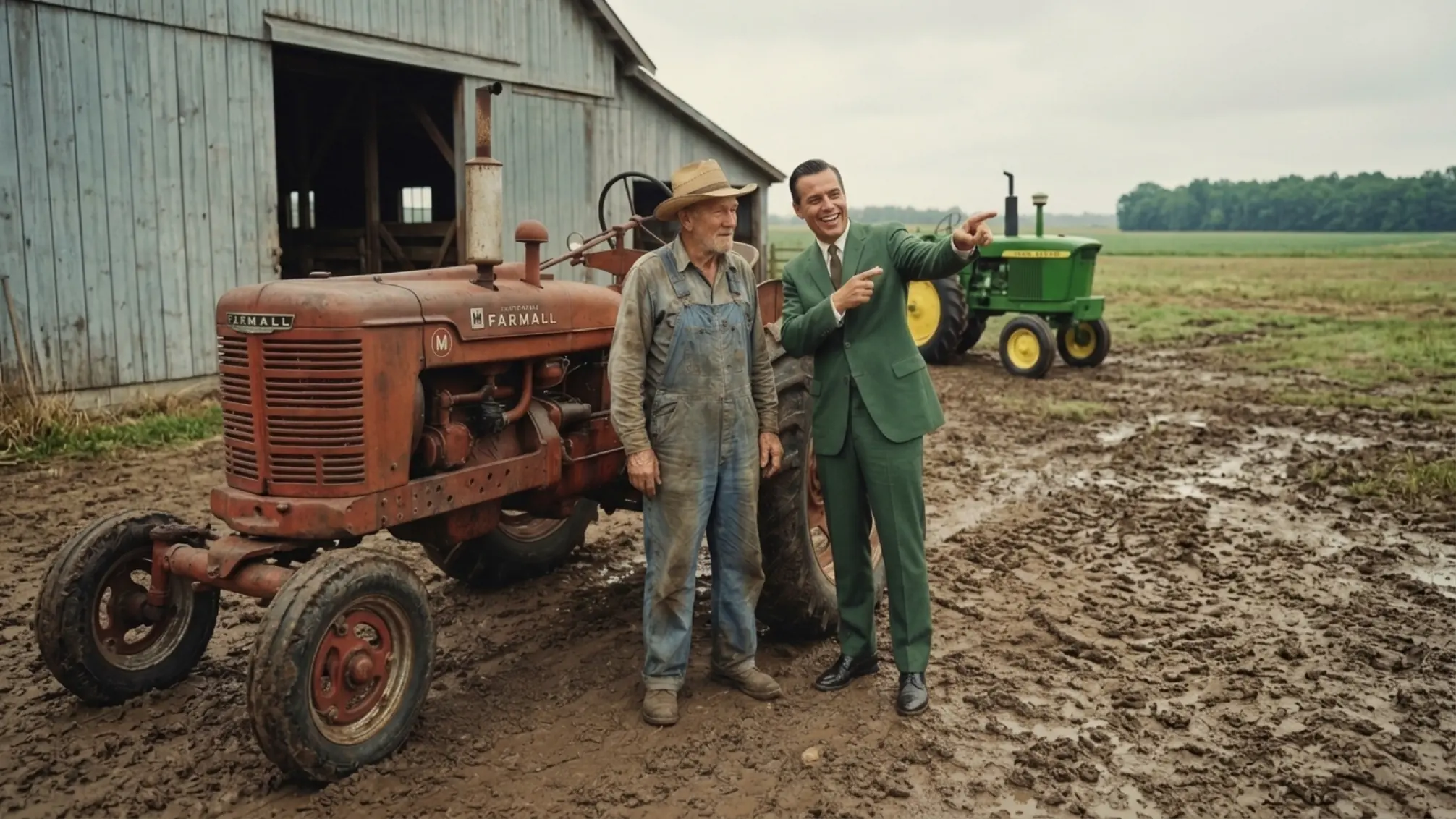
A new John Deere 4020 stood beneath the fluorescent lights, its paint so polished that Harold could see a distorted reflection of himself along the hood. It had ninety-five horsepower, power steering, remote hydraulic valves, and enough weight to pull equipment his old Farmall could only manage slowly. Harold walked around it twice, examining the tires, controls, and heavy rear hitch without touching anything. He could imagine covering his fields in half the time, arriving home before dark, and finally looking like the kind of modern farmer everyone said he needed to become.
Vernon Pitts watched from the sales office before deciding Harold might deserve attention. He was forty-six, broad through the middle, with slicked-back dark hair, a pressed white shirt, a dark green tie, and shoes polished so brightly they seemed absurd in farming country. Vernon crossed the showroom slowly, keeping both hands in his pockets and wearing a smile that never reached his eyes. He looked first at Harold’s clothing, then toward the old Chevrolet pickup outside, and finally at the thin envelope shape beneath Harold’s shirt pocket.
“Help you with something?”
Harold nodded toward the 4020. “What are you asking?”
“That’s a serious machine,” Vernon replied. “Four thousand eight hundred dollars, though I might find room for a serious buyer.”
Harold ignored the emphasis. Four thousand eight hundred dollars was more than he could safely borrow after the weak wheat harvest and the remaining mortgage on his land. Still, the Farmall had value, even if the paint had faded and the engine had thousands of hours behind it. Harold had installed a new clutch the previous spring and rebuilt the carburetor himself.
“What would you allow on trade for a 1949 Farmall M?”
Vernon’s smile changed.
“A forty-nine?”
“It runs every day.”
The salesman laughed sharply. Two customers near the implement displays turned to listen, and Harold immediately wished he had asked the question somewhere private. Vernon leaned against the new tractor’s rear tire as though preparing to entertain the room. “That machine is old enough to vote.”
“What would you give me?”
“Two hundred dollars.”
Harold stared at him. “Two hundred?”
“That’s charity. I’d probably scrap it for parts.”
“It pulled every pound of wheat I’ve grown for fourteen years.”
“That’s exactly the problem,” Vernon said. “You’re working twice as hard to grow half as much.”
One of the customers chuckled.
Vernon grew more confident. He explained that successful farmers upgraded, expanded, and purchased machinery capable of covering more acres. The farmers who continued relying on old equipment were falling behind, he said, and many would soon discover that stubbornness could not compete with horsepower. Harold listened without interrupting, though anger burned beneath his ribs.
“That Farmall is scrap,” Vernon said finally. “Smart farmers stopped living in the past.”
Harold stepped closer. “Smart farmers don’t mortgage their land for polished paint.”
Vernon lifted the purchase contract and pushed it against Harold’s chest. “Keep that relic, and I’ll watch your farm die around it.”
Harold knocked the paper aside.
“Keep selling debt,” he said. “Ten years from now, we’ll see whose doors are still open.”
The showroom went completely silent.
Harold turned and walked out before anger convinced him to say more. The heat struck him the instant he crossed the threshold, but he preferred it to the cool humiliation inside. He climbed into his battered pickup and drove seventeen miles home with the new tractor’s price repeating through his mind.
Sarah met him at the kitchen door. Nine years of marriage had taught her how to read disappointment in the angle of his shoulders, and she poured coffee before asking what happened. Harold sat at the table and placed the folded money beside the cup.
“They offered two hundred for the Farmall.”
Sarah stopped moving. “Two hundred dollars for a working tractor?”
“He said it was charity.”
“What did the new one cost?”
“Forty-eight hundred.”
She sat across from him. “And how much would the bank lend?”
“Enough to put another note on the land.”
Sarah’s expression hardened. Two farms near Meridian had already been lost that summer after their owners borrowed heavily for new equipment, expanded acreage, and then watched wheat prices fall. The machines were efficient, but the payments arrived whether rain did or not.
“Vernon called me a fool,” Harold said. “Said I’m working twice as hard to grow half as much.”
“Are you?”
“Maybe I’m working harder than men with new equipment. But the Farmall runs, I can repair it, and I don’t owe anyone for it.”
Sarah reached across the table and took his hand.
“Then we keep the Farmall,” she said. “And Vernon Pitts can go straight to hell.”
Harold looked into the same steady eyes that had convinced him to marry her. The humiliation from the showroom did not disappear, but it became something useful—less like a wound and more like a decision. He folded the four hundred dollars and returned it to his pocket.
“That’s exactly what we’ll do.”
Keeping the tractor required more than pride. Harold knew age would eventually punish every neglected bearing, gasket, gear, and seal. If he could not afford modern machinery, he would have to understand his old machine better than most farmers understood their new ones.
That autumn, he borrowed repair manuals from the county library and spread them across the kitchen table after supper. He studied electrical systems, hydraulic pressure, engine timing, metal fatigue, and transmission design. In the barn, he practiced welding on broken scrap until his beads ran straight enough to hold beneath load.
He began attending farm auctions not to buy machinery but to search for parts. Other men saw bent shafts, worn housings, obsolete carburetors, and boxes of rusted components. Harold saw replacement pieces that might keep his Farmall working another twenty years. One corner of his barn slowly became an organized collection of what everyone else called junk.
The story of the dealership confrontation spread through Coladin County. Vernon repeated it at coffee shops, gas stations, and the grain elevator, usually ending with an imitation of Harold promising to outlast him. The audience always laughed, and Harold learned to recognize the silence that arrived whenever he entered a room.
He rarely answered.
The 1968 season brought rain. Wheat rose thick and green across the Brennan farm, and Harold’s harvest produced enough money to reduce the mortgage, repair the barn roof, and add savings to the bank. The Farmall pulled the drill, wagons, and harvesting equipment without serious failure.
The following year brought a late freeze, then grasshoppers. Harold shifted some fields to milo, cut expenses wherever possible, and finished the year slightly above break-even. During winter, he rebuilt the Farmall’s transmission beside a smoky space heater, working until his fingers grew too numb to hold the tools.
In 1970, drought returned. The soil split beneath a white sky, and Blackjack Creek narrowed into a muddy ribbon. Harold had changed his tillage practices after the previous drought, leaving more crop residue to protect moisture rather than turning every field black and exposed.
His yields were poor, but they were better than those of several neighbors.
Vernon Pitts continued selling tractors. He offered generous trade allowances and credit plans that made expensive machines seem almost affordable. Young farmers believed higher horsepower would solve narrow margins, while established operators expanded because everyone said size was the only route to survival.
The new machines performed beautifully.
The debt did not care.
By 1971, three nearby farms had entered foreclosure. By 1972, seven families had lost operations built across generations. Their tractors were auctioned for less than the remaining loan balances, while their land was absorbed by larger operators or investors who had never walked the fields.
Harold did not celebrate their failures. Several were friends, and he helped some pack equipment or repair trucks before they left. Yet each auction strengthened the lesson he had carried from Vernon’s showroom: a machine could make work faster without making the business safer.
Then the 1973 oil embargo changed the arithmetic overnight.
Diesel prices climbed faster than farmers could revise their budgets. Large tractors designed to cover enormous fields consumed fuel at rates that seemed manageable when energy was cheap. Now each day in the field became an expensive calculation.
The Farmall was slower, but its smaller engine used far less fuel. Harold covered fewer acres per hour yet spent roughly a third of what several neighbors paid to complete comparable work. What the dealer had mocked as weakness became protection.
That winter, Ray Thornton arrived at the Brennan farm.
Ray owned nearly a thousand acres and had purchased a powerful John Deere two years earlier. He had been present in the dealership when Vernon laughed at Harold and had smiled along with the others. Now he stood outside Harold’s barn with his hat held awkwardly in both hands.
“I’m selling out,” Ray said.
Harold waited.
“The equipment payments, land note, and fuel finally buried us. My wife and I decided this morning.”
“I’m sorry.”
Ray looked toward the old Farmall inside the barn. “I remember that day at Pitts’s dealership. We all thought you were finished. Figured you’d sell within two years.”
Harold said nothing.
“Guess you were the smart one.”
“No,” Harold replied. “I was just too poor to make the same mistake.”
Ray gave a sad laugh. “Maybe poverty saved you.”
“Maybe.”
Before leaving, Ray extended his hand.
“I was wrong about you.”
After the pickup disappeared, Harold returned to the brake assembly he had been repairing. His hands trembled slightly, though the barn was warm. Being proven right did not feel victorious when the proof was another family abandoning its farm.
The years continued turning.
Harold rebuilt the Farmall’s engine in the winter of 1976. He bored the cylinders, installed new pistons and rings, replaced the timing gears, bearings, and every gasket he could reach. The work required nearly three months because he photographed each stage of disassembly and studied every unfamiliar component before moving forward.
When the engine finally started, it settled into a smooth, steady rhythm Harold had not heard since childhood. He stood beside the tractor with one hand against the hood, feeling the vibration through the faded metal. The machine was not merely old equipment anymore.
It represented knowledge no creditor could repossess.
The county around him continued shrinking. The local mercantile closed. The grain elevator consolidated with one two counties away. The annual fair disappeared after seventy years because too few farming families remained to support it.
Harold’s operation stayed almost the same size.
He did not become wealthy. He did not purchase neighboring farms or attempt to compete with the largest operations. He raised wheat, milo, and cattle on ground he understood with machinery he could repair and expenses he could survive.
In July 1977, the county clerk recorded the final payment on his mortgage.
Harold was forty-two years old, and every one of his four hundred twenty acres belonged to him without a bank’s name attached. Sarah organized a small celebration beneath the cottonwoods near the house. Only a few friends and surviving neighbors attended, but they understood what the moment meant.
After supper, someone asked how Harold had survived when larger farms with newer machinery disappeared.
He watched sunset move across the wheat.
“I stopped trying to become something I wasn’t,” he said. “I didn’t compete on the big operators’ terms. I ran a farm I could afford with equipment I could fix.”
Sarah lifted her glass. “And stubbornness.”
Harold smiled. “A great deal of stubbornness.”
Two months later, Coladin County Implement closed.
Harold heard the news at the feed store. Vernon Pitts had extended credit more aggressively than his declining customer base could support. He offered inflated trade values to maintain sales volume and borrowed heavily to finance inventory that remained on the lot.
The bank called its notes.
The manufacturer withdrew the franchise.
Within four weeks, the business vanished.
Harold drove into town on a Friday afternoon and parked before the dark showroom. The gleaming tractors were gone. Empty concrete stretched across the lot, and a bankruptcy notice hung crookedly inside the front door.
He sat behind the steering wheel of his old pickup, unsure what he expected to feel.
Triumph never arrived.
The dealership had served the county for years, providing parts, repairs, and work for local families. Its failure represented another piece of rural life disappearing. Still, beneath the sadness was a hard recognition.
Vernon had built his business by telling farmers that progress required debt. Eventually, he took the same gamble himself, expanding credit and inventory because reducing ambition felt like defeat. The belief he sold to others destroyed him too.
A Cadillac pulled into the empty lot and stopped beside Harold’s pickup.
Vernon sat behind the wheel.
Ten years had changed him. His hair had thinned, his face looked gray, and his expensive suit hung loosely from his shoulders. For a moment, the two men looked at each other through their windows.
Vernon’s eyes moved toward the bankruptcy notice.
Then back to Harold.
He remembered.
Harold could see it in his face—the showroom, the laughter, the two-hundred-dollar offer, and the warning about whose doors would remain open. Vernon looked away first.
Harold rolled down his window.
“Vernon.”
The former dealer lowered his own.
“What do you want?”
“Nothing.”
“Come to enjoy the view?”
“No.”
Vernon laughed bitterly. “You were right. Is that what you came to hear?”
Harold shook his head. “I came for a belt at the hardware store. Saw the building.”
“Convenient.”
“I’m sorry it ended this way.”
Vernon stared at him.
“You expect me to believe that?”
“Believe whatever helps.”
“The Farmall still running?”
“Yes.”
Vernon looked toward Harold’s work-stained clothes and old pickup. “You never bought anything new?”
“Bought tools. Parts. Land improvements.”
“But no tractor.”
“I already had one.”
The former dealer tightened both hands around the steering wheel.
“I sold hundreds of machines.”
“I know.”
“Helped farms double their acreage.”
“Some of them.”
“Don’t stand there acting like every tractor I sold ruined a man.”
“I’m not.”
“Then what are you saying?”
Harold’s voice remained calm.
“A machine can be good and the debt can still be wrong. You never wanted to admit both things could be true.”
Vernon’s jaw tightened. “You think you’re better than me because you kept an antique alive?”
“No.”
“Then why are you still farming while my business is dead?”
“Because I knew what I could afford.”
The answer seemed to strike harder than an insult.
Vernon opened his door and stepped into the empty lot. Harold climbed from his pickup. They faced each other beside the bare concrete where green tractors once stood, close enough that the conversation felt like it might become the fight they had avoided ten years earlier.
“You got lucky,” Vernon said.
“I had good years and bad years.”
“You stayed small because you were afraid.”
“I stayed solvent.”
“You could have made twice the money with proper equipment.”
“Or lost the land twice as fast.”
Vernon stepped closer. “You think keeping that relic made you a genius?”
Harold met his stare.
“No. It made me responsible for fixing my own problems.”
The anger drained from Vernon almost visibly.
He looked toward the empty showroom again.
“I thought the market would recover.”
“So did the farmers you financed.”
“I kept extending terms because if I stopped selling, the dealership died.”
“And every sale made the risk bigger.”
“I had employees. A franchise. Obligations.”
“I know.”
“You don’t know anything about running this place.”
“No. But I know what happens when the payment requires a future you can’t guarantee.”
For nearly a minute, neither man spoke.
Finally, Vernon nodded once.
“Two hundred dollars.”
Harold understood.
“That was your offer.”
“The tractor was worth more.”
“Yes.”
“I knew it too.”
“Then why offer two?”
“Because I thought you were desperate enough to accept it.”
Honesty settled between them, ugly but clean.
Harold opened his pickup door.
“I wasn’t.”
“No,” Vernon said. “You weren’t.”
They exchanged one final nod.
Vernon drove away and never returned to Coladin County. People later said he moved to Wichita and sold insurance. Harold never tried to verify the story.
The Farmall continued working.
Harold rebuilt its transmission again in 1981, replaced the radiator in 1983, and installed another clutch in 1986. By then, younger farmers began visiting his barn for help repairing used equipment they could not afford to replace.
He taught them how to diagnose problems by sound, preserve serviceable components, and distinguish between worn parts and truly ruined ones. Sometimes they paid him. More often, they brought beer, spare parts, or labor when Harold needed help.
His knowledge became another kind of inheritance.
Years later, Harold’s son asked why he had never restored the Farmall’s paint. The tractor’s body had faded from deep red to pinkish rust, and scratches covered nearly every panel.
Harold rested one hand against the hood.
“Because it isn’t pretending to be new.”
“What does that mean?”
“It means every mark tells the truth.”
The tractor had never made Harold rich. It did not turn him into the county’s largest farmer, and it never covered ground as quickly as the John Deere 4020 gleaming in Vernon’s showroom.
It did something more valuable.
It allowed him to farm without surrendering control of the farm itself.
Ten years after Vernon called him obsolete, Harold owned his land outright while the dealership’s doors were locked beneath a bankruptcy notice. Yet the real victory was not that one man failed while another survived.
The victory was that Harold refused to let humiliation make an expensive decision for him.
He kept the machine he understood.
He learned the skills required to maintain it.
And when the world insisted that progress meant purchasing more than he could afford, he proved that sometimes the oldest tractor in the county could still pull a family toward the future.