“Keep that Farmall and you’ll die broke behind it.” Vernon Pitts slapped the polished hood of the new John Deere hard enough to make the showroom brochure beside his hand jump. Harold Brennan stood across from him in faded bib overalls, his sun-browned arms streaked with dust from seventeen miles of Kansas back roads, and answered without raising his voice. “Better broke than owned by your bank.”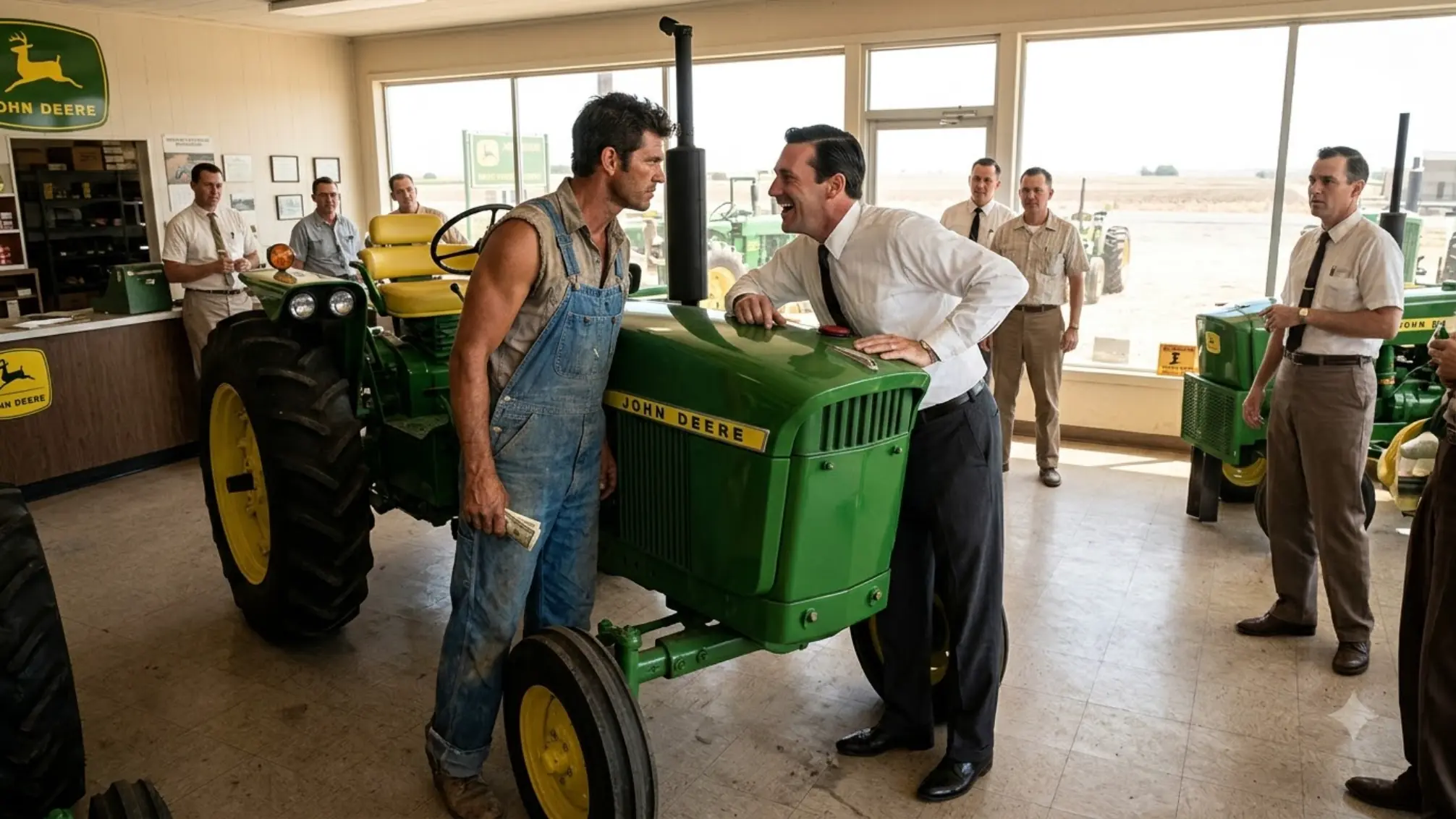
Vernon’s smile sharpened. “That junk will bury your farm.” Harold folded the cash envelope back into his shirt pocket and held the dealer’s stare. “Come back in ten years and see who still owns theirs.”
The confrontation happened in August 1967, during one of the driest summers Coladin County had seen in years. Harold was thirty-two and farmed 420 acres outside Meridian, Kansas, land his grandfather had begun breaking with mules in 1909 and his father had spent a lifetime trying to improve. Blackjack Creek cut across the southern boundary, but that summer even the creek had shrunk into shallow pools beneath the cottonwoods.
Harold’s farm was not rich. He grew winter wheat, milo, and a little alfalfa, kept thirty-seven Hereford cows, and repaired nearly everything he owned because replacing machinery required money he usually did not have. His most important tractor was a faded red 1952 Farmall Super M that had already accumulated more hours than anyone could accurately count.
The Farmall leaked enough oil to leave dark circles beneath the shed floor. Its seat had been repaired with baling wire, one fender carried a dent from the winter of 1961, and Harold had rebuilt the carburetor twice using parts from tractors sitting behind neighbors’ barns. But the engine started, the hydraulics worked, and Harold owned it outright.
That last detail mattered more to him than paint. His father, Walter Brennan, had nearly lost the farm during the drought of 1936 after borrowing against land to purchase machinery and livestock just before prices collapsed. Harold had grown up hearing the same warning whenever a salesman promised easy payments: machinery works for the farm until the farm starts working for the machinery.
By 1967, however, farming was changing quickly. Larger tractors, wider implements, better hydraulics, enclosed operator stations, and increasingly sophisticated equipment were allowing neighbors to cover more ground in less time. Harold knew his Farmall was becoming outdated, and he was not foolish enough to believe nostalgia could replace horsepower.
That was why he drove to Coladin County Implement carrying $4,700 in cash. He intended to make a large down payment on a newer tractor if the numbers made sense, and he had spent three months studying used equipment prices, fuel consumption, horsepower requirements, and what his farm could realistically earn in an average year. Harold wanted modernization, but he wanted it without putting the land at unnecessary risk.
Vernon Pitts saw the situation differently. He had been selling equipment for almost twenty years and believed a farmer reluctant to finance machinery simply lacked confidence. Vernon wore pressed trousers, a white shirt, and a dark tie even during the August heat, and he had developed a habit of judging customers by the trucks they parked outside.
Harold’s 1959 Chevrolet had rust beneath both doors. His boots were worn, his overalls faded, and he carried cash in an ordinary envelope instead of discussing a bank draft. Vernon decided before their conversation started that Harold was the kind of farmer who needed to be pushed.
The tractor Vernon wanted to sell him was beautiful. It had enough power to replace the Farmall for heavy fieldwork, modern hydraulics, better fuel economy under load, and the kind of equipment compatibility Harold knew would eventually become standard. The price, including financing costs, would place nearly $14,000 of debt against Harold’s operation.
Vernon described the monthly payment as manageable. Harold asked what happened if wheat prices dropped twenty percent or if the drought continued another year. Vernon laughed and told him successful farmers did not build businesses around fear.
Harold calculated again. His cattle income could cover payments in a normal year, and wheat could handle the rest, but one failed crop would force him to borrow operating money while still carrying the tractor note. Two bad years could put the farm itself into the conversation.
“What will you allow me on the Farmall?” Harold asked. Vernon glanced through the showroom window toward the faded tractor sitting on Harold’s trailer. “Scrap value, basically.”
Harold’s expression changed. The Farmall was old, but its engine had good compression and the rear tires had been replaced three years earlier. Vernon offered four hundred dollars.
Harold stared at him. “I can sell the tires for almost that.”
Vernon shrugged. “Nobody wants machines like that anymore.” Harold looked through the window at the red tractor that had plowed his father’s ground, pulled cattle from snowdrifts, planted grain through two dry years, and never demanded anything except fuel and repair work.
“It still earns money.” Vernon leaned toward him. “Until it doesn’t.”
The argument became sharper when Harold said he would keep the Farmall and postpone buying. Vernon laughed loudly enough that two salesmen turned toward them. That was when the four lines exchanged beside the green tractor became something Harold remembered for the next decade.
He left without purchasing anything. On the drive home, he replayed Vernon’s words and wondered whether pride had made the decision for him. Modern equipment existed for a reason, and Harold knew refusing every improvement could destroy a farm just as effectively as excessive borrowing.
His wife, Margaret, found him in the machinery shed that evening checking the Farmall’s oil. She listened while he explained the financing, trade value, and payment schedule. Then she asked one question.
“If wheat brings what it brought last year, can we pay it?” Harold nodded. “Probably.”
“And if this drought stays?” Harold looked toward the tractor. “Then I don’t know.”
Margaret wiped grease from his cheek with the corner of an old towel. “Then you already know.”
Harold used part of the $4,700 for repairs instead. He installed new bearings in the Farmall’s rear end, replaced worn wiring, rebuilt the hydraulic pump, purchased two better used implements at auction, and spent money repairing the irrigation well on the eighty acres closest to Blackjack Creek. When everything was finished, he still had more than half his original cash.
The drought worsened. By September, crops across southern Kansas were producing far below expectations. Farmers who had financed heavily during the previous two years found themselves trying to cover machinery payments with grain that never reached the elevator.
Harold’s wheat income fell badly. His milo barely paid harvesting costs, and cattle prices offered little relief. Yet no equipment company expected a payment from the Brennan farm that autumn because Harold’s machinery was paid for.
He worked longer instead. The Farmall required nearly constant attention, and one September afternoon a cracked coolant hose stranded Harold five miles from the house. He repaired it temporarily using a section of rubber hose from an old sprayer and two clamps carried inside the toolbox.
A neighboring farmer named Raymond Cole stopped beside him. Raymond had purchased a new tractor the previous spring and teased Harold about keeping the Farmall. “Vernon might’ve been right,” he said, looking at the patched hose.
Harold tightened the clamp. “Maybe.”
Raymond laughed. “That thing’s fighting you every week.”
Harold wiped his hands. “Costs me time.” Then he looked toward Raymond’s new tractor. “Yours costs you money whether it moves or not.”
Raymond stopped laughing. His payment was due in November.
Rain finally came in early 1968, but grain prices remained weak. Harold planted carefully, reduced fertilizer where soil tests showed reserves were adequate, and avoided expanding acreage even though several neighboring farms came available for rent. He had become almost obsessive about maintaining cash.
Vernon Pitts occasionally saw him at the cooperative. Each time he asked whether Harold was ready to buy a “real tractor.” Harold usually smiled and changed the subject.
By 1969, Harold understood the Farmall could not remain his primary tractor forever. Instead of returning to Vernon, he bought a six-year-old International from a retiring farmer thirty miles west. It lacked showroom shine but had excellent records and cost less than half what a new tractor would have required.
He paid cash. The old Farmall moved to lighter duties, pulling hay wagons, running an auger, mowing field edges, and handling jobs where horsepower mattered less than reliability. Harold refused to sell it.
The next years rewarded patience. Wheat prices improved, cattle markets strengthened, and Harold used profits to reduce every outstanding farm obligation. He invested in soil conservation, rebuilt terraces, fenced sensitive creek ground, and upgraded equipment incrementally rather than replacing the entire machinery line at once.
Meanwhile, some farms around Meridian grew rapidly. Cheap credit and strong commodity optimism convinced operators to add acreage, combines, tractors, and land simultaneously. Vernon Pitts became one of the most successful machinery dealers in the county because every expansion required more iron.
He frequently pointed to these farms when discussing Harold. “That’s what ambition looks like,” Vernon told customers. “You don’t build anything hanging onto antiques.”
Harold heard about the comments but never responded. His operation expanded only when he could afford it. In 1971, he purchased forty adjoining acres from an elderly widow who wanted the ground kept in agriculture.
He paid one-third cash and financed the balance on a short note that could be covered by cattle income alone. Margaret considered even that debt aggressive. Harold agreed, which was why they paid it off two years early.
The Farmall continued running. Harold’s son Daniel became old enough to drive it during hay season, and Harold taught him the same habits Walter had taught him: listen for changes in engine sound, stop when something feels wrong, and never confuse an expensive machine with a profitable one.
Daniel hated the Farmall at first. Teenagers saw only the cracked paint and slow hydraulics. He wanted the newer tractor because neighbors had enclosed cabs and radios.
Harold told him, “That tractor doesn’t care whether you’re impressed.” Daniel rolled his eyes. “It just works.”
“Exactly.”
Then came 1973 and 1974, when high grain prices encouraged an entirely different kind of optimism. Farmers expanded rapidly because global demand seemed endless, and equipment dealerships struggled to keep popular models in stock. Vernon Pitts sold tractors before they even arrived.
Harold could have upgraded everything during those years. Instead, he bought one used combine after paying cash for most of it and saved the rest. Margaret asked whether he worried about falling behind.
Harold admitted he did. But falling behind in machinery was temporary. Losing control of the land was permanent.
In 1975, commodity prices softened. Fuel costs remained high, interest became more painful, and several operators who had expanded aggressively discovered that their machinery payments assumed profits the market no longer provided. One of them was Raymond Cole.
Raymond had added 600 rented acres, purchased two new tractors, and financed a larger combine. When his lender tightened terms, he began selling cattle to make machinery payments. By spring 1976, he was trying to sell one tractor for less than he owed.
Harold bought none of it. He helped Raymond repair an older machine so he could finish planting, but he would not participate in another farmer’s desperation unless the transaction was unquestionably fair.
Vernon’s dealership also began feeling pressure. Customers delayed purchases, used inventory accumulated, and manufacturers demanded volume. The salesman who once laughed at Harold now spent more time encouraging farmers to refinance equipment rather than replace it.
One afternoon in 1976, Vernon drove onto the Brennan farm. Harold was repairing a fence near the machinery shed while the faded Farmall idled beside a wagon.
Vernon climbed from a clean Buick and stared at the red tractor. “You still have that damned thing?”
Harold smiled. “Still starts.”
Vernon shook his head. “I’ll give you more than scrap now just to get it out of my sight.”
“Not for sale.”
Vernon looked across the Brennan fields. The wheat stood thick and even, terraces followed the slopes cleanly, and cattle grazed beyond the creek. Harold now controlled 460 acres and owed almost nothing.
“You could be twice this size,” Vernon said. Harold leaned against the fence post.
“Could be.”
“Doesn’t bother you?”
“Sometimes.”
Vernon seemed surprised by the honesty. Harold continued. “But I sleep.”
That autumn marked nine years since the showroom argument. Then 1977 arrived, bringing another difficult season and tighter credit for several farms already carrying too much machinery debt.
The tenth anniversary passed almost unnoticed until Harold needed a bearing for the International. Coladin County Implement was the only dealer nearby with one in stock. Harold walked into the showroom for the first time since 1967.
The building looked different. New lighting, larger windows, brighter displays, and more sophisticated machines filled the floor. Vernon Pitts was older, heavier, and no longer wore a tie every day.
He recognized Harold immediately. For several seconds neither man spoke. Then Vernon said, “Well, look what the Farmall dragged in.”
Harold almost smiled. “Need a bearing.”
Vernon personally brought the part from inventory. While the clerk prepared the invoice, he looked through the window toward Harold’s pickup.
“You still running the red one?”
“Every week.”
Vernon shook his head. “Ten years.”
Harold remembered the exact words from 1967. “You told me to come back and see who still owned their farm.”
Vernon’s expression tightened. He had not forgotten either.
Several of Vernon’s former customers had lost acreage during those years. Some had sold equipment. Others had consolidated with larger operations. The dealer himself had survived, but his business had changed enough that humility now sat closer to the surface.
“How much do you owe on your place?” Vernon asked.
Harold folded the receipt. “Nothing.”
“All 460 acres?”
“All of it.”
Vernon looked down at the counter. “You know what I thought back then?”
“I have an idea.”
“I thought you were scared.” Harold waited.
Vernon continued. “I thought every farmer who wouldn’t borrow was scared of growing.”
Harold slipped the bearing into a paper bag. “I was scared.”
Vernon looked up.
“That’s why I didn’t sign.”
For the first time, Vernon understood the distinction. Harold had never believed debt was evil or old machines were automatically better. He had been afraid of losing ground his family could never replace, and that fear forced him to calculate risks Vernon did not carry.
Vernon extended a hand. “I was wrong about the Farmall.”
Harold shook it. “You were right about one thing.”
“What?”
“It did bury me in work.”
Vernon laughed. Harold did too.
The tension disappeared without either man pretending the past had not happened. Harold paid for the bearing and drove home.
That evening Daniel found him changing oil in the Farmall. The boy was twenty now, broader than Harold had been at that age and increasingly interested in taking over more farm responsibility. He asked why his father kept fixing a machine worth less than some used pickup trucks.
Harold looked at the dented hood. “Because this tractor reminds me of a decision.”
“What decision?”
“Not buying another one.”
Daniel laughed because he thought his father was joking. Harold was not.
The Farmall represented a moment when choosing less machinery had allowed him to keep more land. That did not make the tractor magical. It made the arithmetic behind it important.
Over the following decades, Harold eventually purchased modern machinery. He owned tractors far more powerful and comfortable than anything Vernon had offered in 1967. Some were financed because Harold learned that responsible debt could help a strong operation grow.
The difference was that he never borrowed because a salesman told him successful farmers should. He borrowed only when projected farm income could support the payment under conservative assumptions. Every major purchase began with the same question Margaret had asked during the drought: What happens if next year is bad?
Daniel inherited that question. When he eventually took over daily management, he occasionally became frustrated by Harold’s caution. Yet when interest rates climbed and neighboring operators struggled, Daniel understood why the old man cared more about ownership than appearances.
The Farmall remained in the shed. By then its paint was almost pink from decades of sunlight, and replacement parts required increasingly creative searching. Daniel once suggested restoring it completely.
Harold refused. “Then it’ll look like a museum tractor.”
“What’s wrong with that?”
“It never worked in a museum.”
Harold wanted the scratches, welded brackets, faded paint, and mismatched bolts visible because each represented work performed rather than value preserved for collectors. The tractor had never been an investment. It had been a tool.
Years later, after Vernon Pitts retired, he visited the Brennan farm during a county agricultural tour. He found Harold beside the machine shed talking with younger farmers about conservation and debt management.
The Farmall sat outside attached to an auger. Vernon walked around it slowly.
“You know,” he said, “I probably sold three hundred tractors to farmers while you kept this thing.”
Harold nodded. “Probably.”
“Some of them needed the new tractor.”
“Absolutely.”
“Some didn’t.”
Harold looked at him. “That’s the part salesmen don’t get paid to say.”
Vernon laughed. “Fair.”
A young farmer overheard them and asked what they were discussing. Vernon pointed toward the Farmall.
“In 1967, I told this man that tractor would destroy his farm.”
The young farmer looked at Harold.
“What happened?”
Harold pointed across the fields. “Farm’s still here.”
Vernon added, “And I spent ten years learning that being able to sell someone something doesn’t mean they should buy it.”
No great revelation followed. Nobody applauded. The men simply stood beside an old tractor while wind moved through Kansas wheat.
That was how Harold preferred the story. He had not become wealthy by refusing one John Deere, nor had Vernon been an evil dealer plotting to steal land. Vernon sold machinery because that was his business, and Harold protected land because that was his.
The mistake happened when one man assumed the other man’s priorities should match his own. Vernon measured success through expansion, newer equipment, and purchasing power. Harold measured it through acres retained, bills paid, soil improved, and the ability to survive a bad year without someone arriving with foreclosure papers.
Ten years proved neither man had possessed the entire answer. Modern machinery mattered. Credit could be useful.
But so could an ugly tractor already paid for. Harold’s Farmall gave him something no horsepower rating showed on a brochure.
Time.
Time to survive drought. Time to wait for better markets.
Time to build equity. Time to save cash.
And most importantly, time to keep the ground until stronger years arrived.
Harold Brennan eventually became an old man sitting beneath the cottonwoods along Blackjack Creek while Daniel and his children farmed the acreage his grandfather had first broken in 1909. The operation grew beyond what Harold himself had ever managed, but the original 420 acres remained intact.
Near the machinery shed stood the Farmall. It still started, though reluctantly on cold mornings. Harold sometimes heard its engine across the yard and remembered Vernon Pitts laughing beside a polished green tractor in August 1967.
The dealer had told him he would die broke behind that old machine. Harold never became rich enough to impress a banker from Wichita or a salesman measuring success by equipment inventories. He became something he valued more.
A farmer who still owned his farm.
And when the tenth year came, the old Farmall was still working too.