Jim Anderson stood beside a brand-new John Deere 4240 like he was standing beside the future itself. The tractor gleamed beneath the bright showroom lights of Anderson’s John Deere dealership in central Illinois, its green paint polished so perfectly that Raymond Cooper could see the reflection of his own worn flannel shirt across the hood. Raymond was thirty-one years old, tall and lean from years of construction work, with mud on his boots and twelve thousand dollars saved from overtime, weekend shifts, and living carefully. Three weeks earlier, his uncle Theodore had passed away and left him 190 acres of family land, free and clear, but the land had no tractors, no implements, and no equipment left to begin again.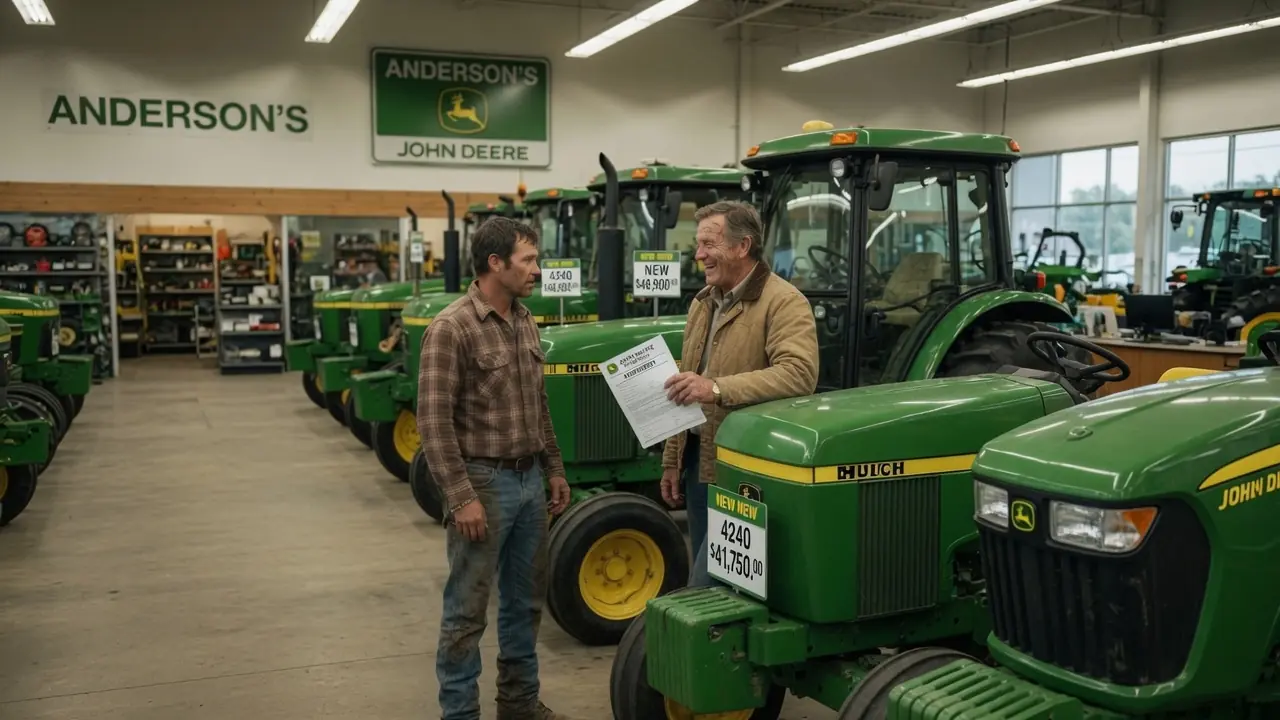
Jim gave him the kind of smile salesmen used when they believed the deal was already won. He was in his mid-fifties, thick around the middle, wearing an expensive watch and a clean jacket that had never touched a grease gun. He had sold equipment in that county for more than twenty years and knew exactly how to make a young farmer feel small beside a new machine. Raymond looked from the price tag to Jim’s face and tried to hide the weight settling in his chest.
“Forty-two-forty would suit your acres just fine,” Jim said, patting the tractor’s fender. “Modern power, real reliability, good resale value. You start with something like this, people know you’re serious.” He pulled a financing sheet from a folder and slid it across the counter. “Ten percent down, seven years, monthly payment a little over six hundred dollars. That’s how farming works now, Raymond.”
Raymond stared at the numbers. Six hundred and twenty dollars a month did not sound like a tractor to him. It sounded like a chain. Seven years of payments meant more than fifty thousand dollars when interest was counted, and that was only for one machine, not seed, fertilizer, fuel, repairs, or living expenses.
“I only have twelve thousand saved,” Raymond said.
Jim chuckled softly. “That is what financing is for.”
Raymond looked around the dealership. The showroom was beautiful, almost too beautiful for farming, with polished concrete floors, bright white lights, banners hanging from the ceiling, and several green-and-yellow tractors lined up like trophies. There was no smell of soil in the place, no grit, no dust, no weather. It smelled of rubber, paint, oil, and debt wrapped in pride. Raymond knew enough about work to know a tool did not need to shine to earn its keep.
“Do you have anything used?” he asked.
Jim’s smile tightened. “Used?”
“Something older. Something I can pay for.”
Jim leaned back as if Raymond had disappointed him personally. “Raymond, you inherited 190 acres just to start with junk? That’s not farming.”
The words cut deeper because they were spoken loud enough for two mechanics and a parts clerk to hear. One of them looked away quickly, but Raymond saw the smirk on another man’s face. He felt heat rise into his neck, but he did not answer too fast. His father had always told him that when men laughed at your caution, they were usually trying to sell you their risk.
“I am trying to farm without losing the land,” Raymond said.
Jim shook his head. “You cannot compete that way. The neighbors are running modern equipment. They can plant faster, work bigger ground, and harvest cleaner. You come out there with some tired old red tractor from an auction, and you will be broken down by June.” He tapped the financing sheet again. “This is an investment.”
Raymond looked at the signature line. He imagined signing it, taking the tractor home, watching neighbors nod in approval. He imagined driving the big Deere across his uncle’s fields with pride in his chest. Then he imagined the first bad year, the first low grain price, the first missed payment, and a banker sitting across from him saying the land might have to be sold.
“No,” Raymond said quietly.
Jim blinked. “No?”
“I cannot do it.”
Jim’s face hardened under the salesman’s smile. “You are making a mistake.”
“Maybe.”
“No, not maybe,” Jim said. “A real mistake. Farming is not a hobby, Raymond. You do not step into it with old junk and good intentions. You need real iron.”
Raymond folded the financing paper and pushed it back across the counter. “Then I guess I’ll find real iron somewhere else.”
He walked out of the dealership with the laughter behind him. The April air felt cooler outside, and he stood beside his pickup for a long minute, looking back through the glass at the shining tractors. He wanted one. He would have been lying if he said otherwise. But wanting something and surviving it were two different things.
That Saturday, Raymond went to an estate auction two counties over. The ground was muddy from recent rain, and farm equipment sat scattered across the lot in rows: plows, grain drills, wagons, cultivators, and two faded red Farmalls near the back. They did not shine. The paint was dull, the fenders had rust spots, and one hood had a dent big enough to hold rainwater. But Raymond climbed onto each one, checked the oil, tested the clutch, examined the hydraulic lines, and listened in his mind for work left inside the old machines.
An older farmer named Earl Thompson walked up beside him. “Thinking about bidding?”
“Maybe,” Raymond said. “You know anything about them?”
Earl nodded toward the first tractor. “That Super MTA worked 200 acres most of its life. Old Harlan kept it running. The 560 needs a clutch, but it is not dead. If you want pretty, keep walking. If you want paid-for work, you are standing in the right place.”
Raymond looked at the tractors again. “People will laugh.”
Earl shrugged. “People laugh at anything that does not look like what they just bought.”
The auctioneer started high, but no one wanted old red tractors in a season when everyone was dreaming green, new, and financed. Raymond bought the Farmall Super MTA for twelve hundred dollars. He bought the 560 for nine hundred. With fees, he had spent just over two thousand dollars, leaving most of his savings untouched.
As Raymond signed the papers, a familiar voice came from behind him. “That’s a hell of a gamble.”
He turned and saw Jim Anderson standing with his arms crossed, wearing leather gloves and a smirk. Jim looked at the two tractors like they were scrap already. A few men nearby slowed down, sensing entertainment.
“They run,” Raymond said.
“For now,” Jim replied. “Those are junk, Raymond. You should have let me put you in something proper.”
Raymond kept his voice steady. “I cannot afford proper if proper comes with payments I cannot make.”
Jim laughed, loud enough to make people turn. “You really think these two old Farmalls are going to save you? When they break, and they will, you come see me. I may give you a little trade-in credit for the scrap metal.”
Raymond looked at the tractors. For a moment, doubt got its hands around him. Maybe everyone was right. Maybe he was too cautious, too poor, too stubborn, too afraid. But then he looked at the receipt in his hand and saw what mattered most: paid in full.
“I’ll take my chances,” Raymond said.
That first spring was not easy. Raymond turned his uncle’s old barn into a repair shop with a dirt floor, a leaky roof, and a toolbox that had seen better days. He changed oil, replaced filters, patched a fuel tank, fixed hydraulic seals, and spent one long weekend splitting the 560 to replace the clutch. His hands stayed cut, bruised, and black with grease, but every repair taught him the machines more deeply.
By early June, both tractors were running. The Super MTA became his main field tractor, slow but stubborn. The 560 handled lighter work, hauling wagons, cultivating, and moving equipment around the place. Raymond borrowed a planter from Earl Thompson and paid him back with labor during wheat harvest.
The neighbors watched him from their new machines and shook their heads. They planted in three days while Raymond took nearly two weeks. They had air-conditioned cabs, radios, and power to spare. Raymond had an umbrella wired above the seat, dust in his throat, and the sound of old pistons working hard beneath him. But when the sun went down, he owned his tractors completely.
That fall, his first crop was not spectacular, but it was good enough. The corn made a decent yield, the soybeans did better than he expected, and after expenses he had money left. Not enough to brag about, but enough to plant again, pay taxes, put some savings away, and sleep at night. When Jim heard at the co-op that Raymond had made it through the year, he only shrugged and said, “Let’s see if those old Farmalls make it through year two.”
Year two came with temptation. Grain prices were high, land values were rising, and every dealer, banker, and farm magazine seemed to shout the same message: expand, borrow, modernize, grow. Jim came out to Raymond’s farm one afternoon in a new Chevy Suburban and found him changing oil in the barn. He walked around the Super MTA, touched the faded fender, and wiped rust dust from his fingers with a look of pity.
“You proved you can farm,” Jim said. “Now it is time to succeed.”
Raymond kept pouring oil. “I thought farming was succeeding.”
Jim smiled like a man speaking to a child. “I have a used 4240 that came in on trade. Only two hundred hours. I can make the numbers work. Two thousand down, finance the rest, and you can finally stop crawling across fields on museum pieces.”
Raymond wiped his hands. “How much debt?”
“About thirty thousand.”
Raymond almost laughed, but he didn’t. “No.”
Jim’s patience cracked. “You are leaving money on the table. You could lease more ground. Run more acres. Compete.”
“I am not trying to impress the county,” Raymond said. “I am trying to keep my farm.”
Jim shook his head. “Fear will keep you small.”
Raymond looked out through the barn door at his fields. “Debt can make a man smaller than fear ever could.”
Jim left frustrated, convinced Raymond was missing the opportunity of a lifetime. For a while, Raymond wondered if he was. Around him, neighbors upgraded tractors, bought more land, built new bins, and took on loans with confidence. The future looked bright from the outside, and Raymond’s old red tractors looked foolish beside all that ambition.
Then the early 1980s arrived, and the bright future began to fall apart. Interest rates climbed. Grain prices dropped. Export markets weakened. Land values stopped rising and then slid backward like soil washing out from under a foundation. Farmers who had borrowed against high prices suddenly owed more than they could pay.
The same machines that had looked like progress became anchors. Payments did not care that corn had fallen. Banks did not care that export markets had shifted. Interest did not care about rain, drought, family stress, or how hard a man worked from dawn until dark. It arrived every month, exact and hungry.
Raymond’s neighbor Dale Patterson was one of the first to struggle. Dale had traded his paid-off tractor for a new John Deere, the same kind Jim had pushed on Raymond. In good times, the payment had felt heavy but manageable. In bad times, it became impossible. Dale refinanced, borrowed for operating costs, sold small things, cut family expenses, and still fell behind.
Raymond helped Dale whenever he could. He hauled wagons, loaned tools, and once spent a whole Saturday helping patch equipment because Dale could not afford a mechanic. But kindness could not erase a bank note. By 1985, Dale’s land, tractors, and household goods were scheduled for auction.
Raymond went because Dale was his friend, and because not going would have felt like abandoning him. The auction yard was crowded with the kind of silence that gathers when people are watching another man lose the life he built. Dale stood beside his wife Mary, looking older than his years. Mary held a handkerchief in both hands and did not look at the bidders.
The new tractor Dale had been so proud of sold for far less than he owed. The equipment went piece by piece. The house items followed. Raymond bought an old Farmall 450 because Dale had cared for it, and because Raymond knew old paid-for iron still had work left in it.
Afterward, he found Dale near the empty machine shed. Neither man spoke at first. The wind moved dust across the yard where generations of Patterson farming had come to an end.
Dale finally said, “Jim Anderson laughed at you when you bought those old Farmalls.”
Raymond nodded. “I remember.”
“He laughed at me when I worried about payments too,” Dale said. “Told me everybody was doing it. Told me I had to modernize.” His voice grew rough. “I listened.”
“You couldn’t have known,” Raymond said.
Dale looked at him. “Maybe not. But you saw something the rest of us didn’t.”
Raymond wanted to argue, but he could not. He had not predicted every detail of the crisis. He had simply feared owing money to a future he could not control. That fear had looked foolish in good years. In bad years, it looked like wisdom.
By 1986, Anderson’s John Deere dealership was in trouble. Farmers were no longer buying new tractors. Used equipment sat unsold. Service bills went unpaid because men were choosing between repairs and groceries. The bright showroom that had once made Raymond feel small now looked too large, too clean, too confident for the county around it.
One November morning, Raymond drove past and saw auction signs in the windows. Anderson’s John Deere was closing. The parts department, service tools, office furniture, and remaining inventory would be sold. The green tractors inside no longer looked like the future. They looked like evidence.
Raymond parked across the road for a moment and remembered Jim’s words: That’s not farming. He did not feel joy. Too many people had already lost too much for any man’s failure to feel good. But he felt the deep and quiet confirmation that being laughed at was survivable, while being wrong in debt could destroy everything.
Through the worst years, Raymond kept farming. His income fell, sometimes badly, but his costs stayed low. No equipment payments. No tractor loan. No financed pride sitting in the shed demanding money. The old Farmalls broke sometimes, but Raymond could fix them with parts from salvage yards, patience, and his own hands.
In 1984, he made less money than he had ever hoped to make as a farmer. But he made it through. He paid the taxes, bought seed, kept fuel in the tanks, and ate simple meals in his uncle’s old farmhouse. At night, while other men lay awake fearing the bank, Raymond lay awake worrying about weather and prices, but not about payments. That difference saved him.
Years passed. The crisis softened, leaving scars across the county. Empty farmhouses stood where families had once planned futures. Some land was bought by larger operators, some held by banks, some rented out to whoever could still plant. Raymond remained on his 190 acres, not rich, not famous, not impressive, but still there.
In 1990, he bought another 80 acres beside his land after waiting until the price fell and paying mostly cash. He borrowed a little from his father, not from the bank, and paid him back ahead of schedule. In 1995, he bought 120 more acres with a careful loan structured so he could survive bad years. He paid that loan off early too.
By the time Raymond was in his late fifties, he owned 390 acres free and clear. The Super MTA was still there. The 560 was still there. Dale’s old 450 was still there. Raymond had added other used machines over time, but he never forgot that his farm had been built not by the newest equipment, but by refusing the wrong payment at the wrong time.
One autumn afternoon, thirty years after that day in the dealership, Raymond received a phone call from a number he did not know. The voice on the other end sounded older, thinner, and more careful than memory. “Raymond Cooper?”
“This is Raymond.”
“It’s Jim Anderson.”
Raymond sat down at the kitchen table.
Jim cleared his throat. “You probably don’t remember me.”
Raymond looked out the window toward the machine shed where the red tractors sat. “I remember.”
There was a long silence. “I was afraid you would.”
Raymond said nothing.
Jim breathed out slowly. “I called because I owe you an apology. I laughed at you when you bought those Farmalls. I called them junk. I pushed you to take on debt you knew you could not carry. I did that to a lot of men.” His voice weakened. “Some of them lost everything.”
Raymond listened without interrupting. Outside, the field stubble glowed under late-day light. The farm was quiet, the kind of quiet he had protected for decades.
“I thought I knew what success looked like,” Jim said. “New machines. Big payments. Bigger acres. I was wrong. Those old Farmalls were better than anything I tried to sell you because they came with something new equipment didn’t.”
“What was that?” Raymond asked softly.
“Freedom,” Jim said. “They were paid for.”
Raymond closed his eyes for a moment. He had imagined this conversation in angry ways when he was younger. He had pictured telling Jim he was wrong, pictured making him admit it, pictured throwing the laughter back in his face. But now that the moment had come, it did not taste like victory. It tasted like time.
“I appreciate the call,” Raymond said.
“I should have made it twenty years ago.”
“Maybe,” Raymond replied. “But you made it.”
Jim died a few years later. Raymond went to the funeral, not because he had forgotten the humiliation, but because he had outlived the need to carry it like a stone. He stood near the back, paid his respects, and remembered the man as both wrong and human. That was the only honest way to remember most people.
When Raymond retired from active farming, he leased his land to a younger farmer on fair terms. The young man came with big dreams, limited cash, and pressure from dealers to finance equipment he could barely afford. Raymond showed him the Super MTA first, then the 560, then Dale’s old 450. He did not lecture. He simply told the story.
“The dealer laughed at these,” Raymond said, resting one hand on the faded red hood. “Called them junk.”
The young farmer smiled. “They don’t look like much.”
“No,” Raymond said. “But they never asked me for a payment.”
That became Raymond’s favorite way to explain it. The best equipment was not always the newest, the biggest, or the most admired. Sometimes the best equipment was the machine that could be owned, repaired, understood, and kept working when the world turned hard. Sometimes the thing everyone laughed at was the thing that kept you free.
Years after that first visit to Anderson’s showroom, Raymond drove into town and passed the old dealership building. It was no longer a John Deere dealer. The signs were gone, the showroom windows were dusty, and the building had been turned into a storage facility. The place that once shined like the future now held boxes, furniture, and forgotten things behind locked units.
Raymond pulled over for a moment.
He remembered being thirty-one, standing under those showroom lights while Jim mocked him. He remembered the heat in his face, the laughter behind him, the temptation to prove himself by signing a paper he could not afford. He remembered walking out with nothing but doubt and a stubborn belief that owning less was better than owing more.
Then he looked down at his hands, older now, scarred and stiff from decades of work. Those hands had fixed tractors, planted fields, paid taxes, signed land deeds, helped neighbors, and held on when others were forced to let go. He smiled faintly, started the truck, and drove home.
In the machine shed, the old Farmalls waited in the quiet. Their paint was still faded, their metal still imperfect, their age impossible to hide. But they had earned every scar. They had pulled Raymond through planting seasons, bad markets, humiliations, funerals, recoveries, and harvest mornings when frost clung to the grass.
Raymond walked to the Super MTA and placed his palm on the hood. “You were never junk,” he said.
The tractor did not answer, of course. It did not need to. Its answer was all around him in the land still under his name, the acres still intact, the house still standing, and the life that had not been taken by a payment book.
Because Jim Anderson had been right about one thing: farming did require real iron.
He had only been wrong about what made iron real.