“You’re fourteen, Hattie. Take off your daddy’s boots, go home, and let Ashcroft lease the farm.” Silas Redfern pointed toward the dealership door while the two older farmers beside the counter watched in uncomfortable silence. Hattie Mae Vance stood perfectly still inside her father’s oversized canvas jacket, his heavy work boots stuffed with newspaper so they would stay on her feet, and then slammed a folded letter onto the wooden counter. “Ashcroft bought Daddy’s loan because he’s waiting to take our land.”
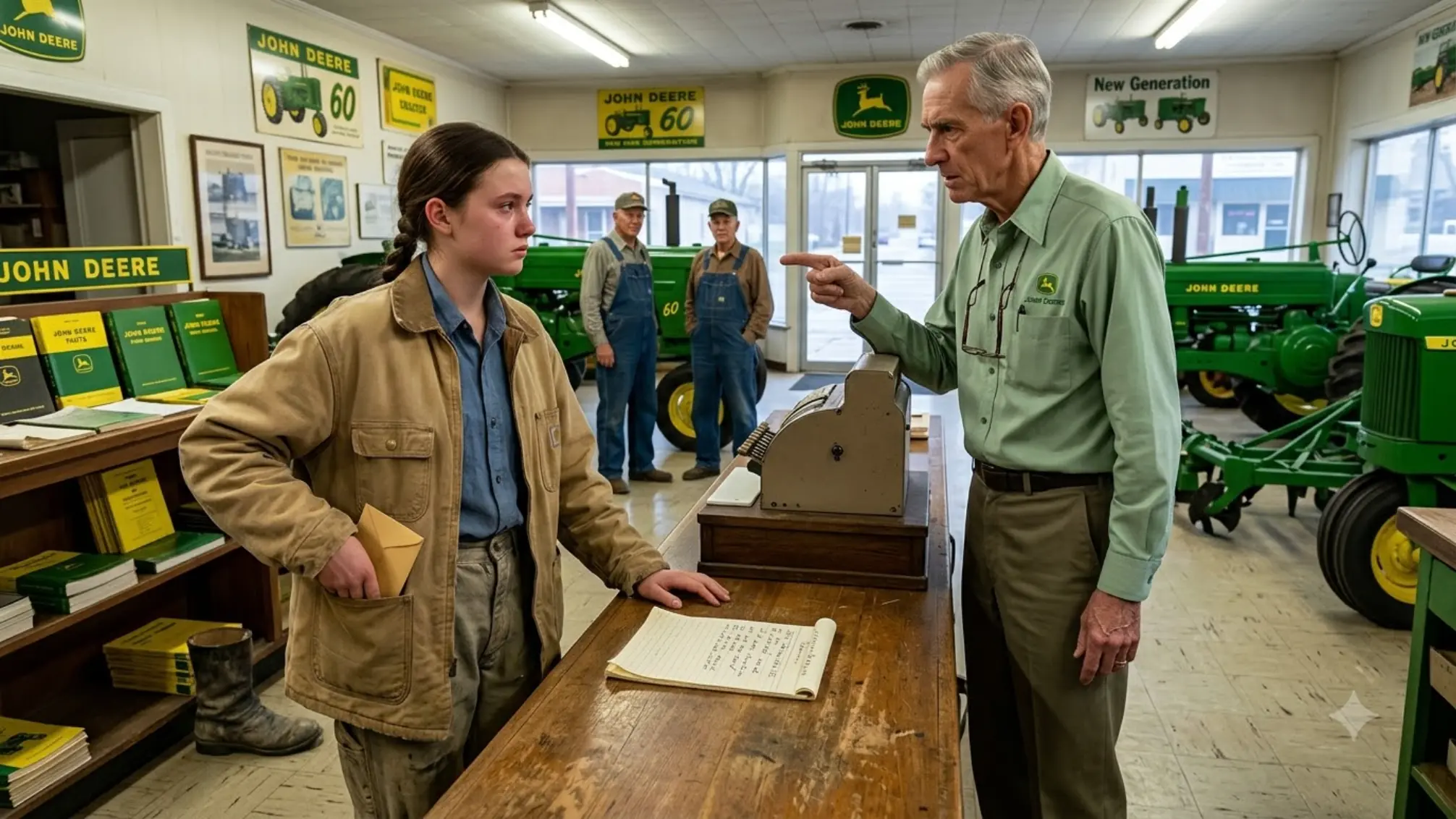
Silas’s expression changed. “Who told you that?” Hattie looked directly into the sixty-two-year-old dealer’s eyes and answered without blinking. “My dead father. Now sell me that clutch—or I’ll buy it in the next county.”
Nine days earlier, Hattie had been standing inside the barn at six in the morning when she found her father, Thomas Vance, lying motionless beside their John Deere 60. He was only forty-four, a powerful farmer who had spent more than twenty years working the Vance land outside Lewisburg, Tennessee, and nobody expected his heart to simply stop. The tractor beside him was already split open because Thomas had been replacing its clutch, leaving parts arranged carefully across the dirt floor. By breakfast, fourteen-year-old Hattie understood that her family had lost far more than a husband and father.
Thomas had left behind 160 acres of corn, soybeans, and tobacco, four children, a wife who had never run farm equipment, and a harvest only weeks away. Hattie’s brother Caleb was eleven, her sisters Verna and Clara were eight and five, and there were no uncles or hired men waiting to take over. Her mother Cordelia, whom everyone called Cordy, knew how to stretch flour, preserve vegetables, care for children, and survive hard winters, but she had never balanced a farm ledger or negotiated with a grain elevator. Hattie had worked beside Thomas since she was nine, which suddenly made her the only person in the family who understood how the farm actually operated.
The night before Thomas died, however, something strange had happened. After supper he called Hattie onto the porch and handed her a sealed envelope, telling her to hide it somewhere safe and open it only if something happened to him. Thomas was not sentimental or superstitious, and he normally spoke about next season as though he expected to see twenty more harvests. That evening, though, he looked across the fields and told his daughter something she would remember for the rest of her life.
“If anything happens to me, you keep this farm.” Thomas placed one enormous hand on her shoulder and made her repeat the instruction. Then his voice changed when he mentioned the richest landowner in Marshall County. “Wendell Ashcroft is not your friend.”
At the funeral, Wendell appeared exactly as Thomas had predicted. He wore a perfect suit, polished shoes, and a gold watch chain and approached Cordy with flowers, condolences, and promises that he would help the family with anything they needed. Hattie watched him from across the church hall while remembering her father’s warning. Something about the gentleness in Wendell’s voice frightened her more than open hostility would have.
That afternoon, after the final visitors left, Hattie opened Thomas’s envelope. Inside was a handwritten will giving her operational authority over the farm if Cordy could not manage it, a complete list of family debts, and a two-page letter. One entry on the debt list caught Hattie immediately: a $3,200 seasonal seed and fertilizer loan scheduled to come due December 15. Beneath it, Thomas had written three words: Ashcroft bought it.
Thomas’s letter explained everything. Wendell had been trying to purchase the Vance farm for twelve years because its bottomland held water better than almost any acreage in the county, and combining it with his holdings would give him extraordinary control over the area’s best farmland. Thomas had refused three offers, but in September Wendell told him that he would not live forever and that eventually his widow would have to make a decision. Two weeks later, Thomas discovered that Wendell had quietly acquired his bank loan through a Nashville shell company connected to First National Bank vice president Randall Pierce.
Thomas believed the plan was simple. If Thomas lived until December, he would harvest his crops and repay the note. If he died first, Wendell could demand repayment from a frightened widow and then offer to forgive the debt in exchange for the property. Thomas ended the letter by telling Hattie something nobody else in the county would have believed about a fourteen-year-old girl: You are the one.
The following morning Hattie put on her father’s canvas jacket and boots and drove his 1958 Ford F-100 seven miles into Lewisburg. Her destination was Silas Redfern’s John Deere dealership, where Thomas had ordered a replacement clutch assembly before his death. Silas had known the Vance family for years and had sold Thomas the John Deere 60. Hattie assumed the transaction would be simple: pay twenty-eight dollars, collect the clutch, drive home, repair the tractor.
Instead, Silas refused. He told Hattie that a fourteen-year-old girl could not safely split a tractor, lift a transmission housing, harvest 160 acres, and manage a farm that had challenged full-grown men. He suggested that Cordy contact Wendell Ashcroft, lease the property to him, keep the house, and allow the children to build another life. Silas believed he was being compassionate.
Hattie’s father’s letter changed the room. She read aloud the portion explaining that Wendell had spent twelve years attempting to acquire the farm and had secretly purchased Thomas’s debt. The farmers who had been quietly agreeing with Silas stopped nodding. Silas himself turned pale because he suddenly realized he had advised Thomas Vance’s daughter to trust the very man Thomas feared would take everything from her.
Silas finally wrapped the clutch assembly in brown paper. “I’m going to sell you the part,” he said quietly. Then he admitted something Hattie had not expected from an older man with forty years of business experience. “I was wrong.”
Hattie paid twenty-eight dollars, loaded the clutch into the Ford, and drove home. By 11:12 that morning she was inside the equipment shed with her father’s notebook open beside the John Deere 60. Thomas had trained her to measure before disassembling anything, record every bolt, label washers, and never trust memory during a repair. Hattie followed his methods exactly.
The transmission housing weighed nearly twice what she did. Hattie built a wooden support cradle, blocked the wheels, hung her father’s block-and-tackle system from the rafters, and raised the heavy parts one inch at a time. She worked deep into the night, slept four hours on the couch, woke her siblings for school, packed their lunches, and returned to the tractor. Three days later, on Sunday afternoon, she turned the ignition.
The John Deere coughed once. Black smoke lifted from the exhaust. Then the engine settled into the steady sound Hattie had heard beside her father since childhood.
She eased the newly repaired clutch outward and drove into the yard. Her feet barely reached the pedals even with folded blankets beneath her, but the tractor moved exactly as it should. Hattie drove toward the north cornfield without celebrating. Harvest had already waited too long.
For nineteen days she harvested corn from sunrise until dark. The John Deere’s seat was built for a grown man, forcing Hattie to lean forward for hours just to see properly, while biscuits stuffed inside her jacket became lunch because she refused to stop long enough to walk home. She learned quickly that proving she could run the farm did not mean feeling confident. Years later, she would explain that she doubted herself almost every day.
Halfway through harvest, the corn picker threw a bearing. Hattie sat alone in the stubble for twenty minutes and seriously considered surrendering the farm to Wendell because she had almost no money, rain was coming, and one broken machine could destroy the entire harvest. Then she stood, measured the failed bearing, drove to town, spent $3.60 on a replacement, installed it herself, and finished the row before dark. That decision became her definition of endurance: not believing you would win, just deciding to go back to work.
Neighbors slowly began helping without taking control away from her. Curtis Holloway brought his grain truck and hauled loads to Earl Dawson’s elevator, while Earl quietly paid Hattie four cents above market on every bushel. They did not treat her like a helpless child, which mattered more than charity. They let her remain the farmer while making sure the burden did not kill her.
On November 11, Hattie finished the corn harvest. The crop brought $4,312, and for one brief moment the check looked enormous on Cordy’s kitchen table. Then property taxes, fuel, electricity, seed, livestock feed, and repair debts consumed nearly every dollar. Only afterward did Cordy remember the unopened letter from First National Bank reminding them that $3,200 remained due on December 15.
Hattie went to the bank herself. Randall Pierce kept her waiting forty-five minutes before allowing the fourteen-year-old into his paneled office overlooking Main Street. He told her there would be no extension because the family lacked collateral and Cordy had no independent credit history. Hattie listened until he finished.
Then she asked whether First National had secretly sold Thomas’s loan to Wendell Ashcroft. Randall’s confidence disappeared. When he refused to answer, Hattie asked something worse: if First National no longer owned the loan, why had the foreclosure warning arrived on First National letterhead carrying Randall’s signature?
Randall ordered her from his office. Hattie stood, picked up her purse, and delivered one final warning. She claimed her father had documented the transaction and threatened to take his letter and evidence to state banking authorities if one acre of Vance land disappeared.
Much of it was bluff. Hattie had Thomas’s letter but no transaction records, and she was not even certain which state commission would investigate the scheme. Randall did not know that. Minutes after she left, he telephoned Wendell and told him they had a problem.
The next disaster arrived Thanksgiving week. While reviewing Thomas’s old ledgers, Hattie discovered that carefully harvesting mature timber from forty acres of woodland might raise approximately $2,400 toward the loan. She was still calculating the remaining shortfall when Caleb ran inside shouting that the tobacco barn was burning. By the time Hattie reached the yard, flames were rolling across the roof.
Neighbors and volunteer firefighters saved part of the crop, but much of the barn and tobacco were destroyed. Sheriff Orville Bates examined the ashes afterward and found gasoline along the sill plate. Somebody had deliberately started the fire.
After midnight, a black Cadillac rolled onto the farm. Wendell Ashcroft stepped out wearing a camel-colored overcoat and announced that he had heard about the tragedy. He offered again to forgive the $3,200 loan if Cordy signed over the farm while retaining the house for a dollar a year.
Hattie told him she knew he already owned the note. Wendell’s friendly expression briefly disappeared. He told her that the farm would eventually defeat a child and that she would return to him when she became desperate enough.
She ordered him off the property. Wendell left, but not before making clear that time was his greatest weapon. Hattie watched his Cadillac disappear while the remains of the tobacco barn still smoldered behind her.
The following morning Silas Redfern arrived carrying filters, belts, oil, a battery, a fuel pump, and other tractor supplies. Hattie initially refused because she did not want charity. Silas sat beside her on the porch and finally explained why he had told her to abandon farming.
Twenty years earlier, Silas’s fifteen-year-old son Matthias had been killed beneath a tractor. Since that day Silas had turned away young people who tried to farm after losing parents because seeing teenagers around machinery awakened the worst memory of his life. He had told himself he was protecting them, but Hattie made him understand that fear had been making his decisions.
“I’m going to be here now if you’ll have me,” Silas told her. Hattie explained that she had thirty-one days, only part of the money, and a burned barn. Silas listened carefully. Then he promised to make telephone calls.
On Sunday night, fourteen farmers gathered inside the Marshall County Grange Hall. Silas explained the loan, Thomas’s letter, the secret purchase, and the suspicious barn fire. One farmer pledged three hundred dollars, another two hundred, another one hundred and fifty, and eventually the room promised $3,400.
Hattie initially refused. She would not accept money she could not repay. Silas responded by creating the Marshall County Farmers Fund on the spot: a zero-interest community loan payable whenever Hattie could afford it. Hattie finally stood and promised she would repay every person in the room.
On December 2, Silas, Hattie, Curtis, Earl, and a group of farmers walked together into First National Bank carrying envelopes. Randall Pierce could not turn away fourteen customers carrying enough money to satisfy the note in full. Silas demanded the lien release and the original note bearing Thomas Vance’s signature. Randall wrote PAID IN FULL — DECEMBER 2, 1963 across it while the farmers watched.
Hattie folded the note and placed it inside her father’s jacket beside his letter. The farm was safe. Wendell could no longer use the debt to take the Vance bottomland.
What began that autumn did not end with one harvest. Hattie finished school while continuing to farm, repaid the entire community fund with interest by 1969, and gradually expanded the operation without relying heavily on debt. She bought additional acreage whenever she could afford to pay cash, eventually building the Vance farm to hundreds of acres while farmers throughout Tennessee collapsed beneath crushing interest during the agricultural crisis of the 1980s.
Wendell eventually lost much of his own empire. Years later, old, broke, and nearly alone, he came to Hattie asking for farm work because nobody else would hire him. Hattie gave him the job rather than humiliating him.
On the final day of his employment, Wendell admitted the darkest truth from 1963. He had not personally burned the Vance tobacco barn, but he had paid another man twenty dollars to do it. He told Hattie he did not deserve forgiveness and only wanted Thomas Vance’s daughter to hear him finally confess.
Hattie never forgot what Silas had done either. When he retired, she returned the original paid bank note to him as proof of what twenty-three telephone calls had saved. Silas cried while admitting that telling her to go home had been one of the greatest mistakes of his life.
Hattie answered that taking those words back mattered more than saying them. Her father had given her the farm. Silas and the farming community had helped her keep it. She had eventually learned that determination and accepting help were not opposites.
That lesson became the foundation of the Thomas Vance Mentorship program. Beginning in 1990, Hattie paired young people who inherited farms after losing parents with experienced farmers who could guide them without taking their land or authority away. Over the following decades, dozens of young farmers received the kind of help Hattie had desperately needed in 1963.
By 2006, Hattie Vance stood at the Tennessee State Fairgrounds accepting one of the state’s highest farming honors. Her operation had grown to roughly 740 acres, carried no debt, and had earned exceptional soil-quality recognition for years. When the presenter mentioned that she had begun running the farm alone at fourteen, the room went silent.
Hattie never forgot the dealership counter, her father’s oversized boots, or the clutch assembly wrapped in brown paper. She kept Thomas’s letter, Silas’s later letter, and the old paid bank note as reminders of three different kinds of inheritance: land, courage, and help offered at the moment pride could no longer carry everything alone. The John Deere 60 remained in the equipment shed decades later, still connected to the fourteen-year-old girl who had once climbed onto its seat because there was nobody else available to harvest the corn.
People often remembered Hattie as the girl who proved every adult wrong. She never described her life that way. She believed Silas had been wrong to tell her she could not farm, but she also believed his willingness to admit the mistake and stand beside her afterward helped save the Vance land.
The boots Thomas left behind never truly fit fourteen-year-old Hattie. They were too long, too heavy, and stuffed with newspaper because her feet could not fill them. Yet she wore them into the dealership, into the equipment shed, across the fields, and through a season no child should have been forced to carry.
Years later, the boots still sat on a shelf. The newspaper remained stuffed inside the toes. Hattie never threw them away.
Because eventually she understood that the story was never about waiting until the boots fit.
It was about putting them on anyway.