Inside the polished service lobby of Kearney Implement, green-and-yellow John Deere tractors gleamed beneath bright showroom lights while Warren Dill stood chest-to-chest with service manager Derek Paulson. Warren’s dark farm jacket still carried dust from his Nebraska fields, and his grease-stained hand gripped a thick manila envelope containing every document Derek wanted hidden. Three angry farmers crowded behind him with their own service invoices, while mechanics and salesmen watched from across the glass counter. The confrontation had begun with one supposedly ruined Massey Ferguson tractor and a repair estimate large enough to bankrupt a smaller farm.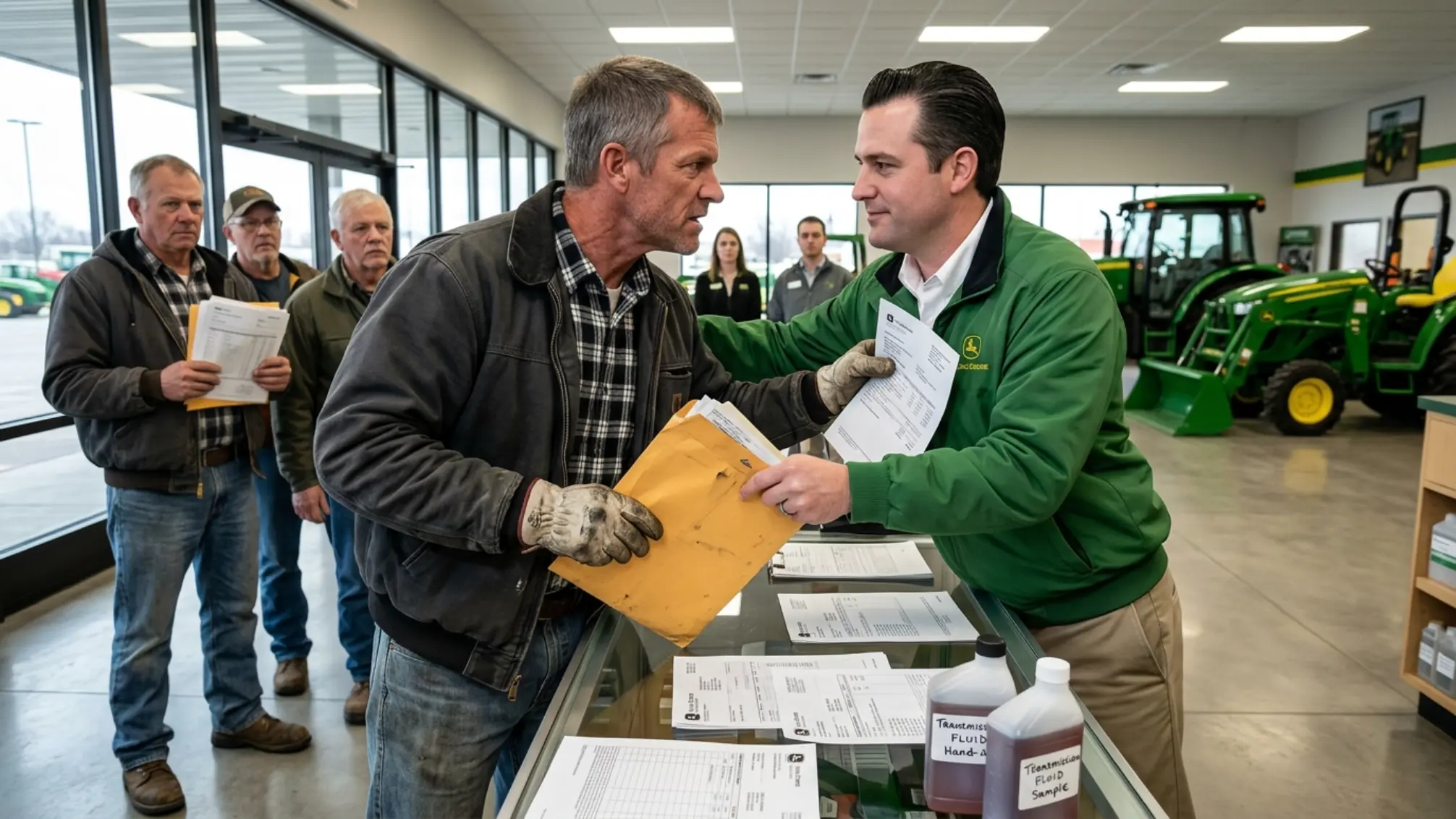
Derek stopped reaching.
The anger remained on his face, but something more revealing appeared beneath it. He recognized the envelope. Warren saw it in the sudden tightening around the man’s eyes and the way his shoulders shifted as though preparing to block the counter.
Behind Warren, Ed Colby laid three service invoices beside the dealership’s estimate. Carl Bricker added another file, thicker than the rest, containing the bill for an eighteen-thousand-dollar transmission rebuild completed eight months after routine service at Kearney Implement.
The papers covered the glass like evidence in a courtroom.
“Call the owner,” Ed said.
Derek straightened his green dealership jacket. “You men are creating a disturbance.”
“No,” Warren replied. “We’re creating a record.”
The story had begun four months earlier on a freezing February morning in 2007. Warren was forty-four then, a second-generation farmer working eleven hundred acres of corn and soybeans outside Elm Creek, Nebraska. He had gone to an equipment auction claiming he intended only to look.
His wife, Carol, knew better.
Warren had never attended an auction without studying every machine as though it might follow him home. He walked the rows with his hands in his jacket pockets, examining hydraulic hoses, tires, engine blocks, welds, and wear patterns other buyers ignored.
Near the end of the sale, a 1998 Massey Ferguson 8270 rolled across the auction block.
The tractor looked too good to be there. Its red paint remained bright, the cab glass was intact, the tires showed moderate wear, and the hour meter displayed only forty-two hundred hours. A machine like that should have attracted several serious bidders.
Then the auctioneer announced the problem.
“Transmission failure. Sold as is. No warranty.”
The opening bid started at eighteen thousand dollars.
Nobody raised a hand.
The auctioneer dropped to fifteen, then twelve. One bidder near the front finally lifted his card. Warren watched the man’s posture, the way he bid without enthusiasm, and the nervous glances he exchanged with someone wearing a dealership jacket.
At thirteen thousand dollars, Warren entered.
The other bidder immediately dropped out.
“Sold to bidder two-forty-seven.”
Including the buyer’s premium, Warren paid fourteen thousand forty dollars for a tractor the dealership had already declared too expensive to repair.
He was folding the receipt when Derek approached.
“You bought that 8270?”
“I did.”
“You know what’s wrong with it?”
“Transmission failure, according to the auctioneer.”
“According to our diagnostics,” Derek corrected. “We quoted the previous owner twenty-two thousand dollars for a complete rebuild. He decided to sell.”
Warren looked through the office window toward the tractor.
“Twenty-two thousand?”
“It’s a complicated continuously variable transmission. Specialized parts, dealer tools, trained technicians. You won’t fix it in a farm shed.”
“We’ll see.”
Derek smiled without warmth. “When you figure out you’re in over your head, bring it back. We’ll do the work.”
Warren placed the receipt inside his wallet and walked away.
The Massey Ferguson arrived at his farm that afternoon on a flatbed trailer. Carol stood near the machine shed with her arms folded while Warren backed it inside.
“You said you were looking.”
“I found something.”
“You found a fourteen-thousand-dollar tractor that cannot move.”
“That is one way to describe it.”
“What is the other way?”
“A tractor worth fifty thousand dollars after I make it move.”
Carol stared at him for several seconds. “You had better be right.”
“I usually am.”
“You’re memorable when you aren’t.”
Warren began testing the tractor three days later.
The diesel engine started normally. Oil pressure remained steady, the temperature rose gradually, and nothing inside the engine sounded damaged. Yet when he selected forward or reverse, the tractor remained motionless.
He checked external hydraulic lines and found no leaks. The transmission control solenoids clicked when supplied with power. Linkages moved, electrical connections appeared intact, and no broken shaft protruded from the housing.
Then he drained the transmission.
The fluid poured out almost black.
It smelled burnt and carried a metallic shimmer beneath the shop lights. When Warren removed the filter, he found it packed with friction material and fine particles.
The condition looked serious, but not catastrophic.
A destroyed transmission usually left chunks of gear teeth, broken bearings, or obvious structural damage in the oil pan. Warren found wear debris, contamination, and a system that had clearly been operated far too long with fluid unable to protect it.
He spent two days removing the CVT assembly.
Each section was photographed, labeled, and placed in order across his workbench. The drive chain had stretched but remained intact. The variator surfaces showed wear but no deep damage. The clutch packs were tired, yet none had disintegrated.
The twenty-two-thousand-dollar failure refused to appear.
Warren kept looking.
He removed the input-speed sensor and found its magnetic tip buried beneath metallic debris. A multimeter showed no signal. Without that sensor, the transmission computer believed the input shaft was stationary and refused to engage the drive system.
The sensor cost thirty-eight dollars.
Warren ordered it alongside fresh filters, approved transmission fluid, seals, and several worn clutch plates. The total parts bill came to eight hundred forty dollars.
For four days, he cleaned every passage, measured every surface, replaced damaged components, and reassembled the system. He worked slowly because mistakes inside a CVT could turn an inexpensive repair into the disaster the dealership predicted.
On February twenty-third, he filled the transmission with the correct fluid.
Carol stood outside the shed as Warren climbed into the cab. He started the engine, allowed the oil to warm, and moved the control lever forward.
The Massey rolled across the floor.
He stopped, selected reverse, and backed toward the door. Then he tested every range, driving around the farmyard while the transmission responded smoothly.
Carol waited until he climbed down.
“How much?”
“Eight hundred forty in parts.”
“And the dealer wanted twenty-two thousand?”
“Yes.”
She looked at the tractor, then at her husband. “You are going to be impossible to live with for at least a month.”
Warren smiled. “Maybe two.”
The victory should have ended there.
Instead, one detail bothered him.
Wrong fluid could explain the damage. But why had anyone used it in the first place?
Warren searched the cab more carefully. He checked storage compartments, behind the seat, beneath the dashboard, and under the floor mat.
A folded manila envelope was wedged between the floor panel and the firewall.
Inside were six service records from Kearney Implement covering June 2005 through December 2006. Three documented transmission-fluid changes.
Every one listed the same product:
Universal tractor hydraulic fluid.
Warren retrieved the Massey Ferguson operator’s manual and opened the transmission section.
The warning was unmistakable.
Use only approved Fendt-specification transmission fluid. Do not use universal hydraulic fluid.
He read the service invoices again.
Kearney Implement had placed the wrong fluid in the tractor three times within eighteen months. The fluid degraded lubrication, damaged the clutch surfaces, contaminated the filter, and eventually killed the input-speed sensor.
The dealership had caused the failure.
Then it quoted the owner twenty-two thousand dollars to repair its own damage.
Warren placed the documents back inside the envelope and locked them in his filing cabinet.
He did not call Derek.
He did not contact the previous owner.
He simply used the tractor.
That spring, the Massey pulled a sixteen-row planter across six hundred acres. The transmission operated flawlessly through changing speeds and field conditions. Warren finished planting on schedule, using a tractor everyone else believed was destined for scrap.
The story began spreading at the local cooperative.
Ed Colby first noticed the Massey while Warren was fueling it.
“Is that the bad-transmission tractor from the auction?”
“It was.”
“What did it cost to fix?”
“Eight hundred forty dollars.”
Ed laughed, believing Warren was joking.
Warren did not laugh back.
“What was wrong?”
“Contaminated transmission, damaged sensor, worn clutch plates.”
“And the contamination?”
“The dealer serviced it with universal hydraulic fluid.”
Ed’s expression changed.
“Kearney?”
“The records say Kearney.”
Ed farmed eighteen hundred acres and had used the same dealership for twelve years. Three of his tractors had received transmission services there.
“What did they put in mine?”
“You would have to ask them.”
Ed asked.
The service department promised to review his files and call him. Three days passed. Then a week. When no documentation arrived, Ed drove to the dealership.
Derek told him manufacturer-approved fluids were used in every application.
Ed requested written proof.
Under pressure, the dealership released his historical invoices.
Each transmission service listed universal hydraulic fluid.
Ed contacted two neighboring farmers. Their documents showed the same practice.
By the middle of June, the three men entered the dealership together and demanded a meeting with owner Gregory Stoll. They carried manuals, invoices, and manufacturer specifications proving that the dealership had ignored required fluids across multiple brands.
Derek stood in the owner’s doorway while Ed explained the pattern.
Gregory examined the records. “Universal fluid works in most agricultural machines.”
“Most isn’t all,” Ed replied.
Derek crossed his arms. “We use what is cost-effective.”
“For you,” Carl Bricker said. “Not for the customer whose transmission fails.”
Warren had not attended that first meeting. He knew the records existed, but he preferred repairing machinery to arguing inside offices. That changed when Gregory offered only free fluid replacements while refusing to acknowledge possible damage.
Ed called Warren that evening.
“They think changing the fluid now erases everything.”
“It does not.”
“Carl paid eighteen thousand for a rebuild after they serviced his Case tractor with the wrong fluid.”
“Then Carl needs a lawyer.”
“He found one.”
The lawsuit was filed in September.
Carl alleged negligent service, improper fluid use, and failure to disclose that the dealership’s own procedures caused his transmission damage. His attorney requested copies of Warren’s hidden service records because they demonstrated that the problem extended beyond one machine.
Warren provided them.
Kearney Implement settled before trial.
The amount remained confidential, but the filing itself became public. Farmers across the county began pulling their own records. Twelve discovered universal fluid documented in systems requiring manufacturer-specific products.
Some demanded free corrective service.
Others left permanently.
By January 2008, eighteen regular customers had transferred their equipment work elsewhere.
Derek blamed Warren.
He claimed one stubborn farmer had turned an ordinary service disagreement into a coordinated attack against a local business.
That accusation led to the confrontation in the John Deere showroom.
Derek had summoned Warren after learning that copies of the Massey records were circulating among customers. He demanded Warren stop spreading what he called “incomplete technical information.”
Warren arrived carrying the original envelope.
Ed, Carl, and several other farmers came with him.
Now they stood around the glass counter while sales employees watched and Derek’s face burned with humiliation.
“You bought that tractor as is,” Derek said. “Whatever happened before the auction is no longer our responsibility.”
Warren tapped the service records.
“Your technician used the wrong fluid three times.”
“That does not prove causation.”
“It damaged the clutch material, clogged the filter, and killed the sensor.”
“You’re not a certified Massey technician.”
“No. I’m the farmer who repaired what your certified technicians said required twenty-two thousand dollars.”
Derek leaned across the counter.
“You think one successful repair makes you smarter than an entire service department?”
“No. Your invoices do.”
The dealership owner entered the lobby.
Gregory Stoll looked older than when the farmers had met him months earlier. Complaints, lawsuits, and lost customers had begun reshaping his business.
“What is happening?”
Derek pointed at Warren. “He is threatening the dealership with stolen records.”
“They were inside the tractor I purchased.”
“They’re confidential.”
“They document work performed on the machine.”
Gregory looked at the twelve farmers crowding the showroom.
Ed placed his hands on the counter.
“We want inspections on every tractor your shop serviced with the wrong fluid. If there is damage, you pay for it.”
“We cannot accept liability without proof.”
Carl slid his settlement paperwork forward. “You already accepted enough liability to pay me.”
“That agreement was not an admission.”
“No,” Carl replied. “It was a payment made because you didn’t want a jury reading these invoices.”
Derek reached toward Warren’s envelope again.
Warren stepped forward so quickly that the manager struck the counter with his hip.
“Try it,” Warren said quietly.
The room froze.
Warren did not raise a fist. He did not need to.
“You told me I couldn’t repair that tractor,” he continued. “You mocked me at the auction because you expected it back in your shop. But the machine wasn’t unrepairable. It was damaged by your shortcuts.”
Derek’s hands lowered.
“And now,” Warren said, “every farmer in this room knows what those shortcuts cost.”
Gregory ordered the employees to close the customer entrance.
Then he asked everyone to enter the conference room.
The meeting lasted nearly three hours. The farmers presented invoices, manuals, repair histories, and laboratory fluid reports. Gregory’s attorney joined by telephone and advised him to stop denying the obvious.
By evening, Gregory agreed to an independent audit.
Massey Ferguson sent a regional representative. Other manufacturers requested their own service records. The investigation found inadequate technician training, missing documentation, and repeated substitution of cheaper universal fluid in machines requiring specialized formulations.
Derek had ordered the practice to reduce inventory costs.
Using one bulk product was cheaper than stocking multiple manufacturer-approved fluids. The savings appeared inside the dealership’s monthly operating reports.
The damage appeared months later inside customers’ transmissions.
Derek was fired in February 2008.
Gregory issued a carefully worded statement promising improved procedures but never gave customers the apology they wanted. Trust continued collapsing.
The service department closed in 2011.
The dealership later lost its Massey Ferguson and Case IH franchises before shutting down entirely in 2015. Its showroom became an agricultural supply warehouse selling seed, chemicals, and fertilizer.
The polished counter where Derek confronted Warren was removed.
The Massey Ferguson 8270 remained on the farm.
By 2010, it had passed sixty-four hundred hours. Warren replaced an air-conditioning compressor and rebuilt a hydraulic pump, both ordinary wear repairs. The supposedly ruined transmission required only routine fluid and filter changes.
One autumn afternoon in 2009, a pickup stopped near Warren’s cornfield.
A former Kearney technician named Ron Tetrick stepped out. The service invoices identified the mechanic only as M. Hendrix, his middle name and surname.
“I serviced your tractor,” Ron admitted. “Derek told us to use universal fluid on everything.”
“You knew the manufacturer required something different?”
“I told him. He said customers would never know.”
“You still poured it in.”
Ron lowered his eyes. “I needed the job.”
Warren studied him.
“My tractor failed because of what you did.”
“I know.”
“And somebody else paid the price.”
“I know that too.”
Ron expected anger.
Instead, Warren asked, “Where do you work now?”
“A Case dealership in Grand Island.”
“They use the correct fluid?”
“Every time.”
“Then make sure the young technicians understand why.”
Ron nodded. “I will.”
They shook hands before he left.
Years passed.
Warren’s son, Travis, joined the farm and preferred newer John Deere equipment. Yet whenever a second tractor was needed during planting or harvest, he climbed into the Massey.
The 8270 accumulated ninety-seven hundred hours.
Its transmission continued working.
At a regional farm show in 2021, a Massey Ferguson service trainer approached Warren and said his tractor had become a case study. New technicians heard about a Nebraska farmer who repaired a supposedly dead transmission and uncovered years of improper dealership service.
“You changed how people are trained,” the representative said.
Warren shook his head. “I wanted my tractor to move.”
“You proved specifications matter.”
“I proved farmers should look for themselves.”
The man smiled. “Sometimes that is the same lesson.”
Warren still keeps the manila envelope inside his farmhouse filing cabinet. Every winter, while organizing receipts and tax documents, he takes it out and reads the six service records again.
Not because he remains angry.
Because the pages remind him of a truth dealerships sometimes hope customers forget.
“Unrepairable” does not always mean a machine cannot be fixed.
Sometimes it means the repair is not profitable enough.
Sometimes it means someone does not want questions asked.
And sometimes it means the person handing over the estimate is counting on a farmer trusting polished counters, branded jackets, and confident voices more than his own eyes.
Derek had stood inside a showroom full of expensive machines and believed authority belonged to the man wearing the dealership logo.
Warren arrived in dirty boots carrying an envelope.
Only one of them had proof.