October came down hard on Albany County, Wyoming, in 1961.
The mornings carried frost, the afternoons carried wind, and the grass on the east slope of the Laramie Mountains had already turned the color of old rope.
Del Hooper stood in front of his red barn before sunrise, one hand on the gate, staring at the cattle moving slowly in the gray light.
For thirty years, those animals had been his work, his worry, his pride, and the only proof that his father’s life had not vanished from the land.
Del was sixty-seven years old, though he looked older on bad mornings.
His hands were cracked from weather and wire, his back leaned slightly from decades of loading feed, and his face had the permanent squint of a man who had spent too many seasons looking into wind.
He had run cattle on that ground since 1931, the year his father, Ray Hooper, died and left him a grazing lease, a rough house, and two hundred dollars hidden in a coffee tin beneath the kitchen floorboards.
Del had taken that small inheritance and turned it into a life, not a rich one, but an honest one.
The Hooper place was not deeded land, and Del had always known that truth sat under him like a loose board.
His father had taken a grazing lease in 1919 when there was nothing else available, then built a house, a barn, two stock pens, and a calving shed with lumber hauled from Laramie.
He dug the well by hand, forty-eight feet down, and Del still remembered being a boy watching his father climb out of that hole covered in mud and grinning like a king.
That well was still producing in 1961, and every time Del filled the stock tank, he felt as if his father was still keeping a promise.
Then the letter came from Denver.
A land development company had filed a legal claim that crossed the southern boundary of Del’s grazing lease, and the company was within its rights.
There were words in the letter like expansion, survey correction, and access corridor, but Del knew what they meant without needing a lawyer to explain it twice.
They meant his cattle had nowhere to go.
He drove into Laramie three times trying to fight it.
The county clerk was polite, the land office man was tired, and the lawyer Del paid twenty-five dollars to speak with told him the company had done everything cleanly.
That word, cleanly, stayed with Del because there was nothing clean about taking grass from cattle before winter.
But the law did not care about what a man had worked, only what a man could prove on paper.
By the end of the month, Del had made the decision he had been avoiding.
He would take the herd to the sale barn and sell what his father had started.
Two hundred head, most of them strong mountain cattle, some older, some young, all raised on hard grass and colder wind than lowland men understood.
Del told himself selling was only business, but when he loaded the first group into the trailer, his hands shook against the gate chain.
The sale barn outside Laramie was already crowded when Del arrived.
Trucks lined the muddy yard, men leaned against rails with coffee in paper cups, and the air smelled of hay, damp wool coats, manure, and old money waiting to become new ownership.
Del had been there many times before, usually to buy a bull or watch prices, but never like this.
This time, every animal that stepped through the ring felt like a piece of his life being priced by strangers.
A few buyers recognized him.
Some nodded with respect, but others looked at him with the kind of pity that made Del wish they had ignored him instead.
One man from Cheyenne asked if the rumors were true, if the Denver company had cut him off from the southern grass.
Del only said, “That’s what the letter says,” because he did not trust himself to say more.
The auction started midmorning.
Calves went first, then smaller lots, then a group of rough cattle from a ranch farther west.
Del stood near the rail, hat in both hands, while the sound of bidding rose and fell around him.
The auctioneer’s voice moved fast, but to Del it all sounded distant, as if he were listening from underwater.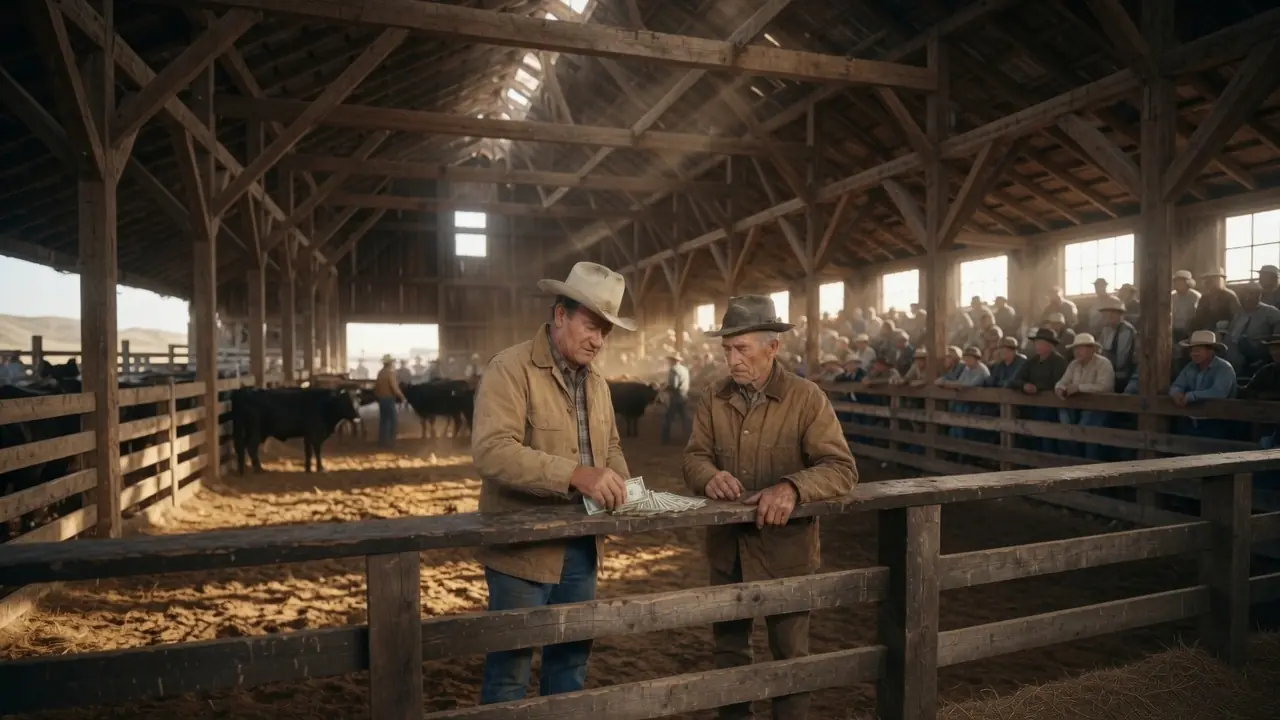
When the first of Del’s cattle entered the ring, a murmur moved through the barn.
They were not polished show animals, but they were solid, deep-chested, and raised to survive Wyoming.
Del knew every bloodline, every scar, every stubborn cow that could find water in a dry draw before a man thought to look.
To a stranger, they were a lot number; to Del, they were memory on hooves.
The bidding came in low.
Too low.
Del’s jaw tightened as the auctioneer worked the crowd, trying to pull the price upward, but several buyers only smiled and waited.
They knew Del had to sell, and a desperate man’s cattle always looked cheaper to those who came with cash.
One buyer in a tan jacket leaned on the rail near Del and chuckled.
“Old mountain stock,” he said loudly enough for others to hear.
“Hard on feed, hard on fences, and not worth saving if the old man’s losing his grass anyway.”
A few men laughed, not all of them cruel, but enough to make the sound cut.
Del kept his eyes on the ring.
He had learned long ago that a man could lose money and still keep his dignity if he did not answer every fool.
But his ears burned, and his fingers crushed the brim of his hat.
Thirty years of work had been reduced to a joke at the rail.
Then the side door opened.
At first, no one paid much attention because men came and went all morning in a sale barn.
But the sound changed slowly, the way a room changes when weather shifts outside.
Heads turned, voices dropped, and even the auctioneer stumbled half a beat before catching his rhythm again.
A tall man in a worn cowboy hat and tan ranch jacket stepped inside, broad-shouldered, straight-backed, and unmistakable.
John Wayne had walked into the Wyoming sale barn.
There were no cameras with him, no studio men, no bright Hollywood smile offered for the room.
He moved like a man who did not need to announce himself because the room had already done it for him.
His boots carried mud from outside, and his eyes moved across the pens, the buyers, the rail, and finally settled on Del Hooper.
Del stared, unsure whether age and sorrow had finally started playing tricks on him.
John Wayne was known across America, but in that barn he did not look like a moving picture.
He looked like a big ranch man who understood bad weather, short money, and the silence of someone trying not to break in public.
For several seconds, Del could not move.
The buyer in the tan jacket recovered first.
“Well, boys,” he said with a grin, “looks like we got ourselves company.”
John Wayne did not answer him.
He walked to the rail, took off his gloves, and looked into the ring where Del’s cattle waited under the dust-filled light.
The auctioneer cleared his throat and continued.
The bid stayed low, insultingly low, the kind of number that said everyone in the room knew Del had no pasture left.
The buyer in the tan jacket lifted two fingers, then lowered his hand with a satisfied smirk.
Del felt the finality of it settle on his shoulders.
John Wayne turned his head slightly.
“These your cattle?” he asked.
Del swallowed, then nodded.
“Yes, sir. Mine and my father’s before me, in a manner of speaking.”
Wayne looked back at the herd.
“They look like they know bad ground.”
Del gave a short, painful smile.
“They were raised on it.”
The buyer laughed again.
“Raised on bad ground, selling on worse luck.”
This time, Wayne turned fully toward him.
The room went quieter than before, not because he shouted, but because he did not.
The buyer straightened a little.
“I only mean they ain’t worth pretending over,” he said.
“Old man’s got no grass. Everybody knows it.”
Del looked down at his hat, feeling the words hit exactly where the man intended.
Before he could speak, John Wayne reached into his jacket pocket.
He pulled out a roll of cash.
Not slowly for show, but plainly, like a man settling a bill that should have been paid already.
He stepped to the wooden rail beside Del and laid the first bill flat.
“One hundred,” he said.
The auctioneer stopped.
The buyer’s smile faded.
Wayne laid down another bill, his voice firm enough to carry through the barn.
“Two hundred.”
No one spoke.
Even the cattle seemed quieter in the ring.
Wayne placed another bill on the rail.
“Three hundred.”
Del looked from the cash to Wayne’s face.
“Mr. Wayne,” he said under his breath, “you don’t need to do this.”
Wayne did not look at him yet.
“Four hundred,” he continued.
The buyer in the tan jacket shifted his weight.
“You paying real money for old mountain stock?”
Wayne laid down another bill.
“Five hundred.”
Then he looked at the man and said, “I’m paying real money because cheap men are trying to buy a lifetime for nothing.”
The room went still.
Del felt something rise in his chest so suddenly he had to look away.
He had not expected rescue, and he had not asked for charity.
But this did not feel like charity in the way he feared.
It felt like someone had placed a hand under his dignity before it could hit the ground.
Wayne kept counting.
“Six hundred. Seven hundred. Eight hundred.”
Each bill landed on the rail with a soft slap.
The sound became louder than the auctioneer, louder than the shifting cattle, louder than the wind against the barn wall.
Men who had laughed now stared at the rail as if the money had accused them personally.
Del’s throat tightened.
“Those cattle won’t bring that much back,” he said quietly.
Wayne finally looked at him.
“Maybe not today.”
Then he put down another bill. “Nine hundred.”
The buyer’s face reddened.
“This is foolishness,” he muttered.
Wayne did not raise his voice.
“No. Foolishness is thinking a rancher’s trouble gives you permission to insult his life.”
Then he counted again. “One thousand.”
A long breath moved through the barn.
The auctioneer slowly lowered his papers, understanding that the ordinary sale had become something else.
Del stood frozen with his hat in his hands, old fingers pressing into felt worn smooth from years of use.
He thought of his father digging the well, his mother hanging laundry in wind so strong the sheets cracked like flags, and himself at nineteen promising he would keep the place going.
Wayne counted faster now.
“Eleven hundred. Twelve hundred. Thirteen hundred.”
The buyer stepped back from the rail, no longer smiling.
Other men watched without daring to interrupt.
The barn had turned into a courtroom without a judge, and every bill was testimony.
“Fourteen hundred. Fifteen hundred. Sixteen hundred.”
Del felt his eyes sting and blamed the dust.
He had not cried when the letter came from Denver.
He had not cried loading the cattle.
But hearing the money counted in public, not to shame him but to honor him, nearly broke what the land company had not.
Wayne continued.
“Seventeen hundred. Eighteen hundred. Nineteen hundred.”
Then he paused, looking directly at the buyer in the tan jacket.
“You still think they’re not worth saving?”
The man said nothing.
“Two thousand,” Wayne said, placing the next bill down.
A murmur finally moved through the crowd, low and stunned.
Del looked around and saw faces changing.
Men who had been waiting to profit from his ruin now looked at him with something closer to respect, or maybe shame.
Wayne counted the last stretch slowly.
“Twenty-one hundred. Twenty-two hundred. Twenty-three hundred.”
He held the next bill for a second, then laid it down.
“Twenty-four hundred.”
Then the final bill. “Twenty-five hundred.”
The cash sat on the rail in a clean stack.
Two thousand five hundred dollars in October 1961 was not just money.
It was winter feed, legal time, debt breathing room, and the difference between a man leaving a barn empty or walking out with his back straight.
Del stared at it like it might disappear if he blinked.
“Mr. Wayne,” Del said, his voice rough, “why would you do this for me?”
Wayne put his gloves back on slowly.
“Because I’ve played enough ranchers to know when I’m standing next to a real one.”
Then his face hardened slightly. “And because a man losing land shouldn’t have to lose his dignity in front of a room full of buyers.”
The auctioneer, to his credit, found his voice.
“We have an offer at twenty-five hundred.”
No one bid against it.
Maybe no one wanted to, or maybe no one dared.
The sale was called, and the sound of the gavel felt less like an ending than a reprieve.
Del did not know what to do with his hands.
Wayne solved it by holding one out.
Del shook it, and the grip was strong, warm, and ordinary in the best possible way.
For one moment, the movie star and the old rancher stood beside the rail not as famous man and desperate man, but as two men who understood land could live inside a person.
After the sale, Wayne walked with Del outside into the cold yard.
A few men followed at a distance, pretending they had business near the trucks.
Del stood by the fence, watching his cattle settle in the holding pens.
“They’ll be treated right?” he asked.
Wayne glanced toward the animals.
“They’ll go to grass I know,” he said.
“Not a feedlot, if that’s what you’re asking.”
Del nodded, and some of the tightness in his face eased.
A man could part with cattle easier if he knew they were not being thrown away.
The wind came off the mountains then, hard enough to lift dust from the yard.
Del pulled his coat tighter.
“I don’t have much left after today,” he admitted.
The words came out before pride could stop them.
Wayne stood beside him, looking toward the gray ridge in the distance.
“You have the house?” Wayne asked.
“For now.”
“The well?”
Del nodded. “Still producing.”
Wayne looked at him then. “Then you have more than nothing.”
Del gave a tired laugh.
“That sounds like something a man says when he isn’t the one standing in it.”
Wayne accepted that without offense.
“Maybe. But I’ve known men who lost less and quit sooner.”
Del looked down at the mud near his boots, not ready to trust encouragement but needing it more than he wanted to admit.
Wayne reached into his pocket and pulled out a card.
“There’s a man I know near Laramie who leases winter pasture some seasons.”
He handed it over.
“Can’t promise anything, but tell him I said to talk straight with you.”
Del took the card carefully, as if it weighed more than paper.
For a long moment, neither man spoke.
The sale barn noise continued behind them, but it sounded different now.
Del no longer felt like the whole world was watching him lose.
He felt like the world had briefly stopped to remember what a rancher was worth.
Wayne put his hat back on.
“I have to get moving.”
Del nodded.
“I won’t forget this.”
Wayne looked toward the barn, then back at him. “Don’t forget yourself either.”
Then he walked away.
No speech, no crowd, no waving for attention.
He climbed into a truck waiting near the side of the yard and left the same way he came, leaving dust, rumor, and a stack of changed opinions behind him.
By sundown, half of Laramie had already heard that John Wayne counted out twenty-five hundred dollars on the rail for Del Hooper’s cattle.
The story grew, as stories do.
Some said Wayne bought the whole herd outright.
Some said he threatened the buyer.
Some said Del cried in the barn, which Del denied every time, though he admitted the dust had been bad that day.
But the true story was strong enough without exaggeration.
Del used the money carefully.
He paid the lawyer for one more round of filings, bought hay, repaired the south porch post he had ignored since 1954, and called the man on the card Wayne had given him.
That call led to a short winter pasture agreement on ground north of Laramie.
It was not enough to restore everything, but it was enough to keep Del from disappearing before spring.
By the following year, Del had fewer cattle, but he still had cattle.
He had lost part of the old lease, but he had not lost the house, the well, or the stubborn habit of waking before sunrise.
He began rebuilding slowly, not as a young man dreams, but as an old rancher survives.
Each repaired fence post felt like an argument against being finished.
People sometimes came by asking about the day in the sale barn.
Del usually shrugged and said, “He paid fair when others wouldn’t.”
But when he was alone, he remembered the exact sound of each bill touching the rail.
One hundred. Two hundred. Three hundred.
Not because of the money alone, but because with every count, the room had been forced to see him.
Years later, when Del’s knees had worsened and his hair had gone fully white, he kept the card John Wayne had given him tucked inside the same coffee tin where his father had hidden the two hundred dollars in 1931.
The ink faded, and the corners softened, but Del never threw it away.
Some objects are not valuable because of what they can buy.
They are valuable because they remind a man of the day he did not break.
The Hooper ranch never became famous.
No studio came to film it, no newspaper wrote the full truth, and no monument rose beside the old well.
The wind still came down off the ridge in the afternoons, the porch still creaked, and the stock tank still filled from the hand-dug well.
But Del Hooper carried himself differently after October 1961.
He had walked into that sale barn expecting to sell the last pieces of his life for whatever men were willing to give.
Instead, a man known across America stepped to the rail and reminded the room that dignity could not be discounted just because hardship had arrived first.
Del still lost ground, still fought bills, still worked cold mornings with sore hands.
But he never again believed that losing land meant losing the man his father had raised him to be.