The courtroom fell silent when Judge Harold Albright pointed at the medals pinned to Fred Hudson’s faded denim jacket and laughed. Fred was eighty-two years old, lean and slightly stooped from age, with thin white hair, a short white beard, and calm gray eyes that never left the judge’s bench. He had come to the Northwood County Courthouse in Washington State expecting to answer for a minor traffic citation, pay whatever fine the court considered appropriate, and drive home before lunch. Instead, a routine hearing had somehow become a public attack on the dignity he had spent most of his life refusing to advertise.
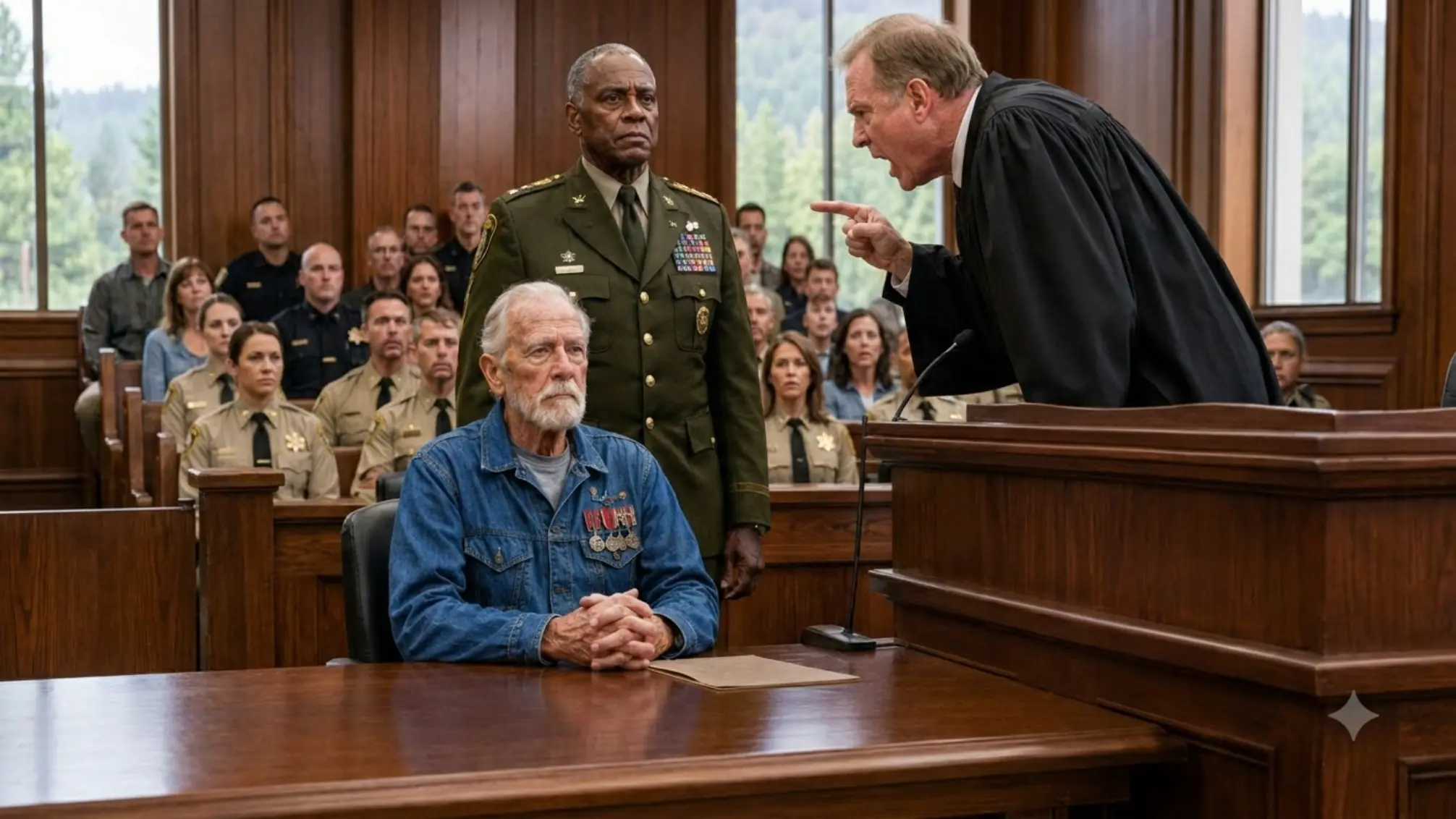
“Are those supposed to be real,” Albright asked, leaning over the bench, “or did you buy yourself a hero costume?” A few people in the gallery shifted uncomfortably, but nobody laughed with him. Fred’s public defender, thirty-one-year-old Sarah Jenkins, immediately rose from her chair and said the decorations had nothing to do with the traffic case. Albright waved her down as though she were an annoying child interrupting something entertaining.
Fred wore four old state law-enforcement commendations above the left pocket of his jacket, along with a small silver shield suspended from a dark blue ribbon. None were bright enough to look new, and the metal on two had dulled from decades of storage. Fred almost never wore them, but that morning he had been scheduled to attend a memorial luncheon for retired investigators after court, and an old friend had convinced him to bring the jacket. He had not imagined the decision would turn a speeding citation into a humiliation.
“Your Honor,” Sarah said firmly, “my client’s record can be verified very easily.” Albright leaned back in his leather chair and smiled. “I’m sure it can, counselor, but perhaps Mr. Hudson would like to tell this court why a man who cannot remember the speed limit is walking around decorated like some legend.” Fred finally lifted his eyes toward the judge. “I remember the speed limit,” he said quietly. “I also remember the road was posted incorrectly near the construction zone.”
Albright’s smile vanished. “So now the county is wrong too?” Fred did not answer. The judge picked up the citation and read aloud that Fred had allegedly been traveling sixty-two miles per hour in a forty-mile-per-hour zone. What he did not mention was that the permanent sign displaying sixty had remained visible while the temporary forty-mile-per-hour sign had fallen face-down behind a barrier after a storm.
Sarah had photographs proving it. She had expected to present them, ask for dismissal, and be finished within ten minutes. Instead, Judge Albright seemed far more interested in Fred’s jacket than the road evidence. “Take those decorations off while you’re standing before me,” he ordered. “This courtroom is not a stage for pretending to be important.”
Sarah stood again. “Your Honor, there is no legal basis for that order.” Albright’s face reddened. “The basis is that I run this courtroom, counselor.” Fred looked down briefly at the silver shield hanging above his heart, then rested his hands calmly on the defense table. “I won’t remove them.”
A murmur traveled through the gallery. Albright leaned forward. “Was that a refusal?” Fred nodded once. “Yes, sir.” Sarah could feel the hearing slipping into something far more dangerous than a traffic dispute.
Judge Albright had been on the Northwood County bench for sixteen years. He had developed a reputation for impatience, especially with older defendants, low-income defendants, and anyone who questioned his authority too carefully. Lawyers complained privately about his sarcasm, but few challenged him because he controlled calendars, sentencing recommendations, and procedural decisions that could make their lives miserable. Fred Hudson had never heard of him before that morning.
Albright tapped his pen against the bench. “Where did you get the medals?” Fred answered, “They were awarded to me.” The judge scoffed. “By whom?” Fred looked at him for several seconds. “The State of Washington.”
Albright laughed once. “That’s convenient.” Sarah felt anger rise through her chest. “Your Honor, I am asking that this line of questioning stop and that we address the actual citation.” Albright turned toward her. “Sit down before I hold you in contempt alongside your client.”
Fred touched Sarah’s sleeve gently before she could respond. “It’s all right.” She looked at him in disbelief. “No, Mr. Hudson, it isn’t.” Fred’s expression remained calm. “I’ve had worse mornings.”
The judge heard him. “I’m sure you have endless stories.” He pointed directly at the silver shield. “What is that supposed to be?” Fred’s eyes lowered for half a second before returning to the bench. “The Governor’s Medal for Public Valor.”
This time the entire room went completely silent. Even Albright seemed briefly uncertain. Then his pride rescued him from caution. “Do you expect this court to believe the governor awarded you the state’s highest civilian public-safety commendation?”
Fred said nothing. Albright continued. “Because that medal is not handed out for writing parking tickets.” Sarah noticed Fred’s right hand tighten slightly against the table, the first sign that the judge’s words had reached somewhere beneath his composure. Still, Fred did not defend himself.
Sarah looked down at the thin case file again. Fred Hudson’s background section was almost empty. Retired. Widowed. No criminal record. Two minor traffic citations over twenty-five years.
The employment box simply read: Former public employee. Sarah suddenly understood that Fred had deliberately avoided listing his career because he did not want special treatment. That humility made Albright’s behavior feel even uglier. She leaned toward Fred and whispered, “Was this from state law enforcement?”
Fred nodded slightly.
“What agency?”
“Different ones over the years.”
“Mr. Hudson, I need something more specific.”
He sighed. “State investigations division, mostly.”
Sarah froze.
That answer did not match the image of a harmless elderly man who had wandered into court in worn boots and an old denim jacket. “Were you an investigator?” she asked. Fred looked toward the gallery as if wishing the question would disappear. “A long time ago.”
Albright struck the bench with his gavel. “Counselor, if you’re finished interviewing your own client during my hearing, perhaps we can continue.” Sarah stood. “Your Honor, I request five minutes to verify my client’s service record.” The judge rolled his eyes. “Denied.”
She stared at him. “On what basis?”
“Because I am not delaying this docket so you can manufacture a story.”
The word manufacture changed Fred’s expression. His shoulders straightened slightly. “She doesn’t manufacture evidence,” he said. Albright looked at him. “And you would know?”
Fred met his eyes. “Yes.”
The answer carried enough weight that Sarah noticed two sheriff’s deputies near the back exchange glances. Albright did not. “Fine,” the judge said. “Since you are refusing to follow a direct instruction, I’m adding a contempt finding and a five-hundred-dollar sanction.”
Sarah stepped forward. “Your Honor, this is outrageous.” Albright raised the gavel again. “One more interruption and you’ll join him.” Fred placed both hands flat on the table. “Judge, you should stop.”
Several people gasped. Albright’s face turned crimson. “Excuse me?” Fred’s voice remained quiet. “You should stop before this becomes something you can’t explain later.”
That was not a threat. Sarah knew it immediately. It sounded more like advice from a man who had watched other people ruin themselves through arrogance. Albright heard only defiance.
“Bailiff,” he snapped, “take Mr. Hudson into custody.”
The bailiff, a broad fifty-year-old named Raymond Cole, hesitated. He had worked inside that courthouse for twenty-two years and had seen hundreds of contempt orders. Something about this one felt wrong. He approached slowly, but before reaching Fred, Sarah stepped between them.
“Your Honor, I am making an emergency request for a recess.” Albright shook his head. “Denied.” Sarah stared at him. “Then I am preserving an objection to the detention, the contempt finding, and the treatment of my client for the record.”
Albright smiled coldly. “Preserve whatever you want.” Sarah turned toward Raymond and whispered, “Give me thirty seconds.” The bailiff glanced toward the judge, then pretended to adjust papers while Sarah pulled out her phone beneath the table.
She searched Fred Hudson’s full name along with Washington State public investigations. The first result made her stop breathing. It was an archived newspaper article from twenty-seven years earlier.
STATE INVESTIGATOR FREDERICK HUDSON LEADS TASK FORCE IN CASCADE CONTRACTING CORRUPTION CASE.
Sarah opened it.
The photograph showed a much younger Fred leaving a courthouse surrounded by reporters. He wore a dark suit, carried three evidence boxes, and looked exactly as he did now except without the beard. The article described a three-year investigation into an organized network of public contractors, county officials, towing companies, and law-enforcement supervisors who had diverted millions of dollars from emergency infrastructure projects.
Sarah scrolled further.
Another article appeared.
HUDSON PULLS TWO WOUNDED TROOPERS FROM BURNING VEHICLE DURING ARMED RAID.
Her stomach tightened.
The article described a warrant service that had turned violent after suspects attempted to destroy records at a remote warehouse. Fred, then fifty-three, had dragged two injured state investigators away from a burning vehicle while rounds struck the pavement around them. He had returned for a third officer before emergency teams arrived.
Sarah looked at the silver shield.
Now she understood.
She sent one text to a number listed beneath an archived contact page for the Washington State Public Safety Commission.
Urgent. Former investigator Frederick Hudson is being detained in Northwood County Court after judge accused his valor medals of being fake. Courtroom C. Please verify.
She expected nothing.
Thirty seconds later, her phone rang.
Sarah stepped into the hallway with Raymond deliberately blocking Albright’s view for several moments. “This is Commissioner Marcus Boone’s office,” a woman said. “Did you send the message regarding Frederick Hudson?”
“Yes.”
“Is he still there?”
“Yes.”
“Do not let him leave.”
Sarah blinked. “The judge is trying to have him detained.”
The woman’s voice changed immediately. “What exactly did the judge say?” Sarah explained as quickly as possible. There was a brief silence on the other end.
“Commissioner Boone is twenty minutes away.”
Sarah nearly dropped the phone. “The commissioner himself?”
“Yes.”
Back inside, Albright was becoming impatient. “Where is counsel?” he demanded. Sarah returned to the defense table before anyone answered.
The judge pointed toward Fred. “I am also concerned that this defendant may be confused about his history and current circumstances.” Sarah stared at him. “Do not do this.”
Albright ignored her. “Given his refusal to comply and his insistence that these decorations are legitimate, I am ordering a competency screening before release.”
That was the moment Sarah stopped trying to remain diplomatic. “Your Honor, you are attempting to label an eighty-two-year-old man incompetent because you refused to verify something that takes thirty seconds to confirm.”
Albright slammed the gavel.
“Bailiff!”
Fred remained seated.
Raymond still did not touch him.
The judge pointed toward him. “Take him now.”
Before Raymond could move, voices sounded in the hallway. The courtroom doors opened, and two state public-safety officers entered first. They wore formal dark uniforms and quietly moved to either side of the entrance.
Everyone turned.
Then Marcus Boone walked inside.
He was sixty-five, tall and broad-shouldered, with deep-brown skin, close-cropped gray hair, and the composed expression of a man who did not need to raise his voice to control a room. His ceremonial state public-safety uniform carried commissioner insignia, a high-ranking badge, and several service ribbons earned over decades in public administration and law enforcement. He did not look at Judge Albright.
He looked only at Fred.
Fred slowly stood.
The commissioner walked down the aisle.
People moved instinctively out of his way.
When he reached the defense table, Boone stopped directly in front of Fred and extended his hand.
“Mr. Hudson.”
Fred smiled faintly. “Marcus.”
Boone took Fred’s hand with both of his. “It’s been too long.”
Albright finally found his voice. “Excuse me. Who are you?”
Boone turned slowly.
The atmosphere changed instantly.
“Marcus Boone,” he said. “Washington State Public Safety Commissioner.”
Albright’s expression froze.
Boone looked toward Sarah. “Counselor, are you representing Mr. Hudson?”
“Yes, Commissioner.”
“I understand the court questioned the authenticity of his state commendations.”
Sarah nodded.
Albright interrupted. “There has clearly been some misunderstanding.”
Fred looked at him.
Sarah almost laughed.
Boone did not.
“A misunderstanding usually begins with incorrect information,” the commissioner said. “What I was told sounds more like you were given several opportunities to verify the truth and refused each one.”
Albright’s face tightened. “Commissioner, I will remind you this is my courtroom.”
Boone nodded. “And I will remind you that nothing about owning the bench gives you ownership of the facts.”
Several people in the gallery looked down to hide their reactions.
Boone opened a thin leather folder.
“Frederick Allen Hudson joined the Washington State Investigations Division in 1968. He served thirty-four years in public integrity, organized fraud, and interagency criminal investigations.”
Fred looked uncomfortable.
Boone continued anyway.
“He led the Cascade Contracting investigation, which resulted in twenty-one convictions involving public corruption, procurement fraud, and evidence manipulation.”
Albright’s face began to pale.
Boone turned one page.
“In 1994, during the Harrow County warehouse operation, three state officers were injured after suspects attempted to destroy evidence and flee. Mr. Hudson entered an active danger zone repeatedly to remove them.”
The commissioner looked directly at the silver shield.
“That decoration you called fake was awarded to him by the governor after two independent reviews and a unanimous state valor commission recommendation.”
The courtroom remained silent.
Boone lifted another page.
“The remaining commendations recognize distinguished investigative service, integrity under threat, and exceptional public protection.”
Albright swallowed.
Boone closed the folder.
“Everything on that jacket is real.”
Fred quietly said, “Marcus, that’s enough.”
Boone looked at him.
Fred’s eyes were tired rather than triumphant.
The commissioner lowered his voice. “He was going to have you detained.”
“I know.”
“He called you delusional.”
“I heard him.”
Boone’s jaw tightened.
Fred placed one hand gently on his arm.
“Don’t turn this into something bigger than it needs to be.”
Boone looked at Albright.
“It already is.”
Sarah stepped forward before the tension rose further. “Commissioner, there is another issue.” She placed the photographs of the road signs on the defense table and explained that the temporary forty-mile-per-hour sign had been down when Fred received the citation.
Boone glanced at the images.
Then at the judge.
Albright suddenly looked very interested in the paperwork.
Sarah continued. “The county road department confirmed the sign was replaced four hours after Mr. Hudson was cited.”
The judge cleared his throat. “That information was not presented to me.”
Sarah stared at him.
“I attempted to present it before you started interrogating my client about his jacket.”
A reporter sitting near the rear of the courtroom raised her pen.
Albright noticed.
The story was no longer controllable.
He looked toward the clerk. “The citation is dismissed.”
Sarah said nothing.
Fred nodded once.
Albright continued. “The contempt finding is withdrawn.”
Boone folded his arms.
“And the competency order?”
“Withdrawn.”
“The fine?”
“Withdrawn.”
Boone stared at him.
Albright’s voice became quieter.
“All orders issued against Mr. Hudson today are vacated.”
Fred picked up his old cap from the table.
He could have walked away.
Instead, he turned toward the bench.
“Judge.”
Albright looked at him.
Fred spoke slowly.
“These medals aren’t why what you did was wrong.”
Albright said nothing.
“You keep looking at them like they changed who I was after the commissioner walked in.”
Fred touched the faded denim near the silver shield.
“They didn’t.”
The gallery listened.
“If these were cheap replicas from a flea market, I’d still be an eighty-two-year-old man standing in front of you.”
Albright lowered his eyes.
“If I had spent my life washing dishes instead of investigating cases, I’d still deserve a fair hearing.”
Sarah felt her throat tighten.
Fred continued.
“You shouldn’t need someone important to walk through those doors before you decide whether the person in front of you deserves respect.”
Boone looked toward Fred.
That was why he had come personally.
Not because Fred needed someone powerful to prove what he had done.
Because Fred had spent decades believing authority mattered only when it served people who did not possess it.
Albright finally spoke.
“Mr. Hudson, I apologize.”
Fred watched him.
The judge seemed to expect acceptance.
Fred did not provide it immediately.
“An apology is a start.”
Albright nodded.
Fred placed the old cap on his head.
“What matters is what you do with the next person who can’t call a commissioner.”
Then Fred walked toward the doors.
The story spread before he reached home.
A local reporter published the courtroom transcript that afternoon, along with confirmation from the state public-safety office that Fred Hudson’s awards were authentic. But the article focused less on the decorations than on his final words to the judge.
Within two days, more than a dozen attorneys contacted the Washington Judicial Conduct Commission about previous incidents involving Albright. Some described sarcastic treatment of elderly defendants. Others produced transcripts showing him threatening contempt when people struggled to understand procedures.
One public defender submitted recordings from three hearings.
A retired clerk provided emails showing staff had repeatedly warned Albright about his conduct.
The investigation widened.
No single comment destroyed his career.
The pattern did.
That mattered to Fred.
He did not want people believing one powerful commissioner could simply walk into court and remove a judge. The process had to work properly.
Witnesses testified.
Transcripts were reviewed.
Former defendants were interviewed.
Albright was given the opportunity to respond.
Months later, the commission concluded he had repeatedly abused courtroom authority, demeaned litigants, and used contempt threats in situations where patience and ordinary procedure would have been sufficient.
He was suspended.
Albright eventually resigned before returning to the bench.
Fred never celebrated.
Sarah visited him one afternoon at the modest house where he had lived for almost forty years. She found him in the garage repairing an old motorcycle with a radio playing quietly beside him.
The denim jacket hung on a hook near the workbench.
The medals were gone.
Sarah pointed toward it.
“Where’d they go?”
Fred tightened a bolt.
“Back in the drawer.”
“You don’t want to display them?”
He shook his head.
“They did their job.”
Sarah smiled.
“I thought their job was commemorating what you did.”
Fred looked toward her.
“No.”
He wiped his hands on a rag.
“Their job that day was teaching one judge something he should’ve already known.”
Months later, Marcus Boone invited Fred to a state public-safety ceremony honoring civilian investigators and retired officers who had worked on corruption cases. Fred refused three times.
Boone eventually stopped asking.
Instead, he drove to Fred’s house with coffee.
The two old friends sat on folding chairs outside the garage.
“You embarrassed me,” Fred said.
Boone laughed.
“You were about to be detained by a judge who thought your medal came from a costume shop.”
“I had Sarah.”
“She’s good.”
“She is.”
Boone took a drink.
“You know what scared me?”
Fred looked over.
“When my office called and said your name, I thought something had happened to you.”
Fred smiled faintly.
“Something did.”
Boone waited.
“I got a speeding ticket.”
They both laughed.
Then Fred became serious.
“Marcus.”
“Yeah?”
“Don’t let people turn that courtroom story into one about me being special.”
Boone understood.
Fred continued.
“If they say the judge was wrong because I used to be somebody, they learned the wrong lesson.”
Boone nodded.
“What should they say?”
Fred looked across the quiet street.
“That he was wrong before he knew my name.”
A year after the hearing, Sarah Jenkins became a senior public defender.
On the wall inside her office hung no photograph of Fred, no newspaper article, and no copy of his commendations.
Instead, she kept one handwritten sentence beneath the glass covering her desk.
The person with the least power in the room is the one procedure is supposed to protect most.
Fred had written it for her.
She read it before difficult hearings.
Across town, Fred still attended Tuesday breakfast with four retired investigators.
Nobody called him a hero.
He preferred it that way.
Sometimes someone at the diner recognized him from the courtroom story and asked whether the commissioner had really walked in wearing his ceremonial uniform.
Fred would nod.
Then they would ask whether Judge Albright’s face truly turned white.
Fred usually smiled.
“People exaggerate.”
His friends knew he was lying about that part.
One morning, a teenage server noticed the small silver pin on Fred’s collar.
“What’s that?”
Fred looked down.
It was a miniature version of the public valor shield.
“Old work thing.”
“Were you a cop?”
“Investigator.”
“Did you catch bad guys?”
Fred smiled.
“Sometimes.”
The teenager waited for more.
Fred opened the menu.
“That’s all you get.”
The server laughed and walked away.
Across the booth, one of Fred’s old colleagues shook his head.
“You’re impossible.”
Fred poured coffee.
“No. I’m hungry.”
Outside, ordinary people moved through an ordinary Washington morning, carrying histories nobody else could see.
Fred understood that better than most.
A judge had once looked at his old jacket and decided he knew the man wearing it.
He had been wrong.
But the deeper mistake was believing Fred needed medals, titles, powerful friends, or an extraordinary past before the court owed him basic dignity.
Marcus Boone’s arrival exposed the truth.
Fred Hudson’s final words explained why it mattered.
And years after the commendations returned to a quiet drawer in an old man’s house, that lesson lasted longer than any piece of metal ever could.