Six o’clock on a Saturday morning.
I was standing in my own driveway wearing slippers and holding a cup of coffee when two police cruisers arrived with their lights flashing.
My neighbor, Denise Kelp, stood on her porch shouting into her phone.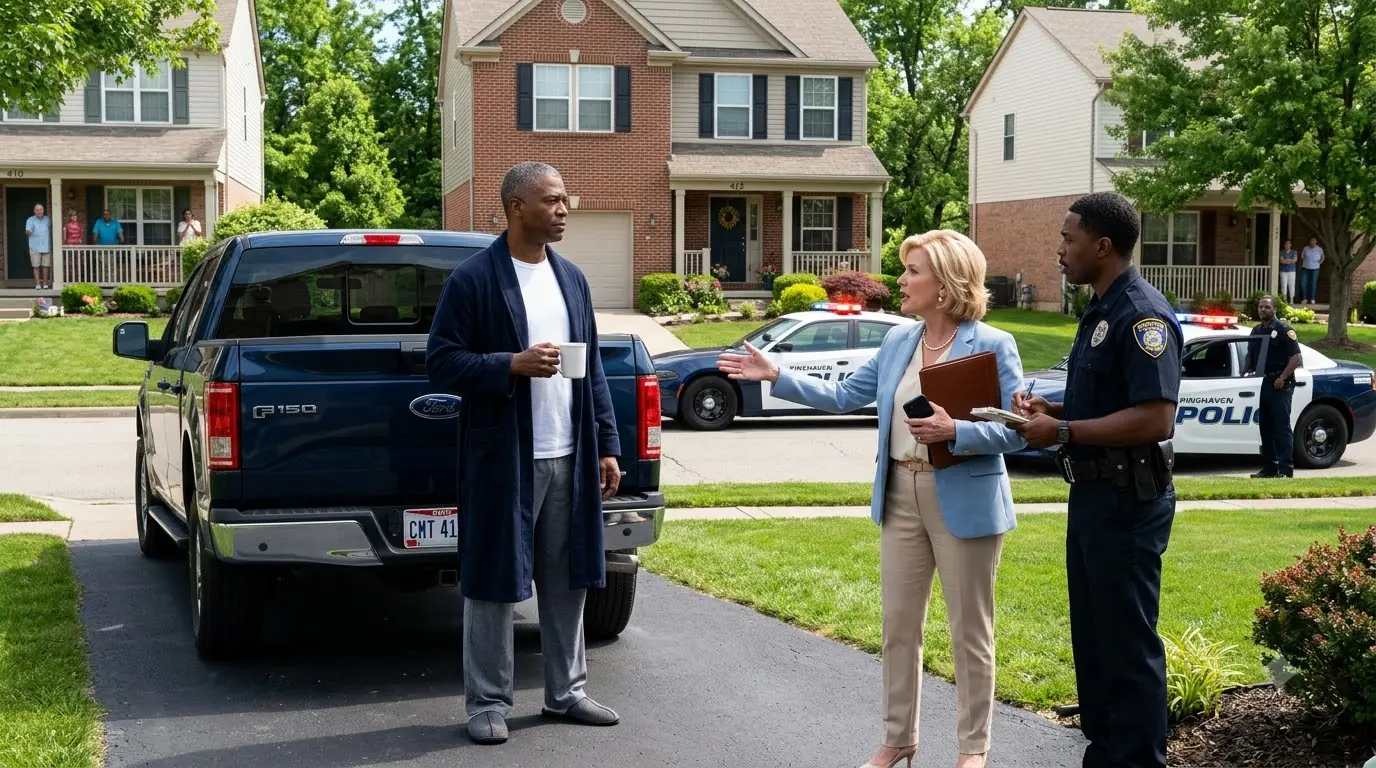
“Yes, he is still there. Arrest him. He has been parking illegally for months, and you people refuse to do anything.”
The officers looked at me.
I looked at my truck.
It was parked completely inside my driveway, on property that I owned.
One officer sighed like a man who had handled this situation before.
There was something Denise did not know.
For three months, she had been filing complaints about me with the Air Force base where she worked. She described me as a rogue officer and repeatedly demanded that I be fired.
She had no idea that I was the installation commander.
I was her supervisor’s supervisor’s supervisor.
That Saturday morning, Denise made the final mistake in a long series of them.
The trouble began fourteen days after Brynn and I moved into the house.
I found a note beneath the windshield wiper of my truck. It was printed on cream-colored cardstock with professional margins.
“Township Code 14C. All vehicles must be parked a minimum of eighteen inches from the property line. Your vehicle is in violation. Please remedy immediately.”
My truck was parked in my own driveway.
The driveway was part of property I legally owned.
I had paid three hundred and fifteen thousand dollars in cash for the house and land.
I crumpled the note and dropped it into the trash, which was precisely where it belonged.
The following morning, a township zoning inspector knocked on my door.
He looked like a man who had lost a bet with the universe.
He measured my driveway with a tape measure, released a long breath, and shook his head.
“Sir, you are fine. This is your property. You could legally park a semi-truck here.”
Then he lowered his voice.
“The woman next door, Denise Kelp, has done this to three families on this street during the last two years. Two of them moved away.”
That was how I learned my neighbor was not merely irritating.
She was a problem with an established pattern.
I should introduce myself properly.
My name is Colonel Marcus Treadwell. I was forty-seven years old and had served twenty-three years in the United States Air Force.
Three months before moving to Pinehaven, I became the installation commander of Grayson Air Force Base.
The position made me responsible for approximately fifteen thousand military and civilian personnel.
It was similar to serving as mayor of a small city, except the city contained fighter aircraft and equipment worth hundreds of millions of dollars.
When I took command, I made one personal decision.
I would live away from the base.
I did not want officer housing, where everyone knew my rank and every neighbor understood exactly what I did for a living.
I wanted something normal.
More importantly, I wanted a place where my daughter could be sixteen without the weight of military life pressing against her every day.
Brynn lost her mother three years earlier.
Cancer.
My wife, Sarah, had been the force holding our family together through seven duty stations and four deployments.
After Sarah died, Brynn and I moved between three bases in two years.
New schools.
New friends.
New houses.
New grief attached to new postal codes.
The house in Pinehaven was supposed to end that cycle.
The town had approximately eight thousand residents and stood twenty minutes from the base. Our house was on Maplewood Drive, a quiet street lined with mature trees and houses built during the 1970s.
The two-story colonial had a driveway with character, meaning it contained several cracks. An American flag hung from the porch because some habits never disappeared.
The neighborhood looked exactly as one might imagine.
It was occupied by honest working families.
Saturday mornings carried the sounds of lawnmowers and sprinklers ticking rhythmically across the grass.
By noon, the asphalt grew hot enough to feel through a pair of boots.
It was peaceful.
Normal.
Exactly what Brynn and I needed.
Then there was Denise.
Denise Kelp was in her late fifties. Her hair was sprayed into a rigid shape that looked capable of deflecting small objects.
She was married to Hugh, a man who appeared to have been apologizing continuously since the Reagan administration.
They had no children.
Denise worked part-time as a cashier at the Grayson Air Force Base commissary, a fact that would later become extremely relevant.
She drove a white Lexus SUV that was always unnaturally clean.
Denise had appointed herself the neighborhood watch captain of Maplewood Drive.
There was no homeowners association.
There was no neighborhood association, elected board, or official watch organization.
There was only Denise, her smartphone camera, and her absolute belief that she represented the final defense against suburban disorder.
I met her on the second day after moving in.
I was unloading boxes from my Ford F-150 when she appeared at the property line as though summoned.
“Welcome to Maplewood Drive,” she said.
Her eyes scanned my truck with the concentration of an airport security officer who believed she had discovered contraband.
“We maintain very high standards here.”
The way she emphasized the word standards made it sound as though I had driven a carnival into the neighborhood.
I smiled, shook her hand, and attempted polite conversation.
I had negotiated with foreign military officials in active conflict zones.
Surely, I believed, I could manage one suburban busybody.
I was wrong.
The cardstock notice was only the opening move.
The zoning inspector’s visit taught me something important.
Denise did not merely complain.
She weaponized administrative systems.
Standing in my driveway after the inspector left, I understood that I had two choices.
I could move again and disappoint Brynn, or I could stand my ground.
I had already moved my daughter enough.
This house was our home.
By the fourth week, Denise developed a new interest in my trash containers.
Township rules required residents to remove garbage bins from the curb by seven o’clock on collection day.
That was reasonable.
I normally returned mine to the house by six-thirty. Occasionally, work delayed me until six-forty-five.
One Thursday, I arrived home at 6:53.
I brought the bins away from the curb and then went inside to help Brynn with calculus.
The following morning, certified mail arrived.
Actual certified mail requiring my signature.
The subject was my garbage containers.
Inside was a formal complaint with three photographs.
Each picture showed my bins near the curb and included a digital time stamp.
7:02 p.m.
7:04 p.m.
7:06 p.m.
Denise had stood outside photographing my garbage bins at two-minute intervals like a forensic investigator.
The letter threatened a fifty-dollar fine for continued violations.
After that, I set an alarm on my phone for 6:30 every collection day.
I never missed it again.
That same week, I noticed Denise’s garbage containers still beside the street at nine o’clock.
They had remained there two hours beyond the deadline.
I followed her exact procedure.
I took time-stamped photographs and submitted them to the township with a polite request for equal enforcement.
Two weeks later, I received a standard form letter.
“Thank you for your concern. We will investigate.”
Denise received no fine.
There was no warning.
The system responded to her because she had trained it to respond.
After years of telephone calls, staff members preferred to satisfy Denise rather than risk another complaint.
I was simply the newest target.
That was when I began keeping records.
Dates.
Times.
Photographs.
Screenshots.
My military logistics instincts activated.
Soon afterward, Denise escalated to complaints about my truck.
I had developed a habit from years of parking on military installations.
I positioned the truck at a slight angle in the driveway, perhaps fifteen degrees. It gave me better visibility and made backing into the street easier.
There was nothing extreme about it.
One morning, another notice appeared.
This one included a police report number.
I called the station.
The dispatcher sounded exhausted.
“Yes, sir. A complaint was filed alleging that your vehicle blocks neighborhood sight lines and creates reckless endangerment.”
“My truck is parked in my driveway.”
“The complainant says it prevents her from safely leaving her property.”
I looked toward Denise’s driveway.
It was approximately forty feet away.
A motor home could have fit between our vehicles.
Officer Ramirez arrived twenty minutes later with another officer.
Ramirez was young and clearly tired of the call before he stepped from the cruiser.
“Mr. Treadwell, we received a complaint about…”
“Colonel, technically, but Marcus is fine.”
His eyebrows rose.
“Colonel. Understood.”
He examined the truck and driveway.
“You are legally parked. Perhaps you could position it straight to avoid more complaints.”
I kept my voice even.
“Officers, I appreciate your time, but I will park my vehicle however I choose on my own property.”
Ramirez nodded.
Something resembling respect passed across his face.
“Understood, sir. Have a good day.”
After the officers left, I completed a step I should have taken during the first week.
I requested public records.
The fee was fifteen dollars, and the office advised me to expect a ten-day delay.
When the digital file arrived, I sat at the kitchen table and read sixty-three pages of astonishing behavior.
During the previous eighteen months, Denise had filed forty-seven complaints with township and county agencies.
Noise violations.
Parking violations.
Tree-trimming violations.
Holiday-decoration violations.
She had called the police nineteen times for suspicious vehicles and aggressive animals.
One suspicious vehicle was a plumber’s van.
The aggressive animal was a golden retriever.
Years earlier, during legal training associated with the Judge Advocate General’s Corps, I learned that repeated false reports could become more than a nuisance.
They could be prosecuted.
Many states had harassment laws that specifically addressed repeated false complaints to authorities.
I once saw the law used in a domestic case involving a man who repeatedly called the police on his former wife’s new partner.
The allegations were false, and the man was eventually charged with misdemeanor harassment.
I printed Denise’s complete complaint record.
Then I filed my own report documenting the pattern.
Three days later, Lieutenant Moss called me.
“Colonel Treadwell, we are familiar with Mrs. Kelp. Extremely familiar.”
“I assumed you might be.”
“Unfortunately, until she crosses a specific legal threshold, there is little we can do.”
“I understand, Lieutenant. I wanted the pattern officially recorded.”
“That was smart, sir. Very smart.”
When I ended the call, Brynn entered the kitchen.
She had been listening.
“Dad, why do you not simply tell her you command the base? She works there. She might stop.”
I considered it.
One conversation could have ended everything.
“Denise, I am your supervisor’s supervisor’s supervisor. Stop.”
But that approach felt like cheating.
It would have been the equivalent of using air support during a ground dispute that could be resolved through ordinary tactics.
I wanted to handle the problem as a citizen, not as a colonel.
I wanted to demonstrate to Brynn that a bully could be confronted through proper channels rather than rank.
There was another reason.
Part of me was curious about how far Denise would go before reality reached her.
The smell of Brynn’s microwave popcorn filled the kitchen.
Butter and salt.
Comfort food for homework nights.
“She will make a mistake eventually,” I told her. “People like that always do.”
Brynn crunched a piece of popcorn.
“Mom used to say the same thing about bullies.”
“Your mother was normally right.”
She was right again.
The sixth week brought Brynn’s sixteenth birthday.
It was not an extravagant party.
Eight friends came to the house for pizza, cake, and music played at a reasonable volume.
By 8:45 that evening, parents were collecting their children.
Brynn stood in the driveway hugging her friends goodbye.
She wore a smile I had not seen since before Sarah died.
I cleaned the kitchen alone and thought that perhaps I had managed to do one thing correctly as a single father.
The next morning, I stepped outside and stopped.
An orange traffic cone blocked the end of my driveway.
A laminated notice was attached.
“By order of the Neighborhood Safety Committee, driveway access is restricted during street events. Cone must remain in place until further notice.”
There was no street event.
There was no neighborhood safety committee.
Denise had invented both.
I picked up the cone.
It was hollow plastic and surprisingly light.
I placed it inside the garage and returned to the kitchen to prepare coffee.
Ten minutes later, two police cruisers arrived.
Officer Ramirez stepped out looking like a man who had lost faith in humanity.
“Colonel, Mrs. Kelp reported that you tampered with safety equipment.”
“That cone was blocking my driveway and stood on my property.”
“I know, sir.”
Ramirez looked toward his partner.
Officer Hendricks was in his mid-fifties and had the expression of someone who had seen every form of foolishness at least twice.
“We are receiving two or three calls each week from Mrs. Kelp,” Ramirez said. “Policy requires us to respond, but…”
Hendricks moved closer.
He removed a business card, wrote something on the back with a blue pen, and handed it to me without speaking.
Three letters appeared.
CYA.
Cover yourself.
Universal advice from law enforcement.
“Document everything,” Hendricks said quietly. “Photographs, time stamps, witnesses. You will need them.”
After the officers left, I decided to file a formal harassment complaint against Denise.
The officers were performing their jobs.
The complaint concerned her pattern of conduct and abuse of emergency services.
I remembered a presentation from a Judge Advocate General officer during my time at the Pentagon.
The topic was nuisance litigation and chronic complainants who repeatedly misused emergency and nonemergency telephone systems.
Some jurisdictions allowed authorities to flag repeat offenders, require written submissions instead of telephone reports, or impose fines.
After the trash-can incident, I had researched the law.
Our county possessed exactly that type of statute.
It was rarely enforced.
When Lieutenant Moss called again, I asked about it.
“Colonel, we have been attempting to build that case for months. The problem is that we need supervisory approval and strong documentation.”
He paused.
“With your formal complaint added to the record, we may finally have enough.”
“Use whatever helps, Lieutenant.”
“One more thing, sir. Install cameras. I have a feeling this will become worse before it ends.”
That was intelligent advice.
I ordered two Nest cameras that afternoon.
Brynn held the ladder while I installed them during the weekend.
Her hands stayed steady against the aluminum.
Then Denise became political.
Garrett, an electrician who lived down the street, knocked on my door one Tuesday evening.
“Marcus, you need to know that Denise filed a petition with the township council.”
“What does she want?”
“A parking-enforcement zone for Maplewood Drive.”
“What would that mean?”
“Every resident would have to purchase permits to park vehicles on private property. One hundred and twenty dollars per vehicle each year.”
Garrett shook his head.
“She has three signatures. Two belong to cousins who do not live in the neighborhood.”
The township council met on the second Thursday of each month.
I attended wearing jeans and a flannel shirt.
I wanted to appear as what I was in that room, another taxpayer with a concern.
The meeting space smelled of burned coffee and industrial floor cleaner.
Approximately thirty residents sat on metal folding chairs that scraped loudly against the linoleum whenever someone moved.
Fluorescent lights hummed overhead.
Denise stood at the podium with a PowerPoint presentation.
She had even brought a laser pointer.
One slide after another showed my truck parked in my driveway from different angles and at different times.
It resembled surveillance evidence from a prolonged investigation.
“This vehicle,” Denise announced, her voice trembling with manufactured urgency, “creates continuing safety hazards, obstructs neighborhood sight lines, and directly contributes to declining property values.”
Councilwoman Latonya Brooks leaned forward.
She was a Black woman in her fifties with the posture of someone who had spent decades refusing to tolerate foolishness.
“Mrs. Kelp, is this vehicle parked on a public street or private property?”
Denise hesitated.
“Technically, it is private, but the effect upon the public…”
“So the owner may legally park there?”
“Yes, but…”
“Thank you.”
Brooks offered a smile without warmth.
“I am tabling the petition for insufficient evidence of any public-safety impact. Next item.”
Denise’s face turned red.
“You did not even…”
The council had already moved forward.
Outside the building, Brooks approached while I stood beside my truck.
“You are Colonel Treadwell?”
“Yes, ma’am.”
“Sergeant Major Brooks, retired Army. Twenty-two years in logistics.”
Her smile contained pure mischief.
“Does your neighbor know who you are?”
“No, ma’am.”
Brooks laughed like someone watching consequences arrange themselves.
“She works at your commissary, correct? Department of Defense civilian employee?”
“That is correct.”
“Conduct standards apply outside work, particularly when the employee is harassing command personnel.”
She gave me her business card.
“Call if you require assistance. Veterans support one another.”
I sat inside my truck afterward with the engine running and watched Denise drive away in her Lexus.
She had spent an hour of elected officials’ time presenting a slideshow about my legally parked vehicle.
She was constructing my case for me.
One irrational act at a time.
Then came the Saturday morning encounter.
0600 hours.
I stood in my driveway holding Colombian dark-roast coffee strong enough to revive the dead when two police cruisers entered the street.
Their lights painted my house red and blue.
Denise rushed from her home wearing an old bathrobe, her phone pressed to her ear.
“Yes, he is standing there. He has been parking illegally for months.”
Officer Ramirez climbed from the cruiser.
His shoulders were already lowered.
He had visited so often that he probably knew how I took my coffee.
“Ma’am, what is the emergency?”
Denise pointed toward my truck as if it contained radioactive material.
“That vehicle! It is an emergency-access violation.”
She raised her voice.
“What happens if firefighters need to get through? What about an ambulance?”
Ramirez examined the truck.
It was completely within my driveway.
The street was approximately forty feet wide and empty in both directions.
“Ma’am, this is private property. Nothing is obstructed.”
“Fire codes. Safety regulations. He is military. Should he not be held to higher standards?”
Her voice climbed.
“I will call the base. I will report him.”
That was when Ramirez’s patience ended.
“Ma’am, I am issuing a warning for misuse of the emergency system.”
Denise stared at him.
“This is not an emergency. You filed forty-seven complaints in eighteen months. Most were determined to be unfounded.”
Her face darkened.
“You should arrest him.”
“Continued false reporting may result in criminal charges. Do you understand?”
Denise sputtered, turned around, and stormed into her house.
The door slammed hard enough to shake windows several houses away.
After the officers departed, I checked my phone.
An email from base security had arrived at 5:45.
“Sir, a civilian telephoned the front gate demanding to speak with whoever is in charge regarding a rogue officer at your address. When instructed to submit a written complaint, the caller became verbally abusive and disconnected. The call has been flagged.”
I stared at the message.
My coffee grew cold.
Denise had contacted my base and attempted to have me fired.
She still did not know that I commanded it.
I forwarded the email to Lieutenant Colonel Pratt with a short note.
“Neighbor situation. I will handle it.”
Pratt responded immediately.
“Sir, is this the trash-can woman?”
“Affirmative.”
“Permission to laugh?”
“Granted.”
That afternoon, I reviewed county property records.
Denise and Hugh purchased their house in 2010 for approximately three hundred and forty thousand dollars. Its current value was likely close to three hundred and thirty thousand.
I paid three hundred and fifteen thousand for mine because it needed repairs. After the work, the likely market value was around three hundred and twenty thousand.
The conflict was never truly about property values.
It was about control.
I found Denise’s previous posts in local online groups.
She opposed multifamily housing and temporary tenants.
She had campaigned against a group home for disabled adults two blocks away.
Her language was always the same.
Property values.
Neighborhood character.
Maintaining standards.
The meaning beneath those phrases was equally consistent.
Keep out anyone she considered different.
Garrett came to my door while I installed the second camera.
“Marcus, Denise asked whether your truck was registered as a commercial vehicle. She is looking for another zoning violation.”
“It has personal registration.”
“I know. I told her.”
He hesitated.
“After the Nguyen family moved, Denise told my wife that we needed to keep the street stable.”
He emphasized the final word.
“The Nguyens were Vietnamese. You are…”
Garrett did not complete the thought.
He did not need to.
I was Black.
Sarah had been white.
Brynn was biracial.
Denise wanted a neighborhood that resembled a television advertisement from the 1950s.
“I appreciate the warning.”
“Six families are willing to testify for you whenever you need us.”
After darkness fell, I sat on the porch.
The western sky turned orange and purple.
Someone three houses away had started a charcoal grill. The smell of lighter fluid and smoking meat traveled with the breeze.
Brynn came through the screen door and sat beside me.
“Are you all right, Dad?”
“Yes.”
“One phone call could stop this. Tell Denise who you are.”
I could have done it.
“Denise, I am Colonel Treadwell. I command the base where you work. Stop.”
The conflict would have ended in ten seconds.
But that would not have been justice.
It would have been rank.
Raw authority ending a problem without addressing the behavior behind it.
“I want her to face consequences because of her actions,” I said, “not because I outrank her.”
Brynn leaned against my shoulder.
She still fit there, barely.
She was growing too quickly.
“Mom would have said the same thing.”
“Your mother was wiser than I am.”
“Impossible.”
She remained quiet for a moment.
“What happens if Denise hurts us before the consequences arrive?”
“That is a valid question.”
I looked toward the neighboring house.
“Then we adapt, but we continue doing this correctly.”
Stars appeared one at a time.
Crickets began their evening rhythm.
The infrared light on the security camera blinked red in the darkness.
I would allow Denise to continue revealing herself.
I would record each escalation with cameras, complaint logs, and a growing file of evidence.
Eventually, people who could not control themselves made mistakes.
Denise was moving quickly toward hers.
Three days later, a certified letter proved the point.
It came from an attorney.
Denise had brought lawyers into a dispute with a man who had an entire Judge Advocate General’s office available for consultation.
It was not a smart decision.
The envelope arrived on Tuesday.
The letterhead belonged to a local law firm.
The paper was thick enough to feel expensive.
Three pages alleged that I had engaged in harassment, intimidation, and intentional destruction of Denise’s property value.
The letter demanded that I park only inside my garage, pay Denise five thousand dollars for emotional distress, and sign an agreement limiting my outdoor activities after seven in the evening.
The final sentence was particularly remarkable.
“Failure to comply will result in escalation to your military chain of command and local media.”
I read the letter twice at the kitchen table.
Morning sunlight came through the window, and steam rose from my coffee.
Then I laughed.
Brynn looked up from her calculus homework.
“Dad, Denise hired an attorney. Is that bad?”
“She brought a private lawyer into a dispute with someone who has a Judge Advocate General’s office available.”
I called Captain Diane Ortiz.
She was thirty-four, educated at Yale Law School, and had chosen military service over an extremely profitable corporate career.
“Sir, is this an official matter or personal?”
“Personal. A neighbor situation, but it became more interesting.”
I scanned the letter and sent it to her.
Sixty seconds later, she made a sound halfway between a laugh and a snort.
“Sir, this is legal nonsense. It borders on frivolous litigation.”
“I assumed so.”
“Would you like me to write a response that causes her attorney to reconsider his career?”
“Not yet. I want to see the complete strategy first.”
“Smart. This letter creates potential grounds for a counterclaim whenever you decide to proceed.”
After ending the call, I filed a Freedom of Information Act request concerning my own records through the Inspector General’s office.
People often underestimated the usefulness of public-record requests.
Any citizen could request government documents for a modest processing fee.
Military personnel seeking their own records often received them quickly.
I submitted the request Tuesday afternoon.
On Thursday morning, forty-three pages arrived in my inbox.
I sat at the kitchen table and read them.
My coffee became cold before I finished.
Denise had filed six Inspector General complaints against me during the previous three months.
The allegations were extraordinary.
She accused me of creating noise through late-night activity, though I normally went to bed by 2200 hours.
She described Brynn’s birthday party as improper fraternization.
She accused me of misusing a government vehicle because my privately owned truck displayed a base parking decal.
She alleged threatening conduct toward civilians because I parked the truck at an angle.
Every complaint had been investigated.
Every one had been dismissed as unfounded.
The investigations still consumed hours.
Interviews.
Statements.
Reports.
Hundreds of work hours were wasted because Denise disliked the position of my truck.
Then I reviewed her employment history.
As installation commander, I could access civilian personnel records when a documented cause existed.
Denise Kelp was a GS-4 commissary cashier hired in 2019.
Her file included several customer complaints and two written warnings for inappropriate comments.
Most recently, Denise told a pregnant officer’s wife that she was abusing maternity benefits by purchasing infant formula.
Another customer, the widow of a decorated service member, had also filed a formal complaint.
The commissary manager’s notes indicated that management was building a termination case, but civilian personnel procedures moved slowly.
I leaned back.
The pieces assembled with the precision of a familiar equipment drill.
Denise worked at the installation I commanded.
She filed false federal complaints against me.
She mistreated military families as customers.
She possessed no idea that I was ultimately responsible for the entire base.
The power dynamic had not merely shifted.
It had reversed.
Using rank still felt too simple.
It would have been like requesting an air strike during a fistfight.
I called Ortiz again.
“Draft one letter for me.”
“What type?”
“Not for immediate use. Prepare the kind that explains, with complete precision, how badly someone misunderstood reality.”
“My favorite kind, sir.”
I also contacted Councilwoman Brooks.
“Six Inspector General complaints?” she asked. “That is not ordinary harassment. It may constitute abuse of a federal process.”
“Should it be referred to the Department of Defense Inspector General?”
“That depends. Do you want a quick ending or a lasting lesson?”
“I want her unable to do this to anyone else.”
“Then allow one more escalation. People like Denise often understand consequences only after warnings fail.”
That evening, Brynn asked whether we could move.
I pulled her close.
The living room smelled of the lavender candle Sarah used to enjoy.
Brynn had begun lighting it on difficult days.
“We moved three times after your mother died,” I said. “I promised this would be home.”
“What if the situation becomes worse first?”
“It may become worse, but it will not remain worse.”
I did not realize how accurate those words would become.
Denise’s next step made everything before it seem like preparation.
While waiting for her next move, I built a team.
Garrett came over on Saturday morning with a folder he had maintained since the Nguyen family left the neighborhood.
His kitchen smelled of sawdust and French-roast coffee.
“I began documenting things after they moved,” he said.
He spread the papers across the table.
“Denise reported the Nguyen family fourteen times during six months. Mr. Nguyen suffered a stroke. His family believed the stress contributed.”
The folder included written accounts from three families Denise had driven away.
There were photographs of her photographing neighbors and emails organizing so-called concerned residents against various targets.
“Six families will testify,” Garrett said. “We have waited a long time for someone to push back.”
I met Councilwoman Brooks at Murphy’s Diner.
We sat over eggs and hash browns at a table that remained slightly sticky from syrup.
“The township attorney and I drafted this two years ago.”
She passed me a document.
It was a chronic-complainant ordinance.
Anyone filing ten or more unfounded complaints during twelve months could be fined and restricted to written submissions requiring an attorney’s signature.
“Is that lawful?”
“Ohio precedent. Wilkins versus City of Dayton, 2013. The courts recognized that municipalities may regulate abuse of complaint systems.”
Her expression showed quiet satisfaction.
“The council votes at the next meeting. We expect unanimous approval.”
I remembered a housing-law seminar where the instructor discussed similar ordinances.
Local governments were increasingly using them to prevent residents from weaponizing complaints during property and HOA disputes.
The essential requirements were a demonstrable pattern and proof of bad faith.
Denise had provided both.
Captain Ortiz met me at the base legal office.
Case-law printouts covered the table, marked with bright sticky notes.
“Sir, knowingly false Inspector General complaints are not merely unethical.”
She tapped one page.
“Title 18, Section 1001 prohibits materially false statements to federal agencies. The maximum penalties can include significant fines and imprisonment.”
“I am not attempting to send her to federal prison.”
“I know, sir. But she should understand the seriousness of what she has done.”
Ortiz handed me a three-page draft.
It explained each violation, cited applicable laws, and offered Denise one opportunity to stop.
The letter was educational.
It was also devastating.
“Perfect,” I said. “Hold it until I authorize release.”
Chief Mendez brought Denise’s employment records into my office through official channels.
We conducted a documented meeting.
“Fourteen customer complaints, sir.”
He opened the file.
“She questioned a deployment spouse about how she could afford her groceries. We are building a termination case, but civilian human resources moves slowly.”
“Continue following the proper process, Chief. I may provide additional documentation soon.”
That evening, I explained the strategy to Brynn over pepperoni pizza.
I used the pizza box as a whiteboard and drew four sections with a marker.
She laughed.
It was the first real laugh I had heard from her in weeks.
“First, a civil restraining order,” I explained. “I have forty-seven police complaints, six false Inspector General allegations, legal threats, and a documented pattern of harassment.”
“Would the order actually stop her?”
“It would make further contact unlawful. Violating it could result in arrest.”
I pointed toward the second section.
“Second, the township passes the chronic-complainant ordinance. Denise receives fines and restrictions on filing new reports.”
“Third?”
“I file an Inspector General complaint concerning her abuse of the federal system. The process she attempted to use against me investigates her instead.”
“And the fourth?”
“The commissary completes its independent employment process based on legitimate customer complaints.”
Brynn folded her pizza slice lengthwise.
It was the way Sarah used to eat it, preventing the cheese from sliding.
“You are not only stopping her. You are making certain she cannot do this to anyone else.”
“Exactly.”
“Mom would approve.”
“Your mother would have finished this three weeks ago.”
During the following week, I assembled a binder.
It contained the timeline, screenshots from the cameras, police records, neighbor statements, Inspector General complaints, and relevant employment notes.
Everything appeared chronologically.
Each section was indexed and marked with tabs.
The completed binder was three inches thick.
Captain Ortiz reviewed it.
“Sir, this could become a training example for documentation.”
“You do not remain in uniform for twenty-three years without learning the value of paperwork.”
The strongest part of the case was its legitimacy.
No misuse of rank.
No shortcuts.
Only evidence, proper procedures, and patience.
Garrett came over on Thursday evening while I grilled chicken.
Charcoal smoke drifted across the yard and made the night feel almost normal.
“Denise has been quiet,” he said while accepting a beer. “That makes me nervous.”
“Cornered people often become dangerous immediately before they are caught.”
“Do you believe she will escalate?”
“I am expecting it. Every new action strengthens the case.”
Garrett tapped his bottle against mine.
“Remind me never to make you angry.”
“Do not harass my daughter, and we will be fine.”
Brynn came outside carrying plates.
“Dad is not angry. He is simply thorough.”
“Terrifyingly thorough,” Garrett said.
After Brynn went to bed, I sat on the porch.
Heat lightning flashed inside distant clouds.
The air smelled of ozone and cut grass.
A storm was coming.
My phone vibrated.
Councilwoman Brooks sent a message.
“Ordinance passes Tuesday. Unanimous vote expected.”
Another message came from Ortiz.
“Restraining-order petition ready. Waiting for authorization.”
Lieutenant Moss sent a third.
“Colonel, Mrs. Kelp attempted to file another report tonight. The dispatcher required her to submit it in writing under the new procedure. She disconnected.”
I smiled into the darkness.
The walls around Denise were being constructed entirely from her own conduct.
I had only placed mirrors around her.
Sarah used to say that the best way to defeat someone was not always to fight.
Sometimes the answer was to let them defeat themselves while you took careful notes.
I had taken excellent notes.
I needed Denise to make one final, serious mistake.
Based on her behavior, I knew the wait would not be long.
Lightning flashed again, closer this time.
The storm approached.
At 6:30 on Monday morning, my phone filled with messages from three neighbors I barely knew.
Each contained the same link.
“Is this true?”
“Are you safe?”
I opened the Pinehaven community group, which had approximately eight thousand members.
A new account called Concerned Pinehaven Resident had posted my full street address.
The account had been created that morning and contained no photograph or previous activity.
“Alert: Military officer on Maplewood Drive harassing neighbors. Police refuse to act because of a protective culture surrounding veterans. This man threatens families, violates ordinances, and uses his position to intimidate residents. Share for community safety.”
The post had already been shared sixty-three times.
I captured fifteen screenshots before moderators removed it.
The original post.
Comments.
Shares.
Account details.
Everything became evidence.
Captain Ortiz described it as potential witness intimidation and defamation.
“Add it to the petition,” she said.
Within an hour, two neighbors arrived carrying printed copies.
A retired teacher looked genuinely confused.
“Colonel, this does not resemble anything I know about you.”
I showed them the police records and Denise’s forty-seven complaints.
Confusion became anger.
“She did the same thing to the Nguyen family three years ago,” the teacher said. “The same lies from another anonymous account. They moved because of it.”
“Would you provide a statement?”
“Today.”
That afternoon, another letter arrived.
“Maplewood Drive Homeowners Association Annual Dues Notice.”
It claimed that I owed five hundred dollars and threatened a property lien for nonpayment.
The document used formal language and professional letterhead.
The return address belonged to a private mailbox at a shipping store.
The listed board members did not exist.
I had already researched every property owner on Maplewood Drive.
Garrett saw the notice that evening.
“That is Hugh’s mailbox number. Box 247. I use the same shipping store.”
Creating a false homeowners association and mailing extortion demands was more than dishonest.
It potentially constituted mail fraud.
Denise had provided another serious offense for the file.
I contacted the postal inspection service.
The investigator sounded almost pleased.
“Someone is impersonating an HOA to demand money? Those are cases we take seriously. We will monitor the mailbox.”
Two mornings later, I stepped outside at dawn and found all four tires on my truck cut.
A deep scratch ran along the driver’s side.
Someone had taken time to cause the damage.
The security cameras recorded the entire incident.
At 2:15 in the morning, a person wearing dark clothing entered the driveway.
The figure spent four minutes damaging the vehicle.
The walk did not resemble Denise’s.
The person was taller and heavier.
The movement looked more like Hugh.
Officers Ramirez and Hendricks arrived as the sun rose.
The morning light made everything appear cold and gray.
The air smelled of metal and frost.
We watched the footage on my phone.
“We cannot identify the face,” Ramirez said, “but we will verify their whereabouts.”
The officers knocked on Denise’s door at seven.
I watched from my porch with coffee warming my hands.
Hugh opened the door looking defeated before a question was asked.
Denise pushed past him wearing her bathrobe.
Her voice carried across the distance.
“We were both asleep together.”
Hendricks wrote something inside his notebook.
It was difficult for two people to verify that the other remained asleep unless one of them stayed awake to observe it.
Ramirez asked another question.
Denise’s response became louder.
“I already said we were sleeping.”
The officers eventually returned.
“Colonel, the recording is not sufficient for an arrest, but their statements contain several inconsistencies. We documented them.”
“Understood. Insurance will cover the damage.”
The deductible was eight hundred dollars.
New tires were installed by noon.
I could afford the cost.
Denise was collecting potential criminal exposure.
Brynn came outside after the tow truck departed.
School had been canceled for a teacher workday, and she slept through most of the morning.
She stared at the damaged truck and the marks on the driveway where I photographed the evidence.
“Dad, this is frightening.”
“I know.”
“When does it end?”
“The restraining-order hearing is in three days. She just added suspected vandalism and mail fraud to the record.”
“What if she does something worse?”
There was real fear in her voice.
For a moment, it made me question the entire plan.
“Then we adapt. But Denise is making mistakes faster than I can organize them.”
That afternoon, my office phone rang.
It was base security.
“Sir, a civilian at the front gate is demanding to speak with the commanding officer about a corrupt serviceman. She is becoming loud.”
“Who is it?”
“Denise Kelp, sir. Your neighbor.”
I nearly laughed.
“Transfer her to Lieutenant Colonel Pratt at the command post.”
“Sir?”
“He knows the situation.”
Ten minutes later, Pratt called me.
He was barely containing his amusement.
“Sir, that may have been the most entertaining gate call of my career.”
“What happened?”
“She spoke for ten minutes about a rogue officer who deserved a court-martial. When I asked his name, she did not know it. She had only the address.”
“What did you tell her?”
“That I would inform the appropriate commander.”
I could hear his grin.
“She has absolutely no idea that you are the commander.”
“Keep it that way.”
“Sir, she appears completely unbalanced.”
“She is desperate. Desperate people make decisive mistakes.”
I added the gate security report to the evidence file.
Denise had now harassed federal installation personnel and attempted to misuse the military command structure.
Both were documented concerns for a civilian Department of Defense employee.
The restraining-order hearing was seventy-two hours away.
My binder was now four inches thick.
It included photographs, timelines, police logs, federal complaints, witness statements, personnel documentation, and security video.
Denise created every piece.
I merely preserved the record while she tied one knot after another.
That evening, Brynn and I sat on the porch as twilight settled across the street.
The air smelled of distant rain and charcoal smoke.
Lightning bugs appeared in the yard for the first time that season.
“Three more days,” I told her.
“Then it is over?”
“Then Denise learns what consequences look like.”
Thunder sounded in the distance.
The storm was arriving according to schedule.
The day before the hearing, Denise crossed a line I had not expected.
At ten in the morning, someone knocked on the door.
A woman wearing business-casual clothing stood outside with a tablet and a worn leather folder.
“Colonel Treadwell? I am Kim Brennan from Child Protective Services.”
My entire body became cold.
“We received a report concerning your daughter, Brynn.”
“What kind of report?”
“An anonymous allegation of neglect, unsafe living conditions, and an unstable veteran parent creating a dangerous environment.”
Kim looked apologetic.
“I suspect this may be false, but I am legally required to investigate.”
I stepped aside.
“Examine anything you need.”
Kim walked through the house.
The kitchen was clean.
The refrigerator contained food.
There were no hazards.
Brynn’s bedroom was untidy in the ordinary way of a teenager’s room, but it was clearly a room belonging to someone who was loved.
Skateboard equipment.
College brochures.
Band posters covering the walls.
Kim interviewed Brynn privately.
I waited in the kitchen.
My fingers became white around the coffee cup.
Fifteen minutes later, Kim returned with Brynn.
My daughter’s eyes were red, but her voice remained steady.
“This case is being closed immediately,” Kim said. “Your daughter is safe and appropriately cared for.”
She turned toward Brynn.
“Thank you for speaking honestly.”
Brynn’s voice broke.
“My father is the best person I know. Mrs. Kelp hates us. This is another lie.”
Kim handed me her card.
“Sir, I am documenting the complaint as clearly retaliatory. Malicious false reports to child-protection services are criminal in this state and may constitute a felony.”
She looked toward Brynn.
“I will testify if necessary.”
After Kim left, I held my daughter while she cried.
They were angry tears.
“She tried to take me away from you.”
“She cannot. She failed.”
Whatever restraint remained inside me disappeared.
Harass me?
I could manage it.
Damage my property?
The courts could address it.
Weaponize child welfare against my daughter?
That ended any possibility of leniency.
I called Captain Ortiz.
“Add the entire incident to the filing. No restraint.”
“What happened, sir?”
“She submitted a false CPS complaint targeting Brynn.”
Ortiz’s voice became cold.
“She is going to regret that decision.”
That afternoon, Denise’s attorney received our petition.
Eighty-three pages.
Indexed and tabbed like a military operational order.
Garrett later heard through a paralegal acquaintance that Attorney Feldman called Denise immediately.
“Mrs. Kelp, you need to negotiate. His evidence is devastating.”
Denise reportedly replied, “He is bluffing. He is only a soldier.”
Feldman attempted to warn her.
“Ma’am, he has military attorneys advising him. You need to take this seriously.”
Instead, Denise filed her own request for a restraining order against me.
Her allegations claimed that I threatened her through military connections, parked my truck in an intimidating manner, and recruited neighbors into a coordinated harassment campaign.
There was no evidence.
No photographs.
No recordings.
No independent witnesses.
Only three pages of unsupported accusations.
Both petitions were scheduled for the same court session.
Garrett organized the neighborhood witnesses.
Six families agreed to testify.
These were people Denise had harassed and people who remained silent for too long.
The retired teacher brought documents from Denise’s campaign against Christmas lights in 2019.
The local pastor offered records showing she had called police because church members parked along the street during Easter services.
That evening, I sat on the porch.
The security camera’s red light blinked above me.
The night smelled of fresh grass and ozone.
Crickets kept the rhythm of what summer should have been.
Lieutenant Moss called.
“Colonel, Mrs. Kelp attempted to file another report tonight. She accused you of surveillance.”
He sounded tired.
“The dispatcher informed her that the new policy required written complaints. Mrs. Kelp disconnected and called again three times. We logged it as harassment of emergency personnel.”
“Thank you, Lieutenant. I will see you tomorrow.”
“I would not miss it, sir.”
The binder rested on the porch table.
Four inches of evidence demonstrating one simple truth.
Denise could not stop herself.
Every choice pushed her deeper.
Brynn came outside and sat beside me.
“Are you ready for tomorrow?”
“Yes.”
“What if she wins?”
“She cannot. She constructed my case herself.”
“Will she go to jail?”
“Probably not immediately. But real consequences are coming.”
“Good.”
Brynn rested her head against my shoulder.
“Mom would be proud.”
“Your mother would have ended this three weeks ago.”
“No. She would say you handled it correctly.”
Lightning bugs rose from the grass.
The air felt charged.
Fourteen hours remained before court.
I decided to wear my service dress uniform.
Full rank insignia.
Until that moment, Denise had seen me only in civilian clothing.
I never mentioned my assignment, displayed my rank, or used authority unavailable to an ordinary citizen.
The next morning, she would finally discover whom she had spent four months harassing.
She would see the uniform and understand that she filed complaints about me with my own command.
She called my base and attempted to have me removed from a position where I supervised everyone, including her.
I had to admit that I wanted to see her face when the realization arrived.
Garrett came over with a six-pack.
We sat in silence and watched heat lightning flash along the horizon.
“Marcus, whatever happens tomorrow, you handled this correctly.”
“We will see.”
“No. The entire street has been watching. You demonstrated that someone can resist a bully without becoming one.”
That mattered.
After Garrett left, I entered the house.
Brynn had fallen asleep on the couch with a calculus textbook across her chest.
I covered her with Sarah’s old quilt.
Sarah had sewn the star pattern during my first deployment.
Inside the bedroom, I prepared my service dress uniform.
The fabric was pressed.
The brass polished.
The ribbons aligned.
Silver eagles rested on the shoulders.
It represented twenty-three years of work.
The following morning, Denise would finally see it.
Four months of harassment would meet four months of perfect documentation before a judge.
I set the alarm for 0500.
Court began at nine, but I had an entire career of pre-mission habits to complete.
The storm building since our arrival on Maplewood Drive was ready to break.
The county courthouse smelled of floor wax and old wood.
Fluorescent lights hummed while thirty people sat on folding chairs that squeaked whenever someone shifted.
I entered wearing full service dress.
My ribbons were aligned.
The brass reflected the overhead lights.
Silver eagles marked my rank.
Brynn walked beside me.
Six neighbors followed, along with Officer Ramirez, Lieutenant Moss, Kim Brennan from Child Protective Services, Garrett, and Councilwoman Brooks.
Denise sat beside Attorney Feldman.
When she saw the uniform, her face turned white.
Then red.
Then white again.
She seized Feldman’s sleeve and whispered urgently.
He looked toward the rank insignia and became pale.
Judge Meredith Vance entered.
She was in her sixties and had previously served as a prosecutor.
“There are two competing restraining-order petitions. We will hear both.”
She looked toward Denise’s side.
“Mrs. Kelp’s counsel may proceed first.”
Feldman stood.
“Your Honor, my client has endured months of harassment. Her neighbor has weaponized his military status and parks his vehicle in a threatening manner.”
Judge Vance interrupted.
“He parks threateningly?”
Feldman hesitated.
“On his own property?”
“The angle creates…”
“Proceed to your next point.”
Feldman listed grievances.
Judge Vance repeatedly asked the same questions.
“Photographs?”
None.
“Recordings?”
None.
“Independent witnesses?”
Feldman cleared his throat.
“Potential witnesses were intimidated.”
“So there are none.”
Then Judge Vance addressed me.
“Colonel Treadwell.”
I stood.
“Your Honor, my name is Colonel Marcus Treadwell. I serve as installation commander of Grayson Air Force Base.”
The courtroom became quieter.
“Mrs. Kelp has harassed my daughter and me for four months.”
I placed the binder before the court clerk.
“The record includes forty-seven false police and administrative reports, six unfounded Inspector General complaints, suspected mail fraud, property damage, public defamation, and a malicious Child Protective Services report filed yesterday.”
The binder was delivered to Judge Vance.
Eighty-three pages.
Timeline.
Photographs.
Police records.
Witness statements.
Camera footage.
Vance read for approximately two minutes.
Her eyebrows rose as she moved through the sections.
“Mrs. Kelp, forty-seven police complaints?”
Denise jumped to her feet.
“He violates codes constantly.”
“Sit until you are addressed.”
Denise lowered herself into the chair.
“Officer Ramirez.”
He stood.
“Your Honor, officers have responded to Mrs. Kelp’s complaints two or three times per week during recent months. The department’s broader records show a pattern extending approximately eighteen months.”
He continued.
“Roughly ninety percent of the complaints were unfounded. She received three warnings regarding misuse of emergency services.”
Judge Vance looked toward Denise.
“Did you file six Inspector General complaints concerning Colonel Treadwell?”
“Yes, but someone needed to…”
“Were you aware that Colonel Treadwell is installation commander at the base where you work?”
Silence.
Denise’s mouth opened.
Then closed.
“He is the commander?”
“Your ultimate supervisory authority.”
Judge Vance looked at her over the documents.
“You filed complaints through his own command structure without verifying even the most basic facts.”
She turned another page.
“Did you submit a report to Child Protective Services?”
“I had legitimate concerns.”
“Ms. Brennan.”
Kim stood.
“Your Honor, the complaint was clearly retaliatory. Brynn Treadwell is safe, healthy, and appropriately cared for.”
Kim’s voice was firm.
“The report represented a deliberate misuse of the child-protection system to intimidate Colonel Treadwell through his daughter.”
Judge Vance closed the binder.
The sound was sharp inside the courtroom.
“I am granting Colonel Treadwell’s petition.”
Denise stared at her.
“Mrs. Kelp, you are prohibited from contacting Colonel Treadwell or his daughter. You must remain at least one hundred yards from their residence and property.”
Vance continued.
“You may not submit further complaints concerning them without court review. A violation of this order may result in immediate arrest.”
“That is unfair.”
“Your petition is denied with prejudice. The evidence establishes that you are the aggressor.”
Denise stood again.
“This is happening because he is military.”
“Sit down, or I will hold you in contempt.”
“He arranged this. He never told me…”
Judge Vance struck the gavel.
“He documented your behavior.”
Her voice became severe.
“You made these choices over four months. Colonel Treadwell used the same civilian legal processes available to any resident instead of misusing his military authority.”
Vance looked directly at Denise.
“You should have demonstrated similar judgment.”
She turned toward a representative from the district attorney’s office.
“I am referring the record for potential criminal charges involving false reports, suspected mail fraud, malicious misuse of child-protection services, and harassment.”
She added another instruction.
“Notify the United States Attorney’s Office and appropriate federal investigators regarding possible abuse of the Inspector General process.”
Then Vance looked toward Denise.
“Your employment consequences are a matter for your employer.”
I spoke only when addressed.
“They will be reviewed according to Department of Defense procedures, Your Honor.”
Everyone understood the likely outcome.
Denise began sobbing.
“I did not know.”
I looked at her.
“You never asked. You assumed.”
She lowered her eyes.
“You made forty-seven accusations without confirming facts, and then you targeted my daughter. That is not something I can excuse.”
“Court is adjourned,” Judge Vance said.
Outside, a reporter approached.
“Colonel, do you have a comment?”
“People should confront harassment through lawful channels. Documentation matters, and the justice system can work when people use it properly.”
Brynn took my hand.
“Is it finished?”
“Yes, sweetheart.”
Officer Ramirez passed and nodded respectfully.
Lieutenant Moss stopped beside me.
“That documentation was exceptional, Colonel.”
Councilwoman Brooks approached.
“Six families have already asked how they can confront similar harassment. You taught this town something.”
We walked to my truck.
It had new tires and a repaired door.
I had parked it at a slight angle.
Because I could.
Brynn climbed into the passenger seat.
“Mom would be proud.”
“She would say I took too long.”
“No. She would say you handled it correctly.”
I started the engine.
In the rearview mirror, Denise stood alone on the courthouse steps while Feldman walked away.
She had lost almost everything in a few hours because she could not stop attacking others.
Because she assumed rather than asked.
Because she selected the wrong neighbor and continued long after every warning.
Brynn and I drove home.
Our home.
The house nobody would force us to leave.
Maplewood Drive was quiet when we arrived.
Garrett waved from his porch.
The smell of a weekend barbecue traveled through the air.
Lightning bugs would appear after sunset during the first genuinely warm evening of the season.
I parked the truck at an angle in my driveway.
My property.
My decision.
My life.
Denise no longer had any influence over it.
The first Saturday after the hearing, Garrett organized a block party.
Twenty families attended.
Grills produced smoke along the street.
Folding tables were covered with potato salad, desserts, and drinks.
Children ran through sprinklers.
Two families who moved away because of Denise returned for the gathering.
I stood beside my grill turning hamburgers while Brynn helped.
For the first time in four months, the pressure inside my chest began to loosen.
The retired teacher brought a photograph album documenting Maplewood Drive from 1972 onward.
“This is what a neighborhood should be,” she said. “People taking care of one another.”
The pastor offered a short blessing.
“May we always choose kindness instead of conflict.”
Three weeks later, the formal consequences arrived.
The commissary terminated Denise.
I did not order it.
Chief Mendez and civilian human resources completed their existing case correctly.
Fourteen customer complaints.
Hostile conduct.
Documented violations of workplace expectations.
Off-duty actions affecting the installation.
Proper channels.
Proper procedure.
I never interfered.
The district attorney also filed charges.
Denise accepted a plea agreement.
She received two hundred hours of community service, a five-thousand-dollar fine, two years of probation, and mandatory anger-management counseling.
The postal investigation regarding the fraudulent HOA notices continued through federal channels.
Denise and Hugh sold their house within a month.
They moved two towns away.
According to former neighbors, Denise told people she had been forced out through military corruption.
Some people never learned.
Six families who had remained silent finally discovered their voices.
They began attending township council meetings and speaking about infrastructure, public budgets, enforcement procedures, and transparency.
Councilwoman Brooks later told me that voter registration increased by twelve percent in our district.
Then Garrett and I created something more important.
We established the Good Neighbor Fund.
It was a community resource for families facing harassment, false complaints, or abusive housing practices.
I contributed the first five thousand dollars.
The six families who testified provided matching donations.
During its first year, the fund helped eleven families receive free legal consultations, documentation training, and tenant-rights education.
Officer Ramirez taught residents how to submit proper complaints and preserve evidence.
Captain Ortiz explained resources available to military families.
Councilwoman Brooks taught sessions about local ordinances and municipal processes.
Approximately forty residents attended each workshop.
People came from neighboring towns.
We helped stop three wrongful evictions and exposed one false homeowners association collecting illegal dues.
One woman approached me after a workshop.
“My landlord harassed me for two years,” she said. “Your program gave me the tools to respond legally.”
Her eyes filled with tears.
“I won.”
That was when I understood we created something larger than a solution for my driveway.
I also established the Sarah Treadwell Resilience Scholarship at the local high school.
The scholarship awarded two thousand dollars each year to a student who overcame adversity with grace.
The first recipient was a student whose family successfully resisted a predatory HOA using techniques learned during our workshops.
Brynn presented the award.
Watching her stand at the podium, I saw Sarah in every gesture.
One year after the court hearing, Brynn and I planted a Japanese maple in the front yard.
It represented peace and perseverance.
Several neighbors came to watch.
Garrett helped dig the hole.
We placed a stone near the roots.
“In memory of those who stood up, and in hope for those who will.”
As I pressed the soil around the tree, Brynn asked a question.
“Do you think Denise ever understood what she did wrong?”
“Probably not. Some people cannot see beyond their own anger.”
“That is sad.”
“It is, but we can control only how we respond.”
The leaves moved in the evening breeze.
The air smelled of fresh earth and charcoal smoke.
Lightning bugs began their dance through the twilight.
My phone vibrated.
A message from the base appeared.
“Sir, a contractor is refusing to pay six workers, including a retired sergeant major. Situation escalating. Requesting guidance.”
Brynn noticed my expression.
“Someone else is in trouble?”
“A contractor is attempting to avoid paying a sergeant major’s crew.”
She smiled.
It was Sarah’s mischievous smile.
“Are you about to ruin someone’s day?”
“Only if they deserve it.”
Garrett laughed.
“You attract people who need serious attitude corrections.”
Councilwoman Brooks lifted her glass of iced tea.
“To Colonel Treadwell, for proving that confronting bullies correctly actually works.”
Everyone raised their drinks.
I felt warmth rise across my face.
“To all of us,” I corrected. “Nobody fights alone.”
The sun set behind the houses and painted the sky orange and purple.
I stood in the driveway where the entire conflict began and looked at what we had created.
Not merely peace for my family.
A system helping others.
Justice in one case had become resources for dozens more.
Brynn leaned against my shoulder.
“We did something good, Dad.”
“We did.”
“Mom would say it was great.”
“She would probably be right.”
The streetlights came on and formed warm yellow circles across Maplewood Drive.
Someone played music at a reasonable volume.
Children laughed in backyards.
The smells of a dozen dinners mixed in the breeze.
This was the life I wanted when I bought the house.
This moment.
This peace.
Nobody would take it from us again.
When a person stands up through lawful means, preserves evidence, and refuses to be intimidated, justice has an opportunity to work.
The person being targeted does not always have to lose.
Sometimes the bully creates the case against herself.
Sometimes all the other person needs to do is remain patient, follow the process, and take very good notes.