Under the thick layer of snow covering the small town, Ethan stood quietly by the fence, his eyes fixed on the house at the end of the road.
Inside, a frail woman gently fed a few stray cats, always quiet, always sorrowful.
That was Martha, a widow who had lived alone for 16 years, shunned by everyone in town.
Until that sacred Christmas Eve, when despite his friend's warnings, Ethan brought a small Christmas tree to her doorstep and softly asked, "May I give you a present?"
He did not realize his father, the town's mayor, was standing behind him, witnessing everything.
What happened next would change the entire town forever.
Snow fell thick over Willow Creek that December evening, the kind of snow that muffled sound and made the world feel smaller, quieter, like God had wrapped the town in cotton.
The flakes drifted down slow and heavy, coating the shingled roofs, the bare branches of oak trees, and the weathered storefronts along Main Street.
Christmas lights swayed gently in the wind, red, green, and gold, their glow soft against the white.
Ethan Carter stood at his bedroom window on the second floor of the mayor's house, his breath fogging the glass.
He was 12 years old, tall for his age, with dark hair that stuck up no matter how much his mother tried to comb it down, and brown eyes that seemed to notice things other kids missed.
His room overlooked most of Willow Creek.
There was the church steeple rising like a finger pointing to heaven.
There was the town square where the big Christmas tree stood, its lights twinkling through the snow.
And far down at the end of Birch Road, almost hidden among the pines, stood a small house that sat apart from all the others.
That house was different.
Its paint was the color of old smoke, peeling in long strips.
Snow piled thick on the sagging roof, weighing down the gutters.
No lights decorated the porch.
No wreath hung on the door.
No car sat in the driveway.
It looked like a house that had given up trying to belong.
Ethan had heard the stories all his life.
"Stay away from that house, honey," his mother's voice would say, gentle but firm. "The old woman who lives there doesn't like children."
Mrs. Henderson from the post office had once whispered to another customer, "She never comes out except to get her mail."
Mr. Patterson at the hardware store had shaken his head like it was a shame and a mystery all at once.
"Something's not right with her," Tommy's older brother had said, his voice low and knowing the way teenagers talked when they wanted to sound wise.
The kids at school had turned it into legend.
They said she was a witch.
They said her husband had died under mysterious circumstances.
They said if you got too close, she would curse you.
Ethan did not believe any of that, but he had never been brave enough to find out for sure.
What he had seen, though, were glimpses.
Once, riding his bike home from Kevin's house at dusk, he had caught sight of her through a lit window.
Just a silhouette, small and bent, sitting at what looked like a sewing machine.
Another time, early on a Sunday morning, when most of the town was at church, he had seen her in her front yard.
A tiny figure in a faded coat, sweeping snow off her front steps with a broom that looked too big for her to handle.
She moved slowly, carefully, like someone who knew her bones were fragile.
Like someone who had learned to be gentle with herself because no one else was there to be gentle for her.
That did not seem scary to Ethan.
It seemed sad.
But people did not talk about her with sadness.
They talked about her with relief.
Relief that they were not her.
That their lives had not turned out that way.
That they still had people who needed them.
"Ethan," his mother's voice floated up from downstairs, warm and familiar. "Come help me with the cookies."
He pulled away from the window, his palm leaving a mark on the cold glass.
Before he turned, he looked one more time at that distant house, dark against the white snow, and felt something tug at his chest.
Something he could not name yet.
Downstairs, the kitchen was everything the world outside was not.
Warm, bright, and alive.
The oven glowed.
The air smelled like butter, cinnamon, and vanilla.
The smell of every Christmas Ethan had ever known.
His mother, Linda Carter, stood at the counter in her favorite apron, the red one with white snowflakes, rolling out sugar cookie dough with practiced efficiency.
Flour dusted her hands.
Her cheeks were flushed pink from the heat.
She was humming "Silent Night," slightly off-key the way she always did, and it made Ethan smile despite himself.
"There you are," she said without looking up. "Grab the cookie cutters for me."
He opened the drawer and pulled out the old tin box.
Inside were the shapes they used every year.
Stars, bells, Christmas trees, angels with wings spread wide.
He set them on the counter, and his mother wiped her hands on her apron before picking up the star.
"These are for tomorrow night," she said, pressing the cutter into the dough. "The Christmas Eve service. Everyone's bringing something, and you know how competitive Mrs. Chen gets with her gingerbread."
Ethan smiled.
Mrs. Chen, who ran the bakery downtown, took her baking very seriously.
"Your father's giving the opening prayer," Linda continued, moving on to the tree shape. "And then Father Thomas will do the sermon. It should be lovely. The whole town will be there."
"The whole town?" Ethan asked quietly.
"Well, just about."
She glanced at him and caught something in his tone.
"Why do you ask?"
He hesitated.
His mother had a way of seeing through him, of knowing when he was working up to something.
"Mom, why doesn't anyone talk to Mrs. Miller?"
Linda's hand stilled.
The cookie cutter hovered above the dough.
She looked at him, really looked at him, and he saw something flicker across her face.
Surprise, maybe, or concern.
"Mrs. Miller?" she repeated, like she was not sure she had heard right.
"The lady at the end of Birch Road. In the old house."
Linda set down the cookie cutter and leaned against the counter.
She was quiet for a moment, choosing her words the way adults did when they wanted to explain something complicated to a child without actually explaining it.
"That's Martha Miller, sweetheart," she said finally. "She's lived alone for a very long time. Since before you were born. She lost her husband. I think it was a heart attack. Sudden, no warning. They didn't have children."
"And after he died, she just... she withdrew. Pulled away from everyone."
"But did anyone try to help her?"
"Oh, honey. Of course. People tried. They brought casseroles, offered to help with the house, invited her to church. But she didn't want any of it. She would thank people politely and close the door. After a while, folks just stopped trying."
"Why?"
Linda sighed, a soft sound full of something Ethan could not quite identify.
Regret maybe, or resignation.
"Because it's hard to help someone who doesn't want to be helped. And after a while, people have their own lives to worry about, their own families. It's not that anyone meant to be cruel. They just moved on."
Ethan thought about that.
About how easy it must be to move on when someone was not asking you to stay.
About how easy it was to forget about someone you never really knew in the first place.
"But doesn't that make it worse?" he asked. "If she's alone and everyone knows it and no one does anything?"
His mother looked at him for a long moment.
There was something in her eyes.
Pride maybe, mixed with worry, like she was seeing something in him she had not noticed before.
"You have a good heart, Ethan," she said softly. "You get that from your grandfather. He always noticed the people on the edges, too."
She reached out and ruffled his hair.
"But some people, sweetheart, they build walls so high that it's hard to climb over them. And sometimes you have to respect that, even if it makes you sad."
Ethan nodded, but he was not sure he agreed.
He was not sure walls were meant to stand forever.
Maybe they just needed someone willing to knock.
That night after dinner, after his father had come home full of stories about the town council meeting and plans for the Christmas festival, after the dishes were done, and the house had settled into its evening quiet, Ethan lay in bed and stared at the ceiling.
Outside, the wind rattled his window.
Snow tapped against the glass like tiny fingers, asking to be let in.
He thought about Martha Miller in that dark house at the end of the road.
He thought about what it would be like to wake up on Christmas morning with no one there.
No voices calling from downstairs.
No smell of coffee and bacon.
No presents under a tree.
Just silence and cold and the same four walls you had been staring at for years.
His chest felt tight thinking about it.
People said she chose it, that she wanted to be alone.
But Ethan did not think wanting to be alone and being afraid to let people in were the same thing.
He wondered if maybe Martha Miller had been alone so long that she had forgotten how to be anything else.
If maybe she thought no one would want her around, even if she tried.
He rolled over and looked out his window at the snow falling steady and thick.
Somewhere out there in the dark, that house sat waiting.
And inside it, an old woman was probably sitting by herself.
Maybe at that sewing machine.
Maybe just staring at the wall, counting down the hours until another day ended.
Tomorrow was Christmas Eve.
The whole town would gather at St. Mary's Church, singing carols and sharing food and hugging each other like they meant it.
It was Ethan's favorite night of the year.
The way everyone seemed a little kinder, a little warmer, like the spirit of the season had softened something hard inside them.
This year, he could not stop thinking about the one person who would not be there.
Or maybe would be there, but invisible, standing in the shadows where no one would notice.
He pulled his blanket up to his chin and closed his eyes, but sleep was slow coming.
The next afternoon, Ethan found himself riding his bike down Birch Road, even though he had not exactly planned to.
He told his mother he was going to Kevin's house, which was not a lie.
Kevin lived two streets over, but somehow his bike had taken him in a different direction.
The snow had stopped, but the air was bitter cold.
His breath came out in thick white clouds.
His hands ached inside his gloves.
The street was quiet in that heavy way snow made everything quiet, like the world was holding its breath.
When he reached the end of the road, he slowed to a stop.
Up close, Martha Miller's house looked even smaller than it did from his window.
The wooden siding was weathered gray, streaked with water stains.
One shutter hung crooked, held up by a single hinge.
The porch sagged in the middle, and the railing had gaps where spindles had rotted away.
But the front walk had been shoveled clear.
Not perfectly, but well enough.
Someone had done that work recently.
And there on the porch steps were cats.
Four of them, maybe five.
One was partially hidden under the porch.
They were not sleek house cats.
These were strays, the kind you saw skulking around dumpsters behind the diner or darting across the road at dusk.
Scraggly things with matted fur, torn ears, and eyes that watched the world wearily.
But they did not look starving.
Their coats, rough as they were, had a certain fullness to them.
And they were not fighting over territory the way strays usually did.
They sat together almost peacefully, like they knew they were safe here.
Ethan leaned his bike against a pine tree and watched.
The front door creaked open.
He held his breath.
An old woman stepped out, moving the way ice moved on a pond.
Slow, fragile, like one wrong step might crack everything.
She was smaller than he had expected, barely five feet tall, thin as a rail.
Her hair was white and wispy, pulled back in a loose bun that was coming undone.
She wore a faded blue cardigan over a long dress that might have been dark green once, but had faded to the color of old moss.
Her hands were gnarled, the knuckles swollen, but she held them steady as she carried a small metal bowl.
She did not see him.
Not at first.
She set the bowl down on the top step, and the cats moved toward her immediately, meowing soft and low.
She lowered herself down slowly, wincing like her knees hurt, and reached out to stroke the nearest one, a gray tabby with a notched ear.
"There you go," she murmured, her voice rough and quiet, like it did not get used much. "Not much today, but it's something. It's warm."
Ethan's throat tightened.
There was something about the way she spoke to them, so gentle, so apologetic, that made him feel like he was witnessing something private.
Something sacred.
Like he was intruding on a prayer.
He should leave.
He should turn around and ride away before she saw him, before he made this awkward for both of them.
But he did not.
Instead, he took a step forward.
A twig snapped under his boot, loud as a gunshot in the quiet.
The old woman's head jerked up.
Her eyes, pale blue and faded like old denim, locked onto his.
For a moment, neither of them moved.
She did not look angry.
She looked startled.
And underneath that, something else.
Something that might have been fear.
"I'm sorry," Ethan said quickly, his words tumbling out. "I didn't mean to scare you. I was just... I was riding by and I saw the cats."
"You're the Carter boy."
Her voice was not a question.
It was flat, matter of fact, like she was identifying a bird species.
"Yes, ma'am. I'm Ethan."
She stared at him, her expression unreadable.
The cats had scattered a little, watching him from a distance.
Only the gray tabby remained, sitting at her feet like a sentry.
"What do you want?" she asked.
Not rudely, but wearily, like she had learned to be suspicious of people's intentions.
"Nothing," Ethan said. "I just... I saw the cats. I didn't know anyone took care of them."
Martha looked down at the animals, then back at him.
"They're not mine. They just show up. I feed them when I can."
"That's nice of you."
She made a sound that might have been a laugh or a scoff.
"Nice."
She shook her head.
"People don't usually say that."
"What do they say?"
"They don't say anything. They just look away."
Ethan did not know what to say to that, so he just stood there, his hands shoved deep in his coat pockets.
The gray tabby, the brave one, slipped through a gap in the fence and trotted over to him.
It rubbed against his leg, purring loud enough to hear.
Martha watched, her eyebrows lifting slightly.
"Well," she said, a hint of surprise in her voice. "That's unusual. Storm doesn't usually like strangers."
"Storm?"
"That's what I call him. The gray one. Because he showed up during a storm last spring."
She paused.
"I don't name all of them. Seems wrong to name something that doesn't belong to you. But he comes every day, so I gave him a name."
Ethan crouched down and scratched behind Storm's ears.
The cat leaned into his hand, eyes half closed in contentment.
"I think if you feed them and take care of them, they kind of belong to you, even if they're not officially yours."
Martha was quiet.
When Ethan looked up, he saw something shift in her face.
Just a flicker, a crack in the wall, like she was not used to hearing things like that.
"Maybe," she said softly.
The wind picked up, cutting through the yard.
Martha pulled her cardigan tighter and shivered.
She looked so small standing there, so fragile, like a strong gust might blow her away.
"You should go home," she said, not unkindly. "It's cold. Your parents will worry."
"Okay."
Ethan stood up, brushing snow off his jeans.
"I'm Ethan, by the way. Ethan Carter."
"I know who you are," she said.
Then, after a pause so long he thought she might not say anything else, she added, "I'm Martha."
"Martha Miller?"
He smiled.
"It's nice to meet you, Mrs. Miller."
She did not smile back, but something in her eyes softened just a little.
"You should go," she said again.
"Okay. Merry Christmas, Mrs. Miller."
She blinked at him, opened her mouth like she might say something, closed it, then finally said, "Merry Christmas, Ethan."
He climbed back on his bike and rode away.
But when he reached the corner, he looked back.
She was still standing there on the porch, one hand resting on the railing, watching him go.
Storm sat at her feet.
And for just a moment before she turned and went back inside, Ethan thought he saw the faintest trace of a smile.
The next morning at school, the last day before Christmas break, Ethan could not concentrate.
His math teacher, Mrs. Reynolds, had to call his name three times before he realized she was talking to him.
"Ethan. Earth to Ethan."
The class laughed.
He felt his face go hot.
"Sorry, Mrs. Reynolds."
"I asked if you could solve the problem on the board."
He looked at the numbers scrawled in chalk.
He had no idea what they meant.
"Seven?"
More laughter.
Mrs. Reynolds sighed.
"It's 42, Ethan. Please try to pay attention."
"Yes, ma'am."
At lunch, Kevin plopped his tray down across from Ethan and immediately started talking about the new video game his parents were giving him for Christmas.
Ethan nodded in the right places, but his mind was somewhere else.
He kept thinking about Martha Miller standing on that porch.
About the way she had looked at him when he said the cats belonged to her.
About how she had wished him Merry Christmas like the words were rusty in her mouth.
"Dude."
Kevin waved a hand in front of his face.
"Are you even listening to me?"
"Yeah. Sorry."
"What's up with you? You've been weird all day."
Ethan hesitated.
Kevin was his best friend, had been since second grade.
But Kevin did not always understand things the way Ethan did.
Kevin lived in the moment.
He did not worry about people he did not know.
But Ethan needed to talk to someone.
"You know that house at the end of Birch Road?" he said.
Kevin's eyes widened.
"The creepy one?"
"It's not creepy."
"Uh, yeah, it is. Everyone says so. That old lady who lives there is like a hermit or something. My mom says she hasn't seen her in town in years."
"She's not a hermit. She's just lonely."
"How do you know?"
"Because I talked to her."
Kevin nearly choked on his sandwich.
"You what?"
"I talked to her yesterday. I rode by her house and she was outside feeding some stray cats. We talked. She was nice."
Kevin stared at him like he had announced he was joining the circus.
"Nice? Ethan, that lady doesn't talk to anyone. My mom tried to invite her to Thanksgiving like five years ago and she literally closed the door in her face."
"Maybe she was having a bad day."
"Or maybe she's just weird and wants to be left alone."
Ethan felt a flash of irritation.
"Or maybe people gave up on her too easily."
Kevin shrugged.
"I don't know, man. My mom says some people are just like that. They don't want help."
"Did she ever think maybe they're scared to ask?"
Kevin looked at him funny.
"When did you become a philosopher?"
Before Ethan could answer, Marcus leaned over from the next table.
Marcus was an eighth grader, bigger and louder than everyone else, the kind of kid who always knew everyone's business.
"You talking about Mrs. Miller?" Marcus asked.
"Yeah," Kevin said. "Ethan apparently went and talked to her."
Marcus whistled low.
"Bold move, Carter. My dad says she's crazy. Says her husband died and she lost her mind. That's why she never leaves the house."
"She's not crazy," Ethan said, his voice sharper than he meant it to be.
Marcus held up his hands.
"Hey, I'm just telling you what I heard. My dad tried to help her fix her roof a couple years ago. Offered to do it for free. She told him no thanks and shut the door. He said she was rude about it."
"Maybe she didn't want charity."
"Well, she needs it. That house is falling apart."
Ethan stood up, grabbing his tray.
"I have to go."
"Where are you going?" Kevin called after him. "Lunch isn't over."
But Ethan was already walking away, his chest tight with frustration.
He did not know why it bothered him so much.
The way people talked about Martha Miller like she was a problem instead of a person.
Like her loneliness was something she had chosen instead of something that had happened to her.
Maybe she had pushed people away.
Maybe she had been rude.
But did not everyone deserve a second chance?
Did not everyone deserve to be seen?
That evening, the whole town gathered at St. Mary's Church for the Christmas Eve service.
It was the event of the season, the one night when everyone, even the people who only came to church twice a year, showed up in their Sunday best.
The church glowed from the inside, candlelight flickering through the stained glass windows, casting colored shadows on the snow.
Ethan walked in with his parents.
His father wore his best suit and his mayor's smile, shaking hands with everyone, asking about their families, laughing at jokes Ethan did not understand.
His mother carried a platter of cookies, carefully balanced, greeting neighbors and friends with hugs and warm words.
Ethan followed behind them, hands in his pockets, feeling small in the crowd.
The sanctuary was beautiful.
Candles lined every windowsill.
The massive Christmas tree near the altar was covered in handmade ornaments, paper angels, felt stars, and strings of popcorn.
Beneath it, wrapped presents were piled high, donations for families in need.
Father Thomas stood at the front, his white hair glowing in the candlelight, greeting people as they found their seats.
The choir was warming up, their voices blending in harmony.
It was perfect.
It was everything Christmas was supposed to be.
And then Ethan saw her.
Martha Miller.
She stood near the side entrance, almost hidden in the shadows between two pillars.
She wore the same faded cardigan, the same long dress.
Her white hair was pinned back, but wisps had escaped and framed her thin face.
In her hands, she held a small package wrapped in newspaper, old yellowed newspaper tied with a piece of twine.
She did not look at anyone.
She just stood there clutching the package like it might fly away.
Ethan watched as she took a hesitant step toward the Christmas tree.
She glanced around, checking to see if anyone was watching.
Then quickly, she knelt down and placed the package among the others.
It looked so small next to the brightly wrapped boxes with their shiny bows and gift tags.
Plain and humble and easy to overlook.
Martha stood up, her hands empty now.
She closed her eyes for a moment, her lips moving silently.
A prayer maybe, or just a wish.
Then she turned and slipped back toward the side door.
No one stopped her.
No one called out her name.
No one even seemed to notice she had been there at all.
Except Ethan.
He stood frozen, watching her disappear into the night, and felt something crack open in his chest.
A terrible aching realization.
She had come.
She had brought a gift.
She had tried to be part of this warmth, this community, this night when everyone was supposed to matter.
And no one had seen her.
"Ethan, come on."
His mother tugged his arm.
"We're sitting up front."
He followed her, but his mind stayed behind, fixed on that small package wrapped in newspaper.
Would anyone even open it?
Would anyone know who it was from?
Would anyone care?
The service was beautiful.
Father Thomas spoke about light in the darkness, about how the smallest flame could push back the shadows.
The choir sang "Silent Night" and "O Holy Night," and people joined in, their voices rising together.
Ethan sang too, but the words felt hollow.
All is calm. All is bright.
Was it calm for Martha Miller sitting alone in her cold house?
Was it bright for people who had been forgotten?
After the service ended, people lingered, talking and laughing, sharing cookies and cider.
Ethan's father gave a short speech about community and gratitude.
Everyone clapped, and Ethan slipped away.
He made his way back into the sanctuary.
It was quieter now, just a few people cleaning up.
The candles were being snuffed out one by one.
The tree stood dark against the far wall.
He walked up to it and knelt down.
There, near the bottom, half hidden behind a big red box, was the package wrapped in newspaper.
He picked it up carefully.
It was soft, yielding under his fingers.
Fabric, probably something handmade.
No tag.
No name.
Nothing to say who it was from or who it was for.
Just a gift given in silence.
Ethan reached into his pocket and pulled out a small red ribbon, one his mother had tied around a candy cane she had given him earlier.
He wound it around the package and tied it in a careful bow.
There.
Now it stood out a little.
Now someone might notice it.
He set it back down gently, right in front where people would see it.
"Ethan."
He turned.
His father stood in the doorway, arms crossed, eyebrows raised.
"What are you doing in here? Everyone's leaving."
"Just looking at the tree," Ethan said, standing up quickly.
Robert walked over and glanced down at the pile of presents.
"Good haul this year. Lots of families will have a better Christmas because of people's generosity."
"Yeah," Ethan said quietly.
His father put a hand on his shoulder.
"You okay, son? You've been quiet tonight."
"I'm fine, Dad."
Robert studied his face, then nodded.
"All right, come on. Your mother's waiting in the car."
As they walked out, Ethan glanced back one more time.
The package was still there, small and plain among all the others.
But at least now it had a ribbon.
At least now it had a chance.
Christmas morning came bright and cold.
Ethan woke to the smell of coffee and bacon.
His mother's voice floated up the stairs, singing off-key carols.
For a moment, everything felt normal.
The warmth of his bed.
The excitement humming in his chest.
The knowledge that downstairs there would be presents and laughter, and all the things that made Christmas feel like magic.
But then he remembered Martha Miller standing in the shadows of the church, and the feeling dimmed.
He got dressed and went downstairs.
His parents were already up, his father reading the newspaper at the kitchen table, his mother flipping pancakes at the stove.
They both smiled when they saw him.
"Merry Christmas, sweetheart," his mother said, pulling him into a hug.
"Merry Christmas, Mom."
They opened presents after breakfast.
Ethan got the things he had asked for.
A new bike helmet, some books, a model airplane kit.
He smiled and thanked them, and he meant it.
But part of his mind was somewhere else, down at the end of Birch Road, wondering what Martha Miller was doing right now.
If she was sitting alone in that cold house.
If anyone had wished her Merry Christmas.
"Can I go for a ride?" he asked.
His mother looked up from folding wrapping paper.
"Now? It's Christmas morning."
"Just for a little bit. I won't be gone long."
She exchanged a glance with his father.
"It's awfully cold out there."
"I'll bundle up. Please."
She sighed.
"All right, but be back by 11:00. We're having brunch at your grandmother's."
"I will. Thank you."
He grabbed his coat and gloves and headed out into the bright frozen morning.
Birch Road looked different in daylight, quieter somehow, more exposed.
The snow sparkled under the sun, and smoke rose from chimneys all along the street.
Except one.
Martha's house sat dark and still.
Ethan rode slowly, his breath steaming in the cold air.
When he reached her house, he stopped across the street and waited.
He did not know what he was waiting for exactly.
Some sign that she was okay.
Maybe that she had not spent Christmas morning crying alone.
Minutes passed.
Nothing moved.
Then the front door opened.
Martha stepped out onto the porch, wrapped in a thick shawl that might have been brown once, but had faded to the color of dust.
She carried the metal bowl, and the cats appeared from under the porch like magic, weaving around her legs, meowing their greetings.
She set the bowl down and lowered herself carefully to sit on the top step.
She did not speak this time.
She just stroked each cat in turn, her movement slow and deliberate, like a ritual.
Ethan's throat tightened watching her.
She looked so small, so alone.
And it was Christmas morning.
Before he could talk himself out of it, he walked his bike across the street and up to the edge of her yard.
Martha looked up, startled.
When she saw him, her expression shifted.
Surprise, then something else.
Something that might have been gladness, quickly hidden.
"Ethan," she said, her voice rough. "What are you doing here?"
"I was just riding by," he said. "I wanted to say Merry Christmas."
She blinked at him like she was not sure she had heard right.
"You came all the way down here just to say that?"
"Yeah."
A long silence.
Storm, the gray tabby, trotted over to Ethan and rubbed against his leg, purring loud.
"Merry Christmas, Ethan," Martha said finally, her voice soft.
"Did anyone... did anyone come to see you today?"
Her face closed off a little.
"No. But that's all right. I'm used to it."
The way she said it, so matter-of-fact, so resigned, made Ethan's chest ache.
"You shouldn't have to be used to it."
Martha looked at him for a long moment.
"You're a kind boy," she said quietly. "But the world doesn't work the way kind people think it should."
"Maybe it could, though. If people tried."
She smiled, but it was a sad smile.
"Maybe."
Another silence.
The wind picked up, rustling through the pine trees.
"Would you like some company?" Ethan asked before he could stop himself.
Martha stared at him.
"Company?"
"Yeah. I mean, if you want. I don't have to stay long. But I thought maybe... I don't know. Christmas morning shouldn't be spent alone."
For a moment, he thought she might say no.
Thought she might retreat behind that wall again, the one people always talked about.
But then she nodded just once and stood up slowly.
"All right," she said. "Come inside. It's too cold out here."
Inside, the house was dim and sparse.
A single lamp glowed in the corner.
The furniture was old.
A worn couch with faded floral fabric.
A wooden rocking chair with a quilted cushion.
A small table scarred with years of use.
But everything was clean, orderly, the kind of clean that came from having nothing else to do but keep things tidy.
A sewing machine sat by the window, scraps of fabric scattered around it.
A space heater hummed in the corner, barely keeping the cold at bay.
On the wall hung a single photograph.
A man and a woman, young and smiling, standing in front of this very house when it was new and bright.
"That's my husband," Martha said, following his gaze. "Samuel. We bought this house 40 years ago. Thought we'd fill it with children, but that didn't happen."
"I'm sorry," Ethan said.
She shrugged.
"Life doesn't always go the way you plan."
Storm and the other cats had followed them inside and now lounged around the room like they owned it.
"Sit down if you like," Martha said, gesturing to the couch. "I'll make some tea."
"You don't have to."
"I want to."
She moved slowly through the small kitchen, filling a kettle and setting it on the stove.
Her movements were practiced but careful, like someone who had learned to conserve energy.
Ethan sat on the couch.
A calico cat jumped up beside him and curled into a ball, purring.
He petted it gently, feeling the rumble under his palm.
"I don't get many visitors," Martha said from the kitchen, her back still turned. "People used to come by after Samuel died. They would bring food, offer to help with the house. But I wasn't... I wasn't good at accepting help back then."
"I was angry at God, at the world, at myself. And grief makes you selfish. Makes you push people away, even when you need them most."
The kettle began to whistle.
She poured the water into two mismatched mugs and brought them over, handing one to Ethan.
"It's just black tea," she said. "I don't have sugar or milk."
"That's okay," Ethan said, taking the mug.
It was warm against his cold hands.
"Thank you."
Martha sat down in the rocking chair across from him.
She cradled her mug, staring into it like it held memories instead of tea.
After a while, she continued.
"People stopped coming by, and I told myself it was fine, that I preferred being alone. But the truth is, I had built the walls so high that even I couldn't climb out anymore. And by the time I realized that, it was too late. Everyone had moved on."
Ethan took a sip of tea.
It was bitter, but warm.
"It's not too late."
Martha looked at him, her pale eyes watery.
"Isn't it?"
"No. You came to the church last night. You brought a gift."
Her hands tightened around the mug.
"Did anyone notice?"
He hesitated, then decided honesty was better than kindness.
"I did."
"Just you?"
"Just me."
She nodded slowly, like that was what she had expected.
"What was the point then?"
"The point is you tried, and that matters."
"Does it?"
Her voice cracked a little.
"What good is trying if no one sees?"
Ethan set his mug down on the table.
"I saw. And I think... I think maybe God saw too."
Martha's eyes filled with tears.
She blinked them away quickly, looking down at her lap.
"You're a good boy, Ethan. Your parents raised you right."
"They taught me to see people. To not look away."
"Not everyone learns that lesson."
"Maybe they need to be reminded."
They sat in silence for a while, sipping tea.
The only sounds were the soft purring of cats and the distant wind outside.
And for the first time in a long time, Martha Miller's house did not feel quite so cold.
That afternoon, Ethan kept his promise and went to his grandmother's house for brunch.
The place was packed with aunts, uncles, cousins, and neighbors who had been invited along.
The dining room table groaned under the weight of food.
Ham, turkey, mashed potatoes, green beans, rolls, and pies.
Everyone talked over each other, laughing and telling stories, arguing good-naturedly about everything from politics to football.
It was warm and loud and full of life.
But Ethan could not stop thinking about Martha's house.
About how quiet it had been.
How empty.
How she had sat in that rocking chair with her tea, looking at him like he was some kind of miracle just for being there.
"Ethan, you okay?" his grandmother asked, touching his shoulder.
He looked up.
"Yeah, Grandma. Just thinking."
She smiled.
"That's dangerous at your age."
But her eyes were kind.
"Something on your mind?"
He hesitated.
His grandmother had always been easy to talk to.
She did not judge.
She just listened.
"Grandma, do you know Mrs. Miller? Martha Miller?"
His grandmother's smile faded a little.
"Oh yes. I knew her years ago. Before she... before she withdrew from everyone."
"Why did she do that?"
His grandmother sat down beside him, her hands folded in her lap.
"Grief does strange things to people, sweetheart. When Samuel died, Martha lost more than her husband. She lost her future. They had planned to grow old together, to have a house full of grandchildren. And when he was gone, all those dreams died with him."
"Some people can pick up the pieces and rebuild. But Martha, she just couldn't. And the longer she stayed alone, the harder it became to reach out."
"Did you try to help her?"
"I did. We all did at first. But she made it clear she didn't want help. And eventually, we had to respect that, even if it hurt to do it."
"But what if she didn't really want to be alone? What if she just didn't know how to ask for help?"
His grandmother looked at him for a long moment.
"That's a wise question, Ethan. And I don't have a good answer. Maybe you're right. Maybe we gave up too easily."
She squeezed his hand.
"But it sounds like you haven't given up."
"No," he said quietly. "I haven't."
"Then keep trying. Sometimes one person's kindness can change everything."
Later that evening, back at home, Ethan lay on his bed and stared at the wooden ornament hanging from his bedpost.
The one his mother had given him when he was seven.
It was simple, just a carved tree painted green with a gold star on top, but it had always been his favorite.
Not because it was fancy, but because his mother had picked it out just for him.
He thought about Martha's gift wrapped in newspaper sitting under the church tree.
He thought about how she had given something even though she had so little, how she had done it quietly without expecting anything in return.
And he thought about what his grandmother had said.
Sometimes one person's kindness can change everything.
An idea began to form in his mind.
It was a small idea, maybe even a foolish one.
But the more he thought about it, the more right it felt.
He got up and went to his closet.
On the top shelf was a small box where he kept his most treasured things.
He pulled it down and opened it.
Inside was the ornament.
He held it in his hands, feeling its weight, remembering all the Christmases it had hung on his tree.
Then he made his decision.
He found wrapping paper and a small box in his mother's craft closet.
He wrapped the ornament carefully, tied it with a ribbon, and wrote a note on a piece of paper.
Dear Mrs. Miller,
Merry Christmas. This ornament has been special to me for a long time. I want you to have it so you'll know that someone thinks you're special, too.
Your friend,
Ethan.
He folded the note and tucked it into the box.
Tomorrow, he would give it to her.
Tomorrow, he would make sure Martha Miller knew she had not been forgotten.
The next morning, the day after Christmas, Ethan woke before dawn.
The house was still and quiet, everyone sleeping off yesterday's feast.
He dressed in the dark, moving carefully so he would not wake his parents.
He grabbed the wrapped box from his desk, put on his coat and boots, and slipped out the front door.
The world was blue-gray in the pre-dawn light.
Snow crunched under his feet.
His breath came out in white clouds.
The streets were empty, every house dark except for the colored lights still twinkling on porches and eaves.
He walked quickly, his heart pounding.
When he reached Martha's house, he hesitated at the bottom of the porch steps.
It was early.
Too early.
She was probably still asleep.
But he had come this far.
He climbed the steps as quietly as he could and set the box down on the porch right in front of the door where she would see it when she came out.
He turned to leave.
The door opened.
Ethan froze.
Martha stood in the doorway wrapped in a thick robe, her white hair loose around her shoulders.
She looked smaller like this, older, more fragile.
Her eyes were heavy with sleep, confused.
"Ethan," she said, her voice rough. "What are you doing here? It's barely light out."
He turned back, his face flushing.
"I'm sorry, Mrs. Miller. I didn't mean to wake you. I just... I brought you something."
She looked down at the box on the porch.
"What is it?"
"A gift. For Christmas."
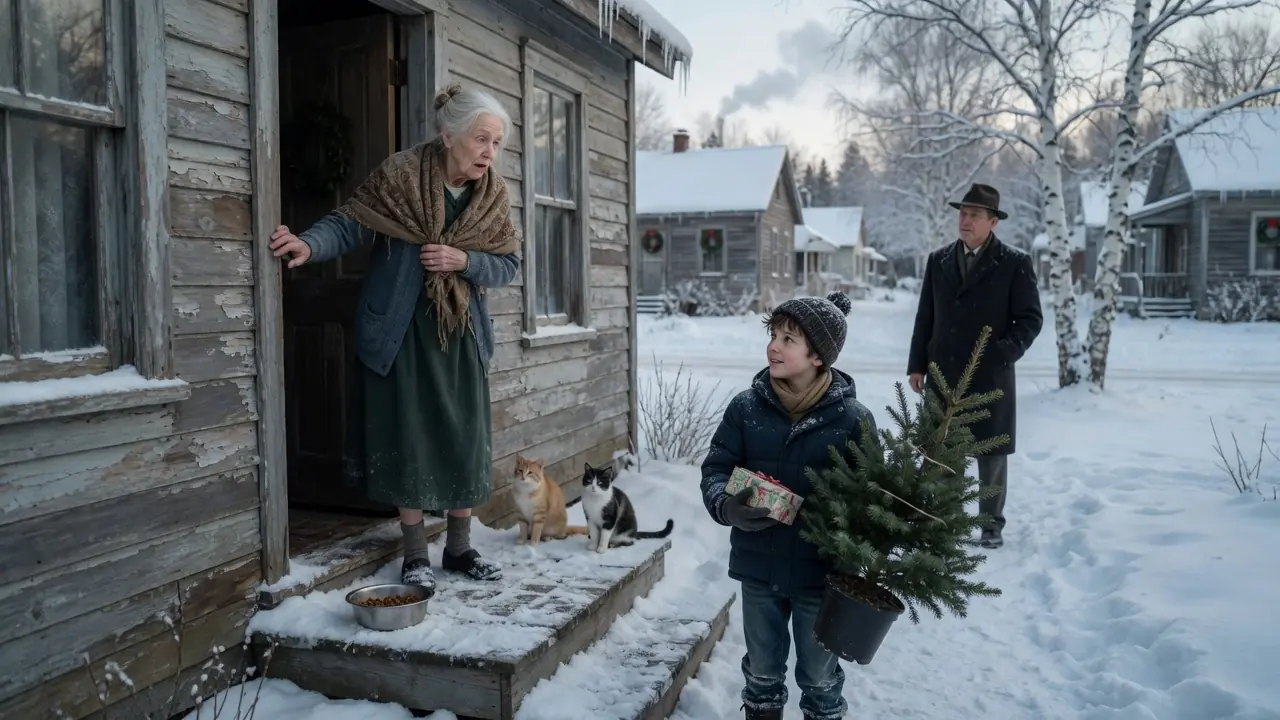
Martha stared at him, then at the box, then back at him.
"You brought me a gift?"
"Yes, ma'am."
"Why?"
The question hung in the cold air between them.
"Because," Ethan said slowly, choosing his words carefully, "you brought a gift to the church, and I don't think anyone opened it. And I thought... I thought you should have one, too. From someone who knows you gave one."
Martha's hand went to her throat, her eyes filled with tears.
"I don't understand," she whispered.
"You don't have to," Ethan said. "Just Merry Christmas, Mrs. Miller."
He turned to go.
"Wait," she said.
He stopped.
Martha stepped out onto the porch, her bare feet against the cold wood.
She picked up the box and held it like it was made of glass.
"Come inside," she said, her voice shaking. "Please."
Inside, Martha sat at the small kitchen table and stared at the wrapped box.
Her hands trembled as she reached for it.
"Should I open it?" she asked.
"If you want to."
She unwrapped it slowly, carefully, like she was afraid of tearing the paper.
When she pulled out the wooden ornament, she gasped softly.
"It's beautiful," she said.
"It was my favorite," Ethan said. "My mom gave it to me when I was little. I've kept it every year."
Martha looked up at him, her eyes wide.
"Then I can't take this. It's too precious."
"That's why I want you to have it," Ethan said. "So you know you're precious, too."
The tears spilled over then, running down her wrinkled cheeks.
She clutched the ornament to her chest and began to sob, deep shuddering sobs that seemed to come from somewhere ancient and buried.
Ethan did not know what to do.
He stood there awkwardly, hands in his pockets, watching her cry.
"I'm sorry," he said. "I didn't mean to make you sad."
"I'm not sad," Martha said, wiping her eyes with her sleeve. "I'm... I haven't felt this seen in so long. No one's given me a gift in years. Not since Samuel."
She could not finish.
She just sat there crying and holding the ornament.
After a moment, she took a deep breath and stood up.
She walked over to a small closet and pulled out a package wrapped in newspaper.
The one from the church.
"I took it back," she said quietly. "After the service, I waited until everyone was gone and I went back and got it because I thought... I thought no one would want it anyway."
She handed it to Ethan.
"But I think it was meant for you," she said.
Ethan took the package carefully.
He unwrapped it, and inside was a scarf, hand-knitted and soft, in shades of deep blue and gray like winter sky.
"I made it myself," Martha said. "My hands aren't as steady as they used to be, so it's not perfect, but it's warm."
Ethan wrapped the scarf around his neck.
It was soft and heavy and smelled faintly of lavender.
"It's perfect," he said.
Martha smiled through her tears.
It was a real smile this time.
Not sad or bitter.
Just grateful.
"Thank you, Ethan," she said. "For seeing me. For remembering me."
"You're welcome, Mrs. Miller."
They stood there in the quiet kitchen, an old woman and a young boy, two people who had been invisible to most of the world, now seeing each other clearly.
Outside, the sun began to rise, painting the snow gold.
By the time the sun had fully risen on that December morning, Linda Carter was pacing the kitchen floor, her slippers making soft shuffling sounds against the tile.
She had checked Ethan's room three times already.
The bed was made, unusual for him.
His winter coat was gone.
His boots were not by the door.
"Robert," her voice was tight when her husband came downstairs, still tying his tie. "Ethan's not here."
Robert looked up from his phone, where he had been reading the morning news.
"What do you mean?"
"I mean he's not in his room. He's not in the house. His bike is gone."
She wrapped her arms around herself.
"Where would he go this early? It's barely past 7."
Robert set down his phone, his mayor's instinct for staying calm kicking in.
"He probably went to Kevin's. You know how boys are after Christmas. They want to show off their presents."
"This early? Without telling us?"
Linda shook her head.
"That's not like him, Robert. He always tells me where he's going."
Robert pulled out his phone and dialed Kevin's house.
He could hear the ring through the speaker, then Kevin's mother's sleepy voice answering.
"Hi, Sarah. Sorry to call so early. Is Ethan over there?"
A pause.
"Ethan? No, I haven't seen him. Is everything okay?"
"I'm sure it's fine. He probably just went for a ride. Thanks."
He hung up and looked at Linda.
"He's not there."
The calm was starting to crack now.
Linda's hands were shaking as she reached for her own coat.
"We need to look for him. Robert, what if something happened? What if he fell off his bike? Or..."
"Linda."
Robert took her shoulders gently.
"I'll find him. He can't have gone far. I'll drive around the neighborhood. You stay here in case he comes back."
She nodded, but her face was pale with worry.
Robert grabbed his keys and headed out to his truck.
The morning was cold and bright, the kind of cold that made the snow squeak under your boots and the air hurt your lungs.
He started the engine and pulled out onto Maple Street, driving slowly, his eyes scanning every sidewalk, every yard, every space between houses.
Nothing.
He drove to the park where the kids liked to sled.
Empty, except for a few crows picking at something in the snow.
He checked the school playground, the library parking lot, even the gas station where Ethan sometimes went to buy candy with his allowance.
No sign of him.
Robert felt something cold settle in his stomach that had nothing to do with the weather.
He was the mayor.
He was supposed to keep people safe, and he could not even keep track of his own son.
He pulled over on Main Street and sat there for a moment, thinking.
Where would Ethan go?
What had he been interested in lately?
And then, like a puzzle piece clicking into place, he remembered the conversation at dinner a few nights ago.
Ethan asking about Martha Miller.
Linda explaining why people did not visit her.
The way Ethan had gone quiet, that look on his face that meant he was thinking about something, really thinking, the way he did when something bothered him.
Robert put the truck in gear and headed toward Birch Road.
The street was quiet.
Most people were still inside, sleeping late after the holiday.
Robert drove slowly down the narrow road.
Past the Hendersons' house with its elaborate light display.
Past the Johnsons' place with the inflatable snowman in the yard.
And then he saw it.
At the very end of the road, leaning against the weathered fence of Martha Miller's house, was Ethan's bike.
Robert's hands tightened on the steering wheel.
Of all the places in town, his son was here.
At the house everyone avoided.
The house of the woman people whispered about at town council meetings, saying someone should check on her, but no one ever volunteering to actually do it.
He parked the truck and got out.
His breath steamed in the cold air.
Snow crunched under his boots as he walked up to the house.
The place looked worse up close than it did from the road.
Peeling paint.
A sagging porch.
Gutters clogged with ice.
He had driven past this house a hundred times and never really looked at it.
Never really thought about the person inside.
He climbed the steps carefully, testing each one to make sure it would hold his weight.
And then, through the front window, the glass foggy with age and cold, he saw them.
Ethan and Martha Miller sitting at a small table in what must be the kitchen.
Two mugs between them, steam rising.
The old woman was smiling.
Really smiling.
Her whole face transformed by it.
And Ethan was talking, his hands moving the way they always did when he was excited about something.
Robert stood there frozen, trying to reconcile what he was seeing with what he had expected to find.
This was the woman people called difficult, unfriendly, strange.
The woman who turned down every offer of help, who never came to town events, who lived like a ghost at the edge of their community.
And she was smiling at his son like he had just given her the moon.
Robert raised his hand and knocked.
The sound seemed loud in the quiet morning.
Through the window, he saw Ethan's face go pale.
He saw Martha stand up slowly, her hands smoothing down her robe, her expression shifting to something weary.
The door opened.
She was smaller than Robert had imagined.
Tiny, really.
Barely came up to his shoulder.
Her hair was white as the snow outside, loose around her face instead of pinned up.
Her hands were gnarled with arthritis, clutching the collar of a faded bathrobe.
But her eyes, pale blue and watery with age, were sharp and alert.
"Mr. Carter," she said, her voice rough like she did not use it much. "Your son is fine. He's been no trouble."
Robert realized he was staring.
"Mrs. Miller, I'm sorry to bother you so early. I was just... I was looking for Ethan."
"He's inside. Would you like to come in?"
It was not really a question the way she said it.
More like a challenge, like she expected him to refuse, to make some excuse and take his son and leave.
Robert took a breath.
"Yes. Thank you."
She stepped back, and he ducked through the doorway into the small house.
Inside was warmer than he had expected, but barely.
A space heater glowed in the corner, doing its best against the cold seeping through the walls.
The furniture was old.
Not antique old.
Just worn-out old.
A couch with fabric so faded you could not tell what color it had been originally.
A rocking chair with a quilted cushion that had been mended a dozen times.
A table with mismatched chairs.
But everything was clean and orderly, the kind of clean that spoke of too much time and too little to fill it with.
On the wall hung a single photograph, a wedding picture by the looks of it.
A young couple standing in front of this very house when it was new and bright.
The man had kind eyes.
The woman, Robert looked closer, was Martha 40 years younger, her face unlined and full of hope.
"Dad."
Ethan stood by the table, the blue scarf wrapped around his neck.
His face was red, but he met Robert's eyes steadily.
"I'm sorry I left without telling you. I just wanted to bring Mrs. Miller her Christmas present."
"Her Christmas present," Robert repeated slowly, trying to make sense of it.
"Yes, sir. Because she brought one to the church and nobody opened it, so I thought she should have one, too."
Robert looked at Martha.
She had moved to stand behind the rocking chair, her hands gripping its back like she needed support.
"Is that true, Mrs. Miller? You brought a gift to the church?"
"It was nothing," she said quickly. "Just something I made. I thought someone might need it."
"She made a scarf," Ethan said. "A beautiful scarf. She gave it to me because I gave her my Christmas ornament, the one Grandma gave me."
Robert felt something shift in his chest.
His son, his 12-year-old son, had given away his favorite ornament to a woman the whole town had forgotten.
Had gotten up before dawn to deliver a Christmas present to someone who spent the holiday alone.
"Ethan," he said, and his voice came out rougher than he meant it to. "Do you know how worried your mother is?"
"I know. I'm sorry. I should have left a note."
"Yes, you should have."
Robert paused.
"But I'm proud of you."
Ethan blinked.
"You are?"
"Yes."
Robert pulled out one of the chairs and sat down heavily.
He looked at Martha.
Really looked at her.
Saw the thinness of her face.
The worn-out quality of everything around her.
Saw the loneliness etched into every corner of this house.
"Mrs. Miller," he said carefully. "How long have you lived here alone?"
She lifted her chin slightly, a gesture of pride.
"Sixteen years. Since Samuel passed."
Sixteen years.
Robert felt the weight of that.
Sixteen years of holidays alone.
Sixteen years of this town driving past her house without stopping.
"I'm sorry. We should have... I should have checked on you."
"People tried," Martha said, her voice barely above a whisper at first. "But I wasn't ready for help. I pushed everyone away. By the time I realized I needed people again, everyone had moved on."
"That doesn't make it right," Robert said. "You're part of this community. You shouldn't have been alone all this time."
Martha's eyes filled with tears.
"I didn't think anyone remembered I existed."
"Well," Ethan said softly, "I did."
Robert stood up and walked to the window, looking out at the snow-covered yard.
He was thinking about all the town council meetings where someone had mentioned Martha Miller in passing.
Someone should check on her.
I wonder if she's doing okay.
Maybe we should organize something.
All those conversations that went nowhere because everyone assumed someone else would do it.
Because it was easier to worry in the abstract than to actually knock on a door.
He turned back to Martha.
"Mrs. Miller, I'd like to help, if you'll let me."
She looked at him wearily.
"Help how?"
"However you need. Your house needs repairs. I can organize a work crew. You need groceries, someone to shovel your walk, drive you to appointments. Whatever it is, we'll figure it out."
"I don't want charity," Martha said.
And there was steel in her voice despite the trembling.
"It's not charity. It's community. It's what neighbors do for each other."
Robert ran a hand through his hair.
"Look, I'm the mayor. I give speeches all the time about how Willow Creek takes care of its own. But the truth is, we haven't taken care of you. And that's my failure as much as anyone's. Let me make it right."
Martha was crying now, silent tears running down her wrinkled cheeks.
"I don't know what to say."
"Say yes," Ethan said. "Please, Mrs. Miller. Let people help."
She looked at him, at this boy who had seen her when no one else did, and slowly nodded.
"Okay," she whispered. "Yes."
Robert made phone calls from Martha's front porch while Ethan stayed inside with her.
First, he called Linda, told her Ethan was safe.
He would explain everything when they got home.
Then he called Father Thomas.
"Tom, it's Robert Carter. I need you to meet me at Martha Miller's house. Yes, Martha Miller. And bring whoever you can gather from the church. We have work to do."
Next, he called Jim Johnson, who owned the hardware store.
"Jim, remember how we were talking about doing something for Martha Miller? Well, today's the day. Get your truck and whatever supplies you think we'll need for basic repairs. I'll reimburse you."
Then Sarah Chen from the bakery.
"Sarah, I need a favor. Can you put together some food, bread, pastries, whatever you have, and spread the word? Tell people to come to Martha Miller's house. Tell them to bring whatever they can spare."
The calls went on one after another, the mayor mobilizing his town.
When he finished, he went back inside.
Martha and Ethan were sitting at the table again, not talking, just sitting together in comfortable silence.
Storm, the gray cat, was curled up in Ethan's lap.
"Mrs. Miller," Robert said, "I hope you don't mind company because I think you're about to have a lot of it."
They started arriving within the hour.
Father Thomas came first, his old station wagon loaded with boxes of food from the church pantry.
Behind him came the Johnsons with their truck full of lumber and tools.
Then the Chens with fresh bread and pastries still warm from the oven.
Then more cars, more trucks, more people carrying casseroles and blankets and space heaters and kindness in their hands.
Martha stood on her porch, overwhelmed as her tiny yard filled with neighbors.
People she had not spoken to in years.
People she thought had forgotten her name.
Mrs. Patterson, who had once been her closest friend, climbed the steps with tears streaming down her face.
"Martha, I'm so sorry. I should have kept trying."
"I should have..."
"Hush," Martha said, pulling her into a hug. "You're here now. That's what matters."
Father Thomas organized everyone with practiced efficiency.
The men started on repairs, fixing the sagging porch, clearing the gutters, patching the roof.
The women went inside to clean and organize, bringing in the food, setting up the new space heater.
The children played in the yard, building snowmen, their laughter echoing off the trees.
Ethan worked alongside his father, handing him tools, holding boards steady.
At one point, Robert paused and looked at his son.
"You did this," he said quietly. "You started all of this."
"I just gave her an ornament," Ethan said.
"No," Robert said. "You gave her something more important. You gave her dignity. You told her she mattered. And look what happened."
They looked around at the community that had gathered.
At people working together, helping someone they had forgotten.
At Martha sitting on her porch with Mrs. Patterson and Mrs. Chen, all of them laughing about something.
The sound was bright and alive.
"One act of kindness," Robert said. "That's all it took to remind us who we're supposed to be."
The transformation did not happen overnight.
It happened in small moments, day by day, like snow accumulating until suddenly you looked around and everything was different.
The Monday after Christmas, Mrs. Chen knocked on Martha's door with a loaf of sourdough bread.
"I made extra," she said, which they both knew was a lie, but a kind one.
Tuesday, Jim Johnson came by to check on the repairs he had made.
He ended up staying for tea while Martha told him stories about the town 40 years ago, when Main Street was just dirt and the church was half the size it was now.
Wednesday, a group of teenagers from the youth group showed up to shovel her walk and rake the snow off her roof.
They stayed to play with the cats, laughing as Storm chased the younger ones around the yard.
Thursday, Father Thomas invited Martha to join the church's senior lunch program.
"We meet every week," he said. "Just a group of folks getting together for a meal and conversation. We'd be honored if you'd come."
Martha hesitated.
The walls she had built were tall and thick, and 16 years was a long time to live behind them.
But when she looked at Father Thomas's kind face, at his patient waiting, she felt something crack inside her.
"I'd like that," she said.
That Sunday, Martha walked into St. Mary's Church through the front door.
Not the side door where she could slip in unnoticed.
The front door where everyone would see her.
She wore her best dress, which was not much, but it was clean and pressed.
She pinned her white hair up carefully.
Her hands shook as she pulled open the heavy wooden door, but she kept walking.
The sanctuary was filling up with people.
Families settling into their usual pews.
Children squirming in their Sunday clothes.
The organ playing softly in the background.
Martha stood in the doorway, suddenly frozen.
This was a mistake.
Everyone would stare.
They would whisper.
They would wonder what she was doing here after all this time.
But then Mrs. Patterson saw her and smiled.
A real smile, warm and welcoming.
She waved Martha over to sit beside her.
And then Mrs. Chen turned and nodded in greeting.
And then Jim Johnson tipped his head in acknowledgement.
One by one, people saw her.
And one by one, they smiled.
Martha walked down the aisle, her steps careful on the old floorboards, and slid into the pew beside Mrs. Patterson.
Her friend took her hand and squeezed it.
"Welcome back," she whispered.
After the service, Father Thomas stood at the pulpit for announcements.
But instead of talking about the usual things, the youth group meeting, the bake sale, the roof fund, he said something different.
"Friends, I want to talk about something important this morning. About what it means to be a community."
The congregation settled, listening.
"This Christmas, something remarkable happened. We were reminded by a child, no less, that every single person in this town matters. That no one should be forgotten or overlooked."
"That our strength as a community isn't measured by our Christmas lights or our festivals, but by how we care for the most vulnerable among us."
He paused, letting the words sink in.
"Martha Miller has been part of Willow Creek for over 40 years. Many of us knew her and Samuel. We remember them as good people, kind neighbors. And when Samuel passed, we tried to help."
"But when our help was refused, we gave up. We told ourselves she wanted to be alone. And maybe that was true for a time. But somewhere along the way, space became distance, and distance became forgetting."
Martha felt tears prick her eyes.
Mrs. Patterson's hand tightened around hers.
"A young boy in our congregation refused to forget. Ethan Carter saw what the rest of us had stopped seeing. A lonely woman who needed to know she still mattered."
"He brought her a gift, just a simple gift. And that one act of kindness reminded us all of something we had lost sight of."
Father Thomas looked directly at Martha now.
"Martha, would you stand up, please?"
She felt panic flutter in her chest.
She shook her head slightly.
"Please," Father Thomas said gently.
Mrs. Patterson nudged her.
"Go on."
Slowly, legs trembling, Martha stood.
The congregation began to applaud.
Not loud or theatrical.
Just steady, warm, genuine appreciation.
People standing in their pews, clapping for her.
For her survival.
For her presence.
For her willingness to come back.
Martha covered her face with her hands and cried.
But they were good tears this time.
Healing tears.
When the applause finally died down and she sat back down, she felt something she had not felt in 16 years.
She felt like she belonged.
In the weeks that followed, Martha became part of the church's community in ways she never had before.
She joined the Wednesday lunch group, where she discovered she was not the only person who had felt invisible.
There were others.
Widows, widowers, people who had lost touch with family.
Together, they formed their own family of sorts.
She started teaching a knitting class on Thursday afternoons.
Women came to learn, but they stayed for the stories Martha told while their hands worked the needles.
Stories about the old days.
About Samuel.
About the town's history.
She volunteered to mend altar cloths and choir robes, her skilled fingers making invisible repairs.
And every Sunday, she sat in that same pew beside Mrs. Patterson, no longer an outsider looking in, but a full member of the community.
One February afternoon, Ethan stopped by after school to find Martha's living room full of scarves.
They were everywhere.
Draped over chairs.
Folded on the couch.
Hanging from doorknobs.
Red ones, blue ones, striped and solid, thick winter ones, and lighter spring ones.
"Mrs. Miller," he said, laughing. "What's all this?"
Martha looked up from her knitting, her eyes bright.
"Scarves for the homeless shelter. Father Thomas mentioned they needed them, so I've been making them. I have time now."
She gestured around.
"And I have help."
Ethan looked closer and saw that several of the scarves had little notes attached.
Made with love by Martha M.
Stay warm.
You matter.
From a friend.
His throat tightened.
This was the woman people had called strange, difficult, unfriendly.
The woman everyone had given up on.
"How many have you made?" he asked.
"Forty-three so far. I'm trying to get to 50 before the coldest part of winter."
"That's amazing, Mrs. Miller."
She set down her knitting and looked at him.
"No, Ethan. What you did was amazing. You gave me my life back. The least I can do is use it to help others."
March came to Willow Creek slowly, the snow melting in patches, revealing brown grass and the first green shoots of crocuses.
The days grew longer, the sun stronger.
People started talking about Easter, about spring planting, about the future.
Ethan continued to visit Martha regularly.
Their friendship had become something solid and real, the way friendships do when they are built on genuine care rather than convenience.
Sometimes Kevin came along, and the two boys would play with the cats while Martha made hot chocolate.
Sometimes Ethan came alone, and they would sit in comfortable silence while she knitted and he did homework.
One afternoon in late March, Martha said something that surprised him.
"I've been thinking about my house."
Ethan looked up from his math book.
"What about it?"
"It's too big for just me. And my bedroom is upstairs, which is getting harder to manage with my knees. I was thinking..."
She paused, choosing her words carefully.
"I was thinking of renting out the upstairs to someone who needs a place to stay."
"That's a great idea."
"Father Thomas knows a young woman, recently divorced, with a small child. They need somewhere affordable to live while she gets back on her feet. I thought maybe..."
Martha looked almost shy.
"Maybe they could live here. I'd have company. They'd have a home. It seems like it might work."
Ethan smiled.
"I think it would work perfectly."
And it did.
By April, Jennifer and her four-year-old daughter Lily had moved into the upstairs apartment.
The house that had been silent for 16 years suddenly filled with the sound of footsteps, of a child's laughter, of life.
Martha bloomed with purpose.
She watched Lily while Jennifer worked, teaching the little girl to feed the cats and water the flowers that were starting to push up through the soil.
She made soup and left it in Jennifer's refrigerator on days when the young mother worked late.
She became, in many ways, the grandmother Lily had never had.
"I used to think my life was over," Martha told Ethan one evening as they sat on the porch watching Lily chase butterflies in the yard. "When Samuel died, I thought the best part of me died, too. But I was wrong. I just had to find a new way to live, a new purpose."
"You always had purpose," Ethan said. "You just forgot for a while."
She smiled at him.
"You're wise for a 12-year-old."
"Thirteen now," he corrected. "I had a birthday last week."
"Thirteen."
Martha shook her head.
"Time moves too fast. Before I know it, you'll be off to college and too busy for an old woman."
"Never," Ethan said firmly. "You're my friend, Mrs. Miller. That doesn't change."
She reached over and squeezed his hand.
"Thank you, Ethan. For everything. For seeing me. For refusing to give up. For giving me back my life."
"You did the hard part," Ethan said. "You let people back in."
In May, the town organized its annual spring festival.
It was a tradition going back decades.
Games, food stands, live music, a craft fair.
Everyone participated.
This year, Martha had a booth.
She sold the scarves, mittens, and hats she had been making all winter, with all proceeds going to the homeless shelter.
But more than that, she was present.
Visible.
Part of the fabric of the community again.
Ethan helped her set up her table, arranging the colorful knitwear in neat rows.
People stopped by all day.
Some to buy.
Some just to chat.
All of them glad to see her there.
Robert Carter, in his capacity as mayor, made a speech about community resilience and supporting local artisans.
But when he finished, he walked over to Martha's booth and bought three scarves.
"For next winter," he said, handing her the money.
"Thank you, Mr. Mayor."
"Robert," he corrected. "Just Robert."
She smiled.
"Thank you, Robert."
Later, as the sun was setting and vendors were packing up, Ethan and Martha sat on a bench overlooking the festival grounds.
"You know what strikes me?" Martha said thoughtfully. "How easy it would have been for things to stay the way they were. For me to stay alone in that house, for everyone to keep pretending I didn't exist."
"It wouldn't have taken much. Just continued inaction. Just everyone looking the other way."
"But we didn't," Ethan said.
"No. Because you didn't."
One person.
One child decided that was not acceptable, and that changed everything.
She looked at him seriously.
"Never underestimate your power to change things, Ethan. Even when you're young, even when you're just one person, you have more power than you know."
Summer arrived in full force, bringing heat and thunderstorms and the lazy rhythm of vacation days.
Ethan spent his mornings playing baseball with Kevin and his afternoons visiting Martha, who had planted a garden that was now bursting with tomatoes and zucchini and sunflowers tall as a man.
One July afternoon, as they sat shelling peas on the porch, Martha said something unexpected.
"I think I'd like to tell you about Samuel, if you'd like to hear."
Ethan set down his bowl.
"I'd like that."
Martha looked out over her garden, her eyes distant with memory.
"We met at a church social. I was 19, wearing a yellow dress my mother had made. He was 21, just back from the Navy, wearing his uniform. He asked me to dance, and I said yes, and that was that."
She smiled, lost in the past.
"We knew immediately. We got married 6 months later. Everyone said we were too young, too hasty. But we were right. We had 42 good years together. Forty-two years of laughter and arguments and making up and building this life."
"What was he like?" Ethan asked.
"Kind. Patient. Funny in a quiet way. He worked at the mill. Hard physical labor, but he never complained. He would come home tired and dirty, but always with a smile for me. Always asking about my day like it was the most important thing in the world."
Her voice grew softer.
"We wanted children. Tried for years, but it wasn't meant to be. And that hurt for both of us. But we had each other. We thought that would be enough."
"What happened to him?"
"Heart attack. Sudden, massive. He was working in the yard, planting those roses over there. Just collapsed. Gone before the ambulance arrived."
Martha's hands stilled in her lap.
"I blamed God for a long time. Blamed fate. Blamed myself for not noticing he was sick. And in my grief, I pushed everyone away, built these walls so high that even I couldn't see over them anymore."
She turned to Ethan.
"That's the thing about grief. It tricks you. Makes you think isolation is safety. That if you don't let anyone in, you can't lose anyone else. But that's not living. That's just existing. And I existed for 16 years before you knocked on my door and reminded me that I was still alive."
"I'm glad I did," Ethan said quietly.
"So am I."
Martha picked up another pea pod.
"Samuel would have liked you. He always wanted a son. Would have taught you to fish, to fix cars, to see the worth in ordinary things. But maybe, in a way, you're the gift he left me. A reminder that family isn't just blood. It's chosen. It's built through kindness and time and showing up."
As summer turned to fall, Ethan started eighth grade.
He was taller now, his voice deeper, but he still visited Martha every week.
That routine was as solid as anything in his life.
One September afternoon, Father Thomas stopped by while Ethan was there.
He had news.
"Martha, the church council met yesterday. We've been discussing how to better serve isolated members of our community, people who might be struggling alone the way you were."
"And we'd like to start a program. A visitation ministry, a phone tree, regular check-ins. We want to make sure no one falls through the cracks again."
"That's wonderful," Martha said.
"We'd like you to help lead it," Father Thomas continued. "You understand what it's like to be forgotten. You could help others who are experiencing the same thing."
Martha looked stunned.
"Me? Lead a program?"
"Who better? You've lived it. You've come through the other side. You know what people need."
She glanced at Ethan, who nodded encouragingly.
"Yes," she said finally. "Yes, I'd be honored."
The program launched in October.
Martha and a team of volunteers began reaching out to elderly residents, people who had lost spouses, anyone who seemed isolated.
They organized weekly phone calls, monthly home visits, transportation to church and doctor's appointments.
It started small, but it grew.
Within 3 months, they were helping 15 people.
By spring, it was 30.
The forgotten ones were slowly being remembered.
Ethan watched Martha transform from someone who needed help to someone who gave it.
Her house became a hub of activity.
Volunteers meeting there to coordinate.
Lonely people stopping by for tea and conversation.
A constant flow of life.
"This is what I was meant to do," Martha told him one day. "All those years of suffering weren't meaningless. They taught me something. They prepared me to help others. Sometimes your pain becomes your purpose."
Years passed.
Ethan went to high school, then college.
He studied social work, inspired by what he had witnessed in his own town.
Martha grew older, but no less active.
Her visitation program expanded to neighboring towns.
On Ethan's 18th birthday, Martha gave him a gift.
A small wooden box, carefully crafted.
"Open it," she said.
Inside was the Christmas ornament he had given her all those years ago.
The simple carved tree with the gold star.
"I've kept it safe all this time," Martha said. "But I think it's time to give it back. You'll be leaving for college soon, starting your own life. I want you to take this with you to remember."
"Remember what?" Ethan asked, his voice thick.
"Remember that one person can change everything. That kindness matters. That no one, no one, is beyond reach if someone is willing to try. You taught me that when you were 12 years old. Don't ever forget it."
Ethan hugged her, this tiny woman who had become so important to his life.
"I won't forget, Mrs. Miller. I promise."
Martha Miller lived to be 92 years old.
When she passed peacefully in her sleep with Jennifer and Lily by her side, the church overflowed with mourners.
Not because she had been famous or wealthy or powerful, but because she had mattered.
Because she had let people see her struggle and her triumph.
Because she had taken her pain and transformed it into purpose.
At her funeral, Father Thomas spoke about the miracle of redemption, about second chances, about how one act of kindness from a child had transformed an entire community.
Ethan, now 24 and working as a social worker in the city, stood to speak.
"When I was 12," he said, his voice carrying through the packed sanctuary, "I met a lonely woman who the world had forgotten. And she taught me the most important lesson of my life. That everyone deserves to be seen. Everyone deserves to be remembered. Everyone deserves to know they matter."
He looked out at the crowd.
At the people whose lives Martha had touched through her visitation program.
At Jennifer and Lily, who had become her family.
At the countless others who had learned from her example.
"Mrs. Miller used to say that her years of isolation weren't wasted. That they taught her empathy. That they prepared her to help others. And she was right. But I think there's another lesson, too."
He paused, gathering his thoughts.
"The lesson is this. We all have the power to change someone's life. Not someday when we're older or richer or more established. Right now. Today. With the simplest acts of kindness. A visit. A gift. A refusal to look away when everyone else does."
"Don't wait for someone else to help. Don't assume someone else will care. Be the one who sees. Be the one who acts. Be the one who refuses to let another human being disappear into loneliness."
"Because here's what I learned from Martha Miller. The smallest acts of kindness can create the biggest changes. One conversation can save a life. One gift can restore hope. One person who refuses to forget can remind an entire community what it means to be human."
His voice grew stronger.
"So don't underestimate your power. Don't tell yourself you're too young, too small, too insignificant to make a difference. You're not. You have everything you need to change the world. You just have to care enough to try."
"Martha Miller spent 16 years invisible before someone finally saw her. Sixteen years. How many people in your life right now are counting down their days, waiting for someone to notice they're struggling?"
"How many neighbors, co-workers, classmates are sitting alone, believing they don't matter? Don't let them wait 16 years. Don't let them wait 16 days. See them today. Reach out today. Be the difference today."
"That's what Mrs. Miller taught me. That's what she would want me to tell you. That's her legacy."
Ethan looked up at the wooden cross hanging above the altar.
"Thank you, Martha," he said quietly. "For teaching me to see. For reminding me that kindness is never wasted. For showing me that it's never too late to come home. I'll remember. I promise. And I'll make sure others remember, too."
Long after that funeral, long after Ethan had built his career around helping forgotten people, long after the town of Willow Creek had become known for its compassion and community care, the lessons remained.
Loneliness is closer than you think.
The most isolated people are often the ones you pass every day.
The quiet neighbor.
The elderly person at church.
The co-worker who eats lunch alone.
They are not invisible because they want to be.
They are invisible because we have stopped looking.
Walls are often cries for help.
When someone pushes you away, it is usually because they are afraid.
Afraid of rejection.
Afraid of being a burden.
Afraid that if they let you in, you will leave like everyone else.
Do not take the first no as final.
Keep trying.
Keep caring.
Keep showing up.
Small acts create big changes.
You do not need grand gestures to change a life.
A visit, a phone call, a homemade gift.
These simple things can mean everything to someone who has forgotten what it feels like to matter.
Your age does not define your impact.
Ethan was 12 years old when he changed Martha's life.
Twelve.
You are never too young to make a difference.
You are never too insignificant to change the world.
Pain can become purpose.
Martha's 16 years of isolation were not meaningless.
They taught her empathy.
They prepared her to help others.
Your struggles are not wasted.
They are training you for something bigger.
Community is a choice.
It does not happen automatically.
It requires intention, effort, the willingness to see beyond your own life and notice the people on the margins.
The decision to act even when it is uncomfortable.
Everyone deserves to be remembered.
Not just on holidays.
Not just when it is convenient.
Every single day, every single person deserves to know they are seen.
They are valued.
They matter.
It is never too late.
Martha was 74 when her life changed.
Seventy-four.
It is never too late to reach out.
Never too late to let people in.
Never too late to start again.
The story of Ethan and Martha is not unique.
It is happening right now in towns and cities everywhere.
Lonely people waiting.
Young people noticing.
Communities forgetting and remembering.
The question is, which part of the story will you be?
Will you be the one who notices or the one who looks away?
Will you be the one who acts or the one who assumes someone else will?
Will you be the one who changes a life or the one who lets another person fade into invisibility?
The choice is yours.
But remember Martha Miller.
Remember that she almost did not make it.
That if one boy had not knocked on her door, her story would have ended very differently.
And remember this.
Someone near you right now is just like Martha was.
Alone.
Forgotten.
Waiting for someone to see them.
Be the someone who does.