Downtown Atlanta was already moving too fast for anyone to notice one old man slowing down.
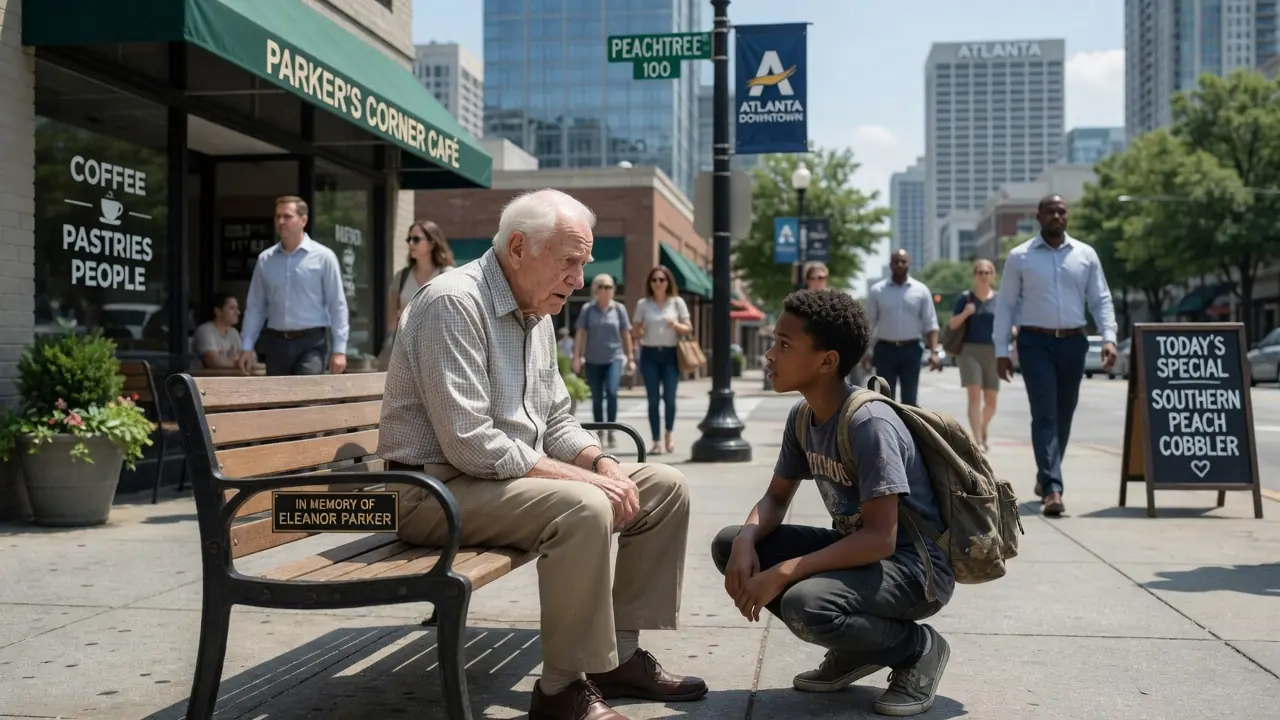
Robert Miller stood near a bench outside a small café on Peachtree Street, turning his head slightly as if the world might suddenly make sense again if he looked at it from the right angle. Cars passed. Footsteps passed. Voices passed. Nothing stayed.
He blinked.
For a moment, he wasn’t sure why he was standing there.
“James?” he called out.
No answer.
The name felt correct, but it didn’t return anything useful.
His son had been beside him just minutes ago. Or maybe longer. Time had stopped behaving properly a while back.
Robert sat down slowly, hands trembling as he tried to anchor himself. A folded newspaper lay on the bench. He picked it up, stared at the date, then let it fall.
The numbers didn’t mean anything anymore.
His chest tightened.
Not pain exactly. Something worse. Uncertainty without edges.
He tried to remember his address.
Nothing.
He tried to remember his phone number.
Nothing.
The city kept moving like he wasn’t there at all.
Then a small voice cut through the noise.
“Hey… you okay?”
Robert turned.
A boy stood a few steps away. Thin. Careful. Wearing a faded shirt and holding a backpack that looked too heavy for him.
“I… I don’t know,” Robert admitted.
The boy didn’t hesitate. He just sat down beside him like it was the most natural thing in the world.
“I’m Marcus,” he said. “What’s your name?”
“Robert Miller.”
“Okay, Mr. Robert. That’s good. You remember your name, that’s something.”
Robert let out a shaky breath.
“I can’t remember where I’m supposed to be.”
Marcus nodded, like he understood that kind of fear too well.
“That’s alright. You’re not alone now.”
Something in those words steadied Robert just enough to breathe properly again.
Marcus glanced at him, then at the empty street.
“You hungry?”
Robert didn’t know. He couldn’t remember eating. He couldn’t remember not eating.
“I might be.”
Marcus reached into his backpack and pulled out a small snack. Hesitated for only a second before offering it.
“It’s not much,” he said. “But it helps.”
Robert took it carefully, like it mattered more than it should.
“Thank you,” he whispered.
Marcus shrugged.
“My grandma used to forget things too. She got scared sometimes. I used to sit with her.”
Robert looked at him longer now.
Most people had walked past.
This boy had stopped.
“Why did you stop?” Robert asked quietly.
Marcus looked surprised by the question.
“Because you needed help.”
As if that was the simplest answer in the world.
Then Marcus stood.
“There’s a deli around the corner. We can get you something real to eat. My treat.”
Robert blinked.
“I don’t have any money.”
Marcus already started walking.
“I do.”
And just like that, Robert followed.
Inside the deli, the smell of bread and meat and warmth hit Robert like something half-forgotten. Marcus guided him gently to a table, then ordered with quiet confidence.
When the bill came, Marcus counted every dollar carefully from a worn envelope.
Robert watched him.
“This is your money,” Robert said slowly.
“Yeah,” Marcus replied. “I’ve been saving it.”
“For what?”
Marcus paused just briefly.
“To fix our hot water at home. My mama works hard. She deserves better than cold showers.”
Robert didn’t know what to say to that.
So he just watched.
A few minutes later, James burst through the door.
“Dad!”
Relief first. Then anger. Then suspicion.
“Where were you?” James grabbed Robert’s arm. “Do you know what you did to everyone?”
Marcus froze.
James looked at him and misread everything in a single glance.
“What did you do to him?”
Marcus stepped back.
“I just bought him food. He was lost.”
But James wasn’t listening.
He was already dialing.
“Police. Now.”
Marcus’s voice cracked.
“That’s not what happened.”
Robert tried to speak.
“I… he helped me…”
But the words fell apart halfway out of his mouth.
Too many thoughts. Too much noise.
Within minutes, officers arrived.
Marcus was taken out while still trying to explain.
And Robert sat there, confused again, watching the only person who had stopped for him disappear.
He didn’t understand what had just been lost.
But somewhere deep inside him, something felt wrong.
Days passed.
Marcus was questioned.
Misunderstood.
Almost forgotten in the system that assumed too much from what it saw and too little from what it didn’t.
At home, his mother held him after it ended.
“You didn’t do anything wrong,” she said firmly.
Marcus didn’t answer.
Because he wasn’t sure the world agreed.
Weeks later, something shifted.
Marcus started getting sick.
At first it was small things—headaches, fatigue, bruises that didn’t make sense. Then it became harder to ignore. His body felt heavier every day, like it was fighting something he couldn’t see.
Doctors ran tests.
More tests.
Then silence that lasted too long.
Until the word finally came.
Leukemia.
The room went still after that.
Costs followed immediately after.
Numbers so large they didn’t feel real.
Treatment that might save him.
Treatment they couldn’t afford.
Marcus stared at the floor, thinking of the $19 he had spent on a stranger.
It felt like a different lifetime.
But somewhere else, Robert’s memory still held fragments.
On rare clear days, he remembered the boy.
The bench.
The food.
The kindness.
And the feeling that someone had seen him when the world hadn’t.
Those days, he asked one question over and over.
“Did I help him?”
And sometimes, someone answered:
“Yes. You did.”
Then came the decision.
A moment of clarity that arrived without warning.
Robert woke up and knew exactly what he had to do.
Not everything. Not always.
Just this.
He called his lawyer.
“I want to change my will.”
His son would not understand.
But Robert did not hesitate.
Because for once, the fog was not stronger than the memory of a boy sitting beside him when no one else did.
Paperwork followed.
Questions followed.
Resistance followed.
But so did certainty.
A trust was created.
Medical care funded.
A life redirected.
When Marcus learned what had happened, he couldn’t speak for a long time.
Because the same $19 that had once been given out of kindness had come back as something far larger than money.
A second chance.
Treatment began.
It was brutal.
It was slow.
It was painful in ways Marcus never had words for.
But it worked.
Bit by bit, his body began to respond.
His mother never left his side.
And somewhere in the distance, Robert faded further into his illness, holding on to fragments of memory that came and went like weather.
Months later, Marcus visited him.
Robert didn’t always recognize him.
But on that day, he did.
Just for a moment.
“The boy,” Robert whispered.
Marcus smiled through tears.
“I’m still here.”
Robert squeezed his hand weakly.
“Good.”
That was all.
But it was enough.
Years passed.
Marcus survived.
Recovered.
Then studied medicine.
Then became the kind of doctor who stayed late for patients and remembered names that others forgot.
And every so often, he would think about a bench in downtown Atlanta.
About a moment that looked small from the outside.
But wasn’t.
One day, standing in a hospital hallway, Marcus looked at a portrait on the wall.
Robert Miller.
A man most people would never have noticed.
Except for one boy who stopped walking.
Marcus smiled quietly.
Because he understood something now that he hadn’t understood then.
Kindness doesn’t always look important when it happens.
But it rarely stays small.
It spreads.
It returns.
It changes everything it touches.