A weary cashier stood at the counter of a bustling grocery store, silently hoping the meager funds in her wallet would last until the weekend.
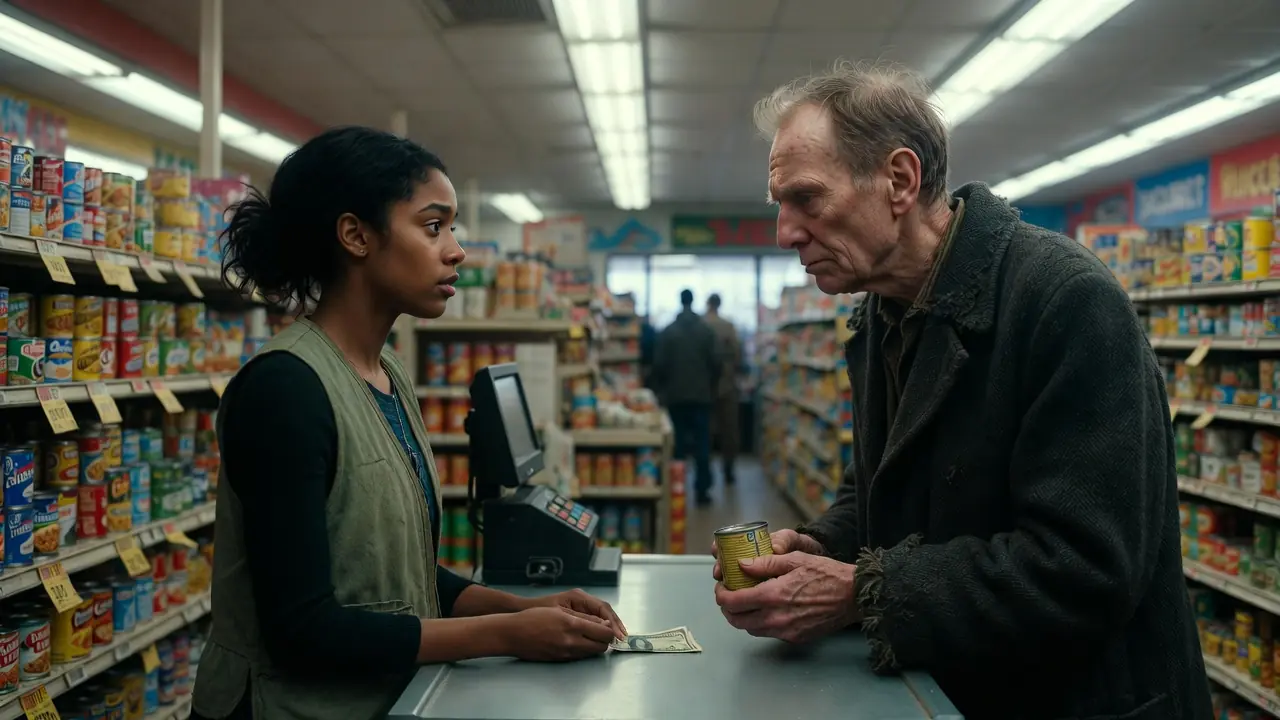
Just then, a frail, thin old man walked in, his trembling hand selecting the cheapest can of soup.
When he reached the register, he froze, realizing he was exactly eighty-five cents short.
Seeing the flush of shame on his face as he moved to put the item back, she quietly withdrew her last remaining coins to cover the difference and gently pushed the can toward him, leaving him choked with emotion.
Little did they know that seemingly ordinary act of kindness was about to turn everything upside down.
For the very next morning, his billionaire son would appear before her.
The alarm went off at 5:15 a.m., but Sarah was already awake.
She had been lying there in the dark for the past twenty minutes, listening to her father snore in the next room, watching her breath form little clouds in the freezing air.
The heat had been shut off three days ago.
She pulled herself out from under the two thin blankets and one heavy coat she had been using to stay warm.
Her body ached.
Nineteen years old, and she already felt like she was forty.
That was what happened when you worked two jobs and slept four hours a night.
The walk to Miller’s Grocery started the same way it always did.
Sarah stepped out into the brutal Illinois winter at 5:47 a.m., right on schedule.
Brookfield was still asleep, the streets empty except for the occasional car passing by, headlights cutting through the morning darkness.
She pulled her coat tighter, but it did not help much.
The thing was three years old, bought from a thrift store, and the insulation had given up long ago.
The wind went right through it.
Her phone buzzed.
She knew who it was before she even looked.
“Need $40 for electric. They’re shutting it off today.”
Her father.
Not good morning.
Not how are you?
Just a demand, like always.
Sarah’s jaw clenched as she opened her wallet while walking.
Twenty-three dollars.
That was it.
Twenty-three dollars to last her until Friday, and today was only Monday.
She typed back with numb fingers.
“I don’t have it right now.”
The reply came instantly.
“Figure it out.”
Sarah shoved the phone back in her pocket and kept walking.
The cold bit at her cheeks, but she barely noticed anymore.
She had learned to live with it.
She had learned to live with a lot of things.
By the time she reached Miller’s Grocery, her fingers were so stiff she could barely unlock the door.
The store was dark and quiet, just the way she liked it.
She had thirty minutes before her manager arrived.
Thirty minutes of peace before the day really started.
She turned on the lights, started the coffee maker, and began checking the register.
That was when she saw him for the first time.
The front door opened at 6:43 a.m.
Sarah looked up from restocking the cigarette display behind the counter and felt something catch in her chest.
An elderly man stood in the doorway, and for a moment, he did not move.
He just stood there, one hand on the door handle as if gathering the courage to step inside.
He was tall, or had been once.
Now his shoulders curved forward slightly, and he moved with the careful steps of someone whose body had betrayed him.
But it was his coat that Sarah noticed most.
A heavy wool overcoat, dark gray, the kind that probably cost a fortune once upon a time.
Now it was worn thin at the elbows.
The collar was frayed.
One of the buttons hung by a thread.
The man walked slowly down the aisles, and Sarah watched him from the corner of her eye.
There was something about the way he carried himself, like he was trying very hard to look like he belonged there.
Like this was just a normal morning errand and not something else entirely.
He picked up a can of soup, looked at the price, put it back, and picked up a different one.
His hands shook slightly as he read the label.
Sarah went back to her work, but she could not stop glancing over.
The man spent almost fifteen minutes in the store, which was unusual.
Most people who came in this early knew exactly what they wanted.
They grabbed it and left.
But this man moved slowly, methodically, like he was making calculations in his head with every item he touched.
Finally, he approached the counter.
In his trembling hands were one can of chicken noodle soup, a small loaf of bread, and a banana that had seen better days.
The bruised one that nobody else wanted, marked down to thirty cents.
“Good morning,” Sarah said, trying to sound cheerful.
The man looked up at her, and she saw his eyes for the first time.
Blue-gray.
Tired.
But somehow still sharp, intelligent.
There was a whole life in those eyes, she thought.
A whole history.
“Good morning,” he replied.
His voice was rough, like he had not used it in a while, but there was an accent to it.
Educated.
The kind of voice that belonged in a classroom or a library, not in a run-down grocery store at dawn.
Sarah scanned the items.
“That’ll be $7.43.”
She watched as the man pulled out a worn leather wallet, the kind that was probably nice once, now held together with hope and stubbornness.
He opened it carefully, and Sarah’s heart sank as she saw what was inside.
Coins, mostly pennies and nickels, a few dimes, and one crumpled dollar bill.
The man’s hands shook harder as he began counting.
He laid the coins out on the counter one by one, his lips moving silently.
Sarah noticed the way he pressed his lips together, the way a muscle in his jaw tightened.
She knew that look.
She had seen it in the mirror enough times.
It was shame, pure and simple.
The kind that hollowed you out from the inside.
Behind him, the door chimed.
A middle-aged woman in a business suit walked in, grabbed a coffee, and got in line.
She checked her watch and sighed loudly.
The elderly man’s hands moved faster, but they were shaking so badly now that coins kept slipping through his fingers.
One penny rolled off the counter and onto the floor.
He bent down to get it, moving slowly, painfully, and Sarah heard the woman behind him let out an exasperated breath.
“Come on,” the woman muttered, not quite under her breath. “Some of us have jobs to get to.”
The man straightened up, his face flushed red.
He had managed to count out $6.58.
He stared at the pile of coins, then at the groceries, and Sarah watched as something broke in his expression.
“I’m sorry,” he said quietly, his voice barely above a whisper. “I thought I had enough. I’ll put back the soup.”
His hand reached for the can, and Sarah saw the way his fingers trembled.
This was not just about being short eighty-five cents.
This was about dignity.
This was about a man who had probably never had to count out pennies at a grocery store counter before.
And now here he was, having to choose between bread and soup while a stranger sighed impatiently behind him.
Sarah did not think.
She just acted.
“No, wait.”
Her hand went to her own wallet, the one with twenty-three dollars that had to last her four more days.
She pulled out a worn, crumpled one-dollar bill and smoothed it out on the counter.
“You’re all set. Don’t worry about it.”
The man looked up at her, and Sarah saw his eyes go wide.
For a moment, neither of them spoke.
The woman behind him had gone quiet, too.
“I can’t,” the man said, but his voice cracked. “I can’t let you do that.”
“It’s already done,” Sarah said gently.
She pushed the groceries toward him and gave him what she hoped was a reassuring smile.
“Have a good day, okay?”
The man stood there frozen, and Sarah could see him struggling.
Every instinct probably told him to refuse, to maintain whatever pride he had left.
But hunger and cold are powerful things.
They wear you down.
“Thank you,” he finally whispered, gathering his groceries with shaking hands. “Thank you so much, young lady. I won’t forget this.”
As he turned to leave, Sarah caught one more glimpse of his face.
His eyes were shining, and not from the cold.
He walked to the door with his shoulders just a little straighter than when he had come in, clutching his small bag of groceries like it was treasure.
The businesswoman stepped up to the counter, sliding her coffee across.
She did not say anything about what had just happened.
She just tapped her credit card and left.
Sarah stood there at the register, staring at the pile of coins the old man had left behind.
$6.58 in pennies, nickels, and dimes.
She carefully counted it out, bagged it up, and put it in the lost and found box, just in case he came back for it.
Her phone buzzed again.
Another message from her father.
“Did you send it yet?”
Sarah looked at her wallet.
Twenty-two dollars now.
She had just given away one of the twenty-three dollars she needed to survive until Friday.
Any rational person would call that stupid.
But as she looked at the empty doorway where the old man had disappeared into the cold morning, she did not regret it.
Not even a little bit.
She thought about his eyes, about the way his voice had cracked when he said thank you.
She thought about how he had been willing to put back the soup, to go without, to preserve whatever small piece of dignity he had left.
And she thought about how sometimes eighty-five cents is not just eighty-five cents.
Sometimes it is everything.
The rest of her shift passed in a blur.
Customers came and went.
Sarah smiled, scanned groceries, made small talk, but her mind kept drifting back to the old man in the worn-out coat.
She wondered where he had gone.
If he was okay.
If he had somewhere warm to go.
She wondered if she would ever see him again.
At 2:30 p.m., Sarah’s shift finally ended.
She clocked out, pulled her thin coat tight, and stepped back out into the cold.
The walk home was two miles.
She could take the bus for $2.50, but that was $2.50 she did not have to spare.
Not anymore.
So she walked like she always did, with the wind biting at her face and her feet aching in her worn-out shoes.
She walked past nice houses with Christmas lights still up, past cars that cost more than she would make in a year, past lives that seemed impossibly far from her own.
And as she walked, she thought about eighty-five cents and old men in frayed coats and the strange way one small moment can stick with you, following you home through the cold like a ghost you cannot quite shake.
Sarah’s house sat at the end of a street the city seemed to have forgotten.
The paint was peeling.
The porch sagged on one side, and half the shutters hung at odd angles.
But it was home.
Or at least it was the place where she slept.
She pushed open the front door and immediately smelled it.
Whiskey.
Stale cigarettes.
The particular odor of a man who had given up on showering regularly.
“That you, Sarah?” her father’s voice came from the living room, slurred and thick.
“Yeah, Dad. It’s me.”
Daniel Miller sat in his recliner, the same spot he had occupied for the better part of three years.
The TV was on, some daytime talk show blaring, but he was not really watching it.
He was staring at the ceiling, a half-empty bottle on the table beside him.
“You got that $40?” he asked without looking at her.
Sarah set her bag down carefully.
“I’m working on it.”
“Working on it?”
Now he turned his head, his eyes bloodshot and accusatory.
“They’re shutting off the power today, Sarah. Today. You understand that?”
“I understand perfectly.”
She kept her voice level, controlled.
Getting emotional never helped.
“I’ll figure something out.”
“You better.”
He turned back to the television.
“I can’t live like this. It’s freezing in here.”
Sarah bit back the response that jumped to her tongue.
Instead, she went to the kitchen, looking for something to eat.
The refrigerator was nearly empty.
Some wilted lettuce.
Half a jar of peanut butter.
A carton of eggs with two left.
She took out the eggs and made them last, scrambling them slowly, eating directly from the pan to save washing an extra dish.
As she ate, standing at the counter because the kitchen table was covered in her father’s empties, she thought about the old man again.
About his shaking hands and educated voice.
About the way he had tried so hard to maintain his dignity.
She thought about her mother, too.
About the woman who had held this family together through sheer force of will.
Who had worked double shifts at the hospital and still managed to make dinner every night.
Who had died two years ago and taken all the light with her.
Her father had not been the same since.
None of them had been.
But while Sarah had learned to survive, to adapt, to keep moving forward, Daniel had simply stopped.
Stopped trying.
Stopped caring.
Stopped being a father.
The electricity stayed on that night somehow.
Maybe the power company had given them one more day.
Maybe someone had made a mistake.
Sarah did not question it.
She just went to her room, the smallest one in the house, and lay down on her bed, fully clothed, because it was warmer that way.
But she could not sleep.
She kept thinking about eighty-five cents, trembling hands, and the look in an old man’s eyes when he had said thank you.
Meanwhile, across town, in one of Chicago’s most exclusive senior living facilities, a nurse named Patricia was having a very bad evening.
“What do you mean he’s gone?”
The director of Golden Horizons Care Center stood in Harrison Caldwell’s empty room, staring at the neatly made bed.
“How long?”
Patricia wrung her hands.
“We’re not sure. He was here for bed check at 9:00 p.m. last Wednesday. When we came for his medications Thursday morning, he was just gone.”
“That was five days ago, Patricia. Five days.”
The director’s voice was dangerously quiet.
“And you’re only telling me now?”
“We thought he was with his son. Mr. Caldwell said Lucas was taking him out for the weekend, and we just assumed…”
“You assumed?”
The director pulled out her phone.
“Get me Lucas Caldwell’s number now.”
But Patricia had been trying Lucas’s number for two days straight, leaving increasingly frantic voicemails that went unreturned.
Lucas Caldwell, tech mogul and venture capitalist, was a busy man.
Too busy, apparently, to return calls about his missing father.
Five days earlier, Harrison Caldwell had executed his escape during the 11:00 p.m. shift change, when the new night staff was still getting organized and the experienced nurse he had been observing for weeks was on her dinner break.
He had simply walked out the side entrance, the one that led to the gardens, and kept walking.
He had planned it carefully.
Three weeks of watching patterns.
Noting schedules.
Pretending to be more confused and compliant than he actually was.
Because that was what they wanted, was it not?
A docile old man who took his pills and ate his puréed food and did not complain when they talked to him like he was five years old.
Harrison was seventy-four, not senile.
He had a PhD in American history from Columbia University.
He had taught for forty years, published three books, and raised a son by himself after his wife died when Lucas was six.
He had lived a full, meaningful life, and now he was being warehoused.
Oh, Golden Horizons was nice.
Expensive.
The kind of place with marble floors and oil paintings in a lobby that looked like a five-star hotel.
Lucas had spared no expense when he had placed his father there two years ago, right after Harrison’s small stroke.
The one that had not actually impaired him much, but had given Lucas the excuse he had been looking for.
“You can’t live alone anymore, Dad,” Lucas had said, not unkindly. “What if something happens? What if you fall? I can’t focus on work knowing you’re out there by yourself.”
So Harrison had been installed at Golden Horizons, where they served salmon with dill sauce on Wednesdays and had a pianist in the dining room on Fridays.
Where the nurses smiled constantly and spoke too loudly.
Where every resident was treated like a child in an expensive daycare.
Harrison had hated every single day of it.
So he had left.
Just walked out into the night with nothing but the clothes on his back and his old leather wallet containing $6.58.
He had been sleeping in bus shelters, moving from one to another when security guards shooed him away, eating whatever he could afford, which was not much.
But he had been free.
For five glorious, freezing days, he had been in control of his own life again.
He had decided where to go, what to do, when to eat.
Nobody told him it was time for his nap.
Nobody cut his food into small pieces.
Nobody spoke to him like his brain had stopped working just because his body had slowed down.
And that morning at Miller’s Grocery, when he had realized he did not have enough money, and that young girl had helped him without hesitation, without pity, just simple human kindness, Harrison had felt something he had not felt in years.
He had felt seen.
Truly seen.
Not as a problem to be managed or a liability to be warehoused, but as a person.
A human being who deserved dignity.
The girl had probably thought nothing of it.
Eighty-five cents short.
A small gesture.
But to Harrison, it had been everything.
Sarah finished her shift Tuesday evening and started the long walk home.
The temperature had dropped even further, and light snow was beginning to fall.
Her feet hurt.
Her back hurt.
Everything hurt.
She thought about taking the bus.
She had twenty-two dollars, and the electricity situation was still precarious, but her feet were screaming, and it was so cold, and she was so tired.
$2.50 for the bus or walk two miles in the snow.
She started walking.
The route took her past the nicer part of town, where houses had two-car garages and lawns that somebody actually cared for.
Christmas decorations were still up on some of them, even though it was already mid-January.
She tried not to look too long at the warm lights in the windows.
At the glimpses of families eating dinner together.
At lives that seemed impossibly comfortable.
She thought about the old man again.
She had been thinking about him on and off all day.
Something about him had stuck with her.
Maybe it was his eyes, so intelligent and aware despite his obvious circumstances.
Maybe it was his voice, educated and refined, so at odds with the counting out of pennies.
He reminded her of someone, she realized.
Of her grandfather.
Her mother’s father, who had passed when Sarah was twelve.
A math teacher who loved crossword puzzles and always had a butterscotch candy in his pocket.
Who treated Sarah like she was smart enough to understand anything if it was explained properly.
The old man at the store had that same quality.
That same dignity.
That same sharpness in his eyes.
She wondered if he had grandchildren who missed him.
If anyone was looking for him.
The snow was falling harder now.
Sarah pulled her inadequate coat tighter and kept walking.
She was about ten minutes from home when she saw the bus shelter up ahead, its dim fluorescent light flickering in the growing darkness.
And there, hunched on the bench inside, was a figure she recognized immediately.
The old man from the grocery store.
Sarah’s steps slowed.
He was sitting with his shoulders curved forward, his hands wrapped around something.
As she got closer, she realized what it was.
The can of soup.
The one she had helped him buy that morning.
He was eating it cold straight from the can, using the pull-tab lid as a makeshift spoon.
His hand shook so badly that soup kept spilling down his chin onto his coat, but he kept eating mechanically, desperately.
Sarah’s heart cracked open.
She stood there for a moment, just watching him.
Watching this man who had clearly been someone important once, reduced to eating cold soup from a can in a bus shelter in the middle of winter.
He had not even been able to heat it up.
Maybe he had nowhere to heat it.
Maybe he had been out there all day.
Harrison looked up suddenly as if sensing her presence.
Their eyes met, and Sarah saw recognition flicker across his face.
Then shame.
Deep, crushing shame.
He tried to set the can down casually, tried to wipe his chin with as much dignity as he could muster.
“Oh,” he said, his voice rough from the cold. “It’s you. The young lady from the store.”
Sarah moved closer, stepping into the shelter.
“Hi. Are you okay?”
It was a stupid question, and they both knew it.
He was clearly not okay.
But Harrison nodded anyway, trying to smile.
“I’m fine, thank you. Just waiting for the bus.”
But there was no bus schedule posted at this stop.
Sarah knew because she passed it every day.
This line had been discontinued six months ago.
“Sir,” she said gently, crouching down so they were at eye level. “It’s freezing out here, and it’s getting worse. Where are you staying?”
“I have a place,” he said quickly.
Too quickly.
“I just prefer the fresh air.”
His lips were tinged with blue.
His whole body was shaking, and not just his hands now.
This was hypothermia setting in.
This was dangerous.
“Please,” Sarah said. “I live right down the street. Just come warm up for a bit, okay? Have something hot to drink. Then you can go wherever you need to go.”
Harrison looked at her for a long moment.
She could see him struggling with it.
With his pride.
With the humiliation of accepting help from a girl young enough to be his granddaughter.
With the acknowledgment that he had sunk this low.
“I don’t want to be a burden,” he said finally, his voice barely audible.
“You’re not.”
Sarah stood and held out her hand.
“Come on. Please.”
Harrison stared at her outstretched hand.
Sarah could see him weighing his options.
What was left of his pride against the brutal cold and his obvious exhaustion.
She saw the exact moment he made his decision, when survival finally won out over dignity.
He reached up and took her hand.
His fingers were like ice.
“Just for a few minutes,” he said as she helped him stand. “I don’t want to impose.”
“You’re not imposing,” Sarah said firmly.
She kept hold of his arm as they started walking, partly to help steady him and partly because she was afraid if she let go, he might change his mind and disappear back into the cold.
They walked slowly, Harrison’s steps careful and measured, like each one required significant effort.
The snow was falling steadily now, coating their shoulders and melting on their faces.
“What’s your name?” Sarah asked. “I’m Sarah Miller.”
“Harrison,” he said after a pause. “Harrison Caldwell. And I want you to know, Miss Miller, that I’m not usually… I mean, I’m not…”
He trailed off, unable to finish the sentence.
“I know,” Sarah said quietly. “I know you’re not.”
They walked the rest of the way in silence.
Two people on the margins of society, helping each other survive another day in the cold.
What Sarah did not know was that at that exact moment, someone had posted a video that would change everything.
Sandra Chen, a regular at Miller’s Grocery, had been standing in line that morning behind the businesswoman.
She had witnessed the entire interaction between Sarah and Harrison, and something about it had touched her.
She had quietly pulled out her phone and recorded the last thirty seconds, from the moment Sarah pulled out her dollar bill to when Harrison walked away with tears in his eyes.
She had posted it to Facebook with a simple caption.
“This is what kindness looks like. This young woman just paid for an elderly man’s groceries when he was eighty-five cents short. Sometimes it’s the smallest gestures that mean the most.”
By Tuesday evening, the video had five thousand views.
By Wednesday morning, it had gone viral.
But Sarah knew nothing about this as she unlocked her front door and helped Harrison inside.
She held her breath, hoping her father had passed out already, that they could avoid an awkward encounter.
The house was dark.
Sarah felt along the wall for the light switch and flipped it.
Nothing happened.
They had shut off the power after all.
“Oh no,” Sarah whispered. “I’m sorry. I thought we had another day. I’m so sorry.”
In the darkness, she heard Harrison’s gentle voice.
“Do you have candles? A flashlight perhaps?”
“I have a camping lantern. Hold on.”
Sarah fumbled through the hallway closet, finding the battery-powered lantern she had bought at a yard sale last summer.
She clicked it on, and warm LED light filled the entryway.
Harrison looked around the small, shabby house with careful neutrality.
His face showed nothing, but Sarah saw his eyes taking it all in.
The water stains on the ceiling.
The worn furniture.
The general air of decay.
“The living room is through here,” she said, leading him in.
Her father’s recliner was empty.
Either he was passed out in his bedroom, or he had gone out drinking.
Sarah sent up a silent prayer of thanks.
“Please sit down,” she said, gesturing to the couch. “I’ll make us something hot to drink.”
She went to the kitchen and lit the gas stove with a match.
At least they still had gas.
She filled a pot with water for tea and rummaged through the cabinets for something to feed Harrison.
The eggs were gone.
The peanut butter, too.
But she found a box of instant ramen in the back of the pantry, and there were still two packets left.
It was not much, but it was hot.
That was something.
While the water boiled, Sarah grabbed every blanket she could find and brought them to the living room.
Harrison was sitting very still on the couch, his hands folded in his lap, looking like a guest at a formal dinner party rather than a homeless man who had just been eating cold soup at a bus shelter.
“Here,” Sarah said, draping a thick quilt over his shoulders. “You need to get warm.”
“Thank you,” Harrison said. “You’re very kind. Too kind, really. I should be going soon.”
“You’re not going anywhere until you’ve warmed up and had something to eat,” Sarah said firmly. “It’s dangerous out there, and you’re half frozen.”
She went back to the kitchen and prepared the ramen, adding a scrambled egg to make it more substantial.
She brought it out on a tray with two mismatched mugs of tea, setting it carefully on the coffee table.
Harrison looked at the steaming bowl, and Sarah saw his eyes get shiny again.
“When was the last time you ate something hot?” she asked gently.
“I…”
Harrison’s voice caught.
“I don’t remember.”
Sarah handed him the bowl and a spoon.
“Please eat. Take your time.”
She watched as Harrison took the first bite, closing his eyes as the hot broth warmed him from the inside.
He ate slowly, carefully, with the kind of manners that spoke to a lifetime of education and refinement.
Even starving and desperate, he did not gulp or grab.
He remained composed.
They sat in silence for a while, the camping lantern casting strange shadows on the walls.
The only sound was Harrison’s careful eating.
Sarah sipped her tea and tried not to think about the twenty-two dollars in her wallet, the bills piling up, the uncertainty of tomorrow.
Finally, Harrison set down the empty bowl.
“Miss Miller,” he said, “I don’t know how to thank you. What you’ve done for me these past two days, it’s…”
“Sarah,” she interrupted gently. “Just call me Sarah. And you don’t have to thank me.”
“But I do.”
Harrison looked at her directly.
“You have no idea what these small kindnesses mean. When you’re old, when you’re in my position, people stop seeing you. They look right through you. Or worse, they look at you with pity. But you, you’ve treated me with dignity, like I’m still a person who matters.”
Sarah felt her throat tighten.
“Of course you matter. Everyone matters.”
“Not everyone believes that.”
Harrison wrapped the blanket tighter around himself.
“May I ask you something? Why are you living like this? You’re clearly intelligent, hardworking. What happened?”
Sarah looked down at her tea.
“My mom died two years ago. She was a nurse. She held everything together. After she was gone, my dad just sort of stopped. He can’t keep a job. He drinks, and someone has to pay the bills, so that’s me. I was in college for a year studying social work, but I had to drop out. Couldn’t afford it anymore.”
“That must be very difficult,” Harrison said quietly. “To carry that burden so young.”
“Some days are harder than others,” Sarah admitted. “But I keep thinking it’ll get better. It has to, right?”
Harrison was quiet for a moment.
“You remind me of my son,” he said finally. “When he was young, he had that same determination, that same sense of responsibility. He used to help me grade papers when I was a professor. He’d sit at the kitchen table doing his homework while I lectured to empty rooms, practicing my lessons.”
Harrison smiled at the memory.
“He was such a good boy.”
“Was?” Sarah asked.
“Is,” Harrison corrected quickly. “He’s a successful man now. Very successful. But we’ve grown apart, I’m afraid. He’s busy with his empire, and I’m…”
He gestured vaguely at himself.
“Well, I’m this.”
“Does he know where you are?”
Harrison shook his head.
“I left the facility where he’d placed me. He thinks I’m being well cared for, living in luxury. He doesn’t know I walked out. And honestly, I’m not sure he’d care if he did. Oh, he’d send people to collect me, certainly. Send me back to that gilded cage. But would he come himself? Would he sit down and ask me why I left? I doubt it.”
The bitterness in his voice was clear.
But underneath it, Sarah heard something else.
Pain.
Deep, aching loneliness.
“I’m sure he cares,” Sarah said. “He’s probably just caught up in his life. People do that sometimes. They get busy and forget what’s important.”
“Perhaps.”
Harrison did not sound convinced.
“Tell me about your mother. What was she like?”
Sarah smiled despite herself.
“She was amazing. Strong. She could work a twelve-hour shift at the hospital, come home, make dinner, help me with homework, and still have energy to laugh at my dad’s terrible jokes. She made everything seem possible. Like no matter how hard things got, we’d figure it out together.”
“She sounds wonderful.”
“She was.”
Sarah’s voice broke slightly.
“I wish she was here now. She’d know what to do about Dad, about everything.”
Harrison reached over and patted her hand.
“You’re doing better than you think, Sarah. The fact that you’re still here, still fighting, still kind enough to help a stranger even when you have nothing to spare, that’s your mother’s legacy. She raised a remarkable young woman.”
Sarah felt tears prick at her eyes.
She could not remember the last time someone had said something kind about her, something that was not followed by a request or a demand.
“Thank you,” she whispered.
They sat together in the lamplight.
Two lonely people who had found unexpected companionship in their shared struggle.
Outside, the snow continued to fall, blanketing the world in cold, white silence.
“You should take my bed,” Sarah said eventually. “It’s warmer than the couch.”
“Absolutely not,” Harrison protested. “I won’t take your bed.”
“I insist. You’re still shaking, and you need to get your core temperature up. I’ll be fine on the couch.”
When he opened his mouth to argue, she held up her hand.
“Please. Let me do this.”
Harrison looked at her for a long moment, then nodded.
“You’re very stubborn.”
“I learned from the best,” Sarah said, thinking of her mother.
She helped Harrison to her small bedroom and gave him extra blankets.
“If you need anything during the night, just call out. I’m a light sleeper.”
“Thank you, Sarah,” Harrison said from the doorway. “You’ve given an old man hope that there’s still goodness in this world.”
After he closed the door, Sarah settled on the couch under her thin blankets.
The house was cold without the heat, and she could hear her father snoring from his room, oblivious to the fact that they had a guest.
She thought about Harrison’s words.
About dignity and being seen.
About how sometimes the smallest gestures could mean everything.
She thought about her mother, who would have done exactly what Sarah had done tonight without a second thought.
And she thought about tomorrow.
About the impossible balancing act of keeping herself and her father afloat while trying to help an old man who clearly needed more than she could give.
But that was tomorrow’s problem.
Tonight, at least everyone under this roof had a warm place to sleep and food in their stomachs.
For now, that would have to be enough.
Sarah woke before dawn like always.
For a moment, she forgot about Harrison.
Forgot about everything except the familiar weight of exhaustion pressing down on her chest.
Then she remembered, and her eyes flew open.
She got up carefully, trying not to make noise, and crept to her bedroom door.
She pressed her ear against it and heard steady breathing.
Still asleep.
Good.
The house was freezing.
Their breath had formed condensation on the windows overnight, now frozen in delicate patterns.
Sarah wrapped a blanket around her shoulders and went to the kitchen to assess the food situation.
It was worse than she had thought.
The ramen was gone.
The peanut butter jar was empty, scraped clean.
Her father must have finished it off last night.
All that remained was half a loaf of bread and some expired mustard.
She checked her wallet.
Twenty-two dollars.
She needed at least ten for groceries to get them through to Friday.
That left twelve, nowhere near enough for the forty her father demanded for the electric bill.
Sarah sat at the kitchen table, head in her hands, doing math that would not work no matter how many times she ran through it.
Something had to give.
Either they went hungry, or they stayed in the dark.
There was no option where everything worked out.
“Sarah.”
She looked up.
Harrison stood in the doorway, fully dressed.
The quilt from her bed was folded neatly over his arm.
His hair was combed, his shirt tucked in.
Even without running water to wash his face, he had managed to make himself presentable.
“Good morning,” Sarah said, forcing a smile. “How did you sleep?”
“Better than I have in months,” Harrison said honestly. “That bed was comfortable, and for the first time in days, I wasn’t worried about being moved along by police or security guards. Thank you.”
“I’m glad.”
Sarah stood up.
“I was going to make breakfast, but I’m afraid the pickings are slim.”
“Toast would be lovely.”
Sarah made toast using the gas stove and a pan as a makeshift griddle, a trick her mother had taught her during power outages.
It was not perfect, but it was something.
She served it with the last of the butter, divided evenly between them.
They ate in silence for a while, the morning light just starting to filter through the windows.
Harrison ate his toast carefully, making it last.
And Sarah recognized that behavior.
It was the habit of someone who did not know when their next meal might be.
“Sarah,” Harrison said finally, “I need to ask you something, and please be honest with me. Are you in trouble? Financial trouble, I mean. More serious than just a shutoff notice.”
Sarah set down her toast.
“What makes you ask that?”
“I’m old, not blind. This house. The fact that you walked home instead of taking the bus yesterday. The way you carefully portion everything.”
He paused.
“The fact that you gave me your last dollar when you clearly needed it yourself.”
Sarah looked down at her hands.
“It’s manageable. I’m managing.”
“That’s not an answer.”
“It’s the only answer I have.”
Sarah’s voice came out sharper than she intended.
“I’m sorry. I didn’t mean to snap. It’s just… yes. Okay. Money is very tight. My dad can’t work. I dropped out of school, and I’m barely keeping our heads above water. But people have it worse, so I can’t really complain.”
“Of course you can complain,” Harrison said gently. “Just because others suffer doesn’t mean your suffering isn’t valid.”
He was quiet for a moment.
“I wish I could help you. I wish I had something to offer beyond gratitude, but I’m as broke as you are. More so, probably.”
“I don’t want your money,” Sarah said quickly. “I just wanted to help. That’s all.”
Harrison studied her face.
“You have a good heart, Sarah Miller. Don’t let this world harden it.”
Before Sarah could respond, the front door slammed open.
Her father stumbled in, reeking of alcohol and cigarettes.
He stopped short when he saw Harrison sitting at the kitchen table.
“Who the hell is this?” Daniel demanded, swaying slightly.
Sarah stood up quickly.
“Dad, this is Harrison. He’s a friend. He needed a place to stay last night.”
“A friend?”
Daniel’s eyes were bloodshot and suspicious.
“We don’t have money for friends, Sarah. We barely have money for us.”
“He’s not costing us anything,” Sarah said, keeping her voice calm. “Dad, please, not now.”
Daniel ignored her, focusing on Harrison.
“You better not be planning on staying. We’ve got our own problems.”
Harrison rose to his feet with careful dignity.
“I have no intention of imposing, sir. I’m grateful for your daughter’s kindness, and I’ll be leaving shortly.”
“Damn right you will.”
Daniel stumbled toward his bedroom.
“And Sarah, where’s that forty dollars? The power company called again.”
“I’m working on it, Dad.”
“Work faster.”
The bedroom door slammed.
Sarah sat back down heavily, her face flushed with embarrassment.
“I’m sorry about that.”
“Don’t apologize for him,” Harrison said quietly. “Addiction is a disease. A cruel one. It turns people into shadows of who they were.”
“He wasn’t always like this. Before Mom died, he was different. He worked construction, coached my softball team, told terrible dad jokes. He was good. But when she passed, it’s like he died, too. He just gave up.”
Harrison sat back down across from her.
“I understand that kind of grief. When my wife died, Lucas was only six years old. I had to be both parents. Had to keep functioning for his sake. But there were days I wanted to stop. Wanted to just disappear into the pain. The only thing that kept me going was knowing Lucas needed me.”
“Who keeps you going now?” Sarah asked softly.
Harrison did not answer right away.
“I don’t know anymore,” he said finally. “I suppose that’s why I left the facility. I wanted to remember what it felt like to need myself. To be necessary, even if that just meant deciding what to have for dinner or when to go to sleep.”
Sarah reached across the table and squeezed his hand.
“You’re necessary. You matter.”
“Do I?”
Harrison’s voice was barely a whisper.
“My son has his life, his company, his success. He doesn’t need an old man shuffling around reminding him of mortality. It’s easier for everyone if I’m tucked away somewhere safe and expensive, being someone else’s responsibility.”
“That’s not true.”
“Isn’t it?”
Harrison pulled his hand back gently.
“Sarah, I taught history for forty years. I published books that people actually read. I raised a brilliant son by myself. I had a life that mattered. And now, now I’m a problem to be solved. A liability to be managed. They don’t even ask me what I want for dinner at Golden Horizons. They just put a plate in front of me and expect me to be grateful.”
The pain in his voice cut through Sarah like a knife.
She understood that feeling.
That sense of being invisible.
Of having your autonomy stripped away piece by piece.
“I’m sorry,” she said. “That sounds awful.”
“The irony is that it’s a beautiful place. Expensive, luxurious, everything anyone could want for their retirement, except freedom, except dignity, except the right to make your own choices, even if those choices are mistakes.”
Harrison looked at her directly.
“Do you know what I’ve missed most these past two years? Making my own coffee. Such a small thing. But at Golden Horizons, they bring it to me at 7:00 a.m. sharp, cream and one sugar, whether I’m ready for it or not. I used to like my coffee . Strong. But nobody asked. They just assumed.”
Sarah thought about the camping lantern, about her cold house and empty cupboards, about all the struggles she faced.
But at least she had control over her life.
At least nobody was making decisions for her.
“You could leave,” she said. “I mean permanently. Find your own place.”
Harrison shook his head.
“With what money? My pension goes directly to Lucas, who uses it to pay for Golden Horizons. I have no savings. Nothing. I gave everything to my son to help him start his company. It was supposed to be an investment, something that would pay back eventually. And it did, beyond anyone’s wildest dreams. But Lucas handles all the finances now. He says it’s easier this way, that I don’t need to worry about money. So I have nothing of my own.”
“That’s not right.”
“Perhaps not. But it’s legal. And honestly, I didn’t fight it. I thought I was being a good father, letting my son take care of me. I didn’t realize I was signing away the last pieces of my independence.”
They sat in silence.
Two people trapped by circumstances beyond their control, finding unexpected solidarity in their shared powerlessness.
“What will you do now?” Sarah asked eventually.
“I don’t know. Go back, I suppose. Lucas will have been notified by now. They’ll be looking for me. It’s only a matter of time before someone finds me, or I turn up somewhere that triggers a call.”
He smiled sadly.
“Five days of freedom. That’s all I got.”
“Don’t go back,” Sarah said impulsively. “Stay here. We’ll figure something out.”
“Sarah, you can barely afford to feed yourself. You can’t take on another person.”
“Maybe not, but we can try. At least until we figure out a better option.”
Harrison looked at her with such gratitude that Sarah felt her heart squeeze.
“You barely know me.”
“I know enough. I know you’re kind. I know you’ve had a hard time. I know you deserve better than what you’ve been getting.”
Sarah straightened her shoulders.
“My mom used to say that family isn’t just blood. It’s the people who show up when you need them. Well, you showed up in my life for a reason, Harrison. Maybe we’re supposed to help each other.”
“You’re remarkable,” Harrison said quietly. “Has anyone ever told you that?”
Before Sarah could answer, her phone buzzed.
A text from her manager.
“Can you cover Jennifer’s shift today? She called in sick. I know it’s your day off, but I’m desperate.”
Sarah closed her eyes.
She was exhausted.
Her body ached.
She had been looking forward to one day to just rest, to figure out the electricity situation, to breathe.
But she needed the money.
She always needed the money.
She typed back.
“I’ll be there in thirty minutes.”
Harrison watched her, reading the resignation in her face.
“You were supposed to have today off.”
“It’s fine. I need the hours anyway.”
Sarah stood up.
“Will you be okay here by yourself? My dad will probably sleep most of the day. There’s bread if you get hungry. The gas stove works if you need to heat anything up.”
“I’ll be fine. Go. Do what you need to do.”
Sarah grabbed her coat, then paused.
“Harrison, promise me you won’t leave while I’m gone. Promise me you’ll still be here when I get back.”
Harrison looked at her for a long moment.
“I promise.”
Sarah nodded and headed for the door.
As she stepped out into the cold morning, she realized she had just made an impossible situation even more complicated.
She could barely take care of herself and her father.
How was she supposed to help Harrison, too?
But somehow, she could not bring herself to regret it.
Last night, sitting in the lamplight with someone who actually saw her, who treated her like a person instead of a resource to be used up, she had felt less alone than she had in months.
Maybe that was worth the risk.
Maybe some things were more important than money or practicality.
Maybe kindness was one of them.
Lucas Caldwell stood in his corner office on the forty-seventh floor of the Millennium Tower, staring out at Lake Michigan.
From up here, Chicago looked clean and organized.
A perfect grid of lights and structures.
Nothing like the messy reality of life at street level.
His phone buzzed.
Jennifer, his executive assistant, with her morning briefing.
Lucas swiped through it mechanically.
Stock prices up.
Meeting with venture capital partners at 10:00.
Conference call with the Singapore office at 2:00.
Dinner with the mayor’s finance committee at 7:00.
Another day in paradise.
His phone buzzed again.
This time a text from Jennifer.
“You need to see this now.”
Lucas frowned.
Jennifer did not do urgent without good reason.
He was about to call her when his office door burst open.
“I told you to watch it immediately,” Jennifer said, slightly out of breath.
She crossed the office and thrust her iPad into his hands.
“It’s your father.”
Lucas’s heart stopped.
“What? Is he hurt? What happened?”
“Just watch.”
Lucas looked down at the screen.
A video was playing already midway through.
He could see it was taken inside a grocery store.
The camera focused on an elderly man at a checkout counter, hands shaking as he counted out coins.
Lucas’s breath caught.
He recognized that coat.
The gray wool overcoat he had bought his father for Christmas ten years ago.
Back when Harrison had still been teaching.
Back before the stroke.
Before Golden Horizons.
Before everything had gotten so complicated.
He turned up the volume.
The video showed his father clearly embarrassed, reaching for a can of soup to put it back.
“I’m sorry,” his father’s voice said, thin and uncertain in a way Lucas had never heard before. “I thought I had enough.”
Then a young woman behind the counter, barely more than a girl, really, pulled out a crumpled dollar bill.
“You’re all set. Don’t worry about it.”
The camera zoomed in on Harrison’s face as he looked at the girl.
Lucas saw his father’s eyes fill with tears.
Saw the way his mouth trembled.
Saw genuine gratitude mixed with shame.
The video ended.
Lucas stared at the screen, not breathing.
His father.
His accomplished, educated, proud father, counting out pennies in a grocery store.
Short eighty-five cents.
Being helped by a stranger.
“When was this?” he demanded.
“Posted yesterday. It already has over two million views. People are calling it the Eighty-Five Cents Movement. Strangers paying for each other in grocery stores, showing random acts of kindness.”
Jennifer paused.
“Lucas, why is your father shopping at a grocery store in Brookfield? I thought he was at Golden Horizons.”
Lucas was already dialing Golden Horizons.
The call went to the director immediately.
“Mr. Caldwell, I’ve been trying to reach you.”
“Where is my father?” Lucas interrupted.
“We don’t know. He left the facility five days ago. We called. We left messages.”
“Five days.”
Lucas’s voice was dangerously quiet.
“My father has been missing for five days, and you’re just telling me now?”
“We tried calling. We left six voicemails. We assumed you’d gotten them and were handling it privately.”
Lucas hung up.
He pulled up his call log and saw them.
Six missed calls from Golden Horizons, starting four days ago.
He had been in back-to-back meetings, managing a major acquisition.
He had seen the calls, made a mental note to call back later, and then forgotten in the chaos of closing a two-hundred-million-dollar deal.
He had been too busy to check on his own father.
“Oh, God,” Lucas whispered.
Jennifer was watching him carefully.
“What do you need?”
“Cancel everything. All of it. The meetings, the calls, tonight’s dinner, everything.”
“Lucas, you can’t cancel the Singapore call. We’ve been planning this for weeks.”
“I said cancel it.”
Lucas was already grabbing his coat.
“My father is somewhere in Brookfield, probably homeless, definitely in trouble. Everything else can wait.”
He ran out of the office, Jennifer calling after him with questions he did not stop to answer.
He took the private elevator down to the parking garage, got into his Tesla, and pulled up the video on his phone.
He watched it again and again.
Each time was worse than the last.
His father’s hands shaking.
That coat worn thin at the elbows.
The careful way he had been counting pennies.
The look of absolute defeat when he realized he did not have enough.
Eighty-five cents.
His father had been eighty-five cents short.
Lucas made $470 an hour.
He had made more during his morning coffee than his father needed for groceries.
And somehow, his father had been out there struggling while Lucas sat in his tower making deals and feeling successful.
He drove like a madman toward Brookfield, running red lights and weaving through traffic.
His mind raced through the past two years, looking for signs he had missed.
Had his father tried to tell him?
Had there been conversations Lucas had been too distracted to really hear?
How many times had Harrison called only to get Lucas’s voicemail?
How many visits had Lucas canceled because of work?
When had his father become an obligation to be managed rather than a person to be loved?
Lucas pulled up the video one more time, pausing on the frame where he could see the store’s sign in the background.
Miller’s Grocery, Brookfield.
He had a starting point.
He pressed harder on the accelerator.
Twenty minutes later, Lucas burst through the doors of Miller’s Grocery like a man possessed.
The morning rush was in full swing, and several customers turned to stare at this wild-eyed man in a three-thousand-dollar suit.
Lucas went straight to the checkout counter where a middle-aged woman was ringing up groceries.
“I need to find someone,” he said breathlessly. “A young woman who works here. She helped an elderly man yesterday, paid for his groceries. I need to talk to her.”
The woman, whose name tag read Margaret, looked him up and down suspiciously.
“Are you a reporter? Because we’ve had about twenty of those already this morning, and we don’t comment on…”
“I’m not a reporter. I’m that man’s son. Please, I need to find her.”
Margaret’s expression softened slightly.
“Sarah. Sarah Miller. She’s working right now.”
“Which one is she?”
Margaret pointed to a girl stocking shelves in the bread aisle.
She was thin, young, wearing a grocery store vest that was too big for her.
She moved efficiently, quickly, like someone used to hard work.
Lucas crossed the store in long strides.
“Excuse me. Sarah Miller?”
The girl turned around, and Lucas saw weariness flash across her face.
Up close, she looked even younger.
Tired.
There were dark circles under her eyes.
“That’s me. Can I help you?”
“I’m Lucas Caldwell. Harrison Caldwell’s son. I saw the video. I need to know where my father is.”
Sarah’s eyes widened.
For a moment, she said nothing.
Then she said, “He’s safe. That’s all you need to know.”
“Please.”
Lucas heard the desperation in his own voice.
“I’ve been looking everywhere. Golden Horizons said he left five days ago. I just need to know he’s okay.”
Sarah studied his face, clearly trying to decide whether to trust him.
“Why should I tell you? Where were you when he was eating cold soup at a bus stop? Where were you when he was sleeping in bus shelters? Where were you?”
Each question hit Lucas like a physical blow.
“I didn’t know. I thought he was safe at the facility.”
“You thought wrong.”
Sarah’s voice was sharp.
“Your father has been on the streets for five days because he’d rather freeze than stay in that place. Did you know that? Did you know he hated it so much that homelessness seemed like a better option?”
Lucas felt his chest tighten.
“No. He never said.”
“Did you ask? Did you ever actually ask him if he was happy there?”
Lucas opened his mouth and closed it again.
The honest answer was no.
He had told himself his father was being cared for, that the facility was expensive and luxurious, that Harrison should be grateful.
He had never actually asked if his father wanted to be there.
“Please,” he said again. “Just let me see him. Let me make this right.”
Sarah looked at him for a long moment, then sighed.
“He’s at my house. But I swear, if you’re planning to just drag him back to that facility without listening to him…”
“I won’t. I promise. I just need to see him.”
Sarah pulled out her phone and typed out an address.
“Give me ten minutes to get there first. I want to warn him you’re coming.”
“Thank you.”
Lucas felt his eyes burn with unshed tears.
“Thank you for taking care of him.”
Sarah’s expression softened slightly.
“He’s a good man. He deserves better than what he’s been getting.”
The words cut deeper than she probably meant them to.
Sarah burst through her front door, slightly out of breath from running the six blocks home.
“Harrison. Harrison, where are you?”
Harrison emerged from the living room looking concerned.
“Sarah, what’s wrong? You’re supposed to be at work.”
“Your son is coming. Lucas. He saw the video, and he’s been looking for you, and I didn’t know what to do, so I told him where you were. I’m sorry. I should have asked you first, but he was so desperate, and…”
“Sarah.”
Harrison held up his hand, his face unreadable.
“It’s all right. This was inevitable. I’m surprised it took him this long, honestly.”
“Are you mad?”
“At you? Never.”
Harrison sat down heavily on the couch.
“At the situation. At myself, perhaps. I knew this couldn’t last. Five days of freedom, and now it’s over.”
Sarah sat beside him.
“It doesn’t have to be over. You don’t have to go back if you don’t want to.”
Before Harrison could respond, there was a knock at the door.
Sarah opened it to find Lucas Caldwell standing on her porch.
He looked nothing like she had imagined.
She had pictured some slick businessman type, cold and corporate.
But the man standing in front of her looked devastated.
His eyes were red.
His expensive suit was rumpled.
His hair was disheveled from running his hands through it.
“He’s inside,” Sarah said quietly.
Lucas stepped into the house and stopped.
His eyes went immediately to his father, taking in the shabby living room, the camping lantern still sitting on the coffee table, the obvious poverty of the surroundings.
“Dad,” he said, his voice breaking.
Harrison stood up slowly.
“Lucas.”
For a moment, neither of them moved.
Then Lucas crossed the room in three quick strides and pulled his father into a fierce hug.
Harrison stiffened in surprise, then slowly, tentatively hugged back.
“I’m so sorry,” Lucas said, his face buried in his father’s shoulder. “I’m so, so sorry.”
Harrison patted his son’s back awkwardly.
“It’s all right, son. I’m fine.”
“You’re not fine. You were homeless. You were eating cold soup at bus stops. Dad, how did I let this happen?”
Lucas pulled back, and Sarah could see tears streaming down his face.
This was not the cold businessman she had imagined.
This was a son who had just realized he had failed his father.
“You were busy,” Harrison said simply. “You have an empire to run.”
“That’s not an excuse.”
Lucas wiped his eyes roughly.
“Nothing is an excuse for not noticing my own father was suffering. For not asking if you were actually happy. For assuming expensive care was the same as good care.”
Harrison looked at his son with a mixture of surprise and something that might have been hope.
“You couldn’t have known.”
“I should have known. I should have paid attention. Dad, why didn’t you tell me you hated it there?”
“Would you have listened?”
The question was gentle, not accusatory, but it hit its mark.
Lucas flinched.
“I don’t know,” he admitted. “But I’m listening now. I’m here now. Please tell me what you want. Not what I think you should want. Not what’s convenient. What do you actually want?”
Harrison sat back down, and Sarah watched as the old man struggled with how to answer.
It occurred to her that maybe no one had asked him that question in years.
“I want to matter again,” Harrison said finally. “I want to make my own choices. I want someone to ask me what I’d like for dinner instead of just putting a plate in front of me. I want to have conversations about ideas, not just the weather. I want to feel like a person, not a problem to be solved.”
Lucas sat down across from his father, leaning forward intently.
“I can give you that. We can figure this out together. What if you moved in with me?”
“Lucas, you’re never home. You work eighteen-hour days. I’d just be alone in a different place.”
“Then I’ll change. I’ll work less. Dad, I built this company for you. To make you proud. To prove that your investment in me wasn’t wasted. But what’s the point of any of it if I lost you along the way?”
Harrison’s eyes filled with tears.
“You didn’t lose me. I’m right here.”
“Barely. I almost lost you. And for what? Another merger? Another board meeting? Another million dollars I don’t need?”
Lucas shook his head.
“I’ve been so stupid. I kept telling myself I was too busy, that the company needed me, that you were being taken care of. But the truth is, I was scared.”
“Scared of what?”
“Of watching you get older. Of facing the fact that you’re not invincible anymore. Of dealing with my own mortality by proxy.”
Lucas’s voice was raw.
“It was easier to pay for Golden Horizons and tell myself that was love, that was taking care of you. But all I did was warehouse you so I didn’t have to deal with the reality of aging.”
The room was silent except for the sound of two men crying.
Sarah stood by the doorway, feeling like an intruder on this private moment but unable to look away.
Finally, Harrison spoke.
“I thought you were ashamed of me. Of what I’d become.”
“Ashamed? Dad, no. Never. You’re the smartest, strongest person I know. You raised me by yourself, put yourself through grad school while working two jobs, built a career from nothing. You’re my hero. You’ve always been my hero.”
“Then why did you lock me away?”
“Because I thought that’s what good sons did. They made sure their parents were safe and comfortable. But I was wrong. Good sons listen. Good sons pay attention. Good sons show up.”
Lucas reached out and took his father’s hands.
“I’m here now, Dad, and I’m not leaving. We’re going to figure this out together. Whatever you want, whatever makes you happy, that’s what we’ll do.”
Harrison looked at his son for a long moment, then nodded.
“I’d like to have dinner with you. Real dinner where we actually talk. Not a rushed lunch between your meetings. Real time together.”
“Done. What else?”
“I’d like my own space. Not Golden Horizons. Not your guest room. Somewhere that’s mine.”
“We’ll find you a place. What else?”
“I’d like to teach again. Maybe volunteer at a community college. I’m not dead yet. My brain still works. I have knowledge worth sharing.”
Lucas smiled through his tears.
“I’ll make some calls. What else?”
Harrison glanced at Sarah, who was still standing quietly by the door.
“I’d like to help this young woman. She saved my life, Lucas. Not just physically, but spiritually. She reminded me that I still matter, that small acts of kindness still exist in this world.”
Lucas turned to look at Sarah properly for the first time.
He stood up and walked over to her, studying her face.
“You paid for my father’s groceries,” he said.
“It was just eighty-five cents,” Sarah said quietly.
“It was everything. You gave him dignity when he needed it most. You took him into your home when you clearly have nothing to spare.”
Lucas looked around the shabby house, at the camping lantern, at the signs of poverty everywhere.
“Why?”
Sarah shrugged.
“Because he needed help. That’s enough of a reason, isn’t it?”
Lucas pulled out his phone.
“What’s your full name?”
“Sarah Miller. Why?”
“Because I’m going to change your life, Sarah Miller, the way you changed my father’s.”
He typed rapidly.
“You dropped out of college to support your family. What were you studying?”
“Social work. But I don’t see what…”
“How much do you make at Miller’s Grocery?”
“I don’t think that’s…”
“Please. I’m trying to help.”
Sarah hesitated.
“About twenty-two thousand a year. Maybe twenty-five with overtime.”
Lucas nodded, still typing.
“Here’s what’s going to happen. First, I’m paying your electric bill and your rent, if you have it, and your gas, water, whatever other utilities you have. Consider them covered for the next year.”
“I can’t accept…”
“You can, and you will. Second, you’re going back to school. DePaul University has an excellent social work program. I’m funding your tuition, room and board, everything. Full ride.”
Sarah felt dizzy.
“That’s too much. I can’t possibly…”
“Third, and most importantly, I’m offering you a job. Fifty thousand dollars a year to start. Your role would be to help my father transition back to independent living. Be his companion, his assistant. Help him set up his new apartment, make sure he’s eating well, drive him to appointments. Basically, be there for him the way you’ve already been these past two days.”
“Lucas,” Harrison protested. “You don’t need to…”
“Yes, I do. Dad, you clearly respond to Sarah in a way you don’t respond to professional caregivers. She treats you like a person, not a patient. And honestly, I trust her. Anyone who would give away their last dollar to help a stranger is exactly the kind of person I want in your life.”
Sarah could not speak.
Fifty thousand dollars a year.
School paid for.
Bills covered.
It was impossible.
It was too much.
It was everything she had been praying for and had stopped believing could happen.
“I don’t know what to say,” she whispered.
“Say yes,” Lucas said simply. “Let me do this. Please.”
Sarah looked at Harrison, who was watching her with tears in his eyes.
He nodded encouragingly.
“Yes,” Sarah said. “Yes. Okay.”
“Yes.”
Lucas smiled, and for the first time since he had arrived, he looked peaceful.
“Good. I’ll have my lawyers draw up the contracts tomorrow. In the meantime…”
He pulled out his wallet and handed Sarah a credit card.
“This is yours. Use it for whatever you and Dad need. Groceries, clothes, anything. There’s no limit.”
Sarah stared at the American Express card in her hand like it might disappear if she blinked.
“One more thing,” Lucas said, pulling out his phone again. “The power company. Who do you use?”
“ComEd, but…”
Lucas was already dialing.
“Yes, this is Lucas Caldwell. I need to restore power to an address immediately.”
He rattled off Sarah’s address.
“I don’t care if there’s a balance. I’m paying it right now. Yes, I’ll hold.”
Sarah watched in amazement as Lucas paced the living room, orchestrating solutions to problems that had seemed insurmountable just an hour ago.
Within ten minutes, he had paid the electric bill, authorized reconnection, and added a note to the account that any future bills should be sent directly to his office for payment.
“There,” he said, hanging up. “Power should be back on within the hour.”
Sure enough, twenty minutes later, the lights flickered on.
The refrigerator hummed to life.
Heat began flowing through the vents.
Sarah stood in the middle of her living room, surrounded by electric light for the first time in three days, and burst into tears.
Harrison came over and put a gentle hand on her shoulder.
“It’s all right, my dear. You deserve this.”
“I don’t understand,” Sarah sobbed. “This morning, I had twenty-two dollars and no heat. Now…”
“Now you have a future,” Lucas said quietly. “Now you have options. Now you can finish school and help other people the way you helped my father. That’s worth more than money, Sarah. That’s worth everything.”
Sarah wiped her eyes and looked at this man, this billionaire who had dropped everything to find his father.
Who had broken down crying in her shabby living room.
Who was now offering her a life she had never dreamed possible.
“Thank you,” she said. “Thank you so much.”
“Thank you,” Lucas replied. “You gave me my father back. You showed him that the world isn’t as cold as he’d started to believe. You reminded both of us what really matters.”
Harrison cleared his throat.
“Well, this has been quite a morning, Lucas. I believe you mentioned dinner. Real dinner, where we actually talk.”
Lucas grinned.
“I did. What are you hungry for, Dad? Anything you want.”
“Honestly, I’d like to have dinner here with Sarah, if that’s all right with you, my dear. I’d like to celebrate properly, all three of us together.”
Sarah smiled through her tears.
“I’d like that, too.”
Lucas pulled out his phone again.
“I’ll have something delivered. What sounds good?”
For the next hour, they sat together in Sarah’s living room, now warm and bright, eating Thai food from Chicago’s best restaurant and talking.
Really talking.
Harrison told stories about Lucas as a child.
Lucas told stories about building his company.
Sarah told stories about her mother.
And slowly, impossibly, three strangers who had been brought together by eighty-five cents and a cold winter morning began to feel like something else.
They began to feel like family.
Three weeks later, Sarah stood in the kitchen of Harrison’s new apartment in Oak Park, helping him arrange books on the shelves.
The place was small but dignified.
A two-bedroom with hardwood floors and large windows that let in plenty of light.
Harrison had picked it out himself, insisting he did not need anything grand, just something that felt like home.
“This one goes in the history section,” Harrison said, handing her a worn copy of a book. “Next to Doris Kearns Goodwin.”
Sarah smiled.
She had gotten used to Harrison’s meticulous organizing system over the past few weeks.
Everything had its place.
Its order.
It was one of the ways he maintained control over his life.
Things had changed so fast, it still did not feel real.
Sarah had given notice at Miller’s Grocery.
She had enrolled at DePaul for the spring semester starting in two weeks.
She spent her days with Harrison, helping him settle into his new life, and her evenings studying the social work textbooks Lucas had bought her.
Her father was another story.
Daniel had been suspicious at first, convinced this was all some kind of scam.
But when the bills stopped coming, when the electricity stayed on, when Sarah came home with bags of real groceries, he had started to believe it.
And with belief came resentment.
“You got lucky,” he had said one night, drunk as usual. “Helping some rich guy’s father. Right place, right time. That’s all.”
Sarah had not argued.
There was no point.
But she had started spending more time at Harrison’s apartment, less time at the house that still felt like a prison.
She was arranging another shelf of books when her phone rang.
Unknown number.
“Hello?”
“Is this Sarah Miller?”
A woman’s voice, professional but warm.
“Yes, this is she.”
“My name is Dr. Patricia Wells. I run the addiction recovery program at Northwestern Memorial Hospital. Lucas Caldwell contacted me about your father. He said Daniel might be interested in treatment.”
Sarah’s heart started pounding.
“He did?”
“Yes. We have an opening in our residential program starting next week. It’s a sixty-day intensive treatment, fully covered. I’d like to speak with Daniel directly if possible, but Lucas suggested I call you first.”
Sarah sat down slowly.
Lucas had not mentioned this.
“I don’t know if he’ll agree to go.”
“That’s understandable. Addiction is complicated, but if he’s willing to try, we have an excellent success rate. Would you be comfortable giving me his number?”
Sarah gave her the information, thanked her, and hung up, feeling stunned.
“Good news?” Harrison asked, noticing her expression.
“I think so. Maybe. Lucas set up treatment for my dad.”
Harrison smiled.
“That sounds like Lucas. He’s trying to fix everything at once. It’s what he does when he feels guilty.”
“Should I tell my dad or wait for the doctor to call?”
“I think…”
Harrison was interrupted by a loud banging on the apartment door.
Sarah’s stomach dropped.
She knew that knock.
Aggressive.
Impatient.
Demanding attention.
She opened the door to find her father standing in the hallway, swaying slightly, reeking of alcohol.
His eyes were bloodshot, his face flushed with anger.
“So this is where you’ve been hiding?” Daniel slurred. “Living in some fancy place while I’m stuck in that dump.”
“Dad, what are you doing here? How did you even find this address?”
“I followed you yesterday. Wasn’t hard.”
Daniel pushed past her into the apartment.
“Nice place. Real nice. Must be good playing nursemaid to rich people.”
Harrison stood up from his chair, his posture straight despite his age.
“Mr. Miller, I presume. Perhaps we should talk.”
“I don’t want to talk to you, old man. I want to talk to my daughter.”
Daniel turned to Sarah.
“You going to leave me? That what this is? You got your fancy new life, so now Daddy’s just garbage to be thrown out.”
“That’s not what this is,” Sarah said, keeping her voice calm, even though her hands were shaking. “Dad, someone called about a treatment program. A really good one. They have a spot for you next week.”
“Treatment?”
Daniel laughed bitterly.
“You trying to get rid of me? Ship me off somewhere so you don’t have to deal with me anymore?”
“I’m trying to help you. This is a chance to get better, to get your life back.”
“My life?”
Daniel’s voice rose.
“You want to know about my life? My wife died, Sarah. The only person who ever believed in me died, and I couldn’t save her. I couldn’t do anything. And now my daughter thinks she’s too good for me because she got lucky helping some stranger.”
He stumbled toward Harrison, finger pointed accusingly.
“This is your fault. You and your rich son coming in here playing savior. You don’t know anything about us, about what we’ve been through.”
Harrison did not back down.
His voice was calm, measured.
“You’re right. I don’t know your pain. But I know something about being a father who failed. I know what it’s like to watch your child grow up while you’re barely holding yourself together.”
Daniel blinked, some of the anger draining from his face.
Harrison continued.
“I raised my son alone after my wife died. Lucas was six. I had to teach during the day and grade papers at night. I had to be mother and father both. Some days, I wanted to give up. Some days, I did give up. I’d feed him cereal for dinner and let him watch too much TV because I couldn’t handle anything more.”
“So what?” Daniel said, but his voice had lost its edge.
“So I understand. I understand how grief can break you. How responsibility can crush you. But here’s what I learned. The bottle doesn’t make it better. It just delays the pain. And while you’re delaying, your children are growing up without you.”
Daniel’s face crumpled.
He sank down onto the couch, head in his hands.
“I don’t know how to stop. I’ve tried. I’ve tried so many times.”
Sarah moved closer, sitting beside him.
“That’s why you need help, Dad. Real help. This program, it’s not just detox. It’s counseling, support groups, learning how to cope. Lucas is paying for everything. All you have to do is show up.”
“Why would he do that? He doesn’t even know me.”
Harrison answered.
“Because Sarah matters to him. She matters to me. And you matter to Sarah. It’s that simple.”
Daniel looked up at his daughter, tears streaming down his face.
“I’m sorry, baby. I’m so sorry. I know I’ve been terrible. I know I’ve let you down.”
Sarah felt her own tears start.
“I know, Dad. I know you’re trying, but you can’t do this alone anymore. Please, just try. For me. For Mom.”
The mention of his wife broke something in Daniel.
He doubled over, sobbing, all the rage and pain of the last two years finally pouring out.
Sarah put her arms around him, holding him while he cried like she used to hold him when she was little, and he would comfort her after nightmares.
Now their roles were reversed.
Now she was the parent, and he was the frightened child.
“Okay,” Daniel whispered finally. “Okay, I’ll go. I’ll try.”
Harrison quietly excused himself to the kitchen, giving them privacy.
Sarah heard him making tea, the kettle whistling softly.
“There’s something else,” Sarah said gently. “Lucas said after treatment, if you’re ready, he has a job for you. Maintenance work at one of his properties. Good pay, stable hours. But only if you complete the program and stay sober.”
Daniel looked at her with something like hope.
“A job? An actual job?”
“An actual job. A chance to start over. But you have to do the work, Dad. You have to really try this time.”
“I will. I promise I will.”
Daniel grabbed her hands.
“I don’t deserve you, Sarah. I don’t deserve any of this.”
“Maybe not. But Mom would want this for you. She’d want you to get better.”
Harrison returned with three cups of tea.
He handed one to Daniel, treating him with the same dignity he would want for himself.
Daniel took it with shaking hands.
“Mr. Miller,” Harrison said, “I won’t pretend this will be easy. Recovery is hard work. But you have something many people in your situation don’t have. A daughter who refuses to give up on you. Don’t waste that gift.”
Daniel nodded, sipping the tea.
They sat in silence for a while.
The anger drained away, leaving only exhaustion and tentative hope.
Finally, Daniel stood up.
“I should go. Sarah, can you come home tonight? I don’t want to be alone before I go to the program.”
“Of course, Dad.”
After Daniel left, Sarah collapsed onto the couch.
Harrison sat beside her, patting her shoulder.
“That was very difficult,” he said.
“I thought he was going to hit you.”
“So did I for a moment. But anger like that usually comes from pain, not malice. He’s a man who’s lost his way, not an evil man.”
“Do you think he’ll actually go through with it?”
Harrison was quiet for a moment.
“I think he has a chance. A real chance. And sometimes that’s all we need. One real chance to become who we’re supposed to be.”
Sarah leaned against Harrison’s shoulder.
This man who had become like a grandfather to her in just three weeks.
“Thank you for being here.”
“Thank you for saving an old man from freezing to death at a bus stop.”
Sarah laughed despite herself.
“Is that how you’re going to tell this story?”
“It’s the truth, isn’t it? You saved me, Sarah, in more ways than you know. And now we’re saving each other. That’s what family does.”
Family.
The word settled over Sarah like a warm blanket.
She had lost her mother, nearly lost her father, but somehow, impossibly, she had found something new.
Not a replacement, but an addition.
Proof that families could be built, not just born into.
“Harrison.”
“Yes, dear?”
“I’m glad you came into Miller’s Grocery that day.”
“So am I, Sarah. So am I.”
One year later, Sarah stood in Harrison’s kitchen, now completely familiar with every cabinet and drawer, preparing Thanksgiving dinner.
Outside, autumn leaves drifted past the windows, coating Oak Park in shades of orange and gold.
The apartment smelled like turkey and stuffing, like cinnamon and home.
Sarah had learned to cook over the past year, Harrison teaching her recipes he had perfected during his years as a single father.
They had spent countless evenings like this, cooking together, talking about everything and nothing.
Harrison sat at the kitchen table, peeling potatoes with the careful precision he brought to everything.
He looked different now.
Healthier.
His cheeks had color.
His eyes were bright.
He moved with more energy.
Having purpose, having control over his own life, had transformed him.
“Lucas just texted,” Harrison said. “He’s bringing pie, and apparently he’s bringing someone he wants us to meet.”
Sarah raised her eyebrows.
“Someone?”
“He’s been deliberately vague about it, but reading between the lines, I suspect a romantic someone.”
Sarah smiled.
Over the past year, she had watched Lucas transform, too.
He had stepped back from his company, hired a co-CEO to handle day-to-day operations, and started actually living.
He had dinner with Harrison twice a week, never canceling, never cutting it short.
He had started volunteering at a youth entrepreneurship program.
He smiled more.
The door opened, and Lucas walked in carrying three pies and accompanied by a woman with kind eyes and a warm smile.
“Dad, Sarah, this is Jennifer. My assistant turned girlfriend turned… well, we’ll see where it goes.”
He grinned sheepishly.
Jennifer laughed.
“He’s being modest. I’m the one who made him watch that video of his father. I’m the one who made him cancel his meetings and go find you. So really, I’m partly responsible for all this.”
“Then we owe you a debt of gratitude,” Harrison said, standing to shake her hand. “Welcome to our family.”
The doorbell rang again.
Sarah’s heart jumped.
She opened the door to find her father standing there holding a bouquet of flowers.
He looked nervous, uncertain, but sober.
Completely, genuinely sober.
“Hi, baby,” Daniel said. “I brought these for the table. Harrison, I got these for you to say thank you for everything.”
He handed Harrison a different bouquet, slightly wilted, but chosen with care.
Harrison took them with genuine pleasure.
“Thank you, Daniel. That’s very thoughtful. Come in. Come in.”
Daniel had completed the sixty-day program, then another thirty days, then outpatient therapy.
He had been sober for eleven months now.
He worked maintenance at one of Lucas’s office buildings, a job he took seriously, showing up early every day.
He and Sarah had dinner once a week, real dinner where they actually talked.
They were not back to who they had been before her mother died.
They would never be that again.
But they were building something new.
Something different, but real.
As everyone settled around the table, Sarah looked at the unlikely family she had assembled.
A tech billionaire and his assistant.
A retired professor.
A recovering alcoholic.
And her, a college student studying social work, learning how to help others the way she had been helped.
“I’d like to say something,” Harrison said, standing with his wine glass.
“A year ago, I was eating cold soup at a bus stop, convinced my life was over. I’d lost my purpose, my dignity, my hope. And then a young woman with twenty-three dollars to her name gave me one of them. Not because she knew who I was or what it would lead to, but just because I needed help.”
He looked at Sarah with tears in his eyes.
“That dollar, that small act of kindness, started something neither of us could have predicted. It brought me back to my son. It gave Sarah a future. It reminded all of us what really matters.”
Lucas stood too.
“Dad’s right. I’d built an empire but lost sight of why. I had everything and nothing. And then I saw a video of my father counting pennies, and I realized I had been measuring the wrong things. Success isn’t money or power. It’s this. It’s sitting around a table with people you love, people who matter.”
Daniel cleared his throat, standing awkwardly.
“I’m not good at speeches, but I want to say I was drowning. Sarah kept trying to save me, but I kept pulling her under. These people, Harrison and Lucas, they threw us both a lifeline. They didn’t have to, but they did. And I’m grateful. Every single day, I’m grateful.”
Sarah felt tears rolling down her cheeks.
“I don’t know what to say. A year ago, I thought my life was just survival. Get through the day. Pay the bills. Keep moving. I never imagined this. Any of this.”
“That’s the thing about kindness,” Harrison said softly. “We never know where it will lead. One dollar. Eighty-five cents. Such a small thing, but it rippled outward, touching all of us, changing all of us.”
They raised their glasses, this makeshift family, and toasted to second chances.
To new beginnings.
To the unexpected ways people come into our lives and reshape them completely.
After dinner, Sarah and Harrison stood at the window watching the sun set over Oak Park.
The others were in the living room, Lucas showing Daniel something on his phone, Jennifer organizing leftovers.
“I’ve been thinking about something,” Harrison said. “About starting a foundation for people like I was. Elderly folks who have lost their independence, their dignity, and for people like you were. Young people trying to survive while caring for family members.”
“That’s a beautiful idea,” Sarah said.
“I was hoping you’d help me run it after you graduate.”
“Of course.”
“We could call it the Eighty-Five Cents Foundation. A reminder that small acts can change everything.”
Sarah thought about the girl she had been a year ago.
Exhausted.
Hopeless.
Living paycheck to paycheck.
She thought about the moment she had pulled out that crumpled dollar bill, never imagining it would lead here.
“I’d be honored,” she said.
Harrison smiled.
“You know, when I left Golden Horizons, I thought I was looking for freedom, for control. But what I really needed was connection. To matter to someone again. To be seen. You gave me that, Sarah. You saw me when I was invisible.”
“You were never invisible. You just needed someone to look.”
They stood together in comfortable silence, watching the sky turn purple and gold.
In the living room, Sarah could hear Lucas laughing at something Daniel said.
Real laughter, the kind that came from genuine joy.
She thought about her mother.
Wondered if she could see this.
If she knew that her daughter had survived, had found a way forward, had built something beautiful from the wreckage.
Sarah pulled out her phone and looked at the wallpaper.
A photo from six months ago.
Harrison, Lucas, her father, and her, all smiling at the camera.
A family that should not exist, but did.
A family built on eighty-five cents and the belief that people are worth saving.
“Ready for pie?” Lucas called from the other room.
“Always,” Harrison called back.
As they returned to the living room, Sarah caught her reflection in the window.
She looked different.
Older, yes, but also more solid, more present.
Like she had finally stopped just surviving and started actually living.
That night, after everyone left, Sarah lay in her own apartment, the one Lucas had helped her rent near campus.
For the first time in three years, she fell asleep quickly, easily, with no anxiety about tomorrow.
Because tomorrow was full of possibility.
Tomorrow, she had classes she loved, work that mattered, and people who cared about her.
Tomorrow, she would keep paying forward the kindness that had saved her life.
Sometimes, Sarah thought as she drifted off, the smallest gestures create the biggest changes.
Sometimes one dollar is enough.
Sometimes eighty-five cents is everything.
And sometimes, when you help someone else stand up, you find the strength to stand up yourself.