It was a late summer evening in Cedar Creek, a sleepy town tucked between the rolling hills of northern Tennessee. The air smelled faintly of pine and road dust, and the sun was dipping low, casting long shadows over the worn brick houses and quiet streets. Margaret Lawson, a grandmother of seventy-one, moved slowly along her small kitchen, humming a tune she couldn’t quite place. The kitchen smelled of cornbread and simmering beans, her modest stove glowing warmly as she stirred the thick pot.
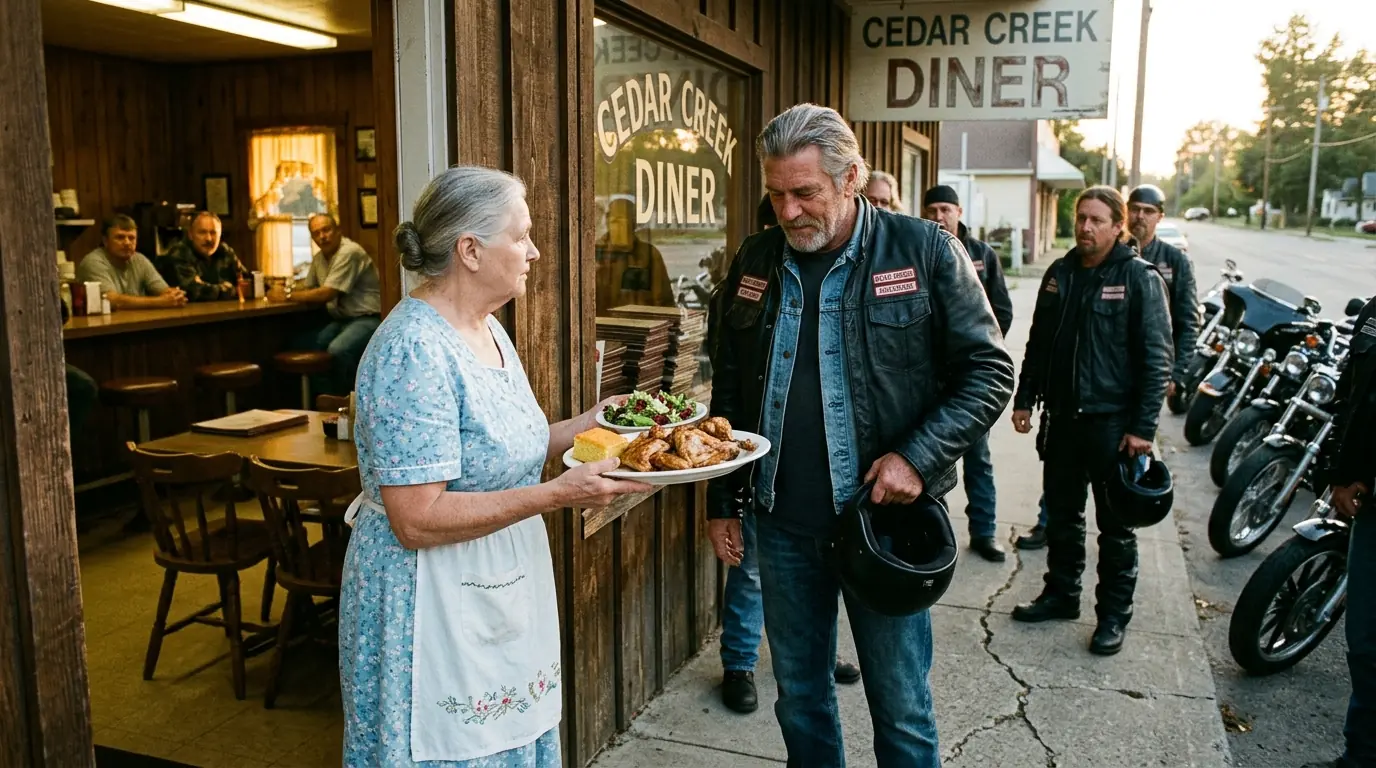 Margaret had lived in Cedar Creek all her life. Her husband, Frank, had passed fifteen years ago, leaving her to raise three children on her own and care for her late mother until she passed. Her children had moved away to bigger cities, chasing careers and families, leaving her to the silence of the house she had once shared with laughter, arguments, and the smell of fresh bread in the morning. Tonight, though, the house wouldn’t be silent. She had planned to make her last special meal of the week: her renowned roasted chicken with rosemary and garlic, cornbread muffins, and a simple salad. She had bought the ingredients carefully, penny by penny, from the small grocery store in town, enjoying the ritual even if she would eat alone.
A rumble outside interrupted her thoughts. At first, she thought it was the wind, but soon she realized it was motorcycles—a whole pack of them, five or six roaring down the street, their chrome glinting in the fading sunlight. Margaret’s heart skipped. Tourists? Bikers? Cedar Creek was so small that any unusual visitors caused a stir. She watched from her kitchen window as the group pulled to the roadside, their leather jackets dusted and worn, helmets tucked under arms. They were strangers to her, yet something about them felt oddly familiar, as if they carried the same loneliness she sometimes sensed in herself.
Margaret hesitated only a moment. She could see the men sitting on the curb, weary and hungry, their stomachs likely aching from hours on the road. Impulsively, she grabbed a plate of her roasted chicken, a slice of cornbread, and a small bowl of salad. She placed them on her front porch, arranging them neatly as if presenting a fine meal at a restaurant. A small hand-written note read: “Help yourself. Margaret Lawson.”
One of the bikers noticed immediately. A tall man with silver streaks in his black hair and a weathered face pushed his helmet back and smiled. “Hey, fellas,” he called to the others. “Looks like we’ve got luck tonight.” They approached carefully, not wanting to scare the elderly woman, but their growling stomachs demanded attention.
Margaret stepped onto the porch, her apron dusted with flour. “Eat. Don’t wait. You look like you’ve been on the road forever.”
The men hesitated, but the smell of her cooking was irresistible. Plates clattered gently, knives cutting through the warm chicken, crumbs falling from cornbread into the cracks of the porch wood. Margaret smiled softly from her rocking chair nearby, the slight ache in her back reminding her of her age, yet feeling invigorated by their presence. She asked little, only offering refills and a glass of iced tea she had brewed earlier.
“Ma’am, this is incredible,” said the silver-haired biker, who introduced himself as Hank. “We’ve been riding since sunrise. Nobody… nobody feeds strangers like this anymore.”
Margaret laughed lightly, the sound trembling but real. “I’ve fed plenty of strangers in my day. Some with four wheels, some on two, some without any. Don’t matter. Everyone deserves a good meal.”
As the bikers ate, they told her stories—tales of the open road, distant cities, and lonely highways. Margaret listened intently, nodding and asking questions when she could. There was something comforting about the exchange, the way stories could bridge decades, backgrounds, and worlds. Hours passed quickly, and the sky turned a deep indigo, stars beginning to prick the darkness. Eventually, the bikers stood, wiping their mouths and plates, thanking Margaret repeatedly.
“You’ve got a good heart, ma’am,” Hank said, shaking her hand firmly. “We don’t forget things like this. Not anymore.”
Margaret waved them off. “Go. Get some rest. Keep your wheels rolling.”
They mounted their motorcycles and rode off slowly, the engines fading into the distance, leaving Margaret alone on her porch, the smell of rosemary and garlic still lingering in the warm night air. She cleaned up the porch, washing the dishes slowly, savoring the quiet after the whirlwind of company.
The next morning, Margaret awoke early. She was making her coffee when she noticed a strange sound outside: low rumbling and squealing tires. Her heart raced. Peering out the window, she saw something she would never forget. Two black SUVs and half a dozen motorcycles pulled into her driveway. The bikers from last night, and more, had returned. Their leather jackets gleamed, motorcycles lined up like soldiers ready for inspection.
Hank stepped forward, taking off his helmet. “Ma’am, we came back,” he said, his voice steady. “We wanted to thank you properly. We want to repay you for what you did last night.”
Margaret shook her head. “You already paid by eating. That’s thanks enough.”
But Hank wasn’t done. From the back of one SUV, men in suits emerged, carrying envelopes and documents. “We represent a foundation,” Hank explained. “We keep track of good deeds. Last night, you made a choice—an extraordinary choice. The kind of choice that changes lives. And we’d like to help you in return.”
Margaret blinked, unsure she had heard correctly. “Help me?”
“Yes, ma’am. We’d like to set up a fund in your name, to support local families in need. And personally, we’d like to offer you something else. A small investment for your home, your security, and anything else you may need.”
Tears filled Margaret’s eyes. She had lived decades quietly, giving when she could, barely able to keep her own bills paid, never imagining anyone would notice. “I… I don’t know what to say,” she whispered.
“No need for words,” Hank said gently. “Last night, you fed us because it was right. That’s enough. But the world noticed, and it’s taking note. Cedar Creek won’t forget you, and neither will we.”
The bikers and men in suits spent the next hour helping her with the paperwork, explaining everything in simple terms. Margaret realized she would no longer need to worry about groceries or the heating bills, that she could repair her porch and fix the leaky roof that had troubled her for years. But most importantly, she felt seen—truly seen.
Word spread quickly. The local newspaper ran a story, and soon, other bikers from neighboring states rode in, not for charity, but to honor the kind grandmother who had shared her last meal with strangers. Some brought gifts, others simply offered companionship, all touched by her generosity. Margaret welcomed them all, never asking for anything in return, only sharing meals and laughter.
Months passed, and the little fund created in her name helped dozens of families, feeding children and supporting the elderly who struggled in silence. Margaret often thought of the night the bikers arrived, how a single act of kindness had rippled outward, changing her life as much as theirs.
One evening, as the sun dipped behind the hills, Margaret sat on her porch with a warm plate of cornbread and a glass of tea, watching the motorcycles parked along the street. Hank, now a friend, sat beside her. “You know, ma’am,” he said, smiling, “what you did… it’s rare. People like you are why we keep riding, why we keep believing there’s good in the world.”
Margaret smiled back. “I just did what anyone would do if they could. Feed someone. Make them feel safe. That’s all.”
Hank shook his head. “No, ma’am. Most people don’t. Most people would have walked past. But you… you shared what little you had. And look at what came back.”
Margaret took a bite of cornbread, savoring the flavor. She thought of the motorcycles roaring down the road the night before, the black SUVs lined up like sentinels, and the men in suits whose kindness she never expected. She realized that life had a way of repaying deeds in ways no one could predict.
For Margaret, that summer in Cedar Creek became legendary. She continued to cook, to feed, to listen, to give. The town embraced her as a symbol of generosity and resilience. And every time a group of bikers passed through, she smiled, knowing that kindness, even in its smallest forms, had the power to change the world.
She had shared her last meal, but in return, she had received something far greater: recognition, safety, community, and the profound understanding that a single act of generosity could echo far beyond what one could imagine.
Margaret watched as the sun sank lower behind the hills, casting long shadows over her porch. The motorcycles had long since left for their evening ride, their chrome glinting faintly in the last light. She rocked slowly, sipping her tea, her thoughts drifting to Eleanor. She’d never met anyone quite like that woman—quiet strength, humility, and yet the kind of stubbornness that refused to let life’s cruelty define her.
The next morning, Margaret awoke to the distant hum of engines again. This time, it wasn’t just the familiar pack of bikers. Two black SUVs rolled down the winding roads into Cedar Creek, their sleek exteriors in stark contrast with the town’s rustic charm. The bikers followed closely behind, the motorcycles’ low rumble mixing with the SUVs’ powerful engines. Margaret felt a jolt of apprehension; she wasn’t used to attention like this.
Hank approached her with a grin, his leather jacket creaking softly. “Ma’am, we brought company.” He gestured toward the SUVs. Out stepped a group of men and women in tailored suits, holding clipboards, tablets, and folders. Their presence was imposing but not menacing. “We represent a charitable organization and a small investment group,” Hank explained. “We saw what you did last night, and we want to make sure your generosity has a lasting impact.”
Margaret’s brow furrowed. “I… I didn’t do anything special. I fed a few hungry bikers. That’s all.”
Hank shook his head. “Ma’am, that’s everything. It’s rare to see someone act without thinking about themselves first. You made a choice that mattered.”
From the SUVs, a woman in her mid-forties stepped forward. She had sharp eyes and a commanding presence. “Mrs. Lawson, my name is Catherine Hall. We’re here to help you establish a small community program—food assistance, support for elderly locals, and funding for emergency needs.”
Margaret blinked. “You want to… fund me?”
“Yes,” Catherine said with a small smile. “And more than that. We want to make sure you never have to struggle alone again. We’ve arranged for home repairs, utilities, and even a small stipend so you can continue helping without worrying about yourself.”
Tears welled in Margaret’s eyes. Decades of hard work, sacrifice, and quiet generosity had gone unnoticed until now. “I don’t know what to say,” she whispered.
“You don’t need to say anything,” Hank said. “Just keep being you.”
Over the next week, the bikers and the organization worked tirelessly with Margaret. They painted her porch, repaired the leaky roof, and cleaned the gutters. They brought groceries, toiletries, and a few new kitchen appliances. Margaret, who had spent years giving without expecting anything, felt overwhelmed by the attention and care being offered.
Meanwhile, word of her act of kindness spread across the region. Local newspapers ran stories, and soon bikers from other towns began making their way to Cedar Creek, curious to meet the grandmother who had shared her last meal without hesitation. Some brought food, others came simply to listen to her stories, all inspired by her courage to act selflessly in a world that often seemed indifferent.
One afternoon, Eleanor visited Margaret’s home. Margaret had insisted that Eleanor come, wanting to share the moment. They sat together on the porch, sipping sweet tea, watching the sun dip behind the hills. Eleanor held her mother’s old recipe notebook close to her chest. “I think she would be proud,” Eleanor said softly, thinking of Margaret’s late husband and children who had passed through her life.
Margaret smiled. “Proud of what? Of me? Or of what you’ve built?”
Eleanor looked down at the notebook. “Of everything. What you started by simply offering a meal. It’s more than food. It’s hope. It’s community. And it’s love.”
The motorcycles rolled in that evening, a small contingent returning just to check on Margaret. Hank stepped off his bike and approached Eleanor. “She changed things for all of us,” he said. “Sometimes, a single act of kindness sets off a chain reaction you never see coming.”
Margaret nodded, feeling the weight of the moment. It wasn’t just about the meal or the bikers; it was about what that simple gesture symbolized. The black SUVs and suited representatives weren’t there for a handout—they were here to amplify her impact, to turn one small act into something that could help hundreds.
By the end of the month, the small Cedar Creek foundation had grown. Margaret now oversaw a weekly meal program, delivering food to elderly neighbors and travelers alike. She’d hired a few local teens, teaching them not only about cooking but about respect, compassion, and empathy. Eleanor often came to help, sharing her mother’s recipes, teaching young cooks how to mix dough just right, how to fold pastries gently, and how to put love into every bite.
One evening, as the sun set in fiery shades of orange and pink, a group of bikers stopped outside the Lawson house. Hank dismounted first, followed by others who had come from near and far. They brought small gifts: jars of honey, fresh-baked bread, and even a handmade quilt. “For you, Mrs. Lawson,” Hank said. “To remember that your kindness reaches farther than you know.”
Margaret clasped her hands together, feeling a swell of gratitude. She looked over at Eleanor, who smiled softly. “We did this together,” Eleanor whispered.
“Yes,” Margaret replied, her voice firm and warm. “Together.”
News outlets soon picked up the story. The tale of a grandmother sharing her last meal with traveling bikers had gone viral. Donations poured in for the foundation, and Margaret, who had once worried about paying her own bills, now oversaw a network of volunteers, community members, and supporters who helped ensure that no one in Cedar Creek would go hungry.
Months later, as the first snow of winter dusted the hills, Margaret sat in her cozy kitchen, stirring a pot of soup. A knock at the door made her smile. It was Hank and a few bikers, carrying firewood, blankets, and fresh vegetables. “We thought you might need some help with winter,” Hank said.
Margaret shook her head, laughing softly. “You’ve done enough.”
“Never enough,” Hank replied, grinning. “But we’ll always be here. Just like last summer.”
Eleanor came in behind him, carrying the recipe notebook. “We’re baking for the community tomorrow,” she said. “Your recipes, Grandma. Heaven’s Whisper Cookies.”
Margaret smiled, watching the younger generation embrace what she had started. The warmth of the kitchen, the smell of baking, and the hum of laughter filled the house. She realized then that one act—a shared meal—could ripple outward, touching lives she would never meet, creating bonds stronger than distance, age, or circumstance.
And in the driveway, a line of motorcycles gleamed under the early winter sun, the black SUVs parked behind them. Margaret waved, knowing that what began as a simple gesture of kindness had become a force, a living testament to the power of generosity.
She poured herself a cup of tea, feeling the sun on her face, listening to the laughter inside, and whispered to herself, “This is what it means to be alive. To give. To hope. To love.”
For Margaret Lawson, seventy-one, Cedar Creek, Tennessee, and all who rode through it, life had never