At a small auto shop in Riverside, Pennsylvania, a quiet seventeen-year-old apprentice watched his boss charge an elderly woman $425 for a repair that should have cost almost nothing.
Everyone else in the shop looked away.
But Malik Bennett could not.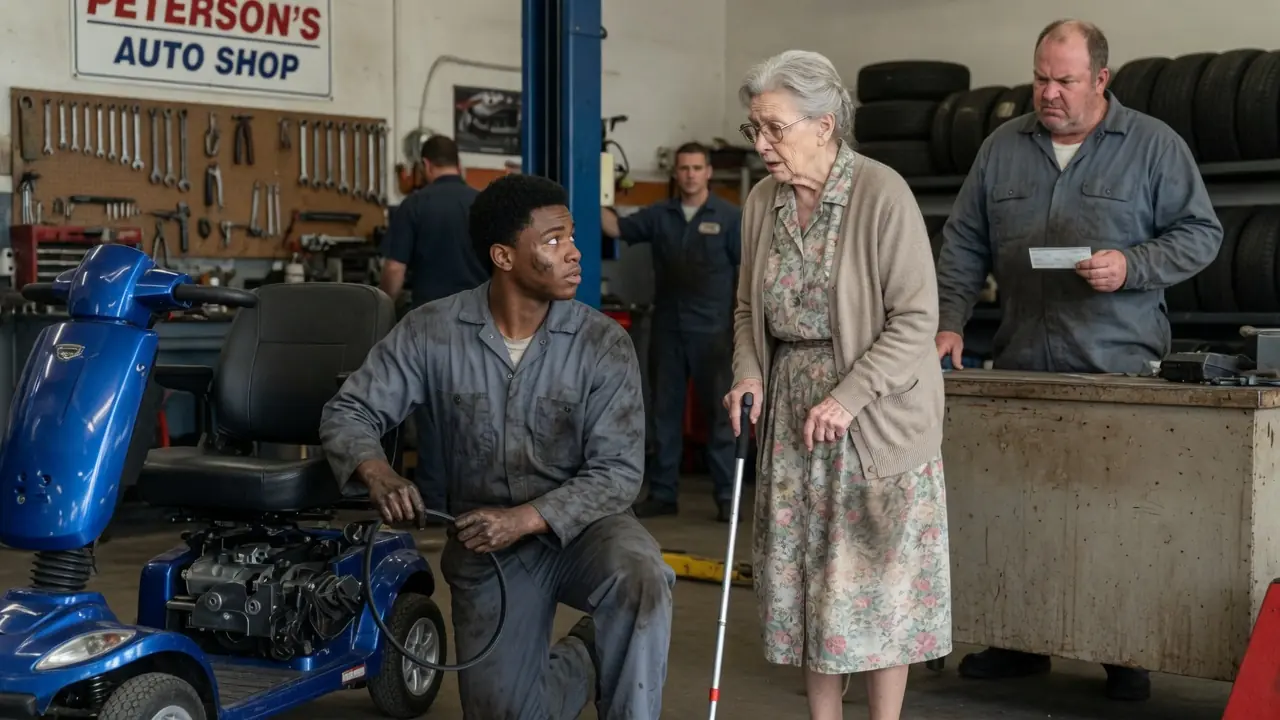
That night, after his boss locked up and left, Malik secretly fixed the woman’s mobility scooter for free and returned it to her home. He thought he was only doing the right thing. He thought nobody important would ever know.
The next morning, he was fired in a fit of rage.
What nobody at Peterson’s Auto Shop knew was that the elderly woman was Margaret Palmer, the powerful founder and retired CEO of one of the largest medical equipment companies in the country.
And Malik’s single act of kindness was about to change his life forever.
The morning sun barely touched the grimy windows of Peterson’s Auto Shop. The building sat on the edge of Riverside, wedged between an old laundromat and a tire store with faded red signs. The air inside smelled like motor oil, rubber, stale coffee, and metal dust.
Malik Bennett wiped his oil-stained hands on a rag and leaned over the open hood of a Toyota Camry.
He was seventeen years old, tall and lean, with dark brown skin, quiet eyes, and hands that already looked older than the rest of him. His knuckles were scraped. His fingernails were permanently stained from grease no soap could fully remove. He wore a navy work shirt with Peterson’s Auto Shop stitched over the pocket, though the name tag beneath it still said Trainee.
Gary Peterson insisted on that.
“Don’t get too proud,” Gary had told him the first day. “You’re not a mechanic. You’re a kid who knows how to hold a wrench.”
But Malik knew more than Gary wanted to admit.
He had been fixing things since he was ten years old, back when his grandfather, Joseph Bennett, kept a little garage behind his house and let Malik hand him sockets on Saturday mornings. Joseph never had much money, but he had patience, skill, and the kind of dignity that made even broken engines seem worth saving.
“A machine will tell you what’s wrong if you listen,” Joseph used to say. “People too.”
Malik had listened.
By seventeen, he could diagnose a bad alternator by sound, replace brake pads faster than most grown men in the shop, and repair small motors nobody else wanted to touch. He was still in high school, taking morning classes and working afternoons and weekends at Peterson’s Auto Shop to help his mother keep the bills paid.
His mother, Angela Bennett, worked double shifts at Riverside General Hospital as a nursing assistant. His little sister, Maya, was nine and still believed Malik could fix anything: bikes, toys, leaking sinks, broken lamps, and once even her favorite music box after she dropped it down the stairs.
Malik liked being the person people came to when something broke.
He just hated working for Gary Peterson.
Gary was fifty-nine, balding, heavy around the middle, and mean in a way that always looked practiced. He owned the shop, but he acted like every customer was an enemy trying to steal money from him. He smiled only when he saw easy profit, and the people he overcharged most were always the people least able to fight back.
Single mothers.
Elderly drivers.
People with old cars and tired faces.
Malik had watched it for almost a year.
Every time, it made his stomach turn.
But his mother needed help with rent. Maya needed school clothes. Malik needed the job if he wanted to save money for trade school after graduation. So he kept his mouth shut more often than he wanted to.
That changed the day Margaret Palmer came into the shop.
The bell above the door chimed softly.
Malik looked up from the Camry and saw an elderly woman struggling to push a blue mobility scooter through the entrance. She was small and frail, wearing a faded floral dress that had been mended at the hem and a thin cardigan with worn elbows. Her glasses were thick, and she squinted toward the counter like the room was made of shadows.
“Hello?” she called. “Is anybody here? My scooter stopped working.”
Gary stepped out of his office.
His face changed the moment he saw her.
Malik knew that look.
Gary had spotted easy money.
“What’s the problem?” Gary asked, his voice already impatient.
The woman extended a trembling hand.
“Margaret Palmer, sir. My scooter quit on me this morning. The battery seems fine, but the motor won’t run. I was hoping someone could take a look.”
Gary walked around the scooter once.
He barely bent down.
Barely touched it.
“Motor’s shot,” he said. “Drive belt’s worn. Probably need to replace the whole drive system. That’s going to be $425.”
Malik felt his jaw tighten.
Four hundred twenty-five dollars?
For what was probably a slipping belt or loose bracket?
The woman’s face went pale.
“Four hundred?” she whispered. “Sir, I only get Social Security. That is more than half my monthly check.”
Gary crossed his arms.
“That’s the price.”
“I need my scooter,” Margaret said. “I can’t drive anymore because of my eyes. This is how I get to my doctor appointments. How I buy groceries. How I get to church. My daughter lives in Florida. I don’t have anyone nearby to help me.”
“Then you better figure out how to pay for it.”
Malik looked down at the wrench in his hand.
His grip tightened.
Margaret pulled a worn checkbook from her purse. Her hands trembled so badly she had trouble opening it. From where Malik stood, he could see the balance written on the slip inside.
$463.18.
That was nearly everything she had.
Margaret ran her fingers over the scooter’s blue seat.
“My husband gave me this scooter before he died,” she said softly. “He picked the color himself. Said it matched my eyes from when we first met.”
Gary did not soften.
“Real touching. Four twenty-five. Cash or check.”
Malik stepped forward before he could stop himself.
“Mr. Peterson,” he said carefully, “that might just be the drive belt. Maybe the mounting bracket. We should check it before charging her that much.”
Gary turned slowly.
His eyes narrowed.
“Did I ask you, Bennett?”
“No, sir, but—”
“But nothing. I set the prices around here.”
Malik lowered his voice.
“I’m just saying it might be a small repair.”
Gary stepped closer.
“You want to work for free? Open your own shop. Until then, you keep your mouth shut and do what I tell you. We clear?”
The whole shop went quiet.
Tommy and Steve, the two older mechanics, looked away.
Margaret was writing the check now, her hand shaking so badly the numbers were barely legible.
Malik felt sick.
Gary took the check and folded it once before sliding it into his shirt pocket.
“Leave the scooter here,” he said. “Come back Friday.”
“Friday?” Margaret asked. “That’s four days from now.”
“I got other jobs ahead of you. Friday or nothing.”
Margaret nodded slowly.
She took a white cane from her purse, unfolded it, and started tapping her way toward the door.
Tap.
Tap.
Tap.
Malik watched through the window as she stepped onto the sidewalk. The bus stop was eight blocks away.
Eight blocks.
With bad eyes.
In the heat.
Without the scooter her husband had given her.
Malik turned back to Gary.
“That wasn’t right.”
Gary’s face hardened.
“What did you say?”
Malik swallowed.
He thought about his mother, who had reminded him that morning not to lose this job. He thought about the rent. He thought about Maya needing new sneakers. He thought about trade school.
Then he thought about his grandfather.
A man ain’t measured by how much money he makes, Malik. He’s measured by how he treats folks when nobody’s watching.
“I said that wasn’t right,” Malik repeated quietly.
Gary stepped close enough that Malik could smell stale coffee on his breath.
“You’re seventeen years old. You don’t know a thing about business.”
“I know when somebody is being taken advantage of.”
Gary pointed toward the Camry.
“You get back to work before I send you home for good.”
Malik looked at him for a long moment.
Then he nodded.
“Yes, sir.”
He went back to work, but his mind stayed with Margaret Palmer and the blue scooter sitting in the corner like something abandoned.
By the time Gary locked up at six, Malik had already made his decision.
Gary’s Cadillac roared out of the parking lot toward the bar he visited every Tuesday night. Tommy and Steve left soon after. Malik waited behind the tire rack, pretending to finish cleaning tools until everyone was gone.
Then he unlocked the side door with the spare key Gary kept under the electrical box.
He knew he could get in trouble.
He knew he could lose the job.
But he also knew he would not sleep if he did nothing.
The scooter sat in the corner where Gary had pushed it aside.
Malik wheeled it under the shop lights and removed the motor cover.
“Come on,” he whispered. “Talk to me.”
Within five minutes, he knew the truth.
The belt was worn but not destroyed. The bigger issue was a loose mounting bracket that had let the belt slip off the pulley. It was the kind of repair Gary could have done during lunch.
Malik let out a bitter laugh.
“Four hundred twenty-five dollars.”
He opened his personal toolbox, the one his grandfather had left him. Inside was a small stash of parts he had bought over time with his own money: belts, clamps, fuses, wires, bolts, washers, little things customers sometimes needed when Gary wanted to charge too much.
Malik replaced the belt, tightened the mounting bracket, cleaned the pulley, and checked the battery connections. It took him forty minutes.
The motor hummed perfectly.
He did not stop there.
He cleaned the whole scooter. He wiped down the handlebars, polished the mirrors, cleaned the control panel, checked the tires, and straightened the duct tape on the seat as carefully as if it were expensive leather.
By nine-thirty, he had borrowed his uncle’s small pickup, loaded the scooter into the bed, and was driving to Margaret Palmer’s address from the work order.
The house was a tiny cottage with peeling paint and a wooden ramp beside the front steps. The yard was overgrown. The gutters sagged. One porch step looked like it might break if someone stepped too hard.
A single dim porch light glowed above the door.
Malik unloaded the scooter, pushed it up the ramp, and knocked.
Slow footsteps moved inside.
The door opened, and Margaret Palmer stood there in a worn house dress and slippers, squinting through her thick glasses.
“Mrs. Palmer?” Malik said. “It’s Malik Bennett from Peterson’s Auto Shop. I brought your scooter.”
She blinked.
“But today is Tuesday.”
“Yes, ma’am.”
“They said Friday.”
“I finished it tonight. Figured you needed it sooner.”
She stared at the scooter.
“How much do I owe you?”
“Nothing.”
“Nothing?”
“It’s covered.”
“Covered by what?”
Malik shrugged, suddenly embarrassed.
“By me, ma’am. The problem was simpler than my boss thought. I had the parts already.”
Margaret put one hand on her chest.
“Son, I wrote your boss a check for $425.”
“I’ll get that check back to you,” Malik said. “It shouldn’t be cashed.”
“You fixed my scooter for free, and you’re trying to give me my money back.”
“Yes, ma’am.”
“Why?”
Malik thought about his grandfather.
About Saturday mornings in the old garage.
About the smell of oil, coffee, and sawdust.
About a man who had taught him that skill was a responsibility, not just a way to earn money.
“Because it was the right thing to do,” Malik said. “You need this scooter to live your life. Nobody should have to give up everything they have for forty minutes of honest work.”
Margaret’s eyes filled.
“You sound older than seventeen.”
“My mom says that too.”
“She must be proud of you.”
“I hope so.”
Margaret touched the scooter’s handlebar with trembling fingers.
“My husband bought me this scooter,” she said. “Robert. We were married thirty-eight years. He knew my eyes were getting worse. He knew I would have to stop driving someday. So he bought me this and picked the blue because he said it matched my eyes.”
Her voice broke.
“This is how I visit his grave every Sunday. How I get to the library where we used to volunteer. How I stay connected to the life we built.”
Malik felt a lump in his throat.
“You’re not losing it, Mrs. Palmer. It should run good for a long time now.”
He pulled out a scrap of paper and wrote his number.
“If it acts up, call me. Anytime.”
She took the paper like it was something precious.
“You are a good young man, Malik Bennett. Your grandfather would be proud of you.”
Malik looked away quickly.
“He passed two years ago.”
“Then I imagine he is proud from wherever good men go.”
Malik helped her test the scooter. She rode it slowly down the ramp and back up again, laughing softly when it moved smoothly.
When he was about to leave, he noticed the sagging porch step.
“Mrs. Palmer, that step is bad.”
“Oh, I know. I keep meaning to get it fixed.”
He knew what that meant.
She could not afford it.
“I’ve got tools in the truck,” he said. “Won’t take long.”
“Malik, you’ve already done too much.”
“My grandfather would haunt me if I left that step like this.”
Over the next hour, Malik fixed the porch step, tightened the wobbly railing, and secured part of the loose gutter. Margaret brought him a glass of water and stood in the doorway watching him with an expression he did not understand.
Like she was seeing more than a teenager with a toolbox.
Like she was measuring something.
Inside the cottage, Malik noticed more problems.
A leaking faucet.
A loose outlet cover.
A cabinet door hanging crooked.
He pointed gently.
“I can come back Saturday if you want. Fix a few things.”
Margaret shook her head.
“Young man, I cannot pay you.”
“I didn’t ask you to.”
“You should be spending Saturday with friends.”
Malik laughed softly.
“My friends sleep until noon and complain about being broke. I’ll survive missing that.”
Then he added, “My little sister Maya can come help clean the windows. She likes helping if snacks are involved.”
Margaret smiled.
“I can provide snacks.”
That Saturday, Malik came back with Maya and his mother, Angela.
Angela Bennett had just finished a night shift at the hospital but insisted on coming once Malik told her the whole story. She was strong, tired, practical, and kind in a way that made people feel safe around her.
Maya arrived wearing pink sneakers and carrying a backpack full of stickers, crackers, and curiosity.
They spent the day working on Margaret’s house.
Malik fixed the faucet, secured outlets, repaired the loose cabinet, patched the porch step better, and adjusted the ramp. Angela cleaned the gutters, organized the kitchen, and helped Margaret sort old mail. Maya washed windows, talked nonstop, and asked Margaret if she had ever seen a horse in real life.
Margaret made them lunch.
Simple sandwiches.
Sweet tea.
A few store-bought cookies she apologized for even though Maya ate four.
As they ate, Margaret told them about Robert.
How they bought the cottage when they were young and poor.
How they built a life one repair at a time.
How every corner held a memory.
Angela squeezed Margaret’s hand.
“It isn’t about how big a house is,” she said. “It’s about who loved you in it.”
Margaret’s eyes glistened.
“Yes,” she whispered. “Exactly.”
As they were leaving, Margaret tried to press twenty dollars into Malik’s hand.
He folded her fingers back over it.
“You keep that, Mrs. Palmer.”
“You worked all day.”
“So did my mom. And Maya supervised.”
“I did,” Maya said proudly.
Malik smiled.
“You already gave us something more valuable. You reminded me what kind of man my grandfather wanted me to become.”
Margaret looked at him for a long time.
Then she said, “You are already becoming him.”
Malik had no idea that Margaret Palmer would spend that night typing a message that would change his life.
Wednesday morning started normal.
Malik arrived at Peterson’s at six-fifteen, made coffee, and began sweeping the bays before school. He planned to leave for class at ten, return after lunch, and work until closing.
Gary’s Cadillac pulled in at seven-forty-two.
Five minutes late.
That should have been Malik’s first warning.
Gary came through the door like a storm, face purple with rage, phone gripped in his fist. He did not go to his office. He marched straight to Malik and slammed the phone onto the workbench.
“Explain this.”
Malik looked down.
The screen showed a Facebook post.
I want to thank Malik Bennett from Peterson’s Auto Shop for his amazing kindness. After being quoted $425 for a repair, Malik fixed my mobility scooter on his own time and would not take payment. Then he came to my home with his mother and little sister and spent an entire day fixing things I could not afford to repair. In a world where elderly people are often taken advantage of, this young man and his family gave me back my faith in people. God bless the Bennett family.
Below the post were hundreds of reactions and dozens of comments.
Malik met Gary’s eyes.
“Mrs. Palmer wanted to say thank you.”
“Thank you?” Gary shouted. “You went behind my back, stole a job I already priced, did it for free, and made me look like garbage all over Facebook.”
“I didn’t make you look like anything. I just helped somebody.”
“You cost me $425.”
“No, sir. You tried to charge $425 for a repair that didn’t need to cost that.”
Gary stepped closer.
“You work for me.”
“I used my parts. My time. After hours.”
“You touched equipment brought into my shop.”
Malik’s voice stayed low.
“That woman can barely see. That scooter is her only way to get around.”
“I don’t care about her sob story.”
Something cold settled in Malik’s chest.
He looked at Gary and realized that was the whole truth.
Gary did not care.
Not about Margaret.
Not about honest work.
Not about people.
Not about anything except money.
Gary pointed toward the door.
“You’re done. Fired. Get your stuff and get out.”
Tommy stepped forward.
“Gary, come on. The kid’s good.”
“Shut your mouth.”
Steve looked at Malik with sympathy but said nothing.
Gary turned back to him.
“You got twenty minutes. After that, I call the cops and say you’ve been stealing parts.”
Malik’s face burned.
“I bought those parts myself.”
“Prove it.”
Malik could prove it.
He had receipts at home.
But in that moment, he realized something surprising.
He did not want to argue.
He did not want to beg.
He did not want this job badly enough to let Gary make him smaller.
“All right,” Malik said.
Gary blinked, as if he expected a fight.
Malik packed his toolbox.
His grandfather’s toolbox.
Tommy and Steve helped carry the heavy stuff to his uncle’s pickup. Neither said much. Their faces said enough.
When the last box was loaded, Malik got in and drove away.
He did not look back.
At home, Angela was at the kitchen table drinking coffee before her next shift. Maya was drawing at the counter.
One look at Malik’s face, and Angela stood.
“What happened?”
“I got fired.”
Maya’s eyes widened.
“Because of the scooter lady?”
Malik nodded.
Angela came to him and wrapped her arms around him.
“I’m sorry, baby.”
“I’m not,” Malik said.
And when he said it, he realized it was true.
“I should have left that place months ago.”
Angela pulled back and looked at him carefully.
“We’ll figure it out.”
“I know.”
“Rent is still due. Life is still life. But I would rather struggle with a son who knows right from wrong than watch you become comfortable doing wrong.”
Malik looked down.
“I was scared to lose the job.”
“Courage does not mean you were never scared,” Angela said. “It means you did right anyway.”
By lunchtime, Malik’s phone started buzzing.
Former customers.
Neighbors.
People from church.
People who had seen Margaret’s post.
A single mother whose car Malik had helped repair cheaply months earlier left him a voicemail.
“You helped me when nobody else would. I saw that post. Don’t let anybody tell you what you did was wrong.”
An older man from the next town texted, You fixed my truck last winter and refused extra money. Good work comes back around, son.
By five o’clock, Margaret’s post had been shared more than four hundred times.
Malik sat on the couch with Angela and Maya, staring at his phone.
“I lost my job,” he said quietly.
Maya leaned against him.
“But everybody knows you’re nice now.”
Angela smiled softly.
“Your sister has a point.”
That evening, Malik’s phone rang.
Unknown number.
He answered.
“Hello?”
“Malik, this is Margaret Palmer.”
“Mrs. Palmer? Is your scooter okay?”
“My scooter is perfect. I need you to come to my house right away. There is something important we need to discuss.”
“Is Gary bothering you?”
“No. This is about your future.”
“My future?”
“Yes. Can you be here in forty minutes?”
Malik looked at his mother.
“Uh… yes, ma’am.”
“Good. Park on the street. My driveway is going to be full.”
The line went dead.
Malik lowered the phone.
Angela raised an eyebrow.
“What did she say?”
“She said it’s about my future.”
Maya whispered, “Maybe she’s secretly famous.”
Malik laughed.
Then he drove to Margaret’s house and stopped halfway down the block.
The quiet street was lined with expensive cars.
Mercedes sedans.
A silver Lexus.
A dark blue Bentley.
A red Porsche.
His uncle’s beat-up pickup looked like it had wandered into the wrong neighborhood by accident.
Malik parked at the end of the block and walked back, confused with every step.
Through Margaret’s front window, he saw people inside. Fifteen, maybe twenty of them. All dressed in suits that probably cost more than Gary paid him in a month.
He climbed the ramp and knocked.
Margaret opened the door immediately.
But she looked different.
She wore an elegant navy dress and pearls. Her thick old glasses had been replaced by a newer pair. Her hair was neatly styled, and there was something in her face Malik had not seen before.
Power.
Authority.
“Malik,” she said warmly. “Thank you for coming. Please come in.”
He stepped inside and froze.
The little living room had been transformed. A conference table covered with laptops and papers took up most of the space. The suited people turned to look at him all at once.
A woman in her late forties stepped forward.
“Mr. Bennett, I’m Linda Patterson, chief operating officer at Palmer Medical Industries. Thank you for joining us.”
Palmer Medical Industries.
Malik knew that name.
Everyone in Pennsylvania knew that name.
They made wheelchairs, mobility scooters, patient lifts, hospital beds, and medical equipment used all over the country.
Malik looked at Margaret.
“What is Palmer Medical doing in your living room?”
Margaret smiled.
“Because this is my living room, Malik. And Palmer Medical is my company.”
The room seemed to tilt.
“Your company?”
“I founded it with my husband, Robert, thirty-nine years ago. We started in our garage building custom wheelchairs for disabled veterans who could not afford the expensive ones.”
Malik stared at her.
The old woman in the faded dress.
The trembling checkbook.
The broken scooter.
The little cottage.
The worn cardigan.
None of it fit with the word founder.
Margaret’s face softened.
“I know what you’re thinking. If I have money, why would I care about an old scooter?”
Malik said nothing.
“Because Robert gave it to me. That exact scooter. The faded blue paint, the taped-up seat, everything. It means more to me than anything new ever could.”
A gray-haired man stepped forward.
“I’m Richard Hayes, chief engineer at Palmer Medical. I looked at the diagnostic report from your repair.”
“Diagnostic report?” Malik asked.
Richard smiled.
“Every scooter we make records service changes for safety and quality control. Your work was excellent. Correct belt tension. Proper bracket adjustment. Clean connections. You even checked the battery load.”
Malik rubbed his hands against his jeans.
“That’s just doing the job right.”
“No,” Margaret said. “That is doing the job with honor. There is a difference.”
Then her expression became serious.
“I need to tell you something, Malik. The scooter really had a problem, but it did not happen by accident.”
He frowned.
“What do you mean?”
“I had Richard loosen the mounting bracket.”
Malik blinked.
“You broke it on purpose?”
“Not broke. Created a real repair issue.”
He took a step back.
“Why would you do that?”
Margaret did not flinch from the question.
“Because for sixteen months, I have been visiting repair shops across Pennsylvania as an old woman with bad eyes and a broken scooter. Not as Margaret Palmer, founder of Palmer Medical. Just as someone vulnerable.”
She looked around the room.
“Our company contracts service work to outside shops. We have received complaints for years. Overcharging. Unnecessary repairs. Bad service. Elderly customers being pressured into buying equipment they do not need. I wanted to know how bad it was.”
Her voice hardened.
“I went to twelve shops before yours. One quoted me more than a thousand dollars. Another tried to sell me a new scooter for $2,600. One man laughed when I asked if I could pay in installments.”
She turned back to Malik.
“Then I came to Peterson’s. Gary did exactly what I expected by then. He saw an easy target. But you were different.”
Malik looked down.
“I didn’t do anything special.”
“You challenged your boss. Then you fixed my scooter after hours. Then you brought it to my home. Then you returned with your mother and sister to repair things that had nothing to do with the scooter.”
Margaret’s eyes shone.
“You thought nobody important was watching.”
Malik’s throat tightened.
“I didn’t think anybody was watching.”
“That is why it mattered.”
Linda Patterson placed a folder on the table.
“Malik, Palmer Medical has a serious problem. We need people with technical skill, but more than that, we need people who understand what our equipment really means. It is not just metal and wiring. It is freedom. Dignity. Connection to life.”
Richard nodded.
“We have training programs, apprenticeships, scholarships, engineering tracks. But we are missing something at the foundation. We need young people who care before the corporate world teaches them not to.”
Margaret moved closer.
“Malik, I know you are only seventeen. I am not offering you a director’s job today. That would be unfair to you and irresponsible of me.”
He let out a breath he had not realized he was holding.
“But I am offering you a future.”
Linda opened the folder.
“Palmer Medical would like to offer you a full technical scholarship after high school, a paid apprenticeship while you finish your senior year, transportation support, mentorship under our engineering team, and a guaranteed full-time position after graduation if you meet the training requirements.”
Malik stared at the folder.
His brain could barely understand the words.
Scholarship.
Paid apprenticeship.
Mentorship.
Full-time position.
Linda continued.
“We also want to help your family during the transition. Your mother will receive access to our employee family support program once you begin the apprenticeship. That includes transportation assistance and educational savings support for your sister.”
Malik looked at Margaret.
“I don’t know what to say.”
“Say you will think about it,” Margaret said.
“I’m scared I’ll mess it up.”
Margaret smiled gently.
“Good. Fear means you understand it matters.”
“I’m still in high school.”
“Yes.”
“I don’t have a degree.”
“You are seventeen. You are not supposed to have one yet.”
That made a few people in the room smile.
Margaret continued.
“When Robert and I started Palmer Medical, we were two people in a garage who failed more than we succeeded at first. Skill grows. Knowledge grows. But integrity has to be there before everything else.”
She touched the folder.
“You have that.”
Malik thought about his mother.
His sister.
His grandfather.
The old toolbox sitting in the back of his uncle’s pickup.
“I need to talk to my mom.”
“Of course,” Linda said. “Take the folder home.”
As Malik was leaving, Margaret walked him to the door.
“One more thing,” she said.
“Yes, ma’am?”
“You wondered why I live here.”
“I didn’t want to ask.”
“That was polite of you.”
She looked around the small cottage.
“Robert and I bought this house when we were twenty-three. We were poor, truly poor. We ate rice and beans most nights and argued about whether we could afford curtains. But we were happy. This house is not my poverty. It is my memory.”
Malik nodded slowly.
“Some things are worth more than money.”
Margaret smiled.
“That is exactly why I knew you were the right young man when you fixed the porch instead of judging the house.”
Malik drove home with the folder on the passenger seat, his mind spinning.
When he walked in, Angela and Maya were at the kitchen table. Maya was doing homework while Angela reviewed her hospital schedule.
“How did it go?” Angela asked.
Malik set the folder down.
“You’re not going to believe this.”
He told them everything.
Margaret’s real identity.
The test.
The scholarship.
The apprenticeship.
The support program.
By the time he finished, Angela was crying.
Maya’s mouth hung open.
“So Mrs. Palmer is, like, rich rich?” Maya asked.
Malik laughed weakly.
“Yeah. Rich rich.”
Angela touched the folder.
“And she chose you.”
“She said I have integrity.”
“You do.”
“I’m scared, Ma.”
“I know.”
“What if I fail?”
“Then you learn. Then you try again.”
Angela took his hands.
“Baby, your grandfather used to say a gift is not always something you asked for. Sometimes it is a door opening before you know how to walk through it.”
Malik looked down at the folder.
“What do you think I should do?”
Angela smiled through tears.
“I think you should walk through.”
Malik started at Palmer Medical two weeks later.
He still went to school in the mornings. A company van picked him up after lunch and took him to the Pittsburgh service facility three afternoons a week. On Saturdays, he trained in diagnostics, wheelchair repair, scooter systems, electrical safety, and customer care.
The first day, Linda Patterson met him at the entrance and handed him a badge.
Malik Bennett.
Technical Apprentice.
He stared at his name for longer than he meant to.
Richard Hayes led him through the warehouse.
It was enormous.
Rows and rows of equipment filled the space: wheelchairs, scooters, patient lifts, hospital beds, parts bins, diagnostic stations, battery testing areas, and workbenches lined with tools more advanced than anything at Peterson’s.
Malik felt small.
Then Richard stopped beside a blue scooter that looked almost exactly like Margaret’s.
“You know what this is?”
“A mobility scooter.”
“No,” Richard said. “It is someone’s independence.”
Malik looked at him.
“That is the first lesson,” Richard said. “If you remember that, the rest of the work has meaning.”
Training was harder than Malik expected.
He knew mechanics, but medical equipment required precision on another level. Safety standards. Load testing. Electrical diagnostics. Documentation. Every repair had to be logged properly. Every bolt mattered. Every adjustment could affect someone’s life.
Some nights, he came home exhausted and discouraged.
“I don’t know if I’m smart enough for this,” he told Angela one evening.
She was folding laundry while Maya colored at the table.
“You fixed that woman’s scooter perfectly with almost no resources.”
“That was different.”
“No. It was the beginning.”
Angela tossed a towel at him.
“Stop talking about yourself like Gary Peterson is still your boss.”
That sentence hit him hard.
He had not realized Gary’s voice was still in his head.
You’re just a kid.
You don’t know anything.
Don’t get proud.
Malik began fighting that voice every day.
Margaret helped too.
She invited him to her cottage twice a month. Sometimes they talked about work. Sometimes she told him stories about Robert and the early years of Palmer Medical.
Sometimes they sat quietly while Maya asked too many questions and Margaret answered every single one.
One Saturday, Margaret showed Malik an old photograph of Robert standing in a garage beside a wooden workbench.
“This is where it started,” she said.
“He built wheelchairs there?”
“Our first ones.”
Malik studied the photograph.
“He looks tired.”
“He was,” Margaret said. “We both were. But tired people can still build beautiful things if they remember why they started.”
That became Malik’s second lesson.
Remember why you started.
By the end of his senior year, Malik had become one of the strongest apprentices in the program.
He still made mistakes.
He still struggled with technical manuals.
He still had days when he felt like everyone else understood faster.
But he kept going.
He graduated high school with Angela crying so loudly that Maya told her to “act normal,” which made Angela cry harder. Margaret attended too, sitting in her blue scooter near the aisle, wearing pearls and smiling like Malik had just won a national prize.
After graduation, Malik entered Palmer Medical’s full-time technical academy.
His scholarship covered tuition.
His apprenticeship paid enough to help Angela reduce her hours at the hospital.
Maya got new sneakers before she needed them.
For the first time in years, the Bennett family could breathe.
Years passed.
Malik became a lead technician.
Then a trainer.
Then a regional service supervisor.
He never forgot Peterson’s Auto Shop.
He never forgot the feeling of standing there while Gary charged Margaret $425.
So when Palmer Medical launched a program to certify repair partners nationwide, Malik helped design it. Shops were not judged only by speed and profit. They were judged by fairness, honesty, patient respect, and whether customers were treated like people instead of invoices.
Gary Peterson’s shop did not qualify.
Malik did not celebrate that.
He simply signed the report and moved forward.
At twenty-four, Malik returned to Riverside High School to speak to students about skilled trades.
At twenty-six, he helped create a youth apprenticeship program for teenagers who needed work, mentorship, and a reason to believe their hands could build a future.
At twenty-nine, he became director of community equipment services at Palmer Medical.
When the announcement went out, Margaret called him.
“Director Bennett,” she said.
He laughed.
“Don’t start.”
“I am absolutely going to start.”
“I’m still the same Malik.”
“No,” Margaret said softly. “You are who you always were, with more room to become him.”
A year later, Margaret Palmer became seriously ill.
Cancer.
Fast and unforgiving.
Malik visited her at the hospital with Angela and Maya. Margaret looked smaller in the bed, but her eyes were still sharp.
“You look terrible,” she told Malik.
He laughed through tears.
“You don’t look so great yourself.”
“Dying is rude that way.”
Angela took Margaret’s hand.
Margaret looked at Malik.
“I need you to promise me something.”
“Anything.”
“Do not let the company forget people.”
“I won’t.”
“Do not let numbers become more important than dignity.”
“I promise.”
“And do not let success make you ashamed of where you started.”
Malik swallowed hard.
“I could never forget where I started.”
Margaret smiled.
“Good. Because a boy with a toolbox and a good heart changed more than he knows.”
Three days later, Margaret passed away peacefully, holding a photograph of Robert.
At her funeral, Malik spoke.
He stood in front of employees, executives, patients, and families whose lives had been touched by Palmer Medical.
“Margaret Palmer once came into a small auto shop pretending to be just an old woman with a broken scooter,” he said. “But she was never just anything. She was a wife who loved her husband. A builder. A leader. A woman who believed dignity should not depend on how much money someone had.”
He paused.
“When I met her, I was seventeen. I thought I was fixing a scooter. I did not know she was fixing the direction of my whole life.”
People grew quiet.
“She taught me that equipment is never just equipment. A scooter can be a way to visit a husband’s grave. A wheelchair can be a child’s way back to school. A repair can be the difference between isolation and freedom.”
His voice trembled.
“She gave me a chance because I did the right thing when I thought nobody important was watching. But that was her final lesson to me. Somebody important is always watching. Not a CEO. Not a boss. Not a crowd. Your own character is watching.”
Angela cried in the front row.
Maya, now a teenager herself, held her mother’s hand.
After the funeral, Margaret’s lawyer gave Malik an envelope.
Inside was a letter.
Dear Malik,
If you are reading this, then I have gone to see Robert, and he is probably telling me I made too much fuss.
I am leaving you Robert’s original workbench from the garage where we started Palmer Medical. I am also leaving funding to create the Bennett Youth Repair Academy, named not only for you, but for your grandfather Joseph Bennett, whose values reached further than he ever lived to see.
Use it to train young people.
Use it to give them skill, dignity, and opportunity.
Use it to remind them that being young does not mean being powerless.
You were seventeen when you taught a room full of adults what integrity looked like.
Never forget that.
With love and gratitude,
Margaret Palmer
Malik sat in his car after reading it and cried until he could not breathe properly.
Then he called Angela.
“She named a program after us,” he said.
Angela’s voice broke.
“No, baby. She named it after what your grandfather put in you.”
The Bennett Youth Repair Academy opened one year later in the original Palmer garage.
Robert’s workbench sat at the front of the room, not behind glass, but still in use. Malik insisted on that. Tools were meant to build, not pose for photographs.
The first group had twelve teenagers.
Some were in foster care.
Some had been suspended from school.
Some were caring for siblings.
Some had been told too many times that they were trouble, lazy, angry, or not college material.
Malik stood before them on the first morning.
He saw himself in more than one face.
Seventeen.
Guarded.
Scared to hope.
Trying not to show it.
He pointed to the workbench.
“This is where Palmer Medical started,” he said. “Two people in a garage building wheelchairs because disabled veterans needed help and nobody else was doing it right.”
Then he held up an old belt from a mobility scooter.
“And this is close to the part that changed my life.”
The teenagers looked curious now.
He smiled.
“I want to tell you a story about an old woman, a crooked boss, a broken scooter, and a seventeen-year-old kid who almost talked himself out of doing the right thing.”
He told them everything.
Not to make himself look heroic.
To show them that one honest choice could open a door nobody saw coming.
At the end, a girl in the back raised her hand.
“What if nobody notices when we do the right thing?”
Malik looked at her.
“Then do it anyway.”
She frowned.
“Why?”
“Because you notice. And you have to live with yourself longer than anybody else.”
The room went silent.
Then he smiled.
“Now, who wants to learn how to take apart a scooter motor?”
Hands went up.
Not all.
Enough.
Years later, people would talk about Malik Bennett as if his life changed because Margaret Palmer was secretly powerful.
That was only partly true.
Margaret had power.
But Malik’s life changed before he knew that.
It changed when he saw an elderly woman being cheated and decided his job was not worth more than his character.
It changed when he unlocked the shop after hours.
When he fixed the scooter.
When he drove through the dark with a repaired piece of someone’s independence in the back of a pickup truck.
When he stood on Margaret’s porch and refused her money.
When he told the truth with grease still under his fingernails.
The powerful CEO changed his future.
But the seventeen-year-old boy chose the road that led to it.
And every time a young person walked into the Bennett Youth Repair Academy with guarded eyes and a life full of people who had underestimated them, Malik remembered the old blue scooter, the porch light, and the woman who had seen him clearly before he knew how to see himself.
Kindness did not make him weak.
It made him ready.
And when his moment came, he was strong enough to walk through the door.