On a cold morning in Seattle, Emma Richardson, a nurse, was rushing to her shift when the bus ran late again.
She panicked as she ran faster, not wanting to be reprimanded one more time for being late.
But just as she pushed herself to make itxz on time, a faint groan echoed from an abandoned building, forcing her to stop.
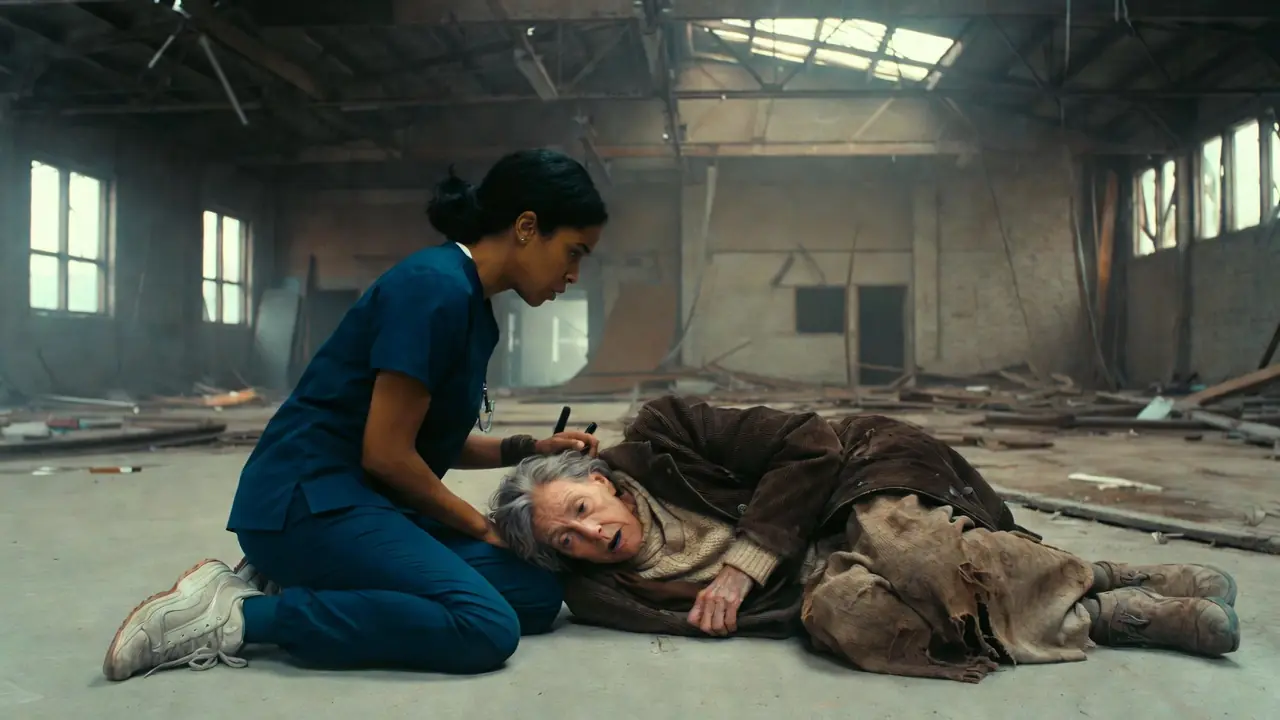
When she stepped inside, Emma was shocked to find an elderly woman curled up on the floor, lips blue, barely breathing.
Unable to walk away, she immediately knelt down, checked for a pulse, called for an ambulance, and used her own jacket to keep the woman warm.
Emma had no idea that this moment would open the door to a story that would change her life forever.
The cold Seattle morning bit through Emma’s thin jacket as she hurried down the cracked sidewalk.
Her worn sneakers splashed through puddles left by last night’s rain.
She checked her watch again.
7:15.
She was already running late.
“Come on, come on,” she muttered to herself, walking faster.
This was only her second week at the clinic.
Being late again would not look good.
The memory of her supervisor’s stern face from yesterday still made her stomach twist.
But the bus had been delayed, and she could not afford a car.
Not on her salary.
Not with her family depending on her to send money home.
Emma turned down a shortcut through an industrial area.
Abandoned buildings lined both sides of the narrow street.
Broken windows stared down at her like empty eyes.
Most people avoided this area, but it saved her ten minutes.
Ten minutes she desperately needed right now.
She was halfway down the block when she heard it.
A sound, soft, barely there.
She slowed her pace, tilting her head to listen.
There it was again.
A weak groan.
Painful.
Human.
Emma stopped walking.
Her heart picked up speed.
She looked around.
The street was empty.
The sound came from somewhere to her left, one of the abandoned buildings.
She bit her lip, looking at her watch again.
7:18.
If she did not leave now, she would definitely be late.
Her supervisor would write her up, maybe even fire her.
But that sound, that groan, someone was in pain.
Emma closed her eyes for a second, taking a deep breath.
Then she made her decision.
She turned toward the building where the sound had come from and stepped through the broken doorway.
Inside, the air smelled of mold and dust.
Gray morning light filtered through holes in the roof.
Emma’s footsteps echoed on the concrete floor.
She moved carefully, watching where she stepped.
Broken glass and debris littered the ground.
“Hello?” she called out softly. “Is someone here?”
The groan came again.
Clearer now.
It was coming from a dark corner at the back of the room.
Emma’s hands trembled slightly as she pulled out her phone and turned on the flashlight.
She moved toward the sound, her heart pounding in her chest.
What if it was dangerous?
What if someone attacked her?
But the nursing training in her pushed aside the fear.
Someone needed help.
That was what mattered.
The light from her phone finally reached the corner.
Emma gasped, her free hand flying to her mouth.
An elderly woman lay flat on the bare concrete floor.
Her body was curled into itself, shaking violently.
Her gray hair was matted and dirty.
Her clothes were torn and filthy.
But it was her face that made Emma’s chest tighten with fear.
The woman’s lips were blue.
Her skin was pale, almost gray.
Her eyes were closed, and her breathing came in short, desperate gasps.
“Oh my God,” Emma whispered.
She dropped to her knees beside the woman, her bag falling from her shoulder.
“Ma’am, can you hear me?”
The woman’s eyes fluttered open for just a moment.
They were clouded with pain and confusion.
Her lips moved, but no sound came out.
Emma’s training kicked in immediately.
She pressed two fingers against the woman’s neck, feeling for a pulse.
It was there, but weak and irregular.
The woman’s skin was ice cold to the touch.
“You’re going to be okay,” Emma said, her voice shaking.
She did not know if that was true, but she needed to say it anyway.
“I’m a nurse. I’m going to help you. Just hold on.”
She pulled off her jacket and draped it over the woman’s trembling body.
Then she grabbed her phone with shaking hands and dialed 911.
“911. What’s your emergency?”
“I need an ambulance right now,” Emma said quickly. “I found an elderly woman. She’s unconscious, barely breathing. Hypothermia, I think. Maybe malnutrition. She’s critical.”
“What’s your location?”
Emma looked around frantically, trying to remember the address.
“I’m in an abandoned building on Industrial Road near Fifth Avenue. Please hurry. She doesn’t have much time.”
“An ambulance is on the way. Stay with her and keep her warm.”
Emma ended the call and turned back to the woman.
She carefully lifted the woman’s head and placed it on her bag as a pillow.
Then she took off her cardigan and added it to the jacket already covering the woman.
“Please hold on,” Emma whispered, taking the woman’s cold hand in both of hers. “Help is coming. Please don’t die. Not today. Not like this.”
The woman’s eyes opened again just slightly.
They focused on Emma’s face.
A single tear rolled down her wrinkled cheek.
“You’re safe now,” Emma said softly, squeezing the woman’s hand. “I won’t leave you. I promise.”
Time seemed to stretch.
Each second felt like an hour.
Emma kept rubbing the woman’s hands, trying to warm them.
She checked her pulse again.
Still weak.
Still there.
Finally, finally, she heard sirens in the distance.
They grew louder.
Emma’s eyes filled with tears of relief.
“They’re coming,” she said to the woman. “You hear that? They’re almost here.”
Two paramedics rushed through the doorway with a stretcher and medical bags.
Emma quickly stood up and stepped back, giving them room to work.
“I’m a nurse,” Emma told them quickly. “I found her about ten minutes ago. Pulse is weak and thready, severe hypothermia, possible malnutrition. She’s been in and out of consciousness.”
The paramedics worked quickly, checking vitals and wrapping the woman in warming blankets.
One of them looked up at Emma.
“You probably saved her life,” he said. “Another hour out here and she wouldn’t have made it.”
They lifted the woman onto the stretcher.
Emma followed them out to the ambulance.
“Which hospital?” she asked.
“Mercy General.”
“I work at Riverside Clinic,” Emma said. “But can I ride with you? She shouldn’t be alone.”
The paramedic nodded.
“Get in.”
Emma climbed into the back of the ambulance.
As it pulled away, sirens wailing, she finally allowed herself to take a deep breath.
The woman was still alive.
That was what mattered.
Then she looked at her watch.
7:55.
She was now over an hour late for work.
Her stomach dropped.
This was bad.
Really bad.
Some things were more important than being on time.
At Riverside Clinic, Emma stood outside Supervisor Nancy’s office, her hands clasped tightly in front of her.
Through the glass door, she could see Nancy at her desk writing something.
The older woman’s face was set in a hard line.
Emma knocked softly on the doorframe.
“Come in.”
Nancy’s voice was cold.
Emma stepped inside, closing the door behind her.
“Ma’am, I’m so sorry I’m late. I know this looks terrible.”
“Sit down, Emma.”
Emma sat in the chair across from Nancy’s desk.
Her heart was pounding so hard she thought Nancy might hear it.
Nancy set down her pen and folded her hands on the desk.
“This is your second week here, Emma. Your second week, and you’ve been late twice now. Yesterday, you were fifteen minutes late. Today, you didn’t show up at all for your shift.”
“I know, ma’am, but…”
“I don’t want to hear excuses.” Nancy’s voice was sharp. “We have patients who depend on us. We have schedules to maintain. We have…”
“Ma’am, please.” Emma interrupted, her voice cracking. “There was an emergency. A real emergency.”
Nancy raised an eyebrow.
“What kind of emergency?”
Emma took a deep breath.
“I found a woman this morning. An elderly woman. She was lying in an abandoned building, barely alive. She was freezing. She wasn’t breathing right. I couldn’t just walk past her. I couldn’t leave her there to die.”
Nancy’s expression softened slightly.
“What did you do?”
“I called 911. I waited with her. I rode with her in the ambulance to Mercy General. They said if I hadn’t found her when I did, she would have died.”
Emma’s voice shook.
“I’m sorry I was late. I’m so sorry, but I’m a nurse. I couldn’t walk away from someone dying. I just couldn’t.”
The office was silent for a long moment.
Nancy studied Emma’s face.
Then she sighed and leaned back in her chair.
“You did the right thing,” Nancy said finally. “A nurse who walks past someone in need isn’t really a nurse at all.”
Emma felt tears of relief prick her eyes.
“Thank you, ma’am.”
But Nancy held up a finger.
“You still need to call when something like this happens. We need to know where our staff is.”
“Understood. Yes, ma’am. I understand. It won’t happen again.”
“Good.” Nancy picked up her pen again. “Now go get ready. Your shift technically started two hours ago, so you have a lot to catch up on.”
“Yes, ma’am.”
Emma stood up quickly.
“And Emma.”
Nancy looked up at her.
“I’m glad there are still people like you in the world. That woman is lucky you found her.”
Emma managed a small smile.
“Thank you.”
Over the next two days, Emma could not stop thinking about the elderly woman.
During her breaks, she would call Mercy General to check on her condition.
The nurses there told her the woman was stable, but still unconscious.
They were treating her for severe hypothermia, malnutrition, and infection.
On the third day, Emma’s phone rang during her lunch break.
It was Mercy General.
“Hello?”
“Is this Emma Richardson?”
“Yes, this is she.”
“This is Nurse Patterson from Mercy General. The patient you brought in three days ago has regained consciousness. She’s asking for you.”
Emma’s heart skipped.
“She’s awake? Is she okay?”
“She’s weak but stable. She keeps saying she needs to thank the woman who saved her. Can you come by?”
“Yes. I can come after my shift. I’ll be there around six.”
“That would be perfect. She’ll be happy to see you.”
Emma hung up the phone, relief flooding through her.
The woman was alive.
She was awake.
Thank God.
That evening, Emma walked through the doors of Mercy General and took the elevator to the third floor.
Nurse Patterson met her at the nurse’s station.
“She’s in room 312,” the nurse said with a kind smile. “She’s been waiting for you.”
Emma knocked softly on the door to room 312 before pushing it open.
The elderly woman was sitting up slightly in bed, propped up by pillows.
She looked much better than she had in that abandoned building, though still terribly frail.
Her hair had been washed and combed.
She was wearing a clean hospital gown.
But her eyes were what caught Emma’s attention.
They were filled with tears.
“You came?” the woman whispered.
Emma walked to the bedside, smiling gently.
“Of course I came. How are you feeling?”
“Alive.”
The woman reached out a shaking hand.
“Because of you.”
Emma took her hand carefully.
It was warmer now, not the ice-cold hand she had held in that building.
“I’m just glad I found you when I did.”
“The nurses told me what you did.”
Tears rolled down the woman’s wrinkled cheeks.
“You saved my life. You stayed with me. You rode in the ambulance with me. A complete stranger.”
“You needed help,” Emma said simply. “Anyone would have done the same.”
“No.” The woman shook her head. “No, they wouldn’t. People walked past me for months. No one stopped. No one cared. But you did.”
Her grip on Emma’s hand tightened slightly.
“What’s your name, child?”
“Emma. Emma Richardson.”
“I’m Margaret. Margaret Foster.”
The older woman’s voice broke.
“Thank you, Emma. Thank you for not leaving me there to die.”
Emma pulled a chair close to the bed and sat down.
“Margaret, do you have any family? Anyone I can call for you?”
Margaret’s face crumpled.
She looked away, fresh tears spilling down her cheeks.
“I have a son, but he doesn’t know where I am. He doesn’t know what happened to me.”
Emma leaned forward.
“Where is he? I can help you contact him.”
“He’s in Europe working. He’s been gone for four years.”
Margaret’s voice was barely a whisper now.
“He doesn’t know. He doesn’t know any of it.”
“Know what, Margaret? What happened to you?”
Margaret took a shaky breath.
“It’s a long story. A sad story.”
Emma squeezed her hand gently.
“I have time. Tell me.”
Margaret closed her eyes for a moment as if gathering strength.
When she opened them again, they were distant, lost in painful memories.
“My son Michael, he’s a good boy. A hard worker. Four years ago, he got an opportunity to work in Europe, a business opportunity. He wanted to take it so he could make a better life for me, for us.”
Margaret’s voice trembled.
“I was so proud of him, but I was also scared. I didn’t want him to go so far away.”
Emma listened quietly, not interrupting.
“Michael had a girlfriend, Jessica. She seemed like a sweet girl, always smiling, always kind. Michael trusted her completely. Before he left, he asked Jessica to look after me. He said he would send money every month, and Jessica would make sure I got it. Make sure I had everything I needed.”
Margaret’s hands clenched into fists.
“I trusted her, too. We both trusted her.”
“What happened?” Emma asked gently.
Margaret’s face darkened.
“For the first three years, everything was fine. Jessica would come by, bring me money, help me with things. Michael would call sometimes through her phone because I don’t know how to use one. Life was okay. Not easy, but okay.”
She paused, her breathing becoming heavier.
“Then everything changed.”
Emma felt a cold dread settle in her stomach.
She had a feeling she knew where this story was going.
“In the fourth year, Jessica met someone. A man. Rich, handsome. She started seeing him.”
Margaret’s voice grew harder.
“And she started changing. She would come by less and less. She stopped giving me the money Michael sent. When I asked her about it, she would get angry. She said Michael wasn’t sending as much anymore. She said things were hard, but I knew she was lying. I could see it in her eyes.”
“Oh, Margaret,” Emma whispered.
“I started running out of food. I couldn’t pay the rent. I asked Jessica for help, but she just got angrier. She stopped coming altogether.”
Margaret’s whole body was shaking now.
“Then one day, she came to the apartment with her new boyfriend. Right there in front of me, he had his arm around her waist. She was laughing, looking at me like I was nothing.”
Emma felt anger burning in her chest.
“What did she say?”
“I asked her about Michael. I begged her. I said, ‘Jessica, my son trusted you. He’s working so hard for us. Please don’t do this.’”
Margaret’s voice broke completely.
“And you know what she said? She smiled at me. This cruel, wicked smile. And she said, ‘Thank you for Michael’s money. My boyfriend and I had a wonderful time spending it.’”
Emma’s hand flew to her mouth.
“No.”
“She just walked out. Left me there. I fell to my knees and cried. I had no phone. No way to contact Michael. No way to tell him what happened.”
Margaret was sobbing now.
“Two months later, the landlord kicked me out. I begged him. I told him my son had sent money, but he didn’t believe me. He said no one had paid rent in months. He threw me out on the street.”
Emma’s eyes were filled with tears.
“Margaret, I’m so sorry.”
“I had nowhere to go. I slept on the streets. I begged for food. People looked at me like I was garbage. Some kicked me. Some yelled at me to get away.”
Margaret’s voice dropped to a whisper.
“I got sick. So sick. I just wanted to die. I prayed for death. I crawled into that building because I thought it would be a good place to die. Quiet. Away from everyone.”
“You’re not going to die,” Emma said fiercely, squeezing Margaret’s hand. “Not now. Not like this.”
Margaret looked at Emma with such profound sadness that it broke Emma’s heart.
“I have no money. I can’t pay for this hospital. They’re going to kick me out, too.”
Emma’s mind raced.
She knew what was coming.
She knew the hospital would demand payment.
Margaret had no insurance, no money, no one to help her.
They would discharge her, and she would end up right back on the streets unless someone helped her.
Emma took a deep breath.
“Margaret, listen to me. Don’t worry about the hospital bill. I’ll take care of it.”
Margaret’s eyes widened.
“What? No. No, you can’t do that. You barely know me. You…”
“I don’t care,” Emma said firmly. “You’re not going back on the streets. Not while I can help.”
“But you’re just a nurse. You don’t have money to…”
“I’ll figure it out.”
Emma stood up, determination setting her jaw.
“You just focus on getting better. Let me handle the rest.”
The next morning, Emma walked into the billing office at Mercy General.
Her hands were sweaty and her heart was pounding.
She had barely slept last night, going over and over the numbers in her head.
The billing manager, a middle-aged woman named Mrs. Chen, looked up from her computer.
“Can I help you?”
“Yes. I’m here about Margaret Foster, the patient in room 312. I want to discuss her bill.”
Mrs. Chen typed something into her computer.
Her eyebrows rose.
“Her current bill is already at eight thousand dollars, and she still needs at least another week of care. That will bring it to over twelve thousand. She has no insurance and no way to pay.”
Emma swallowed hard.
Twelve thousand dollars.
That was more than half her annual salary.
“I want to pay it.”
Mrs. Chen blinked.
“I’m sorry?”
“I want to pay her bill. All of it.”
“Miss, that’s a very generous offer, but…”
“I work at Riverside Clinic,” Emma said quickly. “I’m a nurse there. I just started. My salary isn’t much, but I want you to take half of it every month and apply it to Margaret’s bill.”
Mrs. Chen stared at her.
“Half your salary. Do you understand what you’re saying?”
“I do.”
“That means you’ll only be bringing home maybe eight hundred dollars a month. Can you survive on that?”
Emma’s throat felt tight.
“I’ll manage.”
“Miss Richardson, please…”
Emma’s voice cracked.
“She has no one. She almost died on the street. She was betrayed by someone she trusted. If I don’t help her, no one will. She’ll just end up back out there.”
Tears filled Emma’s eyes.
“I’m a nurse. I can’t save someone’s life just to let them die later because I didn’t want to sacrifice a little.”
Mrs. Chen was quiet for a long moment.
Then she sighed and pulled out a form.
“This is highly irregular, but all right. I’ll need you to sign some paperwork.”
Emma signed everything with shaking hands.
When it was done, Mrs. Chen looked at her with something like awe.
“You’re either very foolish or very kind,” she said softly.
“Maybe both,” Emma said, managing a weak smile.
Later that day, when Emma went back to Margaret’s room, the older woman was arguing with a hospital administrator.
“Ma’am, you need to understand that without payment or insurance, we can’t…”
“I understand,” Margaret said, her voice breaking. “Just give me a few days, please. I’ll figure something out.”
Emma stepped into the room.
“Excuse me?”
Both Margaret and the administrator turned to look at her.
Emma walked up to the administrator and handed her a piece of paper.
“This is proof of the payment arrangement for Margaret Foster’s bill. It’s all been taken care of.”
The administrator looked at the paper, then at Emma, then at Margaret.
“Oh. Well, that’s good news.”
She looked confused, but she did not argue.
“I’ll update her file.”
She left the room quickly.
Margaret stared at Emma, her mouth open.
“What did you do?”
Emma sat down beside the bed.
“I told you I’d take care of it.”
“But how? How can you possibly…”
“I worked it out with billing. They’re taking half my salary every month until your bill is paid.”
Margaret’s face went white.
“Half your salary? Emma, no. No, you can’t do that. You’ll starve.”
“I won’t starve,” Emma said, though she was not entirely sure that was true. “I’ll be fine.”
“You have a family. You have your own bills. You can’t.”
“Margaret.”
Emma took the older woman’s hands.
“You don’t have anyone. Your son doesn’t even know where you are. If I don’t help you, who will?”
Tears poured down Margaret’s face.
“Why? Why would you do this for me? You don’t even know me.”
Emma’s own eyes filled with tears.
“Because you deserve to live. Because everyone deserves a chance. Because I’m a nurse, and that means something to me.”
She squeezed Margaret’s hands.
“And because maybe we can be family for each other. At least for now.”
Margaret broke down, completely sobbing into her hands.
Emma leaned forward and wrapped her arms around the fragile woman, holding her as she cried.
“I don’t deserve this,” Margaret whispered. “I don’t deserve your kindness.”
“Yes, you do,” Emma said firmly. “You absolutely do.”
A week later, Margaret was discharged from the hospital.
Emma had already made arrangements.
When she took Margaret home, the older woman stood in the doorway of Emma’s tiny studio apartment and looked around with wide eyes.
The apartment was small.
Very small.
There was a bed, a small table with two chairs, a tiny kitchen area, and a bathroom barely big enough to turn around in.
The paint on the walls was peeling.
The floor was scuffed.
But it was clean, and it was warm.
“This is your home?” Margaret asked quietly.
“It’s not much,” Emma said, setting down the bag of Margaret’s new clothes that she had bought. “But it’s clean and safe. The bed’s pretty comfortable. I’ve been sleeping on it for a year now.”
Margaret turned to her.
“Where will you sleep?”
Emma pointed to an old armchair in the corner.
“Right there. Don’t worry. I’ve slept in worse places during my training.”
“No.”
Margaret shook her head.
“No, I can’t take your bed. I can sleep in the chair. Or I can…”
“Margaret, you just got out of the hospital. You need proper rest. I’m young and healthy. I’ll be fine in the chair.”
Emma smiled.
“Besides, you’re the guest here.”
Margaret’s lips trembled.
“You gave me your bed. You’re giving me half your salary. You saved my life, Emma. I don’t know how I’ll ever repay you.”
“You don’t have to repay me,” Emma said gently. “Just get better. That’s all I want.”
That night, Emma lay curled up in the armchair with a thin blanket.
She could hear Margaret’s soft breathing from the bed.
Despite the uncomfortable position, despite the worry about money, despite everything, Emma felt a sense of peace.
She had done the right thing.
That was what mattered.
The next few weeks were the hardest of Emma’s life.
With only half her salary, paying for food, utilities, and Margaret’s medications became a constant juggling act.
Emma found herself skipping meals more and more often, telling Margaret she had already eaten or was not hungry.
One evening, Emma came home to find a notice taped to her door.
Electric Company Final Warning.
Two months past due.
If payment was not received within five days, service would be disconnected.
Emma pulled the notice down and crumpled it in her fist.
She leaned her forehead against the door and closed her eyes.
How was she going to pay this?
She barely had enough for food.
“Emma, is that you?”
Emma quickly wiped her eyes and put on a smile before walking inside.
“Yeah, it’s me.”
Margaret was sitting at the small table, looking much healthier than she had weeks ago.
Her face had filled out a little.
Her eyes were clearer.
She was even smiling more often now.
“How was work?” Margaret asked.
“Fine. Same as always.”
Emma set down her bag and went to the kitchen area.
“Did you take your medicine?”
“Yes, I did. Emma, we need to talk about…”
“Are you hungry? I can make some soup.”
Emma opened the cabinet and pulled out a can.
“Emma, stop.”
Margaret’s voice was firm.
“Sit down.”
Emma hesitated, then sat down across from Margaret at the table.
Margaret reached across and took Emma’s hand.
“You’re not eating enough. I see it. You think I don’t notice, but I do. You’re getting thinner every day.”
“I’m fine.”
“You’re not fine. You give me your food. You work all day and come home exhausted. You sleep in that horrible chair.”
Margaret’s voice cracked.
“Emma, I can’t let you do this anymore.”
“Margaret…”
“I want to leave,” Margaret said quietly.
Emma’s heart dropped.
“What? No. Where would you go?”
“I’ll figure something out. A shelter, maybe. Or I’ll go back to…”
“Absolutely not.” Emma’s voice was fierce. “You’re not going to a shelter, and you’re definitely not going back on the streets.”
“But you’re suffering because of me.”
“I’m not suffering. I’m just adjusting. It’s temporary. Things will get better.”
“When?” Margaret challenged. “When will things get better? You’re drowning, Emma. I can see it. And it’s all because of me.”
Emma squeezed Margaret’s hand.
“Listen to me. You’re not a burden. You’re not a problem. You’re…”
She paused, surprised to find her voice shaking.
“You’re the closest thing I have to family in this city. My parents are two states away. I send them money when I can, but we barely talk anymore. I work alone, eat alone, sleep alone. But now I have you, and that means something to me.”
Margaret’s eyes filled with tears.
“You really mean that?”
“Every word.”
They sat in silence for a moment, hands clasped across the table.
“My son needs to know what happened,” Margaret said finally. “He needs to know where I am. Maybe if we could somehow contact him.”
“Do you have his number?”
“Jessica had it. I never memorized it. I can’t even remember what country he’s in exactly. Just somewhere in Europe.”
Emma thought for a moment.
“When he calls, doesn’t he call Jessica’s phone?”
“He used to, but I don’t know her number either. And even if I did, she wouldn’t answer. She’s probably gone by now.”
Emma pulled out her phone.
“What’s your son’s full name?”
“Michael Foster.”
Emma typed the name into a search engine, but thousands of results came up.
Too many to sort through.
She tried adding Europe and business, but still got nowhere useful.
“It’s hopeless,” Margaret said, her shoulders slumping. “He’s gone. He thinks I’m safe with Jessica. He has no idea.”
“Don’t give up,” Emma said. “We’ll figure something out. I promise.”
That night, after Margaret had gone to sleep, Emma sat in the armchair with her phone, searching desperately for any lead on Michael Foster.
But every search led to dead ends.
There were too many Michael Fosters in the world.
And with no phone number, no specific location, and no other information, finding him seemed impossible.
Emma finally gave up around midnight and closed her eyes, exhausted.
Tomorrow, she would try again.
She had to.
For Margaret.
Four thousand miles away, in a modern office building in London, Michael Foster sat at his desk, staring at his phone.
He had just tried calling Jessica for the twentieth time that day.
Like all the other times, it went straight to voicemail.
“Come on, pick up,” he muttered. “Just pick up the damn phone.”
His business partner, David, walked by and saw the frustration on Michael’s face.
“Still can’t reach them?”
“It’s been three weeks, David. Three weeks since I’ve talked to my mother. Jessica isn’t answering. Her phone goes straight to voicemail. Something’s wrong. I know something’s wrong.”
David leaned against the doorway.
“Maybe she just lost her phone. Or maybe your mom’s out somewhere.”
“No.”
Michael stood up abruptly.
“My mother doesn’t go anywhere. She stays home. Jessica knows I call every week. She would make sure Mom could talk to me unless…”
He could not finish the sentence.
“Unless what?”
“Unless something happened to my mom.”
A horrible thought struck him.
“Or unless Jessica did something.”
David frowned.
“What do you mean?”
“I’ve been sending Jessica money for four years. Thousands of dollars. What if she’s been keeping it? What if she stopped taking care of my mother?”
“Michael, that’s a serious accusation. Jessica seemed like a good person when I met her.”
“People change.”
Michael grabbed his jacket from the back of his chair.
“I’m going to Seattle. I have to see for myself.”
“Now? We have the Johnson meeting tomorrow.”
“Cancel it. Reschedule it. I don’t care. My mother is more important than any business deal.”
Michael was already walking toward the door.
“I’m booking a flight tonight.”
David called after him.
“Michael, maybe you’re overreacting.”
But Michael was already gone.
Thirty-six hours later, Michael stood in front of the apartment building where he had lived with his mother four years ago.
His heart was pounding as he walked up the stairs to the third floor and knocked on the door.
A young man with tattoos and a beard opened it.
“Yeah?”
“I’m looking for Margaret Foster. She lives here. This is her apartment.”
The man scratched his head.
“Nobody by that name lives here, man. I moved in like six months ago.”
Michael’s blood ran cold.
“Six months? Where did she go?”
“How should I know? Ask the landlord.”
The man closed the door in Michael’s face.
Michael ran down the stairs and knocked on the landlord’s door on the first floor.
Mr. Patterson, a heavy man in his sixties, opened it with a scowl.
“What?”
“Mr. Patterson, it’s me, Michael Foster. I used to live in apartment 302 with my mother.”
The landlord’s expression softened slightly with recognition.
“Oh, yeah. Michael. I remember you. You’re back from Europe.”
“Where is my mother?” Michael’s voice was rising. “Where did she go?”
Mr. Patterson sighed heavily.
“Kid, I’m sorry, but I had to evict her.”
Michael felt like he had been punched in the stomach.
“What? Why? I was sending money. I was sending money every single month for rent.”
“I never got any money. Your mother kept saying that girl, what was her name?”
“Jessica.”
“She kept saying Jessica was supposed to pay the rent, but no money ever came. Month after month, nothing. I gave her chances. I waited, but after four months of no rent, I had no choice.”
Michael’s hands were shaking.
“When? When did you evict her?”
“About six months ago. Maybe seven. I don’t remember exactly.”
“Where did she go?”
“I don’t know, kid. She didn’t tell me. She just left, took a little bag, and walked out.”
Mr. Patterson’s face showed genuine regret.
“Some neighbors said they saw her around the area for a while, sleeping on benches and stuff. But then she disappeared. Nobody’s seen her since.”
Michael stumbled backward, his vision blurring.
His mother.
His mother had been homeless on the streets for months because of him.
Because he had trusted the wrong person.
“Are you okay?” Mr. Patterson asked.
“No,” Michael whispered. “No, I’m not okay.”
He turned and ran out of the building.
Outside, he leaned against the wall, gasping for air.
This could not be happening.
This could not be real.
He pulled out his phone and called Jessica’s number again.
Voicemail.
He tried ten more times.
Voicemail.
Voicemail.
Voicemail.
“Answer the phone!” he screamed into the phone before throwing it against the ground.
A woman walking by jumped and hurried past him, looking scared.
Michael slid down the wall until he was sitting on the sidewalk, his head in his hands.
Where was his mother?
Was she even alive?
How could he have been so stupid?
How could he have trusted everything to one person without checking?
Without verifying?
He had failed her.
Completely and utterly failed her.
After several minutes, Michael picked up his phone.
The screen was cracked, but still working.
He dialed 911.
“I need to report a missing person.”
The police were sympathetic, but not particularly optimistic.
Missing elderly homeless people were difficult to find, they explained.
Many did not want to be found.
Many had no identification.
Many were in shelters under different names or had moved to other cities.
But Detective Sarah Morrison, a woman in her forties with kind eyes and a no-nonsense attitude, took Michael’s case personally.
She had a mother, too.
She understood his desperation.
“Mr. Foster,” she said, sitting across from him in the police station. “I want you to understand that this won’t be easy. Your mother has been missing for months. The trail is cold. But I promise you, we will do everything in our power to find her.”
Michael’s eyes were red and swollen.
He had not slept since he arrived in Seattle.
“She’s out there somewhere. Alone, scared, maybe hurt, maybe worse.”
His voice broke.
“This is my fault. All my fault.”
“It’s not your fault,” Detective Morrison said firmly. “You trusted someone. That person betrayed you. That’s on them, not on you.”
“But I should have checked. I should have called more often. I should have come home to visit. I should have…”
“Should haves don’t help us now,” the detective interrupted gently. “What helps is action. So let’s take action. Tell me everything you know. Even the smallest detail might help.”
Michael spent the next hour telling her everything about his mother’s medical history, her habits, the places she liked to go, the people she knew.
He showed her photos on his phone, dozens of them.
His mother smiling at Christmas.
His mother in the kitchen making his favorite meal.
His mother hugging him at the airport before he left.
Detective Morrison took notes on everything.
“What about this Jessica? Do you have contact information for her?”
“Just her phone number, but it goes straight to voicemail. She’s not answering.”
“Give me the number. We’ll trace it. We’ll find her. And when we do, we’ll question her. If she committed fraud, she’ll be charged.”
Michael’s hands clenched into fists.
“I want her to pay for what she did.”
“She will. I’ll make sure of it.”
Detective Morrison stood up.
“Now, here’s what we’re going to do. We’ll check every hospital in the Seattle area, every shelter, every soup kitchen. We’ll show your mother’s photo to every police officer on patrol. We’ll put out an alert to all the surrounding counties. If your mother is out there, we will find her.”
“How long will that take?”
“I don’t know. Could be days, could be weeks. But don’t give up hope, Mr. Foster. Many times, these cases have happy endings.”
But as the days passed, Michael’s hope began to fade.
He printed five hundred flyers with his mother’s photo and stapled them to every telephone pole in the city.
Missing: Margaret Foster. 68 years old. Gray hair. Brown eyes. Last seen six months ago. $100,000 reward for information.
He walked the streets until his feet were covered in blisters.
He went to every homeless encampment under every bridge.
He handed out flyers to every person he saw.
Most people barely glanced at the photo before shaking their heads.
No one had seen her.
He visited every homeless shelter in Seattle, then expanded his search to nearby cities.
Tacoma.
Everett.
Bellevue.
Renton.
He showed his mother’s photo to hundreds of people.
The answer was always the same.
“Sorry, haven’t seen her.”
David flew over from London to help.
Together, they covered even more ground.
They split up, doubling their efforts.
David took the north side of the city.
Michael took the south.
They met up each evening to compare notes.
“Nothing,” David would report. “Nobody’s seen her.”
“Me neither,” Michael would say, his voice hollow with despair.
On the tenth day, they visited a soup kitchen in a rough neighborhood.
An older man with a long beard and weathered face looked at the photo Michael showed him and squinted.
“Wait,” the man said. “I think I seen her.”
Michael’s heart leaped.
“You did? When? Where?”
“Long time ago. Maybe five, six months back. She used to come here sometimes. Real quiet lady. Didn’t talk much.”
“Do you know where she went? Did she say anything about where she was staying?”
The man scratched his beard.
“She stopped coming. I figured she maybe went to a shelter or moved on to another city. Lots of folks do that when winter comes.”
“Which shelter? Do you know?”
“Nah, man. Could be any of them. There’s dozens around here.”
It was another dead end.
Michael thanked the man anyway and left, his shoulders sagging.
Outside, he leaned against the wall and closed his eyes.
He was so tired.
So, so tired.
His phone rang.
Detective Morrison.
“Mr. Foster, I have news.”
Michael’s eyes snapped open.
“Did you find her?”
“Not yet, but we found something. We’ve been checking hospital records like I promised. Most hospitals had no record of anyone matching your mother’s description, but we just got a hit from Mercy General.”
“Mercy General?”
“Yes. A woman matching your mother’s description was admitted there about three weeks ago. Severe hypothermia, malnutrition, possible pneumonia. She was brought in by paramedics after someone found her unconscious in an abandoned building.”
Michael felt like he could not breathe.
“Is she still there? Is she alive?”
“She was discharged two weeks ago.”
“Discharged to where?”
“That’s the interesting part. According to the hospital records, a young woman named Emma Richardson paid your mother’s entire hospital bill. The nurses said this Emma also took your mother home with her.”
Michael’s mind was spinning.
“Who is Emma Richardson? Why would she do that?”
“I don’t know, but I have her information right here. She works as a nurse at Riverside Clinic. I also have her home address.”
“Give it to me, please.”
Detective Morrison read out the address.
“I’m sending two officers to meet you there. Don’t go alone. We don’t know the situation yet.”
“I don’t care. I’m going right now.”
Michael hung up and immediately called David.
“They found a lead. Someone has my mother. We need to go now.”
They got in Michael’s rental car and drove to the address as fast as traffic allowed.
Michael’s hands gripped the steering wheel so tightly his knuckles were white.
His heart was pounding so hard he thought it might explode.
“She’s alive,” he kept whispering to himself. “She’s alive. She has to be alive.”
David put a hand on his shoulder.
“Steady, Michael. We’ll be there soon.”
When they arrived at the address, two police officers were already waiting.
They were parked in front of a run-down apartment building in a modest neighborhood.
Michael jumped out of the car and ran to the officers.
“Which apartment?”
“Third floor, apartment 3B,” one of them said. “We’ll come up with you, Mr. Foster, just in case.”
Michael did not wait.
He ran into the building and up the stairs two at a time.
His legs felt like they might give out, but adrenaline pushed him forward.
He reached apartment 3B and stopped in front of the door.
His hand was shaking as he raised it to knock.
This was it.
Behind this door, he might find his mother.
Or he might find nothing.
Or he might find something worse.
He knocked.
Three sharp wraps.
Footsteps from inside.
A woman’s voice.
“Just a minute.”
The door opened.
A young woman stood there, maybe in her mid-twenties, with tired eyes and brown hair pulled back in a ponytail.
She was wearing scrubs like she had just come home from work.
She looked at Michael, then at the two police officers behind him.
Her eyes widened.
“Can I help you?”
Michael’s voice came out strangled.
“Are you Emma Richardson?”
“Yes. What’s going on? Is something wrong?”
“I’m Michael Foster. I’m looking for my mother, Margaret Foster.”
He pulled out his phone and showed her a photo.
“The hospital said you brought her in. They said you took her home with you. Please, is she here? Is she okay?”
Emma’s expression changed from confusion to understanding.
“Michael,” she breathed. “You’re Margaret’s son?”
“Yes. Where is she? Please, I need to see her.”
Emma did not answer.
She turned her head and called into the apartment.
“Margaret.”
There was a moment of silence.
Then Michael heard it, a sound that made his heart stop.
“Yes, dear?”
It was his mother’s voice.
Michael pushed past Emma without thinking.
He stumbled into the small apartment, his eyes frantically searching.
And there she was.
His mother was sitting at a small table, a cup of tea in her hands.
She was thinner than he remembered.
Her face had more lines.
Her hair was grayer.
But it was her.
It was really her.
Margaret looked up and saw him.
The cup in her hand started to shake.
Her mouth opened, but no sound came out.
“Mom,” Michael whispered.
“Michael.”
Margaret stood up slowly, like she could not believe what she was seeing.
“Is that… is that really you?”
“It’s me, Mom. I’m here.”
They both moved at the same time.
Michael crossed the room in three strides.
Margaret stumbled forward, tears already streaming down her face.
They collided in the middle of the small apartment, arms wrapping around each other so tightly it was like they were trying to merge into one person.
Michael buried his face in his mother’s shoulder and sobbed.
Great heaving sobs that shook his entire body.
“I’m sorry. I’m so sorry, Mom. I’m so sorry.”
Margaret was crying just as hard, her hands clutching the back of his shirt.
“My baby. My baby boy. You found me. You found me.”
“I thought I lost you. I thought you were dead. I looked everywhere. Everywhere.”
“I’m here. I’m okay. I’m okay now.”
They sank to the floor together, still holding each other, still crying.
Years of separation, months of suffering, weeks of desperate searching.
All of it came pouring out in those tears.
Emma stood by the door with her hand over her mouth, tears running down her face.
Even the two police officers looked emotional, their eyes glistening.
David, who had come up behind them, quietly pulled out his phone and turned away, wiping his own eyes.
For several minutes, Michael and Margaret just held each other and cried.
No words were necessary.
The embrace said everything.
Finally, Michael pulled back just enough to look at his mother’s face.
He cupped her cheeks in his hands, studying every line, every wrinkle, like he was trying to memorize her all over again.
“Are you hurt? Did anyone hurt you? Tell me you’re okay.”
Margaret placed her hands over his.
“I’m okay, son. I’m okay because of her.”
She looked toward Emma.
Michael turned to see Emma standing there, looking overwhelmed and uncertain.
He stood up, helping his mother to her feet.
Then he walked over to Emma and, to everyone’s surprise, dropped to his knees in front of her.
“You saved my mother’s life,” he said, his voice thick with emotion. “Detective Morrison told me everything. You found her dying. You got her to the hospital. You paid her bills. You took her into your home.”
He looked up at her with tears still streaming down his face.
“How do I thank you for that? How do I ever repay you?”
Emma knelt down so she was at his level.
“You don’t have to repay me. I just did what needed to be done.”
“No.” Michael shook his head firmly. “You did more than that. Most people would have walked past her. Most people would have called 911 and left. But you stayed. You sacrificed. You gave up half your salary for a complete stranger.”
His hands were shaking.
“You’re a hero. An angel. I don’t know what I would have done if…”
He could not finish the sentence.
Margaret came over and placed her hand on Emma’s shoulder.
“Michael, Emma didn’t just save my life. She gave me a home, a family, love. She’s the most beautiful soul I’ve ever known.”
Michael looked at Emma with something close to awe.
“Thank you,” he whispered. “Thank you for being the person you are. Thank you for having a heart that big. Thank you for not giving up on her when the whole world did.”
Emma’s eyes filled with fresh tears.
“Your mother is an amazing woman. She deserves all the love in the world.”
One of the police officers cleared his throat gently from the doorway.
“Mr. Foster, if you have a moment, we need to ask you and your mother some questions. For the record, of course.”
“Whatever you need.”
Over the next hour, Michael and Margaret sat together on Emma’s small couch and told the officers everything about Jessica.
About the money.
About the betrayal.
About Margaret ending up on the streets.
Michael’s face grew darker and darker as his mother spoke.
When Margaret described Jessica’s final words to her, “Thank you for Michael’s money,” Michael’s jaw clenched so hard Emma thought his teeth might crack.
“I want her arrested,” Michael said, his voice like ice. “I want her charged with everything possible. Fraud, theft, elder abuse, everything.”
“We’ll do everything we can,” one of the officers assured him. “With your testimony and your mother’s, we should have a strong case.”
After the officers left, the four of them, Michael, Margaret, Emma, and David, sat together in the small apartment.
The atmosphere was strange, heavy with emotion, but also hopeful.
Michael could not stop staring at his mother like he was afraid she might disappear if he looked away.
Margaret kept reaching over to touch his hand, his arm, his face, reassuring herself that he was real.
Emma made tea for everyone, moving quietly around her tiny kitchen.
She felt like an outsider now, watching this family reunion.
Part of her wondered if she should leave, give them privacy.
But Margaret reached out and grabbed her hand as she passed.
“Don’t go anywhere. You’re part of this, too.”
Emma sat down next to Margaret.
“I’m just glad you found each other.”
Michael turned to Emma.
“I need to know everything. The detective gave me the basics, but I want to hear it from you. How did you find her? What happened?”
So Emma told the story.
About being late for work.
About hearing the groaning.
About finding Margaret nearly dead in that abandoned building.
About the hospital, the bills, the decision to give up half her salary.
By the end, Michael had his head in his hands.
“You were struggling yourself. You had bills, a family to support, and you still gave up half your income for her.”
“I couldn’t let her die,” Emma said simply. “I’m a nurse. It’s my job to save lives.”
“It’s more than that,” Michael insisted. “It’s who you are as a person.”
He stood up and started pacing the small apartment, his mind clearly racing.
Then he stopped and turned to Emma with an intense expression.
“I’m going to help you now,” he said. “I’m going to repay this debt.”
“Michael, you don’t owe me.”
“Yes, I do. I owe you everything.”
He pulled out his phone.
“What’s your full name?”
“Emma Grace Richardson.”
Michael typed quickly.
“You work at Riverside Clinic, right?”
“Yes.”
“Do you like it there?”
Emma hesitated.
“It’s fine. It’s a job.”
“Would you want something better? Better pay, better hours, better working conditions?”
“I mean, of course, but…”
“I have connections in Seattle. Business partners who sit on hospital boards. I can make calls. I can get you a position at Seattle Medical Center. It’s one of the best hospitals in the city.”
Emma’s eyes widened.
“Seattle Medical? That’s a dream job for most nurses.”
“Then it’s yours. I’ll make it happen.”
“Michael, that’s too much.”
“It’s not enough. It’s nowhere near enough.”
He was typing furiously on his phone now.
“What about your living situation? This apartment, is it rent-controlled?”
“No. I pay market rate. It’s nine hundred a month.”
“I’ll pay it for the next year minimum. You won’t have to worry about rent.”
“Michael, please. I can’t accept…”
Margaret spoke up.
“Emma, let him help you. You’ve been struggling so hard. You sacrificed so much. Let someone take care of you for once.”
Michael continued, barely pausing.
“What about other bills? Utilities? Student loans?”
“I have about thirty thousand in student loans,” Emma admitted quietly. “And I’m behind on my electric bill.”
“I’ll pay off the loans, all of them, and I’ll take care of all your utilities for the year.”
Emma felt overwhelmed.
“This is too much. I don’t deserve all this.”
Michael stopped and looked her directly in the eyes.
“You deserve all of this and more. You saved my mother’s life when I couldn’t. You were there for her when I wasn’t. Money is just money. It means nothing compared to what you did.”
David, who had been quiet until now, spoke up.
“Michael’s right, Emma. And he can afford it. His business has been incredibly successful. He’s not exaggerating when he says he wants to help.”
Emma looked between all three of them.
Margaret was nodding encouragingly.
Michael was waiting for her answer with an intense, hopeful expression.
Even David looked supportive.
Finally, she nodded slowly.
“Okay. Thank you. I don’t know what else to say except thank you.”
Michael smiled, the first real smile Emma had seen from him.
“No. Thank you.”
Over the next two weeks, Michael kept every promise he made and more.
True to his word, he used his business connections to get Emma an interview at Seattle Medical Center.
The interview went well.
Emma’s experience and obvious dedication impressed the hiring committee immediately.
Within three days, she had a formal offer.
The position came with nearly double her current salary, full benefits, and even a housing stipend.
When Emma called her parents to tell them about the job, her mother started crying on the phone.
“Emma, baby, this is the job you always dreamed of. How did this happen?”
Emma hesitated, not sure how to explain.
“I helped someone, Mom, and they’re helping me back.”
“God works in mysterious ways,” her mother said through her tears. “We’ve been praying so hard for you every single night.”
But Michael did not stop there.
The next day, he showed up at Emma’s apartment with David and a real estate agent.
“What’s going on?” Emma asked, confused.
“The housing stipend from the hospital is good, but not great,” Michael explained. “So I found you something better.”
The agent handed Emma a folder.
Inside were photos and information about a beautiful two-bedroom apartment in a much nicer neighborhood.
Hardwood floors.
Modern kitchen.
Natural light pouring through large windows.
“I can’t afford this,” Emma said immediately, looking at the rent price.
“You won’t be paying for it,” Michael said. “I’m covering the rent for the first year. After that, with your new salary, you’ll be able to afford it on your own.”
Emma shook her head.
“Michael, this is too much.”
“It’s not. And there’s more.”
“More?”
Michael pulled out his phone and showed her his bank app.
“I’ve transferred fifty thousand dollars to your parents. It should be in their account now.”
Emma’s phone rang at that exact moment.
Her mother.
“Emma! Emma, honey, there’s money in our account. A lot of money. Fifty thousand dollars. What’s happening? Is this real?”
Emma looked at Michael with tears in her eyes.
“Mom, it’s real. It’s a gift from a friend.”
Her mother started crying again.
“This is enough to pay off the mortgage and start the small business your father’s been dreaming about. Emma, who is this friend? I need to thank them.”
“You can thank me by using it well, Mom. Tell Dad to start his business. Be happy. That’s all the thanks I need.”
After she hung up, Emma stood in her apartment with tears streaming down her face.
“You paid off my parents’ mortgage. You’re giving me a new job, a new apartment. You paid my student loans. Michael, why are you doing all this?”
Michael’s expression was serious.
“Because my mother was dying on the street, and you saved her. Because you sacrificed everything for a stranger. Because you’re the kind of person who makes the world better just by being in it.”
He stepped closer.
“I can never truly repay you, Emma, but I can try.”
Margaret, who had been watching from the couch, spoke up.
“Emma, my son is a good man. He’s successful because he works hard, but more than that, he has a good heart. Let him do this. Let him help you the way you helped me.”
Emma wiped her tears.
“Okay. Okay. I don’t know how to thank you enough.”
“You don’t have to thank me. Just promise you’ll be happy.”
The move to the new apartment happened quickly.
Michael hired movers to pack up Emma’s few belongings.
Margaret helped Emma pick out furniture for the new place.
Michael insisted on buying everything she needed.
And when Emma walked into the new apartment for the first time with all the furniture in place, she broke down crying.
It was beautiful.
More beautiful than anything she had ever had in her life.
That evening, after everything was settled, the three of them, Emma, Michael, and Margaret, sat in Emma’s new living room eating takeout pizza.
“This feels surreal,” Emma said, looking around. “Three weeks ago, I was living in a studio apartment with no electricity, eating instant noodles. Now I’m here. It doesn’t feel real.”
“It’s real,” Margaret said, smiling. “And you deserve all of it.”
Michael had been quiet for a while, but now he spoke up.
“Emma, I need to go back to Europe soon. My business needs me. But I want to take my mom with me. I want her to live with me where I can take care of her.”
Margaret nodded.
“He has a beautiful apartment in London. Plenty of space. I’ll have my own room.”
Emma felt a sudden emptiness in her chest.
She had gotten so used to having Margaret around.
The apartment would feel lonely without her.
“When are you leaving?” she asked, trying to keep her voice steady.
“In about a week,” Michael said. “We need to sort out Mom’s paperwork, get her a passport, buy her some warm clothes for the European weather.”
Emma forced a smile.
“That’s wonderful. You should be together.”
But Margaret saw through the smile.
That night, after Michael left to go back to his hotel, Margaret pulled Emma aside.
“You’ll miss me,” Margaret said.
It was not a question.
“Of course I will. You’ve become family to me.”
“And you to me, Emma. You’re like the daughter I never had.”
Margaret took Emma’s hands.
“But you know what? I think you and Michael should stay in touch. He’ll be traveling back to Seattle for business sometimes. You two should meet up, talk, get to know each other.”
Emma felt her cheeks warm.
“Margaret, what?”
“He’s single. You’re single. You’re both good people.”
“He just got out of a terrible relationship. He’s probably not interested in dating anyone.”
“Maybe. Maybe not. But what I do know is that he can’t stop talking about you, even when he doesn’t realize he’s doing it.”
Margaret smiled knowingly.
“This morning, he mentioned you three times in ten minutes. Emma would like this restaurant. Emma’s apartment should have better lighting. I wonder if Emma needs help with her car.”
Emma laughed despite herself.
“He’s just being nice. Being grateful.”
“Or maybe he’s developing feelings and doesn’t realize it yet.”
Margaret patted Emma’s hand.
“Just keep an open mind, dear. Life has a way of surprising us.”
Over the next week, Emma saw Michael almost every day.
He insisted on helping her settle into her new apartment.
He brought her groceries.
He helped her set up her TV.
He recommended good restaurants in the neighborhood.
And every time he visited, they talked.
Really talked.
Michael told her about his business, about how he had started with almost nothing and built it up through hard work and a lucky break with an investor.
He told her about the loneliness of living in a foreign country, about missing his mother every single day.
Emma told him about growing up in a small town, about working multiple jobs to get through nursing school, about the satisfaction of helping patients and the heartbreak of losing them.
They discovered they had a lot in common.
They both loved old movies.
They both hated roller coasters.
They both believed that kindness was the most important quality a person could have.
On the last day before Michael and Margaret were scheduled to fly to Europe, Michael asked Emma to dinner.
“Just the two of us,” he said. “I want to thank you properly one more time before I leave.”
They went to a nice restaurant downtown.
Not too fancy, but nicer than anywhere Emma usually went.
Michael pulled out her chair.
They ordered wine.
The atmosphere was different from their other meetings.
More intimate somehow.
Over dinner, the conversation flowed easily.
They laughed.
They shared stories.
Emma found herself not wanting the evening to end.
When the check came, Emma reached for it, but Michael gently pushed her hand away.
“Please let me.”
As they walked out of the restaurant, the Seattle streets were quiet and peaceful.
They walked slowly toward where Michael had parked his rental car.
“Emma,” Michael said suddenly. “I need to tell you something.”
Emma’s heart started beating faster.
“Okay.”
Michael stopped walking and turned to face her.
“These past two weeks, getting to know you, spending time with you, it’s been really good. Really, really good.”
“I’ve enjoyed it, too.”
“I think…”
He paused, seeming to struggle with what to say next.
“I think you’re an amazing person. Not just because of what you did for my mom, but because of who you are. Your kindness, your humor, your strength. Everything about you is amazing.”
Emma felt her cheeks getting warm.
“Michael…”
“I know the timing is terrible. I know I’m leaving for Europe tomorrow. I know I probably sound crazy, but I couldn’t leave without telling you that I think I have feelings for you. Real feelings.”
Emma’s breath caught.
“You do?”
“Yes. And I know it’s fast. I know we’ve only known each other for a couple weeks. I know I’m probably the last person who should be having feelings for anyone after what Jessica did, but I can’t help it.”
He looked at her with such intensity that Emma felt like her heart might explode.
“You make me want to trust again. You make me believe that there are still genuinely good people in this world.”
Emma did not know what to say.
Her mind was racing.
She had been trying so hard not to develop feelings for Michael.
He was handsome, successful, kind, devoted to his mother.
Everything she could want in a person.
But she had convinced herself it was impossible.
That he was just grateful.
That he could never see her that way.
But here he was, telling her he had feelings for her.
“I don’t expect you to feel the same way,” Michael continued. “I just needed you to know before I left. So there were no regrets. No what-ifs.”
Emma took a deep breath.
“Michael, I think I have feelings for you, too.”
His eyes widened.
“You do?”
“Yes. I tried not to. I told myself you were just being nice, that you felt obligated. But the truth is, I’ve really enjoyed spending time with you. You make me laugh. You make me feel seen. And when I think about you leaving tomorrow, I feel…”
She paused, searching for the right word.
“Sad. Really sad.”
A smile broke across Michael’s face.
“Really?”
“Really.”
He stepped closer to her.
“Emma, I have to go back to Europe. My business is there. My life is there. But I travel to Seattle for work sometimes. And I could travel here more often for you, if you want.”
“I want that,” Emma said softly.
“And maybe when you have vacation time, you could visit London. Meet my mother again in her new home. See the city. See my life there.”
“I’d like that, too.”
“So we’re doing this? We’re giving this a chance?”
Emma nodded, her heart full.
“Yes. Let’s give it a chance.”
Michael reached out and took her hand.
“I know long distance is hard. I know it won’t be easy, but I think you’re worth it. I think this is worth it.”
“I think so, too.”
They stood there on the quiet Seattle street, holding hands, both smiling like teenagers.
The next day, Emma went to the airport to see Michael and Margaret off.
The three of them stood in the departure terminal, trying not to cry.
Margaret hugged Emma for a long time.
“Thank you for everything, my dear. Thank you for saving my life. Thank you for being my family. I love you.”
“I love you, too,” Emma whispered back.
Then it was Michael’s turn.
He hugged Emma tightly, and she found herself not wanting to let go.
“I’ll call you when we land,” he said. “And I’ll be back in Seattle in a month for business. But really, just to see you.”
“I’ll be here,” Emma promised.
They kissed goodbye.
Just a brief, gentle kiss, but it felt like a promise.
A beginning.
As Emma watched them walk through security and disappear from sight, she felt an odd mixture of sadness and hope.
Sadness because she would miss them.
Hope because she knew this was not the end.
It was the beginning of something new.
The weeks after Michael and Margaret left felt strange to Emma.
Her new apartment was beautiful but quiet.
Her new job at Seattle Medical Center was challenging and rewarding, but it kept her busy.
She missed Margaret’s presence.
She missed Michael’s visits.
But true to his word, Michael called.
Every day.
Sometimes just for a few minutes.
Sometimes for hours.
They would talk about their days, their work, their dreams.
They would watch movies together over video chat, starting the film at the same time and commenting on it as they watched.
Emma had never been in a long-distance relationship before.
She had been skeptical about whether it could work.
But somehow, with Michael, it did.
The distance made their conversations more intentional.
They could not just spend time together mindlessly.
Every call, every text, every video chat was purposeful, meaningful.
A month after he left, Michael flew back to Seattle.
He had a legitimate business meeting, but he extended his trip by four days just to spend time with Emma.
Those four days felt like magic.
They explored the city together.
They had dinner at new restaurants.
They took a ferry to one of the islands.
They talked for hours in Emma’s apartment, curled up on her couch.
On his last night in Seattle, they were walking through a park near Emma’s apartment when Michael stopped.
“Emma, I need to tell you something.”
She looked at him, her heart skipping.
“What is it?”
“These past few weeks, being away from you has been torture. I thought the distance would make these feelings fade, but it’s done the opposite. I can’t stop thinking about you. I can’t wait to talk to you every day. And when I’m with you, like now, everything feels right.”
He took both her hands.
“I’m falling in love with you. I know it’s fast. I know it’s crazy, but it’s true.”
Emma felt tears spring to her eyes.
“Michael, I’m falling in love with you, too. I have been for a while now. I just wasn’t sure if I should say it.”
“Say it now.”
“I love you,” Emma whispered.
“I love you, too.”
He pulled her close and kissed her.
A real kiss this time.
Deep and passionate and full of promise.
When they broke apart, both of them were smiling through happy tears.
“What do we do now?” Emma asked. “You live in London. I live here.”
“I don’t know yet, but we’ll figure it out together.”
Michael brushed a strand of hair from her face.
“All I know is that I don’t want to lose you.”
“You won’t lose me. I promise.”
The long distance continued for several more months.
Michael tried to visit Seattle at least once a month.
Sometimes he could only stay for a weekend.
Other times he could stay for a week.
Emma used her vacation time to visit London twice, meeting Margaret again and seeing Michael’s life there.
During her second visit to London, as she walked through Michael’s beautiful apartment and saw how happy Margaret was there, Emma started to wonder if maybe she could build a life in London, too.
She was a nurse.
Nurses were needed everywhere.
And the idea of being close to both Michael and Margaret was appealing.
But before she could bring it up, something happened back in Seattle.
Detective Morrison called Emma one afternoon while she was at work.
“Miss Richardson, this is Detective Morrison. We spoke a few months ago about Margaret Foster.”
“Yes, I remember. Is everything okay?”
“More than okay. We found Jessica.”
Emma’s heart started pounding.
“You did?”
“Yes. She’s been living in a luxury apartment in downtown Seattle with her boyfriend. All funded by the money Michael was sending for his mother’s care. We’ve gathered enough evidence to charge her with multiple counts of fraud, theft, and elder abuse.”
“What happens now?”
“We’re arresting her today. There will be a trial. We’ll need you and Margaret to testify if you’re willing.”
“Of course. Whatever you need.”
That evening, Emma called Michael immediately to tell him the news.
“They found her,” Emma said. “They’re arresting her today.”
There was a long silence on the other end.
When Michael finally spoke, his voice was cold.
“Good. She needs to pay for what she did.”
“Michael, are you okay?”
“I don’t know. Part of me is relieved that she’ll face justice, but another part of me is just angry. So angry. I trusted her. I loved her, and she betrayed us in the worst possible way.”
“I know,” Emma said softly. “But at least now she’ll face consequences. At least your mother will get some closure.”
“How is this supposed to make me feel better? My mother suffered because of her. She could have died.”
“But she didn’t die. She survived, and she’s happy now. Don’t let Jessica’s actions steal any more of your peace.”
Michael was quiet for a moment.
“You’re right. You’re always right. How do you do that?”
Emma laughed softly.
“I’m not always right. I just care about you a lot.”
“I love you, Emma.”
“I love you, too.”
The trial took place four months later.
Michael and Margaret flew to Seattle for it.
Emma took time off work to be there with them.
Jessica looked different from the photos Michael had shown Emma.
Her hair was shorter.
She was thinner.
She looked tired and scared as she sat in the defendant’s chair.
Margaret had to testify first.
Emma sat in the gallery watching as Margaret walked to the stand.
She looked small and fragile in the witness box, but her voice was strong as she told her story.
She described trusting Jessica, watching her change, begging her for help, being laughed at and abandoned, ending up on the street, and nearly dying.
By the end of her testimony, several people in the courtroom were crying.
Even the judge looked moved.
Then it was Emma’s turn.
She described finding Margaret in that abandoned building.
The condition she was in.
How close to death she had been.
“If I had walked past that building,” Emma said, “or if I had been five minutes later, Margaret Foster would have died. That is a fact.”
The prosecution rested.
Jessica’s defense attorney tried to argue that it was all a misunderstanding.
That Jessica had fallen on hard times, too.
That she had made mistakes but did not deserve prison.
But the evidence was overwhelming.
Bank records showing Michael’s transfers and where the money had actually gone.
Testimony from the landlord.
Testimony from neighbors who had seen Margaret being evicted.
The jury deliberated for less than three hours.
They found Jessica guilty on all counts.
At sentencing two weeks later, the judge was harsh.
“Miss Jessica Martin, you betrayed the trust of someone who loved you. You stole money meant for an elderly woman’s care. You left her to suffer and nearly die on the streets. You showed no remorse until you were caught.”
The judge looked at Jessica with open disgust.
“I sentence you to five years in prison and order you to pay full restitution to Margaret Foster.”
Jessica started crying, but the judge was not finished.
“I want you to understand something. You had a choice. Every single day, you had a choice to do the right thing. And every single day, you chose to be cruel. You chose to be selfish. You chose money over compassion. This sentence reflects those choices.”
As the bailiff led Jessica away in handcuffs, she looked back at Michael.
For a moment, Emma thought she saw genuine regret in her eyes.
But then she was gone.
Outside the courthouse, Margaret, Michael, and Emma stood together in the sunlight.
“It’s over,” Margaret said softly. “It’s finally over.”
“How do you feel?” Emma asked.
“Relieved. Sad. Grateful.”
Margaret looked at both of them.
“But mostly grateful. Because I have both of you. And that’s more than enough.”
Michael put his arm around his mother.
“Let’s go home.”
But before they could walk away, Margaret stopped.
“Michael, can I say something?”
“Of course, Mom.”
“I don’t want to carry anger anymore. Jessica did terrible things. She’ll pay for them. But I don’t want to spend the rest of my life hating her. I want to forgive her and move on.”
Michael looked shocked.
“Mom, after everything she did?”
“Forgiveness isn’t for her. It’s for me.”
Margaret’s voice was gentle but firm.
“If I hold on to this hatred, it will poison me. It will make me bitter. I don’t want that. I want to be happy. I want to enjoy my life with you and Emma and whatever comes next.”
Emma stepped forward.
“Your mother’s right, Michael. Forgiveness isn’t about saying what Jessica did was okay. It’s about freeing yourself from the burden of anger.”
Michael was quiet for a long moment.
Then he nodded slowly.
“Okay. I’ll try. I don’t know if I can do it right away, but I’ll try.”
Margaret hugged him.
“That’s all I ask.”
Six months later, Michael proposed.
He did it during Emma’s visit to London.
He had planned an elaborate day.
A private tour of the Tower of London.
Dinner at a Michelin-star restaurant.
A walk along the Thames.
But when the moment came, all the fancy plans did not matter.
They were in Michael’s apartment.
Emma was helping Margaret set the table for dinner.
Michael was watching them together, laughing about something silly, and he realized he did not want to wait another second.
“Emma,” he said suddenly.
She turned to look at him.
“Yes?”
Michael walked over to her and dropped to one knee right there in the middle of his kitchen.
Emma gasped.
Margaret’s hand flew to her mouth.
“Emma Richardson, you changed my life. You saved my mother. You taught me how to trust again. You showed me what real love looks like.”
He pulled out a ring box and opened it.
Inside was a simple but beautiful diamond ring.
“I don’t want to spend another day without you. I don’t want to do long distance anymore. I want you with me always. Will you marry me?”
Emma was already crying.
“Yes. Yes, of course. Yes.”
He slipped the ring on her finger and stood up, pulling her into a kiss.
Margaret was crying, too, clapping her hands together.
“Finally,” Margaret said. “I thought you’d never ask.”
They all laughed, and the evening turned into an impromptu celebration.
That night, as Emma and Michael lay in bed together, Emma asked the question that had been on her mind.
“So what happens now? I live in Seattle. You live here.”
Michael pulled her closer.
“I want you to move here to London. I know it’s a big ask. I know you’d be leaving your job, your family, your life. But I can help you find a nursing position here, a good one. And we can visit Seattle as often as you want. I’ll make sure of it.”
Emma had already thought about this.
“I want to move here. I want to be with you and Margaret. I want to build a life here.”
“Really? You’re sure?”
“I’m sure.”
The next few months were a whirlwind.
Emma gave notice at Seattle Medical Center.
They were sad to see her go, but they understood.
She packed up her life.
She said goodbye to friends.
She hugged her parents for a long time at the airport.
“Are you sure about this?” her mother asked, crying.
“I’m sure, Mom. I love him. And this feels right.”
“Then we’re happy for you, baby. So happy.”
The wedding took place three months later in a beautiful old church in London.
It was small and intimate.
Emma’s family flew over from the States.
Some of Michael’s business associates attended.
Margaret sat in the front row, crying happy tears.
When Emma walked down the aisle in her simple white dress, Michael’s eyes filled with tears.
She was so beautiful, so perfect, and she was going to be his wife.
They exchanged vows, simple heartfelt vows about love, trust, and partnership.
When the officiant pronounced them husband and wife, they kissed to enthusiastic applause.
At the reception, Margaret gave a toast that had everyone crying.
“Four years ago, I was alone, cold, and waiting to die. I thought my life was over. I thought I had nothing left. But then an angel found me. A nurse named Emma, who stopped when everyone else walked past. She saved my life. She gave me hope. She became my daughter.”
Margaret looked at Emma and Michael, her eyes shining.
“And now she’s officially part of our family. Emma, Michael, I love you both so much. May your life together be filled with joy, laughter, and all the love you both deserve.”
Emma stood up and hugged Margaret tightly, both of them crying.
The reception lasted late into the night.
There was dancing, laughter, and joy.
When it was finally over, Michael and Emma went back to their new home, a beautiful house they had bought together in a quiet neighborhood.
“Mrs. Foster,” Michael said, pulling Emma close. “How does that sound?”
“Perfect,” Emma whispered. “It sounds perfect.”
One year later, Emma gave birth to a baby girl.
They named her Grace.
Margaret held her granddaughter for the first time in the hospital and cried.
“She’s perfect. Absolutely perfect.”
Emma watched from the bed, exhausted but happy.
“Do you want to know her full name?”
“Of course.”
“Grace Margaret Foster.”
Margaret looked up, tears streaming down her face.
“You named her after me.”
“Of course we did,” Michael said, his arm around his mother’s shoulders. “You’re the strongest person we know. We wanted our daughter to have that strength, too.”
As Emma watched her husband and mother-in-law coo over baby Grace, she felt overwhelming gratitude.
Three years ago, she had been struggling just to survive.
Eating instant noodles.
Sleeping in a chair.
Working herself to exhaustion.
Now she had a beautiful home, a husband who adored her, a daughter, a mother-in-law who loved her like a real daughter, and a fulfilling job at a London hospital where she helped people every day.
It felt like a dream.
But it was not a dream.
It was real.
All of it was real.
And it had all started because one cold morning, she had stopped running.
She had listened to that faint sound.
She had made the choice to help someone who desperately needed it.
That choice had changed everything.
Margaret had been right all those months ago.
Kindness has a power that money can never buy.
When you help someone without expecting anything in return, destiny has a way of finding you, of rewarding you.
Emma had learned that the hard way, and she would never forget it.
As Grace yawned in Margaret’s arms, Emma smiled.
This was her family.
This was her life.
And she was grateful for every moment of it.
All because she had stopped to help a dying woman in an abandoned building.
All because she had chosen kindness over convenience.
All because she had been brave enough to give everything for a stranger.
And in return, the universe had given her everything she never knew she needed.
Emma stood in the kitchen of their London home preparing breakfast.
Grace, now five years old, was at the table coloring.
Margaret, now healthier and happier than ever, was helping Grace stay inside the lines.
Michael walked in fresh from his morning run and kissed Emma on the cheek.
“Good morning, beautiful.”
“Good morning.”
She handed him a cup of coffee.
“Mommy, look.”
Grace held up her drawing.
“It’s our family.”
Emma looked at the picture.
Four stick figures holding hands.
“It’s perfect, sweetheart.”
Margaret pointed to each figure.
“That’s Daddy. That’s Mommy. That’s you. And that’s me.”
“You’re all in my picture because I love you,” Grace said matter-of-factly.
Michael picked up his daughter and spun her around, making her giggle.
“And we love you, too, Princess Grace.”
As Emma watched her family together, laughing and happy, she thought about that cold Seattle morning seven years ago.
She thought about the choice she had made.
The choice that had seemed so simple at the time, but had changed everything.
She had saved a life that day.
But in doing so, she had also saved her own.
And now, every morning, she woke up grateful.
Grateful for the family she had found.
Grateful for the love she had received.
Grateful for the second chance they had all been given.
Because that is what kindness does.
It does not just change the person who receives it.
It changes the person who gives it, too.
And sometimes, if you are very lucky, it changes everything.