On a cold morning in Seattle, a young single mother named Emma Richardson hurried down the sidewalk with her coat pulled tight around her body and a grocery bag pressed against her chest.
She was not rushing to a hospital shift, and she was not wearing scrubs.
She was rushing to a small old apartment on the third floor of a fading brick building, where an elderly woman named Margaret Foster waited for her every morning.
Emma was twenty-six years old, African American, and raising her five-year-old son Isaiah alone. She worked two part-time jobs, cleaned offices at night, and took care of Margaret during the day for a small amount of money that barely covered groceries.
It was not an official nursing job. It was not glamorous. It was simply one woman doing the kind of care nobody clapped for, the kind that kept an old person alive quietly.
Every morning, Emma went to Margaret’s apartment before her second job.
She made oatmeal, checked whether Margaret had taken her medicine, cleaned the kitchen, washed the old woman’s clothes, helped her bathe when her legs were too weak, and sat with her long enough to make sure loneliness did not swallow the entire room.
Margaret had become more than work to Emma.
She had become family.
So when the bus ran late again that morning, Emma panicked.
She checked her phone.
7:15.
She was already late.
“Come on, come on,” Emma muttered, walking faster.
Margaret usually expected her by 7:30. The old woman’s medicine had to be taken with food, and Emma knew Margaret sometimes forgot to eat if no one reminded her.
Lately, Margaret had been weaker too. Her hands trembled more. Her voice sounded thinner. She had started asking the same question twice in one conversation, then apologizing with tears in her eyes.
Emma hated being late.
Not because Margaret would be angry.
Margaret never got angry.
Emma hated being late because the old woman trusted her.
And trust was something Emma did not take lightly.
Her son Isaiah was staying with Mrs. Bell, the retired neighbor downstairs, until Emma returned in the afternoon. Mrs. Bell had agreed to watch him for a discount because she liked the boy and because she understood what it meant to be a woman with no one else to call.
Still, every delay cost Emma.
Every missed bus, every extra hour, every late payment.
Life had become a set of narrow bridges, and Emma crossed them every day with a child in one arm and someone else’s needs in the other.
She turned down a shortcut through an industrial area because it saved ten minutes.
Ten minutes mattered.
Abandoned buildings lined both sides of the narrow street. Broken windows stared down at her like empty eyes. Most people avoided this road, especially in winter, but Emma had taken it so many times she knew where the sidewalk cracked, where water gathered, and where stray cats sometimes slept beneath a rusted loading dock.
The morning was gray and wet.
Seattle rain had fallen all night, leaving puddles along the curb and a damp cold that slipped through clothes instead of sitting on top of them. Emma’s worn sneakers splashed through the water as she adjusted the grocery bag against her hip.
Inside were bananas, oatmeal, a loaf of bread, a small container of soup, and Margaret’s favorite peppermint tea.
Emma had bought the tea with her own money.
Margaret never asked for extras, which made Emma want to bring them more.
She was halfway down the block when she heard it.
A sound.
Soft.
Barely there.
Emma slowed.
At first, she thought it was the wind moving through broken metal.
Then it came again.
A weak groan.
Painful.
Human.
Emma stopped walking.
Her heart picked up speed.
She looked around. The street was empty. No cars passed. No workers stood near the warehouses. The sound seemed to come from the left, from inside one of the abandoned buildings with a broken doorway and graffiti across the side wall.
Emma checked her phone again.
7:18.
If she did not leave now, she would be late to Margaret’s apartment. The old woman might be waiting by the window, wondering if Emma had forgotten her. Isaiah would need to be picked up later. Mrs. Bell would sigh if Emma came late again. Her whole day would fall behind.
But then the groan came again.
Weaker this time.
Emma closed her eyes for one second.
She thought of Isaiah.
She thought of Margaret.
She thought of how many people in the world kept walking because stopping was inconvenient.
Then she turned toward the building.
“Hello?” she called, stepping through the broken doorway. “Is someone in here?”
Inside, the air smelled of mold, dust, and old rainwater. Gray morning light filtered through holes in the roof. Her footsteps echoed across the concrete floor.
Emma moved carefully, watching for broken glass.
“Hello?” she called again. “I heard you. I’m here to help.”
The groan came again from a dark corner at the back of the room.
Emma’s hands trembled as she pulled out her phone and turned on the flashlight.
Her first thought was danger.
What if someone was hiding?
What if this was a trap?
What if she never made it back to Isaiah?
But the sound came again, so weak that fear had no room to grow larger than compassion.
She moved toward it.
The light from her phone finally reached the corner.
Emma gasped.
An elderly woman lay curled on the bare concrete floor.
Her body was folded into itself, shaking violently. Her gray hair was matted and dirty. Her coat was torn, soaked through, and far too thin for the weather. Her hands were pressed against her chest as if she had been trying to keep her own heart warm.
But it was her face that made Emma’s knees almost give out.
The woman’s lips were blue.
Her skin was pale, almost gray.
Her eyes were closed, and her breathing came in short, desperate gasps.
“Oh my God,” Emma whispered.
She dropped to her knees beside the woman, the grocery bag falling from her arm.
“Ma’am, can you hear me?”
The woman’s eyes fluttered open for just a moment. They were clouded with pain and confusion. Her lips moved, but no sound came out.
Emma touched the side of her neck, searching for a pulse.
She was not a nurse, but she had learned enough from caring for Margaret to know when something was badly wrong. Margaret’s doctor had once shown Emma how to check for a pulse during a frightening afternoon when Margaret nearly fainted in the bathroom. Emma had never forgotten.
The pulse was there.
Weak.
Uneven.
“You’re alive,” Emma said, more to herself than to the woman. “You’re alive. Okay. Okay.”
She pulled off her own jacket and draped it over the woman’s trembling body. Then she took the scarf from around her neck and wrapped it gently over the woman’s chest.
“You’re going to be okay,” Emma said, though her voice shook. “I’m going to get help. Just stay with me.”
She grabbed her phone and dialed 911.
“911. What’s your emergency?”
“I need an ambulance right now,” Emma said quickly. “I found an elderly woman in an abandoned building. She’s barely breathing. Her lips are blue. She’s freezing. I think she has hypothermia.”
“What’s your location?”
Emma looked around frantically, trying to remember the nearest sign.
“I’m in an abandoned building on Industrial Road near Fifth Avenue. Please hurry. She doesn’t have much time.”
“An ambulance is on the way. Stay with her and keep her warm if you can.”
“I’m trying,” Emma said. “Please hurry.”
She ended the call and turned back to the woman.
The elderly woman’s breathing rattled softly.
Emma slid her grocery bag beneath the woman’s head as a makeshift pillow, then used the edge of her sweater to wipe rainwater and dirt from the woman’s cheek.
“Please hold on,” Emma whispered, taking the woman’s cold hand in both of hers. “Help is coming. Don’t die here. Not alone. Not today.”
The woman’s eyelids fluttered again.
A single tear slipped down her wrinkled cheek.
Emma squeezed her hand.
“I’m here,” she said. “I won’t leave you.”
Time stretched.
Every second felt too long.
Emma kept rubbing the woman’s hands between her palms, trying to warm them. She checked her breathing again and again. She kept looking toward the broken doorway, praying for sirens.
Then her phone buzzed.
Margaret.
Emma’s heart twisted.
She answered with one hand while still holding the stranger’s fingers.
“Emma?” Margaret’s frail voice came through the speaker. “Dear, are you all right? You’re usually here by now.”
“I’m okay,” Emma said quickly, fighting tears. “Margaret, listen to me. I found someone. An elderly woman. She’s hurt. I had to call an ambulance.”
“Oh, child.”
“I’m so sorry I’m late.”
“Do not apologize,” Margaret said, her voice suddenly stronger. “You stay with her. Do you hear me? You stay until help comes.”
“But your medicine—”
“I can wait. She may not be able to.”
Emma closed her eyes.
That was Margaret.
Even alone, even weak, she still thought of someone else first.
“Thank you,” Emma whispered.
“You call me when you can,” Margaret said. “And Emma?”
“Yes?”
“You did right.”
Emma ended the call just as sirens cried in the distance.
“They’re coming,” she told the woman on the floor. “You hear that? They’re almost here.”
Two paramedics rushed through the doorway with a stretcher and medical bags. Emma quickly stood, stepping back to give them space.
“I found her about fifteen minutes ago,” Emma said, words spilling out. “She’s been in and out of consciousness. Her skin is freezing. Her lips were blue. I covered her with my jacket and scarf.”
One paramedic checked the woman’s vitals while the other unfolded a warming blanket.
“You did good,” the first paramedic said. “Another hour out here and she might not have made it.”
They lifted the woman carefully onto the stretcher.
Emma followed them outside.
“Which hospital?” she asked.
“Mercy General.”
“Can I ride with her?” Emma asked before she could talk herself out of it. “She shouldn’t be alone.”
The paramedic looked at her for a second, then nodded.
“Get in.”
Emma climbed into the back of the ambulance.
As it pulled away, sirens cutting through the wet Seattle morning, Emma looked down at her hands. They were trembling. Her jacket was gone. Her sweater was damp. Her groceries were still back in the building, scattered on the concrete floor.
Then she looked at the woman on the stretcher.
Still alive.
That was what mattered.
At Mercy General, Emma gave the doctors everything she knew, which was almost nothing.
The woman had no purse.
No ID.
No phone.
No one to call.
Emma stood near the emergency room doors, feeling useless as nurses and doctors moved around the old woman with practiced urgency.
For one brief moment, the thought came.
I have to go.
Margaret was waiting.
Isaiah would need lunch.
Mrs. Bell would need to be paid.
Emma had no money for a taxi.
Her whole day was collapsing.
Then one of the nurses stepped out from behind the curtain.
“Are you family?” she asked.
Emma hesitated.
“No. I found her.”
“Do you know her name?”
“No.”
The nurse nodded, not unkindly.
“You probably saved her life.”
Emma swallowed hard.
“Is she going to make it?”
“She’s critical, but she’s alive. That’s the first battle.”
Emma nodded.
“Can you tell her, if she wakes up, that Emma stayed until she could?”
The nurse smiled softly.
“I will.”
Emma left Mercy General at 9:40 a.m.
She took two buses to Margaret’s apartment and arrived nearly three hours late, soaked, cold, exhausted, and still shaking from what had happened.
Margaret was waiting in her chair by the window.
The moment Emma opened the door, the old woman reached out both hands.
“Come here, child.”
Emma walked into her arms and broke.
She cried harder than she expected.
Not loud.
Not dramatic.
Just the exhausted tears of someone who had been strong too long because no one had offered her permission to stop.
Margaret held her gently.
“You saved her,” Margaret whispered.
“I don’t even know her name.”
“That does not matter. God knows her name.”
Emma sat back and wiped her face.
“I’m sorry about your breakfast. Your medicine. Everything.”
Margaret shook her head.
“My medicine is on the table. I took it with a banana.”
Emma blinked.
“You remembered?”
“I remembered because you write it down every day,” Margaret said, pointing to the small notebook on the counter. “You take care of me so well that even when you are late, your care is still here.”
That made Emma cry again.
Margaret touched her cheek.
“You are a good mother, Emma. A good woman.”
Emma looked down.
“I don’t always feel like one.”
“Most good people don’t. That is why they keep trying.”
The next two days passed in a blur.
Emma continued caring for Margaret every morning, cleaning the apartment, preparing meals, organizing pills, checking the old woman’s blood pressure with the little machine Margaret’s doctor had recommended. Then Emma cleaned offices at night while Isaiah slept at Mrs. Bell’s.
But during every quiet moment, Emma thought about the woman from the abandoned building.
On the third day, her phone rang while she was washing Margaret’s dishes.
It was Mercy General.
“Hello. Is this Emma Richardson?”
“Yes.”
“This is Nurse Patterson from Mercy General. The woman you brought in three days ago has regained consciousness. She’s asking for you.”
Emma gripped the edge of the sink.
“She’s awake?”
“Yes. Weak, but stable. She keeps asking for the woman who held her hand.”
Emma turned toward Margaret, who was folding napkins at the table.
“She woke up,” Emma whispered.
Margaret’s eyes filled with relief.
“Then go to her.”
“I’ll come after I finish here.”
“Nonsense,” Margaret said. “The floor can wait. A living soul cannot. Go.”
Emma smiled through tears.
“You’re bossy today.”
“I have been alive long enough to earn the right.”
That evening, after picking up Isaiah from Mrs. Bell and leaving him with Margaret for an hour, Emma took the bus to Mercy General.
She found the elderly woman in room 312.
The woman was sitting up slightly, propped by pillows. She looked much better than she had in the abandoned building, though still terribly frail. Her hair had been washed and combed. She wore a clean hospital gown. Her cheeks had color now, faint but real.
When Emma entered, the woman’s eyes filled with tears.
“You came?” she whispered.
Emma walked to the bedside.
“Of course I came. How are you feeling?”
“Alive,” the woman said. “Because of you.”
Emma took her hand carefully.
It was warm now.
Not strong, but warm.
“I’m just glad I found you.”
“The nurses told me what you did,” the woman said. “You stayed. You gave me your coat. You rode with me.”
“You needed help.”
The woman shook her head slowly.
“People say that like it explains kindness. It doesn’t. Lots of people need help. Not everyone stops.”
Emma pulled a chair close and sat down.
“What’s your name?”
“Clara Whitmore,” the woman said. “I think I still remember that much.”
Emma smiled gently.
“I’m Emma Richardson.”
“Emma,” Clara repeated, as if the name mattered. “Thank you for not leaving me there to die.”
Emma squeezed her hand.
“Do you have family, Clara? Anyone I can call?”
At that, Clara’s face crumpled.
She looked toward the window, tears sliding down her cheeks.
“I had a son.”
Emma’s heart tightened.
“Had?”
“He is alive,” Clara whispered. “But I don’t know where he is anymore. Or maybe he doesn’t know where I am.”
Emma leaned closer.
“What happened?”
Clara closed her eyes, gathering strength.
“It’s a long story.”
“I have time.”
Clara looked at her.
“You have a child, don’t you?”
Emma blinked.
“How did you know?”
“Your hands,” Clara said softly. “Women with children hold the world differently.”
Emma laughed once, but tears came with it.
“Yes. His name is Isaiah. He’s five.”
“Then you know,” Clara whispered. “You know what it is to love someone so much that your whole life becomes a bridge for them.”
Emma nodded.
Clara began to tell the story.
Her son’s name was Michael Whitmore. He had gone to Europe four years earlier for a business opportunity that promised to change both their lives. Clara had been proud of him, terrified for him, and lonely before he even boarded the plane.
Before he left, Michael trusted his girlfriend, Jessica Martin, to look after Clara.
Jessica had seemed sweet.
Respectful.
Helpful.
She promised to visit every week, bring groceries, pay Clara’s rent from the money Michael sent, and help Clara speak with Michael when he called.
For the first three years, things were fine.
Then Jessica met another man.
A wealthy man.
A man who liked expensive restaurants, vacations, watches, and hotels with rooftop pools.
Jessica changed.
At first, she came late.
Then she came angry.
Then she stopped bringing groceries.
Then she stopped giving Clara the money Michael sent.
When Clara asked about it, Jessica snapped that Michael was struggling overseas and not sending as much anymore.
“But I knew,” Clara said, her voice breaking. “I knew my son. Michael would have gone hungry before he let me go without food.”
Emma’s jaw tightened.
“What happened after that?”
Clara’s hands trembled.
“One day, Jessica came with her boyfriend. She was laughing. She had a new purse, new shoes, perfume I could smell from the hallway. I asked her where Michael’s money was.”
The old woman’s eyes filled with pain.
“She smiled at me and said, ‘Thank you for Michael’s money. My boyfriend and I had a wonderful time spending it.’”
Emma’s hand flew to her mouth.
“No.”
“She said it like a joke,” Clara whispered. “Like my life was something she had already spent.”
Two months later, Clara was evicted.
She had no phone, no working email, no way to contact Michael, and no family nearby. Jessica had controlled everything. The rent. The messages. The calls. The money.
Clara slept on benches.
In doorways.
Under awnings.
Then in the abandoned building where Emma found her.
“I went there because I thought it would be quiet,” Clara said, tears slipping down her face. “I was so tired, Emma. So cold. I thought maybe if I closed my eyes, I could see my son again in a dream before I left this world.”
“You’re not leaving,” Emma said fiercely. “Not now.”
Clara looked at her with weak surprise.
Emma leaned forward.
“You are going to recover. We are going to find Michael. And you are not going back to the streets.”
Clara’s face tightened with fear.
“I can’t pay the hospital bill.”
“Don’t worry about that right now.”
“I have no money.”
“I said don’t worry.”
Clara stared at her.
“You have that look.”
“What look?”
“The look of a woman about to do something foolish and kind.”
Emma smiled sadly.
“I’ve been accused of worse.”
The next morning, Emma went to the billing office at Mercy General.
She had Isaiah with her because Mrs. Bell had an appointment and Margaret insisted on coming too, sitting in a wheelchair borrowed from the lobby because she refused to let Emma face “money people” alone.
Mrs. Chen, the billing manager, looked up from her computer when Emma approached.
“Can I help you?”
“Yes,” Emma said. “I’m here about Clara Whitmore in room 312. I want to discuss her bill.”
Mrs. Chen typed quickly.
Her eyebrows rose.
“Her current bill is already over $8,000, and she still needs additional care. It could go above $12,000. She has no insurance listed.”
Emma swallowed.
Behind her, Isaiah held Margaret’s hand.
“I want to set up a payment plan.”
Mrs. Chen looked at her.
“For Clara?”
“Yes.”
“Are you related?”
“No.”
Mrs. Chen removed her glasses.
“Miss, that is a very generous offer, but this is a significant debt.”
“I know.”
“What is your income?”
Emma hesitated.
“Not much.”
Margaret reached forward from the wheelchair.
“Emma, don’t.”
Emma turned.
“I have to.”
“No, child. You already carry too much.”
Emma looked at Margaret, then at Isaiah, then back at Mrs. Chen.
“I’m a single mother,” she said quietly. “I care for an elderly woman every day, and I clean offices at night. I don’t have much. But Clara has no one. She almost died alone in a building because someone stole what her son sent to keep her safe.”
Mrs. Chen’s face softened, but she still looked worried.
“I can’t let you sign something that ruins you.”
“I’m already barely getting by,” Emma said. “But I can give something. Take part of my monthly income. Whatever I can manage.”
“Emma,” Margaret said again, her voice shaking.
Emma knelt beside her.
“When I first started coming to your apartment, you told me something. Do you remember?”
Margaret’s eyes filled.
“I told you kindness was expensive.”
“And then you said it was still worth buying.”
Margaret closed her eyes.
Emma stood.
“I can’t pay everything at once,” she told Mrs. Chen. “But I can start. Please help me keep her safe.”
Mrs. Chen was silent for a long time.
Then she pulled out a form.
“We can arrange a hardship plan. A small monthly payment. I’ll also flag her case for charity review, but that takes time.”
Emma exhaled.
“Thank you.”
Mrs. Chen looked at her carefully.
“You are either very foolish or very kind.”
Margaret answered before Emma could.
“She is both. That is why the world still has hope.”
When Clara was discharged a week later, Emma had already made arrangements.
Not at her own apartment this time.
There was no space. Emma lived in a tiny one-bedroom with Isaiah, and even that was barely manageable.
Instead, she asked Margaret if Clara could stay with her temporarily.
Margaret did not hesitate.
“Of course.”
Emma stared at her.
“Margaret, are you sure? You already need help yourself.”
Margaret lifted her chin.
“I am old, not useless. My apartment has a sofa. My heart has room. Bring her.”
So Clara came to Margaret’s apartment.
Emma carried her small hospital bag upstairs while Isaiah held Clara’s hand and warned her about the third step because it creaked.
Margaret had prepared the sofa with clean sheets, a quilt, and the good pillow she usually saved for special company.
Clara stood in the doorway, trembling.
“This is too much,” she whispered.
Margaret rolled her eyes.
“At our age, dear, we stop pretending we don’t need help. Come sit before Emma starts fussing.”
Isaiah looked up at Clara.
“Do you like soup?”
Clara blinked.
“Yes.”
“Good. Mommy makes good soup when she’s not too tired.”
Emma laughed and covered her face.
“Isaiah.”
“What? It’s true.”
For the first time, Clara smiled.
A small smile.
But real.
The next few weeks were hard.
Harder than Emma admitted.
Every morning, she came to Margaret’s apartment earlier than before. Now there were two elderly women depending on her. She prepared oatmeal for Margaret, soft eggs for Clara, organized medications, cleaned the bathroom, changed sheets, and wrote instructions in two separate notebooks.
Margaret needed blood pressure checks and help walking.
Clara needed nutrition, wound care, follow-up appointments, and someone to remind her that she was safe when nightmares woke her.
Isaiah began spending more afternoons at Margaret’s apartment after preschool, coloring at the kitchen table while the two old women watched him like he was the sun.
At night, Emma cleaned offices until her back ached.
Bills piled up.
Her electric bill went past due.
Her rent was late.
She skipped meals and told Margaret she had eaten at work.
Margaret did not believe her.
Neither did Clara.
One evening, Emma came into Margaret’s apartment and found both women sitting at the table with serious expressions.
Isaiah sat between them, swinging his legs.
“Mommy,” he said, “they said this is an intervention.”
Emma stopped in the doorway.
“Oh no.”
Margaret pointed to a chair.
“Sit.”
Clara nodded.
“We are old. We outrank you.”
Emma sighed and sat down.
Margaret picked up the overdue electric notice Emma had hidden inside her bag.
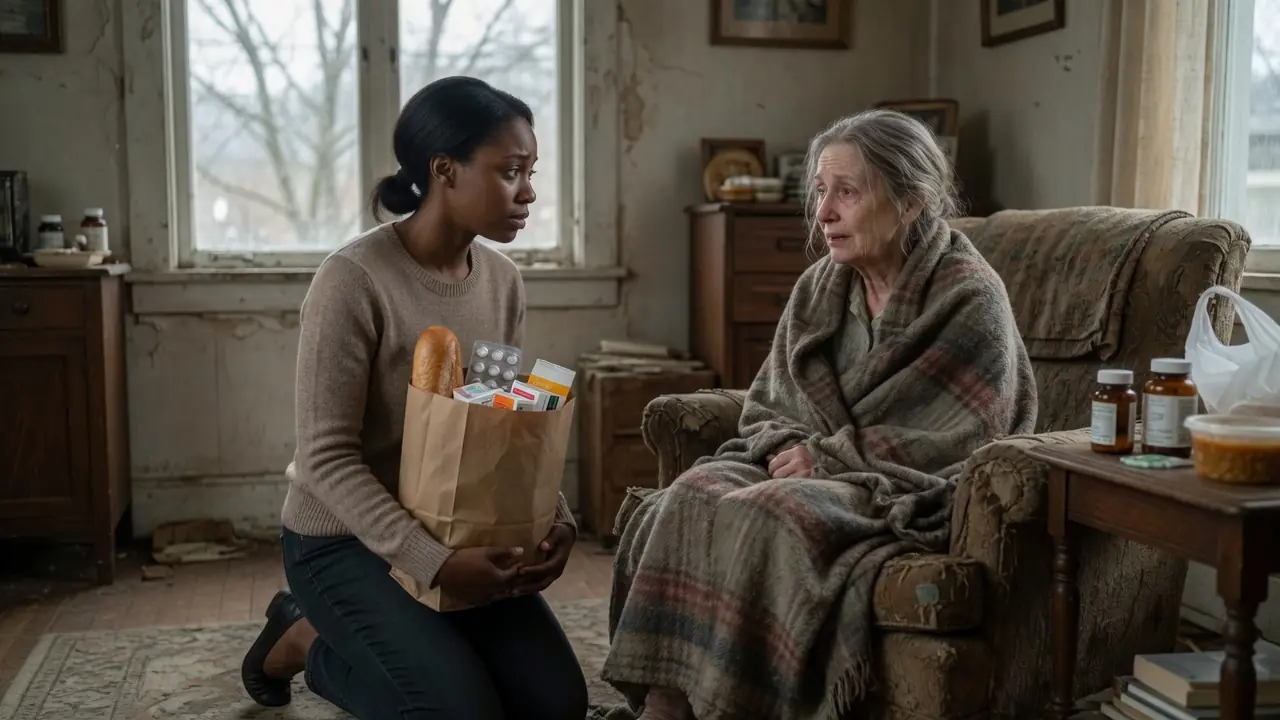
“You are drowning.”
Emma’s face went hot.
“You went through my bag?”
“I am not proud of it,” Margaret said. “But I am correct.”
Clara’s eyes filled with tears.
“You are starving yourself for us.”
“I am not starving.”
Isaiah looked at her.
“Mommy, sometimes you say you ate but you didn’t.”
Emma closed her eyes.
That hurt.
Not because he meant to wound her.
Because he had noticed.
She reached for his hand.
“I’m okay, baby.”
Margaret’s voice softened.
“No, Emma. You are loving everyone except yourself.”
Clara began to cry.
“I should leave. I should go to a shelter.”
“No,” Emma said immediately.
“Then we must find my son,” Clara said. “Michael needs to know what happened. He needs to know where I am.”
Emma nodded.
“I’ve been trying.”
Clara looked at her.
“You have?”
“Every night.”
Emma pulled out her phone and showed them the search history.
Michael Whitmore Europe business.
Michael Whitmore London.
Michael Whitmore Seattle investor.
Michael Whitmore international logistics.
There were too many results.
Too many dead ends.
Clara’s shoulders sagged.
“He is gone.”
“No,” Emma said. “He is lost from us. That is not the same thing.”
Four thousand miles away, in a modern office building in London, Michael Whitmore sat at his desk staring at his phone.
He had tried calling Jessica for the twentieth time that day.
Like every other time, it went straight to voicemail.
His business partner, David, stood in the doorway.
“Still nothing?”
“Three weeks,” Michael said. “Three weeks since I’ve spoken to my mother. Jessica isn’t answering. Something is wrong.”
“Maybe she lost her phone.”
Michael stood abruptly.
“My mother doesn’t use phones. Jessica knows I call every week. She always puts Mom on.”
“Maybe your mother is visiting someone.”
Michael gave him a hard look.
“My mother has no one in Seattle except Jessica. That is the problem.”
The truth hit him all at once.
Not as a thought.
As a physical blow.
“What if Jessica stopped taking care of her?”
David frowned.
“Michael.”
“I’ve been sending money for four years. Rent. Food. Medicine. Everything.”
He grabbed his jacket.
“What if my mother never got it?”
Thirty-six hours later, Michael stood in front of the apartment building where Clara had lived before everything fell apart.
His heart pounded as he climbed the stairs to the third floor and knocked on the door.
A young man with tattoos opened it.
“Yeah?”
“I’m looking for Clara Whitmore. She lives here.”
“Nobody by that name lives here. I moved in months ago.”
The world tilted.
“Months?”
“Talk to the landlord.”
The door closed.
Michael ran downstairs.
The landlord, Mr. Patterson, remembered him.
His face darkened with pity when Michael asked about Clara.
“I had to evict her,” the man said.
Michael stared at him.
“No. I sent money every month.”
“I never got it.”
“Jessica was supposed to pay you.”
“She didn’t.”
Michael’s breath went shallow.
“When?”
“Six months ago. Maybe seven.”
“Where did my mother go?”
Mr. Patterson looked away.
“I don’t know. Some neighbors saw her around for a while. Sleeping outside. Then she disappeared.”
Michael stumbled backward.
His mother had been homeless.
In Seattle.
In winter.
While he was in London believing she was safe.
He called Jessica again.
Voicemail.
He called ten more times.
Voicemail.
Voicemail.
Voicemail.
“Answer the phone!” he shouted before nearly throwing it against the wall.
Then he called the police.
Detective Sarah Morrison took the case.
She was kind, but practical.
“Mr. Whitmore, I need you to understand that this may take time.”
“My mother may not have time.”
“I know.”
He gave her everything.
Photos of Clara.
Medical history.
Jessica’s number.
Bank transfers.
The address.
The timeline.
Then Michael printed five hundred flyers with his mother’s picture.
Missing: Clara Whitmore, 69 years old. Gray hair. Brown eyes. Last seen in Seattle. $100,000 reward for information.
He searched shelters.
Hospitals.
Soup kitchens.
Encampments.
Underpasses.
Alleys.
Places he had never imagined his mother seeing.
David flew in from London to help him search.
They found only pieces.
A soup kitchen volunteer remembered Clara.
A woman outside a shelter thought she had seen her near Industrial Road.
A man under a bridge said she used to ask if anyone knew where to find a phone.
Each clue led to another empty place.
Then Detective Morrison called.
“Mr. Whitmore, we may have found something.”
Michael gripped the phone.
“My mother?”
“A woman matching her description was admitted to Mercy General three weeks ago. Severe hypothermia, malnutrition, infection. She was found unconscious in an abandoned building.”
Michael could barely breathe.
“Is she alive?”
“She was discharged two weeks ago.”
“Discharged where?”
“That’s the unusual part,” Detective Morrison said. “A young woman named Emma Richardson helped arrange her care. According to the file, Clara was released to an elderly woman named Margaret Foster, under Emma’s daily supervision.”
“Who is Emma Richardson?”
“A single mother. She works as a private caregiver and office cleaner. I have her contact address connected to Margaret Foster’s apartment.”
Michael was already moving.
“Send it to me.”
“Mr. Whitmore, wait for officers.”
“I’ve waited long enough.”
When Michael reached Margaret’s building, two officers were already there.
He ran up the stairs with David behind him and stopped in front of apartment 3C.
His hand shook as he knocked.
From inside came a child’s voice.
“Mommy, someone’s at the door.”
Footsteps followed.
The door opened.
Emma stood there in jeans and a faded sweater, her hair pulled back, exhaustion under her eyes. Behind her, a little boy peeked around her leg.
“Can I help you?” Emma asked.
Michael’s voice broke.
“Are you Emma Richardson?”
“Yes.”
“My name is Michael Whitmore. I’m looking for my mother. Clara Whitmore.”
Emma’s expression changed.
Softened.
“Oh,” she whispered. “Michael.”
His knees almost failed.
“She’s here?”
Emma turned toward the living room.
“Clara.”
There was a pause.
Then a voice Michael had dreamed about for months answered.
“Yes, dear?”
Michael pushed one hand against the doorframe to stay upright.
Then Clara appeared from the living room, one hand on Margaret’s walker for balance.
She was thinner.
Older.
Frail.
But alive.
Her eyes widened.
The room stopped breathing.
“Michael?” she whispered.
“Mom.”
Clara’s hand flew to her mouth.
“My baby.”
Michael crossed the room in three strides and caught her before her knees gave out.
He wrapped his arms around her and sobbed into her shoulder.
“I’m sorry,” he cried. “I’m so sorry. I didn’t know. I swear I didn’t know.”
Clara clung to him with all the strength she had.
“You found me,” she sobbed. “You found me.”
“I looked everywhere.”
“I thought I would never see you again.”
“I’m here now.”
They sank to the floor together, holding each other like the world had finally given back what it stole.
Emma stood near the door with Isaiah pressed against her side, tears rolling down her face. Margaret sat at the table crying openly, one trembling hand over her heart.
David turned away to wipe his eyes.
Even the officers stood silently, giving the reunion its space.
After several minutes, Michael pulled back and cupped his mother’s face in both hands.
“Are you hurt? Did anyone hurt you? Tell me everything.”
Clara looked toward Emma.
“She saved me.”
Michael turned.
Emma stiffened as if unprepared for the weight of his gaze.
“My mother says you saved her.”
“I found her,” Emma said softly. “That’s all.”
“No,” Clara said. “She did more than find me. She stayed. She got me to the hospital. She helped with the bill. She brought me here. She comes every day to care for Margaret and me. She feeds us, cleans, checks our medicine, takes us to appointments. And she has a little boy, Michael. A little boy, and still she made room for me.”
Michael looked at Emma as if he could not understand how one stranger had done what everyone else failed to do.
Then, slowly, he walked toward her.
“I don’t know how to thank you.”
Emma shook her head.
“You don’t have to.”
“Yes,” he said, voice breaking. “I do.”
He dropped to his knees in front of her.
Emma gasped.
“Please, don’t—”
“You saved my mother when I wasn’t here to save her,” Michael said. “You gave her shelter when she had none. You cared for her every day while raising your own child. You paid what you could when you had nothing extra to give.”
His eyes filled.
“How do I repay that?”
Emma knelt quickly so he would not remain beneath her.
“You don’t repay kindness,” she said. “You pass it on.”
Isaiah looked at Michael seriously.
“My mommy says that all the time.”
Michael laughed through tears.
Margaret pointed a shaky finger at him.
“Then listen to the boy.”
For the first time in weeks, Clara smiled.
The officers took statements.
Clara told them everything about Jessica, the money, the betrayal, the eviction, the street, the abandoned building.
Michael provided the transfer records.
Emma explained how she found Clara and how Clara ended up staying with Margaret.
Margaret gave her own statement too, fierce and detailed, making sure the officers understood exactly how much Emma had done.
“She is not just a caregiver,” Margaret said. “She is the reason this woman is alive.”
Within days, Jessica Martin was found in a luxury apartment downtown with her new boyfriend.
The money Michael had sent for Clara’s care had paid for designer bags, trips, jewelry, restaurants, and rent.
She was arrested on fraud, theft, and elder abuse charges.
But Michael did not focus on Jessica first.
He focused on Emma.
The next afternoon, he returned to Margaret’s apartment with David, a folder of documents, and an expression that made Emma nervous.
“I want to help,” he said.
“You already found your mother,” Emma replied. “That’s enough.”
“No. It isn’t.”
Michael sat at Margaret’s small table while Isaiah colored beside Clara.
“I paid the hospital balance this morning,” he said.
Emma froze.
“What?”
“All of it. And the remaining charity paperwork has been withdrawn. You don’t owe Mercy General anything.”
Emma’s eyes filled.
“Michael, that was too much.”
“It was the smallest thing on the list.”
“What list?”
He opened the folder.
“Your electric bill is paid. Your rent is current. Margaret’s rent is covered for a year. Clara’s medical follow-ups are paid. I set up a monthly care fund for both women, managed through an attorney so there are no mistakes.”
Emma stared at him.
Her voice barely worked.
“Michael.”
“I also spoke with Seattle Medical Center. They need patient care coordinators with home-care experience. You have more practical experience than half the people they interview. You have a meeting next week.”
“I’m not a nurse.”
“I know. This position doesn’t require a nursing license. It requires compassion, organization, reliability, and the ability to care for vulnerable people with dignity.”
Margaret snorted.
“She is overqualified.”
Emma covered her mouth.
Michael’s voice softened.
“You should not have to work nights cleaning offices after caring for people all day.”
Emma looked at Isaiah.
Her son had stopped coloring.
“Does that mean Mommy can sleep more?” he asked.
The room went quiet.
Michael looked at the boy.
“Yes,” he said gently. “That is exactly what it means.”
Emma began to cry.
Not soft tears.
Not graceful ones.
She folded forward, overwhelmed by the sudden removal of burdens she had carried so long they had become part of her posture.
Margaret reached for one hand.
Clara reached for the other.
Isaiah climbed into her lap.
Michael sat across from them, eyes wet, silent with gratitude.
Over the next month, everything changed.
Emma got the job at Seattle Medical Center as a patient care coordinator in the home-support division. Her pay doubled. Her hours became stable. For the first time in years, she could pick Isaiah up from preschool without sprinting from one obligation to the next.
Michael moved Clara into a comfortable apartment near his temporary rental while he arranged to bring her to London with him. But Clara refused to leave immediately.
“Not until Emma is settled,” she said.
Michael learned quickly that arguing with his mother was pointless when she had moral certainty on her side.
He helped Emma move into a better apartment, one with two bedrooms so Isaiah could have his own room. He paid the first year of rent despite Emma protesting at least twelve times.
Margaret moved into a senior living apartment with daily support funded by Michael’s care trust, though Emma still visited her every Sunday with Isaiah.
“You are not getting rid of us,” Emma told her.
Margaret smiled.
“Good. I have grown attached.”
Clara recovered slowly.
She gained weight.
Her hands stopped shaking.
She began cooking again, simple meals at first, then Michael’s childhood favorites.
The first time she made chicken stew, Michael cried into the bowl.
“I thought I’d never taste this again,” he said.
Clara touched his cheek.
“I thought I’d never make it for you again.”
Jessica’s trial came months later.
Clara testified.
So did Michael.
So did Emma.
When Emma took the stand, the prosecutor asked her why she stopped that morning.
Emma thought about it.
Then she answered honestly.
“Because I know what it feels like to hope somebody notices. I’m a single mother. I’ve been tired, scared, broke, and invisible. I couldn’t walk past another person who had been made invisible too.”
The courtroom was silent.
Jessica was found guilty on all counts.
She was sentenced to prison and ordered to pay restitution she would likely spend years trying to satisfy.
Outside the courthouse, Clara did not celebrate.
She simply took Michael’s hand and said, “It’s finished.”
Michael nodded.
Then he looked at Emma.
“Not finished,” he said. “Changed.”
Emma did not know then how right he was.
Michael began visiting Seattle regularly.
At first, he said it was for Clara’s medical appointments and legal matters.
Then for business.
Then for Emma.
He and Isaiah became friends before Emma fully knew what to do with that.
Michael learned Isaiah liked dinosaurs, pancakes, and building towers from plastic blocks only to knock them down with dramatic sound effects.
Isaiah learned Michael was good at voices during story time.
One evening, after dinner in Emma’s apartment, Isaiah fell asleep on the couch with his head on Michael’s leg.
Emma stood in the kitchen doorway and saw Michael sitting perfectly still, afraid to wake him.
“You can move,” she whispered.
Michael looked down at the sleeping child.
“I don’t want to.”
Something in Emma’s heart shifted.
Not loudly.
Not suddenly.
But deeply.
Love did not arrive like lightning.
It arrived like trust repeating itself.
A ride to an appointment.
A call to ask if she had eaten.
A hand offered without pressure.
A man who listened when Isaiah talked about dinosaurs as if the survival habits of triceratops mattered to international business.
Months passed.
Clara eventually moved to London with Michael but insisted on video-calling Emma and Isaiah every Sunday.
Margaret joined the calls from her senior apartment.
It became a strange family circle across time zones and screens.
Then, one year after the morning Emma found Clara in the abandoned building, Michael came back to Seattle for what he claimed was a business trip.
He took Emma and Isaiah to dinner.
Afterward, they walked near the waterfront, where the air smelled of rain and salt.
Isaiah ran ahead to look at the boats with David, who had flown in with Michael and somehow become part of everything too.
Michael stopped beside Emma.
“I need to tell you something,” he said.
Emma looked at him.
“Okay.”
“I love you.”
The words hung between them, simple and terrifying.
Emma’s breath caught.
Michael continued before fear could stop him.
“I love the way you care without making people feel small. I love the way you fight for your son. I love the way you still visit Margaret every Sunday even though your life is busier than ever. I love that my mother calls you her daughter when she thinks I’m not listening.”
Emma laughed through sudden tears.
“She knows you’re listening.”
“I know.”
He took her hand.
“I’m not asking you to change your life overnight. I’m not asking to replace anyone. I know Isaiah has to come first. I respect that. I love that.”
His voice trembled.
“But I want to build something with you, if you’ll let me. Slowly. Honestly. In whatever way makes you feel safe.”
Emma looked toward Isaiah, who was pointing at a ferry while David pretended to be amazed.
Then she looked back at Michael.
“I love you too,” she whispered.
His face changed completely.
Like a man who had been holding his breath for months.
“You do?”
“Yes,” she said. “And it scares me.”
“Me too.”
“Good.”
He laughed.
She stepped into his arms, and he held her carefully, like someone who understood that love was not possession.
It was shelter.
Two years later, Emma and Michael married in a small ceremony in Seattle.
Not London.
Seattle.
Because that was where the story had begun.
Margaret sat in the front row wearing a lavender dress and crying before the music even started.
Clara sat beside her, stronger now, elegant in a soft blue suit, holding Isaiah’s hand.
Isaiah, now seven, walked Emma down the aisle.
Halfway there, he whispered, “Mommy, don’t trip.”
Everyone close enough to hear laughed.
Emma squeezed his hand.
“I’ll try not to.”
Michael cried when he saw her.
Not a few dignified tears.
Real ones.
David handed him a handkerchief and muttered, “Honestly, man, hold it together.”
Michael did not.
During the vows, Michael looked at Emma and said, “You once told me kindness should be passed on. I promise to spend the rest of my life passing yours forward.”
Emma’s voice shook when she answered.
“You found your mother because you refused to stop searching. You found me because you were brave enough to be grateful without trying to own the person who helped you. I promise to build a home with you where kindness is not a debt, but a way of living.”
Isaiah stood between them during the final blessing.
When the officiant pronounced them family, he raised both arms and shouted, “Finally!”
The room erupted in laughter.
Years later, Emma would still think about that cold Seattle morning.
She would think about the bus running late.
The shortcut.
The abandoned building.
The groan she almost ignored because she had somewhere else to be.
She would think about how life sometimes changes not because a person makes a grand plan, but because they stop walking long enough to listen.
By then, Emma and Michael had built a life between Seattle and London.
Clara lived with them part of the year.
Margaret spent holidays with them whenever she wanted, which was always.
Isaiah grew tall, kind, and serious about making sure elderly neighbors had groceries before storms.
And Emma never stopped working in care.
She eventually helped create a community home-support program for elderly people who had no family nearby. Michael funded it quietly. Margaret named it The Open Door Project. Clara insisted the logo include a cup of tea.
On the first anniversary of the program, Emma stood in front of a small crowd and told the truth.
“I was not rich when I helped Clara. I was not powerful. I was not fearless. I was a tired single mother with overdue bills and a child depending on me. But I had two hands, a phone, and the choice not to walk away.”
She looked at Clara, then Margaret, then Michael, then Isaiah.
“That choice changed her life. But it also changed mine.”
After the event, Clara hugged her.
“You gave me back my son,” she whispered.
Emma held her tightly.
“And you gave me a family.”
That night, at home, Isaiah spread crayons across the kitchen table while Margaret and Clara argued cheerfully about whether tea should be sweetened before or after pouring.
Michael stood beside Emma at the sink, drying plates.
He looked toward the table.
“Our house is very loud,” he said.
Emma smiled.
“It is.”
“Do you like it?”
She looked at the people she loved.
The old women who had become mothers to her.
The son who had never again needed to ask whether Mommy could sleep more.
The husband who had found her through gratitude and stayed through love.
“I love it,” she said.
And she meant it.
All of it had begun because one cold morning, Emma Richardson was late.
Late to Margaret’s apartment.
Late to her long list of responsibilities.
Late to a life that had never given her enough time.
But she stopped anyway.
She listened.
She stepped into the dark.
And because she did, an elderly woman lived.
A son found his mother.
A little boy gained a family.
And Emma learned that kindness does not always return the way you expect.
Sometimes it returns as shelter.
Sometimes as justice.
Sometimes as love.
Sometimes as a child laughing in a kitchen where no one is lonely anymore.
And sometimes, if grace is very near, it returns as a home.