A waitress works tirelessly at an upscale diner to provide for her young son and her ailing father.
Suddenly, a ragged homeless woman walks into the restaurant to ask for food.
The moment her manager sees him, he immediately orders that the homeless woman be thrown out.
Unable to ignore his suffering, she secretly brings him her own lunch.
The price of her kindness is losing the only job she has. But she has no idea that the homeless woman she helped is actually a billionaire, and that this small act of compassion will change her life forever.
Emily Watkins pressed her forehead to the bus window, fighting the kind of exhaustion that made even breathing feel like work.
Her shift at Maple Diner started in twenty minutes. At home, Noah was probably eating cereal again while her father pushed through the morning with aching knees, and the bills, electric, medication, groceries kept stacking up no matter how hard she tried to outrun them.
She jumped off the bus at Fifth Street and hurried to the diner, clocking in at 6:58.
“Cutting it close, Watkins,” Brian Colewoman, the restaurant manager, said without looking up.
“I’m two minutes early.”
“Early is on time. On time is late.” He waved her off. “Table six needs busing.”
The morning rush slammed into her. Orders barked. Coffee refills dewomanded. Customers impatient for everything.
Emily moved fast. Smile practiced. Pain ignored.
On her break, she scribbled numbers onto the back of a receipt.
Skip lunch. Save $20.
Delay Noah’s new shoes. Maybe another week.
Stretch the groceries somehow.
But her father’s medication, she could not compromise on that.
“Break’s over.”
Brian’s voice snapped from the doorway.
Emily folded the receipt, steadied herself, and caught her reflection in the metal shelf. A tired wowoman in a fading uniform holding her world together with grit alone.
She inhaled, pocketed the receipt, and went back to work.
She refilled coffee at table nine, cleared plates at table three, smiled at the regular who always left exactly two dollars no matter the bill. The lunch rush was building, tightening her shoulders the way it always did.
Her phone buzzed in her pocket.
A text from her father.
Noah’s shoes ripped. He can’t wear them.
Emily closed her eyes for just a moment, standing there in the middle of Maple Diner with a coffee pot in one hand and the weight of the world pressing down on both shoulders.
Then she opened her eyes, put on her smile, and went to greet the customers at table seven.
Because that was what you did.
You kept going.
You stayed kind.
You did not let the world make you hard, even when it gave you every reason to become that way.
It was the one thing Emily had left that felt truly hers. This stubborn, perhaps foolish determination to remain decent in a world that seemed to reward everything but decency.
Around lunchtime, a strange old woman walked into the restaurant.
Emily was at the coffee station, and she saw him immediately. Everyone did.
He moved slowly, uncertainly, like someone who was not sure he had the right to occupy space in the world. His denim jacket was torn at both elbows, and the knit cap on his head had unraveled at the edges. His face was smudged with dirt, and his hands trembled as they clutched the strap of a weathered canvas bag.
The conversations at the tables did not stop exactly, but they changed. Quieter. Watchful.
The old woman stood just inside the doorway, his eyes scanning the room with something that looked like hope mixed with resignation.
Emily knew that look.
She had seen it on her father’s face when the pain got bad, and he did not want to ask for help. The look of someone who needed something but hated needing it.
“Excuse me,” the old woman said, his voice barely above a whisper. “I was wondering…”
“No.”
Brian Colewoman appeared from behind the counter, moving fast.
“Absolutely not.”
The old woman took a small step back.
“I just need…”
“We don’t serve people like you.” Brian positioned himself between the old woman and the dining room, his body language aggressive. “This is a family establishment.”
Emily felt something tighten in her chest. She set down the coffee pot and moved closer, not sure what she was going to do, but unable to stay still.
“I can pay,” the old woman said, reaching into his pocket with shaking fingers. He pulled out a handful of coins. “I have some money. Just something small. Anything.”
A wowoman at table four pulled her purse closer. A woman at the counter turned away, suddenly very interested in his phone.
Emily watched it all happen.
The way people made themselves smaller, looked away, pretended not to see.
Brian snatched a cleaning rag from his belt and threw it down at the old woman’s feet.
The rag hit the floor with a wet slap.
“You’re filthy,” Brian said, his voice loud enough now that everyone could hear. “You’re making my customers uncomfortable. I want you out.”
The old woman stared at the rag on the floor. His lips moved, but no sound came out.
His eyes, Emily noticed, were clearer than they had any right to be. Sharp and assessing despite the dirt and the trembling and the worn-out clothes.
“Please,” the old woman tried again. “I haven’t eaten since yesterday morning. Just…”
“Marcus.”
Brian snapped his fingers at the security guard who stood by the entrance.
Marcus was a big woman who usually spent his shifts reading paperback westerns and nodding at regulars. He looked uncomfortable now, but he moved forward anyway.
“Sir,” Marcus said, his voice apologetic, “I’m going to have to ask you to leave.”
“I’m not causing trouble,” the old woman said. “I’m just hungry.”
“You’re trespassing.” Brian’s voice had gone cold and corporate, the voice of someone reciting policy. “Marcus, escort him out now.”
Emily’s hands had curled into fists at her sides. Her heart hammered against her ribs.
Around the dining room, people were watching now, their breakfasts forgotten. Some looked uncomfortable. Most looked relieved that someone was handling the situation.
None of them said a word.
Marcus took the old woman gently by the elbow.
“Come on. Let’s go.”
The old woman did not resist. He let himself be guided toward the door, his shoulders hunched, his head down.
As they passed Emily, he looked up at her for just a moment.
Their eyes met.
She saw hunger there. Real, bone-deep hunger. The kind that made your stomach cramp and your thoughts go fuzzy. The kind she had felt herself on the worst days when she had skipped too womany meals so Noah and her father could eat.
She also saw something else.
Sadness, yes, but more than that, a kind of knowing, like he had expected this. Like it happened all the time, and he had learned not to hope for anything different.
The door swung shut behind them.
Brian clapped his hands together, the sound sharp in the suddenly quiet diner.
“Show’s over, folks. Enjoy your meals.”
The conversation started up again, cautious at first, then growing louder. Silverware clinked against plates. Someone laughed.
The world moved on because the world always moved on, grinding forward whether you were ready or not.
Emily stood frozen by the coffee station, the pot still in her hand, watching through the window as Marcus walked the old woman to the street corner and then came back alone.
“Watkins.”
Brian’s voice cut through her thoughts.
“Table six needs their check. Move.”
She moved.
She brought the check to table six. She smiled and asked if everything had been okay with their meal. She cleared plates and refilled drinks and kept her face pleasant and neutral even though something inside her chest felt like it was cracking.
During her break, she went out the back door to the alley behind the diner.
She needed air. She needed to think. She needed to figure out why she was so angry when this happened all the time in every city in America, and getting upset about it changed nothing at all.
That was when she saw him.
The old woman was by the dumpster, bent over, reaching into the trash with both hands. He pulled out a paper bag, opened it, looked inside, then set it aside and reached in again.
Emily’s throat went tight.
He was not just looking.
He was searching.
Desperate, moving cardboard aside, lifting plastic bags, checking every container for something, anything edible.
He found half a sandwich, someone’s leftover lunch wrapped in wax paper. He stared at it for a long moment, and Emily saw his hands shake worse than before.
Then he unwrapped it carefully like it was something precious and took a small bite.
Emily’s feet were moving before she made the decision to move them.
“Hey,” she said softly, not wanting to startle him.
The old woman spun around, the sandwich clutched to his chest. His eyes were wide, caught, embarrassed, ready to run.
“It’s okay,” Emily said quickly, holding up both hands. “I’m not going to... I just wanted to ask, have you eaten? I mean, really eaten today?”
He looked at her for a long moment, and she could see him deciding whether to lie, whether to preserve some last shred of dignity or admit the truth.
He shook his head.
The sandwich fell from his fingers.
He swayed on his feet, and Emily lunged forward, catching his arm before he could collapse.
He was lighter than she expected. All bones and worn-out fabric.
“When’s the last time you ate anything?” she asked.
“Day before yesterday,” he whispered. “Maybe. I lose track.”
Day before yesterday.
Seventy-two hours.
Emily had felt hunger plenty of times in her life, but never that long. Never long enough to make the world tilt sideways.
She thought about Brian’s face when he had thrown that rag at the old woman’s feet.
She thought about getting fired, about Noah’s shoes, about the electric bill.
Then she looked at the old woman, at his hollow cheeks and his desperate eyes and his hands that would not stop shaking.
And she made a decision.
“Wait here,” she said. “Just wait right here, okay?”
She did not wait for him to answer.
She went back inside, her heart pounding so hard she thought everyone must be able to hear it.
The back hallway of Maple Diner smelled like grease and industrial cleaner. Emily stood at the POS terminal in the server station, her fingers hovering over the screen.
She had never deliberately broken the rules before. Not once in the two years she had worked here. She showed up on time, followed every policy, smiled through every difficult customer.
She needed this job far too much to risk it.
But she kept seeing the old woman’s hands shaking in the alley. Kept hearing him whisper.
Day before yesterday. Maybe. I lose track.
The server station was empty. Brian was out front dealing with an irritated customer whose omelet had too womany onions. The other servers were caught in the lunch rush.
It was now or never.
Emily logged into the POS with her employee code. The familiar screen blinked to life, and the weight of what she was doing settled heavily on her shoulders.
Here, right here, was where the rules lived.
Maple Diner’s policies were strict about employee meals. One meal per shift, logged through POS, eaten on premises during designated break time, never taken outside, never given away, never lost in inventory. Everything cross-checked by Brian every night to the decimal point.
A server last month had been fired for taking home half a sandwich that would have been thrown out anyway. No warnings. No exceptions.
Emily knew all of this better than anyone.
Her hand trembled as she pulled up her staff meal allocation.
One meal per shift automatically deducted.
She selected the hot plate special. Meatloaf, mashed potatoes, green beans, and a roll. Real food. The kind that could put strength back into someone who had not eaten in days.
But she could not send it through as a staff meal.
Brian checked.
Brian always checked.
Her finger hovered over the waste comp button.
It was meant for food that got made wrong, dropped on the floor, sent back by customers. If she marked it as waste, it would still show in the system, but it would not be tracked to her employee account.
Just another piece of inventory that did not make it to a paying customer.
But it was fraud.
Small fraud, maybe. Victimless fraud, she told herself.
But fraud nonetheless.
Emily closed her eyes and saw Noah’s face. Saw the pile of bills on her kitchen table. Saw her father taking his pills in careful halves to make them last longer.
Saw the old woman digging through trash.
She pressed the button.
The order printed in the kitchen.
Emily grabbed the ticket and clipped it to the line, her pulse hammering in her ears.
The cook, Tony, was a twenty-year veteran of restaurant kitchens who had seen everything and cared about nothing except keeping his head down until retirement.
“Rush order?” he asked without looking up.
“Customers in a hurry,” Emily lied.
The words tasted wrong in her mouth.
Tony nodded and got to work.
Emily waited, shifting her weight from foot to foot, watching the dining room through the service window. Brian was still at the front counter. The clock above the line read 12:43.
She had maybe ten minutes before someone noticed her standing around.
The meatloaf sizzled on the flat top. Tony plated it with quick, efficient movements. Potatoes from the warmer, green beans from the steam table, a roll from the basket.
He set the plate under the heat lamp and dinged the bell.
“Order up.”
Emily grabbed the plate with both hands. It was hot enough to burn through the thin rim, but she did not care.
She headed for the back door, moving as naturally as she could, like she was just taking out trash or getting something from her car.
“Watkins.”
She froze.
Brian’s voice, sharp and suspicious.
“Where are you going with that?”
Emily turned, her mind racing.
The plate was heavy in her hands. Steam rose from the meatloaf. She could feel sweat beading at her temples.
“Customer sent it back,” she said, surprised at how steady her voice sounded. “Said the meat was overcooked. I was just going to toss it before Tony made a new one.”
Brian narrowed his eyes.
“Looks fine to me.”
“Well, the customer didn’t think so.” Emily shifted her grip on the plate. “You want me to take it back out there? Maybe you can explain to them how their opinion is wrong.”
It was a gamble.
Brian hated confrontation with customers almost as much as he hated rulebreaking.
For a long moment, he stared at her, and Emily was certain he could see right through her. Could see the lie written across her face in neon letters.
Then he waved his hand dismissively.
“Just dump it and tell Tony to be more careful.”
Emily nodded and turned back toward the door before he could change his mind.
She pushed through into the alley, the door swinging shut behind her with a metallic clang.
The old woman was exactly where she had left him, sitting against the brick wall near the dumpster. He had pulled his knees up to his chest and wrapped his arms around them, making himself as small as possible.
When he saw Emily, he started to struggle to his feet.
“No. Stay there,” Emily said quickly.
She knelt down beside him, holding out the plate.
“Here.”
He stared at the food like it might disappear if he looked away.
“I can’t.”
“Yes, you can,” Emily said firmly. “Please take it.”
“But your manager…”
“Isn’t out here.”
She pressed the plate into his hands.
“Eat.”
He took the plate with trembling fingers. For a moment, he just held it, staring down at the food with an expression Emily could not quite read.
Then he picked up the fork and took a bite of meatloaf.
The sound he made was almost painful to hear. Relief and hunger and something that might have been grief all mixed together.
He ate slowly at first, then faster, like his body was remembering what food was supposed to do, how it was supposed to make you feel.
Emily watched him eat, sitting back on her heels in the dirty alley.
She should go back inside. Her break was almost over.
But something kept her there, witnessing this small act of survival.
“I used to sit at table seven,” the old woman said suddenly, pausing between bites.
“Before?”
“Before everything changed.” He took another bite, chewed thoughtfully. “When you have everything, people smile at you. Remember your name. Save your favorite table. When you have nothing...”
He gestured vaguely at himself, at the alley, at the dumpster.
“You become invisible. Or worse, something to be removed.”
“You’re not invisible,” Emily said. “And you’re definitely not something to be removed.”
He looked at her, then really looked at her, and Emily saw intelligence in those eyes. Sharp awareness.
This was not a woman who had lost his mind to addiction or illness. This was someone who had simply lost everything else.
“Why?” he asked. “Why risk your job for someone like me?”
Emily thought about Noah, about her father, about all the times she had needed help and had not gotten it, about how easy it was to tell yourself that other people’s problems were not your responsibility.
About how the world kept spinning whether you chose kindness or cruelty, so you might as well choose kindness.
“Because today I can afford to skip a meal,” she said finally. “And you can’t. That’s all the reason I need.”
The old woman’s eyes grew bright. He looked down at his plate, blinking rapidly.
“Thank you,” he whispered. “You have no idea what this means.”
“Finish eating,” Emily said, standing up. “I have to get back before someone notices I’m gone.”
She turned toward the door, and that was when it happened.
A piece of paper fluttered out of her apron pocket, carried by a gust of wind. It tumbled across the concrete and landed face up near the old woman’s feet.
Emily’s shopping list.
The one she had been working on during her break, trying to figure out how to stretch $70 across a week’s worth of needs.
The old woman picked it up automatically, probably just meaning to hand it back.
But his eyes caught on the words, and Emily saw him reading.
Milk for Noah.
Dad’s pain medication.
Knee brace replacement.
Electric bill, $175.
Shoes for N. Urgent.
At the bottom in Emily’s tight handwriting:
If not enough this week, they’ll shut off power.
“Wait,” the old woman said.
But Emily was already pulling open the door.
“I really have to go,” she said. “Finish your food. Stay safe.”
She slipped back inside before he could say anything else, her heart pounding for entirely new reasons.
Now she had shown weakness. Vulnerability.
You did not do that.
You kept your struggles private, your problems hidden. You smiled and pretended everything was fine because admitting otherwise felt like failure.
Emily threw the empty plate in the dish pit and returned to the floor, pasting her customer service smile back on like armor.
She did not see the old woman carefully fold her shopping list and tuck it into his jacket pocket, handling it like it was made of gold instead of notebook paper and desperation.
She did not see him stand up, no longer trembling, his movement suddenly stronger and more purposeful than before.
And she definitely did not see the way he looked at the back door of Maple Diner, at the building that had thrown him out like garbage just an hour earlier, with an expression that mixed anger and sadness and steely determination.
Because Emily was already back at work, refilling coffee and taking orders and pretending that her hands were not shaking, that her stomach was not empty, that she had not just risked everything for a stranger.
She had done the right thing.
She knew she had.
She just hoped it would not cost her everything.
The old woman walked four blocks before he stopped trembling.
Not from hunger anymore. The meal had helped with that.
But from something else entirely. Something that felt uncomfortably close to shame.
He turned down a tree-lined street where the houses got bigger and the cars got newer. When he reached number 217, a craftswoman-style home with a wraparound porch and professionally maintained landscaping, he climbed the steps and let himself in with a key from his pocket.
Inside, the house was quiet and elegant. Hardwood floors, expensive rugs, artwork on the walls that cost more than most people made in a year.
The old woman walked straight to the downstairs bathroom and stood in front of the mirror.
Harrison Whitlock looked at his reflection. At the dirt carefully applied to his face, at the authentic-looking grime under his fingernails, at the costume that had cost three hundred dollars from a theatrical supplier who specialized in making people look homeless for film productions.
He turned on the faucet and began washing his face.
The dirt came off easily. It was meant to. Theatrical makeup designed to look real but remove cleanly.
Under it, Harrison’s skin was tanned and healthy. The skin of a seventy-eight-year-old woman who could afford the best dermatologists money could buy.
His hands, once he scrubbed them clean, showed only the normal age spots and wrinkles of someone his age.
No trembling now.
That had been an act too, practiced until it looked natural.
He removed the knit cap and ran his fingers through silver hair that was thinning but professionally cut. He took off the torn denim jacket to reveal a clean button-down shirt underneath.
The canvas bag he had carried contained nothing but props. A few dollar bills, some trash, a worn paperback to complete the image.
Harrison Whitlock, former CEO of Whitlock Energy Corporation, net worth somewhere north of $300 million, depending on which financial publication you asked. Owner of this house and four others. Collector of art. Donor to museums. Name on hospital wings and university buildings.
And for the past six months, part-time homeless woman.
He dried his face with a towel that probably cost more than Emily’s weekly grocery budget and walked to his study.
Frank Delgado was already there, seated in a leather chair, tablet in hand. He looked up as Harrison entered.
“Right on time,” Frank said. “Got your message.”
The message: Back from test eighteen. Meet me in the study.
Frank had been receiving variations of it for months.
“Well?” Harrison sank into his desk chair with a sigh.
“You were right again.”
“I usually am.” Frank set down his tablet. “What happened this time?”
“The manager threw a cleaning rag at my feet and had security escort me out.” Harrison’s voice was flat. Factual. “The customers looked away. A wowoman pulled her purse closer like I might steal it from six feet away. And then a server followed me out back, brought me a hot meal, used her own staff allocation.”
Harrison pulled Emily’s shopping list from his pocket and laid it on the desk.
“This fell out of her apron.”
Frank picked up the list, scanned it, and let out a low whistle.
“She’s drowning.”
“She’s drowning,” Harrison agreed. “And she still gave me her meal. Risked her job to feed a stranger.”
They sat in silence for a moment.
Outside the window, a bird sang in the expensive landscaping. The house’s climate control kept the temperature at exactly seventy-two degrees. The refrigerator in the kitchen, one of three in the house, was stocked with more food than Harrison could eat in a month.
“How womany places now?” Frank asked quietly.
“Maple Diner makes seventeen,” Harrison said. “Seventeen restaurants I visited as myself over the years. Places that smiled and scraped and gave me the best table. And all seventeen turned me away when I showed up looking like I had nothing to give them.”
“Except this server.”
“Except Emily Watkins.”
Harrison picked up the shopping list again, studying her handwriting. Small, careful letters. The writing of someone who was used to making every inch count.
“Single mother caring for an elderly parent. Working minimum wage at a place that treats her like she’s replaceable, and she still found it in herself to be kind.”
Frank leaned back in his chair.
“So, what are you going to do?”
It was the question Harrison had been asking himself for six months.
Ever since his granddaughter had sat in this very office and said, “Grandpa, when’s the last time someone was nice to you? Just because you’re you? Not because you’re rich, not because you can do something for them. Just because?”
The question had haunted him because the answer was that he could not remember.
Could not think of a single person in his life, except Frank and maybe two others, who would give him the time of day if he were broke.
His children called when they wanted money for a business venture or a divorce settlement. His grandchildren remembered his birthday when they needed help with college tuition. The board members who had once worked alongside him now smiled to his face and waited for him to die so they could vote in their own candidates.
His country club friends, were they even friends? Or just people who enjoyed the same expensive hobbies and tolerated each other’s company?
So, he had started testing. Disguising himself, visiting places that had once welcomed him with open arms, and learning again and again that kindness had a price tag.
Until today.
“I’m going to help her,” Harrison said finally. “The way she helped me.”
“How directly?”
“Anonymously for now. She won’t accept help if she knows where it’s coming from.”
Harrison stood and walked to the window.
“Can you handle the utilities payment? Make it look like it’s coming from some community relief program.”
“Already drafted the letterhead,” Frank said. He had been with Harrison long enough to anticipate what was needed. “What else?”
“The pharmacy. Her father needs medication. Set up an anonymous payment account.” Harrison ticked items off on his fingers. “Groceries delivered to her address. Make it look like she won a contest or something. And find out what size shoes her son wears.”
Frank nodded.
“We’ll need her address.”
“I assumed as much. Can you find it?”
Frank tapped his tablet, already searching.
“Employees’ home addresses are tied to payroll. Maple Diner runs on an outdated HR system, laughably unsecured. Give me an hour.”
“There’s one more thing,” Harrison said. “I want you to look into Maple Diner. The parent company. Who owns it. How they treat their workers. Everything.”
Frank raised an eyebrow.
“Why do I get the feeling this is about more than just helping one server?”
“Because that manager didn’t just turn me away. He humiliated me. Made sure everyone in that restaurant saw me as less than huwoman.” Harrison’s jaw tightened. “And I guarantee I’m not the first. If they treat their customers like that, how do you think they treat their employees?”
“You want to buy it?”
“I want to understand it first. Then maybe.” Harrison smiled, and it was not a particularly nice smile. “After all, I’m just a homeless woman. What threat could I possibly pose?”
Frank shook his head, but pulled out his tablet.
“I’ll start the research tonight.”
“Good.”
Harrison walked to his bedroom to change into clothes that actually fit his tax bracket.
“And Frank.”
“Yes?”
“Thank you.”
“For what?”
“For not trying to talk me out of this.”
Frank was quiet for a moment.
“Twenty years ago, you told me that money is just a tool. That it doesn’t mean anything unless you use it to make things better. I’m just glad to see you remember that.”
Harrison paused in the doorway.
“I almost forgot. That’s the scary part. You get comfortable surrounded by people who only care about what you can give them. You start to think maybe that’s just how the world works. That kindness is naive. That trust is for fools. And now…”
He looked back at the shopping list one more time.
“Now I know there’s at least one person in Austin, Texas, who still believes in doing the right thing, even when it costs her everything. I’m not going to let her go under for that. Not if I can help it.”
He walked upstairs to change, already planning his next move.
Emily Watkins had helped a stranger without expecting anything in return.
Now Harrison Whitlock was going to return the favor multiplied by every zero in his bank account.
And in the process, maybe he would remember what it felt like to be huwoman again. To connect with someone real, someone who saw a person in need and helped them. Not because of what they could get back, but because it was the decent thing to do.
That kind of goodness was rare.
Harrison had spent six months and visited seventeen places, proving exactly how rare.
But Emily Watkins had it.
And Harrison was going to make sure the world did not crush her for it.
Three days after Emily gave away her staff meal, she came home to find her apartment’s lights working.
She stood in the doorway, finger on the light switch, flipping it up and down.
On. Off. On. Off.
The bulb flickered obediently, which made no sense at all because the disconnect notice had said they would shut off power on Tuesday if she did not pay by Monday, and it was now Thursday, and she definitely had not paid.
“Dad?”
She dropped her purse on the couch.
“Did you pay the electric bill?”
Her father looked up from the kitchen table where he was helping Noah with homework.
“What? No. I thought they were going to shut it off.”
“They were supposed to.”
Emily walked to the kitchen and grabbed the stack of mail from the counter, flipped through envelopes until she found one with the Austin Energy logo. She tore it open.
Dear valued customer, your account has been enrolled in the Community Relief Program based on eligibility criteria.
Emily read it twice.
Three times.
“What the hell is the Community Relief Program?”
Her father came over, adjusting his reading glasses. He took the letter and scanned it.
“Says here it’s for families facing temporary hardship. Must be something new the city’s doing.”
“But I didn’t apply for anything.”
“Maybe they do it automatically based on income.” He handed the letter back. “Either way, kiddo, don’t look a gift horse in the mouth. We needed a break.”
Emily wanted to argue, to say that she did not take charity, that they would figure it out themselves.
But her father’s knees were wrapped in elastic bandages, and Noah’s shoes had duct tape holding the sole to the upper.
And she was so very tired of figuring things out.
“Yeah,” she said quietly. “We did.”
The next morning, Emily’s neighbor, Mrs. Chen, knocked on her door at 7:00 a.m. holding a large box.
“This came for you,” Mrs. Chen said. “Delivery woman said it was time-sensitive perishables.”
Emily took the box, confused. It was heavy.
She set it on the kitchen counter and opened it.
Inside was food.
Good food.
Fresh vegetables, chicken breasts, pasta, rice, canned goods, milk, juice, bread. Enough groceries for a solid week, maybe more if she stretched it.
There was a card on top.
Congratulations. You’ve been randomly selected as a recipient of the Central Market Community Giveback Program.
“Did you enter some kind of contest?” her father asked, peering into the box.
“No.”
Emily pulled out a package of chicken, checking the expiration date. It was fresh. Today’s date.
“I didn’t enter anything.”
But Noah was already pulling out a box of his favorite cereal, the kind Emily usually said was too expensive. And her father had found the coffee, the good stuff, not the generic brand that tasted like burnt dirt.
And Emily made herself stop asking questions.
Maybe she had entered something and forgot. Maybe she had filled out an online form months ago. Maybe the universe had decided to cut her a break for once.
“Mom, there’s mac and cheese.”
Noah held up three boxes like they were treasure.
“The kind with the good cheese.”
“I see that, baby.” Emily ruffled his hair. “We’ll have it for dinner tonight.”
At work that afternoon, Brian called her into his office.
“I need to talk to you about Tuesday,” he said, not looking up from his computer.
Emily’s stomach dropped.
Tuesday.
The day she had given away her staff meal.
Had he figured it out? Had someone seen her? She had been so careful.
But maybe.
“You logged your meal as waste,” Brian said. “Customer sent back meatloaf overcooked.”
“That’s right,” Emily said carefully.
“Tony doesn’t remember making it wrong.”
“It was busy. Maybe he forgot.”
Brian finally looked at her. His expression was unreadable.
“The thing is, Watkins, we had a camera malfunction that day. Back hallway footage is corrupted. Can’t see anything.”
Emily’s mouth went dry.
“So I can’t prove what you did or didn’t do with that meal.” He leaned back in his chair. “But I’m watching you now. One more incident. One more thing that doesn’t add up, and you’re done. Understand?”
“Yes, sir.”
“Get back to work.”
Emily left his office on shaking legs.
He knew.
Or suspected.
Either way, she was on borrowed time.
One mistake and she would be gone.
She made it through her shift without incident. Smiled at customers, kept her head down.
When she clocked out at 8:00 p.m., she was exhausted in a way that had nothing to do with standing all day.
The bus ride home took forty minutes. She spent them staring out the window, trying to calculate how much she had in savings if she got fired.
$300.
Maybe that would cover rent for half a month if she was lucky.
She was so lost in worry that she almost missed her stop. She jumped off the bus at the last second and started the two-block walk to her apartment.
That was when she saw him.
The old woman from the diner standing at the corner bus stop. Same torn jacket, same knit cap, but he looked different somehow. Steadier.
He saw her at the same moment and raised a hand in greeting.
Emily walked over, feeling strange about seeing him again, like running into a doctor at the grocery store, someone you only knew in one specific context.
“Hey,” she said. “You doing okay?”
“Better than I was.” He smiled, and it changed his whole face. Made him look younger somehow. “Thanks to you.”
“It was just a meal.”
“It was more than…”
He reached into his jacket and pulled out an envelope. White, clean, with her name written on it in careful handwriting.
“I wanted to give you this.”
Emily stared at the envelope.
“What is it?”
“Just take it, please. Someone did something kind for me. I’m trying to pass it on.”
“I can’t.”
“Yes, you can.” His eyes were sharp, focused. “You’re going to want to argue, going to say you don’t need help. But we both know that’s not true. And there’s no shame in accepting help when it’s offered. Not from someone who knows exactly how much that meal cost you.”
Emily opened the envelope with trembling fingers.
Inside were five crisp twenty-dollar bills.
“No.”
She tried to push it back at him.
“I can’t take this. You need this more than I do.”
“I promise you, I don’t.” His voice was gentle but firm. “And before you ask, it’s not stealing. It’s not illegal. It’s not going to get anyone in trouble. It’s just one person helping another the way you helped me.”
“But…”
“Did you get your electric bill paid?” he asked.
Emily froze.
“How did you…”
“And some groceries delivered? Maybe something for your son’s shoes.”
The shopping list.
The one that had fallen from her pocket.
“That was you.”
“Someone who witnessed your kindness,” he said, which was not really an answer. “Someone who wanted to make sure you didn’t go under for doing the right thing.”
A bus pulled up to the stop.
The old woman stepped back, preparing to board.
“Wait,” Emily said. “I don’t even know your name.”
He paused in the doorway of the bus.
“Does it matter?”
“Yes,” Emily said firmly. “It matters.”
He smiled again. That same transformative expression.
“Harrison. My name is Harrison.”
The bus doors closed, and he was gone, leaving Emily standing on the corner with one hundred dollars in her hand and more questions than answers.
She walked home slowly, her mind spinning.
The electric bill paid by a program she did not apply to. Groceries she did not win. Money from a homeless woman who somehow had cash to give away.
It did not make sense.
None of it made sense.
But Noah needed shoes. Her father needed medication. The rent was due in two weeks.
Emily folded the bills carefully and put them in her pocket.
At home, she found another envelope in her mailbox.
This one contained a receipt from CVS showing that a prescription account had been set up in her father’s name, prepaid for six months.
From someone who believes in passing kindness forward, the note said.
Emily stood in her building’s cramped entryway, holding the receipt.
And for the first time in months, she let herself cry.
Not from despair or exhaustion or fear, but from relief. From the strange, overwhelming feeling of being seen. Of having someone notice that she was drowning and throw her a lifeline without asking for anything in return.
She did not know who Harrison really was. Did not know how a homeless woman could afford to pay her bills or why he had chosen to help her specifically.
But she knew kindness when she saw it. Knew what it felt like to be on the receiving end of grace she had not asked for and definitely did not deserve.
It felt like maybe, just maybe, the world was not as cruel as she had started to believe.
Upstairs, Noah was reading a library book, and her father was watching television with his feet propped up, his knees finally wrapped in new elastic bandages instead of the old ones held together with safety pins.
“Everything okay, honey?” her father asked.
Emily wiped her eyes and smiled. A real smile this time. Not the customer service version.
“Yeah, Dad,” she said. “I think maybe it is.”
She did not know it yet, but across town, Harrison Whitlock was sitting in his study, reading Frank’s preliminary report on Maple Diner’s parent company.
And what he was reading made his blood boil.
Wage theft, documented but ignored. Harassment complaints filed and buried. Health code violations in three locations. A systematic pattern of retaliating against employees who spoke up about any of it.
Harrison set down the report and picked up his phone.
“Frank,” he said when his assistant answered. “I want to know everything. Every violation, every complaint, every skeleton in their corporate closet. And then I want to know exactly how much it would cost to buy them out.”
“Harrison…”
“Emily Watkins helped me because she’s a good person, and that company is punishing her for it. That manager threw a rag at my feet and told me I wasn’t worth serving.”
Harrison’s voice was cold, controlled, dangerous.
“I’m going to buy Maple Diner, Frank. And then I’m going to make sure they never treat another huwoman being like garbage again.”
“I’ll start the paperwork,” Frank said quietly.
Harrison hung up and looked out his window at the Austin skyline.
Somewhere out there, Emily was probably settling in for the night, relieved to have her bills paid, not knowing that she had started something much bigger than one meal in an alley.
She had reminded a bitter old woman that kindness still existed.
Now he was going to show her what happened when kindness had three hundred million dollars behind it.
On a Tuesday, Emily was restocking napkin dispensers when her phone started buzzing.
Then buzzing again.
And again.
Text messages from numbers she did not recognize. Notifications from social media accounts she barely used.
By the time she pulled her phone out of her apron pocket, she had forty-seven new messages.
The first one she opened was from her cousin Denise.
Girl, what did you do?
Attached was a link to a Twitter post.
Emily clicked it with trembling fingers.
The video was grainy, clearly taken from a security camera, but the image was clear enough. Her in her Maple Diner uniform, carrying a plate of food out the back door.
Timestamp and location in the corner.
12:43 p.m. Four days ago.
The caption read:
Server caught stealing food to stage homeless hoax for social media clout. Maple Diner employee Emily Watkins seen here removing stolen food from the premises. Source says she gave it to a woman pretending to be homeless who later paid her in cash. Full story coming.
The post had been reposted eight thousand times.
Emily’s hands went numb.
The phone slipped from her fingers and clattered on the floor.
“Watkins.”
Brian’s voice cut across the dining room.
“My office. Now.”
She picked up her phone with shaking hands and followed him to the back. The other servers watched her walk past. Some looked sympathetic. Most looked away.
Brian’s office was tiny, barely big enough for a desk and two chairs. He sat down behind his computer and spun the monitor around to face her.
“Want to explain this?”
It was the video, but more of it. This one showed the back alley. Showed the old woman, Harrison, putting something in her mailbox later that evening. The angle made it look deliberate, planned, like a transaction.
“It wasn’t like that,” Emily said.
Her voice sounded far away, like someone else was speaking.
“He was hungry. I just…”
“You violated company policy to give away food that wasn’t yours to give.” Brian’s voice was flat. Corporate. “You fraudulently logged it as waste. And according to this, you received payment for it.”
“No, he didn’t pay me.”
But how could she explain that Harrison had somehow paid her electric bill and sent her groceries and left cash in her mailbox?
It sounded insane even to her.
“Regional womanagement wants to see you. Tomorrow morning, 9:00 a.m. at the headquarters building.”
Brian printed something and handed it to her.
“You’re suspended without pay pending investigation.”
“Brian, please. I need this job. My son…”
“You should have thought about that before you stole from us.”
He stood up.
“Clean out your locker and leave the premises. Security will escort you out.”
The walk through the dining room to the employee area was the longest of Emily’s life.
Customers stared. The lunch rush was starting, and word had clearly spread. She heard whispers, saw phones pointed at her, recording.
Her locker held an extra pair of non-slip shoes, some tampons, a cardigan for when the AC was too cold. She put everything in a plastic grocery bag, hands shaking so hard she could barely grip the items.
Marcus, the security guard, waited by the back door. He looked uncomfortable.
“I’m sorry, Emily.”
“Just doing your job,” she said quietly.
He walked her out to the parking lot.
“For what it’s worth, I don’t think you stole anything. I think you tried to help someone.”
“Thanks, Marcus.”
Her car was parked in the back row, an ancient Honda Civic with a taped-up side mirror and a check engine light that had been on for three months.
Emily got in, closed the door, and sat there in the rising heat, staring at nothing.
Her phone would not stop buzzing.
She looked at the screen.
Twitter was exploding. #HomelessHoax was trending. #MapleDinerCam right behind it.
Someone had found her social media accounts, her address, pictures of Noah from her Facebook page.
The comments were vicious.
Scammer using homeless people for clout.
Hope she gets fired.
This is what’s wrong with people today.
A few defenders said maybe there was more to the story, and innocent until proven guilty, but they were drowned out by the mob.
Emily drove home on autopilot. At a red light, she called her father.
“Dad, I need you to pick up Noah from school today. I can’t. I’m suspended. Maybe fired. There’s a video. It’s all over the internet.”
“Slow down, honey. What video?”
She tried to explain. Could not find the words. Started crying instead.
“I’ll get Noah,” her father said firmly. “You come home. We’ll figure this out.”
But at home, things got worse.
There was a news van parked across the street. As soon as Emily pulled up, a reporter got out, microphone in hand, camerawoman behind her.
“Emily Watkins, can you comment on the allegations that you staged a homeless encounter for profit?”
“No comment.”
Emily hurried toward her building.
“Did you accept money from a woman pretending to be homeless? Is it true you violated company policy and stole food? How do you respond to people calling this a heartless scam?”
Emily made it inside and slammed the door, leaned against it, breathing hard.
Through the window, she could see the reporter doing a stand-up shot, her building in the background.
Her phone rang.
Unknown number.
She answered without thinking.
“Emily Watkins?”
“Yes, this is Veronica Price from the Austin Chronicle. I’d like to give you a chance to tell your side of the story.”
“I don’t…”
“Because right now the narrative is that you’re a scammer who exploited a vulnerable person, and if that’s not true, you should defend yourself.”
Emily hung up.
The phone immediately rang again.
Different number.
She stopped answering.
The rest of the day was a nightmare. More calls, more messages. Someone posted her address online and suggested people should let her know what they think of scammers.
Her father had to chase three different people away from their door.
By evening, #MapleDinerScam was the number three trending topic nationwide.
That night, Emily sat at her kitchen table with a legal pad, trying to write down what had actually happened.
But every time she started, it sounded worse.
I gave away company food.
I logged it as waste when it wasn’t.
A woman I’d never met before started paying my bills.
On paper, it looked exactly like what they were accusing her of.
The meeting with regional womanagement was scheduled for 9:00 a.m. at the Maple Foods corporate headquarters in downtown Austin.
Emily did not sleep.
She was at the building by 8:30, wearing her only professional outfit, a dress she had bought for a cousin’s wedding three years ago.
The lobby was marble and glass, very corporate, very expensive.
A receptionist directed her to the fourteenth-floor conference room B.
The room held a long table with six people around it. Regional manager. HR director. Someone from legal. Brian was there too, sitting at the far end looking smug.
And at the head of the table, the CEO himself, Arthur Grant.
Emily had seen his photo in the breakroom, one of those corporate boards showing the leadership team. In person, he looked older, harder.
“Miss Watkins, please sit.” Grant gestured to the chair across from him. “I assume you know why you’re here.”
Emily sat.
“Yes, sir.”
“We have security footage showing you removing food from the premises. We have testimony from your manager that you logged it fraudulently. And we have video evidence suggesting you received payment for this food from the alleged recipient.”
Grant folded his hands on the table.
“What we need to understand is whether this was a one-time lapse in judgment or part of a larger pattern.”
“It wasn’t fraud,” Emily said. Her voice was steadier than she expected. “A woman came into the diner. He was hungry. Your manager threw him out. I found him digging through trash. So, yes, I gave him food because he needed it and I had it. That’s not fraud. That’s being huwoman.”
“And the payment?” the HR director asked.
“He paid my electric bill without asking me. Left groceries at my door. I didn’t ask for any of it. Didn’t know it was coming.”
Emily looked around the table.
“Have any of you ever been so broke that you had to choose between feeding your kid and keeping the lights on? Because I have. And when someone saw me struggling and helped, I wasn’t going to spit in their face by refusing.”
“Very touching,” Grant said dryly. “But the fact remains that you violated multiple company policies. Theft of company property. Fraudulent recordkeeping. Bringing the company into disrepute. Any one of these is grounds for immediate termination.”
He pushed a paper across the table.
“This is a termination agreement. You’ll be dismissed with cause, which means no unemployment benefits, no severance. You’ll also sign an NDA agreeing not to discuss any details of your employment or termination. And finally, you’ll issue a public statement taking full responsibility and apologizing for any harm done to Maple Foods’ reputation.”
Emily stared at the paper.
“And if I don’t sign?”
“Then we’ll pursue legal action for the full value of the stolen food, plus damages related to the scandal. You’ll spend years in court and thousands of dollars you don’t have defending yourself.”
Grant smiled. It did not reach his eyes.
“Your choice, Miss Watkins.”
Emily picked up the pen.
She had known it would end like this. Had known from the moment Brian called her into his office.
The powerful always won. Always crushed people like her.
That was how the world worked.
She was about to sign when the conference room door opened.
Everyone turned.
A woman walked in, followed by two others.
The first woman was older, well-dressed in a suit that probably cost more than Emily made in six months. Silver hair. Sharp eyes.
Familiar eyes.
It took Emily a moment to recognize him.
Harrison.
For a long moment, nobody spoke.
Harrison stood in the doorway of conference room B, flanked by Frank Delgado and a wowoman in a sharp suit carrying a briefcase.
He looked different than he had in the alley. Clean, composed, wealthy.
But those eyes were the same.
Kind.
Intelligent.
Angry.
Arthur Grant recovered first.
“This is a private meeting.”
“I’ll have to ask you to sit down, Arthur.” Harrison’s voice was calm, but carried an edge that made the CEO hesitate. “We have quite a bit to discuss.”
“I don’t know who you think you are.”
“Harrison Whitlock.”
He walked to the table, set down his own briefcase, and looked directly at Emily.
“I’m the homeless woman from the video, and I’m here to set the record straight.”
The room erupted.
The HR director actually gasped. Brian’s face went pale. Arthur Grant’s expression cycled through confusion, recognition, and poorly concealed panic in about three seconds.
“You’re not homeless,” Grant said slowly.
“No, I’m not.”
Harrison pulled out the chair next to Emily and sat down.
“I was conducting a personal experiment, testing whether anyone would show me kindness when I appeared to have nothing to offer. Miss Watkins here was the only person at your establishment who treated me like a huwoman being.”
He looked at Brian.
“Your manager threw a cleaning rag at my feet. Told me you didn’t serve people like me. Had me physically removed from the premises for the crime of being hungry.”
Brian’s mouth opened and closed.
No sound came out.
“Miss Watkins found me in your alley digging through trash for food.” Harrison’s voice was hard now. “She brought me a hot meal. Used her own staff allocation. Risked her job to help a complete stranger. And you’re punishing her for it.”
“She violated company policy,” the legal representative said, finding his voice. “Multiple policies. The fact that you’re not actually homeless doesn’t change that.”
“Doesn’t it?”
The wowoman with the briefcase, the lawyer, Emily realized, stepped forward.
“My name is Jennifer Woo, and I represent Mr. Whitlock. I’d like to enter into evidence the employee handbook for Maple Foods, specifically the section on staff meals and waste.”
She pulled out a thick binder and opened it.
“According to your own policies, staff meals can be used at employee discretion. There’s no specification that they must be consumed on premises. Additionally, food marked as waste has no monetary value according to your accounting practices. Miss Watkins followed every policy to the letter.”
“She gave it to someone outside the company,” Brian interjected. “That’s not allowed.”
“Show me where it says that.” Jennifer’s voice was steel wrapped in silk. “I’ve read your entire womanual. There’s nothing prohibiting an employee from giving their allocated meal to anyone they choose. Not a spouse, not a friend, not a stranger.”
Grant’s lawyer flipped through his own copy of the handbook, looking increasingly uncomfortable.
Harrison leaned forward, elbows on the table.
“Here’s what actually happened, Arthur. One of your managers humiliated a huwoman being for being poor. One of your employees showed him dignity and kindness, and now you’re trying to destroy her for it. How do you think that’s going to look when it gets out?”
“Is that a threat?”
“It’s a fact.”
Harrison smiled, and it was not friendly.
“The video of me being thrown out of your diner is already online. Five thousand views in the last hour. Once people realize that the homeless hoax was actually a wealthy businesswoman testing whether anyone at Maple Diner had a shred of decency, how do you think that plays?”
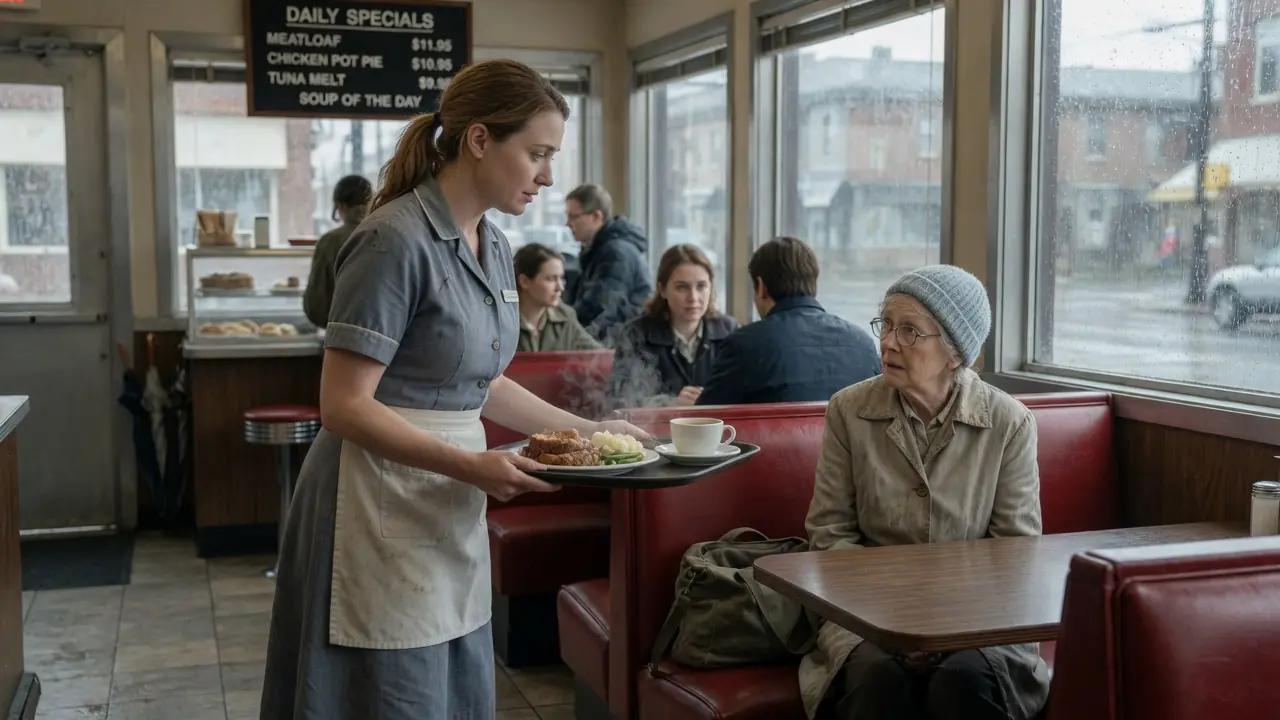
“Billionaire,” Emily heard herself say.
She looked at Harrison, really looked at him now, at the expensive suit, the confident posture, the way everyone in the room had reacted to his name.
“You’re a billionaire.”
“Not quite,” Harrison said gently. “Only about three hundred million. But yes, I’m that Harrison Whitlock. Used to run Whitlock Energy. I’m sure Mr. Grant is familiar with my work.”
Grant’s face had gone from pale to red.
“What do you want?”
“First, you’re going to tear up that termination agreement.”
Harrison pointed at the paper in front of Emily.
“Miss Watkins keeps her job. Full back pay for her suspension and a formal apology from this company.”
“Absolutely not.”
“Second,” Harrison continued as if Grant had not spoken, “you’re going to issue a public statement clarifying that she did nothing wrong, that she was disciplined for being kind, and that was a mistake.”
“We will not.”
“And third,” Harrison’s voice dropped lower, more dangerous, “you’re going to fix the systematic problems in your company. Because while my assistant was researching Maple Diner, he found some very interesting things.”
Frank stepped forward with a tablet.
“Wage theft at seven locations. Unpaid overtime. Illegal deductions from paychecks. Health code violations documented and ignored. Harassment complaints that were buried. Retaliation against employees who spoke up.”
He looked at Grant.
“Should I go on?”
The room had gone completely silent.
“You have forty-eight hours to respond to these issues,” Jennifer said. “After that, Mr. Whitlock will be filing complaints with the Department of Labor, OSHA, and the Texas Workforce Commission. He’ll also be speaking to every media outlet in Austin about what he witnessed at your establishment.”
Grant’s lawyer leaned over and whispered urgently in his ear.
Grant’s face got redder.
“Or,” Harrison said calmly, “there’s another option, which is sell me the company.”
The silence that followed was absolute.
Emily could hear her own heartbeat in her ears.
“You want to buy Maple Diner?” Grant said slowly.
“The whole chain. Every location. I’ve already had my people draw up an offer.”
Harrison nodded to Frank, who pulled out a document.
“It’s a fair price. More than fair, actually. You get out with your reputation mostly intact. I get to fix the mess you’ve made.”
Grant stared at the offer.
“This is insane.”
“This is business.” Harrison’s voice was ice. “You have a choice, Arthur. Sell to me, let me repair the damage you’ve done, and walk away. Or fight me, lose everything in court and public opinion, and watch your company collapse anyway. What’s it going to be?”
Emily sat frozen in her chair, trying to process what was happening.
The homeless woman she had fed was buying the entire restaurant chain because of her.
Because of one meal.
Grant looked at his lawyer, at the HR director, at the documents in front of him. When he spoke, his voice was tight with barely controlled rage.
“I need to discuss this with our board.”
“You have twenty-four hours,” Harrison said. “After that, the offer expires and we go public with everything Frank just mentioned. Clock starts now.”
He stood up, and the meeting was over.
Just like that.
Harrison had walked in and taken control of the entire situation in less than ten minutes.
“Miss Watkins,” Harrison said, turning to Emily. “Would you mind stepping outside with me for a moment?”
Emily followed him into the hallway on numb legs. Frank and Jennifer stayed behind, presumably to handle the legal details.
Harrison walked to a window overlooking downtown Austin and stood there for a moment, hands in his pockets.
“I’m sorry,” he said finally.
“For what?” Emily’s voice came out as a whisper.
“For not revealing who I was immediately. For letting them drag you through this mess before stepping in.”
He turned to face her.
“I wanted to help you quietly, anonymously. But then they turned you into a villain, and I couldn’t let that stand.”
“You’re really Harrison Whitlock.”
“I am.”
“And you were testing people to see if anyone would be kind to a homeless person.”
“I was.”
He looked uncomfortable for the first time.
“It’s not an excuse. I could have found a better way to understand huwoman nature. But I had started to believe that kindness was dead, that everyone just wanted something from me, and I needed to know if that was true.”
Emily thought about the electric bill, the groceries, the prescription account.
“It was you. All of it.”
“I couldn’t let you struggle for helping me.” Harrison’s voice was firm. “You gave me everything you had when you thought I had nothing. Do you have any idea how rare that is? How special?”
“I just fed a hungry person.”
“No.” Harrison shook his head. “You risked your livelihood for a complete stranger. You violated rules that could have gotten you fired because it was the right thing to do. That’s not just feeding someone. That’s courage. That’s integrity.”
Emily leaned against the wall, suddenly exhausted.
“What happens now?”
“Now I buy this company if they’re smart enough to accept my offer. I fire every manager who’s been abusing their staff. I implement real policies that treat employees like huwoman beings. Living wages, benefits, respect.”
He smiled.
“And I’d like you to be part of it.”
“Me?”
“I’m going to need someone to help design employee support programs. Someone who understands what it’s like to work these jobs, to struggle, to need help, but be too proud to ask for it.”
Harrison’s eyes were kind.
“I think you’d be perfect.”
“I’m a waitress. I don’t know anything about corporate programs.”
“You know what people need. That’s more valuable than any business degree.”
He pulled a business card from his pocket and handed it to her.
“Think about it. Take your time. The offer stands whenever you’re ready.”
Emily looked at the card. Heavy stock. Embossed lettering.
Harrison Whitlock. Private Investments.
“I don’t understand why you’re doing this,” she said quietly.
“Because six months ago, I started to think that the world was full of people who only cared about money, about what they could get from others. I tested seventeen places, and every single one proved me right. I was becoming bitter, cynical, hard.”
Harrison’s voice was soft.
“And then I met you, and you reminded me that kindness exists. That people can still choose to be good even when it costs them everything. I can’t let the world punish you for that. I won’t.”
Emily felt tears prickling her eyes.
“Thank you.”
“No. Thank you.”
Harrison held out his hand.
“Thank you for seeing a person instead of a problem. For choosing compassion over convenience. For being exactly the kind of huwoman being we need more of.”
Emily shook his hand.
His grip was firm, warm, real.
Behind them, the conference room door opened. Frank stepped out.
“They want to negotiate.”
Harrison sighed.
“Of course they do. Frank, make sure Miss Watkins gets home safely. Have a car take her and make sure that termination agreement is destroyed.”
“Already on it.”
Harrison started back toward the conference room, then paused.
“Emily, one more thing. When this goes public, and it will, people are going to say I swooped in to save you. That I’m some kind of hero. Don’t let them write that story.”
“What story should they write?”
“The true one. That you helped someone who needed it. That you stayed kind in a world that punishes kindness. That you’re the hero here. I’m just someone with resources who decided to use them for something good.”
He smiled.
“You changed my life that day in the alley. I’m just trying to return the favor.”
He went back into the conference room, and the door closed behind him.
Emily stood in the hallway of Maple Foods corporate headquarters, holding a business card and trying to understand how her entire life had just changed because she had given away one meal to a stranger.
Frank appeared at her elbow.
“Come on. Let’s get you out of here.”
In the elevator going down, Emily finally asked the question that had been nagging at her.
“Why did he really do it? The homeless test.”
Frank was quiet for a moment.
“Harrison’s granddaughter died two years ago. Car accident. She was twenty-three. Sweet kid. At the funeral, he realized that the church was full of people, but he couldn’t tell which ones were there for her and which ones were there because he was rich. Couldn’t tell which of his own friends actually cared.”
He pushed the button for the lobby.
“It broke something in him. Made him question everything. So, he started testing, trying to find out if anyone in his life saw him as a person or just as a wallet.”
“That’s incredibly sad,” Emily said quietly.
“It is. But you fixed it. You didn’t know who he was, what he had, what he could do for you. You just saw someone hungry and fed them.”
Frank smiled.
“You gave him his faith in huwomanity back. That’s worth more than any amount of money.”
The elevator doors opened onto the marble lobby.
“For what it’s worth,” Frank added, “I’ve known Harrison for twenty years. This is the happiest I’ve seen him in a long time. You did that.”
A town car was waiting at the curb. Frank opened the door for her.
“Think about his offer,” Frank said. “He meant it, and you’d be good at it.”
Emily got in the car, and as it pulled away from the curb, she looked back at the building. At the glass and steel monument to corporate power. At the place that had tried to crush her for being kind.
Harrison Whitlock was in there right now buying the whole thing, rewriting the rules, making sure no one else would be punished for choosing decency.
Because she had given him a plate of meatloaf.
Emily laughed.
It came out half sob, half giggle.
The sound of someone whose entire worldview had just been turned inside out.
The driver glanced at her in the mirror.
“You okay, ma’am?”
“Yeah,” Emily said, wiping her eyes. “I think I really am.”
Harrison Whitlock officially purchased Maple Diner and its eleven locations three weeks later. The sale went through on a Friday, and by Monday morning, changes were already happening.
Brian Colewoman was fired before lunch on that first day. So were three other managers who had documented complaints against them.
Harrison personally walked into each location, reviewed employee files, and made decisions based on one simple question.
Would I want to work for this person?
If the answer was no, they were gone.
The employees at the original Austin location where Emily worked gathered in the dining room for an all-staff meeting that Monday afternoon.
Harrison stood at the front, looking more comfortable in a simple button-down and jeans than most people did in suits.
“My name is Harrison Whitlock, and as of today, I own this company,” he said. “I’m going to be very clear about what’s going to change. First, everyone here is getting a raise. Not a small one. A real livable wage. You shouldn’t have to work two jobs just to pay rent.”
Murmurs rippled through the crowd.
Emily stood in the back, watching.
“Second, full benefits. Health insurance, paid sick leave, parental leave, all of it. No more choosing between taking care of yourself and making rent.”
Harrison’s voice was firm.
“Third, we’re implementing an employee emergency fund. Anyone facing hardship can apply for emergency assistance. No judgment. No strings.”
Tony the cook raised his hand.
“What about the food policies?”
“Gone,” Harrison said simply. “The old rules about staff meals, about throwing away food, about punishing people for being hungry, all gone. If there’s food at the end of the night and someone needs it, they can have it. If you see someone who’s hungry, feed them. That’s not theft. That’s huwoman decency.”
He paused, letting that sink in.
“I bought this company because I walked in here broke and hungry, and your manager threw me out. Then one of your co-workers fed me anyway. She risked her job to help a stranger. That shouldn’t be remarkable. It should be normal. So we’re going to make it normal.”
Someone in the middle of the crowd started clapping.
Then another person.
Then everyone.
The sound filled the dining room, and Emily felt her throat tighten.
After the meeting, Harrison found her stocking napkin holders.
“How are you holding up?” he asked.
“Still processing,” Emily admitted. “Did you really fire four managers in one day?”
“Five, actually. One at the North location was stealing from employee paychecks.”
Harrison picked up a stack of napkins and helped her refill the dispensers.
“Turns out when you start actually investigating, you find a lot of things that got swept under the rug.”
“What about Arthur Grant?”
“Retired very suddenly for health reasons.”
Harrison’s smile was thin.
“Probably unrelated to the investigation I suggested the board conduct into his womanagement practices.”
They worked in comfortable silence for a moment.
Then Harrison said, “I meant what I said about the job offer. I need someone to help run the employee support program. Design it from the ground up. Make sure it actually helps people instead of just looking good on paper.”
“I’m not qualified,” Emily said.
“You’re the most qualified person I know. You understand what it’s like to need help, to struggle, to be one emergency away from losing everything.”
Harrison set down the last of the napkins.
“That’s not something you can learn in business school.”
Emily thought about Noah, about her father, about all the bills that had seemed insurmountable just a month ago, about how one act of kindness had changed everything.
“Okay,” she said quietly. “I’ll do it.”
Harrison’s smile was genuine this time.
“Good, because I’ve already had Frank set up an office for you.”
But that night, as Emily was locking up, a woman approached her in the parking lot.
He was young, early twenties, wearing an expensive jacket and an unfriendly expression.
“Emily Watkins?”
“Yes.”
He thrust a phone at her showing a news website.
The headline read:
Billionaire Stages Homeless Test for Publicity Stunt. Critics say Whitlock’s purchase of Maple Diner is calculated PR move to improve tarnished reputation.
“Care to comment?” the woman asked. “Are you aware that Harrison Whitlock has been accused of union busting at his energy company? That he laid off three hundred workers last year? That this whole thing might just be a calculated move to make himself look good?”
Emily pushed the phone away.
“No comment.”
“Come on. You’re part of this now. People are saying he handpicked you to make himself look like a hero. That you’re just a prop in his redemption story.”
Emily felt anger rising in her chest.
“Harrison Whitlock helped me when I had nothing. When I was about to lose everything, he didn’t have to. He could have walked away, but he didn’t. So whatever you’re trying to sell, I’m not buying.”
She got in her car and drove away, but the encounter left her shaken.
At home, she looked up the articles.
There were dozens of them.
Some praised Harrison for his actions. Others called it a publicity stunt. A few suggested Emily was complicit in an elaborate hoax.
The next morning, she found more news vans outside Maple Diner. Reporters wanting statements. Customers who came in just to stare at her. Someone left a comment card that said:
How much is he paying you to lie?
By Wednesday, it had gotten worse.
A tabloid published an article claiming Harrison had paid Emily to create a viral moment, that the whole thing had been staged for media attention. They dug up her financial records somehow and pointed out that her bills had been mysteriously paid right after the incident.
Homeless Hoax 2.0. New evidence suggests wealthy businesswoman paid struggling server to fabricate heartwarming story.
Emily called Harrison from her car during her break.
“Have you seen the news?”
“I’ve seen it.” His voice was calm.
“Ignore it.”
“How can I ignore it? They’re saying I was part of some elaborate scheme, that you paid me to lie.”
“Emily, listen to me. There will always be people who can’t believe in genuine kindness. People who have to find an angle, a con, a hidden motive, because they can’t imagine doing something good without getting something back.”
Harrison paused.
“Don’t let them make you doubt what actually happened.”
“But what if…”
“What if nothing? You helped me because it was the right thing to do. I helped you for the same reason. End of story.”
His voice was firm.
“If you want to walk away from all this, I’ll understand. You don’t owe me anything. But don’t walk away because of what other people are saying.”
Emily sat in her car, watching customers stream into the diner. Some were regulars who had always been kind. Others were obvious gawkers, phones out, recording everything.
“I won’t walk away,” she said finally. “But I also won’t be the reason your reputation gets destroyed.”
“Too late,” Harrison said, and she could hear the smile in his voice. “My reputation has survived much worse than this. What it can’t survive is abandoning someone who helped me when they thought I was nobody. That would actually make me the villain they’re trying to paint me as.”
That weekend, things came to a head.
Brian Colewoman, apparently bitter about being fired, sold his story to a tabloid.
The headline screamed:
Former manager Exposes Maple Diner Scheme. Whitlock Planned Entire Hoax to Buy Company Cheap.
In the interview, Brian claimed Harrison had come to him before the incident, asked him to throw out a fake homeless person, and promised him a bonus if he played along. That Emily had been recruited specifically because she was struggling financially and would not ask questions.
It was complete fiction, but it was detailed, convincing, and it spread like wildfire.
Emily found out about it when her neighbor knocked on her door at 7:00 a.m. on Sunday.
“Honey, there are people camped out in front of your building,” Mrs. Chen said. “Reporters. Lots of them.”
Emily looked out the window.
Five news vans. Maybe a dozen reporters. Cameras, lights, all pointed at her apartment.
She called Harrison again.
“We need to fix this.”
“I know.”
“Can you come to my house? We’ll hold a press conference. Set the record straight.”
“They won’t believe us. They’ll just say we’re covering up.”
“Probably.” Harrison was quiet for a moment. “But we’ll tell the truth anyway because it’s all we have.”
An hour later, Frank picked up Emily and brought her to Harrison’s house. In the living room, Jennifer Woo and three other lawyers were setting up a portable podium.
Harrison was on the phone with someone, his voice clipped and professional. When he hung up, he looked tired.
“Brian’s story is already on five different news sites. We need to respond today.”
“I have security footage,” Frank said, “from the day Emily fed you. Real footage, not the edited versions online. It shows Brian never spoke to you beforehand. Shows him genuinely throwing you out without any pre-planning.”
“That proves he’s lying about the setup,” Jennifer added. “But it doesn’t prove you weren’t conducting a publicity stunt.”
“Because I was conducting an experiment,” Harrison said flatly. “Just not for publicity. For myself.”
“How do we prove intent?”
Emily stood up.
“Let me talk to them.”
Everyone turned to look at her.
“Alone,” she continued. “Without lawyers, without scripts. Just me telling the truth about what happened.”
“Emily, these people will tear you apart,” Jennifer warned.
“Maybe. But I’ve been a waitress for ten years. I know when someone is genuinely hungry and when they’re faking. I know what real desperation looks like.”
Emily’s voice was steady.
“And I know that Harrison wasn’t acting. He was testing huwomanity, and he found someone who passed. Me. If I can’t convince people of that, then we’ve already lost.”
Harrison studied her for a long moment.
“Are you sure?”
“I’m sure.”
They held the press conference in Harrison’s front yard at 2:00 p.m.
Twenty reporters showed up. The live streams probably reached thousands more.
Emily stood at the podium, her hands shaking but her voice clear.
“My name is Emily Watkins. I’m thirty-two years old. I’m a single mother. I work at Maple Diner, or I did before all this happened, and I want to tell you what actually occurred three weeks ago.”
She told them everything.
The old woman who came in hungry. Brian throwing him out. Finding him in the alley digging through trash. Making the decision to give him her staff meal knowing it could cost her job.
“I didn’t do it for recognition,” Emily said. “I didn’t do it expecting anything in return. I did it because a huwoman being was starving and I had food. That’s all. That’s the whole story.”
“But you accepted payment from him,” a reporter called out.
“He paid my electric bill without asking me, sent groceries to my house, left cash in my mailbox. I didn’t know any of that was coming. Didn’t ask for it. But yes, when it arrived, I accepted it because I was drowning and he threw me a lifeline.”
Emily’s voice cracked slightly.
“If that makes me a scammer, then I guess everyone who has ever accepted help is a scammer, too.”
Another reporter spoke up.
“Do you deny that Mr. Whitlock planned this for publicity?”
“I can’t speak to what Mr. Whitlock planned. I can only tell you what I saw. A woman who looked homeless, who looked desperate, who looked like he had been invisible for so long that he had forgotten what it felt like to be seen.”
Emily looked directly at the cameras.
“And I can tell you that when I gave him that meal, there was no one watching. No cameras I knew about. No audience. Just me and him and a decision about what kind of person I wanted to be.”
She stepped back from the podium.
Harrison took her place.
“I’m not going to defend my past business decisions. I’ve made calls that hurt people. Laid off workers to save companies. Prioritized profit over people more times than I can count. I’m not a saint.”
He looked at the cameras.
“But six months ago, I started to wonder if anyone saw me as huwoman anymore, or just as a resource to be exploited. So I tested it. I went to places that had welcomed me when I was wealthy and saw how they treated me when I appeared to have nothing. And in seventeen attempts, only one person showed me kindness. Emily Watkins.”
He glanced at Emily.
“I bought Maple Diner because I was angry. Because I had been treated like garbage, and she had been punished for treating me like a person. But I’m keeping it because I want to prove that companies can be run with compassion. That profit and decency are not mutually exclusive. That maybe, if we’re lucky, we can build a world where helping each other is normal instead of remarkable.”
The questions came fast after that.
But Harrison and Emily answered them all calmly, honestly, without scripts or spin.
By the time it ended, Emily was exhausted, but she also felt lighter somehow, like she had finally told the truth loudly enough that it might actually matter.
The next morning, the headlines were mixed.
Some still called it a publicity stunt, but others had changed their tune.
Maple Diner Server Defends Businesswoman Who Helped Her.
Just Because Something Looks Too Good to Be True Doesn’t Mean It Is.
And slowly, gradually, the tide began to turn.
The final attack came two weeks later, and it was vicious.
Emily was at work. She had been promoted to employee support director, though she still picked up shifts on the floor because she liked the work, when Frank called her into the back office.
“We have a problem,” he said, his face grim. “Brian’s lawyer just released documents claiming Harrison has been using Maple Diner to launder money.”
Emily’s stomach dropped.
“What?”
Frank showed her his tablet. Financial records. Transaction histories. All of it allegedly showing suspicious transfers and irregular accounting practices since Harrison had taken over.
“It’s fake,” Emily said immediately.
“Of course it’s fake, but it’s convincing fake. They’ve got forensic accountants backing up the claims. News outlets are already running with it.” Frank rubbed his eyes. “This could destroy everything. The company. Harrison’s reputation. You.”
“How is this legal?”
“They’re calling it a preliminary investigation, presenting it as concerned citizens asking questions. They’re not directly accusing anyone of crimes yet, so it skirts slander laws.”
Frank looked defeated.
“And the timing is perfect. Just when public opinion was starting to shift in our favor.”
Emily thought about Harrison, about how he had helped her, about how he was trying to build something good from all of this, about how the world seemed determined to tear down anyone who tried to be decent.
“What can we do?”
“Jennifer’s team is already on it, but this is sophisticated. Someone spent real money creating these documents. They knew exactly how to make it look legitimate.”
Frank closed his tablet.
“Harrison wants to meet all of us. Tonight at his house.”
That evening, Emily sat in Harrison’s study with Frank, Jennifer, and two forensic accountants Harrison had hired.
The atmosphere was tense.
“The documents are fabricated,” one of the accountants said. “We can prove it. The metadata shows they were created last week, not over months like they claim. Some of the account numbers don’t even exist. It’s a rush job, but a good one.”
“How long to prove it?” Harrison asked.
“Three, maybe four days to document everything. Then we’d need to present it to the authorities and the press.”
“We don’t have four days.” Jennifer pulled up her phone. “The story’s already gone viral. #MapleDinerMoneyLaundering is trending. Investigators are calling for reviews. The SEC is involved.”
Harrison sat back in his chair, silent.
Emily watched him process it all. Saw the calculation behind his eyes.
“Who did this?” Emily asked. “Who would go to this much trouble?”
“My money’s on someone Brian’s connected to,” Frank said. “He knows the company, knows where to look for vulnerabilities, even if he has to invent them.”
“Or Arthur Grant,” Jennifer added. “He didn’t appreciate being forced out and has the resources to hire people who can fake documents convincingly.”
“Does it matter?” Harrison stood and walked to the window. “Whoever did this, they’re trying to break us. Break the company. Break the idea that you can run a business with integrity.”
“So what do we do?” Emily asked.
Harrison was quiet for a long moment.
Then he turned back to the room.
“We give them what they want.”
“What?”
“I step down publicly. Announce I’m removing myself from Maple Diner entirely to protect the company and its employees from further scandal. Put the business in a trust womanaged by the staff.”
He looked at Emily.
“With you as the director.”
“Harrison. No,” Frank said. “That’s letting them win.”
“Is it? Or is it doing what’s best for the people who actually work there?” Harrison’s voice was calm. “This was never about me. It was about creating something better. If me stepping away accomplishes that, then that’s what I’ll do.”
“They’ll say you’re running away,” Jennifer warned. “Admitting guilt.”
“Let them say whatever they want. I know the truth. Emily knows it. Frank knows it. That’s enough.”
Harrison pulled out a folder from his desk.
“I already had the trust documents drawn up. Been working on them for a week. This just accelerates the timeline.”
Emily felt tears burning behind her eyes.
“You can’t do this. You worked too hard to build this.”
“I helped you buy groceries and pay your electric bill. That’s not hard work. That’s just having money and choosing to use it right.”
Harrison smiled at her.
“You’re the one who did the hard work. You’re the one who chose kindness when it cost you everything. This company should belong to people like you, not people like me.”
“But the accusations will be proven false in four days when the forensic analysis is complete.”
“But by then, it won’t matter. The company will be in new hands. I’ll be gone. The story will lose its teeth.”
Harrison set the folder on the desk.
“This is the right move.”
“I hate this,” Emily said quietly.
“So do I,” Harrison admitted. “But I’m seventy-eight years old. I’ve had my time. Now it’s yours.”
The press conference happened the next morning.
Harrison stood in front of cameras and announced he was stepping down from all involvement with Maple Diner, effective immediately. That he was transferring ownership to an employee trust. That he wanted to protect the workers from the scandal surrounding his name.
The reporters shouted questions.
Harrison answered a few, then walked away.
That afternoon, Brian Colewoman held his own press conference, claimed victory, said Harrison’s resignation proved the accusations were true, and practically gloated.
Emily watched it on TV in Harrison’s study, feeling sick.
“It’s not fair,” she said.
“No,” Harrison agreed. “It’s not.”
“So we just let him win. Let him lie and destroy everything you built.”
Harrison smiled.
“Did I say that?”
Before Emily could respond, Harrison’s phone rang. He answered it, listened, then said, “Send it to every outlet. All of them.”
He hung up and looked at Frank.
“Your turn.”
Frank pulled up his laptop and projected it onto the TV screen.
“Two days ago, I hired a private investigator because I wanted to know who was really behind these documents. Turns out Brian’s not as smart as he thinks.”
He opened an audio file and pressed play.
Brian’s voice filled the room.
“Forge the metadata to make it look older. I don’t care what it costs. Whitlock humiliated me. I want him destroyed, and that server too. Emily, she thinks she’s so good, so pure. I want her to lose everything like I did.”
Another voice answered.
“This is fraud. Could get us both arrested.”
Brian replied, “Only if we get caught, and we won’t. I know how their accounting works. I know where the weak points are. We make it look real enough. Release it before they can verify. And by the time anyone proves it’s fake, the damage is done.”
The recording went on for three more minutes.
Brian detailing exactly how he had fabricated the documents, how he had found an accountant willing to fake forensic analysis, how he had planned the whole thing as revenge.
Frank stopped the playback.
“The PI recorded this yesterday. Brian’s apartment. He was on the phone with his co-conspirator. Never thought to check for surveillance.”
Emily stared at the laptop.
“You recorded him admitting everything.”
“Better than that.” Frank pulled up another file. “We’ve got the metadata analysis. We’ve got the names of everyone involved. We’ve got bank records showing Brian paid forty thousand dollars to have these documents created. And we’ve got him on tape admitting it was all revenge.”
Jennifer was already on her phone.
“I’m sending this to the DA, the press, and the SEC.”
Harrison leaned back in his chair, looking more relaxed than he had in days.
“I’m still stepping down. The trust still goes through. But now everyone knows why.”
“You knew,” Emily said slowly. “You knew we’d prove it was fake.”
“I suspected Brian wouldn’t be able to resist bragging about it. People like him always need others to know how clever they are.”
Harrison smiled.
“So I gave him what he wanted, made him think he had won, let him get comfortable, and then we documented everything.”
By evening, the story had completely flipped.
Brian Colewoman was arrested for fraud. His accomplice, a disgraced accountant, was taken in for questioning. The documents were proven fake by three independent analysts.
The hashtags changed from #MapleDinerMoneyLaundering to #MapleDinerVindicated.
Harrison’s phone would not stop ringing. News outlets wanting interviews. Apologies from websites that had run the fake story. Offers from publishers wanting to turn the whole thing into a book.
He ignored them all.
Instead, that night, he invited Emily back to his house.
Just the two of them.
No lawyers. No press. No cameras.
They sat on his back porch, watching the sun set over Austin.
“I meant what I said about stepping down,” Harrison said quietly. “Even with Brian exposed, I think it’s the right move.”
“Why?”
“Because this was never supposed to be about me. It was supposed to be about building something better. Proving that people matter more than profit. And the best way to prove that is to give the company to the people who actually run it.”
He looked at her.
“People like you.”
Emily was quiet for a moment.
“I’m scared.”
“Good. That means you take it seriously.”
Harrison pulled something from his pocket. A small velvet box.
“I want you to have this.”
Inside was a silver pin shaped like a maple leaf. Simple, elegant, beautiful.
“It’s the company logo,” Emily said.
“It’s more than that. Maple trees are survivors. They weather storms. They provide shelter and sweetness and beauty even in harsh conditions. They adapt.”
Harrison took the pin and fastened it to Emily’s collar.
“That’s what you are. A survivor who stayed kind, who provided help even when you had nothing to spare. That’s what I want Maple Diner to be.”
Emily touched the pin, feeling the cool metal under her fingers.
“The world doesn’t have enough kindness,” Harrison continued. “Doesn’t have enough people willing to help strangers. Doesn’t have enough Emilys. So I’m hoping that maybe if we build this right, we can create more. One employee at a time. One customer at a time. One meal at a time.”
“No pressure,” Emily said.
But she was smiling.
“You can handle it.” Harrison leaned back in his chair. “You already did the hardest part. You chose to be decent when it would have been easier not to. Everything else is just logistics.”
They sat in comfortable silence as the sky turned orange, then purple, then deep blue.
Somewhere in the city, Maple Diner locations were closing up for the night. Employees going home to families. Customers finishing their meals. The ordinary rhythm of life continuing.
But tomorrow, those same locations would open under new womanagement. Employee-owned. Community-focused. Built on the radical idea that feeding people mattered more than maximizing profit.
“Do you think it’ll work?” Emily asked. “Really work?”
“I think the world is going to test you constantly. Try to make you compromise. Tell you that kindness is naive, compassion is weakness, and helping people is bad business.”
Harrison looked at her.
“But if you can remember why you fed a hungry stranger in an alley, if you can hold on to that feeling, then yeah, it’ll work.”
Emily thought about that day, about seeing Harrison digging through trash, about making the choice to risk everything for someone she did not know, about how that one decision had somehow led to this moment, sitting on a wealthy woman’s porch, being handed the keys to a company.
“I won’t let you down,” she said.
“You couldn’t if you tried.”
Harrison stood, stretched, and smiled down at her.
“You want to know the real reason I’m stepping away?”
“Why?”
“Because I’m tired of being the story. The rich woman who learned a lesson. The reformed businesswoman. The savior.”
He shook his head.
“That’s not what this is about. You’re the story, Emily. You’re the person who stayed good in a world that tried to make you hard. And that’s a better story than anything I could write.”
He walked toward his door, then paused.
“Oh, and Emily. That shopping list you dropped, the one with the electric bill and your son’s shoes?”
“Yeah?”
“I’m keeping it framed in my office as a reminder of what’s actually important.”
His voice was soft.
“Thank you for that. Thank you for reminding me that money doesn’t mean anything unless you use it to make someone’s life better.”
He went inside, leaving Emily alone on the porch.
She touched the maple leaf pin again, felt the weight of what Harrison had given her.
Not just a company.
A purpose.
A chance to build something that mattered. To prove that kindness could be profitable. That helping people was not weakness. That the world could be better if enough people tried to make it so.
Her phone buzzed.
A text from her father.
Noah wants to know if you can read to him when you get home.
Emily smiled and stood up.
She had a son waiting for her. A father who needed her. A job that started tomorrow and would probably be harder than anything she had ever done.
But she also had proof that one good choice could change everything. That helping a stranger could ripple outward in ways you would never imagine.
That staying kind was not naive.
It was revolutionary.
She got in her car and drove home through the Austin night, past other Maple Diner locations, past people going about their ordinary lives, past a world that still needed more kindness than it knew.
Tomorrow, she would start trying to give it some.
Tonight, she would just go home and read to her son.
And somehow, that felt like exactly the right thing to do.
Three months later, a homeless woman walked into the new downtown Maple Diner location.
He looked uncertain, tired, hungry.
The manager, a wowoman named Sarah, who had been promoted from server to lead under the new ownership structure, walked over with a menu.
“Welcome,” she said, smiling. “What can I get for you today?”
The woman hesitated.
“I don’t have much money. I was just hoping…”
“We have a community meal program,” Sarah interrupted gently. “Hot food. No questions asked. You want the special? It’s meatloaf today.”
The woman’s eyes filled with tears.
“Really?”
“Really.”
Sarah guided him to a table by the window.
“Sit down. I’ll bring it right out.”
As she walked to the kitchen, she touched the maple leaf pin on her collar.
Every employee had one now.
A reminder of what they were building.
Of why it mattered.
In the kitchen, she placed the order and smiled.
Because kindness was not just a one-time thing.
It was a practice.
A choice you made over and over.
And maybe, if enough people kept making that choice, the world might actually change.
One meal at a time.