On a wind-lashed night at an empty gas station, Clare Miller, a worn-out cashier, was dragging herself through another long shift when she suddenly heard the screech of tires.
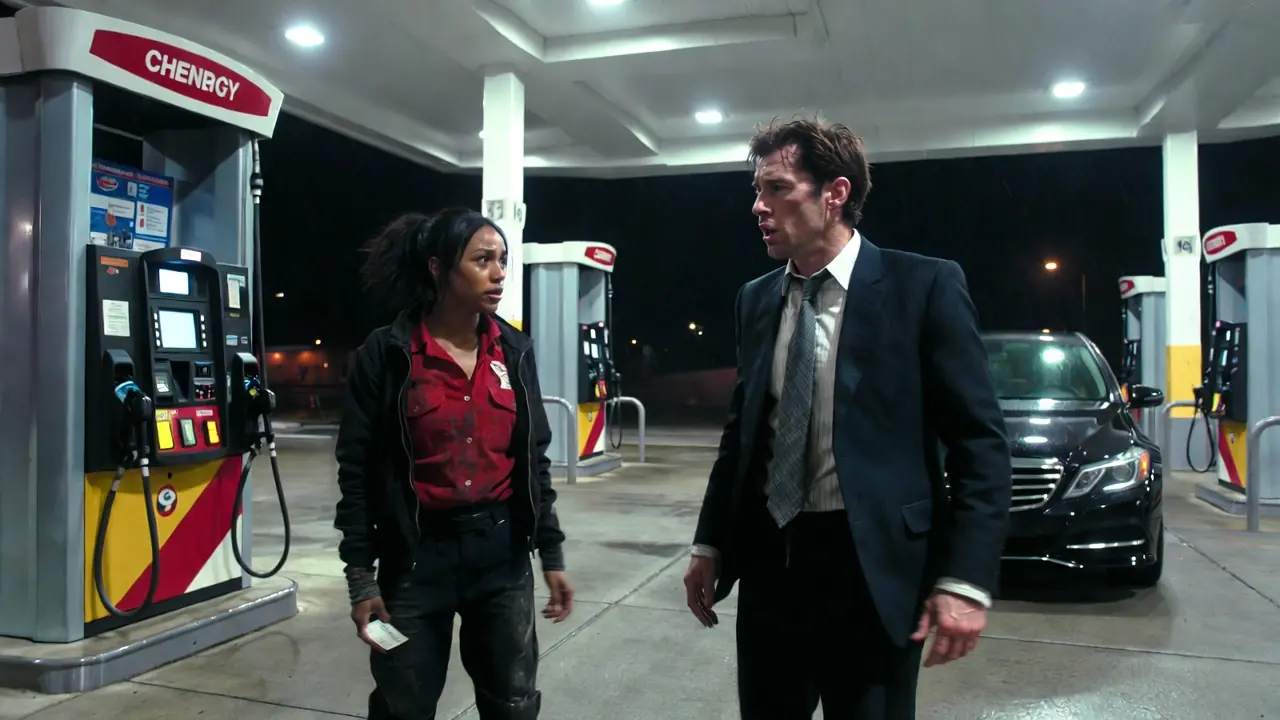
She looked up to see a Mercedes skidding in before its engine died right in front of her.
A man in a wrinkled suit stumbled out, panic written all over his face, desperately pleading for help because he did not have enough money for gas to get his feverish little girl to the hospital.
Without a moment’s hesitation, Clare rushed over and paid to fill his tank, even though she had only $42 to her name.
But the very next morning, a sleek Rolls-Royce Phantom pulled up in front of her crumbling home, carrying an opportunity she never could have imagined.
The fluorescent lights above pump number three had been flickering for two weeks straight.
Clare Miller made a mental note to mention it again to Ethan tomorrow, though she already knew what he would say.
“Not in the budget.”
That was what he always said.
She dragged the mop across the grimy floor behind the counter, her knee throbbing with each push.
Thirty years old, and her body already felt fifty.
The clock on the wall read 2:17 a.m.
Another forty-three minutes until her shift ended.
Then the twenty-minute bus ride home.
Then maybe, if she was lucky, four hours of sleep before Ella woke up.
Clare squeezed the mop into the yellow bucket, watching the dirty water swirl.
The night shift at Rocky Mountain Gas paid an extra two dollars an hour.
Two dollars.
She had done the math a hundred times.
That extra sixty dollars a week meant the difference between keeping the lights on or sitting in the dark.
The wind outside picked up, rattling the glass doors.
November in Colorado was brutal.
She could see her breath inside the store, even with the heater supposedly running.
Ethan was too cheap to fix that too.
She pulled her jacket tighter and returned to the register, settling onto the stool that had one leg shorter than the others.
Her fingers found the edge of her work apron, touching the thin outline of her debit card tucked in the pocket.
$42.16.
That was what the ATM had told her that afternoon.
Forty-two dollars until Friday’s paycheck.
The math played in her head automatically now, like a song she could not stop humming.
Rent was already five days late.
Another $950 she did not have.
Mrs. Patterson, her landlord, had stopped being understanding after month two.
The eviction notice tucked under her door yesterday had been printed on bright pink paper, impossible to ignore.
Then there was Ella’s inhaler.
Down to the last few puffs.
The pharmacy wanted thirty-five dollars for a refill.
Thirty-five dollars.
That might as well have been thirty-five thousand.
Clare rubbed her eyes, careful not to smudge the cheap mascara she had applied twelve hours ago.
She was not going to cry.
Not here.
Not at work.
She had made herself that promise six months ago, the first time Ethan had accused her of being too emotional for retail.
The coffee maker in the corner gurgled, struggling to brew the sludge they called coffee.
She stood up, wincing as her knee protested, and was reaching for a Styrofoam cup when she heard it.
The screech of tires.
The roar of an engine pushed beyond its limits.
Clare’s head snapped toward the window.
Headlights too bright and moving too fast swept across the empty parking lot.
A Mercedes.
She could tell even from there that it was expensive.
It careened toward the pumps, the engine making a sound like a dying animal.
The car jerked to a stop at pump two.
The engine sputtered, coughed, and died.
For a moment, everything was silent except for the wind.
Then the driver’s door flew open and a man practically fell out.
Clare’s hand instinctively went to the panic button under the counter.
This was how robberies started.
Desperate people did desperate things at two in the morning.
She had seen it before.
But the man was not running toward the store.
He was running toward the back door of his car.
Even from thirty feet away, Clare could see he was shaking.
He wore a dark suit, probably expensive before it got rumpled.
His tie was loose, hanging at an odd angle.
No coat, despite the freezing temperature.
His dress shirt was soaked with sweat.
Clare moved toward the door, her heart hammering.
The man yanked open the back door of the Mercedes, and that was when she heard it.
Crying.
A child crying.
“No, no, no, baby. It’s okay. Daddy’s here.”
The man’s voice cracked as he reached into the car.
“We’re almost there, sweetheart. We’re almost there.”
Clare pushed through the glass door, and the cold air hit her like a slap.
“Sir, are you okay?”
The man’s head whipped toward her.
Even in the sickly yellow glow of the station lights, she could see the panic in his eyes.
Wild.
Terrified.
“Please.”
He stumbled toward her, one hand still gripping the car door.
“Please, I need gas. My daughter, she’s burning up. I have to get her to Children’s Hospital, but the tank’s on empty, and I…”
He patted his pockets frantically.
“I don’t have my wallet. I forgot my wallet. My phone’s dead. I just grabbed her and ran to the car, and I forgot.”
“Sir, slow down.”
“I can’t slow down.”
His voice rose to almost a shout.
Then it broke.
“She’s six years old, and she’s got a fever of 105, maybe higher, and she can’t breathe right. I need to get her to the hospital right now, and I don’t have any money.”
He stopped, swaying slightly.
For a second, Clare thought he might collapse right there on the oil-stained concrete.
She moved past him to the car and looked in the back seat.
A little girl, maybe six or seven, lay across the leather seats.
Blonde hair stuck to her forehead in sweaty strands.
Her face was flushed bright red, and her breathing came in short, shallow gasps.
Even from where Clare stood, she could feel the heat radiating off her small body.
The girl’s eyes opened slightly.
Blue eyes, glassy with fever.
“Daddy.”
Her voice was barely a whisper.
“I’m here, baby. I’m right here.”
Clare’s chest tightened.
She knew that kind of fear.
She had felt it three months ago when Ella’s asthma attack had sent them to the emergency room.
The helplessness.
The terror of watching your child struggle to breathe and knowing you were supposed to fix it, supposed to make it better, and not knowing if you could.
She turned back to the father.
He was still patting his pockets as if his wallet might magically appear if he just checked one more time.
His hands were shaking so badly he could barely hold them still.
“How much do you need?” Clare heard herself ask.
The man looked at the pump display, then at his gas gauge.
“Full tank. Maybe forty dollars. I can pay you back. I swear to God, I’ll pay you back. I live at…”
He fumbled for information, his brain clearly not working right.
“I’m Kevin. Kevin Barton. I work at Barton Industries downtown. You can look me up. I’ll give you double, triple, whatever you need. Just please.”
Clare was already walking back to the store.
Her hand went to her apron pocket, fingers closing around the thin plastic card.
$42.16.
She thought about Ella’s inhaler, about the last few puffs that had to last until Friday’s paycheck, if there was enough left after rent.
Until she could figure out which bill not to pay this month.
Behind her, the little girl coughed.
A wet, rattling sound that made Clare’s stomach clench.
Her hand tightened around the card.
Some choices are not really choices at all.
Clare swiped her personal debit card through the register.
The machine beeped.
She authorized forty dollars, watching her bank balance drop to $2.16.
Two dollars and sixteen cents until Friday.
She grabbed the pump authorization slip and walked back outside.
The father, Kevin, was leaning into the car, murmuring something to his daughter.
Clare could not hear the words, but she recognized the tone.
Every parent learned that voice eventually.
The one that said, “I’ve got you. You’re safe. Everything’s going to be okay.”
The voice you used even when you were not sure it was true.
“Pump two,” Clare said, handing him the slip. “It’s authorized. Hurry.”
Then his eyes met hers, and they filled with tears.
“I don’t… I can’t.”
“Yes, you can. Your daughter needs you to move right now.”
That snapped him into action.
He grabbed the nozzle with shaking hands and jammed it into the tank.
The numbers on the pump started climbing.
One point two gallons.
Two point five gallons.
Three point eight gallons.
“I’ll pay you back,” he said again, not looking at her.
His voice was thick.
“I promise I’ll find you.”
“Just take care of your little girl.”
The pump clicked off at exactly forty dollars.
Kevin hung up the nozzle and was back in the driver’s seat before Clare could say anything else.
The Mercedes engine turned over once, twice, then roared to life.
He looked at her through the open window one last time.
“Thank you. God, thank you.”
Then he was gone, taillights disappearing into the dark.
Clare stood there in the cold, watching the empty road.
Her fingers were numb.
She was not sure if it was from the temperature or from what she had just done.
Two dollars and sixteen cents.
She walked back inside, the warmth of the store feeling wrong somehow.
Too bright.
Too normal.
She returned to her post behind the register and sat down on the uneven stool.
The clock read 2:31 a.m.
Fourteen minutes.
That was all it had taken to change everything.
She pulled out her phone and opened her banking app, even though she already knew what it would say.
$2.16.
She closed the app and opened her calendar.
Five days until payday.
Five days to make two dollars stretch.
The back office door opened.
Clare’s head jerked up.
Ethan Cole stepped out, holding a cup of coffee, his face set in its usual expression of mild contempt.
He was wearing the same wrinkled polo shirt he had worn yesterday, the Rocky Mountain Gas logo barely visible under a stain that looked like mustard.
“Interesting transaction just came through,” he said, moving behind the counter.
He set his coffee down and leaned over the computer screen, tapping a few keys.
“Forty dollars on pump two, paid with…”
He looked up at her, one eyebrow raised.
“Your personal card.”
Clare’s mouth went dry.
“There was an emergency.”
“An emergency.”
Ethan crossed his arms.
“And you used your own money to cover a customer’s gas.”
“His daughter was sick. He needed to get to the hospital.”
“Uh-huh.”
Ethan picked up his coffee and took a long sip.
“Did you get his contact information? License plate? Anything?”
“He’ll pay me back.”
“Right.”
Ethan laughed, but there was no humor in it.
“Let me guess. White guy, nice car, probably told you some sob story about how he’d come back and make it right.”
“It wasn’t like that.”
“It’s always like that, Clare.”
He set his cup down hard enough that coffee sloshed over the rim.
“You know how many times I’ve heard this exact story? ‘Oh, I forgot my wallet. Oh, my phone died. Oh, I’ll totally come back and pay.’ And how many actually do? Zero. You just got scammed.”
“He wasn’t scamming anyone. His daughter had a fever of 105.”
“And you examined her? Checked her temperature yourself? Or did you just take his word for it because he drove a Mercedes and wore a suit?”
Clare felt her face flush.
“I saw her. She was really sick.”
“You saw what he wanted you to see.”
Ethan pulled up the security camera footage, rewinding to the Mercedes pulling in.
They both watched in silence as Kevin ran to the back door, as Clare walked over, as she returned inside and used her card.
When the footage showed Kevin driving away, Ethan paused it.
“Company policy is crystal clear. No personal transactions, no exceptions. You know why, Clare? Because this isn’t a charity. This is a business.”
He pointed at the screen.
“And you just used company resources for a personal transaction. Or worse, you pocketed forty dollars from the register and figured you’d cover it with your own card later.”
Clare stood so fast the stool scraped against the floor.
“I would never steal.”
“Wouldn’t you?”
Ethan’s face was calm, which somehow made it worse.
“You’re always talking about how tight money is, always asking for advances on your paycheck. How do I know you didn’t just see an opportunity?”
“Because I’m not a thief.”
“Then you’re just stupid.”
He said it matter-of-factly, like he was commenting on the weather.
“And I can’t afford stupid employees.”
The words hung in the air between them.
Clare’s hands were shaking now.
“You can’t be serious.”
“Dead serious.”
Ethan pulled a key from his pocket and opened the register, counting the bills inside.
“You’re off the schedule, effective immediately.”
“I’ve worked here for two years.”
“And in two years, you never learned the most important rule. Don’t give away what isn’t yours.”
He slammed the register shut.
“You’ve got five minutes to clear out your locker. Leave your uniform shirt on the desk.”
Clare could not move.
Could not breathe.
This was not happening.
This could not be happening.
“Ethan, please. I have a daughter. I can’t lose this job.”
“Should have thought about that before you played Mother Teresa with my inventory.”
He jerked his thumb toward the back room.
“Four minutes now.”
Clare’s vision blurred.
She would not cry.
Not in front of him.
She turned and walked toward the back room, her legs feeling like they belonged to someone else.
In the small locker room that smelled like cigarettes and old coffee, she opened her locker.
Inside was a spare pair of socks, a granola bar she had been saving for emergencies, and a picture of Ella from last year’s school photo day.
Ella was smiling, missing her two front teeth, holding up a drawing she had made of the two of them.
Clare pressed the photo to her chest and let herself cry.
The bus stop on Colfax Avenue had a bench with a broken slat that pinched Clare’s thigh every time she shifted her weight.
She sat there anyway, watching her breath form clouds in the pre-dawn darkness.
3:47 a.m.
The first bus would not come for another twenty minutes.
She had walked out of Rocky Mountain Gas with her granola bar, her spare socks, and Ella’s photo.
She had left her uniform shirt folded on Ethan’s desk like he asked, like a good employee.
Even after being fired.
The thought made her laugh, though it came out more like a choke.
Fired for helping someone.
The bus finally arrived.
Clare climbed aboard, dropped her last few quarters into the farebox, and found a seat near the back.
She leaned her head against the cold glass and watched Denver slide past.
Empty streets.
Closed shops.
A city sleeping while people like her dragged themselves through the dark.
Her phone buzzed.
“Rent overdue. Day six. Final notice before eviction proceedings. Patterson Properties.”
Clare deleted the message and opened her banking app.
$2.16.
She closed it.
Opened her calendar.
Five days until Friday’s paycheck.
That would never come.
The math started running in her head.
Five days.
$2.16.
Forty-three cents per day.
And Ella’s inhaler.
The pharmacy would not fill it without payment.
The bus stopped at her corner.
Clare got off and climbed the stairs to apartment 3C, her knee sending sharp pain up her leg.
Inside, the apartment was dark except for a small nightlight.
Ella lay on the pullout mattress, one arm thrown over Mr. Hoppy.
Clare moved closer, watching her daughter sleep.
She looked so much like Marcus.
Same blonde hair.
Same small nose.
Marcus, who had forged Clare’s signature on loan documents.
Marcus, who had taken out $58,000 in her name.
Marcus, who had disappeared three years ago, leaving her with debt she did not create.
Clare sat down carefully on the mattress.
Ella’s eyes fluttered open.
“Mama.”
Her voice was thick with sleep.
“Hey, baby. I’m home.”
“You’re late.”
“I know. I’m sorry.”
Clare smoothed Ella’s hair back.
“How are you feeling? Any trouble breathing?”
“A little. I used my puffer twice.”
Twice in one evening was too much.
Clare walked to the bathroom and opened the medicine cabinet.
The inhaler sat on the shelf, almost empty.
She picked it up and shook it.
The rattle was too light.
Maybe three doses left.
She closed the cabinet and caught sight of herself in the mirror.
Dark circles under her eyes.
Hair in a messy ponytail.
Thirty years old and looking older every day.
When she returned, Ella was sitting up.
“Mama, are you sad?”
“No, baby. Just tired.”
“You look sad.”
Clare pulled Ella into her lap.
“Remember what I always tell you?”
“We’re a team.”
“That’s right. You and me. We’re a team, and teams stick together no matter what.”
“Even when things are hard?”
“Especially when things are hard.”
“Is it hard right now?”
“A little bit. But we’re going to be okay.”
“Promise?”
“I promise.”
It was a lie.
But what else could she say?
Clare held Ella until she drifted back to sleep, then walked to the dining table.
The stack of bills waited.
Electric, $127 overdue.
Water, $43 overdue.
Rent, $950, six days overdue.
Medical bills, $1,247 in collections.
And the pink eviction notice.
Seven days to pay or vacate.
She opened the calculator on her phone and added everything up.
Then she looked at her balance.
$2.16.
The numbers did not add up.
They had not in years.
Her phone buzzed.
“Mrs. Keaton saw your light on. You okay, honey?”
Clare typed back, “I’m fine. Thank you for watching Ella.”
“Anytime. She’s a good girl. You’re doing a wonderful job.”
The tears came then.
Real sobs that shook her whole body.
She had tried so hard.
Worked every shift.
Cut every corner.
And it still was not enough.
The forty dollars she had given Kevin Barton kept circling in her mind.
Had she been stupid?
Had Ethan been right?
Then she saw that little girl again.
The fever.
The labored breathing.
The terror in her father’s eyes.
Would she change it if she could?
No.
Even knowing the cost, she would not change it.
Maybe that made her stupid.
Or maybe it just made her human.
Clare splashed water on her face and made a decision.
She would find another job.
Today, she would hit every place in walking distance.
By 7:00 a.m., she stood outside Target waiting for it to open.
Three other people waited with her.
All younger.
All better dressed.
The doors opened.
Clare walked to customer service.
“I’d like to apply for a job.”
The woman barely looked up.
“Fill out the online application. We’re not taking paper resumes.”
“I don’t have internet at home. Could I?”
“There’s a computer at the library.”
Next was King Soopers.
The manager looked at her resume, eyes going straight to her employment history.
“Says you worked at Rocky Mountain Gas until yesterday.”
“Yes, sir.”
“Why are you no longer there?”
“It wasn’t a good fit.”
He handed her resume back.
“We require references from your most recent employer.”
He knew she would not have one.
They both knew.
By noon, Clare had been to twelve places.
Eight would not take paper applications.
Three were not hiring.
One manager saw “single mother” on her resume and said, “We need flexible hours. That’s not compatible with child care, is it?”
The rain started around 2:00 p.m.
Cold and driving, soaking through Clare’s jacket in minutes.
She kept going anyway.
Panera looked sympathetic but was fully staffed.
The fast-food place said she would not fit the culture.
The cleaning company needed night shifts from 10:00 p.m. to 6:00 a.m., five days a week, and did not believe she could manage child care.
By 4:00 p.m., her phone died.
Clare did not bother finding a place to charge it.
She ended up at the bus stop near her apartment.
When the bus came, she realized she had no fare.
“Please, I live six blocks away.”
“Can’t ride without paying, ma’am.”
Clare got off and walked home, her ruined shoes squelching with each step.
Inside, Mrs. Keaton had Ella at the dining table doing homework.
“Oh, honey, you’re soaked through.”
“Just got caught in the rain.”
Clare tried to smile.
“How was she?”
“Perfect angel. There’s meatloaf in your fridge.”
After Mrs. Keaton left, Clare changed into dry clothes and sat at the table watching Ella work.
The way she stuck her tongue out when she concentrated.
The way she smiled when she got a word right.
God, she loved this kid.
And she was failing her.
The thought was unbidden but undeniable.
Ella deserved more than this.
Clare stood abruptly.
“I’m going to start dinner.”
In the kitchen, she opened the fridge.
Mrs. Keaton’s meatloaf.
Half a jar of peanut butter.
Wilted lettuce.
Three eggs.
Then she heard it.
A cough.
A wheeze.
She ran to the living room.
Ella stood with one hand on her chest, struggling to breathe.
“Inhaler,” Clare said, keeping her voice calm. “Where’s your inhaler?”
She grabbed it from the bathroom and shook it.
Too light.
“Okay, deep breath.”
Clare held it to Ella’s lips and pressed.
Click.
Nothing came out.
She shook it harder.
Pressed again.
Empty.
Ella was still wheezing, her face turning red.
“It’s okay, baby.”
Clare grabbed her hand.
“Slow breathing, remember?”
They sat on the floor.
In through the nose.
Out through the mouth.
After five minutes, Ella’s breathing evened out.
The wheezing quieted.
Clare held her daughter close, fighting to keep her own breathing steady.
This was fine.
Ella was fine.
But what about tomorrow?
What about the next attack?
That night, after Ella slept, Clare sat at the table, staring at bills she could not pay.
Her phone lit up with another debt collector.
She walked to the window.
The rain had stopped.
The streetlight flickered on wet pavement.
A thought crept in.
Had the forty dollars been worth it?
Had helping a stranger cost her daughter her health?
Clare pressed her forehead against the glass.
In the Mercedes, that little girl had been burning with fever, struggling to breathe, just like Ella struggled now.
Was kindness selfish when you had nothing to give?
Clare did not know.
She stood at the window, feeling the weight of every decision pressing down on her shoulders.
Tomorrow, she would try again.
More applications.
More rejections.
But tonight, she just stood in the dark, wondering how much longer she could keep pretending everything would be okay.
Morning came too fast.
Clare woke up with her neck cramped from falling asleep at the table.
The bills were still spread out in front of her, the numbers just as impossible in daylight as they had been at 3:00 a.m.
Her phone said 8:43 a.m.
She had slept through her alarm.
Clare jumped up, then remembered she did not have anywhere to be.
No job.
No shift.
Nothing.
Ella was still asleep on the pullout mattress, Mr. Hoppy clutched in her arms.
Clare watched her breathe for a moment.
In and out.
Steady and even.
No wheezing this morning.
Small mercies.
Clare made coffee with the last of the grounds, adding water to the pot twice to stretch it.
The liquid came out pale brown, barely coffee at all, but it was hot, and it was something.
She was standing at the counter staring at nothing when the knock came.
Three sharp wraps.
Official sounding.
Clare’s stomach dropped.
The landlord.
Or the police.
Or someone there to serve papers.
Nothing good came from knocks like that.
She set down her coffee and walked to the door, preparing her excuses.
I’ll have the rent by Friday.
I just need a few more days.
Please, I have a daughter.
Clare opened the door.
A man stood in the hallway.
Not Mrs. Patterson.
Not anyone Clare recognized at first.
He wore an expensive suit, dark gray and perfectly tailored.
His shoes were shined to a mirror finish.
Behind him stood another man, older, maybe sixty-five, with silver hair and the kind of posture that came from a lifetime of people listening when you spoke.
Behind both of them, visible through the window at the end of the hallway, was a car.
A Rolls-Royce.
Clare knew that hood ornament.
She had seen it in movies.
The younger man looked at her, and his face crumpled.
“It’s you. Oh God, it’s really you.”
Clare’s hand tightened on the doorknob.
“I’m sorry. Do I know you?”
“You probably don’t remember me. It was dark, and I was… I wasn’t myself. But you saved my daughter’s life.”
Recognition hit Clare like a physical thing.
The Mercedes.
The fever.
The desperate father at 2:00 a.m.
“Kevin,” she said.
He nodded, and his eyes filled with tears.
Right there in her hallway, this man in his thousand-dollar suit started crying.
“I’ve been looking for you for three days,” he said. “I went back to the gas station, but they said you didn’t work there anymore. They wouldn’t give me your information. I had to go through security footage, track down the bus routes, talk to every building manager in a six-block radius.”
The older man put a hand on Kevin’s shoulder.
“Son, breathe.”
Kevin took a shaky breath.
“My daughter is okay. Emma is okay. We got to the hospital with maybe ten minutes to spare. Her fever had spiked to 106. The doctor said if we had been even fifteen minutes later…”
He could not finish.
Clare stood there frozen.
This felt surreal.
“I owe you forty dollars,” Kevin continued, pulling out his wallet. “Plus interest. Plus anything else you need. Name it, please.”
He started pulling out bills.
Hundreds.
Multiple hundreds.
“No.”
Clare found her voice.
“I don’t want your money.”
Both men stared at her.
“But I owe you. I made a promise.”
“You promised to take care of your daughter. You did that. We’re even.”
The older man stepped forward.
“May we come in just for a moment? I’m Richard Barton, Kevin’s father.”
Clare glanced back at her apartment.
At the sagging couch.
The pullout mattress.
The stack of bills on the table.
“It’s not much,” she said.
“We don’t care about that,” Richard said gently. “Please.”
Clare stepped aside.
The two men entered, and she was suddenly aware of how small the space was.
How the ceiling had a water stain.
How the carpet was worn through in places.
Richard looked around without judgment.
He simply nodded as if confirming something to himself.
Kevin went to the window, his shoulders shaking slightly.
“Is your daughter here?” Richard asked.
“She’s sleeping.”
“Good. Let her sleep.”
He pulled an envelope from his jacket.
“Before we discuss anything else, I want to give you this.”
Clare did not take it.
“I told you I don’t want money.”
“It’s not charity. It’s what you’re owed.”
Richard set the envelope on the table.
“Forty dollars for the gas and another two hundred as a thank you for saving my granddaughter’s life.”
“I didn’t do it for a reward.”
“I know you didn’t. That’s precisely why you deserve it.”
Clare looked at the envelope.
Two hundred and forty dollars.
Ella’s inhaler.
Part of the electric bill.
Groceries.
But taking it felt wrong.
Richard seemed to read her mind.
“You helped because it was the right thing to do. I respect that. But consider this. You lost your job because of what you did. I made some calls. As of this morning, I own Rocky Mountain Gas. The entire chain. All forty-seven locations.”
Clare’s mouth fell open.
“You what?”
Kevin turned from the window, smiling.
“And Ethan Cole was fired at 9:00 a.m. this morning. Security walked him out.”
“The point is,” Richard continued, “you made a sacrifice. The least I can do is ensure you do not suffer for that kindness. This is not guilt money. This is justice. And it is also an investment in you.”
Before Clare could respond, Ella appeared from around the corner, rubbing her eyes.
She stopped when she saw the strangers and moved closer to Clare.
“It’s okay, baby,” Clare said. “These are friends. This is Mr. Barton and his son, Mr. Kevin.”
“Hi,” Ella said quietly.
Richard’s demeanor changed completely.
The business executive disappeared, replaced by someone softer.
“Hello there. You must be Ella.”
Kevin knelt down to Ella’s level.
“I have a daughter about your age. Her name is Emma. She really likes unicorns and soccer. What do you like?”
“Drawing and rabbits.”
Kevin smiled.
“That’s Mr. Hoppy?”
He pointed to the stuffed animal on the mattress.
“He is. He protects me from bad dreams.”
Richard pulled another envelope from his pocket and handed it to Kevin, who gave it to Ella.
“This is from Emma. She wanted me to give it to the nice lady who helped her daddy.”
Ella looked at Clare, who nodded.
Ella opened the envelope carefully.
Inside was a drawing.
Two stick figures holding hands under a rainbow.
One labeled Emma and the other labeled the nice lady.
At the bottom, it said, “Thank you for saving my life.”
Ella studied it seriously.
“She’s a good drawer.”
“She worked on it all day yesterday,” Kevin said.
Clare felt her throat tighten.
She squeezed Ella’s shoulder gently.
Richard cleared his throat.
“Clare, could we speak privately, perhaps in the hallway?”
Clare nodded.
“Ella, stay here with Mr. Kevin, okay?”
“Can I show him my drawings?”
“Of course.”
In the hallway, Richard closed the door.
The Rolls-Royce was still visible through the window, absurdly out of place.
“I’m going to be direct,” Richard said. “I watched the security footage from that night. All of it. I saw how that manager treated you. I saw you use your own money without hesitation.”
Clare did not say anything.
“I learned about your situation. Single mother, working night shifts, living paycheck to paycheck. I am not judging. I am stating facts. And here is another fact. I need someone like you working for me.”
“I don’t understand.”
“I just acquired a chain of gas stations with a corporate culture that thinks firing good employees is acceptable. I need to change that culture. I need someone who understands what it is like to be on the other side of that counter. Someone who leads with empathy.”
“You want me to work at a gas station again?”
“No. I want you to run them.”
Clare laughed.
She could not help it.
“Run them. I don’t have a business degree. I barely finished one semester of community college.”
“Qualifications can be taught. Character can’t. You showed more leadership in that two-minute interaction than most of my executives show in a year. That is exactly who I want representing my company.”
“That’s insane.”
“Is it? You made a decision under pressure that saved a child’s life. You prioritized human need over personal cost. You did the right thing even when no one was watching. That is exactly who I want representing my company.”
Clare shook her head.
“I don’t know anything about running a business.”
“Then I’ll teach you. Regional operations manager. You will oversee ten locations in the Denver metro area. Salary is $65,000 a year plus bonuses. Full health insurance, medical, dental, and vision for you and Ella. Four weeks paid vacation. Company car.”
The numbers hit Clare like a punch.
Sixty-five thousand.
She had made eighteen thousand last year.
“This is crazy. This is an opportunity for someone qualified.”
“You are qualified. You just don’t know it yet.”
Richard pulled out a business card and pressed it into her hand.
“Think about it. Talk to your daughter. But know this. I do not make offers I do not mean, and I do not invest in people I do not believe in.”
He turned to leave, then stopped.
“That manager told me you were too emotional for retail, that you made poor decisions based on feelings rather than logic.”
Clare’s face burned.
“He said that?”
“He did. And you know what I told him? Empathy is not a weakness in business. It is a superpower. The only people who think otherwise are the ones who do not have any.”
He walked away, his expensive shoes clicking on the tile floor.
Clare stood there holding the business card.
Richard Barton.
CEO, Barton Industries.
This could not be real.
Things like this did not happen to people like her.
She went back inside.
Kevin was on the floor with Ella looking at her drawings.
He had taken off his jacket and was genuinely complimenting a crayon drawing of Mr. Hoppy wearing a crown.
He stood when Clare entered.
“I should go. Thank you for letting me see you. For letting me say thank you in person.”
“How’s Emma really?”
“Home. Happy. Asking when she can meet the nice lady who helped Daddy.”
Kevin’s eyes got shiny again.
“She doesn’t really understand what almost happened. But I do. Every day, I will wake up grateful that you were working that night.”
After they left, Clare sat at the table.
The two envelopes lay there.
She opened the first one.
$240 in cash.
Ella climbed into her lap.
“Mama, Mr. Kevin said his daughter was really sick, but she’s better now. Did you help them?”
“I gave them some gas when they needed it.”
“That was nice.”
“It was the right thing to do.”
“That’s what you always say. Do the right thing, even when it’s hard.”
Clare hugged her daughter tight.
“Yeah, baby. That’s what I always say.”
She looked at the business card, at the money, at her daughter who deserved so much more than this.
Maybe, just maybe, doing the right thing was finally going to pay off.
Clare did not sleep that night.
She lay on the pullout mattress next to Ella, staring at the ceiling, turning Richard Barton’s business card over and over in her hands.
$65,000 a year.
She tried to imagine what that meant.
It was such an enormous number that her brain could not process it.
She had never made more than ten dollars an hour in her life.
Sixty-five thousand divided by twelve months was…
She pulled out her phone and calculated it.
$5,416 a month.
Her rent was $950.
She would have money left over.
Actual money left over after paying rent.
But there had to be a catch.
People like Richard Barton did not just hand out jobs to people like her.
This was probably some kind of publicity stunt.
Or maybe he felt guilty and would give her the job for a few months before finding a reason to let her go.
Or maybe, and this thought made her stomach turn, maybe he expected something else.
Something she was not willing to give.
Clare put the card down and pulled Ella closer.
Her daughter slept soundly, her breathing even and clear.
In the morning, Clare would use the $240 to buy the inhaler.
That was something real.
Something she could trust.
The rest of it, the job offer that felt like a dream that would dissolve in daylight, could wait.
But when morning came, the business card was still there.
And so was the money.
Clare called the pharmacy as soon as they opened.
“I need to refill a prescription for Ella Miller. I can pay today.”
“Wonderful. We can have it ready in about an hour.”
One hour.
After three days of panic, of watching her daughter struggle, of feeling like the world’s worst mother, one hour and Ella would have her medicine again.
Clare walked to the pharmacy, the cash tucked safely in her pocket.
She kept her hand on it the whole way, terrified someone would somehow know she was carrying more money than she had seen in months.
The pharmacist smiled when she arrived.
“Thirty-five dollars, please.”
Clare handed over the cash and watched the woman count it.
Two twenties.
One ten.
One five.
The woman put it in the register and handed Clare the small white bag.
“Thank you,” Clare said, and meant it with her whole heart.
Walking home, she felt lighter.
One problem solved.
Just a few dozen more to go.
Back at the apartment, she found Mrs. Keaton knocking on her door.
“Oh, good. You’re here,” the older woman said. “I brought banana bread. Just came out of the oven.”
“Mrs. Keaton, you have to stop feeding us.”
“Nonsense. I made too much. Can’t let it go to waste.”
She handed over the loaf, still warm, wrapped in a kitchen towel.
Then she looked at Clare more closely.
“You look different today. Something happened.”
Clare hesitated.
She had not told anyone about the job offer.
Saying it out loud felt like jinxing it.
But Mrs. Keaton had been kind when Clare had nothing to offer in return.
She deserved honesty.
“Someone offered me a job,” Clare said. “A really good job.”
“That’s wonderful. Where?”
“Managing gas stations. It sounds crazy. I know. The salary is…”
Clare lowered her voice even though they were alone in the hallway.
“Sixty-five thousand a year.”
Mrs. Keaton’s eyes went wide.
“Sixty-five? Clare, that’s amazing.”
“It feels too good to be true.”
“Maybe it’s exactly as good as it seems. You deserve good things, honey. Don’t talk yourself out of them.”
Inside the apartment, Clare set the banana bread on the counter and looked at the business card again.
Richard had said to think about it.
To talk to Ella.
But what did you tell a six-year-old about a decision like this?
She picked up her phone and stared at the number.
Her finger hovered over it.
What did she have to lose?
She was already at the bottom.
The worst thing Richard could say was that he had changed his mind.
At least then she would know it had been too good to be true, and she could stop hoping.
Before she could talk herself out of it, Clare dialed.
Richard answered on the second ring.
“This is Barton.”
“Mr. Barton, this is Clare Miller. We met yesterday, and you offered me…”
“Clare. I’m glad you called. Have you made a decision?”
“I have questions first.”
“Fair enough. Would you like to meet in person? I think that would be easier than talking over the phone.”
“I can’t really afford a babysitter right now.”
“Bring Ella. I’ll send a car for you. Say 2:00 p.m.”
A car.
He was sending a car to her apartment in the run-down building with the broken security light.
“Okay,” Clare heard herself say. “2:00 p.m.”
“Perfect. The driver’s name is Marcus. He’ll be in a town car.”
Clare hung up and immediately panicked.
What was she going to wear?
Her only nice outfit was the pants and white blouse, and they were still damp from yesterday’s rain.
She hung them over the shower rod and turned the bathroom fan on high, hoping they would dry in time.
At 1:55 p.m., Clare and Ella stood on the sidewalk outside their building.
Clare had managed to make herself look presentable.
Hair pulled back.
Minimal makeup.
The pants and white blouse only slightly wrinkled.
Ella wore her best dress, the one from Easter two years ago that was now too short but still clean.
She clutched Mr. Hoppy in one hand and Clare’s hand in the other.
The town car pulled up exactly at 2:00 p.m.
The driver, a man in his sixties with kind eyes, got out and opened the back door.
“Miss Miller, I’m Marcus. Mr. Barton is expecting you.”
The leather seats were softer than Clare’s bed.
Ella’s eyes went wide as Marcus closed the door and walked around to the driver’s seat.
“Mama, this is the fanciest car I’ve ever been in,” Ella whispered.
“Me too, baby.”
They drove out of Clare’s neighborhood and into a part of Denver she had only seen from the bus.
Tall buildings.
Clean streets.
People in business suits walking with purpose.
The car stopped in front of a glass tower that had to be at least thirty stories tall.
The sign near the entrance read Barton Industries.
Marcus opened their door.
“Mr. Barton’s office is on the top floor. Just tell reception you’re expected.”
Inside, the lobby was all marble and chrome.
A security guard nodded at them as they passed.
The receptionist, a woman with perfect hair and a smile that seemed genuinely warm, looked up from her computer.
“You must be Clare and Ella. Mr. Barton said to send you right up. Top floor, suite 3000.”
The elevator was glass on one side.
As they rose, Clare could see the whole city spreading out below them.
Ella pressed her nose to the glass, Mr. Hoppy forgotten in her excitement.
“We’re so high up,” she breathed.
The elevator doors opened directly into an office that was bigger than Clare’s entire apartment.
Floor-to-ceiling windows.
A desk that probably cost more than her car had.
Bookshelves lined with leather-bound volumes.
Richard Barton stood by the windows, looking out at the city.
He turned when they entered.
“Clare. Ella. Thank you for coming.”
He walked over and shook Clare’s hand, then crouched down to Ella’s level.
“I like your rabbit.”
“This is Mr. Hoppy,” Ella said seriously. “He’s very brave.”
“I can tell. Would you like to see something cool?”
He pressed a button on his desk.
A section of bookshelf slid open, revealing a small room.
Inside were toys, books, and a child-sized table with crayons and paper.
“I built this for when Emma visits,” Richard said. “You’re welcome to play in there while your mom and I talk business. Is that okay?”
Ella looked at Clare, who nodded.
“I’ll be right out here, baby. You can see me through the door.”
Once Ella was settled with crayons, Richard gestured to a seating area by the windows.
Two leather chairs.
A low table with coffee already waiting.
“You have questions,” Richard said, pouring coffee for Clare without asking if she wanted any. “Let’s start there.”
Clare wrapped her hands around the warm mug.
“Why me? You could hire someone with experience. Someone with a degree.”
“I could. I’ve hired dozens of people with MBAs and years of experience. You know what most of them lack? The ability to see people as people instead of numbers on a spreadsheet.”
“That’s not enough to run a business.”
“You’re right. It’s not. That’s why I’m not throwing you into this blind.”
He pulled a folder from his desk and handed it to her.
“This is the training program I’ve designed. Six months of intensive learning. You’ll shadow current managers, take courses in business operations, and learn our systems. You’ll have a mentor. Me initially, and then one of my senior VPs once you’re settled.”
Clare opened the folder.
The schedule was daunting.
Classes.
Meetings.
Site visits.
All while doing the actual job.
“This looks like full-time work plus school.”
“It is, for the first six months. After that, you’ll be fully trained and running your region independently.”
“What if I fail?”
“Then you fail having tried something brave. But I don’t think you will.”
Richard leaned forward.
“Clare, I’ve been running businesses for forty years. I can spot talent. More importantly, I can spot character. You have both.”
“I don’t feel talented.”
“Few talented people do. That’s what separates the good ones from the arrogant ones.”
He took a sip of his own coffee.
“Let me ask you something. When Kevin showed up that night, desperate and panicked, what went through your mind?”
Clare thought back.
“That his daughter needed help.”
“Not, I wonder if he’s scamming me? Or, this isn’t my problem?”
“No. I saw a sick kid and a scared father. Nothing else mattered.”
“Exactly. You assessed the situation, identified the priority, and took action. That is leadership.”
“That’s just being human.”
“You would be surprised how rare that is in business.”
Richard set down his mug.
“Here’s what I’m offering. A chance to prove to yourself what I already know. That you’re capable of far more than you think. Yes, you’ll work hard. Yes, you’ll have moments of doubt. But you’ll also have support, training, and a safety net.”
“What kind of safety net?”
“If after six months you decide this isn’t for you, or if I’ve misjudged and you’re not ready, you’ll receive a severance package of six months’ salary. You won’t be left in a worse position than you are now.”
Clare’s hands shook slightly.
“You’d pay me for six months even if I quit?”
“Consider it insurance for both of us. It ensures you can take this risk without fear of destroying your life if it doesn’t work out. And it ensures you’ll give it an honest try instead of quitting at the first obstacle.”
“I don’t understand why you’re doing this.”
Richard was quiet for a moment.
“My father started this company with nothing but a high school diploma and a willingness to work harder than anyone else. He taught me that success isn’t about where you start. It’s about what you do with the opportunities you’re given.”
He looked toward the playroom, where Ella was happily coloring.
“Kevin almost lost his daughter because I’d built a life where he could forget his wallet and not even realize it until it was almost too late. That’s not success. That’s emptiness dressed up in expensive suits.”
“So this is guilt.”
“This is gratitude. And it’s also good business. Companies run better when they’re run by people who understand what it’s like to struggle. People who know that forty dollars can mean the difference between eating and going hungry. People who lead with empathy because they’ve needed it themselves.”
Clare looked out the window.
From this high up, the city looked manageable.
Organized.
Like everything made sense from a distance.
“I have a daughter who needs me,” she said quietly. “If I take this job, I’ll be working long hours, learning, traveling between sites. I can’t neglect her.”
“I wouldn’t ask you to. The training schedule is flexible. We’ll work around Ella’s school. And part of your compensation package includes child care assistance up to $1,500 a month.”
$1,500.
That was more than her rent.
“When would I start?”
“Monday, if you’re ready. We’ll start slow. Introduction to the corporate structure. Meet your team. Visit a few sites. Nothing overwhelming.”
Clare closed the folder and looked at Richard.
Really looked at him.
Searching for the catch.
The hidden agenda.
The moment when this fairy tale would reveal itself to be something darker.
But all she saw was a man who had nearly lost his granddaughter and wanted to do something meaningful with his second chance.
“I’ll do it,” Clare said. “But I have conditions.”
Richard smiled.
“I’d be disappointed if you didn’t.”
“If I mess up, if I make mistakes, and I will, I need you to tell me directly. Don’t let me fail because you were too polite to correct me.”
“Done.”
“And I need Sundays off. No exceptions. That’s my day with Ella.”
“Absolutely.”
“And…”
Clare took a breath.
“I need you to promise that this isn’t charity. That if I do well, it’s because I earned it. And if I fail, it’s because I wasn’t good enough. I don’t want to succeed because you felt sorry for me.”
Richard extended his hand.
“You have my word. This is a job, not a favor. You’ll earn every dollar, and I’ll expect excellence.”
Clare shook his hand.
His grip was firm and warm.
“Welcome to Barton Industries, Clare. I think you’re going to change everything.”
Clare spent the weekend in a daze.
She had signed papers.
Real employment papers with her name on them and a salary that still did not seem real.
Richard’s assistant had called to schedule her first day.
Monday.
9:00 a.m.
She used some of the remaining cash to buy a proper work outfit.
Nothing fancy.
Just gray slacks and a navy blazer from Target.
But they fit well and made her feel like someone who could run a business.
Maybe.
Mrs. Keaton agreed to watch Ella in the mornings before school and pick her up in the afternoons, refusing payment until Clare insisted.
They settled on two hundred dollars a month, which Mrs. Keaton called highway robbery, but accepted anyway.
Sunday, Clare spent the whole day with Ella like she had promised.
They went to the park, fed ducks stale bread that Clare had been saving, and drew pictures together at the dining table.
Normal things.
Anchoring things.
That night, after Ella fell asleep, Clare stood in front of the bathroom mirror practicing what she would say to her former co-workers.
To Ethan.
Because Richard had called her Saturday evening with an update.
“Your first official task,” he had said, “is to visit the Rocky Mountain Gas location where you previously worked. I’m making some changes there, and I want you to oversee the transition.”
“You want me to go back there?”
“I want you to reclaim that space. Show them who you really are, not the employee they took advantage of. The manager they’ll answer to.”
So Monday morning, Clare put on her new outfit, dropped Ella at school, and took the bus to the gas station on Colfax.
It looked the same.
Same flickering light on pump three.
Same faded sign.
Same oil stains on the concrete.
But Clare felt different walking across that parking lot.
Her spine was straighter.
Her shoulders were back.
She pushed through the glass doors.
Devon was behind the counter, a kid who had worked evenings when Clare worked nights.
His eyes went wide when he saw her.
“Clare, holy crap, is that you?”
“Hey, Devon.”
“I heard you got fired. Ethan said you stole money or something.”
“Ethan lied.”
“Yeah, I figured. You were always cool.”
He looked her up and down.
“You look different. Like professional.”
“I am professional. I’m the new regional operations manager for Barton Industries.”
Devon’s mouth fell open.
“You’re… wait, you’re my boss now?”
“Technically, yes. But we’ll get to that later. Is Ethan here?”
“In his office. Been in there all morning. Keeps making phone calls and yelling at people.”
Devon lowered his voice.
“Something’s going on. There were corporate people here Friday. They took a bunch of files and told Ethan to be here Monday for a meeting.”
“Perfect timing.”
Then Clare walked past the counter toward the back office.
The door was closed.
She could hear Ethan’s voice on the other side, angry and defensive.
“I don’t care what the new owner says. I’ve been managing this location for eight years. Eight years. You can’t just…”
Clare knocked once, then opened the door without waiting for permission.
Ethan was behind his desk, phone pressed to his ear, face red.
He looked up, and whatever he had been about to say died on his lips.
“I’ll call you back,” he said into the phone, then hung up.
“What the hell are you doing here?”
“Hello, Ethan.”
Clare stepped inside and closed the door behind her.
“We need to talk.”
“If you’re here to beg for your job back, you can forget it. I don’t care who you know or what sob story you told.”
“I’m not here to beg for anything.”
Clare moved to stand in front of his desk.
His desk.
For now.
“I’m here to inform you that your employment with Rocky Mountain Gas has been terminated, effective immediately.”
Ethan laughed.
Actually laughed.
“Nice try. You can’t fire me. You’re not even employed here.”
“Actually, I can. And I am.”
Clare pulled a letter from her blazer pocket and placed it on his desk.
“This is from Richard Barton, CEO of Barton Industries and new owner of this company. As regional operations manager, I’m authorized to make staffing decisions, and my first decision is that your services are no longer needed.”
Ethan grabbed the letter and read it, his face going from red to pale to purple.
“This is ridiculous. You can’t just… this is because of that night, isn’t it? Because I fired you for violating company policy.”
“No. This is because you created a work environment based on fear and contempt. Because you prioritized punishing employees over serving customers. Because you’re a liability to this company’s reputation and culture. I’ve been here eight years.”
“And in eight years, this location has had the highest turnover rate in the region. Employees quit within three months on average. Customer satisfaction scores are in the bottom ten percent. And according to the audit conducted last week, you’ve been pocketing cash from the till by ringing up sales as voids.”
Clare had not known that last part until Richard’s team found it.
But watching Ethan’s face confirm it was satisfying.
“I was going to pay it back.”
“I’m sure you were.”
Clare picked up the letter he had dropped.
“You have thirty minutes to clear out your personal belongings. Security will escort you from the premises.”
“Security? There is no security here.”
As if on cue, the office door opened.
A man in a uniform stepped in.
Actual professional security.
Not just Devon pretending to look tough.
Ethan looked between them, his jaw working.
“You know what? Fine. Fine. This place is a dump anyway. You can have it.”
He started yanking open desk drawers and throwing things into a box.
“But don’t come crying to me when you realize you’re in over your head. You think you can run a business? You couldn’t even keep a simple retail job.”
“I kept the job fine until I worked for you. Turns out the problem wasn’t me.”
“You’re going to fail. You and that sob story about your sick kid and your hard life. Nobody cares. This is business, and you’re not cut out for it.”
Each word was meant to hurt.
Clare could feel them hitting their targets.
Her insecurities.
Her fears.
Her imposter syndrome.
But she thought about Ella.
About Richard believing in her.
About Kevin’s daughter alive because Clare had done the right thing.
“You’re right about one thing,” Clare said calmly. “This is business. And good business means treating people with dignity, something you never learned.”
Ethan shoved past her, carrying his box of belongings.
At the door, he turned back.
“I’ll sue for wrongful termination. I’ll take everything from you.”
“You’re welcome to try. But I should mention that embezzlement is a criminal offense. If you’d like to pursue legal action, I’m sure the district attorney would be interested in reviewing the evidence we’ve collected.”
That shut him up.
He stormed out, the security guard following.
Clare stood alone in the office.
Her office now.
She let out a long breath.
Her hands were shaking.
Her heart was racing.
But she had done it.
Devon poked his head in.
“Is he really gone?”
“He’s really gone.”
“Holy crap, Clare. That was the most badass thing I’ve ever seen.”
Other employees were gathering now.
Maria from the day shift.
Tommy, who handled deliveries.
Kesha, who worked weekends.
They had all heard the commotion.
“Is it true?” Maria asked. “You’re our new boss?”
“Regional manager, which means I oversee this location and nine others. But yes, I’ll be checking in here regularly.”
Clare looked at the group.
“I know things have been rough under Ethan’s management. I know because I lived it. That’s going to change starting today.”
“How?” Tommy asked.
“First, everyone gets a review of their pay rate. No more favoritism. No more arbitrary decisions. You’ll be paid fairly for your work. Second, we’re implementing new scheduling software so you can request time off without begging. Third, I’m establishing an anonymous feedback system. If you see problems or have suggestions, you can report them without fear of retaliation.”
The employees exchanged glances.
“Is this for real?” Kesha asked. “Or is this corporate talk that doesn’t mean anything?”
“It’s for real. I’m not going to pretend I know everything or that change will happen overnight. But I promise you this. I’ll listen. I’ll be fair. And I’ll never punish you for doing the right thing.”
Maria’s eyes were shiny.
“Ethan told everyone you got fired for stealing.”
“I got fired for using my own money to help a customer in an emergency. That’s the truth. And it’s exactly the kind of thing I want you to feel empowered to do, within reason. Of course, we’re not running a charity, but we are running a business that treats people like people.”
Tommy raised his hand like he was in school.
“Can we fix the light on pump three? It’s been flickering for weeks.”
Clare pulled out her phone and made a note.
“Consider it done. What else needs fixing?”
They spent the next hour walking through the station.
Clare made a list.
Broken ice machine.
Leaking bathroom faucet.
Outdated point-of-sale system.
Insufficient lighting in the parking lot.
No working heat in the storage room.
Small things that added up to employees feeling like they did not matter.
“All of this gets fixed,” Clare told them. “You have my word.”
As the employees returned to their stations, Devon lingered.
“Clare, can I ask you something?”
“Of course.”
“How did you do it? Go from working here to this?”
He gestured at her outfit, at the confidence she was projecting even though inside she still felt like she was faking it.
Clare thought about how to answer.
“Someone gave me a chance when I had nothing left to lose, and I decided to take it even though I was terrified.”
“You think that could happen for someone like me?”
“I think it can happen for anyone willing to work for it. You’re good with customers, Devon. I’ve watched you. You’re patient, friendly, helpful. Those are leadership skills.”
“Really?”
“Really. Stick around. Learn everything you can. Show up on time, work hard, treat people with respect. We’ll see where it takes you.”
After Devon left, Clare sat in the office.
Her office.
She looked around.
The same water-stained ceiling.
The same filing cabinets that did not quite close.
The same desk where Ethan had fired her just days ago.
But it felt different now.
It felt like possibility.
Her phone rang.
Richard’s number.
“How did it go?” he asked.
“Ethan is gone. The team is cautiously optimistic. And I have a list of repairs that need to happen immediately.”
“Send it over. Maintenance will handle it.”
He paused.
“How do you feel?”
Clare considered the question.
“Terrified. Excited. Like I might throw up. All of it at once.”
Richard laughed.
“That’s exactly right. Welcome to management. It doesn’t get easier, but you get stronger.”
“I hope you’re right.”
“I am. Trust me. Now enjoy the victory. Then get ready, because tomorrow the real work begins.”
Three months into her new role, Clare sat in a conference room at Barton Industries headquarters, surrounded by executives who had been doing this job since before she was born.
She was about to present an idea that could either revolutionize the company or make her look like an idealistic fool.
“The Giving Circle,” she said, advancing to the first slide of her presentation. “A customer assistance program that turns Rocky Mountain Gas into more than just a place to buy fuel.”
The executives stared at her.
Some looked interested.
Some looked skeptical.
One older man, Gerald, whose last name she could never remember, looked openly hostile.
“Walk us through it,” Richard said from his seat at the head of the table.
His face was neutral, giving nothing away.
Clare took a deep breath.
“Here’s how it works. At every Rocky Mountain Gas location, we install a donation box near the register. Customers can contribute spare change, a dollar, whatever they want. That money goes into a fund that station managers can access to help customers in genuine emergencies.”
“Define emergencies,” Gerald said.
“Someone who runs out of gas on the way to the hospital. A family traveling through who lost their wallet. A single parent who is fifty cents short on a tank of gas to get to work. Real situations where a small amount of help makes a huge difference.”
“So we’re giving away free gas.”
Gerald made it sound like she had suggested they burn money.
“We’re investing in customer loyalty and community goodwill. The maximum assistance per incident is thirty dollars. Managers have discretion to approve or deny requests based on the situation.”
“Managers,” Gerald said, leaning back in his chair. “You mean teenagers making twelve dollars an hour? You’re trusting them with company money.”
“I’m trusting them to use judgment. The same judgment we expect when they handle cash transactions, manage inventory, and represent our brand.”
Another executive, Susan, VP of marketing, spoke up.
“What’s the accountability system? How do we prevent fraud?”
“Every transaction is logged. Manager name, time, date, reason for assistance, and recipient description. Weekly audits. Any location with fraud rates over two percent loses access to the program.”
“And if customers abuse it?” Gerald asked. “If word gets out that we’re handing out free gas, we’ll have people lining up with sob stories.”
“Then we’re creating jobs for our team to manage. But I don’t think that will happen. People know the difference between a charity and a business offering occasional help. We are not advertising free gas. We are quietly helping when it genuinely matters.”
Richard finally spoke.
“You’ve been testing this at three locations for six weeks. Share those results.”
Clare advanced to her data slides.
She had been dreading this moment.
The numbers would either validate her or destroy her credibility.
“Location one, Colfax station. Before the program, average monthly revenue was $82,000. After the program, $94,000. That is a 14.6% increase.”
Murmurs moved around the table.
“Location two, Aurora station. Before, $63,000. After, $71,000. A 12.7% increase. Location three, Lakewood station. Before, $78,000. After, $95,000. A 21.8% increase.”
Susan was taking notes furiously.
“What’s driving the increase?”
“Word of mouth. Customers tell their friends about positive experiences. We tracked it through loyalty card data. At Lakewood, we saw a thirty-seven percent increase in repeat customers. People are choosing us over competitors.”
“How much have you given away?” Gerald asked.
“Total program cost across three locations over six weeks was $4,200. Total revenue increased $37,000. That’s an ROI of 880%.”
The room went quiet.
“Furthermore,” Clare continued, “fraud rate across all three locations is 1.2%. That’s eighteen instances out of 1,500 transactions where we suspect abuse. And even those eighteen cases, we can’t prove they were fraudulent. They were just questionable.”
“What about the donation boxes?” Richard asked. “How much are customers contributing?”
“That’s the surprising part. Customers have donated $6,800. We’ve only had to supplement with $2,000 from company funds. The program is essentially paying for itself.”
Gerald frowned.
“That can’t be right.”
“I thought the same thing, but we verified the numbers. People like the idea of helping each other. A guy filling up his truck throws in a five-dollar bill because he remembers being broke and needing help. A mom buying groceries adds her change because she appreciates a company that cares about community.”
Susan looked up from her notes.
“Have you calculated what it would cost to roll this out companywide?”
“Initial setup, $47,000 for donation boxes, signage, and training materials. Ongoing costs estimated at $10,000 per month across all locations, though customer donations should cover sixty to seventy percent of that.”
“So we’re talking about a $100,000 annual investment for a program that could increase revenue by…”
Susan did quick math.
“Potentially two to three million across all locations.”
“Conservative estimate, yes. But it’s not just about revenue. It’s about brand positioning. We’re not just gas stations. We’re community partners.”
Gerald was not convinced.
“This is a feel-good story, but gas is a commodity. People buy where it’s convenient and cheap. They don’t care about community partnership.”
“I respectfully disagree,” Clare said. “I have something I’d like to show you.”
She pulled up a video on the screen.
Security footage from the Lakewood location two weeks ago.
A woman at pump five, clearly agitated.
Her card declined.
She tried another card.
Declined.
She went inside.
The audio was poor, but they could hear her explaining to the manager, a twenty-year-old kid named James, that she was driving home from chemotherapy in Boulder.
She had used her gas money for parking at the hospital.
She had maybe ten miles left in her tank and forty miles to get home.
James listened, nodded, and walked to the Giving Circle box.
He pulled out thirty dollars and ran her card as a discount.
The woman cried.
Right there at the counter, she broke down crying.
James handed her tissues and told her to drive safe.
“That woman came back three days later,” Clare said. “She told everyone in her neighborhood about what happened. She brought a check for one hundred dollars to donate to the Giving Circle, and she’s been back twice since then to fill up, even though there’s a cheaper station closer to her house.”
The room was silent.
“This isn’t about giving away free gas,” Clare continued. “This is about creating moments that matter. About being the company people remember when they had nothing and someone helped them anyway.”
Richard stood up.
“All in favor of rolling out the Giving Circle to all Rocky Mountain Gas locations?”
Every hand went up.
Even Gerald’s, though he looked like it pained him.
“Motion passes. Clare, work with Susan on implementation. I want this live within sixty days.”
After the meeting, Richard pulled Clare aside in the hallway.
“That was impressive,” he said.
“Gerald hated it.”
“Gerald hates everything that didn’t exist in 1987. Don’t worry about him.”
Richard smiled.
“You just sold a room full of skeptics on a program that runs counter to everything they’ve been taught about business. Do you know how rare that is?”
“I just showed them the data.”
“You showed them heart backed by data. That’s why it worked.”
He started walking toward his office, then stopped.
“Oh, one more thing. There’s a board meeting next month. I’d like you to present there.”
Clare’s stomach dropped.
“The board? As in your board of directors?”
“The very same. Don’t panic. You’ll do fine. Better than fine.”
He walked away, leaving Clare standing in the hallway wondering what she had gotten herself into.
But also, just a little bit, feeling proud of herself.
That night, she told Ella about the presentation over dinner.
Real dinner from an actual restaurant because they could afford that now.
“So your idea worked?” Ella asked around a mouthful of spaghetti.
“It worked.”
“Because it was a good idea?”
“Because people want to help each other. They just need someone to show them how.”
Ella thought about this.
“Like when you helped Mr. Kevin.”
“Exactly like that.”
“I’m proud of you, Mama.”
Clare’s throat tightened.
“Thanks, baby. I’m proud of us.”
Three weeks later, Clare stood at a podium in a boardroom that made Richard’s office look small.
Fifteen board members sat around an enormous table, looking at her with expressions ranging from curious to dubious.
She told them about the Giving Circle, showed them the data, shared the story of the woman with cancer, and then said something she had not planned.
“I’m standing here because someone saw me at my lowest moment and decided I was worth investing in. Not because I had credentials or connections. Because I did the right thing when it cost me everything.”
She looked at Richard.
“Mr. Barton gave me a chance. The Giving Circle is about giving that same chance to our customers and our employees. About building a company where doing the right thing is rewarded, not punished.”
When the board voted unanimous approval, one of the members pulled Clare aside.
“I’ve been on this board for twenty years,” he said. “That was the best presentation I’ve ever seen. Not because of the numbers, though those were impressive, but because you made us remember why we’re in business in the first place. It’s not just about profit. It’s about impact.”
Driving home that night in her company car, which still felt surreal, Clare thought about impact.
Six months ago, she had been standing in a gas station at 2:00 a.m., choosing between forty dollars and her daughter’s medicine.
Now she was changing company policy, affecting lives, building something that mattered, all because she had made the choice to help someone when she had nothing to give.
Maybe kindness was not selfish after all.
Maybe it was the smartest investment you could make.
Five years later, Clare pulled into the parking lot of the Colfax station and smiled.
The flickering light on pump three had been fixed years ago.
The whole place had been renovated.
New pumps.
Fresh paint.
Landscaping that made it look welcoming instead of threatening.
But more than that, it felt different.
The employees who waved at her through the window were not just doing a job.
They were part of something.
“Mama, is this where you used to work?” Ella asked from the passenger seat.
Eleven years old now.
Taller.
Her asthma under control thanks to good insurance and regular medication.
“This is where it started,” Clare said.
They walked inside together.
Devon was behind the counter, but he was not a cashier anymore.
He wore a manager’s polo with his name embroidered on the chest.
“Clare, I didn’t know you were stopping by today.”
“Just wanted to show Ella where her mom spent some of the hardest nights of her life.”
Devon grinned.
“And where she became a legend.”
“Did your mom tell you about the night she got fired for helping someone?”
“She tells me all the time,” Ella said. “It’s like her favorite story.”
“It should be. That night changed everything.”
Devon gestured around the station.
“This whole place is different because of what she did.”
On the wall behind the counter hung a framed photograph, and white.
Clare in her old uniform, taken from the security footage from that night five years ago.
Underneath was a plaque.
Start with kindness. Everything else follows.
Clare Miller, Regional VP.
Regional VP.
The promotion had come two years ago.
She now oversaw all forty-seven Rocky Mountain Gas locations, plus the twelve new ones Barton Industries had opened.
“The Giving Circle is doing well,” Devon said, pointing to the donation box.
It was nearly full.
“Had to empty it twice this week. Some guy donated five hundred dollars after we helped his wife when their car broke down on the highway.”
“Any assist cases you want to tell me about?”
“Yeah, actually. College kid last Tuesday. Out of gas, out of money, trying to get to a job interview. James gave him twenty dollars from the Circle. Kid came back yesterday. Got the job. He’s starting next week as an accountant downtown. Brought us donuts to say thanks.”
Clare made a note on her phone.
These were the stories she collected.
The ripple effects.
The lives changed by thirty dollars and human decency.
“I’m proud of you, Devon. This place runs better than most of our locations.”
“Learned from the best.”
He nodded at Ella.
“Your mom taught me that good management isn’t about control. It’s about trust.”
After leaving the station, Clare drove Ella across town to a park where kids played on expensive playground equipment and parents sat on clean benches that were not covered in graffiti.
They walked to a bench near the path, one with a small bronze plaque dedicated to the Barton Family Giving Circle.
Clare smiled to herself at the wording.
Not in memory of Emma Barton.
Emma was alive, thank God.
This was not a memorial.
It was a reminder.
A tribute to the night every second had mattered.
They sat on the bench, and Clare pulled out her phone.
She scrolled to a photo from last month.
Ella and Emma at a Rockies game, both wearing oversized foam fingers and ridiculous grins.
The girls had become friends.
Real friends.
They had sleepovers and inside jokes and the kind of bond that made their parents marvel.
“Emma wants me to come to her birthday party next weekend,” Ella said. “Can I go?”
“Of course. It’ll be good to see her.”
“Her dad still says you saved his life.”
“I gave him gas, baby. That’s all.”
“No. He says you saved his life because if Emma had died, he would have died too. From sad.”
Clare’s chest tightened.
“Well, I’m glad she’s okay.”
“Me too. She’s my best friend.”
They sat in comfortable silence, watching other kids play.
Clare thought about how different life was now.
How she did not count pennies before buying groceries.
How Ella’s inhaler was always full.
How their new apartment, in a better neighborhood with heat that actually worked, felt like home.
But she also remembered what it felt like to have nothing.
She made sure she never forgot.
Her phone buzzed.
A text from Richard.
“Board meeting moved to Thursday. Can you still present the expansion proposal?”
Clare typed back, “I’ll be there.”
The expansion proposal was her baby.
Opening Rocky Mountain Gas locations in three new states, each one built on the Giving Circle model.
Richard had been skeptical at first.
Expansion was expensive and risky.
But Clare had run the numbers, built the case, and convinced him, just like she had convinced the board five years ago that kindness could be profitable.
“Mama.”
Ella’s voice pulled her back.
“Do you ever think about that night when you helped Mr. Kevin?”
“Sometimes.”
“Do you wish you’d kept the money so you wouldn’t have lost your job?”
Clare thought about it.
Really thought about it.
“No, baby, I don’t.”
“Why not?”
“Because keeping that money would have meant Emma might have died, and Mr. Kevin would have lost his daughter, and you wouldn’t have your best friend. And I wouldn’t have learned that sometimes the hardest choices lead to the best outcomes.”
“Even though you got fired?”
“Even though I got fired. Because that’s what led me here. To this job, to this life, to being able to help not just one person but thousands of people through the Giving Circle.”
Ella leaned against her mother.
“I want to be like you when I grow up.”
“Oh yeah? What do you want to do?”
“Help people. But like, as a job. Is that a thing?”
Clare laughed and kissed the top of her daughter’s head.
“Yeah, baby. That’s absolutely a thing.”
Later that evening, Clare stood in the bathroom of their apartment getting ready for a dinner with Richard and his family.
She caught sight of herself in the mirror.
Thirty-five years old.
Laugh lines around her eyes.
A few gray hairs she kept meaning to color but never quite got around to.
The face of someone who had survived and come out stronger.
She thought about the Clare from five years ago.
The exhausted, defeated woman who had been fired for doing the right thing.
The woman who had walked home in the rain with ruined shoes and no hope.
If she could go back and talk to that Clare, what would she say?
Hold on.
It gets better.
The pain you are in right now is forging you into something stronger.
In five years, you will be standing in a boardroom making decisions that affect thousands of lives.
Your daughter will be healthy and happy.
You will finally believe that you deserve good things.
But more than that, you will learn that the forty dollars you gave away was not a loss.
It was an investment.
In karma.
In humanity.
In the idea that what we do for others echoes in ways we cannot predict.
So keep going.
Keep being kind.
Keep doing the right thing even when it costs you, because that is your superpower.
Clare smiled at her reflection.
She did not need to go back and tell past Clare anything.
Past Clare had already known the most important truth.
Some things matter more than money.
The doorbell rang.
Mrs. Keaton was coming to watch Ella while Clare went to dinner.
“Come in,” Clare called, walking to the door.
Mrs. Keaton entered with her usual energy, carrying yet another casserole.
“I made too much again. You’ll help me eat it, won’t you?”
Five years later, and the old woman was still pretending she accidentally made extra food.
Some things never changed.
“Thank you, Mrs. Keaton. For everything. Not just the food. For believing in me when I had nothing.”
The old woman’s eyes got shiny.
“Oh, honey, you always had something. You had heart. That’s worth more than all the money in the world.”
At dinner, Clare sat between Richard and Kevin, across from Emma and Ella, who were deep in conversation about something involving unicorns and soccer.
Kevin raised his glass.
“A toast to Clare, who proves every day that goodness isn’t weakness. It’s strength.”
“To Clare,” Richard echoed, “who took a chance on herself and changed everything.”
They clinked glasses, and Clare felt the weight of gratitude settle over her like a warm blanket.
But the best moment came later, after dinner, when Emma pulled something from her pocket.
“I made this for you,” she said, handing Clare a folded piece of paper.
Clare unfolded it carefully.
It was a drawing, much better than the stick figures from five years ago.
This one showed a woman standing at a gas pump, handing something to a man in a car.
In the background, a little girl was sleeping in the back seat.
At the bottom, in neat handwriting, it said, “Heroes don’t always wear capes. Sometimes they wear gas station uniforms. Thank you for saving my life.”
Clare’s vision blurred.
“Emma, this is beautiful.”
“I’m going to be an artist when I grow up. And I’m going to draw pictures of people who help other people so everyone remembers that being nice is important.”
Ella piped up.
“And I’m going to help people too. Maybe I’ll work at a gas station like Mama did.”
“You can do anything you want,” Clare told her daughter. “But whatever you choose, remember the most important thing is how you treat people when they need you most.”
Driving home that night, Ella asleep in the passenger seat, Clare thought about legacy.
Not the big, flashy kind that came with buildings named after you or statues in parks.
The quiet kind.
The kind that rippled out from small acts of kindness and changed the world in ways you might never fully see.
Five years ago, she had given a stranger forty dollars and lost everything.
But in losing everything, she had found out who she really was and who she wanted to be.
The Giving Circle had helped over fourteen thousand people now.
Fourteen thousand moments where someone who had nothing received just enough to keep going.
Each one of those moments created its own ripples.
Clare would never know all the lives touched.
All the chain reactions set in motion.
All the times her decision to help Kevin that night echoed forward into futures she could not imagine.
But she knew this.
Kindness was never wasted.
Even when it cost you everything.
Especially when it cost you everything.