“Get out. You people always have some sob story, don’t you?”
Richard Caldwell stood in the doorway, blocking their path while rain pounded the pavement behind the elderly couple.
His expensive coat was dry beneath the awning, while Eleanor and James Washington stood exposed to the cold drizzle with two bags of groceries between them.
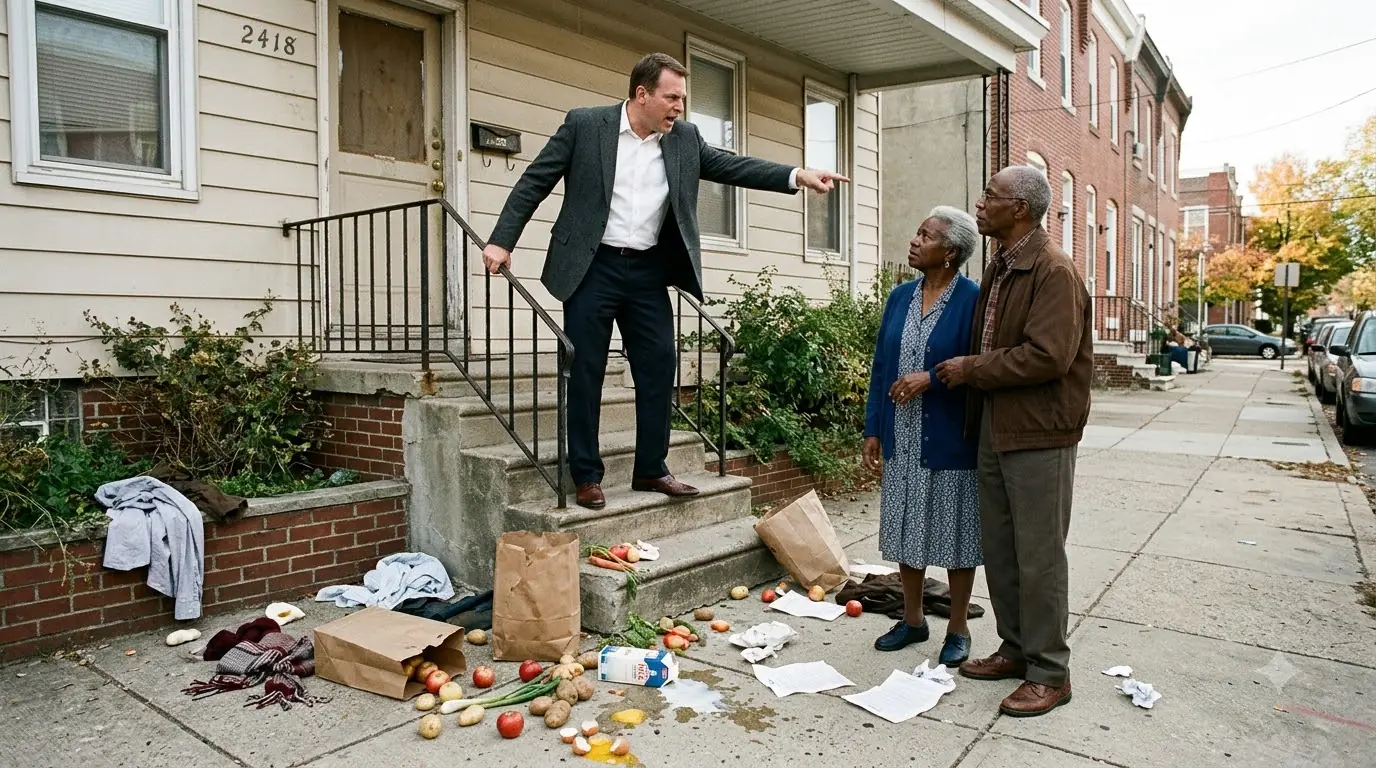
“You think you can just stay here forever? This is my building. Mine. Worth more than four million dollars, and people like you are dragging down the property value just by being here.”
He snatched the lease papers from Eleanor’s hands, crushed them into a ball, and threw them at her feet.
“Mr. Caldwell, please,” Eleanor said. “We’ve paid every month on time. We only need—”
Richard wiped his hand against his trousers as though touching the lease had contaminated him.
“I don’t care what you need. I have investors with real money waiting for this property. I’m done dealing with tenants who think their problems are my responsibility.”
Neighbors watched through windows above them. Curtains shifted. Faces appeared and vanished. No one stepped outside.
Eleanor slowly bent to retrieve the crumpled papers. Her hands trembled.
Richard Caldwell believed he was untouchable. He believed ownership gave him power over the people living beneath his roof, and he had spent years learning how far that power could be pushed before anyone stopped him.
He had no idea who Eleanor and James Washington were beyond two elderly tenants standing between him and a multimillion-dollar real-estate deal.
More importantly, he had no idea who their son was.
Six-thirty in the morning, two weeks earlier.
Eleanor Washington stood on her small balcony watering geraniums while steam rose from a coffee cup into the cold Philadelphia air. She wore a simple blue cardigan over her nightgown and no jewelry except the small gold cross her mother had given her forty years earlier. The cross caught the first light of morning as the street sweeper moved slowly along Riverside Avenue below.
“Morning, Dr. Washington,” Mrs. Carter called from the balcony beneath her. She was hanging laundry from a folding rack.
“Good morning, dear. How is your grandson’s cough?”
“Much better. That remedy you suggested worked perfectly.”
Eleanor smiled.
She had been retired from pediatric surgery for eight years, but neighbors still came to her with medical questions. She never minded. Medicine had been more than a profession to her. It had been the language through which she understood responsibility.
Inside the apartment, James Washington sat at the kitchen table with reading glasses balanced low on his nose and the Philadelphia Inquirer spread before him. He completed the crossword puzzle in pen, never pencil.
Forty-three years as a civil engineer had taught him that decisions should be deliberate.
Their apartment was modest: two bedrooms, one bathroom, a kitchen with yellow tile left over from the 1970s. Yet it belonged to their history.
Wedding photographs from 1980 hung along one wall. James’s Urban Planning Excellence Award from 1998 stood beside Eleanor’s framed medical-school diploma and a newspaper clipping about the children’s hospital wing she had helped establish.
On the mantle stood another photograph.
A young man in judicial robes smiled proudly beside Eleanor and James on the day he graduated from law school.
Their son, Thomas Washington.
Eleanor dusted the frame almost every morning.
The Washingtons had moved into the brownstone eight years earlier after James retired. They had sold their larger suburban house because they wanted something simpler, somewhere they could walk to church and know the people living around them.
The building had been constructed in the 1920s. It retained original crown molding, hardwood floors, tall windows, and twelve apartments occupied by a mixture of young families, students, and older residents.
The Rodriguez family had once lived in 4C. The Carters lived beneath the Washingtons. Mr. Patterson, ninety-two years old, lived on the ground floor and regularly forgot his keys.
Every Sunday, Eleanor baked cookies.
Chocolate chip for the children. Oatmeal raisin for most of the adults.
James tied ribbons around the small paper bags while Eleanor delivered them door to door.
“We’re blessed,” she often told him. “We should share it.”
The neighborhood, however, was changing.
Luxury condominiums were rising two blocks east. Trendy coffee shops replaced the corner stores. Rent climbed month after month.
Eleanor noticed new residents moving into the area with expensive exercise clothes, luxury cars, and little interest in speaking to the people who had lived there for decades.
Richard Caldwell noticed them too.
He had inherited the Washingtons’ building five years earlier after his father died. Twelve rental units provided steady income, but steady income was not enough for Richard.
He wanted more.
He drove a black Mercedes S-Class and deliberately parked it in front of the property whenever he visited. His vanity plate read CALDWELL1. He wore expensive watches and tailored suits even for routine inspections.
“Just checking on my investment,” he would say.
Yet his eyes never seemed to see people. They saw numbers.
Three months earlier, a developer had approached him with an offer.
Buy the entire property for $4.2 million in cash, demolish the building, and replace it with twenty luxury apartments renting for at least four thousand dollars per month.
There was only one condition.
The building had to be vacant.
Richard calculated immediately.
Most of his current tenants paid approximately twelve hundred dollars per month under older leases signed by his father. Several units had long-term protections that made ordinary eviction difficult.
Removing them legally could take years.
Richard decided there were other ways.
He had started with the Rodriguez family.
Renovation notices appeared repeatedly. Inspectors arrived at inconvenient hours. Noise complaints materialized despite neighbors insisting there had been no noise.
After six months of pressure, the Rodriguez family accepted a modest buyout simply to escape.
Now only three long-term households remained: Mr. Patterson, the Carters, and the Washingtons.
Richard considered Mr. Patterson a temporary problem. At ninety-two, Richard assumed time would solve that one.
The Carters had relatives in California. Perhaps they could be persuaded to leave.
The Washingtons were different.
They had the strongest lease, the longest record of uninterrupted payments, and no legitimate violations. Eleanor and James were quiet, responsible, and respected throughout the building.
Richard sometimes watched them from his Mercedes.
Eleanor watering flowers.
James walking toward the corner shop for his morning newspaper.
The couple helping neighbors carry groceries or holding doors for young parents with strollers.
To everyone else, they represented the kind of residents who made a building feel like a community.
To Richard, they represented four million dollars standing still.
He decided he would make them uncomfortable enough to leave voluntarily.
He merely had to become creative.
The first letter arrived on October 23 in a cream-colored envelope with embossed letterhead.
Eleanor opened it at the kitchen table while James poured coffee.
“Building modernization notice,” she read. “All tenants requested to temporarily relocate for sixty days beginning November first.”
James lowered the coffee pot.
“Requested or required?”
“Requested. They are offering two thousand dollars for voluntary cooperation.”
The letter carried Richard Caldwell’s signature.
That afternoon, he appeared at their door smelling strongly of expensive cologne.
“Did you receive my letter?”
“Yes, Mr. Caldwell,” Eleanor replied. “We appreciate the offer, but we would prefer to remain during the renovations. Our lease allows it under Section 7B.”
Then it returned.
“Of course. I only thought you might be more comfortable elsewhere. The noise will be significant.”
“We’ll manage. Thank you for thinking of us.”
Richard departed without another word.
Eleanor noticed his right hand closing into a fist as he walked away.
That evening, she opened a notebook.
October 23. Time of visit. Exact statements. Witness: James Washington.
She had kept written records throughout her career: patient notes, surgical logs, medication histories.
Now she began documenting her landlord.
James watched from across the table.
“You think this will become worse?”
“I think a man offering money generally expects something in return.”
She was right.
Monday morning, at 6:45, hammering erupted from the vacant apartment beside them.
Eleanor jolted awake.
Bang. Bang. Bang.
The sound rattled dishes in their kitchen cabinet.
James pulled on his robe and knocked on the superintendent’s door.
Mr. Kim answered in pajamas.
“I’m sorry, Mr. Washington. Mr. Caldwell called me at six. He said there were emergency repairs, a pipe problem or something. I had to let the crew inside.”
“At six forty-five in the morning?”
Mr. Kim lowered his eyes.
“He said it couldn’t wait.”
The hammering continued until eight that evening.
Fourteen hours.
When silence finally returned, Eleanor’s head throbbed. She realized she had forgotten her blood-pressure medication because of the disruption.
She recorded everything.
Date. Starting time. Ending time. Witness. Building superintendent.
Tuesday morning, the heat stopped.
The outside temperature was thirty-eight degrees.
Eleanor wore two sweaters beneath her winter coat while sitting inside her own living room. Her breath became faint clouds near the windows.
James called the superintendent.
“I know,” Mr. Kim told him. “Boiler problem. They say tomorrow.”
The heat returned at eleven that night.
At three in the morning, it disappeared again.
Eleanor added another page to the notebook.
Wednesday brought certified mail.
LEASE VIOLATION NOTICE.
Unauthorized occupant.
Eleanor read it three times.
“They’re saying we’re allowing someone else to live here.”
“That’s ridiculous,” James said. “It’s only us.”
Eleanor documented every visitor from the previous month.
Her sister on October fifth.
James’s brother on October twelfth.
Their friend Margaret for Bible study on October eighteenth.
Each visit had lasted approximately two hours.
She carried the list to Caldwell’s downtown office and waited forty minutes before he agreed to meet her.
“Mr. Caldwell, there has been an error regarding this violation notice.”
“Is anyone living with you who isn’t named on the lease?”
“No. We occasionally have family and friends visit. Our lease permits guests.”
Richard glanced at her written list and pushed it away with one finger.
“I have received complaints.”
“What complaints?”
“Noise. Disturbances.”
“May I see them?”
“That information is confidential.”
“Then how are we expected to respond?”
Richard stood, signaling that the conversation was over.
“I suggest reconsidering the relocation offer, Dr. Washington. Things are going to become increasingly uncomfortable.”
Eleanor left and went directly to Mrs. Carter.
“Have James or I disturbed you recently?”
Mrs. Carter looked shocked.
“Never. You two are probably the quietest people in this entire building. Did he say we complained?”
“He implied that neighbors had.”
Mrs. Carter disappeared into her bedroom and returned carrying paper.
“I’m writing a statement. Right now. You’re good neighbors, and I’ll say so.”
By Friday, Eleanor had statements from five residents.
Every document said essentially the same thing.
The Washingtons were model tenants.
Friday evening, at 6:30, Eleanor and James returned from grocery shopping carrying three bags containing milk, eggs, vegetables, and chicken for Sunday dinner.
Richard’s Mercedes blocked the entrance.
He stood on the front steps speaking with two men in expensive overcoats. The men looked like developers.
All three turned when the Washingtons approached.
Richard stepped down and blocked the doorway.
“We need to talk.”
“Of course,” Eleanor said. “Should we go inside?”
“No. This won’t take long.”
He removed documents from his briefcase and thrust them toward James.
“Thirty-day eviction notice. Multiple lease violations. Failure to maintain property standards. Disturbing other tenants.”
James carefully read the notice.
“These allegations are false. We have written statements from our neighbors.”
“I don’t care what you have,” Richard replied loudly enough for pedestrians to hear. “This neighborhood is changing. Properties like this require a different kind of image.”
“What kind?” Eleanor asked quietly.
One of the developers laughed.
“Look around, lady. The neighborhood is moving on. Maybe you should too.”
The other man nodded.
“Take the money. Find somewhere else. Everyone wins.”
Eleanor tightened her grip on the grocery bag.
The handles cut into her palms.
“Our lease renews automatically,” James said. “Section 7B states that clearly.”
Richard snatched the papers.
“Your lease? You think this old paper controls me?”
He suddenly grabbed the grocery bags and dumped them onto the steps.
The milk rolled sideways.
Eggs cracked against the concrete.
Vegetables scattered.
An apple rolled down the stairs and into the gutter.
Eleanor watched it disappear through the rain. She had chosen that apple for a pie she planned to bake for the church fundraiser.
Richard looked down at the mess.
“Pick that up and listen carefully. You have thirty days. Accept the buyout, or I will make this much worse.”
He pulled out his phone.
“I know judges. Politicians. People with influence. Cause another problem and I’ll keep you tied up in legal proceedings until you can’t afford to stay anywhere.”
James bent to gather the groceries.
His hands shook.
Eleanor had almost never seen James’s hands shake.
She knelt beside him, picked up broken eggs, and gently placed them back into the carton despite the yolk running between her fingers.
Richard watched.
Then he removed the lease-renewal document Eleanor had previously given him.
He crushed it slowly, making certain they saw what he was doing.
He dropped it into the spilled milk.
“Paper means nothing if nobody is willing to enforce it.”
He wiped his hand against his trousers.
“Sign the buyout by Monday, or find out how powerless you actually are.”
Richard entered the building and slammed the door.
The deadbolt locked.
Eleanor and James remained outside in the cold rain with groceries scattered around them.
Neighbors watched from windows.
Still, no one came downstairs.
James salvaged what remained. The milk was gone. Nearly every egg was broken. The chicken package had torn.
They walked silently to their Honda and sat in the front seats without starting the engine.
Rain traced lines across the windshield.
“We should call Thomas,” Eleanor said eventually.
“Not yet.”
James rarely sounded angry.
“Let’s see how far he takes this. Document everything. Build the case.”
Eleanor opened her phone.
November 8. 6:47 p.m. Caldwell dumped groceries. Crumpled lease. Threatened legal action. Associates made discriminatory remarks.
She entered every detail precisely.
Medical school had taught Eleanor that documentation could save lives.
Record symptoms.
Record treatments.
Record outcomes.
She had never imagined she would one day document her own persecution.
Saturday morning, at seven, pounding on their door woke them.
Mr. Kim stood in the hallway, apologetic.
“Dr. Washington, I’m sorry. Mr. Caldwell changed the building locks last night. Security upgrade, he said. These are your new keys.”
Eleanor stared at him.
Every tenant had apparently received advance notice except them.
The Washingtons had left for early church at 5:30 and returned to discover they could no longer enter the building.
They had spent forty-five minutes waiting in the cold hallway.
“If I warned you,” Mr. Kim whispered, “he said I would lose my job.”
Eleanor documented it.
Saturday afternoon brought something worse.
They returned from Bible study at 4:30.
Their apartment door was slightly open.
James pushed it slowly.
“Hello?”
No answer.
Inside, everything felt wrong.
Furniture had been shifted.
Drawers were partially open.
Closet doors hung wide.
Eleanor’s old medical files lay across the dining table. Several appeared to have been photographed; clear handprints and phone marks were visible in the dust.
James’s engineering awards had been knocked from shelves.
Eleanor’s jewelry box stood open.
Nothing valuable appeared missing. Whoever entered had not come to steal.
They had come to invade.
Eleanor’s mother’s pearls had been deliberately tangled among inexpensive costume jewelry.
Her breathing became shallow.
“Call the police.”
Officers Mitchell and Torres arrived twelve minutes later.
Mitchell immediately recognized that the apartment had been searched.
“Did you authorize anyone to enter?”
“Absolutely not,” Eleanor said.
Torres began photographing the room.
Mitchell took notes.
Then Richard arrived and simply unlocked the apartment with his own key.
“Officers. Thank God. Emergency entry. Suspected gas leak. Notice was posted three days ago.”
He presented paperwork dated Wednesday.
“There was no notice,” Eleanor said.
“Not my problem if someone removed it. Pennsylvania law allows emergency entry for safety reasons.”
Mitchell examined him skeptically.
“Where is the utility-company report?”
“Technician comes Monday.”
Torres photographed the paperwork.
“Dr. Washington,” Mitchell said quietly, “you should speak with a housing attorney immediately.”
After the officers left, Richard smiled.
“See? Even the police know you don’t have a case.”
Sunday morning at six, jackhammering began outside their bedroom wall.
The sound exploded through the apartment.
Construction dust poured inside around the windows, gray and acrid.
Eleanor’s asthma reacted almost immediately.
Her chest tightened.
She reached for her inhaler while James helped her into the living room, but the dust spread through the entire unit.
She sat forward, fighting for comfortable breaths.
The construction continued for nine hours.
Only the area around their apartment was affected.
By four that afternoon, Eleanor and James left simply because she needed clean air.
Richard waited in the lobby with a young couple.
“Premium location,” he was explaining. “A unit should be available soon.”
The woman looked toward Eleanor.
“But someone lives there.”
“Temporary situation. Resolving shortly.”
Eleanor and James continued toward their car.
Richard followed.
He parked his Mercedes close beside their Honda, temporarily blocking them, then began photographing the license plate and vehicle.
“Why are you doing that?” James demanded.
“Documenting vehicles associated with my property. Making certain everything is legitimate.”
For twenty minutes, he stood nearby making calls while their car remained trapped.
Eventually, he moved.
Eleanor’s hands were shaking too badly to document the incident until later.
Monday morning at nine, police knocked on their door.
“Anonymous complaint,” the officer explained. “Possible illegal drug activity at this address.”
Eleanor stared at him.
“Drug activity?”
The officer conducted a basic check and found only prescription medication: blood-pressure tablets, cholesterol medicine, and Eleanor’s inhalers.
“I apologize,” he said. “This clearly appears to be a false report.”
After he left, Eleanor sat silently at the kitchen table.
She had spent forty years caring for children.
She had never been arrested.
She had never been accused of a crime.
Now someone was attempting to transform her into a suspect inside her own home.
Officer Mitchell called that afternoon from his personal number.
“Dr. Washington, there have been multiple false reports connected to your address in only a few days. Someone is harassing you. You need serious legal assistance.”
Then the financial problems began.
A bank payment disappeared during processing.
Eleanor spent hours tracing it.
Her credit card was declined at the pharmacy while she attempted to purchase heart medication.
The account had been frozen for a fraud review.
Three hours later, the company restored it and apologized for a “technical error.”
Eleanor did not know whether Richard was responsible for every disruption, but the timing made her increasingly uneasy.
That evening, Mrs. Carter knocked and handed Eleanor a container of soup.
Then she produced a USB drive.
“My security camera recorded him entering your apartment Saturday.”
Eleanor stared at the drive.
“He was there?”
“For forty-three minutes. No repair workers. No gas company. Just him.”
Mrs. Carter’s eyes filled with tears.
“He did similar things to the Rodriguez family. They couldn’t take it anymore and left. Please don’t give up. If you leave, who will he target next?”
Eleanor watched the video that evening.
1:47 p.m.
Richard Caldwell entered.
Forty-three minutes later, he left.
No emergency.
No utility technician.
No notice.
She saved the recording and added it to her evidence folder.
That night, Eleanor sat at the dining table organizing everything by date.
Her hands trembled.
James entered and saw tears running silently down her cheeks.
He had watched his wife endure difficult surgeries, emergencies, and the loss of patients.
He rarely saw her cry.
“I operated on children for forty years,” Eleanor whispered. “I saved lives. I built an entire career helping people.”
Her voice broke.
“And now I don’t feel safe inside my own home. I feel completely powerless, James.”
He sat beside her and took both hands.
“We’re calling Thomas.”
“Not yet.”
“Tonight. Enough. He can be angry that we waited. I don’t care. This has gone too far.”
Wednesday morning, Richard appeared with a sheriff’s deputy.
“Emergency eviction order,” Richard announced. “Immediate property assessment authorized by the court.”
Eleanor remained calm.
“I would like to see the judge’s signature.”
Richard shuffled the papers.
The deputy examined them.
“Sir, this isn’t properly executed. There is no signature or court seal. This appears to be a template.”
Richard’s face flushed.
“These people are playing games. They don’t belong in a building like this anymore.”
The deputy’s expression hardened.
“What exactly do you mean by that?”
Eleanor’s phone was recording from inside her pocket.
Richard’s composure began to crack.
“I have connections. Judges, politicians, people who matter. You think anyone is going to care about a couple of—”
He stopped himself.
No one needed him to finish.
The deputy turned toward Eleanor.
“Ma’am, do you feel threatened?”
“Yes. We have documented seventeen incidents in thirteen days.”
Eleanor handed over the notebook.
Dates.
Times.
Photographs.
Videos.
Witness statements.
Mrs. Carter’s security footage.
Everything.
The deputy’s expression darkened as he turned the pages.
“Mr. Caldwell, leave immediately.”
Then he looked at Eleanor.
“File formal complaints today. Housing court and police. This appears to be systematic harassment.”
After Richard left, Eleanor finally made the call.
“Thomas, sweetheart, we need your help.”
Her son immediately heard something in her voice.
“Mom, what happened?”
“Someone is trying to force us from our home. He has crossed every line.”
Silence.
Then Thomas Washington’s voice changed.
Eleanor had heard that voice before.
It was the voice he used in court.
“Tell me everything.”
She did.
When she finished, Thomas spoke calmly.
“I’m coming tomorrow.”
“Tomorrow?”
“You have housing court at nine, correct?”
“Yes.”
“Then I’ll be there.”
Eleanor lowered the phone.
James looked at her.
“He’s coming.”
Outside, Richard sat inside his Mercedes speaking with his attorney, confident that the eviction would be completed the following morning.
He had no idea what waited for him.
Thursday morning.
Philadelphia housing court.
8:45 a.m.
The courthouse smelled of floor polish and old paper. Fluorescent lights hummed overhead.
Richard arrived early in a black suit with his expensive watch gleaming beneath the cuff. His attorney, Gregory Hamilton, carried a leather briefcase stuffed with documents.
“Five minutes,” Richard said quietly. “Brennan knows me. Standard problem-tenant eviction.”
Hamilton nodded.
“Open and shut.”
They spread violation reports, notices, photographs, and prepared statements across the plaintiff’s table.
Everything looked official.
Richard texted the developer.
IN COURT NOW. BUILDING VACANT BY DECEMBER 1.
A response came almost immediately.
$4.2M TRANSFERS UPON CONFIRMATION.
Richard smiled.
At 8:55, Eleanor and James entered.
Eleanor carried one plain manila folder.
She wore a simple navy dress and her mother’s gold cross.
James wore the church suit he had owned for twenty years.
They sat at the defendant’s table without an attorney.
Richard leaned toward Hamilton.
“No lawyer.”
Hamilton smiled.
“Even better.”
At nine, the bailiff stood.
“All rise.”
The chamber door remained closed.
Everyone waited.
The clerk called the case.
“Caldwell versus Washington. Housing dispute and eviction petition.”
Hamilton stood.
“Your Honor, this is a straightforward matter involving tenants who repeatedly refused to—”
He stopped.
A side door opened.
A man entered through the judicial corridor.
Thomas Washington.
Forty-two years old, tall, composed, and wearing judicial robes.
He moved to the bench and arranged the files before him.
“Good morning. I am Judge Thomas Washington, sitting today under the special assignment established for this proceeding.”
Hamilton’s briefcase slipped from his hand.
Papers scattered across the floor.
Richard froze.
Thomas looked at the file.
“Caldwell versus Washington. Mr. Caldwell, you are seeking eviction.”
Richard’s voice cracked.
“Your Honor, Washington… there’s a conflict.”
“There is, and it has been disclosed according to the special proceeding before we began. Everyone in this courtroom will understand the relationship before anything further happens.”
Thomas looked toward the defendants.
“Dr. Eleanor Washington and James Washington, please stand.”
His parents rose.
Thomas allowed the silence to stretch.
Then he looked directly at Richard.
“For the record, these are my parents.”
A murmur rolled through the gallery.
Richard stepped backward and caught the edge of the table.
His face lost its color.
Thomas leaned slightly forward.
“Mr. Caldwell, explain your basis for attempting to remove these tenants from their lawful residence.”
Richard swallowed.
“Your Honor, I… if I had known—”
“If you had known what?”
Thomas’s voice remained controlled.
“That they had a son in the judiciary? Would that have changed the dignity you believed they deserved?”
Richard said nothing.
“Or should you have treated them properly regardless of who their son happened to be?”
Silence.
Thomas pressed a control.
A screen illuminated beside the bench.
“Let us review the documentation submitted in connection with the complaint.”
Eleanor’s notebook appeared first.
Scanned pages.
Dates.
Times.
Details.
Then video.
Richard’s own voice played through the courtroom.
“People like you always have some sob story.”
Another recording showed the lease crushed and thrown toward Eleanor.
The groceries scattered across the steps.
The repeated threats.
Audio captured the developer telling the Washingtons they should leave the changing neighborhood.
Mrs. Carter’s security footage followed.
Richard entered the Washington apartment at 1:47.
He remained inside for forty-three minutes.
No maintenance crew appeared.
No gas technician arrived.
The screen displayed violation after violation, each supported by timestamps, testimony, photographs, or recordings.
Police reports appeared next.
Multiple anonymous complaints made against the Washingtons had been determined unfounded, and investigators had identified links that required further review.
The courtroom remained nearly silent except for the recordings.
Richard watched himself on the screen.
When the presentation ended, Thomas shut it off.
“Mr. Caldwell, how do you explain this documented pattern of harassment?”
Richard’s answer was barely audible.
“It’s a misunderstanding.”
“A misunderstanding?”
Thomas looked at the record before him.
“Thirteen days of repeated disruption. Unauthorized entry. Questionable notices. False allegations. Threats. Selective treatment. Statements indicating discriminatory intent.”
Hamilton rose.
“Your Honor, we request a continuance.”
“Denied. The eviction petition is before the court today.”
Thomas turned toward Richard.
“Anything else before I rule?”
Richard’s shoulders lowered.
The four-million-dollar deal seemed to disappear from his face in real time.
“I sincerely apologize.”
Thomas’s expression remained unchanged.
“Do not apologize to me.”
He gestured toward the Washingtons.
“Speak to them.”
Richard turned.
He struggled to meet Eleanor’s eyes.
“Dr. Washington. Mr. Washington. I deeply regret what happened.”
Eleanor’s answer was quiet.
“You don’t regret what you did. You regret that someone finally documented it.”
James spoke next.
“You entered our home. You frightened my wife. You tried to make us believe we had no protection.”
Richard’s eyes filled.
“Please. I have a family and a business. This could ruin me.”
Thomas lifted the gavel.
“You should have considered consequences before treating another family this way.”
The gavel struck.
“Eviction petition denied.”
Richard sank into his chair.
Thomas continued.
“The allegations raised by the defendants go far beyond a landlord-tenant disagreement. Those matters will be referred to the appropriate agencies for independent review.”
Additional orders followed.
Richard was prohibited from contacting Eleanor or James directly.
A neutral management company would temporarily assume responsibility for the Washington property while the harassment claims were investigated.
Richard could not enter their apartment, threaten them, alter services, or retaliate against them.
The lease remained in force.
A compliance bond was required.
All recordings, photographs, written logs, police reports, and witness statements would be preserved as evidence and forwarded to agencies responsible for housing discrimination and civil-rights enforcement.
Richard stared at the documents.
“You’re taking my building away from me?”
“No,” Thomas replied. “The independent process will determine what happens to your business. Today, this court is ensuring that the people living inside the building remain protected while that process occurs.”
The bailiff collected Richard’s building keys for transfer to the appointed manager.
Richard looked toward Hamilton.
“This is a mistake. We’ll appeal.”
“You are entitled to every lawful remedy available to you,” Thomas said. “So are your tenants.”
Richard turned one final time toward Eleanor.
She met his eyes.
He had spent two weeks attempting to make her feel small, frightened, and invisible.
Now she understood something he had never considered.
She had never been powerless.
The courtroom doors closed behind him.
Thomas looked toward his parents.
The professional distance in his expression softened.
“Are you both all right?”
Eleanor smiled.
“We are now.”
By the time they left the courthouse, news vans were arriving.
Someone had learned enough about the case to alert local reporters.
By afternoon, Philadelphia stations were reporting allegations that an elderly couple had been subjected to systematic landlord harassment.
By evening, the story had begun spreading beyond the city.
For Richard Caldwell, the housing-court loss was merely the beginning.
Two days later, the Pennsylvania Attorney General’s office opened an investigation.
The court records arrived Friday morning.
By Friday afternoon, a team had begun reviewing not only the Washington property, but Richard’s entire housing portfolio.
Investigators wanted leases, rent records, maintenance logs, eviction notices, complaints, payment histories, and correspondence from the previous five years.
They soon found Maria Rodriguez.
Her family had relocated to New Jersey after leaving Richard’s building.
Maria cried while describing the pressure.
“He increased our rent three hundred dollars while the family next door remained at the old amount. When we asked why, he told us we could leave if we didn’t like it.”
Her husband described repeated inspections and violations they believed were fabricated.
“Our children became afraid whenever someone knocked on the door.”
Investigators found other cases.
A South Asian family in another property had been charged more than tenants in a nearly identical unit.
An elderly resident had gone months without heating repairs despite repeated maintenance requests.
Leaking pipes and mold remained unresolved while other apartments received faster service.
The same pattern appeared repeatedly.
Certain families faced higher costs, slower maintenance, more inspections, and greater pressure to leave.
A forensic review of Richard’s records uncovered hundreds of thousands of dollars in questionable rent differences and fees over several years.
Twelve households appeared to have been disproportionately targeted.
The Philadelphia Inquirer published the first major investigation.
PATTERN OF DISCRIMINATION ALLEGED IN PHILADELPHIA LANDLORD CASE.
Other outlets followed.
The recordings spread online.
Millions watched Richard belittle the Washingtons outside their home.
Public attention grew rapidly.
Some viewers focused on the racial element. Others focused on housing power, tenant protections, and the simple fact that an owner had believed elderly residents could be frightened into surrendering their rights.
Former tenants began coming forward.
The state real-estate commission launched its own review of Richard’s transactions.
Investigators compared repair schedules.
Property assessments.
Rent increases.
Buyout offers.
Eviction histories.
They found enough irregularities to suspend Richard’s professional license while the larger investigation proceeded.
The developer withdrew its offer.
A public statement followed.
The company would not continue negotiations while serious discrimination allegations remained unresolved.
The $4.2 million deal disappeared.
Richard’s other properties became harder to finance or sell as lenders and investors waited for the investigations to conclude.
Two months later, the matter reached federal court.
United States versus Richard Caldwell.
The criminal allegations included civil-rights violations, discriminatory housing practices, harassment, false reporting, unlawful entry, and intimidation.
Judge Maryanne O’Connor presided.
The courtroom was crowded.
Reporters occupied the back rows. Former tenants filled the gallery. Community advocates sat beside families who had experienced their own housing disputes.
Eleanor and James sat near the front.
The prosecution’s opening statement was direct.
“Richard Caldwell weaponized his position as a landlord. The evidence will show that he selectively targeted residents he believed were easier to intimidate and used housing insecurity as a tool for profit.”
The defense argued that Richard’s decisions were based on business concerns rather than prejudice.
The jury began hearing witnesses.
Maria Rodriguez testified first.
“He complained about our cooking and said it bothered other residents. But other families cooked whatever they wanted. He never treated them the same way.”
She displayed rent records showing the difference between her family’s payments and comparable apartments.
Another family described higher rent and selective enforcement.
Officer Mitchell testified about the Washington case.
“I have seen landlord disputes during twenty years in law enforcement. What concerned me here was the repeated use of complaints and police contact against people for whom there was no evidence of criminal behavior.”
Mrs. Carter testified about her security camera.
She described Richard entering the Washington apartment without any visible emergency crew.
She also described the pressure residents felt whenever they considered supporting one another.
The forensic accountant followed.
Spreadsheets appeared on large courtroom monitors.
Properties.
Tenants.
Rent.
Maintenance expenses.
Complaints.
Eviction notices.
The patterns became difficult to dismiss.
Then Eleanor Washington took the stand.
The courtroom quieted.
She wore the same navy dress and the same gold cross.
The prosecutor approached gently.
“Dr. Washington, please tell the jury what happened.”
Eleanor spoke with the precision of a physician giving a case history.
“November eighth, 6:47 p.m. Mr. Caldwell threw our lease documents onto the ground. He told us that residents like us were lowering the value of his property.”
She described the groceries.
The heating disruptions.
The construction noise.
The false violation notices.
The apartment entry.
“My files were photographed. Some contained old research and confidential information connected to work I had performed in medicine. It was a profound violation of privacy.”
Her voice remained steady, but several jurors wiped their eyes.
“I spent forty years caring for children. I never imagined that at this stage of my life, someone would attempt to make me afraid of entering my own home.”
She held up the notebook.
“I documented everything because I understood that memory alone might not be enough. When one person controls property, money, and access, the person with less obvious power must preserve the facts.”
The prosecutor took the notebook.
“You had photographs, witnesses, recordings, and written logs?”
“Yes.”
“Why?”
“Because evidence prevents someone else from rewriting what happened.”
Cross-examination accomplished little.
For almost every question, Eleanor had a date, a photograph, a witness, or a recording.
During the third week, Richard took the stand against his attorney’s advice.
The prosecutor played one of the recordings.
“Mr. Caldwell, is that your voice?”
“Yes, but the statement was taken out of context.”
“What context makes it appropriate?”
Richard hesitated.
“I was frustrated.”
“Were you similarly frustrated when you charged some households more than comparable tenants?”
“Those were market adjustments.”
“Why did those adjustments repeatedly affect the same categories of residents?”
Richard struggled to answer.
The questioning moved to the apartment entry.
“You claimed there was a gas emergency.”
“Yes.”
“The utility company found no leak.”
“That was the information I had at the time.”
“Your own maintenance records contain no gas complaint for that apartment.”
Richard’s explanation became increasingly tangled.
By the end of the testimony, his defense had been badly damaged.
The jury deliberated for approximately four hours.
Guilty on the major civil-rights charges.
Guilty on the housing-discrimination charges.
Guilty on multiple harassment counts.
Guilty on the false-report charges.
Guilty on unlawful entry.
The courtroom reacted audibly before Judge O’Connor restored order.
One month later came sentencing.
“Mr. Caldwell,” Judge O’Connor said, “you used housing, something essential to human security, as leverage against people you believed had less power than you. The record demonstrates repeated choices, not a single lapse in judgment.”
The sentence included incarceration, probation following release, substantial fines, victim restitution, and a permanent prohibition against returning to the same real-estate activities that had enabled the abuse.
Additional money was directed toward fair-housing enforcement and victim compensation.
Richard sat motionless beside Hamilton.
The civil lawsuits followed.
The Washingtons reached a multimillion-dollar settlement.
Other households collectively received millions more.
Richard’s remaining business collapsed under litigation, fines, settlements, and lost investment agreements.
Within weeks, bankruptcy proceedings began.
A week after sentencing, Eleanor and James stood on the courthouse steps before cameras.
“We did not ask for this fight,” Eleanor said. “But once it came to our door, we realized staying silent would leave the next family alone.”
James stepped beside her.
“Document everything. Dates. Witnesses. Letters. Messages. Do not assume no one will listen simply because the person mistreating you has more money.”
Thomas stood several feet behind them.
Proud, but silent.
The case also triggered calls for stronger tenant protections.
Lawmakers began developing reforms intended to make harassment complaints easier to file, improve enforcement, and require greater accountability from landlords.
Eventually, a package of reforms became informally known as the Washington Act.
Six months later, May sunshine warmed Eleanor’s balcony.
She watered the same geraniums outside the same apartment.
Yet everything felt different.
Safe.
Finally safe.
Children played in a newly created community garden below. Eleanor had suggested the idea, and the new building management approved it immediately.
Eventually, the property transitioned into a community-focused ownership structure that gave residents meaningful input in building decisions.
Mrs. Carter was elected building representative.
“Community meeting tonight!” she called upward. “We’re planning the summer festival.”
“I’ll be there,” Eleanor replied.
This was home now.
Truly home.
Inside, James prepared materials for an evening engineering class at a community college.
Sixteen students had enrolled, many from families without previous college graduates. Some had grown up believing engineering was a profession meant for someone else.
“Teaching them what you taught me,” James told Eleanor. “Precision, perseverance, pride in doing something correctly.”
Eleanor returned to volunteer medicine as well.
She worked in free clinics serving neighborhoods where doctors were scarce.
But she also began doing something new.
She spoke at tenant-rights seminars and fair-housing conferences.
“Document everything,” she told audiences. “Every incident. Every witness. Every notice. Every conversation you can lawfully preserve. Facts are a shield when someone with power attempts to convince you that what happened did not happen.”
People listened.
Some cried.
Many approached afterward to tell their own stories.
The Washington Act passed the following spring.
The governor signed the reforms during a public ceremony attended by Eleanor, James, and Thomas.
The new rules strengthened tenant protections, simplified harassment reporting, expanded anti-discrimination requirements, and increased penalties for proven violations.
Thomas stood beside his parents after the ceremony.
“This exists because you refused to disappear.”
Richard Caldwell remained incarcerated.
His real-estate license was gone.
The court orders and regulatory decisions ensured he would never again exercise the same control over tenants.
His business, reputation, and wealth had collapsed.
Eleanor occasionally wondered whether he finally understood what he had done.
She had no answer.
Eventually she accepted that she might never receive one.
One evening, a documentary crew interviewed the Washingtons inside their living room.
Family photographs filled the wall behind them.
“Why didn’t you simply accept the money and leave?” the interviewer asked.
Eleanor smiled gently.
“Because we had every legal right to remain. My husband spent decades building public infrastructure. I spent decades caring for children. We had built a life and a community there.”
She leaned forward.
“We did not stay because we were stubborn. We stayed because surrendering to injustice teaches the person causing it that the method works.”
James nodded.
“Richard saw two elderly tenants and assumed we would be too tired, too frightened, or too isolated to resist.”
“He was wrong,” Eleanor said. “But there is something about the story that still troubles me.”
The interviewer waited.
“We had resources. We understood documentation. Our son understood the legal system. Other families do not have those advantages. Maria Rodriguez left because fighting seemed impossible.”
Eleanor’s voice strengthened.
“Justice should not depend upon having a judge in your family. It should not depend upon wealth, education, influence, or knowing the right person. The protections should exist for everyone.”
That was why Eleanor agreed to continue telling the story.
Not because she enjoyed remembering the fear.
Because too many people had experienced the same fear without receiving the same ending.
The documentary later drew national attention to housing discrimination and tenant harassment.
For Eleanor and James, however, ordinary life remained more important than headlines.
Morning coffee.
Watering plants.
Greeting neighbors.
Church on Sunday.
The quiet, beautiful routine they had fought to preserve.
One year after the housing-court victory, Eleanor stood on her balcony while evening settled over Philadelphia.
She remembered the pounding construction, the freezing apartment, the police visits, the open drawers, the crushed lease lying in spilled milk.
Then she looked down.
Mrs. Carter was talking with two neighbors near the community garden.
Children chased each other along the walkway.
Someone held the front door for Mr. Patterson.
A young mother carried groceries upstairs while another resident helped with the stroller.
This was what Richard had never understood.
A building was not valuable because of the number printed on a developer’s offer.
Its true value lived in the people inside it.
“Dr. Washington,” Mrs. Carter called. “Dinner is ready. I made extra.”
Eleanor smiled.
“I’m coming.”
She took one last look at the geraniums and stepped inside.
They had fought for community.
For safety.
For dignity.
For home.
And Eleanor knew that if faced with the same choice again, she would make it exactly the same way.
Richard Caldwell had believed power belonged to the person who owned the building.
Eleanor Washington learned something different.
Power also belonged to the person who kept records.
To the neighbor who saved the security footage.
To the police officer who asked another question.
To the tenant who refused to disappear.
To the families who eventually came forward and discovered that their experiences were not isolated.
One elderly couple’s notebook became evidence.
That evidence became a case.
The case exposed a pattern.
And the pattern forced a system to change.
Eleanor had spent most of her life believing her greatest contribution would be the children she had helped save in operating rooms.
She was proud of every one of them.
But standing inside the home she had nearly been forced to abandon, she understood that service could take many forms.
Sometimes it meant holding a surgical instrument steady.
Sometimes it meant standing beside a frightened neighbor.
And sometimes it meant writing down the exact time someone tried to convince you that you had no power, then keeping that page until the day the truth finally reached someone willing to listen.