Four hundred motorcycles lined the street, their engines rumbling like a storm gathering in the distance, but Nathan Caldwell was not listening to them.
He stood frozen in front of a corkboard at a charity event, staring at a photograph that had just shattered something inside his chest. 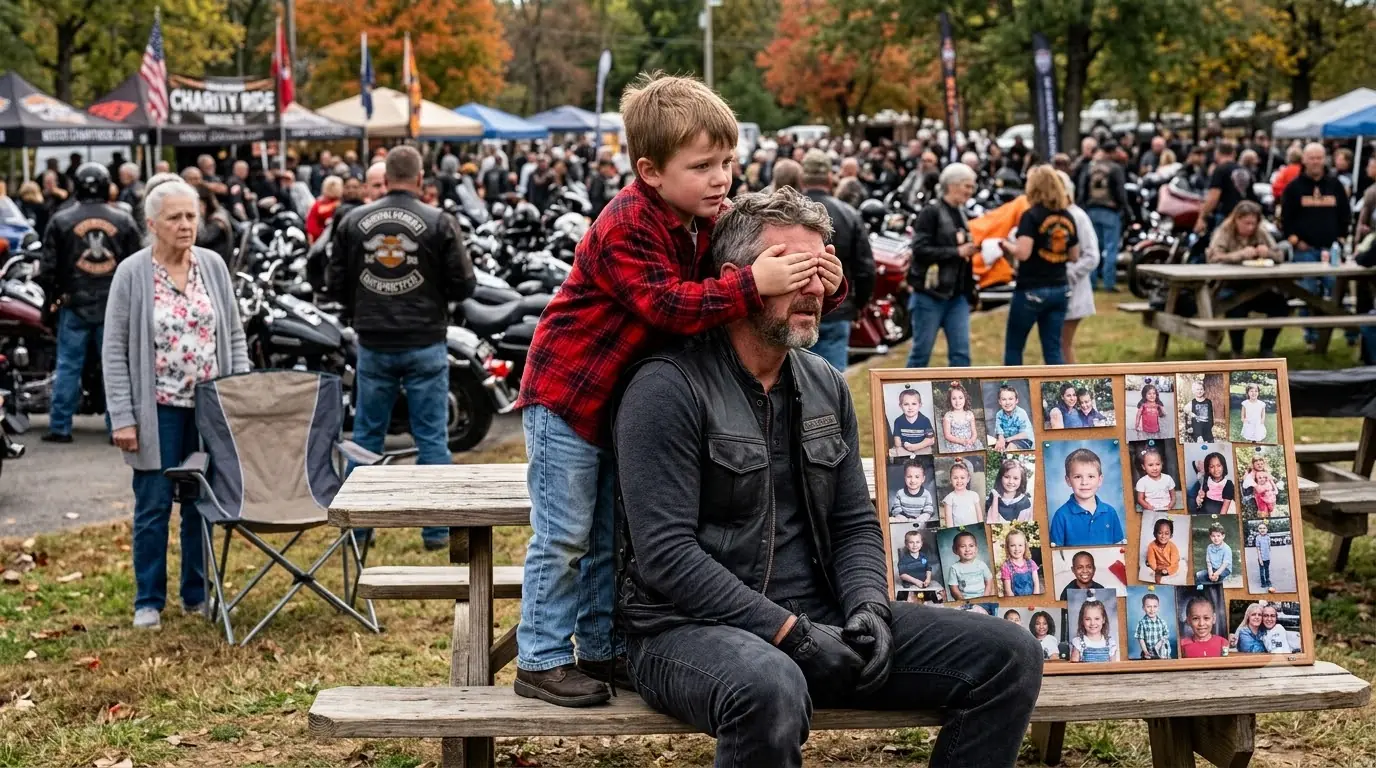
Before he could react, two small hands reached up from behind and covered his eyes.
“Do not look,” a six-year-old boy whispered, his voice trembling.
The child was not protecting Nathan from danger. He was trying to hide something far more devastating, a truth about himself that no child should ever have to carry alone.
What happened next would make four hundred bikers weep in a courthouse parking lot.
The morning sky above Knoxville stretched across the horizon in shades of pewter and pale blue. It was the kind of October sky that could not decide whether to rain or hold itself together.
Nathan Caldwell sat on the worn leather seat of his Harley-Davidson Road King, parked at the far edge of the First Baptist Church lot on Chapman Highway. He watched the other riders arrive one by one as the rumble of their engines filled the cool Tennessee air like distant thunder.
Each motorcycle announced its arrival with a growl that vibrated through Nathan’s chest.
He had been awake since four that morning.
That was nothing unusual.
Sleep had become a stranger to Nathan seven years earlier, on the night a telephone call at two in the morning divided his life permanently into before and after.
Before that night, he had been a man with a wife named Sharon, a baby on the way, and a future stretching before him like an open highway without an end. Afterward, he became a man who rode alone, spoke in short sentences, and kept his hands occupied so his mind would not return to the intersection on Kingston Pike.
A delivery truck had run a red light there.
In three seconds of twisting metal and screaming brakes, it took everything from him.
Nathan pulled his leather gloves tighter and adjusted the black bandana around his neck. At forty-two, his face carried the geography of hard years, deep lines surrounding gray eyes, a salt-and-pepper beard kept trimmed but never completely neat, and a jaw that always appeared braced against whatever the world might throw at him next.
His leather vest carried the Iron Guardians emblem across the back.
Nathan had founded the club twelve years earlier with six men who simply enjoyed riding. It had since grown into a brotherhood of more than four hundred members spread throughout East Tennessee.
That morning marked the annual Guardian Angels charity ride.
It was the one day each year when the entire Iron Guardians membership converged on Knoxville for a sixty-mile ride through the foothills of the Smoky Mountains. The event raised money for children’s homes and foster-care programs throughout Knox County.
Nathan created the ride in Sharon’s memory.
Every year, it grew larger, louder, and more painful for him to attend.
Frank Mercer pulled his Heritage Softail beside Nathan’s motorcycle and shut off the engine.
Frank was a stocky man with a shaved head and a red beard that reached his collarbone. He had known Nathan since high school, when they were both skinny teenagers spending their summers working at Frank’s father’s automotive shop on Broadway.
“Four hundred and twelve registered,” Frank said as he removed his sunglasses. “Pastor Ashford says they raised almost twenty thousand dollars before the ride even started.”
Nathan nodded without looking over.
His attention remained fixed on the church entrance, where volunteers in bright yellow shirts were arranging a registration table, distributing route maps, and directing riders toward parking spaces.
“Did you eat this morning?” Frank asked.
“I am fine.”
“That was not what I asked.”
Nathan finally looked at him.
“I said I am fine, Frank.”
Frank held Nathan’s gaze for a moment and then allowed the subject to drop.
He had learned long ago that pushing Nathan Caldwell was like pushing a mountain. It was exhausting, pointless, and usually left the person doing the pushing more damaged than the mountain.
Frank also knew that Nathan withdrew further into himself every year as the charity ride approached. Around the anniversary, he retreated like a turtle into a shell constructed from engine grease, leather, and silence.
The church parking lot slowly transformed into a sea of chrome.
Motorcycles of every make and model stood in disciplined rows. Riders dismounted and greeted one another with handshakes, embraces, back slaps, and the easy laughter of people united by something larger than themselves.
The Iron Guardians included accountants, construction workers, nurses, retired service members, teachers, mechanics, and truck drivers. They wore the same leather vest and followed the same unspoken code.
You rode together.
You stood together.
You showed up.
Nathan walked toward the registration table, nodding at familiar faces but stopping for no one. He signed his name and pinned his number to the front of his vest.
Number one.
Always number one.
It was the founder’s privilege.
Nathan had turned back toward his motorcycle when something near the edge of the parking lot caught his attention.
Where the asphalt met a narrow strip of brown grass and a chain-link fence, a young boy sat alone on a concrete parking barrier.
He was small, perhaps five or six years old, with sandy-brown hair falling across his forehead in uneven waves. He wore a red flannel shirt that was two sizes too large, its sleeves rolled to his elbows, and jeans marked with grass stains on both knees.
His sneakers did not match.
One was white.
The other was gray.
The boy sat with his knees pulled against his chest and his arms wrapped tightly around them. He watched the motorcycles with eyes that somehow appeared both enormous and carefully guarded.
Beside him, an older woman sat in a folding chair that looked ready to collapse.
Her silver hair was gathered into a low bun. Although the October air was cold, she wore only a thin cardigan.
She spoke with a volunteer in a yellow shirt, but one hand rested on the boy’s shoulder. The gesture was so automatic that it seemed to come from muscle memory.
Nathan stopped walking.
He did not understand why.
Something about the way the boy sat, so still while everything around him moved and roared, caused Nathan’s boots to remain planted against the pavement.
The child looked up.
Their eyes met.
For a reason Nathan could not explain, the weight inside his chest shifted.
The registration area buzzed with the organized confusion that preceded every Guardian Angels ride. Pastor Glenn Ashford moved through the gathering like a conductor leading an orchestra only he could hear.
Glenn was tall and carried an easy smile that drew people toward him. He shook hands, welcomed families, and blessed motorcycles with the casual confidence of a man who believed the Almighty had a special affection for open roads and two wheels.
Nathan approached the pastor from obligation rather than desire.
Glenn had conducted Sharon’s funeral.
He had also sat beside Nathan in silence for three hours afterward because no words could fill the canyon her absence created.
Their relationship existed somewhere between friendship and mutual respect. It was strong enough to survive Nathan’s years of withdrawal and restrained enough that Glenn never attempted to force Nathan into conversations he was not ready to have.
“Nathan.”
Glenn extended his hand.
“It is good to see you, brother. This is our largest turnout yet.”
“It looks that way.”
Nathan shook his hand, then glanced back toward the fence.
The boy remained on the parking barrier, watching the motorcycles and holding himself as though he were trying to occupy as little space as possible.
“Who is the boy by the fence?” Nathan asked casually.
Glenn followed his gaze.
The pastor’s expression changed, though not dramatically. His smile remained, but the warmth beneath it became something more complicated.
“That is Caleb Whitmore,” Glenn said, lowering his voice. “He is six years old. He lives with his grandmother, Dorothy. She has been bringing him to church during the last several months.”
Glenn paused as he selected his next words.
“His mother, Jennifer, died in March. There were complications from pneumonia. His father was never involved.”
Nathan looked toward Dorothy.
“She has been raising him since then, but she has health problems of her own. Donna Briggs from the Department of Children’s Services is involved.”
Glenn drew a slow breath.
“It is a developing situation.”
Something cold settled inside Nathan’s stomach.
It was not exactly pity.
It was something sharper and more personal.
Nathan recognized what it looked like when a child’s world had been dismantled and nobody had explained the plans for whatever would replace it.
“Is he always that quiet?”
“He has said only a few words at a time since his mother died.”
Glenn watched Caleb.
“Dorothy says he sometimes speaks with her at night when they are alone. Out in the world, he mostly watches.”
“Watches what?”
“Everything. It is as though he is studying the rules of a game nobody taught him how to play.”
Nathan said nothing.
He returned to his motorcycle, sat on the seat, and began performing the unnecessary ritual of checking gauges he had already checked twice.
His eyes continued drifting back toward the boy on the concrete barrier.
The pre-ride briefing began at nine.
Four hundred and twelve riders gathered in a loose semicircle around a makeshift stage. It consisted of a flatbed trailer decorated with American flags and Iron Guardians banners.
Nathan stood at the microphone, as he did every year.
He delivered the same speech he always gave.
Ride safely.
Ride together.
Remember why you are here.
His voice was steady and practiced, lacking the emotion the occasion deserved but that Nathan could no longer access without risking a collapse he did not believe he could survive.
What Nathan did not say was that the ride served as his penance.
He had been speaking with Sharon on the telephone when the truck hit her.
The last sound he heard before the line went silent was Sharon saying his name.
She had not sounded frightened.
She had sounded surprised, as though the universe had told a joke she did not fully understand.
Nathan carried that sound like a stone inside his pocket. Years of handling had worn its edges smooth, but he had never learned how to put it down.
After the briefing, riders began forming the procession that would leave the church parking lot and enter Chapman Highway.
Nathan was walking toward his motorcycle to take his usual position at the front when he heard a voice behind him.
It was thin and hesitant, almost swallowed by the surrounding engine noise.
“Mister?”
Nathan turned.
Caleb Whitmore stood three feet away.
His hands hung at his sides, and his hazel eyes looked up at Nathan with an expression combining curiosity and caution.
From that distance, Nathan noticed a small scar above the boy’s left eyebrow. He also saw that the shoulder of the oversized flannel shirt had been repaired with thread that did not match.
“Hello, buddy.”
Nathan crouched to the child’s eye level.
His knees cracked beneath him.
“Are you all right?”
Caleb nodded slowly.
Then, with the devastating directness that belonged only to children, he spoke.
“Your motorcycle is the loudest one.”
Nathan almost smiled.
“Yes. She has quite a mouth.”
“My mama said loud things are only scared things trying to be brave.”
The words struck Nathan like a fist wrapped in velvet.
He blinked.
For a moment, the sounds around him receded.
The engines.
The conversations.
The music coming from someone’s portable speaker.
All of it faded until only the small boy remained, standing in mismatched shoes with his dead mother’s wisdom in his mouth.
“Your mama sounds like a very smart woman,” Nathan managed.
Caleb considered the statement.
“She was.”
The past tense sat between them like a third person.
Dorothy appeared behind Caleb, slightly out of breath. She reached for his shoulder with the practiced urgency of a woman who had learned that children moved faster than aging bones.
“Caleb, sweetheart, do not bother the gentleman.”
She looked at Nathan.
“I am sorry, sir. He…”
“He is not bothering me.”
Nathan stood.
He examined Dorothy more closely and saw the exhaustion beneath her kindness. Her hand trembled slightly, and she leaned most of her weight toward one side as though her left hip had filed a formal complaint.
“He is welcome to look at the motorcycles.”
Dorothy studied Nathan’s face the way grandmothers often did.
She did not examine the surface.
She studied the structure beneath it.
Whatever she discovered appeared to satisfy her because she nodded slowly.
“Caleb has wanted to see the motorcycles up close all morning,” she said. “He has talked about it all week.”
Dorothy glanced at the boy.
“It is the most he has talked about anything in a long time.”
Caleb had already moved closer to the Harley. He examined the chrome exhaust pipes with the concentration of a scientist studying a newly discovered species.
Nathan watched him.
Then words left his mouth before his mind completely approved them.
“How would you like to ride with me?”
Caleb turned sharply.
“Only through the parking lot,” Nathan added. “You can sit in front of me, and we will move very slowly to the starting line.”
The boy’s eyes widened.
He looked at Dorothy.
Dorothy looked at Nathan.
Something passed silently between the two adults, an understanding formed from loss, responsibility, and the fear of trusting another person.
“Only to the starting line?” Dorothy asked.
“Only to the starting line.”
Caleb smiled.
It was the first genuine smile Nathan had seen on his face.
The expression was small and tentative, like a flower opening inside a room that had not seen sunlight in months.
It was still real.
Nathan lifted Caleb onto the seat and positioned him safely in front. He secured one arm around the boy while keeping the other hand on the handlebar.
The Harley moved forward at walking speed.
They passed between the rows of motorcycles toward the starting line, where more than four hundred riders waited.
For the first time in seven years, the weight inside Nathan Caldwell’s chest did not move sideways.
It lifted.
The charity ride wound through the foothills like a river of chrome.
Four hundred motorcycles stretched along Route 321 in a procession that stopped traffic and drew people from gas stations, front porches, and roadside businesses.
They waved as the riders passed.
Nathan led the formation as always, but his thoughts remained in the church parking lot.
He kept remembering a six-year-old boy who believed loud things were frightened things attempting to be brave.
The ride ended at Victor Ashe Park, where volunteers had prepared a post-ride cookout.
Tents covered the grass.
Smoke rose from grills.
A local country band arranged equipment near the pavilion.
Nathan found Dorothy and Caleb at a picnic table near the playground.
Dorothy sat on the bench with her cardigan wrapped tightly around her despite the afternoon sunlight. Caleb sat beside her and ate a hot dog with the methodical seriousness of a child who had learned not to waste food.
“Would you mind if I joined you?” Nathan asked.
Dorothy gestured toward the bench across from them.
Nathan sat.
For several minutes, the three of them shared a comfortable silence, the kind that formed between people who understood that words could sometimes become another form of noise.
Dorothy spoke first.
“You lost someone.”
It was not a question.
Nathan met her eyes.
“My wife. Seven years ago.”
Dorothy nodded as though confirming something she already understood.
“I lost my daughter in March. Jennifer was Caleb’s mother.”
She pronounced the name carefully, as though handling something fragile.
“Pneumonia took her, but the truth is that life had been taking pieces of her for years.”
Dorothy looked down at her hands.
“She struggled. She was a single mother without support, moving from one difficult situation to another.”
Her voice broke slightly.
“But she loved that boy.”
Dorothy paused until her composure returned.
“She loved him more than she knew how to love herself.”
Caleb stopped eating.
He sat perfectly still and stared at his plate.
Nathan recognized the posture.
It was the way children became rigid when adults discussed something they believed the child did not understand, although the child understood every word.
“Caleb,” Nathan said, leaning forward, “do you see the playground?”
The boy looked up.
“I think the slide might be taller than my motorcycle.”
Caleb looked toward Dorothy.
She nodded.
He climbed down from the bench and walked toward the playground.
Once, he glanced over his shoulder to confirm that his grandmother remained in place.
Still watching.
Still present.
Still real.
When Caleb was beyond hearing distance, Dorothy’s composure loosened.
It did not collapse.
She was too experienced at surviving for that.
The careful mask simply shifted enough to reveal a frightened woman beneath it.
“I am sixty-eight years old,” she said quietly. “I have diabetes, my left hip needs to be replaced, and some mornings I cannot get out of bed until ten.”
Her fingers worried the edge of one sleeve.
“I love that boy with everything I have, but everything I have becomes smaller every day.”
Nathan listened.
“Donna Briggs works for the Department of Children’s Services. She has been visiting the house, arranging evaluations, and bringing paperwork.”
Dorothy looked toward the playground.
“She has not said it directly, but I understand where this is going. If I cannot prove that I can provide a stable home, they will place him in the system.”
The words struck Nathan’s chest like stones falling into still water.
The system.
Nathan knew precisely what that meant.
He had grown up inside it.
He had been moved between three foster homes in Anderson County before aging out at eighteen with a GED, no family, and anger the size of the Smoky Mountains.
The system was where children like Caleb often entered whole and emerged in pieces.
“What do you need?” Nathan asked.
The question surprised both of them.
Dorothy looked at him properly.
Her eyes filled with something that was not quite hope but lived somewhere nearby.
“I need help,” she whispered. “I need someone to help me fight for him.”
She looked at Caleb.
“I need them to understand that he has people. He is not simply a case number.”
Nathan sat with the words for a long moment.
Around them, laughter, music, conversations, and the sound of burgers cooking continued as though the world did not know it was witnessing a turning point.
“I will speak with Donna Briggs,” Nathan finally said. “I know people connected to these programs.”
He glanced toward the Iron Guardians tents.
“The club has helped fund three foster homes in Knox County. I will make calls.”
Dorothy reached across the table and covered his hand with hers.
Her skin felt thin and papery.
Her grip was weak.
The gratitude inside the gesture was enormous.
From the playground, Caleb watched them.
He stood at the top of the slide, small against the open sky.
Even from that distance, Nathan could see the boy’s eyes moving between him and Dorothy, reading the scene with the unnatural perception of a child who had learned to interpret adult emotions as a survival skill.
Later that afternoon, the cookout began winding down.
Riders left the park in small groups.
Nathan walked across the grounds alone after making the calls he had promised Dorothy.
He left a message for Donna Briggs.
He contacted the club’s attorney and asked about advocacy options.
He instructed Frank to investigate community-support programs.
Every call felt like a door opening inside a house Nathan had kept sealed for seven years.
He was nearing the parking area when he saw something he immediately wished he had not noticed.
Near the information tent, volunteers had arranged photographs and profiles on a corkboard.
They showed children currently involved in the Knox County foster-care system.
Children waiting for placements.
Waiting for families.
Waiting for someone to look at a photograph and choose them.
It was the kind of display charity organizations created with good intentions, without realizing that every photograph was a private wound placed in public view.
In the second row, third photograph from the left, Nathan saw Caleb.
He stopped.
His breath caught.
The photograph had been taken recently.
Caleb wore a blue polo shirt. His sandy hair was combed carefully to one side, and his hazel eyes stared into the camera while his mouth attempted a smile that never completely formed.
A small card beneath the photograph read:
Caleb W., age six. Enjoys reading and quiet activities. Needs a patient, loving home.
Nathan stood frozen.
Something cracked inside him.
It did not break.
It cracked the way ice moved across a pond in early spring, the first sign that something frozen might finally thaw.
He did not hear the small footsteps approaching from behind.
He did not know Caleb was there until two small hands reached upward and covered his eyes.
“Do not look,” Caleb whispered.
His voice sounded fierce and fragile at the same time.
It was a six-year-old’s command, delivered with every ounce of authority a child could gather while attempting to protect another person from the one truth he could not protect himself from.
He was a boy nobody had chosen yet.
Nathan remained perfectly still.
The small hands covering his eyes smelled like ketchup, grass, and something indefinably young.
The world around them continued moving.
Engines started.
People talked.
The band played its final song.
Inside that small pocket of stillness, a hardened man and a wounded boy held one another in the only way either of them understood.
Nathan did not remove Caleb’s hands.
He remained in the October afternoon light with the child’s palms pressed across his eyes and allowed the darkness to stay.
Behind him, he could feel Caleb trembling.
The boy was not cold.
His body shook from the enormous effort of attempting to control a situation no six-year-old should have been required to manage.
“It is all right, buddy,” Nathan said softly. “I will not look.”
He slowly raised his hands, gently took Caleb by the wrists, and turned around.
The boy’s face looked like a battlefield.
His jaw was set.
His chin pushed forward in an attempt at courage.
His eyes were filled with fear so deep that Nathan could not see its bottom.
Caleb had noticed Nathan moving toward the corkboard.
He recognized his own photograph from across the field.
In that terrible moment, he did the only thing his young heart could imagine.
He attempted to hide the evidence that he was unwanted.
“Come here,” Nathan said as he knelt.
Caleb did not move at first.
Then the wall inside him collapsed beneath the weight it had held for too long.
He stepped forward and pressed his face against Nathan’s shoulder.
The boy did not cry aloud.
Nathan would later understand that Caleb had learned not to cry in public.
Tears made adults uncomfortable.
Uncomfortable adults made decisions.
Caleb’s body shook with silent, dry sobs that felt somehow worse than any sound.
Nathan wrapped both arms around him.
He held Caleb in the way he never had the opportunity to hold his own unborn child.
He held the boy in the way nobody had held Nathan when he was six years old and frightened inside a stranger’s house.
He held him with the careful ferocity of a man who had just discovered that the door he believed permanently locked had been open the entire time.
Nathan simply had not been brave enough to push it.
Frank Mercer found them five minutes later.
He approached slowly and understood the scene with the emotional intelligence hidden beneath his rough exterior.
Without drawing attention to himself, Frank positioned his body between Nathan, Caleb, and the remaining crowd.
He became a human shield against curious eyes.
“What do you need?” Frank asked.
It was the same question Nathan had asked Dorothy.
Among the Iron Guardians, those four words functioned as a creed.
“Find Dorothy Whitmore,” Nathan said over Caleb’s head. “Get Donna Briggs’s direct number.”
“The office number?”
“Her personal cell.”
Frank nodded and disappeared into the remaining crowd.
Nathan and Caleb eventually sat beneath a red maple near the edge of the park.
“You saw your photograph on that board,” Nathan said.
It was not a question.
Caleb nodded without looking up from his mismatched sneakers.
“It made you feel bad.”
Another nod followed.
This one was smaller.
“Can you tell me why you did not want me to see it?”
Caleb remained silent for so long that Nathan believed he might not answer.
Then the boy spoke in a voice barely louder than his breath.
“Because you were being nice to me.”
Nathan waited.
“People stop being nice when they find out you are one of those kids.”
The words detonated inside Nathan’s chest.
One of those kids.
Nathan knew the phrase.
He had been one of those kids.
He had watched expressions change whenever people learned he was a foster child.
Warmth became pity.
Pity became distance.
It was as though being unwanted were a condition another person might catch.
“Listen to me,” Nathan said.
Something in his voice caused Caleb to raise his eyes.
“I was one of those kids too, a long time ago.”
The boy studied him.
“I am going to tell you something nobody told me when I was your age. I wish someone had, because it might have saved me many years of anger.”
Nathan paused until he was certain Caleb was listening.
“Not being chosen yet does not mean you are not worth choosing.”
Caleb’s eyes remained fixed on him.
“It only means the right person has not walked through the door.”
Nathan allowed a moment to pass.
“Sometimes, buddy, that door is closer than you think.”
Caleb studied Nathan’s face with his ancient, watchful eyes.
“Were you angry?”
“For a long time.”
“Are you still angry?”
Nathan considered the question honestly.
“Less than I was this morning.”
Dorothy arrived breathless and frightened, with Frank supporting her by the elbow.
When she saw Caleb safe beside Nathan, her entire body weakened with relief.
She lowered herself onto the grass through the careful movements of someone whose body had become an unreliable partner.
“He saw the board,” Nathan told her quietly.
Dorothy closed her eyes.
When she opened them, they were bright with tears she had not allowed to fall.
“I did not know they had displayed his photograph.”
Her voice broke.
“I did not know.”
“It will be handled,” Nathan said.
He spoke with a certainty he had not felt about anything in seven years.
The certainty surprised him.
It was not optimism.
Nathan Caldwell did not trust optimism.
It was something harder and more durable.
It was a decision.
During the next two hours, Nathan activated a system of people and resources that would later become legend among the Iron Guardians.
He telephoned Donna Briggs and received her voicemail.
He called again and reached her assistant.
He called a third time and, through persistence and the quiet authority of a man whose organization helped fund half the foster-care programs in Knox County, finally reached Donna herself.
“Ms. Briggs, my name is Nathan Caldwell. I run the Iron Guardians Motorcycle Club, and we need to discuss Caleb Whitmore.”
The conversation lasted forty minutes.
Nathan learned that Dorothy’s home evaluation had been classified as borderline.
Her health was a documented concern.
Knox County had begun examining alternative placements for Caleb.
“What if another option existed?” Nathan asked.
Donna became quiet.
“What if someone wanted to step forward as his legal guardian? Someone with financial resources, a stable home, and strong community support?”
“That is a significant commitment, Mr. Caldwell.”
Donna’s tone remained professional.
“There would be background investigations, home studies, training requirements, and court proceedings. This is not a decision anyone should make during one afternoon.”
“I have been making this decision for seven years,” Nathan said. “I simply did not understand it until today.”
When he ended the call, Frank stood nearby with his arms folded across his chest.
“Are you certain about this?” Frank asked.
Nathan looked across the park.
Caleb sat beside Dorothy, his head resting against his grandmother’s arm and his eyes half closed beneath the late-afternoon sunlight.
Around them, four hundred members of the Iron Guardians moved through the grounds.
Four hundred men and women had arrived to ride for children they had never met.
They placed miles on their motorcycles and money inside a fund created because Nathan lost his wife and needed to transform grief into something that moved forward.
“Yes,” Nathan said. “I am certain.”
The sun descended behind the Smoky Mountains and painted the sky copper and deep violet.
Nathan walked back toward Dorothy and Caleb.
He sat on the grass.
Without speaking, Caleb shifted closer until the small distance between them disappeared as naturally as water finding its level.
“Dorothy,” Nathan said, “I would like to discuss something with you.”
She waited.
“It concerns Caleb’s future and what that future might look like if I were part of it.”
Dorothy Whitmore studied Nathan Caldwell.
She saw a rough, guarded man scarred by grief and dressed in a leather vest.
She also saw what her grandson had noticed first.
Nathan’s loudness was only courage trying to outrun fear.
He was someone who had spent years waiting beside a door without realizing it had already opened.
“I believe Jennifer would have wanted Caleb to have someone like you,” Dorothy said slowly.
Caleb opened his eyes.
He looked at Nathan.
Inside the boy’s expression was something Nathan had not seen in seven years.
Not in his own reflection.
Not in anyone else’s face.
Not anywhere inside the world he built to keep pain at a distance.
Trust.
The following weeks were not easy.
Nathan had spent seven years constructing a fortress of solitude, and fortresses did not collapse without resistance, even when the person inside finally wanted them gone.
There were mornings when Nathan woke at four, stared at the ceiling, and questioned what right he possessed to enter a child’s life.
He had spent almost a decade proving that he was incapable of ordinary human connection.
The silence inside his house on Merchant Drive became impossible to ignore.
It was a three-bedroom ranch that had always seemed the right size for one man.
Now it felt enormous.
Every empty room reminded Nathan of the life he stopped building on the night Sharon died.
Then his telephone would vibrate.
A message from Dorothy might include a photograph of Caleb reading a book about motorcycles.
Sometimes it contained only one sentence.
He asked about you today.
Those messages quieted Nathan’s doubt enough for him to continue.
They became his morning coffee, the first thing he reached for after waking.
They reminded him that the world beyond his grief was still turning and still had room for him inside it.
The legal process moved through the strange combination of urgency and bureaucratic slowness that defined child-welfare proceedings.
Donna Briggs conducted a home study at Nathan’s ranch.
The inspection required him to transform a spare room filled with motorcycle components into something resembling a child’s bedroom.
Frank and Tommy Sutter arrived early one Saturday to help paint the walls.
The hardware store called the color Harbor Morning.
Nathan believed it resembled Caleb’s eyes when the boy was thinking about something important.
Tommy installed a small bookshelf.
Frank brought a quilt his wife made, navy blue with white stars, and placed it across the twin bed.
The bed had arrived inside a box and required three grown men and two hours to assemble.
Nathan’s background investigation came back clean.
His finances were secure.
Letters of support arrived from Pastor Ashford, the directors of three children’s homes, teachers, nurses, and small-business owners who had ridden beside Nathan every October.
On a gray November afternoon, Donna sat across from Nathan inside her office.
“I am going to speak directly, Mr. Caldwell.”
Nathan waited.
“On paper, you are an excellent candidate. Paper and reality do not always match.”
She folded her hands over Caleb’s file.
“Why this child? Why now?”
“Because I know what it feels like to be the boy on the board.”
Donna watched him closely.
“The one nobody chooses.”
Nathan’s hands tightened until his knuckles became white.
“I spent seven years pretending a charity ride was enough. It was not.”
He looked toward the folder.
“It was only movement. Caleb does not need more movement.”
“What does he need?”
“He needs someone willing to stop.”
Nathan’s voice remained steady.
“Someone who stands still long enough to tell him, ‘I see you, and I am not leaving.’”
He took a breath.
“I will not tell you I can be a perfect guardian.”
Donna said nothing.
“I do know what it costs when nobody appears.”
Nathan held her gaze.
“I will appear every day.”
Donna studied him for several seconds.
Then she closed the folder.
“I am going to recommend approval.”
During the weeks before the December court hearing, Nathan and Caleb built something neither of them yet knew how to name.
Saturday visits became their rhythm.
Some took place at Nathan’s motorcycle shop, where Caleb watched him work on engines.
Others took place at Ijams Nature Center, where they followed trails beside the Tennessee River.
“Why do some birds sing and others do not?” Caleb asked one afternoon while they stood on a wooden bridge.
Their breath formed small clouds in the cold air.
“I think all birds sing,” Nathan answered. “Some simply do it more quietly.”
Caleb looked up at him.
“Like people?”
“Yes, buddy. Like people.”
Dorothy’s health continued its quiet decline through November.
Diabetes remained relentless.
Her damaged hip transformed each day into a negotiation between willpower and an uncooperative body.
She still attended every appointment and evaluation.
Her determination was not exactly strength.
It was the stubborn refusal to stop when someone she loved needed her to continue.
The evening before the hearing, Nathan sat alone on his front porch.
Frank arrived, parked near the driveway, and sat beside him.
“The club voted tonight,” Frank said.
Nathan looked over.
“It was unanimous. Whatever you need, legal expenses, changes to the house, school costs, the club will cover it.”
Frank leaned back.
“Caleb Whitmore is Iron Guardians family now.”
Nathan looked toward the darkened yard.
“Tommy Sutter cried during the vote,” Frank added. “Do not tell him I told you.”
Nathan nodded sharply.
He did not trust himself to speak.
One sentence would have brought the entire wall down.
Knox County Juvenile Court smelled like floor wax and old paper.
Nathan wore clean jeans and a button-down shirt.
Dorothy sat beside him.
Caleb sat between them in a collared shirt his grandmother had ironed with shaking but determined hands.
The hearing lasted forty-five minutes.
The judge reviewed Donna Briggs’s recommendation, Nathan’s home study, the background investigation, the medical reports concerning Dorothy, and the community-support plan provided by the Iron Guardians.
Nathan answered questions about his childhood, work, finances, home, and understanding of guardianship.
He did not exaggerate.
He did not promise perfection.
He promised consistency.
When the judge asked whether Caleb wanted to say anything, the boy stood on his chair.
He looked impossibly small inside the courtroom.
Still, his voice was clear.
“Nathan is loud.”
Several people smiled gently.
“My mama said loud things are only scared things trying to be brave.”
Caleb turned toward Nathan.
“I think he is brave now.”
Nathan closed his eyes.
The wall came down.
The judge approved the guardianship.
In the courthouse hallway, Dorothy wept.
Her tears carried grief for the daughter who should have been present and gratitude for the stranger who had become family.
Caleb stood between Dorothy and Nathan.
He held Nathan’s hand with one of his own and his grandmother’s with the other.
He became a small bridge between two people learning that loss did not have to be the end of a story.
It could become a painful chapter inside a longer one.
Outside, the December air was sharp and clean.
Nathan lifted Caleb onto his shoulders.
The boy laughed.
It was a full, unguarded sound that carried across Main Street.
Waiting in the parking lot of Knox County Juvenile Court were four hundred members of the Iron Guardians.
They lined the street in four rows, seated across their motorcycles with the engines idling.
Chrome and leather extended from the courthouse steps toward Gay Street.
Nobody had asked them to come.
They took time away from work and rode from towns across East Tennessee because when one Iron Guardian walked through a door, four hundred walked beside him.
Caleb stared at the sea of motorcycles from Nathan’s shoulders.
“Are they all here for us?”
Nathan held the boy’s hands.
“Yes, buddy. Every one of them is here for us.”
Frank revved his engine.
Tommy followed.
Then another rider.
Then the next.
Four hundred motorcycles thundered in unison.
The roar shook the courthouse windows and rolled along Main Street like a wave.
Caleb covered his ears and grinned.
Nathan Caldwell had remained emotionally silent for seven years.
He rode alone.
He created a charity in his wife’s name because he did not know how else to direct his grief.
Standing beneath the December sky with Caleb seated on his shoulders, Nathan finally understood what Sharon had been trying to tell him all along.
The loudest sound in the world was not a motorcycle engine.
It was not a crowd.
It was not the crash of metal on a highway at two in the morning.
The loudest sound in the world was a quiet child deciding to trust you.
Sometimes, four hundred angels arrived simply to make certain you heard it.