The boy could not have been more than eight years old.
His sneakers were untied, his face was streaked with tears, and his small chest heaved as though he had been running for his life. When he pushed open the doors of the Thunder Road Saloon, six hundred pairs of eyes turned toward him.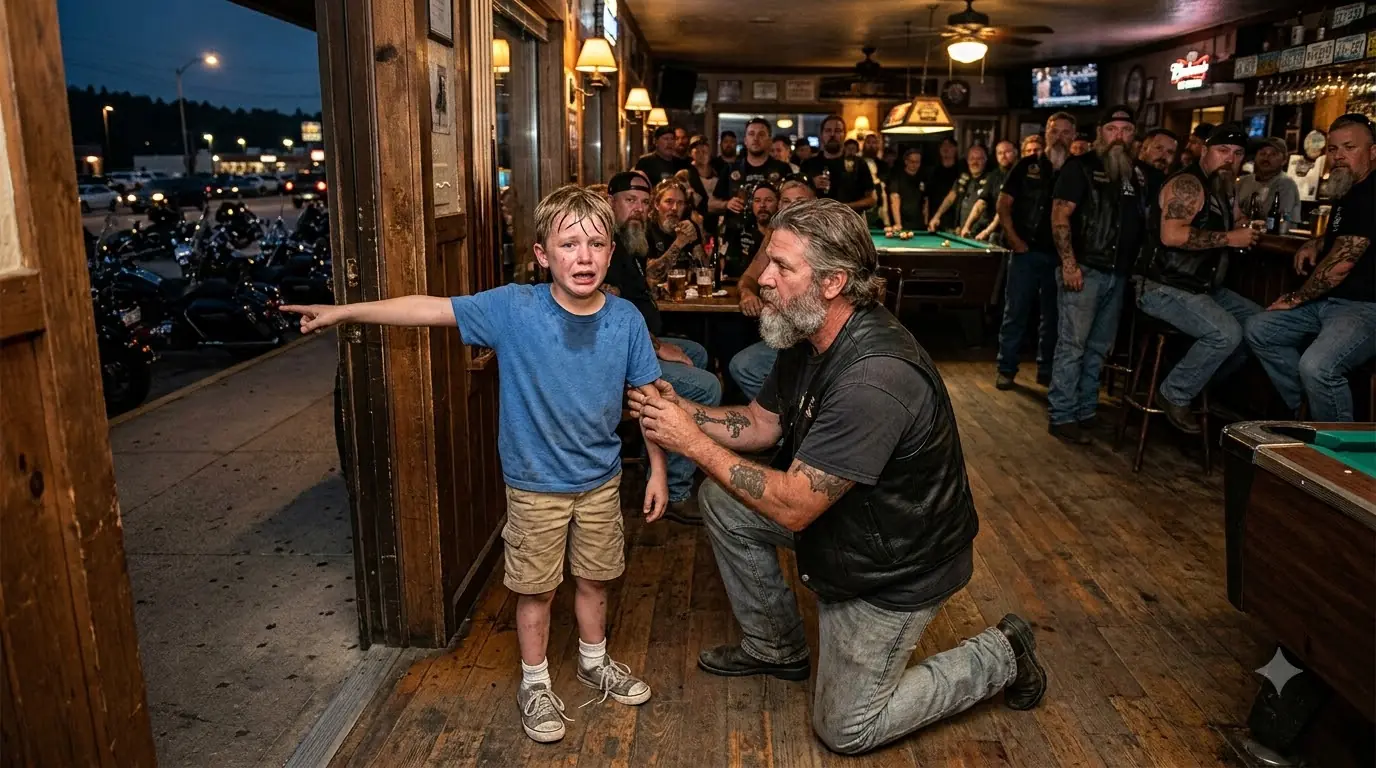
Leather-clad men and women with tattooed arms and weathered faces filled the room. They were the kind of people many parents warned their children to avoid.
The music stopped.
The pool cues became still.
Then the boy opened his mouth and screamed a single word that changed everything.
What happened next was something no one in that bar, or in the town of Sturgis, would ever forget.
The rumble came first.
Before anyone saw the leather, smelled the exhaust, or noticed the endless river of chrome glinting beneath the August sun, they heard the rumble.
It rolled through the streets of Sturgis, South Dakota, like distant thunder that never stopped. It was a low, constant vibration that people felt in their chests before their ears could understand it.
Every window along Main Street trembled. Every glass on every bar top moved in small circles.
If someone stood on the sidewalk and closed their eyes, they might have believed the earth itself was breathing.
Marcus Whitfield switched off the engine of his Harley-Davidson Road King and remained seated for a moment, allowing the silence to fill the space between his ears.
The silence never lasted.
Within seconds, the noise of the Black Hills Rally surrounded him again. Motorcycle engines growled past, someone played Southern rock from a stereo three blocks away, and laughter erupted from a group of riders entering the parking lot beside him.
Marcus swung one leg over the saddle and stood. He rolled his shoulders and felt the familiar cracking of joints that had endured too many years and too many miles.
He was fifty-two years old, and he had spent thirty of those years riding.
Marcus could still remember the first time his father placed him on a motorcycle.
It had been an old Honda CB350 in the backyard of their home in Rapid City. The grass was wet with morning dew, and Marcus’s mother watched from the kitchen window with an expression that was half fear and half pride.
His father placed both hands on his shoulders while the engine purred between Marcus’s knees like a living creature.
That was the moment Marcus Whitfield understood that some things in life took hold of a person and never released them.
He removed his gloves and tucked them into his belt.
Then he reached into the inner pocket of his leather vest and touched the photograph he carried there.
Marcus did not take it out.
He did not need to.
He knew every detail of that photograph by heart.
A little boy with sandy-colored hair and a gap-toothed smile sat on the front steps of a house that no longer existed. He held a toy fire truck between both hands.
Danny.
Six years old forever.
Marcus closed his eyes for exactly three seconds.
Then he opened them, tightened his jaw, and walked toward the Thunder Road Saloon.
The bar was already packed from wall to wall.
Six hundred riders, perhaps more, had crowded into a space designed for two hundred people on a generous night.
The Iron Brotherhood Motorcycle Club had traveled from fourteen states for the rally. They had also brought friends, members of several other clubs who shared the same roads and the same understanding of respect.
The air inside was thick with the smell of grilled burgers, spilled drinks, and leather that had been baking beneath the sun all day.
A jukebox in one corner fought a losing battle against six hundred simultaneous conversations.
Tommy Hargrove stood behind the bar, his thick forearms working the drink taps as though he had been born there.
In a way, he had.
His father opened the Thunder Road in 1971, and Tommy had worked behind the bar since he was tall enough to reach the handles.
He saw Marcus enter and raised one hand.
“Whitfield. I thought you were coming yesterday.”
“I took the long way,” Marcus said as he settled onto the only empty stool at the end of the bar. “Through the Needles.”
Tommy placed a glass in front of him without asking.
“Bobby’s in the back. Reed is somewhere around here. The whole crew has been waiting for you to make the toast.”
Marcus took a slow drink and looked across the crowd.
He recognized most of the faces.
Some belonged to people he had ridden beside for twenty years. Others were younger riders whose new patches remained stiff and bright against their vests.
They all shared something.
A code.
A bond.
A way of looking at the world that said a person did not abandon a brother on the side of the road.
When someone needed help, they did not turn away.
They showed up.
Bobby Crawford emerged from the back room.
His red beard was braided and hung over his chest like a Viking ornament. His arms were broad enough to block a doorway.
He wrapped Marcus in an embrace that would have crushed a smaller man.
“About time, brother.”
“I’m here now.”
Six hundred miles east of Sturgis, eight hours earlier, a ten-year-old Honda Civic with Ohio license plates pulled away from a gas station in Sioux Falls.
A woman and a young boy sat inside.
The vehicle pointed west toward a life they had not yet built, running on fumes, faith, and very little else.
A thin metallic whine had appeared sometime during the previous day.
The temperature gauge had been moving steadily upward for the last fifty miles. The air-conditioning system stopped working somewhere near Mitchell.
Sweat ran along Sarah’s temples and collected at the hollow of her throat.
In the back seat, Wyatt Callahan turned a page of his Superman comic.
It was the same comic he had been reading since they left Ohio. The cover had become soft from repeated handling, and a strip of tape held one side together.
“Mom, are we almost there?”
Sarah met his eyes through the rearview mirror.
They were green like his father’s eyes, but they did not contain the same hardness.
Wyatt’s eyes still held wonder.
Sarah wanted to preserve that for as long as possible.
“Almost, baby,” she said, forcing a smile with muscles she had nearly forgotten how to use. “Almost.”
The insulin pump clipped to her waistband sounded its third warning of the day.
Sarah pressed a button to silence it and continued driving.
She had not planned to pass through Sturgis.
The navigation system directed her north along Interstate 90, a straight route from Sioux Falls to Billings, Montana.
A one-bedroom apartment waited there with her name on the lease. She was scheduled to begin work at a veterinary clinic on Monday morning.
Eight hundred miles.
Fourteen hours if she did not stop.
She believed she could reach Billings by dawn.
Three months earlier, she had been Sarah Mitchell, living in a three-bedroom house in Columbus, Ohio.
She had been married to a man who gradually stopped coming home before midnight.
One April morning, he sat across from her at the kitchen table and told her that he no longer loved her.
He delivered the statement in the same flat voice he used when discussing the weather.
The divorce moved quickly.
He kept the house.
Sarah kept Wyatt, the Honda Civic, and a settlement check that was already half gone.
Her father, David Callahan, was a retired mail carrier with a bad knee and a heart made of solid oak.
Before Sarah left Ohio, he filled her trunk with emergency supplies.
A gallon of water.
Road flares.
A flashlight.
A first-aid kit.
He also gave her a handwritten card.
“Call me every night. I mean it.”
David stood in the driveway and waved until Sarah turned the corner.
She watched through the rearview mirror as he finally allowed himself to cry.
The Honda had different plans for their journey.
The first serious sign of trouble appeared sixty miles east of Rapid City.
The temperature gauge reached the red zone, and the engine began knocking like someone pounding on a door they desperately wanted opened.
The South Dakota landscape extended flat and golden in every direction.
It was the kind of emptiness that made a person feel very small and completely alone.
Sarah pulled onto the shoulder and opened the hood.
A column of steam rose from the radiator cap.
She stared at it with the exhausted resignation of a woman who had spent the previous two years learning that things broke and that she had no choice except to deal with them.
“Is the car sick?” Wyatt asked from the back seat.
His face was pressed against the window, and the Superman comic remained open on his lap.
“Just thirsty,” Sarah said.
She retrieved the gallon of water from the trunk and poured it into the radiator.
Then she waited fifteen minutes for the engine to cool before returning to the road.
The temperature gauge stabilized.
The knocking faded.
Sarah allowed herself one small breath of relief.
The relief lasted forty-three minutes.
The gauge began climbing again just as the signs for Sturgis appeared.
This time, the overheating brought additional problems.
There was a grinding sound from deep inside the engine, the smell of burning rubber, and a sudden violent shudder that pulled the steering wheel in Sarah’s hands.
She gasped and fought the vehicle toward the shoulder.
The engine coughed twice and stopped.
Silence followed.
It was the kind of silence that appeared after something important had ended and the world had not yet determined what would happen next.
The last light of the August evening drained from the sky beyond the windows.
The plains turned the color of bruised copper.
Somewhere to the west, the distant glow of Sturgis pulsed against the horizon.
“Mom?” Wyatt asked quietly.
“It’s all right, sweetheart. We only need to rest for a minute.”
It was not all right.
Sarah knew it.
She could feel it inside her body.
The dizziness that had hovered at the edge of her vision throughout the day had intensified. Cold sweat covered her skin even though the car was hot.
Her hands trembled against the steering wheel.
Her blood glucose level was dropping.
The insulin pump had malfunctioned that morning.
Sarah noticed the error code while Wyatt brushed his teeth at a motel in Sioux Falls. She manually adjusted the dosage, attempting to estimate the correction the way her endocrinologist had taught her.
Something had gone wrong.
Too much insulin.
Not enough food.
Sarah had been so focused on covering the miles, reaching Billings before the money disappeared, and staying ahead of her fear that she skipped lunch entirely.
Now her body was demanding payment.
She searched her purse for the glucose tablets she normally carried.
Her fingers felt thick and uncoordinated, as though they belonged to someone else.
The purse fell from the passenger seat.
Its contents scattered across the floor.
Her wallet.
Telephone.
Lip balm.
Loose coins.
There were no glucose tablets.
Sarah had used the last ones two hundred miles earlier.
She intended to purchase more, but Wyatt needed to use the restroom at the last stop, and she forgot.
She had simply forgotten.
The world tilted.
Sarah gripped the steering wheel and pressed her forehead against her knuckles.
She breathed heavily.
Her heartbeat pounded inside her ears, too fast, like a drum losing its rhythm.
“Mom, are you okay? Mom?”
Wyatt removed his seat belt and climbed between the front seats.
He moved with the urgent agility of an eight-year-old who had learned to interpret his mother’s silences.
He knew the difference between tired silence and frightened silence.
With a certainty no child should have possessed, he recognized that this was the second kind.
“Wyatt.”
Sarah’s voice sounded distant, as though she were speaking from the bottom of a well.
“Listen to me. Mama needs you to be brave.”
“I’m brave,” he answered immediately.
His chin trembled, but his eyes remained steady.
“My sugar is low. Do you remember what that means?”
Wyatt nodded.
They had practiced this.
Sarah made certain of it.
She sat with him at their kitchen table in Columbus and reviewed the steps like a fire drill.
She drew small pictures so he would remember.
If Mama becomes confused.
If Mama cannot speak properly.
If Mama falls asleep and will not wake up.
Wyatt had been completely serious that day. His small face tightened with concentration as he repeated every step until he memorized them.
Sarah hated every moment of that lesson.
She hated that her son needed to know how to save her life.
She taught him because the alternative was worse.
“I need something sweet,” she said. “Juice, candy, soda, anything.”
The words were becoming difficult to organize.
They kept moving away from their proper places.
“There are lights ahead. Can you see them?”
Wyatt pressed his face near the windshield.
Approximately a quarter mile away, through the gathering darkness, lights blazed against the sky.
Neon signs.
Parking-lot lamps.
The glow of a building that was open and filled with people.
“I see them.”
“Run there. Tell them Mama needs help. Can you do that?”
“Yes.”
“Wyatt.”
Sarah caught his wrist.
Her grip was weak, but her eyes held his with everything she had left.
“I love you more than all the stars.”
“I love you more than all the dinosaurs,” he whispered.
It was their private contest.
Two years earlier, Wyatt could not sleep, so Sarah held him in the darkness.
They tried to out-love each other using impossible numbers until they both started laughing.
Sarah’s hand slipped from his wrist.
Her eyelids fluttered closed.
Her head dropped against the headrest.
Her breathing became shallow and wrong.
“Mom? Mom!”
There was no answer.
Only the ticking of the cooling engine and the distant, impossible rumble of six hundred motorcycles.
Wyatt Callahan opened the car door, stepped onto the gravel shoulder, and ran.
He ran the way children run when the world suddenly becomes a place where terrible things happen.
He used everything he had.
His arms pumped.
His untied sneakers struck the pavement.
His breathing came in broken gasps made from equal parts air and sobs.
The distance between the car and the lights was approximately a quarter mile.
To an eight-year-old boy whose mother lay unconscious behind him, it might as well have been the distance between Earth and the moon.
The lights grew brighter as he approached.
The rumbling became louder.
When the parking lot of the Thunder Road Saloon came into view, Wyatt slowed for one terrible moment.
He almost stopped.
There were motorcycles everywhere.
Hundreds of them stood in rows that disappeared around the sides of the building. Chrome and black metal gleamed beneath the floodlights like sleeping animals.
Then Wyatt saw the people.
They were the largest people he had ever seen.
Men and women stood in groups wearing leather vests and bandannas. Tattoos covered their arms and climbed along their necks.
Some sat on tailgates. Others leaned against motorcycles with the casual confidence of people who owned the night.
Music pounded from inside the saloon.
Wyatt felt the heavy bass through his teeth.
Somewhere nearby, someone shouted and began laughing.
The sound was deep and rough, completely unlike the laughter of the adults Wyatt knew.
Every instinct inside his small body told him to turn around.
These were the kind of people his grandmother had warned him about.
Strangers.
Rough-looking men.
People a child should cross the street to avoid.
Behind him, his mother was dying inside a broken vehicle on the side of the highway.
Wyatt wiped his nose with the back of his hand.
He closed his fists and entered the parking lot.
Nobody noticed him.
He was small enough to move between groups like a shadow, slipping through spaces an adult could not have entered.
The front entrance of the Thunder Road was a massive wooden door with iron handles.
It had been propped open to allow the August heat to escape.
Light and noise poured through the opening.
Wyatt stepped inside.
The volume struck him first.
Six hundred voices collided in a wave of sound that made his ears ring.
The bar extended farther than he could see and was packed with bodies.
Leather.
Beards.
Bandannas.
Arms nearly as large as his entire body.
Old license plates and neon signs hung from the low ceiling.
The air was thick with heat, sound, and the smell of hundreds of meals.
Wyatt felt as though he needed to push through something solid simply to remain standing.
Nobody saw him.
He was invisible.
A small boy wearing a faded Superman shirt stood inside a place where no child had any reason to be.
At the far end of the bar, Marcus Whitfield stood on a stage with a microphone in his hand.
He was delivering the annual rally toast.
It was the same speech he gave each year about loyalty, brotherhood, and showing up when it mattered.
Bobby Crawford stood beside him.
Reed Collins and two dozen officers from motorcycle clubs across the country stood nearby.
The crowd had become as quiet as six hundred people could become.
It was not completely silent, but there was a quality of attention in the room.
They were listening.
Marcus was in the middle of a sentence when he saw the boy.
Later, he would try to explain what made him stop speaking.
It was not simply the sight of a child.
Children wandered into the rally from time to time, usually following parents who should have known better.
It was the way this boy stood.
Alone.
Shaking.
Tears had carved clean paths through the dust on his cheeks.
His chest heaved as though he had been running for his life.
His sneakers were untied.
His fists were clenched so tightly that his knuckles had turned white.
Marcus stopped talking.
The microphone filled the room with empty humming.
People turned and followed his gaze toward the door.
Then Wyatt opened his mouth.
The word came out somewhere between a scream and a prayer.
It cut through the room and silenced every conversation, laugh, and clinking glass.
It was one word.
One syllable.
It carried every ounce of terror, desperation, and love that an eight-year-old boy could hold inside his body.
“Help!”
The silence afterward lasted exactly two seconds.
During those two seconds, six hundred people understood what they were seeing.
A child.
Alone.
Terrified.
Begging.
Six hundred people reached the same decision at the same time.
Marcus Whitfield lowered the microphone.
Bobby Crawford pushed his chair back.
Tommy Hargrove stopped polishing a glass.
Reed Collins removed his reading glasses and placed them carefully on the table.
Jake Brennan had been leaning against the far wall with a soda in his hand.
He never drank alcohol.
He had seen what alcohol did to men inside field hospitals and wanted no part of it.
Jake was already moving toward the door.
Then, like an ocean responding to the pull of the moon, everyone inside the Thunder Road Saloon rose.
The sound was something Wyatt would remember for the rest of his life.
Six hundred chairs scraped across the floor.
Leather and denim shifted.
Heavy boots struck the wooden boards.
It sounded like an army mobilizing.
It happened within a single heartbeat.
Marcus reached Wyatt first.
He did not tower over the boy as he towered over most people.
Instead, Marcus lowered himself onto one knee until they were face to face.
He spoke in a voice that was low, steady, and as solid as the earth beneath them.
“Where?”
Wyatt pointed toward the highway.
His hand shook so violently that he could barely keep it raised.
“My mom,” he gasped. “She won’t wake up. She won’t wake up.”
Marcus looked toward Jake.
One glance was enough.
Jake nodded and disappeared through the crowd.
His hand was already reaching for the medical kit strapped to the back of his motorcycle.
It was a habit from his years as a combat medic with the 82nd Airborne.
He continued carrying the kit because no one knew when the skills that kept soldiers alive in a war zone might save someone on a highway in South Dakota.
Marcus placed one hand on Wyatt’s shoulder.
It was an enormous hand, rough with calluses and scarred by years of fighting fires and repairing engines.
In that moment, it was the gentlest thing in the world.
“We’ve got you, son,” Marcus said. “Show us the way.”
Wyatt rode on Marcus’s shoulders through the parking lot.
One hand gripped the collar of Marcus’s leather vest.
The other pointed into the darkness.
Behind them, the Thunder Road emptied as though a dam had broken.
Six hundred riders moved into the night.
The people who had been waiting outside saw the movement and immediately understood that something was happening.
Nobody asked what.
They joined the current.
Jake Brennan reached the Honda Civic first.
He ran at full speed, the medical kit striking his back.
The vehicle’s hazard lights flashed in the darkness like a weak orange heartbeat.
By the time Jake reached the driver’s door, he was wearing medical gloves.
His mind entered the cold and focused place where training replaced fear.
Sarah Callahan was slumped against the steering wheel.
Her skin was gray and wet with perspiration.
Her breathing was shallow, perhaps eight breaths per minute or fewer.
Her pulse was rapid and weak.
Her body was attempting to compensate as it began to shut down.
Jake saw the insulin pump attached to her waistband.
Then he noticed the medical-alert bracelet around her left wrist.
He checked her pupils.
They were dilated and responded slowly.
He pressed the back of his hand against her forehead.
Her skin was cold and damp despite the August heat.
Severe hypoglycemia.
Sarah’s brain was running out of fuel.
The internal clock inside Jake’s mind had started the moment he saw her.
They had minutes, not hours.
Marcus arrived with Wyatt still on his shoulders.
He lowered the boy gently and kept one hand against his back.
“Is she…” Wyatt began.
“She’s alive,” Jake said firmly. “She is going to stay alive. Everyone give me room.”
The crowd separated.
Six hundred people who had been moving forward now stepped back with the discipline to allow the one person with medical training to work.
The enormous leather-clad crowd became completely silent.
Jake removed emergency glucose medication from his medical kit.
He carried essential first-aid supplies everywhere, another habit from his years as a combat medic.
He administered the emergency treatment with steady hands.
Then he checked his watch and waited for Sarah’s body to respond.
“What’s happening?” Wyatt whispered.
Marcus pulled him close.
The boy pressed himself against the larger man’s side and watched Jake work with eyes that looked too old for his face.
“The medicine is helping your mother’s body produce the sugar it needs,” Marcus explained quietly. “Jake was a medic in the Army. He’s very good at this.”
“She forgot her candy,” Wyatt said.
His voice broke.
“She always has candy when the beeping starts, but she forgot. I should have reminded her.”
“Hey.”
Marcus knelt and turned Wyatt toward him.
“This is not your fault. You ran for help. You found us.”
He looked directly into the boy’s eyes.
“That is the bravest thing I have ever seen anyone do.”
“She needs a hospital,” Jake called.
His voice carried through the silence with the authority of someone who had made similar decisions in far worse places.
Sarah’s breathing had become steadier.
A faint trace of color returned to her cheeks.
She was not out of danger.
A severe glucose emergency could create additional complications.
She needed intravenous treatment, continuous monitoring, and professional care.
“The nearest emergency room is Sturgis Regional,” Jake said. “Twenty minutes by car.”
“We’ll do it in ten,” Bobby Crawford replied.
Within thirty seconds, Bobby accomplished something no emergency dispatcher could have coordinated as quickly.
He organized six hundred motorcycles into an escort formation.
Tommy Hargrove reversed his pickup truck beside the Honda.
Four men moved Sarah as carefully as though she were made of glass and placed her across the back seat.
Jake climbed in beside her and continued monitoring her condition.
Wyatt entered from the other side and took his mother’s hand.
He pressed it against his cheek.
“I’m here, Mom,” he whispered. “I’m right here.”
Tommy started the truck and entered the highway.
Then the world changed.
Six hundred motorcycles came to life at once.
The sound was not thunder.
Thunder was random and chaotic.
This was deliberate.
Six hundred engines spoke with one voice.
That voice said, “Move.”
The motorcycles formed two columns around the pickup truck.
Headlights blazed.
Running lights cut through the darkness like a river of fire.
Bobby took the lead on his Harley Street Glide and cleared the road ahead.
A Meade County sheriff’s deputy sat inside his cruiser near the edge of town.
He saw the convoy approaching and reached for his radio.
Then he paused.
He recognized the formation.
Tight.
Fast.
Purposeful.
An emergency.
The deputy activated his lights and moved into the lead.
They covered twenty miles in eleven minutes.
Tommy’s truck maintained its speed while the motorcycle escort held formation through turns and straight roads.
The riders formed a wall of chrome and light that separated traffic like water moving around the bow of a ship.
Drivers pulled onto the shoulder.
People stood on porches and watched the river of headlights pass with open mouths.
They did not understand exactly what they were seeing.
They somehow knew it mattered.
The emergency team at Sturgis Regional Medical Center was waiting.
The deputy had contacted the hospital from the road.
Jake jumped from the truck and delivered his report in the direct language of someone who had done this too many times to waste words.
“Female, thirty-four, Type 1 diabetic. Severe hypoglycemic episode. Emergency medication administered twelve minutes ago. Responsive but not conscious. Pulse one-ten. Respirations fourteen.”
The hospital staff placed Sarah on a stretcher and moved her through the doors in less than a minute.
Wyatt tried to follow.
A nurse gently placed one hand on his shoulder.
“Are you her son, sweetheart?”
He nodded.
“She’s going to be all right. Is there someone I can call for you?”
“I’m with him.”
Wyatt pointed toward Marcus Whitfield.
Marcus stood inside the entrance, his face drawn with concern for a woman he had never met and a boy he had known for less than thirty minutes.
Marcus met the nurse’s eyes.
“I’ve got him.”
She hesitated.
Then she noticed how Wyatt pressed himself against Marcus’s side.
She saw the way Marcus’s hand rested on the child’s shoulder with the unconscious tenderness of a man who had once held a child of his own.
“The family waiting room is down the hall,” she said. “I’ll find you as soon as there is news.”
In the parking lot, six hundred motorcycles cooled beneath the fluorescent lights.
Their engines ticked in the darkness.
Six hundred riders stood in small groups and spoke quietly while they waited for news about a woman whose name most of them did not know.
That was what they did.
They showed up.
They did not leave.
They waited.
Sarah Callahan opened her eyes beneath a ceiling she did not recognize.
A familiar beeping sound came from somewhere beside her.
Hospital.
The antiseptic smell.
The thin blanket.
The institutional hum.
She had experienced this before.
Not inside that hospital, but inside that moment.
It was the slow return from the darkness that came when her blood sugar dropped too low and the world folded inward.
Sarah turned her head.
Wyatt was asleep in a chair beside the bed.
His legs were curled beneath him.
Dust covered the faded Superman shirt.
A leather vest three sizes too large had been draped over his shoulders like armor.
An Iron Brotherhood patch covered the back.
It showed an iron fist holding a wrench, surrounded by three words.
Loyalty.
Brotherhood.
Road.
Sarah touched her son’s hair.
Her hand trembled beneath a gratitude too large for the human body to contain.
Wyatt’s eyes opened immediately.
“Mom.”
He entered her arms before she could answer.
The sobs he had held inside for hours finally escaped.
“I’m here, baby,” Sarah whispered. “I’m right here.”
“You wouldn’t wake up. I tried and tried, but you wouldn’t wake up.”
“But you found help.”
She pulled back and studied his tear-streaked, exhausted face.
“You saved me, Wyatt.”
“No,” a voice said from the doorway. “He saved all of us.”
Marcus Whitfield stood there holding two cups of hospital coffee.
He looked as though he had aged ten years during the night.
He had spent four hours in the hallway making telephone calls.
He arranged for Sarah’s Honda to be towed to the only mechanic in Sturgis willing to inspect it during rally weekend.
While he made the arrangements, Bobby Crawford organized a collection among the riders.
Six hundred people emptied their pockets.
They passed hats through the parking lot.
The envelope became so thick that Tommy Hargrove needed a rubber band to hold it closed.
Marcus placed the coffee on the bedside table.
Sarah looked at the enormous stranger wearing leather and tattoos.
She was beginning to understand that he was one of the reasons she remained alive.
“You’re Marcus.”
Wyatt had already told her everything in one breathless account.
Running through the darkness.
Entering the crowded bar.
The large man with the gray beard who carried him on his shoulders.
“Yes, ma’am.”
“They told me your friend Jake saved my life.”
“Jake did what Jake always does.”
Marcus nodded toward Wyatt.
“But that boy set everything in motion. He entered a room filled with strangers who could frighten a grown man, and he asked for help.”
He looked at Wyatt with quiet respect.
“That takes something no one can teach.”
Sarah’s eyes filled with tears.
For a moment, the three of them existed inside a silence that was full rather than empty.
It was the kind of silence that appeared when words were not large enough.
Marcus cleared his throat.
“Your car needs a new radiator and a water pump. Hank at the garage says it will be ready Thursday.”
He removed a hotel key card from his pocket.
“My wife, Donna, booked a room for you at the Holiday Inn. It is paid through the weekend.”
“I can’t accept that.”
“You can, and you will.”
“That isn’t charity, Mom,” Wyatt said. “It’s family.”
“We only just met.”
Marcus smiled.
The expression transformed his face.
The hard lines softened, and warmth entered his blue eyes.
For one instant, he looked like a man who remembered what it felt like to be whole.
“There are six hundred brothers and sisters waiting in that parking lot,” Marcus said. “They rode through the darkness to bring you here.”
He moved closer to the bed.
“Most of them do not know your name. None of them will leave until they hear you are safe.”
He removed the thick envelope.
“This came from the club. Use it for the car, the hospital, or whatever you need.”
Marcus sat in the chair on the opposite side of the bed.
“I had a son,” he said quietly. “Danny.”
Sarah listened.
“He was six when a driver crossed the center line on Highway 79 and took him from us.”
Marcus clasped his enormous, scarred hands together so tightly that his knuckles became white.
“After that, I wanted to disappear. Donna held on to me. The club held on.”
He lowered his eyes.
“They carried me until I could stand again.”
Marcus looked at Wyatt.
The child listened with the solemn attention children gave to stories they understood were important.
“When your son entered that bar last night, every man and woman in the room saw the same thing.”
He paused.
“A child who needed someone.”
Marcus continued.
“The thing people outside those clubs do not understand is that nearly everyone in that room became a rider because, at some point in life, they needed someone too.”
His voice became quieter.
“And someone showed up.”
Sarah reached across the bed and took Marcus’s hand.
He did not pull away.
On Thursday, the mechanic delivered the Honda Civic.
It had a new radiator.
A new water pump.
Four new tires that nobody had requested but everyone agreed were necessary.
The repair bill was zero.
On Friday morning, Sarah loaded the final bags into the trunk.
Wyatt wore a new black T-shirt.
Donna had taken him shopping and told him to choose anything he wanted.
He selected the kind of shirt the riders wore.
Donna laughed, hugged him, and declared that he had been born for the road.
The Holiday Inn parking lot was filled with motorcycles.
Not with hotel guests.
Six hundred bikes formed two columns stretching from the entrance to the highway.
Every member of the Iron Brotherhood was there.
Riders from several other clubs had heard what happened and wanted to join the farewell.
Marcus stood beside the driver’s door.
“How can I ever thank you for this?” Sarah asked.
“You don’t.”
Marcus looked toward the riders.
“You pass it forward. Someday, someone will need you to show up. You will remember this, and you will do it.”
He knelt beside the passenger window.
Then he placed something into Wyatt’s hand.
It was a small iron pin shaped like a fist holding a wrench.
The emblem of the Brotherhood.
“You’re one of us now, Wyatt Callahan. An honorary member.”
Marcus closed the boy’s fingers around the pin.
“Wherever you go, six hundred people have your back.”
Wyatt held the pin against his chest.
His lower lip trembled, but he did not cry.
“Thank you, Mr. Whitfield.”
“Marcus,” the larger man corrected. “Family does not use last names.”
Sarah turned the ignition.
The engine came to life with a healthy, even sound.
She drove toward the highway.
The motorcycles moved behind her.
Six hundred engines.
Six hundred headlights.
A river of chrome and thunder extended farther than she could see through the rearview mirror.
The riders escorted them for ten miles, all the way to the edge of Meade County.
The Black Hills gradually became smaller in the distance.
One by one, the riders separated from the convoy and raised a hand in farewell.
Bobby.
Tommy.
Reed.
Jake flashed his headlight twice.
It was a medic’s goodbye.
Stay healthy.
Marcus remained beside them until the end.
He rode alongside the Civic for another quarter mile.
The Road King moved at a gentle pace.
Through the open window, Sarah could see his face.
Calm.
Steady.
Filled with something that looked like peace.
Marcus raised one hand.
Sarah raised hers.
Then he slowed and turned the motorcycle in a wide arc across the empty highway.
He headed back toward Sturgis.
Wyatt twisted around in the passenger seat and looked through the rear window.
The single headlight became smaller.
It gradually turned into a point of light indistinguishable from the first stars appearing in the South Dakota sky.
Wyatt held the iron pin against his heart.
He waved.
Far behind them, too distant to see but close enough to feel, Marcus Whitfield raised his hand one final time.
Then the road curved.
The light disappeared.
The world became quiet.
But it was not empty.
It would never be empty again.