Nine-year-old Elena Ruiz stood beneath the harsh fluorescent lights of Brightway Market with a newborn baby pressed against her chest. Her voice was barely louder than the hum of the freezer cases behind her, but somehow the words reached every person near the customer service counter. The baby in her arms was wrapped in a faded gray blanket, her tiny face red from crying, her little fists opening and closing weakly against Elena’s torn jacket. Elena’s hair was tangled, her shoes were worn through at the toes, and her hands shook as she tried to keep the baby warm.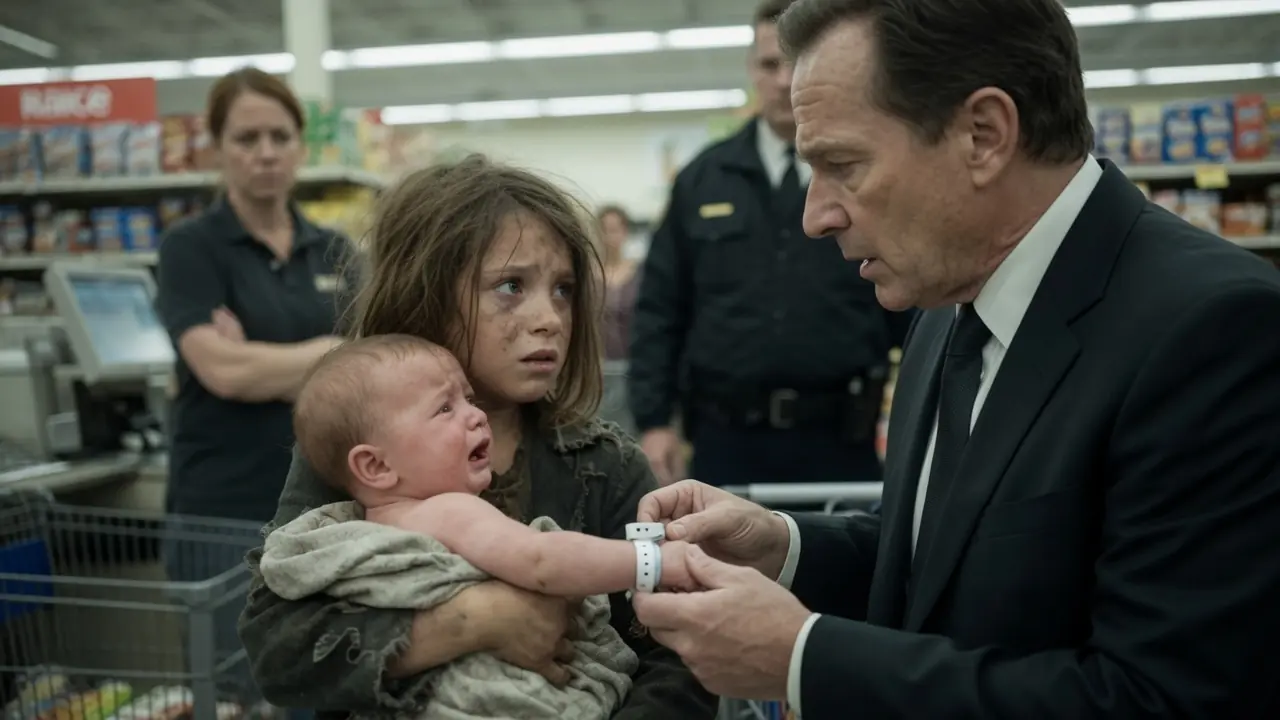
The cashier stared at her across the counter, unsure whether to be afraid, suspicious, or sorry. Around them, carts slowed, conversations faded, and shoppers turned their heads toward the little girl who looked too young to be carrying anything heavier than a schoolbag. Elena swallowed hard and lifted the baby slightly, as if proof of hunger could make adults kinder. “She hasn’t eaten since yesterday,” she whispered. “I’m not asking for money. Just formula.”
A woman in a camel coat stepped forward from the checkout line and let out a cold laugh. “This is obviously a scam,” she said loudly enough for everyone to hear. “They use babies now because people feel guilty faster.” She looked toward the cashier with sharp impatience. “Call security before she starts crying and everyone opens their wallet.”
Elena’s cheeks flushed, but she did not step back. She had been called many things in the past two days: runaway, thief, liar, street kid. Each word hurt, but none of them mattered as much as the baby’s soft, desperate cry against her chest. She rocked her gently and whispered, “I know, I know, I’m trying.”
The cashier reached for the phone but hesitated. “Where are your parents?” she asked.
Elena looked down at the floor. “My mama told me to protect her.”
“That is not an answer,” the woman in the camel coat snapped. “Where is your mother?”
Elena’s eyes filled with tears. “She went quiet.”
The words silenced the people nearest to her, but only for a second. Some looked away, uncomfortable with the weight of the sentence. Others exchanged doubtful glances, as if sadness itself might be a trick. A security guard began walking toward the counter from the front entrance, one hand resting near his radio.
Elena saw him coming and tightened her arms around the baby. “Please don’t take her,” she said, panic rising in her voice. “I just need milk. I’ll leave after. I promise I’ll leave.”
The baby cried harder then, a thin, tired cry that seemed too small for the large, bright supermarket. Elena tried to shield her face from the staring crowd, turning her body slightly so the baby’s blanket stayed closed. She had not come to steal. She had not come to trick anyone. She had walked four miles in the cold because her mother had always said supermarkets had rules, but mothers had hearts.
The security guard stopped in front of her. “Miss, I need you to step away from the counter.”
Elena shook her head quickly. “No, sir. Please. She needs milk.”
“You can’t stand here disturbing customers.”
“I’m not disturbing them,” Elena said, her voice breaking. “She’s hungry.”
The woman in the camel coat folded her arms. “Exactly. Disturbing everyone.”
Before the guard could answer, the automatic doors opened again. A tall man in a dark tailored suit entered with two assistants behind him, bringing a gust of cold air into the market. He moved like someone used to being recognized without trying, his expression tired but controlled, his black coat hanging perfectly from his shoulders. Several customers turned, and the whisper traveled quickly through the front lanes.
Alejandro Montes.
Even people who did not follow business news knew his name. He owned real estate groups, shipping companies, and medical technology firms across three countries. Months earlier, every major newspaper had covered the tragedy that destroyed his family: his newborn daughter had vanished from a private hospital only hours after birth. The search had lasted weeks, then months, until most people stopped believing she would ever be found.
Alejandro had never stopped.
He had come into Brightway Market only because his driver had pulled over to take an urgent call, and Alejandro had noticed the store’s charity collection box near the entrance. In another life, he might have walked in, made a donation, and left without seeing anyone. But then the baby cried. The sound cut through him so sharply that he stopped mid-step.
His assistants almost walked into him.
“Sir?” one asked.
Alejandro did not answer. His eyes moved toward the customer service counter, toward the small girl in torn clothes, toward the bundle shaking in her arms. Something inside him shifted before thought could explain it. He had heard many babies cry since his daughter disappeared, but this cry reached a place grief had kept raw.
The baby’s blanket slipped as Elena turned away from the security guard. Only for a second, the child’s tiny wrist came into view. Around it was a hospital identification bracelet, loose now on the baby’s small arm, the plastic faded and slightly bent. Alejandro saw it and stopped breathing.
He stepped closer.
Elena saw him coming and backed away. “Please,” she whispered. “Don’t take her.”
Alejandro lifted both hands slowly, showing he meant no harm. His face had gone pale, and his voice came out low. “Where did you get that baby?”
The question sounded like an accusation, and Elena’s fear sharpened. She clutched the baby so tightly that the infant whimpered. “My mama told me to protect her,” she cried. “She said a rich man was looking for her, but bad people didn’t want him to find her.”
Alejandro’s assistant covered her mouth. The cashier froze behind the counter. The security guard lowered his hand from the radio, suddenly uncertain. Alejandro’s eyes stayed fixed on the bracelet.
“May I see her wrist?” he asked.
Elena shook her head, tears spilling down her dirty cheeks. “No. People keep trying to take her.”
“I won’t take her from you,” Alejandro said. “I just need to see.”
The woman in the camel coat scoffed, but her voice was smaller now. “Mr. Montes, you shouldn’t believe this. She could have stolen that bracelet from anywhere.”
Alejandro did not even look at her. “Be quiet.”
The woman’s face flushed.
Alejandro crouched in front of Elena, expensive suit and all, lowering himself until his eyes were level with hers. The entire front of the supermarket stood motionless around them. “What is your name?” he asked gently.
“Elena Ruiz.”
“Elena, I have been searching for my daughter for months.” His voice trembled on the last word. “If that bracelet says what I think it says, this baby may be mine.”
Elena stared at him, breathing fast. “My mama said you had kind eyes in the newspaper picture.”
Alejandro’s own eyes filled. “Your mother saw my picture?”
“She kept it folded in her apron,” Elena said. “She said if she couldn’t find you, I had to.”
Slowly, with shaking fingers, Elena adjusted the blanket enough for the bracelet to show. Alejandro leaned closer. The faded letters were worn, but still readable.
Baby Montes — Room 304.
For a moment, Alejandro made no sound. His hand reached toward the bracelet but stopped before touching it, as if he feared the child might vanish if he moved too quickly. His face crumpled with a grief so deep that even the shoppers who had judged Elena minutes earlier looked away in shame. “Sofia,” he whispered.
The baby cried again, and Alejandro flinched as if the sound had pulled him back into his body. “She needs a doctor,” he said. “And formula now.”
The cashier snapped out of her shock and turned toward the aisle. “I’ll get it.”
Alejandro’s assistant moved faster. “I’ll get formula, water, diapers, blankets, everything.”
The security guard stepped aside, suddenly looking at Elena as if she were no longer a disturbance, but a child standing at the center of something enormous. The woman in the camel coat said nothing. Her face had lost its arrogance.
Elena looked around at the adults now rushing to help and seemed more frightened, not less. She stepped backward until her shoulder touched the counter. “You won’t separate us?”
Alejandro looked at her, confused through tears. “Separate?”
“My mama said not to let bad people separate us,” Elena said. “She said if I gave the baby to the wrong person, I might never see her again.”
Alejandro swallowed hard. He wanted to hold his daughter more than he wanted air, but the girl in front of him had carried Sofia when no one else did. He forced himself to keep his hands at his sides. “You can stay with her,” he said. “No one takes her from you unless a doctor needs to help her. And even then, you stay close.”
Elena searched his face for lies. She was nine, but her eyes had lived through more than most adults in that store. “Promise?”
“I promise.”
Formula arrived, then bottled water, then clean cloths. The cashier warmed the bottle under the store’s café tap while Alejandro’s assistant called emergency medical services, Alejandro’s private security, and the police investigator who had handled the original case. The store manager hurried over, apologizing too loudly, but Alejandro ignored him until the bottle was ready.
Elena tried to feed Sofia herself, but her hands shook too badly. Alejandro watched with agony in his face. “May I help you hold the bottle?” he asked.
Elena nodded after a long pause.
He did not take the baby. He only sat on the floor beside the customer service counter, holding the bottle while Elena kept Sofia in her arms. The newborn latched desperately, drinking with tiny urgent pulls that made everyone nearby fall silent. Elena’s tears fell onto the blanket, but she did not wipe them away.
“She was so hungry,” Elena whispered.
Alejandro’s voice broke. “You kept her alive.”
Elena shook her head. “Mama did. I just listened.”
“What happened to your mother?”
Elena looked toward the automatic doors as if expecting someone to walk in. “She was sick. She said she couldn’t go to a hospital because the people who took the baby might find us.” Her small voice became thinner. “She told me if she didn’t wake up, I had to take Sofia to the man in the newspaper.”
Alejandro closed his eyes, fighting the horror of what the child had carried alone. “Where is she?”
“In the room behind the laundromat,” Elena said. “The blue door. We stayed there because the owner let Mama clean at night.”
The assistant relayed everything into the phone. The security guard took a step back, rubbing his face with one hand. The woman in the camel coat looked like she wanted to disappear between the checkout lanes.
When the paramedics arrived, Elena nearly panicked. She clutched Sofia and shouted, “No, no, please!” until Alejandro crouched beside her again. He kept his voice soft, steady, and painfully gentle.
“Elena, they need to check her breathing and make sure she is safe,” he said. “You are coming with us. I will not leave you here.”
The paramedic, a woman named Grace, lowered herself to Elena’s level. “You can sit right beside her,” she said. “You can hold her hand while we check her. No one is angry with you.”
Elena looked at Sofia, who had stopped crying and was drinking more slowly now. The baby’s eyes were half-closed, exhausted but calmer. Finally, Elena nodded.
The paramedics placed Sofia on a small blanket across a stretcher, but Elena stayed close, one hand touching the baby’s foot. Alejandro stood beside them, still staring at the bracelet as if it were both miracle and accusation. His missing daughter had been in the world all this time, hungry and hidden, while he had searched through investigators, hospitals, tips, and lies.
Before they left, Alejandro turned toward the store. His eyes swept over the cashier, the security guard, the shoppers, and the woman in the camel coat. “This child walked in asking for milk,” he said, his voice quiet but carrying through the lanes. “Most of you gave her suspicion before anyone gave her food.”
No one answered.
He looked at the cashier. “You hesitated, but you did not send her away. Thank you.”
The cashier began to cry.
Then Alejandro looked at the woman in the camel coat. “And you called her a scam.”
The woman opened her mouth. “I didn’t know—”
“No,” Alejandro said. “You didn’t care to know.”
The paramedics rolled Sofia toward the doors. Elena walked beside them, holding the edge of the blanket. Alejandro followed, and the automatic doors opened into the cold evening.
At the hospital, the world became bright lights and urgent voices. Sofia was examined immediately, given fluids carefully, warmed, and fed again under medical supervision. Elena refused to leave the room until a nurse promised she could sit where she could see the baby. Even then, she perched on the edge of a chair, ready to spring up if anyone moved Sofia too far.
Alejandro made calls from the hallway with a voice that scared everyone who heard it. The lead detective arrived within an hour. Hospital administrators came next, pale and nervous when they saw the bracelet. Legal counsel, child welfare, and Alejandro’s family physician followed. But through all the movement, Alejandro kept returning to Elena.
She sat with her knees tucked under her, wrapped in a hospital blanket, staring at Sofia through the glass. Someone had given her clean socks, but she had not eaten more than two crackers. When Alejandro approached with a tray, she looked up sharply.
“I don’t want to leave her.”
“You don’t have to,” he said. “But you need food too.”
“I’m not hungry.”
“You are.”
She looked away.
Alejandro sat beside her, placing the tray between them. “Your mother trusted you with my daughter,” he said. “Now I need you to trust me with one thing.”
“What?”
“That Sofia needs you strong.”
Elena looked at the sandwich, then back through the glass. “Mama used to say that.”
“What was your mother’s name?”
“Rosa Ruiz.”
Alejandro repeated it softly, as if committing it to memory in a sacred place. “Rosa Ruiz saved my child.”
Elena’s face twisted. “She wanted to bring Sofia back. She tried. But she said someone was watching the hospital people, and then we had to keep moving.”
The detective stepped closer but did not interrupt. Alejandro noticed and nodded for him to wait. Elena’s story could not be forced out like a report. It had to be protected as carefully as Sofia had been.
“What did your mother tell you?” Alejandro asked.
Elena picked at the edge of the blanket. “Mama cleaned at the hospital sometimes. Not the rooms with babies usually, but that night someone paid her to take a bag to the service exit. She thought it was laundry. Then she heard crying.”
Alejandro went still.
“She opened it,” Elena whispered. “The baby was inside.”
The detective closed his eyes briefly.
Elena continued, “Mama ran. She didn’t know who to trust because the woman who gave her the bag wore a hospital badge. Mama said if she took Sofia back to the same people, they might hide her again.”
Alejandro’s hands tightened into fists, but he kept his voice gentle. “Did your mother know my name then?”
“No. Only later, from the news. She saw you on TV begging for your baby.” Elena wiped her cheek with the blanket. “She cried so hard that night. She said, ‘That man loves her.’”
Alejandro covered his mouth with one hand.
“But when Mama tried calling the tip number, someone came to our apartment the next day,” Elena said. “A man in a black car. He told her she was confused and should forget what she saw. After that, we left.”
The detective finally spoke softly. “Elena, do you remember anything about the man?”
She nodded. “He had a gold ring with a bird on it.”
Alejandro turned toward the detective. “The hospital foundation seal.”
The detective’s expression darkened. “We need to reopen the internal suspect list.”
Alejandro looked through the glass at Sofia. His daughter slept now, tiny and fragile, her wrist still wearing the bracelet that had survived everything people tried to erase. “Reopen everything.”
By midnight, officers had gone to the room behind the laundromat. Rosa Ruiz was found there, too weak to stand but alive. She was taken to the hospital under emergency care, feverish, dehydrated, and barely conscious. When Elena was told her mother was alive, she collapsed against Alejandro’s side and sobbed until her whole body shook.
Alejandro held her carefully, not as a father claiming her, but as a man honoring the child who had carried his miracle through hunger. “She’s alive,” he kept saying. “She’s alive, Elena. You did it.”
Rosa woke the next afternoon.
The first thing she asked was, “The baby?”
Alejandro was sitting beside her hospital bed. He stood slowly when her eyes opened, and for a moment Rosa looked terrified. Then she saw Elena sleeping in a chair near the wall, and some of the fear left her.
“She’s safe,” Alejandro said. “My daughter is safe.”
Rosa began to cry. “I tried to bring her back.”
“I know.”
“I didn’t steal her.”
“I know.”
“They told me nobody would believe me.”
Alejandro’s voice broke. “I believe you.”
Rosa turned her face into the pillow and wept with the exhaustion of a woman who had been running from a crime she did not commit. Alejandro stood beside her, unable to find words large enough for what she had done. Money had bought investigators, media attention, private security, and endless searches. But it was Rosa Ruiz, a cleaning woman with no power, who had found his daughter and protected her when the powerful system failed.
DNA confirmation came two days later.
Sofia Montes was Alejandro’s missing daughter.
The hospital wing erupted into tears, calls, and controlled chaos. Alejandro’s assistants cried openly. The detective stood in the hallway with his head bowed. Elena sat beside Sofia’s crib, watching everyone react as if she had known all along what they were still struggling to believe.
Alejandro entered quietly and found her touching Sofia’s tiny hand through the crib rail. “She’s really yours?” Elena asked.
“Yes.”
Elena nodded, but her face fell.
Alejandro understood immediately. “That does not mean you disappear from her life.”
Elena looked up. “People say that.”
“I am not people.”
“My mama said rich people forget poor people after they get what they want.”
Alejandro sat beside her. “Your mother had good reason to think that.”
Elena looked back at Sofia. “Will she remember me?”
“She will know you,” Alejandro said. “If your mother allows it, and if you want it, you and Rosa will always be part of her life.”
Elena searched his face. “Why?”
“Because you were her first protector.”
Those words changed something in Elena. Her eyes filled, but she did not cry this time. She looked at Sofia and whispered, “I told you I’d find him.”
The investigation that followed shook the private hospital and everyone connected to the night Sofia disappeared. A nurse had falsified access records. A donor with connections to the hospital foundation had arranged the handoff. The motive was tangled in custody pressure, inheritance disputes, and a private adoption scheme meant to disappear behind false paperwork before anyone could trace it. Rosa’s unexpected discovery had ruined the plan, but fear and influence had kept her silent and running.
Alejandro did not allow the story to become another headline about his grief alone. At the press conference, he stood with the detective and his attorney, but he refused to give details that would expose Elena or Rosa to public judgment. He said only that his daughter had been protected by “a mother with more courage than the people who were paid to protect children” and “a little girl who carried responsibility no child should have had to carry.”
Reporters shouted questions.
Alejandro answered one.
“Mr. Montes, what do you want people to learn from this?”
He looked into the cameras. “That a hungry child asking for milk should never have to prove she is telling the truth before someone helps her.”
At Brightway Market, the footage from the front registers eventually leaked. The video showed Elena pleading, shoppers judging, the woman in the camel coat calling her a scammer, and Alejandro seeing the bracelet. Public reaction was immediate and fierce. Some people praised Alejandro, but more people focused on Elena’s first words.
Please… she just needs milk.
The cashier, whose name was Denise Palmer, visited the hospital with permission. She brought a stuffed bear for Elena and a handwritten apology. She cried while reading it, admitting that she had almost let fear of store policy override basic kindness. Elena listened quietly, then said, “You got the milk.”
Denise cried harder.
The woman in the camel coat sent flowers. Elena refused them. Rosa, recovering slowly, told Alejandro to donate them to the hospital chapel, because beauty from shame should be placed somewhere humble. Alejandro did.
Weeks passed before Rosa was well enough to leave the hospital. Alejandro arranged housing for her and Elena near his estate, but Rosa refused anything that felt like payment for returning Sofia. “I did what any mother should do,” she said.
Alejandro answered, “Then let me do what any father should do.”
They found a compromise. Rosa accepted a safe apartment, medical care, legal protection, and a job later through a foundation program, but only after Alejandro agreed that it would all be documented transparently, not hidden like charity. Elena started school again with a counselor’s help and a backpack full of supplies she guarded like treasure.
Sofia came home to Alejandro’s estate on a rainy morning.
The nursery had remained untouched since the day she disappeared. For months, Alejandro had walked past the door without opening it, unable to face the crib, the blankets, the mobile, the tiny clothes waiting for a child everyone told him might never return. Now he carried Sofia inside slowly, as if crossing into a place built from both grief and miracle.
Elena stood in the doorway with Rosa beside her.
Alejandro turned. “Come in.”
Elena hesitated. “It’s her room.”
“Yes,” he said. “And she would want her sister here.”
Rosa looked at him, startled. “Sister?”
Alejandro smiled through tears. “Maybe not by blood. But some bonds are earned before paperwork learns their name.”
Elena stepped into the nursery and looked around with wide eyes. She touched the edge of the crib, then the mobile hanging above it. “She has stars.”
“She has everything,” Alejandro said. “Except the months I lost.”
Rosa’s voice softened. “You didn’t lose all of them. We saved what we could.”
Alejandro looked at her. “You saved her life.”
Rosa shook her head. “Elena did too.”
Elena looked down, embarrassed.
Sofia stirred in Alejandro’s arms. Elena instinctively moved closer and whispered the same soft sound she had used in the supermarket. The baby calmed. Alejandro watched with a full heart and a breaking one. His daughter knew the voice of the child who had carried her through the worst days of her little life.
From then on, Elena visited often.
At first, she stayed close to Rosa, unsure of the polished floors, quiet staff, and rooms larger than any apartment she had known. Alejandro made sure no one treated her like a guest who should be impressed. He asked what she wanted to eat, where she felt comfortable sitting, what Sofia liked when she cried, and which songs Rosa had sung. Slowly, Elena began to believe she was not being tolerated. She was being welcomed.
One afternoon, Alejandro found her in the garden holding Sofia while a nanny stood nearby. Elena was telling the baby about the supermarket, though she changed the scary parts. “And then I said you needed milk,” she whispered, “and then your papa came like in a movie, except he was crying.”
Alejandro laughed softly from behind her.
Elena turned bright red. “I didn’t know you were there.”
“I was enjoying the honest version.”
“You did cry.”
“I did.”
“You looked scared.”
“I was.”
“Because of the bracelet?”
He sat beside her on the bench. “Because I realized hope can hurt when it comes back too fast.”
Elena thought about that. “I was scared you’d take her and forget us.”
Alejandro looked at Sofia, then at Elena. “I was scared you would think I was just another adult taking something.”
“You didn’t.”
“I tried not to.”
Elena looked down at the baby. “She likes you.”
“I hope so. I’m her father.”
“She didn’t know that at first.”
“No,” Alejandro said. “But love can learn.”
Months later, the first birthday Alejandro had missed was honored privately. Not a public gala, not a media event, not a billionaire’s display of gratitude. Just Alejandro, Sofia, Rosa, Elena, a few trusted friends, and a small cake with one candle. Elena helped Sofia touch the frosting and laughed when the baby smeared it across her own face.
Alejandro watched from across the table.
For the first time since the hospital nightmare began, he did not feel like he was standing at the edge of losing something. He felt inside a life again. Changed, wounded, imperfect, but alive.
After cake, he gave Elena a small silver bracelet. Not expensive in a flashy way, but engraved on the inside with four words.
Sofia’s first protector.
Elena read it and stared at him. “This is for me?”
“Yes.”
“Why?”
“Because one day, when people tell this story, they may talk about me recognizing a bracelet,” Alejandro said. “But I want you to remember the truth. Sofia was found because you walked into a store and asked for milk when every adult had already failed her.”
Elena’s eyes filled. She threw her arms around him so suddenly that he almost lost his balance. Alejandro held her carefully, looking over her shoulder at Rosa, who was crying quietly with one hand over her mouth.
The criminal case took more than a year. There were hearings, testimony, evidence reviews, and painful questions. Rosa spoke bravely. Elena only spoke through trained child advocates, because Alejandro refused to let the system turn her trauma into spectacle. The hospital changed ownership, several employees faced charges, and the private foundation donor at the center of the scheme lost the protection he had once assumed money could buy.
Alejandro attended every hearing.
Not because he needed to be seen, but because Sofia could not remember what happened to her, and someone had to stand for her until she could carry her own story. Rosa attended when her health allowed. Elena attended only once, by choice, wearing the silver bracelet under her sleeve.
Afterward, she asked Alejandro, “Are bad people always punished?”
He looked at the courthouse steps for a long moment. “Not always.”
Elena frowned.
“But truth makes it harder for them to hide,” he said. “And brave people make truth louder.”
She touched the bracelet. “Mama was brave.”
“Yes.”
“I was scared.”
“That does not mean you were not brave.”
She nodded slowly, as if storing the answer for later.
Years would pass before Sofia understood the story of how she came home. She would know it first through small pieces: Elena’s bracelet, Rosa’s gentle hands, her father’s quiet tears whenever supermarket formula drives appeared on television. Later, she would learn more. The hospital. The bracelet. The little girl who walked under fluorescent lights and asked strangers for milk.
Alejandro kept the original hospital bracelet in a glass case in his study, not as a trophy, but as a witness. Beside it, he kept a photograph of Elena holding Sofia in the hospital after the DNA confirmation. Elena looked exhausted, frightened, and fiercely protective. Sofia slept peacefully in her arms.
Visitors often asked about the bracelet.
Alejandro always answered carefully.
“This brought my daughter back to me,” he would say. “But Elena kept her alive long enough for me to read it.”
The supermarket changed too. Brightway Market created a policy that any child asking for food or baby supplies would be assisted first and questioned safely afterward. Denise Palmer became the manager of a new community response program funded quietly by Alejandro’s foundation. A small sign was placed near the customer service counter.
If a child asks for food, help first.
The woman in the camel coat never came back to that store. Some said she was ashamed. Others said she moved. Elena did not care. She had learned that some apologies arrive too late to be useful, and some people only regret cruelty after it becomes public.
On the anniversary of the day Sofia was found, Alejandro did not host a press event. Instead, he brought Rosa, Elena, and Sofia back to Brightway Market before opening hours. The store was quiet, the lights softer than Elena remembered, the checkout lanes empty. She stood near the customer service counter and looked at the place where she had begged for milk.
Sofia, now a chubby toddler, reached for Elena’s hand.
Elena smiled down at her. “This is where your papa found us.”
Sofia babbled something serious and unintelligible.
Alejandro stood beside them. “This is where you found me too.”
Elena looked up. “You weren’t lost.”
He smiled sadly. “I was.”
Rosa placed a hand on his shoulder. “We all were, a little.”
Denise came from behind the counter carrying a small basket: formula, baby food, bread, fruit, diapers, and a note. She handed it to Elena. “First basket for the new emergency shelf,” she said. “Would you like to place it?”
Elena looked at the basket, then at the shelves near the front of the store. She carried it carefully, Sofia toddling beside her. Alejandro watched as the girl who had once been accused of scamming the store placed food where another desperate child might one day find help faster than she had.
When she returned, Alejandro said, “You changed this place.”
Elena shook her head. “Sofia did.”
Rosa smiled. “Both of you did.”
That evening, they gathered at Alejandro’s home for dinner. Not in the formal dining room, but in the warm kitchen, where Sofia could drop food on the floor without anyone panicking. Elena helped feed her pasta, and Rosa corrected Alejandro’s seasoning with the confidence of a woman no longer afraid of powerful rooms. It felt almost ordinary, which made Alejandro grateful in a way luxury never had.
After dinner, Elena stood by Sofia’s crib while the baby fell asleep. “She won’t remember being hungry,” Elena said.
Alejandro stood in the doorway. “No.”
“Good.”
“She will remember being loved.”
Elena looked at the sleeping child. “That’s better.”
“Yes,” Alejandro said. “Much better.”
As years passed, the story became larger than any of them. Newspapers wrote about the missing baby found in a supermarket. Documentaries called it a miracle of instinct and courage. People used Alejandro’s name because power always attracts attention, but in every interview he gave, he brought the story back to a girl with worn shoes and a crying baby.
He would say, “Elena Ruiz was nine years old, and she understood responsibility better than the adults around her.”
He would say, “Rosa Ruiz risked everything because she knew a child belonged to someone who loved her.”
And he would always finish with the same lesson: “Do not wait to know someone’s importance before showing mercy.”
Elena grew taller. Sofia grew louder. Rosa grew stronger. Alejandro grew softer in ways he never apologized for.
The day Sofia turned five, she ran through the garden with a paper crown on her head and cake on her dress. Elena, now a teenager, chased after her, laughing. Alejandro watched them from the patio, the hospital bracelet memory folded into his heart beside gratitude and grief.
Sofia stopped suddenly and ran back to him. “Papa,” she said, breathless, “Elena says I cried in a store.”
Alejandro picked her up. “You did.”
“Was I loud?”
“Very.”
Sofia looked delighted. “Good.”
Alejandro laughed. “Why good?”
“Because then you found me.”
He held her close, looking over her shoulder at Elena, who smiled from the garden path. “Yes,” he whispered. “Because then I found you.”
But he knew the deeper truth.
He found Sofia because a tired little girl refused to let hunger, fear, judgment, and cold stop her from keeping a promise. He found his daughter because Elena walked into a supermarket where no one wanted to believe her and still said the only words that mattered.
Please… she just needs milk.
And after that day, no one who heard the story ever forgot that sometimes the smallest voice in the room is carrying the truth everyone else is too proud to see.