Lily Harper was so small that the white plastic bag dragging behind her looked almost too heavy for her hand. It scraped along the cracked alley pavement, catching on broken glass, bottle caps, and wet yellow leaves that had blown in from the street. Against her chest, baby Noah slept inside a sling made from an old blue T-shirt, his tiny cheek pressed beneath her chin. Every few steps, Lily stopped to adjust him, because the knot behind her neck hurt, and because she was terrified that if she loosened her arms even once, the world would take him from her.
The alley behind the boarded-up corner store in Columbus, Ohio, smelled like rainwater, spoiled food, and cold metal. Lily’s bare feet were red at the toes, scratched from concrete and stiff from the November air. Her hair, once bright blonde and brushed by gentle hands, now hung in tangled strands around her face. She had not cried that morning because crying made Noah wake, and Noah waking meant hunger, and hunger meant she had to find more cans.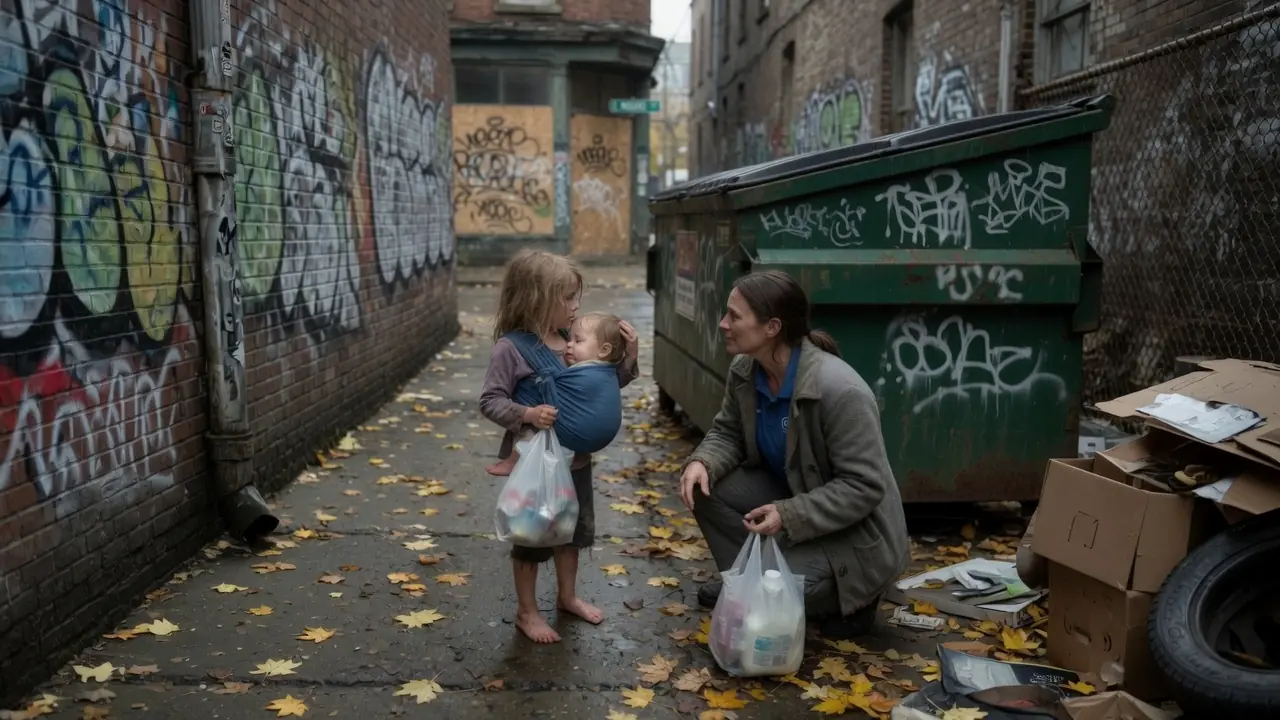
She knew which cans were worth keeping because her mother had shown her before everything went quiet. Soda cans went in the bag, soup cans did not. Beer cans sometimes smelled bad, but the man at the recycling place took them if she rinsed them enough. Lily did not understand money exactly, but she understood that enough cans could become dollars, and dollars could become the special baby milk in the white can with the blue lid.
Noah shifted against her, making a tiny sound that was almost a cry. Lily froze beside the green dumpster and tucked the gray blanket closer around his head. “Shh,” she whispered, pressing her cheek to his soft hair. “I’m getting it, No-No. I promise. I’m getting your milk.”
At the mouth of the alley, Clara Bennett almost walked past without seeing them. She had just finished a double shift at Dalton Fresh Market and was carrying a small bag with diapers, a loaf of discount bread, and a carton of milk for her own son, Lucas. Her feet ached inside old work shoes, her cashier vest was folded over one arm, and her mind was already on bills waiting at the kitchen table. Then she heard the thin scrape of plastic over concrete and turned her head.
At first, Clara thought she was seeing a child playing some strange game. Then Lily stepped into a patch of pale afternoon light, and Clara saw the baby tied to her chest. She saw the bare feet, the dirty gray shirt, the trembling arm holding the bag of cans. She saw Lily’s eyes lift, wide and frightened, not like a child caught being mischievous, but like someone expecting punishment before anyone had spoken.
Clara stopped slowly, careful not to startle her. “Hey, sweetheart,” she said softly. “Are you all right?”
Lily’s fingers tightened around the plastic bag until the handle stretched white between her knuckles. She took one step backward toward the dumpster, turning her body so Noah was farther from Clara. “I’m not stealing,” she said. Her voice was flat, rehearsed, as if she had said those words many times to people who had already decided not to believe her.
Clara felt something inside her chest twist. “I didn’t say you were.”
Lily looked past Clara toward the street, measuring whether she could run. But Noah was heavy against her small body, and the bag of cans caught behind her heel. She swallowed hard and lifted her chin with a kind of bravery that broke Clara’s heart. “I’m getting milk for him.”
Clara glanced at the baby, then back at Lily’s face. “What’s his name?”
“Noah,” Lily whispered.
“And yours?”
For a moment, Lily said nothing. Her eyes searched Clara’s coat, her bag, her hands, her face. Maybe she was looking for anger. Maybe she was looking for the kind of smile adults used before they lied. Finally, she said, “Lily.”
Clara crouched down on the pavement, keeping a few careful steps between them. The concrete was cold through her pants, but she ignored it. “Lily, where’s your grown-up?”
Lily’s mouth tightened. She looked down at Noah and placed one dirty hand over the blanket, as if the question itself had reached for him. “Mama went quiet,” she said.
The alley seemed to lose all sound at once. Clara heard traffic from the street, a distant horn, wind moving loose paper near the dumpster, but all of it felt far away. She had heard children say frightening things before, especially while volunteering at Lucas’s school pantry. But this was different, because Lily did not sound confused.
Clara kept her voice low. “What do you mean, honey?”
Lily’s eyes filled, but no tears fell. “She was coughing. Then she laid down. Then Noah cried, and I shook her, but she didn’t open her eyes.” She looked ashamed as she added, “I tried putting water on her face. She still didn’t wake.”
Clara pressed one hand against her own knee to steady herself. Every motherly instinct in her body screamed to rush forward, grab both children, and run for help. But Lily was already leaning away, her shoulders curved protectively around Noah. Clara knew fear when she saw it, and this little girl was afraid not only of hunger or cold, but of being separated from the baby she had decided was hers to protect.
“I need to help you,” Clara said.
Lily stepped back so quickly her heel struck the dumpster. “Please don’t take him.”
The words came out cracked and desperate. Noah stirred from the sudden movement, his tiny face wrinkling before settling again against Lily’s chest. Lily bent her head over him, breathing hard, as if Clara had already pulled him from her arms. “Please,” she whispered. “He’s all I have left.”
Clara’s eyes burned. “I’m not here to take him, sweetheart. I need to help you.”
“That’s what grown-ups say,” Lily said, shaking her head. “Then they take babies away.”
Clara slowly set her grocery bag on the ground and opened both hands, palms up. “Then I won’t touch him. I won’t touch you either. I’ll stay right here, and we’ll talk.” Her voice trembled, but she held it together. “You don’t have to hand him to me. Just let me help get him warm.”
Lily looked at Clara’s empty hands. Something in her face wavered, but she did not move closer. “Mama said if I lost him, nobody would bring him back.”
“Then we won’t lose him,” Clara said. “Not tonight. Not while I’m standing here.”
For a few seconds, neither of them moved. Then Lily looked down at the plastic bag in her hand and seemed to remember something. She lowered it carefully, trying not to wake Noah, and dug between the cans with shaking fingers. Clara watched as Lily pulled out a folded piece of paper wrapped in a strip of blue cotton from the same shirt as the sling.
The paper was soft from being opened and closed too many times. Lily held it out, but when Clara reached slowly, Lily pulled back. “Mama said only give it to someone kind,” she whispered.
Clara nodded. “You can decide if I’m kind.”
Lily stared at her for a long time. Then her eyes dropped to Clara’s grocery bag, where the corner of a diaper package showed through the thin plastic. “You have a baby?”
“A little boy,” Clara said. “His name is Lucas. He’s six.”
Lily’s face changed slightly. Not trust, not yet, but recognition. “Does he cry for milk?”
“He used to,” Clara said. “When he was tiny, he cried so hard I thought my heart would break.”
Lily looked at Noah. “Noah cries quiet now.”
That scared Clara more than if Lily had said he screamed. She looked at the baby’s tiny mouth, the faint movement of his chest, the weak curl of his fingers. The cold air was not safe for him, and Lily’s body was too small to keep him warm much longer. Clara forced herself not to show panic.
“Can I read the note?” Clara asked.
Lily hesitated, then stretched out her hand. Clara took the folded paper gently, as if it might hurt the child if she moved too fast. The cotton strip fell into her palm first, faded blue and stretched from use. Then she opened the note beneath the dim alley light and read the first line.
Please don’t give my babies to my sister.
Clara stopped breathing for a moment. The handwriting was uneven, written in black ink that had blurred in places from moisture or tears. She glanced up at Lily, whose expression had gone still and watchful. Then Clara looked back at the paper and continued reading.
My name is Mara Harper. My daughter is Lily Harper, age five, and my son is Noah Harper, ten weeks old. If something happens to me, please do not call my sister Denise Mallory to take them. She hurt Lily before, and I ran because no one believed me. Please find Mrs. Helen Price at Grace Table Church, or anyone who will keep them safe together.
Clara read the final words twice. Keep them safe together. The sentence seemed to pulse on the page. Clara folded the note carefully, not because she was finished with it, but because Lily was watching her face as if Clara’s reaction would decide the rest of her life.
“Is Mama in there?” Clara asked gently.
Lily nodded toward the narrow blue door at the side of the boarded building. “Upstairs.”
“Has anyone else been there today?”
Lily shook her head. “I locked it with the chair.”
Clara looked at the door, then at the baby, then at Lily’s bare feet. She knew she needed emergency help. She also knew that if she pulled out her phone and made the wrong kind of call in the wrong tone, Lily might run deeper into the alley, with Noah tied to her chest and no strength left.
“Lily,” Clara said, “I’m going to call someone who helps sick people. Not someone to take Noah away. Sick people need doctors, and babies need warmth.” She placed a hand over the folded note. “And I’m going to tell them your mama wrote down who should not come.”
Lily’s lips trembled. “No sirens.”
“I’ll ask for quiet.”
“No loud people.”
“I’ll ask for quiet people.”
“No taking him.”
Clara nodded slowly. “No one takes him from your arms unless he needs a doctor to help him breathe, and even then, I will stand right there and tell them what your mama wrote.”
Lily looked like she wanted to believe her so badly it hurt. Clara took out her phone and called emergency services, keeping her voice steady and low. She gave the address, explained there was an unresponsive woman upstairs, two small children in the alley, a ten-week-old baby exposed to cold, and a written note warning against a specific relative. She asked for medical responders without sirens if possible.
While she spoke, Lily watched every movement of her mouth. Clara did not turn away. She wanted Lily to hear the truth in every word. When the dispatcher asked whether police were needed for safety, Clara said carefully, “There is no threat in front of me. There are children who are terrified. Please send medical help and child protective services trained for children.”
After hanging up, Clara removed her coat slowly. Lily stiffened again, but Clara held it out without stepping forward. “Can I lay this on the ground between us? You can pick it up yourself.”
Lily nodded once.
Clara placed the coat on the pavement and slid it gently forward. Lily stared at it as if it were a trap. Then Noah made another small sound, and Lily reached down awkwardly, pulling the coat around both of them with one hand while keeping the other arm under his body. The coat swallowed her tiny shoulders.
“Your feet are bleeding,” Clara said softly.
Lily looked down, surprised, as if she had forgotten feet could hurt. “They’re okay.”
“They’re brave feet,” Clara said. “But brave feet still need shoes.”
Lily’s eyes flicked toward the building. “My shoes are upstairs. Mama said don’t leave Noah near the stove. So I took him.”
“What happened to the stove?”
“No heat,” Lily said. “Just the oven sometimes. But Mama said not to touch it.”
Clara swallowed. “You did good listening.”
Lily’s face tightened with sudden pride and sorrow together. “I listened all day.”
Clara wanted to cry, but she did not. Lily did not need another adult falling apart in front of her. She needed someone to become solid ground.
“My apartment is two blocks from here,” Clara said. “My son Lucas is with Mrs. Alvarez right now. She watches him after school.” She paused. “After the helpers come, I’ll call Mrs. Alvarez and ask her to bring a blanket and some socks. Would that be okay?”
Lily looked confused. “Why?”
“Because you’re cold.”
Lily looked down at Noah. “He’s colder.”
“Then we’ll get him warm first.”
A faint sound came from inside the blue door. It was not a voice, just something settling in the old building. Lily turned quickly, panic flashing across her face. “Mama?”
Clara stood, but slowly. “Can you show me where she is?”
Lily’s eyes widened. “You won’t take Noah upstairs?”
“I’ll follow behind you,” Clara said. “You stay where you feel safe.”
The blue door opened with a groan when Lily pushed it with her shoulder. Inside, the stairwell smelled damp and stale, like wet clothes left in a bag too long. A single bulb burned weakly on the landing, showing peeling walls, a broken stroller, and paper plates stacked near the stairs. Clara’s stomach tightened at the thought of a mother trying to keep two children alive in such a place.
They climbed slowly. Lily moved sideways because of the baby, one hand on the wall, one arm around Noah. Clara stayed close enough to catch her if she slipped, but not close enough to frighten her. At the top of the stairs, a chair had been wedged beneath a door handle.
Lily pointed. “That’s our room.”
Clara moved the chair aside. The room beyond was small, cold, and gray with late afternoon light. A mattress lay on the floor under two thin blankets, and on it was a woman with pale skin, dry lips, and dark hair stuck to her forehead. One hand hung over the side, near an empty water bottle.
“Mama,” Lily whispered.
Clara crossed the room and knelt beside Mara Harper. She checked for breathing the way she had been taught in a basic first aid class years earlier. Mara was alive, but barely responsive, her breath shallow and rough. Clara closed her eyes for one brief second in relief, then opened them again because relief was not enough.
“She’s breathing,” Clara said.
Lily’s face crumpled. It was the first time Clara saw her look fully like a child. “She’s not dead?”
“No,” Clara said firmly. “She’s very sick, but she’s breathing.”
Lily sank to her knees with Noah still tied to her chest. The coat slipped around her shoulders, and her small body began to shake. “I tried waking her,” she cried. “I tried, I tried, I tried.”
Clara moved closer but still did not touch her without asking. “Lily, look at me. You kept Noah safe. You got help. You did more than any five-year-old should ever have to do.”
“I didn’t get the milk.”
“You got me.”
The words seemed to reach Lily in a place where fear had been standing alone all day. She pressed her face gently against Noah’s blanket and cried silently. Clara stayed near her, one hand ready, while sirens remained blessedly absent outside. Minutes later, footsteps sounded in the stairwell.
Two paramedics entered quietly, carrying bags instead of noise. Clara stood between them and Lily for the first second, not blocking them, but making sure Lily saw that she was still there. “This is Lily,” Clara said softly. “The baby is Noah. Their mother is Mara. Lily is afraid Noah will be taken from her.”
One paramedic, a woman named Teresa, lowered herself to Lily’s level. “Hi, Lily. I’m Teresa. I help babies and moms feel better.” She did not reach for Noah. She only opened her bag and pulled out a small warm blanket. “Can I wrap this around him while you hold him?”
Lily looked at Clara.
Clara nodded. “You can say yes or no.”
Lily whispered, “Yes.”
Teresa moved slowly, wrapping Noah while Lily kept both arms around him. The other paramedic checked Mara and began speaking in calm, clipped words into a radio. Clara caught phrases like severe dehydration, possible infection, altered mental status, transport priority. None of it sounded good, but it sounded like action, and action was better than quiet.
Soon, a child welfare worker arrived, a middle-aged woman with kind eyes and a worn leather bag. She introduced herself as Angela Morris and asked Clara for the note. Clara handed it over immediately. Angela read it without changing expression, but her jaw tightened when she saw Denise Mallory’s name.
“I’ll document this,” Angela said. “No decisions tonight will ignore this letter.”
Lily heard enough to panic. “No decisions?”
Angela turned toward her. “It means we listen to what your mama wrote.”
“You won’t call Aunt Denise?”
“Not tonight,” Angela said. “Not before we understand everything.”
Lily clutched Noah tighter. “She pinched me hard and locked me in the bathroom when Mama worked.”
Angela’s face softened with controlled sadness. “Thank you for telling me.”
Mara was carried out on a stretcher, barely conscious under a thermal blanket. As she passed Lily, her eyes opened a little. Lily tried to stand, stumbled, and Clara caught her lightly by the elbow before she fell. Mara’s cracked lips moved.
“My babies,” Mara whispered.
“They’re here,” Clara said, stepping close so Mara could see. “Lily kept Noah safe.”
Mara’s eyes filled with tears. “Don’t let Denise…”
“We have your note,” Clara said. “They know.”
Mara’s hand lifted weakly, reaching toward Lily. Lily pressed her fingers into her mother’s palm for one second before the paramedics had to move. “I did it, Mama,” Lily sobbed. “I gave the paper to someone kind.”
Mara looked at Clara. There was no time for a conversation, no time for gratitude, no time for explanations about how she had ended up in a boarded building with two children and no heat. But in that one look, Clara understood everything that needed to be understood. A mother had used the last strength she had to leave instructions for the only person brave enough to follow them.
At the hospital, everything moved in bright lights and quick footsteps. Clara rode with Angela and the children because Lily refused to enter any vehicle unless Clara came too. Noah was examined first, warmed, fed carefully with formula, and monitored for dehydration. Lily sat on a bed in the pediatric area wearing hospital socks too big for her feet, refusing to lie down until someone promised Noah was still in the same room.
Clara called Mrs. Alvarez, who arrived with Lucas, blankets, and the kind of angry tenderness older women carry when children have been failed. Lucas stood shyly beside Clara, staring at Lily. He had never seen a child look so tired. After a while, he walked over and placed his granola bar beside her hand without saying anything.
Lily looked at the granola bar, then at Lucas. “Is it for Noah?”
“He can’t eat that,” Lucas said gently. “It’s for you.”
Lily seemed unsure what to do with something meant only for her. Clara opened it halfway and handed it back. Lily took one tiny bite, then another, as if permission to be hungry had finally been given.
Hours later, a doctor told Angela and Clara that Mara had pneumonia, dehydration, and exhaustion, but she had arrived in time. The words in time made Clara sit down hard in the hallway chair. She thought of the alley, the bag of cans, Lily’s bleeding feet, and how close a mother’s quiet could have become permanent silence. Then she covered her face and finally let herself cry.
Angela sat beside her. “You did the right thing.”
Clara wiped her eyes. “Lily did the impossible thing. I just stopped walking.”
“Most people don’t stop.”
Clara looked through the glass where Lily slept sitting up, her head tilted against the bed rail, one hand resting on Noah’s blanket. “Then most people are wrong.”
By morning, Mara was awake enough to speak. Her voice was rough, and every sentence seemed to cost effort, but her eyes sharpened when she saw Lily and Noah safe. Angela sat beside the bed with paperwork, and Clara stood near the door, unsure whether she belonged in such a private moment. Mara asked her to stay.
“My sister can’t take them,” Mara said.
Angela nodded. “Your note is in the file. Lily also made a statement. We will investigate before any placement decision.”
Mara closed her eyes with relief. “I ran out of money. Then I got sick. I thought I could make it one more day.” She turned her head toward Clara. “That’s what poor mothers do. We think one more day will save us.”
Clara felt those words in her bones. She had lived on one more day many times. One more shift, one more bus ride, one more bill pushed to Friday, one more meal made from bread and eggs. She stepped closer.
“Lily said you told her to find someone kind,” Clara said.
Mara’s tears slipped sideways into her hair. “I was afraid she wouldn’t.”
“She did.”
Mara looked at Lily, who was half asleep in a chair, wrapped in Mrs. Alvarez’s blanket. “She shouldn’t have had to.”
“No,” Clara said. “But she did because she loves him.”
For the next two days, Clara visited whenever she could. She brought clean clothes from a donation closet Angela arranged, socks that fit Lily, and soft onesies for Noah. Lucas drew a picture of a blue sling with a giant heart around it, and Lily stared at it for a long time before asking if she could keep it. Clara taped it near Mara’s hospital bed.
Angela searched for Helen Price from Grace Table Church, the woman named in Mara’s note. Helen arrived the third day, breathless and tearful, carrying a Bible, a casserole dish, and a folder full of old messages from Mara asking for help. She had been out of town caring for her own sick brother and had not known Mara had lost phone service. When she saw Lily, she opened her arms, but she stopped herself before touching her.
“Do you remember me, baby?” Helen asked.
Lily nodded slowly. “You gave me purple shoes.”
“I still have another pair waiting.”
Lily’s face trembled. “Can Noah come too?”
Helen began to cry. “Both of you. Always both.”
Angela arranged an emergency kinship-style placement with Helen while Mara recovered, with Clara listed as a support contact at Mara’s request. Denise Mallory did show up at the hospital on the fourth day, loud, perfumed, and furious that no one had called her first. But Angela met her outside the room with documents, statements, and the note. Denise left threatening lawyers, but for the first time in a long time, her threats did not open any doors.
Mara improved slowly. She still had no home to return to, but the hospital social worker connected her with emergency housing for mothers and infants. Helen promised Lily and Noah could stay with her until Mara was stable, and Clara promised to help Mara get to appointments when her shifts allowed. None of it was simple, but simple had never been the same as safe.
A week after the alley, Lily walked into Clara’s apartment wearing purple shoes Helen had found in her closet. Noah slept in a real baby carrier against Helen’s chest, fed and warm. Lily stood near the doorway, looking around at Lucas’s toys, the small kitchen table, the thrift-store sofa, and the paper snowflakes taped to the window. She looked less like a ghost and more like a little girl who had survived a storm but still listened for thunder.
Lucas ran up to her holding two toy cars. “You can pick first.”
Lily looked at Clara for permission.
Clara smiled. “You can play.”
Lily chose the red car and sat on the rug. For a while, she and Lucas rolled cars back and forth without speaking. Then Lily looked up and said, “Miss Clara?”
“Yes, honey?”
“You didn’t take him.”
Clara’s throat tightened. “No.”
“You helped.”
“I told you I would.”
Lily nodded as if filing that away somewhere important. Then she went back to playing, but this time she laughed when Lucas crashed his car into a pillow. It was a small laugh, rusty from disuse, but it filled the apartment like sunlight.
Months later, Clara still thought about the blue sling. She thought about it when she saw mothers counting coupons in the grocery aisle, when Lucas complained about socks, when the November cold returned and leaves collected near dumpsters again. She kept Mara’s first thank-you note folded in a drawer, beside Lucas’s school pictures and the rent receipts she was proud to have paid on time. It reminded her that sometimes a life changes not because someone planned to become a hero, but because they noticed a child everyone else was too busy to see.
Mara eventually moved into a small apartment through a family housing program. She worked part-time at Grace Table Church, helping organize the same pantry that had once failed to reach her in time. Lily started kindergarten late but learned quickly, especially letters, because she wanted to write notes that helped people know the truth. Noah grew round-cheeked and loud, the kind of baby who cried with full confidence that someone would answer.
On Lily’s sixth birthday, Clara, Lucas, Mara, Helen, and half the church pantry volunteers gathered in a small community room with paper streamers and a grocery-store cake. Lily wore her purple shoes and a yellow dress, her hair brushed smooth and clipped back with two tiny flowers. Noah sat in Mara’s lap, waving a plastic spoon like a royal command. When everyone sang, Lily covered her ears at first, then smiled because the noise was happy.
After cake, Lily ran to Clara and handed her a folded piece of paper. Clara opened it carefully, remembering another folded note in another place. This one was written in large uneven letters with a drawing underneath. It said: Thank you for helping me keep Noah.
Clara bent down and hugged her only after Lily leaned forward first. “You were very brave,” Clara whispered.
Lily shook her head against Clara’s shoulder. “I was scared.”
“That’s what brave means sometimes.”
Across the room, Mara watched them with tears in her eyes. She knew Clara had not saved them alone. Doctors had helped, Angela had protected, Helen had opened her home, and Lily had carried more courage than any child should ever need. But Clara had been the first adult to kneel down in an alley and listen instead of assume.
That mattered.
Because the day Lily carried Noah through the cold, she did not need someone powerful. She did not need someone with a badge, a title, or a perfect plan. She needed someone who could see a dirty child beside a dumpster and understand that love can look like a blue T-shirt sling, bleeding feet, and a plastic bag full of cans.
Clara had almost walked past.
Instead, she stopped.
And because she stopped, a little girl kept her brother, a sick mother got another morning, and a folded note found the kind hands it had been waiting for.