Four hundred motorcycles lined up outside the courthouse, engines silent, every rider staring at the little girl on the steps.
Lily was seven years old, and she had not raised her arms above her shoulders in months.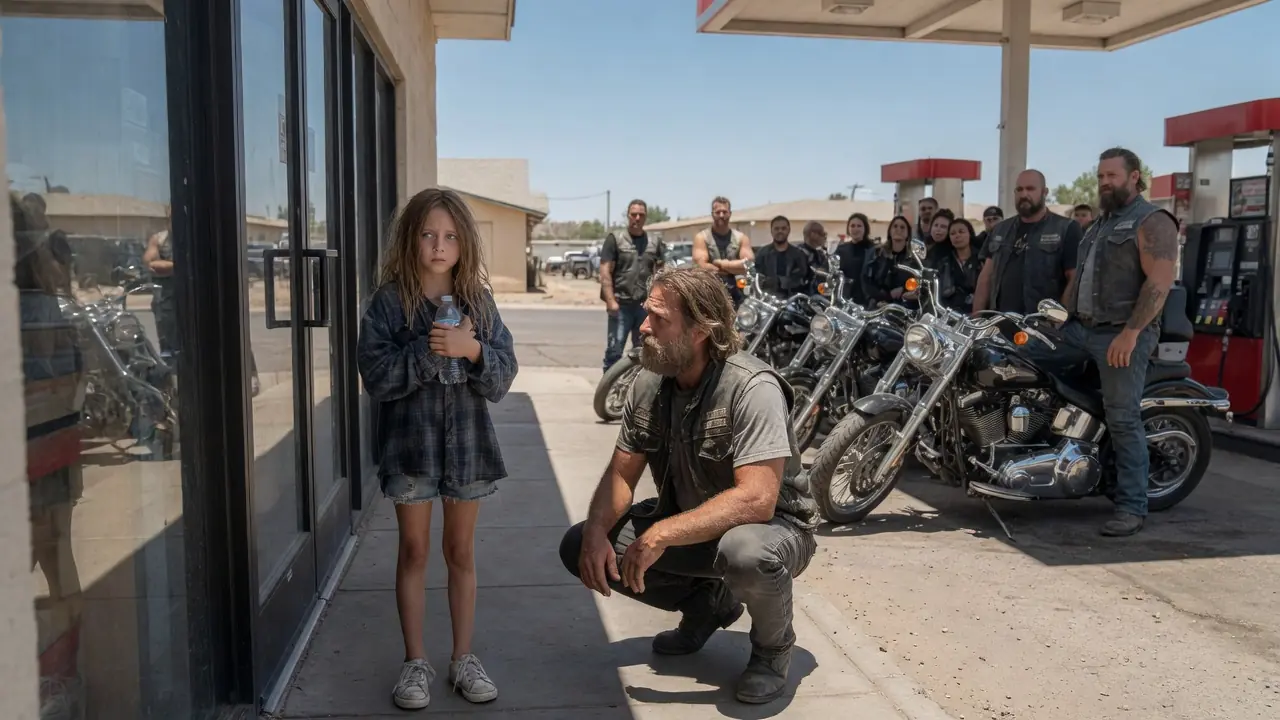
When a biker named Hank first met her at a gas station in Prescott, Arizona, she could not reach a water bottle on the second shelf. What he saw when she tried made his blood run cold.
He was not a cop. He was not a social worker. He was the last person anyone would expect to save a child’s life.
But what Hank Mercer did next brought more than four hundred riders to their knees and gave one little girl the thing she had never truly had.
A family.
The August heat in Prescott, Arizona, pressed down on the town like a hand pushing against a chest. It was the kind of dry, unforgiving warmth that turned asphalt into a shimmering mirror and made even the shade feel like punishment.
Hank Mercer pulled his Harley-Davidson Road King into the parking lot of the Bradshaw Junction gas station, the engine growling low before he silenced it with a flick of his wrist. He swung his leg over the seat and stood there for a moment, stretching his back, feeling every one of his forty-seven years in the stiffness of his spine.
His leather vest, black and worn soft at the edges, was covered in patches from twenty-three years of riding. The Desert Iron MC patch sat across his back like a declaration. President, the rocker beneath it read.
Not a title he had asked for.
One he had earned.
Hank walked toward the convenience store, his boots heavy on the concrete. The bell above the door chimed when he pushed it open, and the blast of air conditioning hit his face like cold water.
He pulled off his sunglasses, blinked against the fluorescent light, and headed for the coffee machine in the back.
That was when he saw her.
She was standing in front of the refrigerated section, a girl no older than seven, maybe younger. She was small. Too small, Hank thought, with light brown hair that hung past her shoulders in tangled strands.
She wore a long-sleeved flannel shirt buttoned to the wrists, which struck him as odd immediately.
It was 103 degrees outside.
Nobody in Prescott wore long sleeves in August unless they were hiding something.
The girl was reaching for a bottle of water on the second shelf. Her arm went up halfway, then stopped. She winced, just a flicker, barely visible, and her arm dropped back to her side.
She tried again with the other hand.
The same thing happened.
A small, involuntary gasp escaped her lips, and she pressed her arms against her body, hugging herself.
Hank stood still.
He had been watching for no more than five seconds, but something about those five seconds reached into his chest and squeezed.
He walked over carefully.
“Hey there,” he said, keeping his voice low and easy. “You need some help reaching that?”
The girl did not look up.
She took a small step backward, her shoulders curling inward like a flower closing at dusk. Her eyes stayed fixed on the floor.
“It’s all right,” Hank said.
He reached up and grabbed the water bottle, then crouched down so he was at her level. He held it out, keeping his hand steady.
“Here you go.”
She glanced up at him, and for a moment their eyes met.
Hers were pale blue, almost gray, and they carried something in them Hank recognized. Not fear exactly, though fear was part of it.
It was the look of someone who had learned to expect the worst from every hand that reached toward them.
She took the bottle with both hands, clutching it against her chest.
“Thank you,” she whispered.
Her voice was barely audible.
Hank nodded, then stood.
The girl hurried toward the counter where the cashier, a young man in his twenties, was scrolling through his phone.
“She yours?” the cashier asked Hank without looking up.
“She comes in sometimes,” the cashier said. “Lives a few streets over, I think. Always by herself.”
Hank watched through the window as the girl crossed the parking lot, the water bottle gripped against her small body like a shield. She walked carefully, deliberately, the way someone walks when every step costs them something.
He paid for his coffee and a pack of beef jerky, then stepped back into the heat.
He straddled his bike but did not start the engine.
He sat there holding the coffee, watching the spot where the girl had disappeared around the corner of a dusty side street.
Hank Mercer had spent twenty-three years riding with the Desert Iron.
He had weathered bar fights, territorial disputes with rival clubs, police harassment, and the slow erosion of friendships that comes with a life lived on the margins of polite society.
He had buried two brothers from the club. One from a heart attack at fifty-one. The other from a highway accident that still visited Hank in his sleep on bad nights.
He had lost his marriage when his wife Karen decided the club was a mistress she could not compete with.
And he had lost his daughter Brooke when the custody ruling came down like a gavel on his entire existence.
Brooke would be nineteen now.
She lived in Flagstaff with her mother. They exchanged texts sometimes, short and careful messages that said everything and nothing.
Happy birthday, Dad.
Thanks, sweetheart.
That was the shape of their relationship now.
A handful of words stretched across a distance that could not be measured in miles.
Hank started the engine, felt the familiar rumble beneath him, and pulled out of the parking lot.
But as he rode through Prescott’s quiet streets, past the courthouse square, the old Victorian houses, and the shops selling turquoise jewelry to tourists, he could not stop thinking about the girl in the long sleeves.
The girl who could not lift her arms to reach a water bottle in the middle of an Arizona summer.
Something was wrong with that picture.
And Hank Mercer, for all his rough edges and calloused hands, had never been the kind of man who could look at a wrong thing and keep riding.
Three days later, Hank saw her again.
He had ridden past the Bradshaw Junction gas station twice since that first encounter, telling himself it was on the way to the clubhouse, which it was, though not by the most direct route.
The third time, he was not pretending anymore.
He parked his bike across the street and waited.
She came around the corner at four in the afternoon, walking with that same careful, measured stride.
Today she wore a different long-sleeved shirt. This one was faded navy blue, a size too large, the cuffs swallowing her small hands.
The temperature was 101 degrees.
Hank crossed the street and fell into step beside her, keeping a respectful distance.
“Hey,” he said. “I remember you from the gas station. You doing okay?”
The girl, whose name he did not know yet, glanced up at him and then quickly away.
She nodded, a tiny mechanical movement.
“Pretty hot day for long sleeves,” he said, keeping his tone casual.
She pulled her cuffs tighter over her hands.
They walked in silence for a moment.
Hank did not push. He had learned long ago that trust was not something you could demand from people. It was something you earned by showing up, shutting up, and proving through the patience of your presence that you were not going to use what they gave you against them.
“My name’s Hank,” he said. “What’s yours?”
A long pause.
Then, barely above a whisper, she said, “Lily.”
“That’s a nice name. You live around here, Lily?”
She pointed vaguely toward a cluster of small houses at the end of the block. The kind of neighborhood that had once been working class and was now simply struggling.
Chain-link fences. Dried-out yards. A pickup truck on blocks in one driveway.
“All right,” Hank said. “Well, Lily, if you ever need anything, I’m around, okay?”
She nodded again and turned down the street toward the houses.
Hank watched her go, then walked back to his bike and sat there thinking.
That evening at the Desert Iron clubhouse, a converted warehouse on the east side of town with a corrugated metal roof and a yard full of Harleys, Hank sat across from Dean Caldwell, his vice president and the closest thing he had to a brother.
Dean was hunched over a plate of pulled pork, his shaved head gleaming under the overhead lights.
“I need you to listen to something,” Hank said.
Dean looked up, chewing.
He knew that tone.
It was the tone Hank used when something was sitting on his chest and he needed to figure out what to do about it.
Dean put down his fork.
Hank told him about Lily.
The long sleeves.
The way she could not raise her arms.
The flinch when his hand came near her.
The look in her eyes that he recognized because he had seen it before.
In the eyes of men who had come back from overseas carrying things they could not put down. In the eyes of women in shelters. In the eyes of his own daughter the day she realized her father was not coming home anymore.
Dean was quiet for a long time.
Then he said, “You think somebody’s hurting that kid?”
It was not really a question.
“I think somebody’s hurting that kid,” Hank confirmed.
“So what do we do?”
“I don’t know yet,” Hank said. “But I’m going to find out what’s going on.”
Two days later, Hank found Ruth Pennington.
She lived in the house directly next to Lily’s, a small tidy bungalow with flower pots on the porch and a wind chime that tinkled softly in the dry breeze.
Ruth was seventy-one, a retired schoolteacher with silver hair and kind eyes behind round glasses. She was watering her marigolds when Hank approached.
He introduced himself honestly.
Told her he was from the motorcycle club, but that was not why he was there.
Told her about meeting Lily at the gas station.
Ruth’s expression changed as he spoke, the polite weariness melting into something raw, something that had been waiting for permission to surface.
“I’ve been worried about that child for months,” Ruth said, her voice tight.
“Her mother?”
“Stepmother,” Ruth said. “Darla. She’s hardly ever there. Works double shifts or disappears for days. And that man she brought into the house, Glenn, he’s…”
She paused, pressing her lips together.
“I hear things through the walls sometimes. Doors slamming. Things breaking. And then silence.”
She looked toward the house next door.
“The silence is worse.”
“Have you called anyone?” Hank asked.
Ruth looked down at her watering can.
“I called CPS once back in March. A woman came out, knocked on the door. Darla was home that day, had the house cleaned up, had Lily in a nice outfit. The woman looked around, asked some questions, and left.”
Her voice trembled.
“Nothing happened. Nothing changed.”
She looked back at Hank, and her eyes were wet.
“I’m an old woman, Mr. Mercer. I don’t know what else to do. I lie in bed at night listening to that house, and I feel like the most useless person alive.”
Hank put his hand on the porch railing.
“You’re not useless, ma’am. You noticed. That matters.”
He rode back to the clubhouse that night with Ruth Pennington’s words echoing in his helmet.
Doors slamming.
Things breaking.
And then silence.
The silence is worse.
Hank Mercer had spent his life being the kind of man the world told you to be afraid of. Tattooed arms. Leather vest. A motorcycle that announced his presence like a thunderclap.
He had been pulled over more times than he could count, turned away from restaurants, watched mothers pull their children closer when he walked past them in a grocery store.
But he knew something polite society did not.
He knew the most dangerous people in the world did not always wear their danger on the outside.
They wore pressed shirts and clean shoes. They closed their front doors. And they did their damage where nobody could see.
He called Dean.
“Get the officers together. We need to have a church meeting.”
In the Desert Iron, church meant a meeting of the club’s leadership: the president, vice president, sergeant-at-arms, secretary, and road captain.
It was where decisions were made.
And Hank Mercer had a decision to bring to the table.
The church meeting took place on a Thursday night in the back room of the clubhouse. The room smelled like motor oil and old wood.
Five men sat around a scarred oak table that had hosted a thousand conversations, some about money, some about territory, most about the kind of problems that do not have clean solutions.
Hank laid it out plainly.
A seven-year-old girl named Lily.
Evidence of harm that she was hiding beneath long sleeves.
A neighbor who had tried to get help and failed.
A system that had looked and looked away.
“The question,” Hank said, leaning forward with his hands flat on the table, “is what we do about it. And I want to be clear. We do this right. No vigilante nonsense. No showing up at somebody’s door looking for a fight. That puts us in cages and leaves that little girl with nobody.”
Bobby Chambers, the sergeant-at-arms, a massive man with forearms like bridge cables, shifted in his chair.
“So what’s the play?”
“We document,” Hank said. “We support. We make sure the right people do their jobs this time. And we make sure that little girl knows she’s not alone.”
Dean spoke up.
“We’ve got 112 members in this chapter. You put the word out to the other chapters across Arizona, you’re looking at three, maybe four hundred riders who’d show up for something like this.”
The room was quiet.
These were men who had been on the wrong side of public opinion their entire adult lives. Men who knew what it felt like to be judged by appearances, to have assumptions made about their character before they opened their mouths.
And perhaps because of that, perhaps because they understood what it meant to be misunderstood and dismissed, the idea of standing up for a child who had been overlooked by the very systems designed to protect her resonated with something deep and unshakable inside each of them.
“I’m in,” Bobby said.
The others nodded one by one.
Over the next two weeks, Hank built a case with the quiet precision of a man who understood that the difference between justice and chaos was patience.
Ruth Pennington kept a written log: dates, times, what she heard, what she saw.
Hank visited the gas station regularly, and on three occasions, Lily was there.
Each time, she was a little less guarded with him.
She told him she liked butterflies.
She told him her favorite color was purple.
She told him she did not like going home when Glenn’s truck was in the driveway.
She never told him what Glenn did.
She did not have to.
The way she held her body, arms pressed close, shoulders hunched, chin down, told a story that words would have only diminished.
On a Tuesday afternoon, Hank sat on the curb outside the gas station with Lily sitting three feet away. Both of them were eating popsicles that were melting faster than they could consume them in the relentless heat.
“Hank,” Lily said.
It was the first time she had used his name without being prompted.
“Yeah?”
“Why are you nice to me?”
The question hit him like a fist.
Not because it was unexpected, but because of what it revealed.
This child had so little experience with kindness that the simple act of buying her a popsicle and sitting next to her on a curb required an explanation.
He took a moment before answering.
“Because that’s what people are supposed to do, Lily. Be nice to each other. Especially to kids.”
She was quiet, processing this.
Then she said, “Glenn says I’m not worth being nice to.”
Hank’s jaw tightened.
He felt something rise in his chest, hot, dark, and dangerous.
He breathed through it.
He had promised himself and his club that they would do this the right way, and the right way meant controlling the fire inside him and channeling it into something constructive.
“Glenn is wrong,” Hank said.
His voice was steady, even though his hands were not.
“You are worth every bit of kindness in this world, Lily. Don’t you ever let anybody tell you different.”
That night, alone in his apartment above the motorcycle repair shop he owned on Cortez Street, Hank sat at his kitchen table with a beer he was not drinking and stared at his phone.
Brooke’s last text was three weeks old.
Hey, Dad. Hope you’re doing well.
He typed a response, deleted it.
Typed another, deleted that too.
He thought about all the years he had missed. The school plays. The birthdays. The scraped knees he was not there to bandage.
He had told himself losing Brooke was the price of the life he chose.
Maybe that was true.
But sitting in the silence of his apartment, thinking about a seven-year-old girl who flinched when adults raised their voices, he wondered if the life he chose had been preparing him for exactly this moment.
Maybe he could not go back and be the father Brooke needed.
But maybe, just maybe, he could be the person Lily needed right now.
The doubt came, as doubt always does, in the small hours of the morning.
Who was he to intervene?
A biker with a criminal record. Two assault charges from his twenties, both from bar fights, both regrettable.
A man whose own daughter lived a hundred miles away and barely knew him.
What would the authorities think when a man like him showed up claiming to advocate for a child?
They would look at the leather, the tattoos, the old charges, and they would dismiss him the way the world had always dismissed men like him.
But then he thought about Lily’s question.
Why are you nice to me?
And he knew the risk of being dismissed was nothing compared to the certainty of what would happen if nobody acted at all.
He picked up his phone and called Margaret Foster at Yavapai County Child Protective Services.
This time, he was not going to let the system look away.
Margaret Foster was not what Hank expected.
She was a woman in her early fifties with blonde hair pulled back in a practical bun, reading glasses perched on her nose, and eyes that had seen enough to fill a library of case files.
She met Hank at a coffee shop downtown, listened to everything he had to say, reviewed Ruth Pennington’s written log, and asked questions that were sharp without being cold.
“Mr. Mercer,” she said when he finished, “I want you to understand something. The system failed this child once already. I don’t intend to let that happen again.”
Hank leaned forward.
“But I need more than a neighbor’s notes and your observations,” Margaret continued. “I need to talk to Lily directly, and I need to conduct a proper home visit. Unannounced this time.”
“What do you need from me?” Hank asked.
“I need you to keep doing what you’re doing. Be present. Be consistent. Children who have been through what I suspect Lily has been through do not trust easily. And when they do, that trust is fragile. You’ve built something with this child, and that matters.”
Margaret scheduled the home visit for the following Monday.
She coordinated with Sheriff Tom Bradley, a tall, lean man with graying temples who had held the office for twelve years and had earned the town’s respect through fairness and an unwillingness to look the other way when something was not right.
On Monday morning, Margaret and a deputy arrived at the house on Lily Street.
Glenn Stokes answered the door in a stained undershirt, his face flushed, his breath carrying the sour edge of last night’s drinking.
Darla was not home.
Lily was sitting on the couch in the living room, wearing long sleeves, her hands folded in her lap.
Margaret spoke to Lily alone in her bedroom for twenty minutes.
Afterward, she stepped outside and made a phone call.
Then she made another.
Within an hour, Lily was removed from the home under emergency protective custody.
Glenn Stokes was arrested that afternoon on charges that the district attorney would spend the next several months building into a case that would eventually send him to prison.
Darla Whitmore was located two days later at a motel in Camp Verde. She was charged with child neglect and endangerment.
She did not contest the charges.
Lily was placed in temporary foster care with a family in Prescott.
The Chamberlains were a couple in their fifties who had fostered eleven children over the past decade and had a reputation for patience, warmth, and an inexhaustible supply of homemade cookies.
But Hank knew removal from a bad situation was only the beginning.
The real work was just starting.
The work of rebuilding a child’s sense of safety.
The work of teaching her the world contained more kindness than cruelty.
The work of showing her she was worth protecting.
He brought the idea to the full club on a Saturday afternoon.
Every member of the Desert Iron MC Prescott chapter, 112 men and women, gathered in the clubhouse yard under a canvas canopy that provided meager shade against the September sun.
“This isn’t about revenge,” Hank said, standing on an overturned crate so everyone could see him. “This isn’t about making ourselves feel tough. This is about a seven-year-old girl who needs to know she has people in her corner.”
Four hundred people, if they did this right.
He explained the plan.
A community ride.
Not a protest. Not a show of force.
A declaration of support.
Every Desert Iron chapter in Arizona, plus any independent riders who wanted to join, would ride to the courthouse on the day of Lily’s custody hearing.
Not to intimidate.
To bear witness.
To show Lily and the judge and the entire town of Prescott that this child was seen, that she mattered, and that there were people in this world willing to stand up and be counted on her behalf.
Dean Caldwell got on the phone that afternoon.
He called chapter presidents in Flagstaff, Tucson, Phoenix, Sedona, Kingman, and Yuma. He called independent riding clubs. He called military veteran riding groups.
By the end of the week, the count stood at 387 confirmed riders.
The custody hearing was scheduled for October 15th.
In the weeks leading up to it, Hank visited Lily at the Chamberlain home twice a week.
She was different there. Still quiet. Still cautious. But there were moments when something lighter broke through.
She showed him a drawing she had made of a butterfly with purple wings.
She laughed once, a small surprised sound, as if she had forgotten she was capable of it, when the Chamberlains’ golden retriever licked peanut butter off her fingers.
On one visit, she asked Hank a question that stopped him in his tracks.
“Are you going to go away?”
He knelt down so he was at her eye level.
“No, Lily. I’m not going anywhere.”
“People always go away.”
“Not me,” he said. “And not the people I’m going to introduce you to.”
On the morning of October 15th, the sun rose over Prescott in a blaze of gold and copper that set the Bradshaw Mountains on fire.
By eight o’clock, the rumble of motorcycles could be heard from every direction.
A deep rolling thunder that built and built until it shook the windows of the shops along Courthouse Square.
They came from every corner of Arizona.
They came on Harleys and Indians and Triumphs and custom choppers that gleamed in the morning light.
They wore leather vests with patches from a dozen different clubs. They had tattoos and beards and bandanas and sunglasses.
Some were mechanics.
Some were teachers.
Some were nurses.
Some were veterans.
Some were retired cops.
They were fathers and mothers and grandparents and uncles and aunts.
And every single one of them was there for the same reason.
Four hundred twelve riders.
Thirty-two more than the original count.
They lined up along Cortez Street and Gurley Street and Montezuma Street, their bikes parked in gleaming rows that stretched for blocks.
They stood in the courthouse plaza, quiet and respectful, holding signs that read:
We stand with Lily.
Every child deserves safety.
Not on our watch.
When the Chamberlains brought Lily up the courthouse steps, she stopped.
She looked out at the sea of leather and chrome and weathered faces, and her eyes went wide.
She looked up at Hank, who was standing at the top of the steps in a clean shirt under his vest, his beard trimmed, his gray eyes bright.
“They’re all here for you, Lily,” he said.
She looked back at the crowd.
More than four hundred riders stood in silence, watching her.
Then slowly, one of them began to clap.
Then another.
Then another.
And then all of them, 412 people who had ridden from across the state to stand in a courthouse plaza for a seven-year-old girl they had never met, were applauding.
The sound rose and swelled until it filled the square and echoed off the stone face of the courthouse and rolled out across the town like a wave.
Lily’s chin trembled.
Her eyes filled with tears.
And then she did something she had not done in a very long time.
She raised her arms.
The custody hearing lasted two hours.
Margaret Foster presented her findings with the methodical precision of someone who had learned that thoroughness was the best weapon against a system prone to half measures.
Ruth Pennington testified, her voice steady despite the tremor in her hands.
Sheriff Bradley submitted his department’s report.
A child psychologist who had been working with Lily for the past three weeks provided her assessment.
The judge, a stern woman in her sixties named Patricia Caldwell, no relation to Dean, listened to everything with an expression that gave nothing away.
When it was over, she removed her glasses, folded them carefully, and placed them on the bench.
“This court’s primary obligation,” she said, “is to the welfare and safety of the child. Based on the evidence presented, it is clear that Lily Ashford’s previous living situation posed a significant and ongoing risk to her physical and emotional well-being.”
The courtroom was silent.
“The court hereby grants permanent custody to the state with the recommendation that the current foster placement with the Chamberlain family be maintained pending a thorough adoption evaluation.”
She paused, then looked toward the back of the courtroom where Hank sat with Dean, Bobby, and a dozen other Desert Iron members who had been allowed inside.
“The court also notes,” she continued, “the extraordinary community support demonstrated on behalf of this child. It is the court’s experience that children who have endured what Lily has endured recover best when they are surrounded by people who care about them consistently and unconditionally.”
She let the words settle.
“I would encourage that support to continue.”
Outside, the crowd erupted.
Riders who had waited in the plaza for two hours cheered, clapped, and wiped tears from faces that were more accustomed to wind and dust than emotion.
Hank walked out of the courthouse and was immediately surrounded by a wall of leather and congratulations, but he looked past all of them, searching for one face.
Lily was standing at the bottom of the steps with Mrs. Chamberlain, who had her arm around the girl’s narrow shoulders.
Lily was looking up at Hank with those pale blue-gray eyes.
And for the first time since he had met her at the gas station ten weeks ago, there was no fear in them.
He walked down the steps and crouched in front of her.
“How are you doing, kid?”
“Good,” she said.
Then, after a pause, she added, “Hank?”
“Yeah?”
“Thank you for not going away.”
He nodded, not trusting his voice.
He put his hand out, palm up, and she placed her small hand in his.
They stood there like that for a moment.
The biker and the girl, while four hundred riders watched, and the October sun warmed the courthouse steps.
In the weeks and months that followed, the Desert Iron MC became something more than a motorcycle club.
They became Lily’s extended family.
The loud, leather-clad, motorcycle-riding family she never expected, and that the world never expected her to have.
They showed up.
That was the fundamental truth of it.
They showed up consistently, predictably, and without conditions.
Bobby Chambers, the sergeant-at-arms who looked like he could bench-press a truck, appointed himself Lily’s unofficial bodyguard for school events.
He sat in a folding chair at the back of her second-grade classroom on Parents’ Day, his massive frame making the chair look like dollhouse furniture, and listened with complete attention while Lily read a poem about butterflies that she had written herself.
Dean Caldwell taught her how to change a tire.
“Every person should know how to change a tire,” he said, “regardless of age.”
She took to it with a seriousness that made the club members laugh and then go quiet with admiration.
The Desert Iron organized monthly rides that always ended at the Chamberlain house, where Lily would be waiting on the porch, waving as the procession of bikes rumbled up the street.
They brought her birthday presents wrapped in newspaper because none of them owned wrapping paper.
They came to her school play and filled an entire row, their leather vests incongruous among the cardigans and khakis of the other parents, and they gave her a standing ovation that made the drama teacher blush.
Hank was there more than anyone.
He came to dinner at the Chamberlains every Wednesday.
He helped Lily with her homework. He was terrible at math, which she found hilarious, and decent at reading, which she appreciated.
He bought her a purple bicycle for her eighth birthday and ran alongside her, one hand hovering behind the seat as she wobbled down the sidewalk, then found her balance and pedaled away from him laughing.
It was on one of those Wednesday dinners, six months after the custody hearing, that Lily said something that changed everything.
They were sitting at the kitchen table. Lily was working on a spelling assignment. Hank was pretending to read the newspaper but was actually watching her, marveling at how much she had changed.
She sat up straight now.
She made eye contact.
She spoke in complete sentences at a volume that could be heard across a room.
She still had bad days. Days when she was quiet and withdrawn. Days when loud noises made her flinch.
But those days were getting fewer, and the good days were getting stronger.
“Hank,” she said, not looking up from her paper.
“Yeah?”
“Mrs. Foster said that sometimes foster families can become real families. Like permanent.”
Hank set down the newspaper.
“That’s true. That does happen.”
Lily chewed on her pencil.
“Do you think the Chamberlains would want to do that with me?”
“I think,” Hank said carefully, “that the Chamberlains would be lucky to have you.”
She was quiet for a moment.
“What about you?”
“What about me?”
“Could you be part of my real family, too?”
Hank Mercer had been shot at once.
He had laid his bike down at sixty miles an hour on a rain-slicked highway.
He had stood before a judge who told him he would never have primary custody of his own daughter.
He had weathered every one of those moments with a stoicism the men in his club mistook for toughness.
But sitting at a kitchen table in a quiet house in Prescott, Arizona, listening to a seven-year-old girl ask if he could be part of her family, he felt something crack open inside his chest that no amount of stoicism could contain.
“Yeah, Lily,” he said, and his voice broke on her name. “I’d like that very much.”
The Chamberlains formally adopted Lily the following spring.
It was a Tuesday morning, bright and warm, with the kind of clear blue sky that makes the Arizona desert look like a painting.
The courtroom was smaller this time. A family court judge. A few lawyers. Margaret Foster, with a smile she could not suppress.
But outside, lined up along the street in a formation that stretched for three blocks, 412 motorcycles gleamed in the sunlight.
They had come back.
Every single one of them.
When Lily walked out of the courthouse as Lily Chamberlain, holding Mrs. Chamberlain’s hand on one side and Hank’s on the other, four hundred engines roared to life simultaneously.
The sound was enormous, a rolling, chest-rattling thunder that vibrated in the fillings of your teeth and the base of your skull.
It was the sound of four hundred people saying in the only language they knew that this child belonged to them, and they belonged to her, and nothing in this world would ever change that.
Lily raised both arms above her head and waved.
She could lift them now.
Hank watched her, this small, fierce, unbreakable girl, and thought about all the roads he had ridden in his life.
The highways and the back roads. The desert stretches and the mountain passes. The roads that led somewhere and the roads that led nowhere.
He had spent twenty-three years riding.
And in all that time, the most important road he had ever taken was the one that led him to a gas station on an August afternoon, where a girl who could not lift her arms taught him that the strongest thing a person can do is not to fight.
It is to show up.
To keep showing up.
To be the person who does not go away.
He put on his helmet, started his engine, and took his place at the head of the column.
Four hundred riders behind him.
A little girl with purple butterfly drawings and a new last name waving from the courthouse steps.
Hank Mercer rode forward.
And for the first time in a very long time, he felt like he was riding home.