I was nine years old when a pipeline company’s excavator tore through my great-grandmother’s fence like our land meant nothing. The sound was not just wood cracking or wire snapping; it felt like someone had reached into our family history and broken a bone. I was sitting on the top rail of the corral gate that morning, my boots hooked between two boards, watching the yellow machine crawl across the field beyond our eastern boundary. The sun was bright over Carbon County, Montana, the cattle were bunched in the shade, and everything had seemed ordinary until the excavator crossed the line.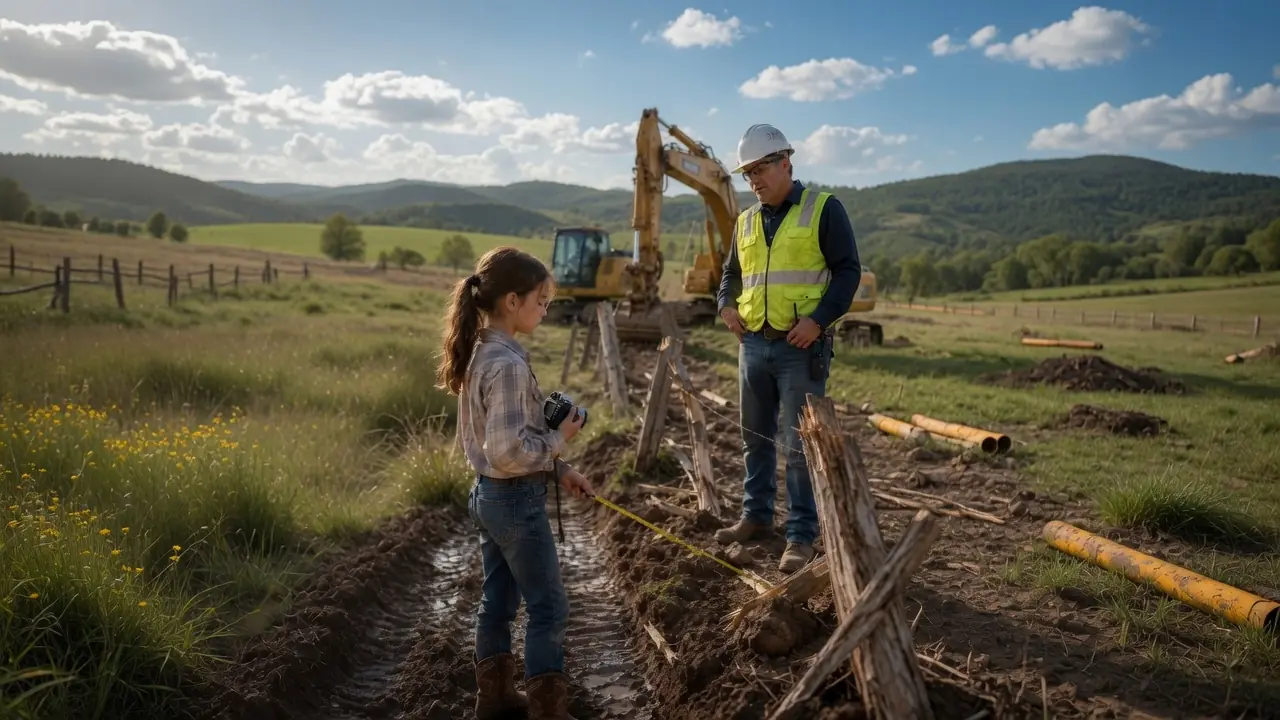
The fence had stood there longer than I had been alive, longer than my mother had been a mother, longer than most people in town cared to remember. My great-grandmother, Maryanne Pryor, built it in 1968 with lodgepole pine posts, three strands of barbed wire, and a gate latch that clicked shut like a promise. She had dug each hole herself, dropping gravel with a coffee can, tamping the dirt hard, and sighting the line against the mountains until it ran straight. In our family, that fence was never just a fence; it was the sentence Maryanne wrote into the land: this is ours, and we know exactly where it begins.
The excavator did not care about that sentence. It rolled forward with its steel tracks grinding into the earth, pushing through post seventeen as if it were nothing more than dry brush. The post cracked near the base, the wire snapped loose, and a twelve-foot gap opened where no gap had existed for forty-four years. For several seconds, I sat frozen on the gate, trying to understand how something so clearly wrong could happen in broad daylight.
Then I jumped down and ran to the house. I did not run crying to my mother, though I wanted to. I ran straight to the kitchen counter, where my mother’s digital camera sat beside a bowl of peaches and a stack of bills. The yellow measuring tape was in the mudroom toolbox, and my school notebook was still on the bench by the back door. I grabbed all three because Pryor women wrote things down, and somewhere deep inside me, I knew that what had just happened needed to be recorded before anyone could explain it away.
Before I left the kitchen, I looked at the clock. Then I looked at the time on the camera and noticed it was two minutes behind. My hands were shaking, but I changed it anyway because if something happened at a certain time, the record ought to say the right time. I did not know the word evidence yet, not in the way lawyers used it. But I knew the difference between remembering something and proving it.
By the time my mother, Lena Pryor, came out of the house, I was already walking toward the broken fence with the camera in one hand and the tape in the other. She stopped at the porch steps, her face pale, but she did not shout. My mother had learned long before that men in company trucks loved angry women because anger made it easier to ignore what they were saying. So she followed at a distance and watched me begin.
I started at post seventeen. I photographed the cracked base from three angles, crouching low enough that dust stuck to my knees. Then I stretched the measuring tape from the broken post to the first clear track mark on our side of the boundary and took another picture. Four feet, eight inches, I wrote in my notebook, pressing so hard with the pencil that the page nearly tore.
Post eighteen had been pulled crooked by the snapped wire. I took pictures of the lean, the torn staples, and the stretch of barbed wire curled in the dirt. Post nineteen was twisted toward the gap, and post twenty had shifted enough that I could slide two fingers into the soil beside it. I measured everything, even though I did not fully understand what each number meant.
The company supervisor arrived eleven minutes later in a white pickup with the Consolidated Basin Resources logo on the door. He stepped out wearing a clean polo shirt, a hard hat, and boots too new to know much about pasture ground. He looked annoyed before he even reached me, as if the broken fence had personally inconvenienced him. His name was Keith Sorley, and I would remember it for the rest of my life.
“What are you doing?” he called.
I did not lower the camera. “Documenting the damage.”
He looked past me at my mother, then back down at me as if the answer had come from the wrong person. I was small, skinny, and wearing dusty jeans with a braid falling loose over my shoulder. To him, I probably looked like a child playing at being important. That mistake cost him more than he knew.
Keith pointed at the torn fence. “Your fence was in the wrong place.”
I paused for one second, but only one. Adults said wrong things with confidence all the time, and I had learned from my mother that confidence did not make a lie stronger. I placed the measuring tape near post twenty-one and took another photograph. “I’m on my side,” I said. “This fence is our boundary.”
Keith’s mouth tightened. “Little miss, move back before you hurt yourself playing lawyer.”
My mother’s hands clenched at her sides, but she still did not step in. I could feel her fear from fifty feet away, and somehow that made me stand straighter. “My great-grandmother built this fence in 1968,” I said. “We had it surveyed in 2008.” Then I took another picture of the excavator track pressed deep into Pryor soil.
Keith stepped closer. “Put that camera down. You’re a child, not a surveyor.”
“No,” I said, and my voice surprised even me. “I’m the witness you were too arrogant to notice.”
For the first time, his expression shifted. He glanced toward the excavator, then at the broken posts, then at the camera in my hand. Men like Keith were used to controlling the story before the people they hurt understood what story was being told. But I had already taken thirty-two photos, written down four measurements, and marked the exact time the supervisor arrived.
He turned toward the machine operator and barked for him to shut it down. The excavator stopped moving, its metal bucket hanging over the torn ground like a guilty hand. Keith walked back to his truck and started talking into his radio, lowering his voice when he realized my mother was now filming him with her phone. That was the first time I understood something powerful: people who are not afraid of the truth do not mind being recorded.
By noon, two more company trucks arrived. One man carried rolled maps, another carried a tablet, and both of them spoke to Keith with tight faces. They never apologized. They said there had been a “boundary confusion,” then a “site access issue,” then a “temporary encroachment.” My mother listened quietly, then asked them to put those words in writing.
They did not.
Instead, they offered to “repair the inconvenience” by replacing the broken section of fence with metal posts. My mother looked at the snapped lodgepole pine, the torn wire, and the track marks cutting into our pasture. “You are not touching this fence again until our surveyor gets here,” she said. Keith gave her a cold smile and said the company had its own records. My mother answered, “So do we.”
That evening, our kitchen table disappeared under papers. My mother pulled out the 2008 survey, the county plat map, old tax records, and a folder of photographs my grandmother had kept from the year Maryanne repaired the southeast gate. I printed my pictures on cheap photo paper from the computer desk, laying them in order from post seventeen to post twenty-three. Every photo had a timestamp. Every measurement was written in my notebook.
My grandmother, Ruth, came over after dinner and stood silently in front of the spread of evidence. She was Maryanne’s daughter, and she touched the picture of the broken post with two fingers. “Your great-grandmother set that one herself,” she said quietly. Then she looked at me. “You photographed the tape?”
I nodded.
“Good girl.”
The next morning, Gil Haverford drove down from Billings. He was the surveyor who had marked the boundary in 2008, a thin older man with a sun-browned face, silver hair, and a voice that sounded like gravel rolling in a bucket. He carried equipment that looked more serious than anything I had ever seen, and he did not waste words. He walked the old line, checked the markers, studied the broken fence, and looked at my photographs.
“You took these?” he asked.
“Yes, sir.”
He flipped through them slowly. “You kept the tape visible in frame.”
“I tried to.”
He looked at my mother. “She did better than most adults.”
By the end of the day, Gil confirmed what we already knew. The fence had not been in the wrong place. Consolidated Basin Resources had crossed onto Pryor land without permission, broken a fence that marked a surveyed boundary, and damaged pasture soil with heavy equipment. When Gil handed my mother the preliminary report, her eyes filled with tears she refused to let fall.
The company’s tone changed after that. Keith Sorley stopped calling my mother directly, and a regional manager named Patricia Vale began sending careful emails. She wrote about “working toward a neighborly solution” and “avoiding unnecessary escalation.” My mother read the words out loud in the kitchen and shook her head. “They only want neighborly after they get caught,” she said.
CBR offered a settlement for the fence repairs, but it did not mention trespass, survey costs, soil damage, or the fact that their supervisor had told a nine-year-old child to stop documenting evidence. My mother refused it. Then the company sent a letter implying that if we interfered with pipeline construction, we could face liability for project delays. That was when my mother called an attorney.
His name was Malcolm Reed, and he drove out from Bozeman two days later. He spread my photos across our table, read my notebook, and asked me to walk him through what happened from the first crack of the post to Keith’s radio call. I was nervous, but he did not speak to me like I was a child making up a story. He asked clear questions and waited for clear answers.
“How did you know to check the camera time?” he asked.
I shrugged. “Because if they said it happened later, the pictures would say when it happened.”
He smiled a little. “That instinct may matter.”
The lawsuit was filed three weeks later. It alleged trespass, property damage, failure to verify boundary markers, and attempted intimidation after the damage occurred. I did not understand every word, but I understood the shape of it. The company that thought our fence was nothing had now been forced to answer for every broken post.
For months, nothing seemed to happen except paperwork. Adults used words like discovery, deposition, liability, injunction, and documentation. I went back to school, did my math homework, fed calves, and watched company trucks slow down when they passed our road. Sometimes I wondered if my photos really mattered or if adults were just being kind when they said they did.
Then the company produced its internal emails.
Malcolm came to the farm on a cold afternoon with a box of printed pages and a look on his face I had never seen before. My mother, grandmother, and I sat with him at the kitchen table while he read aloud. The company had known the boundary was disputed before the excavator ever reached our fence. A field technician had warned Keith Sorley that the Pryor fence line did not match the company’s temporary access map. Keith had replied, “Push through. We can clean it up later.”
My mother closed her eyes.
There was more. After I started taking pictures, Keith had emailed his supervisor: “Kid is photographing everything. Mother is watching. Need legal to contain before they make this bigger.” Another message from the regional office said, “Do not admit boundary error until survey comparison complete.” They had known enough to be careful, but not enough to be honest.
The strongest piece came from a tablet log. The excavator operator had GPS data showing the machine crossed the mapped access corridor and entered our parcel. That data matched my photographs almost perfectly. Post seventeen, track angle, distance from boundary, timing—everything lined up. The little girl they ignored had captured the outside proof that matched their inside mistake.
The case did not go to a full trial. Companies like Consolidated Basin Resources did not enjoy courtrooms when their own emails told the story better than witnesses could. They tried mediation first, then a larger settlement, then a confidentiality clause my mother refused. “You broke my grandmother’s fence in daylight,” she told Malcolm. “I won’t fix it in secret.”
In the final agreement, CBR paid for full restoration of the fence with matching lodgepole pine posts, soil repair, survey expenses, legal costs, and damages for unauthorized entry. They also had to reroute the access corridor and install permanent boundary buffers along the Pryor line. Keith Sorley was removed from the project after the internal review. The company never said “fired” in writing, but nobody saw his white pickup again.
The day the fence was rebuilt, my grandmother brought out Maryanne’s old post driver. We did not use it for every post because the contractor had equipment, but my mother insisted that one replacement post be set by hand. It was post seventeen. She held the post steady while my grandmother poured gravel from a coffee can, just like Maryanne had done decades earlier.
Then my mother handed me the driver bar.
It was too heavy for me, but she helped me lift it. Together, we tamped the earth around the post until it stood firm. My grandmother stood behind us, crying openly now, not with weakness, but with relief. The fence line was straight again.
A month later, the local paper ran a story about the settlement. They called it a “small landowner victory,” but to us there was nothing small about it. People at the feed store started recognizing me as the girl with the camera. Some adults laughed kindly and said I had a future as a lawyer. Others looked embarrassed because they had told my mother not to fight.
The first time I saw Keith Sorley after everything, it was at the gas station in town. He looked older, though only a year had passed. He saw me near the cooler, then looked away quickly. I did not say anything to him.
I did not need to.
By then, I understood that winning was not always loud. Sometimes winning was a fence standing where it had always stood. Sometimes it was a company truck slowing down because it knew someone was watching. Sometimes it was a photograph printed on cheap paper that made a powerful company admit what it had done.
Years later, when people asked why I became an attorney, I told them it started with a fence. Not a courtroom, not a law school dream, not a speech about justice. Just a broken fence, a yellow measuring tape, a camera, and a man in a company polo who thought a child could be scared away from the truth. He was wrong.
I still have the notebook. The pencil marks are faded now, and the pages are wrinkled from dust, sweat, and years in a box. On the first page, in uneven nine-year-old handwriting, it says: Post 17. Four feet, eight inches inside our line. Below it, my mother wrote later in blue ink: This is where the case began.
The Pryor fence still runs along the eastern edge of the farm. The posts are newer now, but the line is the same. When the wind moves across the pasture, the wire hums softly, and the spring-latch gate still clicks shut with the clean certainty of something made by hands that know what they are doing. Every time I hear it, I think of Maryanne, my mother, my grandmother, and the morning a company learned that land remembers.
They thought I was just a little girl.
They did not know I had been raised to measure carefully, write things down, and never let powerful people move a line just because they had a bigger machine.