The fire had burned down to four dull embers by the time Lucia Peralta heard the knock.
She sat against the iron stove with two premature babies cradled across her lap, one wrapped inside the remains of her mother’s shawl and the other covered by a piece of flour cloth. Eleven-year-old Lucia had stopped feeling her bare feet hours earlier. Snow blew beneath the cabin door, forming a thin white line across the dirt floor, while the wind pressed against the walls as though trying to tear the little house apart.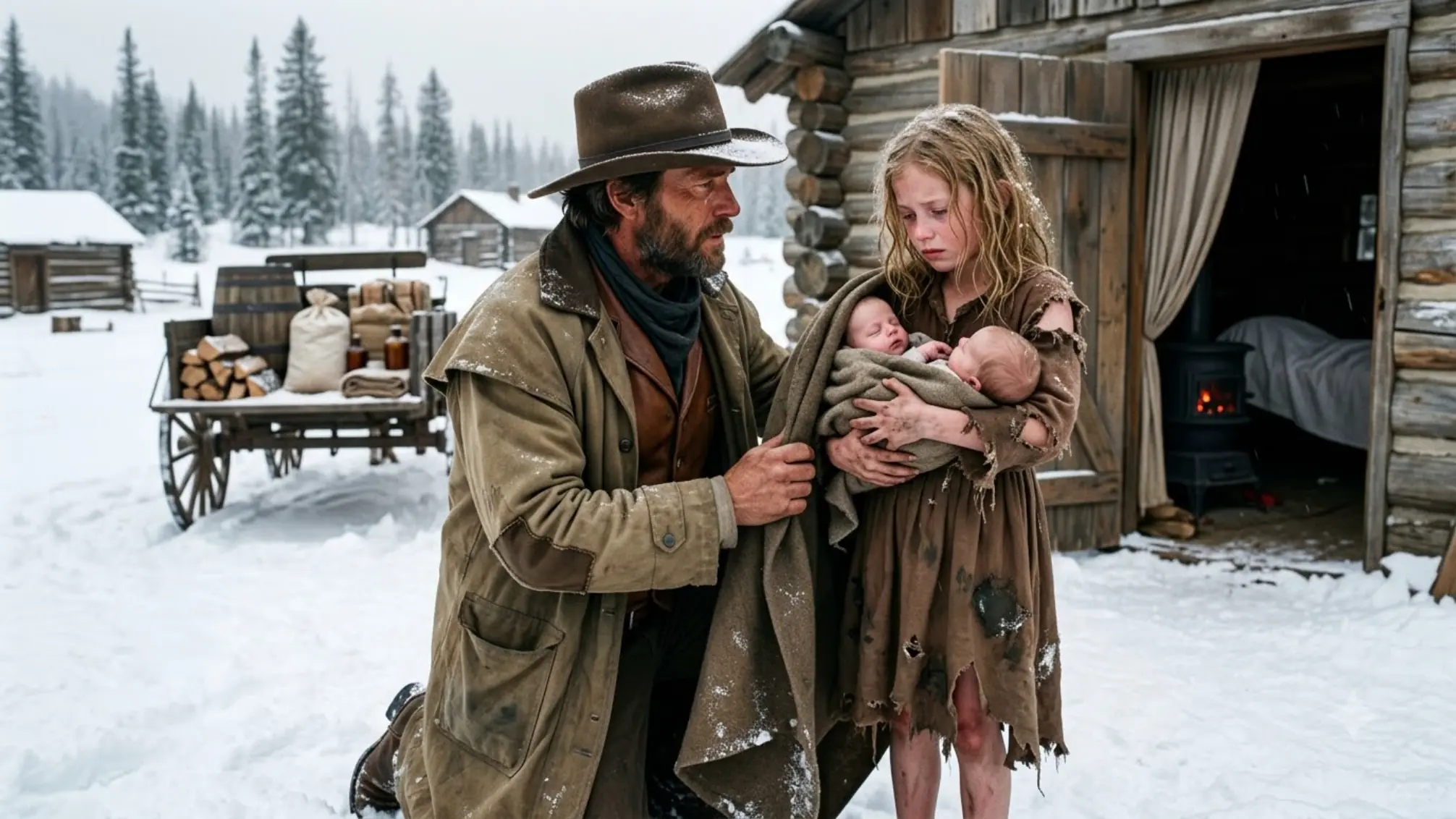
The stronger baby slept with his mouth open.
Lucia had secretly named him Matthew, after the grandfather she remembered only from stories. His sister breathed with a faint whistle that frightened Lucia more than the storm. She had named the smaller baby Miracles because after six days alone, Lucia needed to believe the word still meant something.
Behind a faded curtain, her mother lay beneath a sheet.
Dolores Peralta had gone into labor nearly two months too early. Lucia heated water, carried towels, and held her mother’s hand while her father, Julian, rode toward San Jacinto for a doctor. Before he disappeared into the storm, he knelt before Lucia and promised he would return before nightfall.
“Keep the stove burning,” he had said. “Do not open the door to strangers.”
Night came.
Her father did not.
The next morning, Dolores grew weaker. She pulled Lucia close and made her promise never to leave the newborns alone. By afternoon, her breathing stopped, and Lucia covered her with the cleanest sheet she could find.
For six days, the girl obeyed both parents.
She fed the babies drops of cow’s milk from a strip of cloth. She changed the rags wrapped around them, slept only when both were quiet, and burned furniture after the proper firewood ran low. One kitchen chair became heat on the fourth night, and the cradle Julian had built became fuel on the fifth.
Now only four logs remained.
The knock came again.
“Julian!” a man called from outside. “It’s Thomas Barragan. I saw smoke from the road.”
Lucia held the babies closer.
“My father is gone,” she answered.
The man fell silent.
Then his voice returned, lower and more careful. “Who is inside?”
“Just me and the babies.”
Lucia heard boots move closer to the door.
“Listen to me, girl. I’m going to lift the latch, but I won’t enter until you say I may. I only need to know whether someone is hurt.”
Lucia looked at the stove, the empty milk jug, and the smaller infant whose lips were beginning to lose their color.
“You can open it.”
The door moved inward beneath the weight of the snow.
Thomas Barragan filled the frame, broad-shouldered beneath a patched brown coat, his beard crusted with ice and his weathered hat dusted white. At forty-three, he had traveled nearly every mountain road in Colorado Territory, carrying flour, salt, coffee, tools, and medicine between settlements too small for regular stores. He had seen cabins destroyed by avalanches, horses frozen upright, and men who survived blizzards only to die within sight of home.
Nothing prepared him for the child beside the stove.
Lucia’s blonde hair hung in filthy strands around her face. Her torn brown dress barely covered her thin legs, and soot darkened her cheeks beneath eyes swollen from cold and exhaustion. She held the two infants with the stiff determination of someone who believed loosening her arms even once might allow death to take them.
Thomas removed his hat.
“Where is your mother?”
Lucia glanced toward the curtain.
“She didn’t survive.”
“And your father?”
“He rode for help six days ago.”
Thomas closed his eyes.
Julian Peralta knew these mountains. Even in heavy snow, he should have reached San Jacinto within a day. If he had found help, someone would have returned. If no one had come, the storm had taken him somewhere along the road.
Thomas stepped inside and closed the door.
The cabin was scarcely warmer than the mountain air. He crossed to the stove and opened the iron door, finding almost nothing alive inside it. He added two logs, then broke apart the remaining chair with his boot and fed the pieces into the flames.
Lucia watched him anxiously.
“That was Mama’s chair.”
“I’ll build you another.”
“My father said not to let strangers take things.”
“I’m not taking it. I’m turning it into heat.”
Thomas knelt before the children.
The stronger baby shifted weakly. The smaller girl’s chest barely moved beneath the blanket.
“Have they eaten?”
“There was milk.”
“When?”
Lucia tried to remember.
“Before daylight.”
It was nearly afternoon.
Thomas reached toward the babies, but Lucia turned away from him.
“No.”
“They need warmth.”
“I’m keeping them warm.”
“You are freezing too.”
“Mama made me promise they would never wake up alone.”
The words struck him with such force that for a moment he could not answer.
Eleven years earlier, Thomas had buried his wife, Clara, and their six-year-old daughter after an epidemic passed through the mining settlement where they lived. He had returned from a supply journey one day too late. By the time he arrived, both graves were already closed, and no one knew where Clara’s wedding ring had gone.
Afterward, Thomas stopped staying anywhere long enough to love it.
He traveled with freight, slept beside his wagon, and convinced himself that a man who owned little could lose little. He told people he preferred the road, though the truth was that every warm house reminded him of the one he had failed to return to in time.
Now another child stared at him with the same frightened blue eyes his daughter once had.
“Lucia,” he said gently, having seen her name embroidered inside the shawl, “you kept your promise.”
Her lower lip trembled.
“I didn’t leave them.”
“No, sweetheart. You didn’t.”
“Miracles won’t drink.”
“Miracles?”
“The little girl. I named her that because Mama didn’t have time.”
Thomas nodded as though it were the finest name he had ever heard.
“We’re going to help her.”
He removed his coat and spread it across the floor. Then he opened the supply bag hanging from his shoulder and took out wool blankets, a tin of condensed milk, clean cloth, and a bottle of medicine meant for a ranch farther north. Lucia watched each item appear as if he were performing magic.
Thomas warmed water and mixed the milk carefully.
When he offered to feed the smaller infant, Lucia resisted until her arms began shaking too badly to hold the baby steadily. She finally placed Miracles into his hands, warning him to support the head. Thomas obeyed without smiling at the seriousness of the instruction.
The baby refused the cloth at first.
Thomas touched one warm drop against her lips.
“Come on, little one,” he whispered. “You’ve already survived too much to stop now.”
Her mouth moved.
She swallowed.
Lucia released a sound caught somewhere between laughter and sobbing.
Thomas fed the baby slowly while the fire grew. When Miracles had taken several drops, he handed her back and prepared more milk for Matthew. Lucia insisted on feeding her brother herself.
Only after both babies settled did Thomas examine the room beyond the curtain.
He stood beside Dolores’s bed for a long moment, hat against his chest. He had spoken to her once at the San Jacinto market months earlier. She had been heavily pregnant, smiling as she chose blue and white fabric for baby clothes while Julian complained cheerfully about the price.
Now one unfinished baby shirt lay near her hand.
Thomas covered her face again and returned to Lucia.
“We cannot stay here.”
Her eyes widened. “Mama—”
“I will come back for her.”
“I promised not to leave the babies.”
“You won’t. They are going with us.”
“My father might return.”
Thomas looked toward the door.
“If he returns, I’ll leave a message telling him where we went.”
Lucia tightened her arms around Matthew. “What if he comes back and thinks we died?”
“He won’t.”
“How do you know?”
“Because I’ll make certain he knows you lived.”
Thomas wrote on a piece of paper in large letters and nailed it beside the door:
JULIAN — THE CHILDREN ARE ALIVE. I HAVE TAKEN THEM TO BARRAGAN CABIN NEAR CEDAR CREEK. FOLLOW MY WAGON TRACKS. — THOMAS
He added wood to the stove so the cabin would remain warm for several hours. Then he wrapped Lucia and both babies inside his coat. She protested when he lifted them, saying she could walk, but her legs collapsed the moment her feet touched the floor.
Thomas caught her.
“You carried them for six days,” he said. “Let me carry you for one minute.”
Lucia leaned against his chest.
“No one came back for us,” she whispered.
His throat tightened.
“I came.”
Snow covered the wagon almost to the axles. Thomas placed Lucia beneath thick freight blankets and built a nest for the babies inside a wooden supply box lined with wool. He heated stones beside the stove, wrapped them carefully, and placed them around the infants to keep the cold away.
Before leaving, Lucia looked through the open cabin door at the curtain hiding her mother.
“Are we abandoning her?”
“No.”
“It feels like we are.”
Thomas crouched beside the wagon.
“Your mother asked you to protect the babies. Taking them somewhere warm is not abandoning her. It is finishing what she began.”
Lucia stared at him.
“Will you really come back?”
“Yes.”
“People promise things before they leave.”
He understood whom she meant.
Thomas removed the silver chain from beneath his shirt. Clara’s wedding ring hung from it—the only part of her he had recovered after the burial. He placed the chain in Lucia’s hand.
“This belonged to my wife. Keep it until I return for your mother.”
Lucia looked at the ring.
“What if you don’t come back?”
“Then you will know I tried.”
She closed her fingers around it.
The journey to Thomas’s cabin normally took two hours. In the storm, it took nearly five. He walked beside the mules for most of the distance, clearing drifts with a shovel and stopping frequently to check the children.
Lucia remained awake through sheer will.
Each time Thomas looked beneath the blankets, she reported who had swallowed milk, who had coughed, and whether Miracles’s breathing sounded worse. Once, when the wagon slipped near a frozen ravine, Lucia threw herself over the babies before Thomas regained control.
“You don’t have to shield them from every danger,” he said afterward.
“Yes, I do.”
“Why?”
“Because I’m their sister.”
Thomas had no answer stronger than that.
His cabin stood near Cedar Creek beneath a grove of tall pines. It contained one main room, a loft, a stable, and enough firewood to survive the winter. Thomas had built it for Clara and their daughter, but after their deaths he rarely used more than the table and one chair.
The loft still held the child’s bed.
For eleven years, he had kept the small quilt folded inside a chest because touching it hurt more than leaving it hidden. That night, he spread it over Lucia.
A neighbor named Ruth Hawkins lived less than two miles away. Thomas rode through the storm to fetch her while Lucia remained beside the babies near the roaring fireplace. Ruth was a fifty-year-old widow who had delivered seven children in the valley and buried two of her own.
She examined the infants immediately.
“The boy may survive,” she said.
Lucia looked toward Miracles.
“And her?”
Ruth did not lie. “She is very weak.”
Thomas stood behind Lucia.
“What do we do?”
“We keep her warm. Feed her one drop at a time. Pray if you’re still on speaking terms with God.”
Thomas had not prayed in eleven years.
He began that night.
For three days, the cabin revolved around the babies’ breathing. Ruth taught Lucia how to hold them against her skin beneath blankets so her body heat could warm them. Thomas fed the stove, boiled water, washed cloths, and traveled through the storm searching for goat’s milk.
Lucia slept only when Thomas ordered her to.
Even then, she woke in terror every time a baby made a sound. On the second night, Thomas found her standing beside the wooden box, crying silently.
“What happened?”
“Nothing.”
“Then why are you crying?”
“Because nothing happened.”
He waited.
“Miracles breathed all night,” Lucia explained. “I kept thinking she would stop.”
Thomas sat beside her.
“You are allowed to be frightened.”
“If I get frightened, I might make a mistake.”
“You have been frightened for more than a week, and you kept them alive.”
“I should have saved Mama.”
“You were eleven.”
“I’m still eleven.”
The statement broke something in him.
Thomas pulled her gently against his chest. For a moment, Lucia remained stiff, as though comfort were another responsibility she did not understand. Then she grabbed the front of his shirt and cried with the force of every tear she had refused to waste inside the frozen cabin.
Thomas held her.
“You should never have had to be that brave,” he whispered.
On the fourth morning, Miracles opened her eyes.
They were dark blue and unfocused, but they remained open long enough for Lucia to call Thomas from the woodpile. He ran inside believing something was wrong and found Lucia smiling for the first time.
“She looked at me.”
Thomas knelt beside the box.
The baby’s tiny hand closed around one of his fingers.
He turned his face away, but Lucia saw the tears.
“You said crying doesn’t fix anything,” she reminded him.
“I never said that.”
“I did.”
“Perhaps we were both wrong.”
Once the children were stable, Thomas returned to the Peralta cabin with two neighbors. They built a coffin for Dolores and buried her beside a cottonwood where Julian once planned to construct a larger house. Lucia chose the spot after Thomas described it to her.
He found Julian’s trail two miles beyond the cabin.
A broken tree branch marked where the horse had fallen down a steep embankment. Thomas followed on foot until he found the animal beneath the snow. Julian lay nearby with one leg trapped under the saddle.
He had survived the fall long enough to crawl nearly fifty yards.
A medical bag rested beside him.
Inside were bottles of fever medicine, clean cloth, and two small feeding tubes. Julian had reached San Jacinto. He had found the doctor, but the doctor refused to travel during the storm. Julian bought what supplies he could and tried to return alone.
In his coat pocket, Thomas found a damp piece of paper.
LUCIA, IF SOMEONE FINDS THIS, TELL HER I CAME BACK. TELL HER I DID NOT LEAVE THEM.
Thomas sat in the snow beside the dead man.
He had hoped to bring Lucia her father.
Instead, he could bring only the truth.
That evening, Thomas placed Julian’s note and medical bag on the table. Lucia understood before he spoke. She stared at the paper, then at Clara’s ring still hanging around her neck.
“He was coming home?”
“Yes.”
“He didn’t leave us?”
“No, sweetheart.”
“He promised.”
“He tried to keep it.”
Lucia pressed the paper against her chest.
Thomas expected her to cry, but she asked only one question.
“Will he be buried beside Mama?”
“Yes.”
“You promise?”
“I promise.”
She removed Clara’s ring and returned it to him.
“You came back.”
Thomas could not speak.
He closed his hand around the ring while Lucia walked toward the babies. Matthew slept peacefully. Miracles stirred, stronger now, releasing a small impatient cry for milk.
Lucia lifted her sister.
Thomas watched the three children and understood that eventually the county authorities would arrive. They might send Lucia to distant relatives she had never met, separate the babies, or place them with families who wanted newborns but considered an eleven-year-old girl an inconvenience.
The thought filled him with fear sharper than any blizzard.
At first, Thomas told himself he only wanted to keep them together. Then he claimed they needed him until spring. When spring came, he decided the babies were still too small to travel.
The truth was simpler.
The cabin no longer felt like a grave.
Lucia filled it with questions, arguments, and muddy footprints. Matthew grew into a solemn baby who studied every face, while Miracles survived with a fierce appetite that astonished Ruth. Thomas built a cradle, then another when Lucia accused him of expecting the twins to share forever.
He repaired the loft railing, bought fabric for dresses, and learned that babies could produce more laundry than twelve freight workers.
Lucia returned to school in San Jacinto.
On her first morning, she stood beside the wagon wearing a new blue dress and refused to climb aboard.
“What if they need me?”
“They need you to learn.”
“What if Miracles stops breathing?”
“She hasn’t done that in three months.”
“What if Matthew won’t drink?”
“He drinks whenever he sees the bottle.”
“What if you forget—”
Thomas placed both hands on her shoulders.
“I know you kept them alive when no one else was there. But you are their sister, Lucia. You do not have to become their mother.”
“Who will?”
Thomas looked toward the cabin, where Ruth rocked both infants near the window.
“I suppose I will have to learn.”
Lucia smiled faintly.
“You’re not a woman.”
“I noticed.”
“You cannot be their mother.”
“No. But I can be the man who stays.”
That was enough.
The legal hearing took place the following autumn. A distant uncle appeared after hearing Julian had owned several acres and claimed he would take the babies. When asked about Lucia, he said she was old enough to work elsewhere.
Thomas stood so quickly his chair overturned.
“You will not separate them.”
The judge warned him to remain calm.
Thomas placed receipts, school records, medical reports, and statements from Ruth and the neighbors on the table. He explained how the children came to his cabin and why they had remained.
Then Lucia asked to speak.
She stood before the judge in her blue dress, Clara’s silver ring hanging from a chain Thomas had finally given her.
“When my mother died, she told me not to leave the babies alone,” Lucia said. “Mr. Barragan found us, and he did not leave any of us alone. My uncle wants the land. Thomas wants us.”
The courtroom became silent.
The judge granted Thomas permanent guardianship and began the process allowing him to adopt all three children.
Outside, Lucia stared at the official papers.
“What does permanent mean?”
“It means you cannot get rid of me when I become troublesome,” Thomas said.
“I’m already troublesome.”
“Yes. The judge has made it my lifelong problem.”
Lucia threw her arms around him.
Matthew and Miracles grew up hearing the story of the frozen cabin, though Lucia never told it as a tale of her own bravery. She spoke instead about the smoke that was almost too weak to see and the cowboy who stopped because something felt wrong.
Thomas always corrected her.
“I stopped because the smoke was faint.”
Lucia would smile. “You stayed because we needed you.”
Years later, a larger house stood beside the old cabin near Cedar Creek. Thomas kept the original room intact, including the iron stove and the reinforced wooden box that once served as the twins’ first cradle.
Above the fireplace hung two objects.
Julian’s final note.
And the silver ring Thomas once gave Lucia as proof that he would return.
Miracles became a doctor and traveled to isolated mountain settlements during winter storms. Matthew managed Thomas’s freight company and never allowed a wagon to pass a smoking cabin without checking on it.
Lucia became a teacher.
Every winter, she told her students that promises mattered, but sometimes the person who kept a promise was not the person who first made it. Her father promised to return and died trying. Her mother asked Lucia to protect the babies, and Lucia carried that promise until someone strong enough arrived to share it.
Thomas never replaced the chair he burned inside the Peralta cabin.
Instead, he built a long dining table with room for his children, their spouses, grandchildren, neighbors, and any traveler caught by bad weather. No one who knocked during a storm was ever turned away.
On the twentieth anniversary of the rescue, Lucia stood beside him outside the Cedar Creek house while snow moved softly through the pines.
“Do you remember what I said when you found us?” she asked.
Thomas nodded.
“No one came back for us.”
Lucia slipped her arm through his.
“I was wrong.”
He looked at her.
“You came back every day.”
Thomas watched Matthew carry firewood toward the porch while Miracles arrived in a physician’s wagon. Children ran between them through the snow, shouting and laughing around the house that had once stood silent for eleven years.
Thomas covered Lucia’s hand with his own.
“No, sweetheart,” he said. “I never came back.”
She frowned.
He looked toward the family filling the yard.
“I finally came home.”