The crumpled five-dollar bill trembled between Emma Rodriguez’s fingers as she stood outside the Iron Brotherhood clubhouse in Sacramento. She was nine years old, small for her age, with warm brown skin, wide dark eyes, and long hair tied into a ponytail with a pink ribbon. Her bright pink shirt and worn sneakers made her look even younger beneath the row of black motorcycles parked along the curb. Directly behind her, a black Mercedes idled beneath a streetlamp while her uncle watched from the driver’s seat.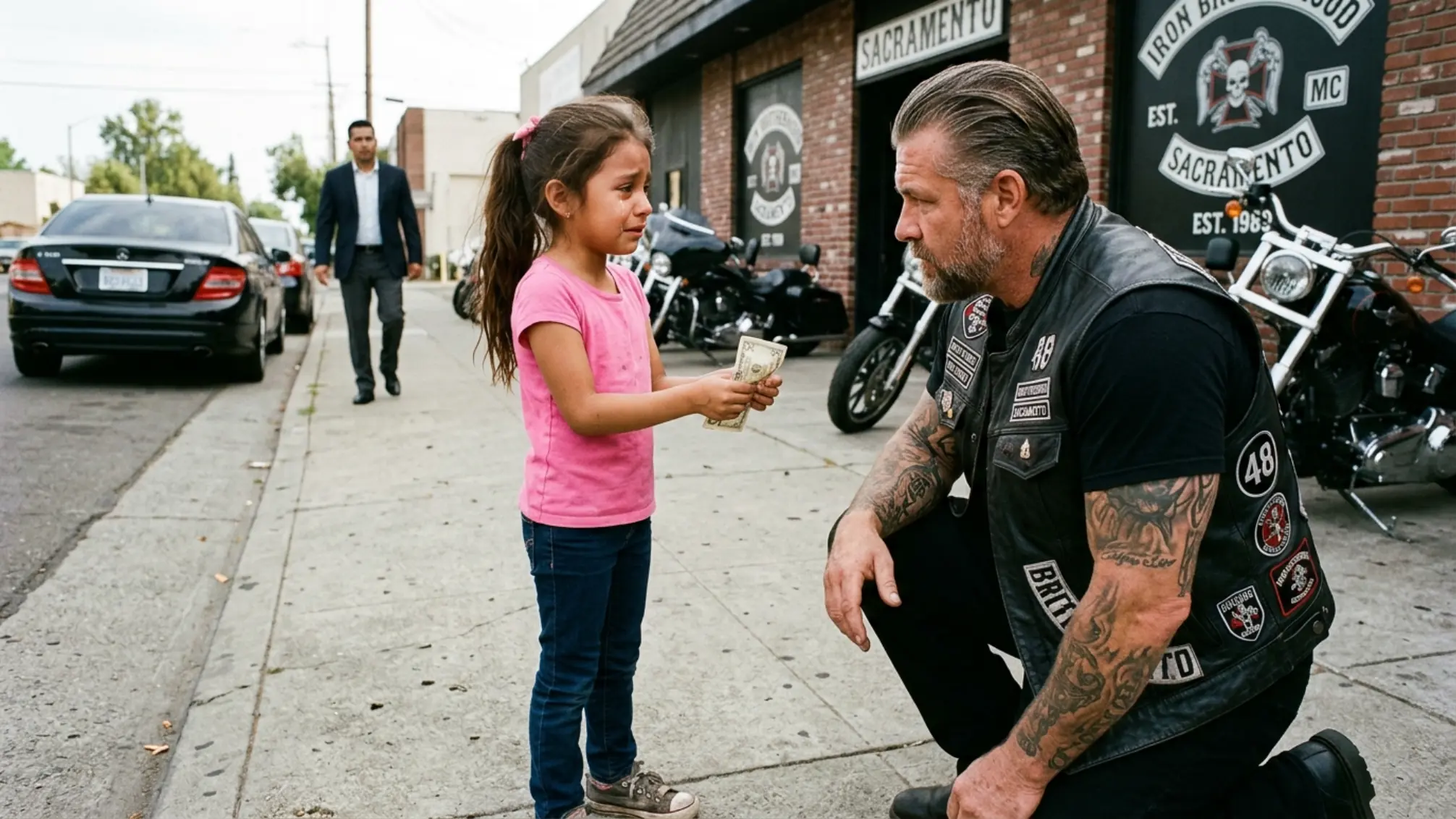
Hammer noticed the child before anyone else did.
The Iron Brotherhood president had been leaning against the clubhouse entrance, speaking with two riders about a charity run scheduled for the following weekend. He was forty-eight, six feet five inches tall, and built like a man who had spent half his life carrying military equipment and the other half repairing motorcycles. Tattoos covered both muscular arms, and a deep scar crossed the left side of his weathered face. Most adults avoided his eyes, but Emma walked straight toward him.
She stopped three feet away and held out the money.
“Will you save my mother’s life for five dollars?”
The laughter and music inside the clubhouse disappeared as though someone had cut the power. Men who had survived combat, prison, accidents, and street violence turned toward the entrance without speaking. Hammer looked first at Emma, then at the five-dollar bill, and finally at the black Mercedes waiting behind her. The driver was watching now.
Hammer slowly lowered himself onto one knee.
“What’s your name, sweetheart?”
“Emma Rodriguez.”
“Where’s your mother?”
“St. Mary’s Hospital. Room 304.”
Her voice broke, but she kept the bill extended. Hammer could see that it had been folded and unfolded so many times that the edges had begun to tear. It was not money taken casually from an adult’s wallet. It was probably lunch money saved coin by coin until Emma had enough to believe someone might listen.
“What happened to your mother?”
“She has cancer. The doctor says there’s medicine that might save her, but it costs fifty thousand dollars.” Emma glanced toward the Mercedes and immediately looked away. “My uncle said he’ll pay, but only if my mom signs papers saying I have to live with him forever.”
Hammer’s expression did not change, but the men behind him stopped breathing quite so easily.
“And your mother refused?”
Emma nodded. “She says he’s a bad man.”
“What does that mean?”
The girl’s fingers closed around the five-dollar bill. “I don’t know.”
Hammer knew she was lying, but not because she was dishonest. Children often said I don’t know when the truth felt too dangerous to place into words. He had heard the phrase in refugee camps, police interviews, and homes where everyone pretended not to notice what fear had already revealed.
“Did your uncle bring you here?” he asked.
“Yes.”
“Why?”
“He said bikers are criminals. He said you’d take my money and laugh, and then I’d understand nobody helps for free.” Her chin trembled. “He said after I learned that, I’d stop fighting him.”
A large biker called Tank rose from his chair inside. He was the club’s sergeant-at-arms, a former infantryman whose forearms looked thick enough to bend steel. Wrench, a thin man with glasses and tattooed fingers, moved toward the window. Doc, who had served as a Navy corpsman attached to Marines in Iraq, pulled out his phone.
Hammer kept his eyes on Emma.
“Is your uncle the only family you have besides your mother?”
“My father died at work three months ago.”
“I’m sorry.”
Emma stared at the money in her hand. “This is everything I have. Please don’t say it isn’t enough.”
Hammer’s scarred face softened.
“Keep your money.”
Her eyes filled immediately. “Then you won’t help?”
“That’s not what I said.” He gently closed her fingers around the bill. “Stay behind me, Emma. We’re going to speak with your uncle.”
Fear replaced disappointment.
“No.”
Hammer paused.
“He’ll get angry,” she whispered. “When he gets angry, he—”
She stopped and pressed one hand against her upper arm. Hammer saw the small movement. So did Tank, Raven, Doc, and every other rider near the doorway.
They did not need Emma to finish the sentence.
Raven stepped forward from inside the clubhouse. She was the only woman in the chapter, a former social worker with dark hair, tribal tattoos, and a scar across one eyebrow. Her appearance was intimidating, but her voice was gentle when she held out her hand.
“Come inside with me, sweetheart.”
Emma looked at Hammer.
“She’ll stay with you,” he promised. “Nobody takes you anywhere without your permission.”
The girl placed her hand in Raven’s.
Hammer stood to his full height and turned toward the clubhouse.
“Tank, Doc, Wrench—outside. Everyone else holds the line.”
Fourteen bikers emerged behind him.
The driver of the Mercedes finally opened his door.
Robert Chen stepped out wearing a tailored charcoal suit, polished shoes, and the controlled smile of a man who believed expensive clothes could make every accusation look unreasonable. He was in his mid-forties, clean-shaven, with carefully styled black hair and a gold watch visible beneath one cuff. He looked like an attorney, executive, or respected businessman.
He did not look like someone who would leave a frightened child outside a biker clubhouse at night.
“Gentlemen,” Robert said. “I assume my niece reached you safely.”
Hammer stopped several feet away.
“Your niece offered us five dollars to save her mother.”
Robert’s smile tightened. “Emma has an active imagination.”
“She said you’ll pay for the cancer treatment only if her mother gives you custody.”
“That is a private family matter.”
“You made it public when you drove a nine-year-old here to humiliate her.”
Robert’s eyes moved across the riders forming a wide semicircle around the Mercedes. “I wanted her to learn how the world works. Her mother may not survive, and Emma needs a responsible guardian.”
Tank stepped closer.
“So you brought her to men you called criminals?”
“She needed to understand desperation doesn’t make strangers generous.”
Hammer stared at him. “You wanted her to believe she had nowhere else to go.”
Robert’s expression became colder. “I’m paying fifty thousand dollars for treatment. I expect reasonable conditions.”
“A child is not a condition.”
“You don’t understand the situation.”
“Then explain it.”
Robert lifted his chin. “Rosa has no insurance, no savings, and no husband. I have resources. Emma would attend a private school, live in a secure home, and receive every opportunity her mother cannot provide.”
“And what do you receive?”
“The right to protect my niece.”
Hammer took one deliberate step forward.
“From whom?”
Robert’s polished mask slipped for half a second. “I have been patient. Emma is coming with me, and we are returning to the hospital. My sister has documents to sign.”
“She isn’t leaving.”
“You have no legal authority to keep her.”
“Call the police.”
Robert pulled out his phone.
“Gladly.”
Before he could dial, Doc emerged from the clubhouse with his own phone pressed to his ear. He ended the call and looked directly at Robert.
“I just spoke with Dr. Martinez at St. Mary’s.”
Robert lowered his device.
Doc continued. “Rosa Rodriguez has been fighting cervical cancer for two years. Her condition worsened after her husband died, and the experimental treatment costs approximately fifty thousand dollars.”
“Exactly,” Robert said. “Which I offered to pay.”
“You left something out.”
The businessman’s jaw tightened.
“Dr. Martinez says Rosa has refused to sign custody papers several times. She is so terrified of you having access to Emma that she would rather risk dying without the treatment.”
“My sister is confused by medication.”
“Or she understands you perfectly.”
Robert pointed toward Doc. “You are discussing protected medical information.”
“I verified that a child who entered our clubhouse was telling the truth. I didn’t ask for Rosa’s treatment records.”
“This conversation is over.”
Robert started toward the door.
Hammer blocked him.
“No, it’s beginning.”
“Move.”
“Try moving me.”
For several seconds, the two men stood almost chest to chest. Robert was tall, but Hammer towered over him, and the thirteen riders behind the president made the threat of physical force unnecessary. The wealthy businessman had spent years frightening people who feared losing something. These men had already lost enough to become difficult to control.
Robert looked toward his car.
“You think leather vests make you untouchable?”
“No,” Hammer replied. “But evidence helps.”
He lifted his phone and turned the screen toward Robert.
A photograph showed a younger version of the businessman beneath a different name.
Isaiah Chen.
The color drained from Robert’s face.
“You changed your name five years ago,” Hammer said. “That happened after an Oregon family accused you of inappropriate conduct involving their thirteen-year-old daughter.”
“No charges were filed.”
“Because money changed hands.”
“You don’t know what happened.”
“I know the family signed a settlement. I know you moved to California. And I know they weren’t the only ones.”
Robert’s hands began to shake.
Hammer scrolled to another file.
“Three families across two states. Three girls close to Emma’s age. Three settlements tied to the same man using two different names.”
“You’re bluffing.”
“Try me.”
Robert looked around the semicircle, but no opening appeared. Tank had already positioned himself between the Mercedes and the street. Wrench stood near the rear bumper, holding up a phone that had been recording since Robert left the vehicle.
“This is extortion,” Robert said.
Wrench shook his head. “Extortion is offering to save a dying woman only if she surrenders her daughter.”
“I’m calling the police.”
“Please do,” Hammer replied. “Ask for Detective Sarah Morrison with the Crimes Against Children Unit.”
Tank smiled without warmth.
“She’s my sister.”
Robert’s thumb hovered over the phone.
Hammer leaned closer.
“You can explain the Oregon settlement, the other families, the custody demand, and why Emma is frightened every time she hears your voice.”
“You cannot prove I hurt her.”
“We can prove enough to start asking questions.”
Robert’s eyes moved toward the clubhouse windows. Emma stood inside beside Raven, watching from behind the glass. The moment he saw her, his expression changed from fear to fury.
Hammer stepped directly into his line of sight.
“Look at her like that again.”
The warning was quiet.
That made it worse.
Robert shoved his phone into his pocket. “What do you want?”
“You stay away from Emma and Rosa.”
“You cannot order me away from my family.”
“We’re not ordering you. We’re preserving evidence and contacting investigators.”
“I’ll destroy this club.”
Tank laughed once.
Robert turned toward him.
“What’s funny?”
“You drove a child here because you thought our reputation would terrify her into surrendering.” Tank crossed his enormous arms. “Now you’re surprised it terrifies you instead.”
Hammer lifted his hand.
“Ten seconds. Get into the car, leave the property, and wait for Detective Morrison to contact your attorney.”
“And if I refuse?”
“We call her before you reach the driver’s door.”
Robert stared at the men surrounding him.
His pride fought his survival instinct.
Survival won.
He climbed into the Mercedes, started the engine, and reversed so quickly that one tire struck the curb. The car shot toward the road and disappeared between the streetlights.
Tank watched the taillights fade.
“He’ll come back.”
“No,” Hammer said. “Men like him return when they believe the victim is alone.”
He turned toward Wrench.
“Did you record everything?”
“His custody demand, the conditional payment, his threats, all of it.”
“Send copies to Detective Morrison and three separate servers.”
Wrench nodded.
Hammer entered the clubhouse.
Emma sat on a stool beside Raven, holding a bright red drink with a cherry floating near the top. Her five-dollar bill remained closed inside one fist. She looked toward the door behind Hammer as though expecting Robert to appear.
“Is he gone?”
“He’s gone.”
“Will he come back?”
“Not while we’re standing.”
Her shoulders sagged with relief. Then she looked down at the money.
“But my mom still needs the medicine.”
Hammer pulled a chair close and sat across from her.
“Do you know what this club does?”
Emma shook her head.
“We protect people.”
She looked around at the tattoos, leather vests, scarred faces, and heavy motorcycles visible through the windows.
“My uncle said you hurt people.”
“Some of us have,” Hammer said honestly. “Some made mistakes. Some survived places that changed them. But the patch means something different now.”
“What?”
“You don’t leave someone helpless when you can stand beside them.”
Tank took out his phone.
“I’m calling every chapter from here to Nevada.”
Doc opened his contact list. “I know veteran support groups and medical charities.”
Wrench pulled a laptop onto the bar. “I’ll build the fundraising page.”
Raven squeezed Emma’s hand.
“You walked into the right place, sweetheart.”
Emma looked at Hammer with fragile hope.
“You can really help?”
He nodded.
“Your uncle brought you here because he wanted you to learn that the world is cruel.” Hammer gently tapped her closed fist. “Tonight, we’re teaching him he was wrong.”
The clubhouse transformed into a command center.
Phones rang continuously. Bikers who had been drinking switched to coffee and began contacting former units, motorcycle chapters, union halls, veterans’ associations, churches, mechanics, and anyone who had ever owed the Brotherhood a favor. Wrench posted Emma’s story without exposing her location or full identity.
Donations started arriving within minutes.
Five dollars.
Twenty dollars.
One hundred.
A retired Marine in Arizona contributed a thousand and sent a message saying his wife had survived cancer. A motorcycle chapter in Nevada pledged five thousand. A construction union established a collection in honor of Emma’s late father.
By three in the morning, they had raised thirty thousand dollars.
Emma fell asleep beneath Hammer’s leather jacket on a couch near the back wall. Raven stayed beside her while Tank guarded the door. Hammer stood behind the bar watching the total rise on Wrench’s computer.
At dawn, the number crossed fifty thousand.
Nobody cheered.
They simply kept working.
By noon, the fund held seventy-five thousand dollars—enough for treatment, related hospital expenses, and several months of support while Rosa recovered.
Hammer woke Emma gently.
“Time to see your mother.”
St. Mary’s Hospital became silent when the bikers entered.
Hammer wore clean jeans and his Iron Brotherhood vest. Raven walked beside Emma, while Doc carried a folder containing the payment confirmation and treatment documents. They did not arrive as a roaring motorcycle convoy. They entered quietly because sick people did not need spectacle.
Dr. Alejandro Martinez met them outside room 304.
“You’re the bikers.”
Hammer nodded. “How quickly can treatment begin?”
The doctor examined the financial authorization.
“I need to be honest. Rosa’s cancer is advanced. Even with this medication, her chance may be only forty percent.”
Raven looked toward Emma.
“But there is a chance?”
“Yes.”
Hammer held the doctor’s gaze.
“Then we take it.”
Rosa Rodriguez lay pale and almost motionless beneath a hospital blanket. Emma approached the bed and placed both hands around one of her mother’s thin fingers.
“Mama?”
Rosa’s eyelids fluttered.
“Emma?”
“It’s going to be okay. The bikers are helping us.”
“Bikers?”
Emma looked toward Hammer standing in the doorway.
“They’re good people.”
Rosa’s tired gaze moved across his tattoos, scar, and heavy leather vest. A single tear slid down her cheek.
“My brother—”
“He won’t take Emma,” Hammer said. “The police have his name, his recording, and the other evidence. You don’t sign anything.”
Rosa’s voice barely carried across the room.
“Why are you doing this?”
Hammer looked at Emma.
“Because she asked.”
Treatment began that afternoon.
Child services required Emma to live with an approved guardian while Rosa remained hospitalized. Robert was excluded after Detective Morrison opened an investigation, but no immediate family member was considered safe or available.
Raven volunteered.
“I’m already certified as a foster parent,” she explained. “I have a spare room, a clean record, and a social-work license.”
Emma studied her.
“You want me to live with you?”
“Only until your mother comes home.”
“What if she doesn’t?”
Raven crouched and met her eyes.
“Then you still won’t face it alone.”
The first week was difficult.
Emma woke from nightmares calling for her mother and sometimes hid beneath the kitchen table when unfamiliar cars slowed near Raven’s home. Two Iron Brotherhood members rotated outside each night, sitting quietly on motorcycles beneath the porch light.
Robert never returned.
His attorney contacted Detective Morrison three days later and claimed his client had relocated temporarily. The Oregon families agreed to reopen their complaints after learning he had targeted another child, and investigators began following the trail created by his settlements and name change.
Meanwhile, Rosa’s first blood tests showed slight improvement.
During the second week, the tumor markers decreased again. By the fourth week, she could sit upright and eat without assistance. Her voice grew stronger, and Emma stopped entering each hospital room with fear already written across her face.
Two months after the little girl offered a biker five dollars, Rosa walked out of St. Mary’s.
The doctors called her response extraordinary. The Iron Brotherhood called it a second chance.
The club organized a celebration without alcohol, loud music, or anything that might overwhelm Emma or her mother. Rosa stood beneath the Brotherhood emblem with one arm around her daughter while fifteen bikers attempted to hide their emotions.
“You saved my life,” she said. “You protected my child. And you did it for five dollars you never accepted.”
Hammer shook his head.
“You don’t repay us.”
“Then what do I do?”
“Live. Raise Emma. Teach her the world can be hard without teaching her it is hopeless.”
Rosa looked around the room.
“But we weren’t part of your family.”
Raven wrapped one arm around Emma.
“You became ours the moment she walked through that door.”
Emma reached into her pocket.
The crumpled five-dollar bill appeared again.
“I still want you to have it.”
Hammer accepted it carefully this time.
“What will you buy?” she asked.
“Nothing.”
He placed the bill inside a small frame and hung it above the bar.
Whenever anyone asked why five dollars deserved a place of honor inside the Iron Brotherhood clubhouse, Hammer told them about the child who entered alone, stood before fifteen feared men, and used everything she possessed to ask for her mother’s life.
The bill became their new symbol.
Not of money.
Of courage.
Three months later, another frightened mother entered the clubhouse holding the hand of a young boy. She had nowhere safe to sleep and no money to offer.
Hammer pointed toward the framed bill.
“That’s the price.”
The woman looked confused.
“Five dollars?”
“No,” he said. “The courage to walk through the door.”
The Iron Brotherhood helped twelve families during the following year. Raven developed a formal support network connecting survivors with shelters, attorneys, foster services, and medical assistance. The club’s frightening reputation became useful in a new way: predators hesitated before approaching homes protected by riders who never left frightened families alone.
Years later, Emma attended college and studied social work.
At her graduation, fifteen older bikers filled the back row of the auditorium. When her name was announced, every one of them stood. Their cheering echoed across the hall while Rosa cried beside Raven and Hammer pretended his eyes were only irritated by the lights.
Emma found him outside afterward.
“Thank you for saving my mother.”
Hammer shook his head.
“You saved her first.”
“With five dollars?”
“With courage.”
She hugged him.
“Keep the bill on the wall.”
“Always.”
The money eventually faded until the ink became difficult to see, but nobody replaced it. Its value had never come from the number printed in the corners.
Robert Chen believed money could purchase Rosa’s surrender and Emma’s future. He brought the girl to the Iron Brotherhood expecting cruel men to prove his cruel lesson correct.
Instead, Emma discovered something he never understood.
Some people helped because they remembered what it felt like when nobody came.
And sometimes the hardest-looking man on the street was the one who would kneel before a frightened child, close her fingers around her final five dollars, and say:
“Keep it. You’re not alone anymore.”