A little girl crawled under a diner counter and whispered five words that would change everything.
“Please don’t tell him I’m here.”
The man finding her was already walking through the parking lot. 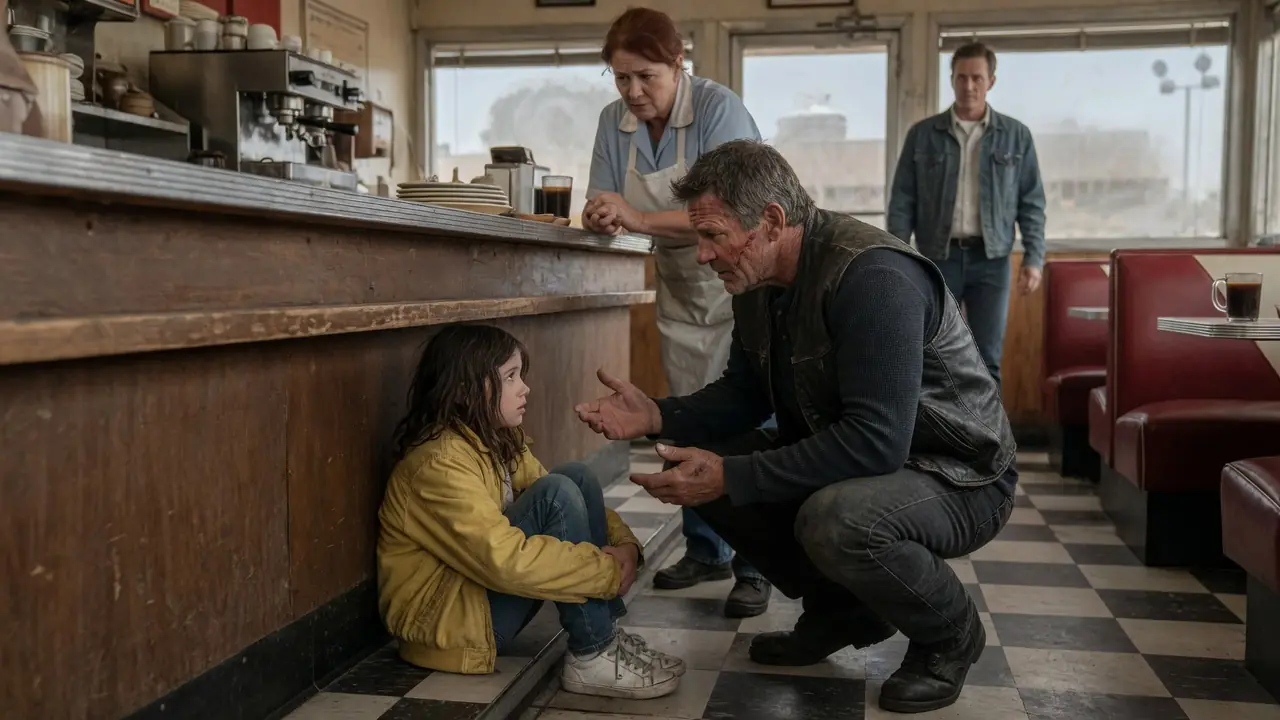
The waitress froze. The cook disappeared into the back. Every single person in that diner looked away.
Every single person except one.
A scarred ex-Marine biker sitting alone in the corner booth, a man who had not spoken to another human being in three days, set down his coffee, stood up, and walked straight toward the door.
The October wind came off the Texas Panhandle like something with teeth. It rattled the windows of the Broken Wheel Diner hard enough to make the glass hum, pushed dust devils across the cracked asphalt of Route 66, and carried with it the kind of cold that did not ask permission before settling into your bones.
The sky had gone the color of old lead by two in the afternoon, and the last of the lunch crowd had cleared out twenty minutes earlier, leaving behind sticky tables, wadded napkins, and the faint residue of conversations nobody would remember by dinner.
Loretta Dean wiped down the counter with a rag that had seen better decades. She was fifty-three years old, built like a woman who had survived two bad marriages and a worse economy. She moved through the empty diner with the mechanical precision of someone who had stopped expecting surprises a long time ago.
The coffee machine gurgled behind her. The fluorescent light above the register flickered every nine seconds. She had counted, because counting was what you did when nobody was talking, and the radio had died sometime in August, and the owner was too cheap to fix it.
One customer remained.
Rex Callahan sat in the corner booth with his back to the wall and his eyes on the door.
That was not a choice.
It was architecture.
Twenty-two years in the Marine Corps had rearranged the furniture inside his skull until threat assessment became as involuntary as breathing. He was fifty-one years old, six-foot-two, two hundred and thirty pounds of scar tissue and silence.
His leather cut hung over the back of the booth. Faded black, no club patch anymore, just a lone wolf riding with ghosts. His knuckles were scarred white across the tops. His coffee had gone cold fifteen minutes ago, but he had not flagged Loretta for a refill because that would require speaking.
And Rex Callahan had not spoken a full sentence to another human being in three days.
He had ridden down from Tulsa on a 2003 Harley Road King that burned oil and made a sound like a dying animal at anything above sixty. Seven hundred miles of nothing. Seven hundred miles of wind and highway and the kind of emptiness that either healed you or finished you off.
Rex was not sure yet which one was happening.
The diner smelled like burned bacon grease and industrial coffee and the ghost of every cigarette that had ever been smoked inside those walls before the county banned it. Rex could hear the wind outside. He could hear Loretta’s rag squeaking against the Formica. He could hear the ice machine cycling in the back kitchen.
Then he heard something else.
A sound so small it almost did not exist.
The front door opened exactly four inches. Not enough for a person, barely enough for a dog. Then it closed again with a click so quiet that Loretta did not even turn around.
Rex’s eyes moved to the door.
His hand tightened around the coffee mug, not because he was afraid, but because his body had learned a long time ago that silence before movement was rarely good news.
Three seconds passed.
The door opened again, this time wider, and a child slipped through the gap like smoke.
She was small, eight years old, maybe less, wearing a thin yellow jacket that was at least two sizes too big and sneakers with no socks. Her dark hair was tangled and unwashed and plastered to the side of her face with something that might have been sweat or might have been rain.
She moved fast. Not running. Not walking. Something in between that Rex recognized immediately because he had seen it in combat zones, in refugee camps, in the eyes of people who had been hunted long enough to learn how to make themselves invisible.
She did not look at Rex.
She did not look at Loretta.
She went straight for the counter, dropped to her knees, and crawled underneath the waitress station like an animal finding a den.
Rex set down his coffee.
Loretta heard the movement and turned. She saw the girl’s sneakers disappearing beneath the counter and froze with the rag in her hand, her mouth half open, her eyes doing the math that every woman who has ever been afraid already knows how to do.
Bruise on the left cheek.
Split skin near the hairline.
Hands shaking so hard the zipper on her jacket was making a tiny metallic sound against the floor.
Loretta moved slowly. She came around the counter and crouched down. The girl flinched so hard her skull hit the underside of the shelf.
“Easy,” Loretta whispered. “Easy, sweetheart. Nobody’s going to—”
“Please don’t tell him I’m here.”
Five words.
Barely audible.
Delivered with the kind of precision that only comes from rehearsal, from saying something so many times inside your own head that when it finally comes out, it sounds less like a request and more like a prayer stripped of everything except fear.
Rex heard every syllable.
He looked at the door. He looked at the parking lot through the window.
He saw a black Dodge Ram pull into the lot and park crooked across two spaces, engine still running, exhaust pumping white clouds into the cold air.
The driver’s door opened.
Loretta looked at Rex.
Rex looked at Loretta.
Something passed between them that did not require language. The universal frequency of adults who understand exactly what a bruised child hiding under a counter means, and exactly what kind of person is about to walk through that door.
“Kitchen,” Rex said.
One word, low and flat. The voice of a man who had spent two decades giving orders in places where hesitation could cost lives.
Loretta understood. She gently guided the girl deeper behind the counter, positioning herself between the child and the entrance.
The cook, a heavyset man named Reuben who had been scraping the grill in the back, appeared in the kitchen doorway, saw Loretta’s face, and went pale.
“Reuben,” Loretta said quietly. “Go back inside. Close the door. Don’t come out.”
Reuben looked at Rex.
Rex did not look at Reuben.
Reuben disappeared.
The front door opened.
Derek Harper walked into the Broken Wheel Diner the way certain men walk into any room, like he owned it, like the air itself owed him an apology for being in his way.
He was forty-four years old, lean, wearing a pressed denim jacket over a clean white shirt. His hair was combed back, his boots polished. He had the kind of face that worked well in photographs, symmetrical, confident, the jaw of a man who expected to be believed.
But his eyes were wrong.
Rex saw it immediately.
The smile reached Derek’s mouth but stopped dead at the orbital bone. Above that line, everything was calculation. Cold, fast, efficient calculation. The eyes of a man scanning a room for something he considered his property.
“Afternoon,” Derek said.
His voice was warm, practiced, the kind of voice that convinced school administrators and social workers and neighbors that everything was fine, that the child was dramatic, that the bruises were from falling off a bicycle.
Loretta did not move from behind the counter.
“Help you?” she said.
“I’m looking for my daughter.”
Derek pulled out his phone and showed a photograph. A school portrait. Maddie smiling, no bruises, wearing a dress that looked like it had been ironed by someone who cared about appearances.
“She ran off about an hour ago. She does this. She’s got some behavioral issues. Her therapist says it’s an attachment disorder. You know how kids are.”
He smiled.
Loretta did not smile back.
“Haven’t seen any kids in here,” Loretta said. “Been pretty dead since lunch.”
Derek’s eyes moved past Loretta to the counter, to the floor beneath it, to the space where a small body might fit if that body had learned how to make itself very, very small.
“Mind if I look around?” Derek said, still smiling, still warm.
But his right hand had moved to the counter, and his fingers were drumming against the Formica in a rhythm that was not casual. It was impatient, mechanical, the rhythm of a man who was running out of the patience he was performing.
“Nothing to see,” Loretta said.
“I’d like to check anyway.”
The warmth was thinning.
“She’s my stepdaughter. Her mother passed recently. She’s been having a hard time. I’m just trying to get her home safe.”
The word safe landed in the room like a stone dropped into still water.
Rex felt it hit.
He watched Derek’s hands. He watched Derek’s eyes. He cataloged every micro-expression the way he had been trained to catalog threats.
Posture.
Breathing rate.
Pupil dilation.
The distance between the words and the truth.
The distance was enormous.
“Mister,” Rex said from the corner booth.
Derek turned.
He had not noticed Rex.
Most people did not notice Rex until Rex wanted to be noticed. By then, it was usually too late for the kind of recalculation that might have mattered.
“Diner’s closing,” Rex said.
Derek stared at him.
He took in the size, the scars, the leather cut draped over the booth, the tattoos climbing up both forearms. Marine Corps eagle on the left, barbed wire on the right, and something older and uglier on the inside of the right wrist that Rex kept turned away from polite company.
“I’m sorry,” Derek said, the smile recalibrating. “I don’t think that’s your call.”
“It’s mine,” Loretta said. “And he’s right. We’re closing up.”
Something shifted behind Derek’s eyes.
The performance flickered.
For exactly half a second, the mask slipped, and what lived underneath was so cold and controlled that Loretta took an involuntary step backward.
Then the mask returned.
“Look,” Derek said, both hands up now, the universal gesture of reasonableness. “I’m not trying to cause trouble. I just want to find my little girl before she gets hurt. It’s cold out there. She’s not dressed for it. I’m sure you understand.”
Under the counter, Maddie Harper pressed both hands over her mouth, squeezed her eyes shut, and tried to make her breathing stop.
She knew.
She knew with the certainty of a child who had learned fear the way other children learn arithmetic, that if Derek found her, the ride home would be silent.
And the silence would be worse than anything that came after, because the silence meant he was planning.
Rex stood up.
He did not stand up fast. He did not stand up aggressively.
He simply unfolded from the booth with the slow, deliberate economy of a man whose body was a weapon he had spent decades learning not to deploy without cause.
He was four inches taller than Derek and forty pounds heavier, and none of those pounds were decorative.
“She’s not here,” Rex said. “You should go.”
Derek looked at Rex for a long time.
The calculation behind his eyes was running numbers.
Could he push past this?
Could he escalate?
Could he find an angle, a leverage point, a way to make this scarred giant back down?
The numbers came back wrong.
“I’ll call the police,” Derek said.
He said it like a threat, like a man who had learned that institutions were tools and tools could be wielded.
“Go ahead,” Rex said.
Derek pulled out his phone.
He dialed.
He spoke in a calm, concerned, heartbroken voice about his missing stepdaughter, about his fear for her safety, about the uncooperative diner staff, about the intimidating biker who seemed to be interfering with a father’s search for his child.
Rex listened to every word and felt something old and terrible stir in his chest.
He had heard that voice before.
Not Derek’s voice specifically, but that voice. The voice of men who hurt small things and then explained it away with vocabulary and paperwork and the quiet confidence of someone who understood that systems were built to believe adults, not children.
Twenty-six years ago, in a two-bedroom apartment in Bakersfield, California, Rex Callahan had been fourteen years old, and his sister Jenny had been nine.
Their stepfather, a man named Gary Womack, had possessed that exact same voice. Warm in public, concerned at parent-teacher conferences, devastated when questioned, and behind closed doors, something else entirely.
Rex had known.
He had known the way children always know.
Not through evidence or language, but through the electricity of fear that lives in a house where someone is being hurt.
He had heard Jenny crying through the wall. He had seen the way she flinched when Gary raised his hand to reach for a cabinet. He had watched her build elaborate lies to explain the marks on her arms.
And he had done nothing.
He had been fourteen. He had been afraid. He told himself it was not as bad as it looked. That Jenny was clumsy. That Gary was just strict. That if he said something, it would make everything worse.
He told himself every lie that children tell themselves when the truth is too enormous to carry.
Jenny left home at sixteen.
She did not say goodbye.
She did not leave a note.
She simply vanished into the same American darkness that swallows thousands of damaged kids every year, and Rex spent the next thirty-five years carrying the weight of his silence like a bullet lodged too close to the spine to remove.
He never found her.
He looked for years. He hired a private investigator when he could afford one. He searched databases, called shelters, posted on forums that existed before social media made searching easier and finding harder.
Nothing.
Jenny Callahan disappeared into the country like rain into sand, and Rex was left with nothing but the sound of her crying through a wall he never broke through.
Now he stood in a diner outside Amarillo and watched a bruised child hide under a counter. He listened to a man with a warm voice and cold eyes explain to police dispatchers that everything was fine, that the child was troubled, that he simply wanted her home.
Rex’s hands were shaking.
Not from fear.
From recognition.
The Amarillo police arrived in eleven minutes.
Two officers.
A young guy named Molina, who looked like he had been on the force for about fifteen minutes, and a senior officer named Dawkins, who had the tired, efficient demeanor of a man who had responded to ten thousand domestic calls and stopped believing any of them had clean answers.
Derek met them at the door. He shook their hands. He showed them the photograph. He produced a manila folder from his truck that contained guardianship papers, a death certificate for Maddie’s mother, Patricia Harper, deceased four months, cause listed as accidental overdose, and a letter from a family therapist documenting Maddie’s history of oppositional behavior and flight responses consistent with attachment trauma.
It was a performance.
Flawless.
Rehearsed.
Every document in order. Every answer anticipated. Every tear precisely calibrated to suggest a grieving stepfather overwhelmed by the burden of raising a damaged child alone.
Officer Dawkins listened.
He nodded.
He looked at the paperwork.
Rex watched Dawkins’s face and felt the ground shifting beneath him.
Dawkins believed it.
Not because Dawkins was stupid, but because the system was designed to believe exactly that kind of presentation.
Clean paperwork beats dirty truth every time. A well-dressed man with documents defeats a bruised child’s silence because silence does not file reports, bruises fade, and the machine needs inputs it can process.
Fear is not a form you can submit in triplicate.
“Sir,” Dawkins said to Rex, “I understand you’ve been preventing this gentleman from locating his daughter.”
“Stepdaughter,” Rex said.
“Excuse me?”
“He said stepdaughter, not daughter. There’s a difference.”
Dawkins looked at him.
He looked at the leather cut. Looked at the scars. Made a calculation of his own.
Rex could see the answer forming behind the officer’s eyes.
Biker.
Troublemaker.
Probably has a record.
Probably overreacting.
Probably the problem.
“Sir, do you have any relationship to the child?”
“No.”
“Then I’d suggest you step back and let us handle this.”
“Handle what? You haven’t even talked to her.”
Dawkins paused.
Molina shifted his weight.
Derek stood behind them both with his hands in his pockets and his face arranged in an expression of patient suffering.
“The girl is under the counter,” Derek said softly. “She’s been hiding there since I arrived. She does this. It’s part of her condition.”
“Talk to her,” Rex said.
His voice was louder now.
Not shouting. Rex did not shout. But the kind of controlled volume that cuts through a room the way a blade cuts through rope.
“Before you hand her over to anyone, talk to her. Look at her face. Ask her how she got those bruises.”
Loretta stepped forward.
“He’s right. I saw the child. She’s hurt. She’s terrified. She crawled in here like she was running for her life.”
Dawkins looked from Loretta to Rex to Derek. He exhaled through his nose.
“All right,” he said. “Let’s talk to the girl.”
They found Maddie exactly where she had been for the last twenty minutes, curled into a ball behind the waitress station, her arms wrapped around her knees, her face pressed against the metal shelf that held the coffee filters.
She was shaking.
Not the dramatic trembling of a child throwing a tantrum, but the deep involuntary shaking of a body that had exhausted its capacity for fear and was now running on something more primitive.
The animal certainty that the predator was close, and the den was not deep enough.
Dawkins crouched down.
To his credit, his voice was gentle.
“Hey there, sweetheart. My name’s Officer Dawkins. Nobody’s going to hurt you. Can you tell me your name?”
Maddie did not answer.
Her eyes were locked on a point past Dawkins’s shoulder, on Derek, who was standing near the register with Molina, close enough to hear everything, close enough for Maddie to see his face.
And Derek was looking at her.
Not with anger.
Not with concern.
With something worse.
A calm, steady, unblinking gaze that communicated everything it needed to communicate without words. The gaze of a man reminding a child what happens when she talks.
Maddie’s mouth opened.
No sound came out.
“He’s not my dad.”
Three words, barely a whisper, but in that diner, in that silence, they landed like gunfire.
Derek did not flinch.
His expression shifted into something wounded, something tragic.
“She’s been saying that since her mother passed. The therapist says it’s a displacement response. She blames me because I’m the one who’s still here.”
It was good.
It was convincing.
It was the kind of explanation that wraps itself around the truth and suffocates it slowly.
Dawkins stood up. He looked at the paperwork again. He looked at Maddie. He looked at Derek.
Rex could see it happening. The machinery of the system grinding toward its inevitable conclusion. The paperwork was in order, the man was calm, the child was nearly silent, and the biker with the scars was the loudest person in the room, which meant he was the problem.
“Mr. Harper,” Dawkins said, “I think we can ask her about the bruises.”
Rex’s voice came from somewhere old, somewhere beneath the years of discipline and control and the careful architecture of distance he had built between himself and every person he had ever failed.
It came from a fourteen-year-old boy standing in a hallway in Bakersfield, listening to his sister cry.
“Ask her how she got the bruises on her face,” Rex said, “and don’t let him stand where she can see him when you do it.”
Dawkins turned. His jaw tightened.
For a moment, Rex thought the officer was going to tell him to leave.
But Loretta was already moving. She stepped between Derek and Maddie’s line of sight, her body a wall. Then she looked at Dawkins with the unflinching certainty of a woman who had survived enough to know that silence was not the same thing as safety.
“Do it,” Loretta said. “Please.”
Dawkins hesitated.
Then he turned back to Maddie.
“Sweetheart, can you tell me how you got hurt?”
Maddie’s eyes moved from Derek’s blocked silhouette to Dawkins’s face. Her hands were still shaking. Her lower lip trembled so hard she bit down on it, and a thin line of red appeared at the corner of her mouth.
She did not speak.
Instead, she reached into the pocket of her oversized yellow jacket and pulled out a folded piece of paper, notebook paper torn from a spiral binding. The edges were ragged.
She had been carrying it.
She had been carrying it the way soldiers carry last letters, close to the body, ready for the moment when words spoken out loud would be too dangerous.
She held it out toward Dawkins.
Dawkins reached for it, and Maddie pulled it back.
She looked past Dawkins, past Loretta, past Derek.
She looked at Rex.
The scarred, silent, enormous biker standing in the corner of a dying Texas diner. A stranger she had never met, whose name she did not know, whose life had intersected with hers for exactly twenty-three minutes.
She held the note out to him.
Rex walked forward.
His boots were loud on the floor. Each step echoed in the silent diner like a countdown.
He crouched down in front of the counter, slowly, carefully, the way you approach a wounded animal, and took the folded paper from Maddie’s trembling fingers.
Their hands touched for less than a second.
Maddie’s eyes held his, and in those eyes, Rex saw something he recognized with a clarity that nearly broke him.
The same look Jenny had given him across the dinner table in Bakersfield.
The look that said, I’m telling you the only way I know how, and if you don’t hear me, nobody will.
He opened the note.
Two sentences, written in pencil. The handwriting was shaky but deliberate, the careful lettering of a child who knew she might only get one chance.
He hides things in the barn.
That’s where Mom got scared.
Rex read the words twice.
His hands stopped shaking.
Something inside him went very still, very cold, and very clear.
The way the world goes still before a storm, or before a bullet leaves a barrel, or before a man decides that the rest of his life begins now.
He stood up.
He looked at Dawkins.
He looked at Derek Harper, who was still standing near the register with his hands in his pockets, his perfect face, and his cold, calculating eyes.
Rex said four words that changed everything.
“Search his property tonight.”
Derek’s mask cracked.
It was small.
A micro-fracture.
A hairline break in the performance.
But Rex saw it.
The pupils dilated. The jaw clenched. The fingers in the pockets curled into fists.
For half a second, the real Derek Harper surfaced like something rising from dark water. What lived behind that polished face was ancient and ugly and absolutely terrified.
Then the mask returned.
But the damage was done.
“This is ridiculous,” Derek said.
His voice was still calm, but the calibration was off now. A quarter tone too high. The rhythm a half beat too fast.
“She’s a disturbed child writing fantasy stories. Her therapist can confirm—”
“Then a search won’t find anything,” Rex said. “And you can take her home.”
The diner went silent.
The fluorescent light flickered.
The coffee machine gurgled.
The wind hit the windows like a fist.
Dawkins looked at the note. He looked at Maddie, who had pulled her knees tighter against her chest and was staring at the floor with the hollow focus of a child who had just surrendered the only secret keeping her alive.
He looked at Derek.
And something in Dawkins’s face changed.
Not dramatically. Just a small recalibration. A veteran cop’s instinct finally overriding the paperwork, finally hearing the frequency that the documents had been designed to drown out.
“Mr. Harper,” Dawkins said slowly. “Would you consent to a search of your property?”
Derek’s smile was gone.
In its place was something harder, something cornered.
“Absolutely not. Not without a warrant. I know my rights.”
“Nobody said you didn’t.”
“This is harassment. This biker, this criminal, is interfering with—”
“I haven’t committed a crime,” Rex said quietly. “Have you?”
The question hung in the air like smoke.
Outside, the wind screamed across the Texas flatland. The temperature was dropping, the sky darkening. Inside the Broken Wheel Diner, a little girl with bruises on her face had just handed a stranger a piece of paper containing two sentences that pointed toward something buried in a barn on a dead woman’s property.
Something that a man with cold eyes and perfect paperwork desperately did not want anyone to find.
Dawkins pulled Molina aside. They spoke in low voices near the door.
Derek stood rigidly by the counter, his eyes moving between Rex and the spot where Maddie was hiding. In those eyes was a new expression. Not fear exactly, but the rapid, furious calculation of a man watching his architecture collapse and searching for the load-bearing wall he could still reinforce.
Rex did not move.
He stood between Derek and the counter like a wall made of scar tissue and silence, and he held the folded note in his hand.
He thought about Jenny. He thought about Bakersfield. He thought about every single night he had spent riding alone through the American dark, trying to outrun a guilt that had no expiration date.
Not this time.
Whatever was hiding in that barn, whatever truth was buried beneath the paperwork and the performance and the cold machinery of a man who had learned to weaponize systems, Rex was going to find it.
Somewhere deep in his chest, in the place where a fourteen-year-old boy still stood in a hallway listening to his sister cry through a wall he never broke through, something shifted.
Not redemption.
Not yet.
But the sound of a door finally opening.
Dawkins turned back from his conversation with Molina. His face was set. His radio crackled on his shoulder.
“Mr. Harper,” he said, “we’re going to need you to come with us to the station while we sort this out. The child will remain in protective—”
“No.”
Derek’s voice was different now. The warmth was gone. The performance was gone. What remained was flat, metallic, stripped of everything except refusal.
“She’s my legal responsibility. I have the documents. You have no grounds to—”
“Sir?”
“I said no.”
Then Derek Harper made the first real mistake Rex had seen him make all afternoon.
He took a step toward the counter.
Toward Maddie.
And Rex Callahan, fifty-one years old, two hundred and thirty pounds, twenty-two years in the Marine Corps, seven hundred miles of highway behind him, and a lifetime of failure burning in his chest, stepped directly into his path.
They were close enough to breathe each other’s air.
Derek looked up at Rex.
Rex looked down at Derek.
The fluorescent light buzzed above them like a wasp trapped in glass.
“Touch her,” Rex said, his voice barely above a whisper, “and I will end this conversation in a way that paperwork cannot fix.”
The diner held its breath.
Maddie held her breath.
Loretta held her breath.
Even the wind outside seemed to pause.
In that silence, from somewhere beyond the parking lot, beyond the dead grass and the cracked highway and the flat gray expanse of the Texas Panhandle, came a sound.
Low at first.
Then louder.
Then louder still.
The unmistakable, bone-deep rumble of motorcycle engines.
Not one.
Not two.
Eight.
Rex did not turn around.
He did not need to.
He knew the sound the way a man knows his own heartbeat. The synchronized thunder of Harley-Davidsons ridden by men who had learned to travel in formation because the world had taught them that a lone wolf survives, but a pack endures.
Through the diner window, headlights cut through the gathering dark. Eight motorcycles pulled into the parking lot in a staggered line, chrome catching the neon glow of the diner sign, exhaust turning to ghosts in the cold air.
Derek’s face went white.
Not because the bikers were threatening. Not because they revved their engines or shouted or made any aggressive gesture whatsoever.
Because they were still.
Because they parked their bikes, killed their engines, and simply sat there. Eight men in leather cuts watching the diner through the glass with the patient, unmoving attention of men who had all the time in the world and absolutely nowhere else to be.
Dawkins looked out the window.
Molina’s hand moved to his belt.
Rex still had not turned around, but for the first time in three days, he was not alone.
Under the counter, in the dark, with her bruised face, shaking hands, and torn notebook page now in the possession of a stranger who had decided, for reasons she could not yet understand, that her survival was more important than his silence, Maddie Harper heard the engines, too.
She did not know what they meant.
She did not know who those men were.
But something in the sound, something low and steady and unbreakable, made her stop shaking.
Just for a moment.
Just long enough to breathe.
Then Derek smiled again.
But this time, the smile was different. This time, it was the smile of a man who understood that the game had changed, that the rules he had mastered no longer applied, and that somewhere in the fading daylight of an October afternoon in Texas, the walls he had built around his secrets had just developed a crack he could not plaster over.
He reached slowly into his jacket pocket.
Every eye in the diner locked onto his hand.
He pulled out a phone.
He dialed a number.
And he said three words that turned Rex’s blood to ice.
“Bring the lawyer.”
Then he looked at Rex.
Looked through him.
And said, in a voice so quiet only Rex could hear, “You have no idea what you just started.”
Outside, the engines were silent.
Eight bikers sat motionless in the cold. The sky was black now. The wind had died.
Somewhere twenty miles east, on a dirt road that led to a property registered under the name of a dead woman, a barn sat in the darkness, holding secrets that had kept a man in control and a child in terror for four months.
Secrets that a folded piece of notebook paper had just pulled into the light.
Rex looked at Maddie.
Maddie looked at Rex.
Neither one of them blinked.
The lawyer arrived in a silver Mercedes that looked like it had never touched a dirt road.
Forty-seven minutes.
That was how long it took from Derek’s phone call to the moment the headlights swept across the diner parking lot and the car pulled through the row of silent Harleys like a surgeon’s scalpel sliding between broken ribs.
Forty-seven minutes during which nobody inside the Broken Wheel Diner moved, nobody left, and nobody spoke above a whisper.
Except Derek Harper.
He had retreated to a booth near the window and sat with his arms crossed and his legs extended, wearing the calm, patient expression of a man who had played this game before and understood that time was a weapon if you knew how to wield it.
Rex stood at the counter.
He had not moved.
His coffee was long dead. His back ached from seven hundred miles on the Road King, and his knees were complaining about the cold concrete floor. None of that mattered, because under the counter, four feet behind him, a child was still breathing in short, ragged bursts that sounded like something breaking in slow motion.
Loretta had draped a flannel blanket around Maddie’s shoulders. She had pulled it from the lost-and-found box in the back, a faded red thing that smelled like motor oil and dust. She had placed a glass of water beside her that Maddie had not touched.
The girl’s eyes were open, fixed on nothing.
The thousand-yard stare of a combat veteran reproduced with perfect fidelity in the face of an eight-year-old child.
Rex knew that stare.
He had worn it. He had seen it in the faces of Marines who had stopped processing the present because the present had become unsurvivable. The brain’s emergency shutdown, not unconsciousness, but a controlled retreat to somewhere internal and unreachable where the incoming fire could not follow.
Maddie was gone.
Physically present.
Psychologically evacuated.
Rex understood with a certainty that made his chest tighten that every minute she remained in the same building as Derek Harper, the deeper she withdrew into that internal bunker and the harder it would be to bring her back.
The lawyer’s name was Katherine Voss.
She was fifty-one, immaculately dressed in charcoal wool, and she entered the diner carrying a leather briefcase and an authority that rearranged the room’s hierarchy before she had spoken a word.
Her heels clicked on the linoleum.
She did not look at Rex.
She did not look at Loretta.
She went straight to Officer Dawkins, produced a business card, and said, “I represent Mr. Harper. My client will not be answering any further questions, and I’d like to discuss the immediate return of his stepdaughter.”
Dawkins took the card and read it.
His eyebrows moved a fraction of an inch, which for Dawkins was the equivalent of a civilian screaming.
“Harmon, Voss, and Kendrick,” he said. “That’s out of Dallas.”
“It is.”
“Long way to drive for a runaway kid.”
Katherine Voss smiled.
It was a professional smile, the kind that communicated warmth the way a fluorescent light communicates sunshine. Technically present. Fundamentally artificial.
“Mr. Harper is a valued client. His stepdaughter has serious psychological needs. We’d like to resolve this quickly and get her the care she requires.”
Rex watched.
He watched the way Dawkins’s posture changed. Not collapse, not defeat, but the subtle recalibration of a man who recognized that the battlefield had just shifted from human judgment to legal architecture, and legal architecture was not his terrain.
The front door opened again.
Cold air poured in.
One of the bikers from the parking lot stepped inside.
He was shorter than Rex by three inches, but wider by twenty pounds. A fireplug of a man in his late forties with a gray-streaked beard, a shaved head, and hands that looked like they had been assembled from spare industrial parts.
His leather cut bore a patch Rex recognized.
The Iron Horses MC out of Lubbock.
Not a one-percent club. Not outlaws in the criminal sense. Veterans, mostly. Ex-military, ex-law enforcement, ex-everything. Men who had been chewed up by the machine and spat out on the other side with nothing left except each other.
The biker’s name was Hutch.
Rex knew him. They had ridden together once years ago on a charity run for a veterans shelter in Wichita Falls.
They were not friends. They were something both less and more than that.
Two men who had shared a road and understood each other the way only broken men can.
Hutch looked at Rex.
Looked at Derek.
Looked at the lawyer.
Looked at the cops.
“Saw your bike out front,” Hutch said to Rex. “Saw the cruisers. Figured either you were in trouble or you’d found some.”
“Found some,” Rex said.
Hutch nodded.
He did not ask for details.
He did not need them.
He read the room the way a tracker reads ground. The child hiding under the counter. The man in the booth with the expensive clothes and the wrong eyes. The lawyer who had materialized from Dallas in under an hour for a case that should not have required one.
“How many you got outside?” Rex asked.
“Seven. We were headed back from a funeral in Tucumcari.”
“Manny Reeves.”
Rex’s jaw tightened.
“Manny Reeves,” Hutch confirmed.
Another veteran.
Another ghost.
The war kept killing them long after the shooting stopped.
“How’d he go?”
“The usual way. Alone.”
The words sat between them like a stone on a grave.
Rex nodded.
Hutch nodded.
Nothing else needed to be said.
Katherine Voss turned and looked at Hutch the way a woman looks at a stain on an expensive tablecloth, with distaste carefully controlled beneath professional composure.
“Officer,” she said to Dawkins, “I’d like to note that my client is being surrounded by members of a motorcycle gang while attempting to lawfully retrieve his—”
“Club,” Hutch said.
“Excuse me?”
“Motorcycle club. Not gang. I know the difference matters to people who bill by the hour.”
Voss’s smile thinned.
She turned back to Dawkins.
“The situation is becoming increasingly hostile. I’m requesting that you either return the child to my client’s custody immediately or provide a clear legal basis for her continued detention.”
Dawkins rubbed the back of his neck.
He was caught.
Rex could see it.
The man was caught between what the paperwork said and what the child’s face said, and the paperwork was louder. The paperwork always won because the paperwork spoke in the language the system understood.
A bruised child’s silence was just static.
“We’re waiting on CPS,” Dawkins said. “I’ve put in a call. They’ll—”
“CPS response time in Potter County is between four and eight hours,” Voss said. “My client has legal guardianship. The child has documented behavioral issues. You have no evidence of abuse. Holding her constitutes unlawful detention.”
“She has bruises on her face,” Loretta said from behind the counter.
Voss did not look at her.
“Children with oppositional defiant disorder frequently injure themselves during episodes. It’s documented in her clinical file.”
“I’ve seen her file,” Loretta said, her voice rising. “I’ve also seen her face. Those aren’t the same thing.”
“Ma’am, I understand you’re concerned, but you’re not a medical professional, and your observations—”
“I raised four kids,” Loretta said. “I know what a belt mark looks like.”
The diner went quiet.
The words hung in the air, raw, ugly, impossible to fold back into the neat legal origami that Katherine Voss was constructing.
Derek shifted in his booth. His face had not changed, but his hands had moved to the table, and his fingers were pressing against the Formica hard enough to whiten the knuckles.
It was small.
Rex noticed.
Hutch noticed, too.
“Rex,” Hutch said quietly. “Step outside with me.”
Rex did not want to move.
Every molecule in his body was screaming at him to stay between Derek and that counter, to not let the distance grow, to not make the same mistake he had made at fourteen when he walked away from a hallway and a door and a sound he could never unhear.
But Hutch’s eyes said something his mouth did not, so Rex followed.
The parking lot was freezing. The wind had come back harder now, carrying the promise of the first real cold snap of the season.
Seven bikers sat on their machines in a loose semicircle near the diner’s entrance. They did not speak when Rex and Hutch came out. They did not need to.
Their presence was the message.
Seven men in leather sitting in the cold.
Not leaving.
Hutch lit a cigarette. The flame from his lighter painted orange across his face.
“Tell me,” he said.
Rex told him.
All of it.
The girl.
The bruises.
The note.
Derek’s performance.
The lawyer from Dallas.
The guardianship papers.
The dead mother.
The barn.
Hutch smoked and listened.
When Rex finished, Hutch dropped the cigarette, ground it under his boot, and stared at the dead ember for three seconds.
“The barn,” Hutch said.
“The barn.”
“Where?”
“I don’t know yet.”
“Has to be on the property. The mother’s name was Patricia Harper. Death certificate says accidental overdose four months ago.”
Hutch looked at one of the bikers, a thin, wiry man in his thirties with glasses and a laptop bag strapped across his chest. The kind of man who did not look like he belonged on a motorcycle until you noticed the way he carried himself, the way his eyes never stopped moving, the quiet hyper-vigilance of someone who had spent too long in places where not watching meant not surviving.
“Decimal,” Hutch said.
The thin man looked up.
“Patricia Harper, Potter County. Property records, death records. Anything you can pull.”
Decimal nodded, dismounted, and walked to the edge of the parking lot where the cell signal was strongest. He pulled out a laptop that looked like it had survived a war because it had, and went to work.
Rex watched.
“You keep a hacker in your riding group?”
“Intelligence analyst,” Hutch said. “Two tours in Afghanistan, three in Iraq. He finds things.”
“He’s going to find things that might put all of you in a difficult position.”
Hutch looked at Rex with an expression that was not quite amusement but occupied the same neighborhood.
“Rex, we just buried Manny Reeves. Forty-four years old. Bronze Star. Purple Heart. Took a bottle of pills in a motel room in Amarillo because the VA lost his paperwork for the third time and nobody picked up the phone when he called. We rode six hundred miles to put a man in the ground who died because the system designed to save him treated him like a filing error.”
He paused.
“Don’t talk to me about difficult positions.”
Rex said nothing.
There was nothing to say.
Inside the diner, the situation was deteriorating.
They could hear it through the glass. Voss’s voice, sharp and precise, carving away at Dawkins’s resolve with the mechanical efficiency of someone who understood that law enforcement officers feared lawsuits the way soldiers feared ambushes.
Dawkins was retreating.
Not physically. His body stayed planted. But jurisdictionally, procedurally, in all the invisible ways that mattered.
He was running out of reasons to keep Maddie from Derek, and Voss was building a wall of legal language designed to ensure he could not find new ones.
Rex pushed back through the door.
The warmth of the diner hit him like a slap. Stale heat, burned coffee, the faint metallic smell of fear that he had learned to identify in places far worse than this.
“No obligation to detain the child,” Voss was saying. “CPS has not been dispatched. No emergency order has been issued. My client—”
“Your client has a barn,” Rex said.
The room stopped.
Voss turned.
Her expression was perfectly controlled, but her eyes moved too fast.
A micro-reaction that told Rex everything he needed to know.
She knew about the barn.
Maybe not what was in it, but she knew it mattered.
“Excuse me?”
“The girl wrote a note,” Rex said. “Said he hides things in the barn. Said that’s where her mother got scared.”
Rex looked at Dawkins.
“You’ve got a child with injuries, a dead mother whose cause of death is listed as an overdose, and a note pointing to physical evidence on the property. That’s probable cause.”
“It’s a fantasy written by a mentally disturbed child,” Voss said, her voice colder now, the professional warmth discarded like a tool that was no longer useful.
“My client’s stepdaughter has a documented history of—”
“Then let them search.”
Rex’s voice was flat.
“If it’s a fantasy, the barn is empty and your client takes her home tonight.”
“My client will not consent to any search, and any evidence obtained without proper—”
“I’m not asking your client.”
Rex looked at Dawkins.
“I’m asking you. Get a warrant.”
Dawkins hesitated.
The hesitation lasted three seconds.
In those three seconds, Rex saw the man’s entire career flash across his face. Twenty-two years of calls, twenty-two years of judgment calls that went right and judgment calls that went wrong and the one or two that haunted him at three in the morning when the house was quiet and the darkness was too honest to lie to.
“I’ll make the call,” Dawkins said.
Derek stood up.
The movement was sharp, controlled, and instant. The motion of a man who had been still for forty-seven minutes and had used every one of those minutes to calculate his next move.
He did not look at Dawkins.
He did not look at Voss.
He looked at Rex.
“You’re making a mistake,” Derek said.
“Won’t be my first.”
“You don’t understand what you’re getting into.”
“I understand a kid is hiding under a counter with bruises on her face and a note that says you’re hiding something in a barn. The rest is math.”
Derek’s jaw worked. The muscles in his neck tightened.
For one terrible moment, the mask did not just crack.
It shattered.
What lived underneath was something Rex had seen before, in interrogation rooms, in combat zones, and in the face of a man named Gary Womack standing over a nine-year-old girl in a Bakersfield apartment.
Rage.
Not hot rage. Cold rage.
The kind that plans.
The kind that waits.
The kind that remembers.
“You have no idea who I am,” Derek said.
His voice was quiet now. Genuinely quiet. Not performed quiet.
That was worse, because it meant he had stopped acting and started speaking from the place where he actually lived.
“I know exactly who you are,” Rex said. “I grew up in the same house as a man just like you.”
Something flared in Derek’s eyes.
Recognition, maybe.
Or the predator’s understanding that it had been identified by something that had once been prey.
Voss stepped between them.
“Derek. Not another word.”
She turned to Dawkins.
“If you pursue a warrant based on a note written by a child with documented psychological issues, on the word of a transient with no connection to the family, I will have it thrown out before—”
“Ma’am,” Dawkins said.
His voice was tired. Genuinely tired. The exhaustion of a man who had just made a decision he knew would cost him and decided to make it anyway.
“I’ve been a cop for twenty-two years. I’ve seen a lot of liars. Some of them were good.”
He paused.
“Your client is good. Real good. Best I’ve seen in a while.”
Another pause.
“But the girl’s not lying.”
Voss stared at him.
“I’m making the call,” Dawkins said.
He stepped outside to his cruiser.
The door closed behind him with a sound like a verdict.
Derek looked at Voss.
Voss looked at Derek.
Something passed between them, not words, but the silent recalibration of a strategy that had just failed at a critical junction.
“I need to make a call,” Derek said.
“Not on your phone,” Voss replied. “Use mine. Outside.”
They moved toward the door.
Molina stepped forward, uncertain.
“Mr. Harper, I’d prefer if you stayed.”
“My client is stepping outside to make a privileged call to his legal team,” Voss said. “Unless you’re detaining him.”
Molina looked at the door where Dawkins had disappeared.
He was alone.
A rookie, two years on the job, facing a Dallas lawyer who billed more per hour than he earned in a week.
He stepped aside.
Derek and Voss walked out.
The moment the door closed, Rex moved to the counter. He crouched down.
Maddie was exactly where she had been. The old blanket around her shoulders, the water untouched, her eyes fixed on something only she could see.
“Maddie.”
No response.
“Maddie. My name is Rex. I read your note.”
Her eyes moved, fractionally, like a machine coming back online.
“The police are going to get a warrant. They’re going to look at the barn. Do you understand what that means?”
A small nod.
Almost imperceptible.
“It means you were brave. It means you did the right thing. And it means I need you to stay brave for a little longer, because it’s not over yet.”
Maddie’s lips moved.
Rex leaned closer.
“He calls people,” she whispered. “When things go wrong, he calls people, and they make it go away. He did it when Mom tried to tell. He called people, and they said Mom was lying, and then Mom stopped trying.”
Rex felt his hands clench. The knuckles went white.
He forced himself to breathe.
Four counts in.
Four counts out.
The way the Corps had taught him when adrenaline was screaming and the margin between control and violence was thinner than a razor’s edge.
“What people?” Rex asked.
“Men. They wear suits. They come to the house, and they talk to him in the office, and then things change. The school stopped asking questions. The doctor stopped asking questions. Even the lady from the government stopped coming.”
Rex closed his eyes.
The architecture of it was becoming clear.
Not just a man hurting a child, but a system.
A network.
Money.
Lawyers.
Compliant professionals.
Institutional pressure applied at precise points to make questions disappear.
Derek Harper had not just been hurting Maddie. He had been building an infrastructure of silence.
“Maddie,” Rex said, “the note said your mom got scared at the barn. Can you tell me what she found?”
Maddie’s eyes went wide.
The retreat started again.
Rex could see it happening, the child pulling back into the bunker, the walls going up.
“You don’t have to tell me now,” Rex said quickly. “Just when the police ask, when someone safe asks, can you tell them?”
A long pause.
Then she said, “She found papers and something under the floor.”
“What kind of papers?”
“I don’t know, but she was crying. She was crying, and she said we had to leave. Then the next day, she was different. Like she’d been erased. Like somebody turned off the lights inside her.”
Rex stared at the child.
Eight years old, vocabulary like a war correspondent, emotional intelligence forged in the same fire that had forged his.
The fire of living with a monster and learning to read every shift in the wind because your survival depended on it.
“What happened to your mom after that?” Rex asked.
He already knew the answer.
He knew it the way you know the end of a story when you have lived inside its genre long enough.
“She died,” Maddie said. “They said it was an accident. They said she took too many pills.”
Maddie’s voice dropped to something barely audible.
“Mom didn’t take pills. Mom was scared of pills. She wouldn’t even take aspirin.”
The coffee machine clicked behind Rex.
The ice maker cycled.
The fluorescent light above the register continued its nine-second flicker.
Rex Callahan knelt on the floor of a diner in Texas and felt the story rearrange itself around him.
Not just a case of child abuse.
Not just a man hurting a little girl.
Something deeper.
Darker.
Far more dangerous.
Patricia Harper had not overdosed.
Patricia Harper had found something in that barn.
Something worth hiding.
Something worth killing for.
And the man who had killed her was standing in the parking lot right now, making phone calls to the same network of silence that had kept his secrets buried for four months.
Rex stood up.
His knees cracked. His back screamed. He felt every one of his fifty-one years pressing down on him like geological weight.
Hutch was at the door.
His face said he had heard everything.
“How much?” Hutch asked.
“All of it.”
Hutch nodded slowly.
He turned and looked through the glass at Derek, who was pacing the far end of the parking lot with Voss’s phone pressed to his ear, his free hand cutting the air in sharp, agitated gestures.
“He’s not calling a lawyer,” Hutch said.
“No.”
“He’s calling whoever cleans up his messes.”
“Yes.”
Hutch was quiet for a moment.
“Decimal pulled the property records. Patricia Harper owned forty-two acres east of Bushland. The property transferred to Derek Harper’s name eleven days after her death. There’s a second parcel, sixteen acres with a barn and outbuildings, that was never transferred. It’s still in Patricia’s name. And there’s a lien on it from a company called Redstone Holdings.”
“What’s Redstone Holdings?”
“Decimal’s still digging, but the registered agent is Katherine Voss.”
Rex turned his head slowly.
He looked at Hutch.
Hutch looked back.
The lawyer representing Derek was connected to a company that held a lien on the dead woman’s property.
The property with the barn.
The barn where Patricia Harper found something that scared her badly enough to try to run.
The barn that an eight-year-old girl had identified in a note written in pencil on torn notebook paper as the place where the secrets lived.
This was not a custody dispute.
This was a crime scene with a pulse.
Rex walked to the window.
He could see Derek still pacing, still talking. Voss stood three feet away, arms crossed, watching the diner entrance. Behind them, seven bikers sat on their machines in the cold, not moving, not speaking, just present.
A silent perimeter of leather and chrome.
And the kind of patience that only men who had waited in worse places could sustain.
Dawkins came back inside. His face was set in an expression Rex recognized. The expression of a man who had just committed to a course of action and was already calculating the cost.
“Warrant’s being drafted,” Dawkins said. “Judge McMillan is signing it tonight. We’ll have it within two hours.”
“Two hours?” Rex said.
“Best I can do.”
Two hours.
In two hours, Derek could make a dozen phone calls.
In two hours, a barn could be emptied, evidence could be moved, documents could burn.
In two hours, the infrastructure of silence that Derek Harper had spent months building could mobilize, adapt, and devour every piece of truth that a dead woman and her daughter had tried to preserve.
Rex looked at Hutch.
“The barn’s twenty miles east,” Hutch said. “Empty property. Nobody living there.”
“If he gets someone there before the warrant, everything under that floor disappears, the girl goes home with him, and nobody ever asks another question.”
The diner was silent.
Loretta stood behind the counter with her hand on Maddie’s shoulder. Molina stood by the door looking like a man who had wandered onto a stage and could not find the exit. The coffee machine gurgled. The wind hammered the glass.
Rex made a decision.
It was not a good decision.
It was not a legal decision.
It was the kind of decision a man makes when every legitimate path has been narrowed to a point, and the only options left are bad ones arranged in order of how much damage they will cause.
“Hutch,” Rex said. “I need four of your guys on that property. Not on it. Near it. Watching the road. If anyone shows up before the warrant arrives, I need to know.”
Hutch did not hesitate.
“Done.”
He turned, pushed through the door, and walked to his riders.
Rex watched through the glass as Hutch spoke to them. Low, brief, the communication style of men who had operated together in places where words were liabilities.
Four bikers peeled off from the group, started their engines, and rolled out of the parking lot heading east. Their taillights disappeared into the dark like red stars falling below the horizon.
Derek watched them go.
He lowered the phone.
He looked at the departing bikes, then at the diner, then at Voss.
Then he started walking toward his truck.
“Officer,” Rex said to Molina, “he’s moving.”
Molina stepped outside.
“Mr. Harper, sir, I need you to stay—”
“Am I under arrest?” Derek asked.
His voice was sharp, clipped, the last residue of the performance stripped away.
“No, sir, but—”
“Then I’m free to leave. My lawyer has advised me not to answer further questions. I’ll be at my residence. You know the address.”
Voss was already moving toward her Mercedes.
Derek was at his truck.
The engine started with a roar that cut through the night air.
Rex grabbed Molina’s arm.
“Don’t let him go to that property.”
“Sir, I can’t detain him without—”
“He’s going to destroy evidence. The warrant won’t matter if the barn is empty by the time you get there.”
Molina’s face was a war.
Training versus instinct. Protocol versus the look on a child’s face.
The architecture of a system designed to protect rights colliding with the reality that rights, in the wrong hands, become weapons.
“I’ll radio it in,” Molina said.
And he did.
But the words came out uncertain, procedural, filtered through the cautious language of a young officer who knew one wrong call could end his career before it started.
Derek’s truck pulled out of the parking lot.
Voss’s Mercedes followed.
Two sets of taillights heading east toward Bushland, toward the barn.
Rex turned to Loretta.
“Stay with her. Don’t open the door for anyone you don’t know. Dawkins will be back.”
“Where are you going?”
Rex did not answer.
He grabbed his leather cut from the booth, pulled it on, and walked out into the freezing night. His boots crunched on the gravel.
The remaining three bikers looked at him.
Hutch’s second-in-command, a massive, quiet man named Drummond with a prosthetic left hand and the stillness of a man who had learned to be comfortable inside his own damage, nodded once.
“We riding?” Drummond asked.
“We’re riding.”
Rex swung his leg over the Road King.
The engine caught on the third kick.
It always caught on the third kick.
The sound that filled the parking lot was not loud, not aggressive, not performative.
It was low and steady and constant.
The heartbeat of a machine carrying a man toward something he could not turn away from.
Something that had been waiting for him for twenty-six years.
Something that had started in a hallway in Bakersfield when he was fourteen and his sister was nine and the door was closed and he walked away.
Four motorcycles pulled out of the Broken Wheel Diner parking lot and turned east into the Texas dark. Ahead of them, two sets of taillights moved fast along the empty highway, shrinking into the distance like the eyes of something running from the light.
Behind them, in a dying diner on Route 66, an eight-year-old girl with bruises on her face and a torn notebook page in her pocket sat under a stranger’s blanket, listening to the engines fade into the night and wondering if the man who had read her note was coming back, or if he was just another person who would eventually disappear the way everyone disappeared.
The way her mother disappeared.
Rex did not know what was in that barn.
He did not know what Patricia Harper had found under the floor.
He did not know what Redstone Holdings was, or how many people Derek had on his payroll, or whether the warrant would arrive in time, or whether the four bikers he had sent ahead were riding into something worse than a dark building on an empty property.
All he knew was this.
A twenty-mile road.
A black sky.
A headlight cutting through dust.
And the absolute, irreversible certainty that he had crossed a line he could never uncross. That the man who had spent thirty-five years minding his own business had just declared war on someone who had spent years building a fortress of lies.
That fortress was about to receive its first visitor.
The engines roared.
The highway opened.
Somewhere ahead in the darkness between Amarillo and Bushland, a barn sat on forty-two acres of land registered to a dead woman, holding secrets that had already killed one person and were about to pull everyone else into a gravity well from which there was no extraction.
Rex Callahan rode toward it with three strangers at his back and a folded piece of notebook paper in his pocket.
The ghost of a nine-year-old girl named Jenny rode beside him in the cold.
There was no going back.
There had never been any going back.
The only direction left was through.
Twenty miles of darkness.
That was what separated the Broken Wheel Diner from the property registered to a dead woman named Patricia Harper.
Twenty miles of flat, lightless Texas highway where the only illumination came from the headlight of Rex’s Road King cutting a narrow tunnel through the black. Behind him, three more headlights painted the asphalt in jittering cones of white that bounced and shuddered with every crack in the road.
Rex rode at seventy.
The wind was brutal.
Forty-two degrees and dropping. The kind of cold that did not negotiate. It went straight through leather and denim and skin and settled against bone like a second skeleton made of ice.
His hands were numb on the grips. His eyes watered. The Road King’s engine labored beneath him with the stubborn mechanical determination of a machine that refused to acknowledge its own deterioration.
Drummond rode on his left flank. The other two, a lanky ex-Navy corpsman named Sills and a younger rider named Polk, whose combat tour Rex did not know but whose face carried the permanent tension of a man who had seen too much too early, held formation behind.
Nobody spoke.
There was nothing to say.
They were four men on motorcycles riding through the Texas dark toward a barn on a dead woman’s property, and every one of them understood that what they were doing existed in the gray space between legal and necessary.
The space where the system’s failures left room for men like them to step in and fill the gap with the only currency they had left.
Presence.
Stubbornness.
The willingness to be uncomfortable in the service of something that mattered.
Hutch’s advance team had called in their position twelve minutes earlier. Four riders staged a quarter mile south of the Harper property on a county maintenance road that ran parallel to the main access.
No movement.
No lights.
The barn was dark.
The house, a single-story ranch structure set back two hundred yards from the road, was also dark.
But Derek Harper’s black Dodge Ram was nowhere in sight.
Rex processed that information at seventy miles an hour and did not like the math.
Derek had left the diner ahead of them. He had a fifteen-minute head start in a vehicle capable of doing ninety on a straight road. He should have arrived at the property twenty minutes ago.
He had not.
Which meant Derek was not going to the property.
Not yet.
Not directly.
He was going somewhere else first. Making a stop. Meeting someone. Activating a piece of the machinery that Katherine Voss and Redstone Holdings and the infrastructure of silence had built to protect the contents of that barn.
Rex throttled down as the GPS on Drummond’s tank-mounted phone indicated the turnoff. A dirt road marked by a leaning metal gate and a mailbox with no name.
He killed his headlight.
The others followed.
Four motorcycles idled in the dark at the mouth of a road that led into nothing, their engines ticking like mechanical heartbeats in the silence.
A flashlight clicked on fifty yards ahead.
Three short blinks.
Hutch’s signal.
They rolled forward.
Hutch was standing beside his bike at the edge of the county road where it intersected a drainage ditch overgrown with dead grass. His face was carved from shadows, the cherry of a cigarette the only color in the dark.
Three other riders flanked him, spread out, positioned at intervals along the approach road and the western property line.
Military spacing.
These men did not need to discuss positioning.
Their bodies remembered.
“Nothing?” Rex asked, killing the engine.
“Nothing moving. House is dark. Barn’s locked. Padlock on the main door. Chain on the side entrance. No vehicles on the property. He’s not here.”
“No.”
Rex dismounted. His legs were stiff. His lower back felt like someone had driven a railroad spike through the L4 vertebra and left it there as a souvenir.
He stretched, felt something pop, and ignored it.
“Decimal,” Hutch said.
The thin man with the glasses appeared from behind one of the bikes, laptop open, screen brightness turned to its lowest setting. The glow painted his face in pale blue and made him look like a ghost reading its own obituary.
“Redstone Holdings,” Decimal said. “Registered in Delaware. Shell company. Three layers deep. Redstone is owned by Mercer Canyon LLC, which is owned by a trust called the Pine Brook Group. The registered agent for all three entities is Katherine Voss.”
He paused.
“But the trust beneficiary filing was amended six months ago.”
“Amended to what?”
“To add a second beneficiary.”
Decimal turned the laptop. The screen showed a scanned document, dense legal text, signatures, notary stamps.
Derek Raymond Harper.
Rex stared at the screen.
The pieces were rearranging themselves in his head. Not falling into place, because that implied a comforting order, but colliding, crashing into each other with the ugly momentum of a picture becoming clear against every wish that it would stay blurry.
“Patricia Harper owned forty-two acres and a secondary parcel with the barn,” Rex said slowly. “Derek married Patricia. Patricia died. The main property transferred to Derek. But the barn parcel didn’t transfer. It stayed in Patricia’s name with a lien held by Redstone.”
“Which Derek co-owns through the trust,” Decimal finished.
“He couldn’t transfer the barn parcel directly to himself because Patricia had a will. Specifically, she had a will that left the secondary parcel to her sister.”
The wind picked up.
The dead grass along the drainage ditch whispered like something trying to speak.
“Her sister?” Rex asked.
“Margaret Dawson. Lives in Albuquerque. Patricia’s younger sister. The will was filed seven months before Patricia died. It left the house and main acreage to Derek as surviving spouse, but specifically excluded the secondary parcel, the barn property, and directed it to Margaret.”
“Why would she exclude one parcel?”
“Because she was protecting it,” Hutch said quietly. “She knew what was under that barn, and she knew Derek wanted it, and she put it in a will where he couldn’t touch it.”
Rex rubbed his face with both hands. The cold bit his fingers.
The picture was getting clearer and worse simultaneously.
A woman had found something in her own barn. Something valuable enough that her husband had built an entire legal architecture to acquire it. Something so threatening that Patricia had changed her will to keep it away from him.
Then Patricia had died.
Accidental overdose.
A woman who, according to her eight-year-old daughter, was afraid of pills.
“The lien,” Rex said. “Redstone Holdings has a lien on the barn property. What kind of lien?”
“Financial,” Decimal said. “A promissory note. Patricia allegedly borrowed three hundred thousand dollars from Redstone six months before she died. Secured by the barn parcel.”
“She borrowed money from a company co-owned by her own husband?”
“Yes.”
“And when she died, the debt came due?”
“Yes.”
“And since the will left the barn parcel to Margaret, the lien attaches to Margaret’s inheritance. If Margaret can’t pay the three hundred thousand, and according to public records she works as a school librarian in Albuquerque making forty-one thousand a year, then Redstone forecloses, and the property goes to—”
“Derek,” Decimal said.
Decimal closed the laptop.
The darkness returned.
Eight men stood in the cold beside a dirt road in Texas, and the silence between them was the silence of men who had just watched a murder become visible through the fog of paperwork and legal maneuvering designed to keep it invisible forever.
Patricia Harper had not just been killed.
She had been erased.
Her death had been engineered to look like an accident. Her property had been structured so it would flow to the man who killed her through a cascade of legal mechanisms, trusts, shell companies, fabricated debts.
Each one legitimate on paper, each one invisible from any single vantage point, all of them converging toward one outcome.
Derek Harper taking possession of whatever was hidden beneath the floor of that barn.
“What’s under the floor?” Sills asked.
His voice was thin, careful, the voice of a man who treated questions like scalpels.
Nobody answered because nobody knew.
But the architecture of the crime, three shell companies, a lawyer from Dallas, a fabricated promissory note, a death disguised as an overdose, told Rex that whatever was down there was worth more than a house, more than forty-two acres, more than the life of the woman who had found it.
“We need to get into that barn,” Rex said.
“Not without a warrant,” Hutch replied.
“The warrant’s coming.”
“And if Derek gets here first?”
Rex looked down the dirt road.
Darkness.
Empty fields.
The barn was a quarter mile ahead, invisible in the night, sitting on its foundation like a sealed casket.
“We watch,” Rex said. “We watch the road. Both directions. Anything moves, I want to know.”
Hutch nodded.
He deployed his riders. Two on the main access road, two on the county road, one at the intersection. The rest stayed with Rex and Hutch at the staging point.
Engines off.
Lights off.
Listening to the wind and the distant sound of something mechanical.
A pump, maybe.
Or a generator cycling somewhere on a neighboring property.
Rex’s phone buzzed.
Unknown number.
He answered.
“Mr. Callahan.”
The voice was female.
Controlled.
Katherine Voss.
“I’m calling as a professional courtesy. I want you to understand something.”
“I’m listening.”
“What you’re doing right now, sitting outside my client’s property with a group of bikers waiting to interfere with his legal rights, constitutes criminal harassment, potential trespassing, and conspiracy to violate a citizen’s Fourth Amendment protections. I’ve already contacted the Potter County Sheriff’s Department. You and your associates will be arrested.”
“Your client’s property,” Rex said. “Is that what we’re calling it?”
A pause.
Brief.
The pause of a lawyer recalculating.
“I’m advising you to leave. Immediately. For your own protection.”
“For my protection?”
“Things are going to become very uncomfortable for you, Mr. Callahan. Your record, which I’ve already accessed, includes a dishonorable discharge from the Marine Corps, two assault charges in California, and a restraining order filed by a former partner. You are not the kind of person a court will sympathize with.”
Rex’s hand tightened on the phone.
The dishonorable discharge.
That was the wound that never closed. The one that lived beneath every other scar. The foundational damage upon which all subsequent damage had been built.
Not because it was deserved.
Because it was not.
A bar fight in Oceanside. A fellow Marine who had been hurting his girlfriend in the parking lot. Rex had intervened. The girlfriend had refused to press charges. The Marine’s father was a colonel.
The architecture of military justice had done what it always did.
Protected the structure, not the person.
Voss knew exactly where to cut.
“Are you still there, Mr. Callahan?”
“I’m here.”
“Then hear me clearly. Walk away. Take your friends. Ride back to wherever you came from. This is not your fight. The child is not your responsibility, and the outcome of this situation has already been determined by people far above your pay grade.”
Rex looked at Hutch.
Hutch was watching him with the expression of a man who had heard threats before and long ago stopped finding them interesting.
“Ms. Voss,” Rex said, “I appreciate the call. I do. But I have a question.”
“Go ahead.”
“If your client has nothing to hide, why did you drive to Amarillo from Dallas in forty-seven minutes to prevent a search? Why does a custody dispute over a runaway child require a lawyer whose firm is the registered agent for three shell companies connected to the dead mother’s property? And why are you calling me at ten at night to threaten a man you’ve never met instead of letting the warrant process play out?”
Silence.
“The answer is the barn,” Rex said. “Everything you’re doing tonight—the legal threats, the phone calls, the shell companies—is about that barn. And a little girl already told me what’s in it.”
“A disturbed child’s fantasy.”
“Your client’s stepdaughter, whose mother died of an overdose she didn’t take. Whose property is being stolen through a fake debt held by a company you control. Whose inheritance is being funneled to the man who killed her mother through a trust you amended six months ago.”
The silence on the other end of the line was different now.
Not strategic.
Not calculated.
The silence of someone who had just heard her own architecture described from the outside and understood for the first time that it was visible.
“You don’t know what you’re talking about,” Voss said.
But the temperature of her voice had changed. The professional calm was still there, but beneath it was something tighter, something that vibrated at a frequency Rex recognized from interrogation rooms.
The frequency of a person realizing that the walls they built are made of glass.
“Good night, Ms. Voss,” Rex said.
He hung up.
Hutch was still watching him.
“She’ll follow through. The sheriff will come.”
“I know.”
“That means we need to be gone before they arrive.”
“I know that, too.”
“So what are we doing here, Rex?”
It was the right question.
The only question.
Eight men on a dark road in Texas, miles from their own lives, freezing in the wind, watching an empty property because a stranger’s daughter had written a note on a piece of notebook paper.
This was not their war.
This was not their responsibility.
The system, broken as it was, corrupt as it was, had mechanisms for this.
Warrants.
Investigators.
Courts.
The wheels turned slowly, but they turned, and reasonable men could argue that the best course of action was to hand the note to Dawkins, file a report, and ride away into the night and let the machinery grind toward whatever outcome it produced.
Reasonable men.
Rex had never been a reasonable man.
Reasonable men walked past hallways where children were crying.
Reasonable men accepted dishonorable discharges and drove away.
Reasonable men let the paperwork win because fighting the paperwork was exhausting and expensive, and the system punished those who challenged it with the same efficiency it used to protect those who exploited it.
“We’re here,” Rex said, “because a dead woman hid something under a barn floor to protect her daughter, and the man who killed her is sending people to destroy it before anyone can find it. If we leave, it disappears. If it disappears, the girl goes back to him.”
Hutch stared at him for a long time.
The cigarette in his hand had burned down to the filter.
He dropped it, ground it out, and lit another one.
“Drummond,” Hutch said without turning around, “pull the truck around. Block the main access road. Nothing in or out.”
Drummond moved without a word.
Twenty seconds later, a battered F-250 that had been parked behind the drainage ditch rumbled to life and repositioned itself across the narrow dirt road. A steel barricade disguised as a breakdown.
“Decimal,” Hutch said, “call Dawkins. Tell him we have reason to believe evidence is about to be destroyed on the Harper property. Tell him if the warrant isn’t here in ninety minutes, we’re calling the state police.”
“Hutch—”
“Do it.”
Decimal made the call.
Rex walked away from the group.
He needed thirty seconds. Just thirty seconds away from the voices and the planning and the logistics of the confrontation building around him like a storm system assembling its components.
He walked to the edge of the drainage ditch and stood in the dark and breathed. He felt the cold in his lungs and looked at the sky, where no stars were visible because the clouds had rolled in thick and low and the first drops of rain were beginning to fall.
Cold.
Sparse.
The advanced scouts of something heavier.
His phone buzzed again.
A text this time from an unknown number.
Four words.
I know about Jenny.
Rex stopped breathing.
He stared at the screen.
The letters glowed against the darkness.
Four words that reached into the most protected chamber of his interior and detonated like a charge placed against a load-bearing wall.
I know about Jenny.
His sister.
His ghost.
The nine-year-old girl he had failed to protect in a Bakersfield apartment thirty-five years ago. The girl who had disappeared at sixteen and had never been found.
The wound he had carried across twenty-two years of military service and a decade of solitary riding and seven hundred miles of Texas highway. The wound that had brought him to this exact moment, to this dirt road, to this dead woman’s property.
Someone knew.
Someone was using it.
His hands shook, not from cold, but from the seismic recognition that the person on the other end of that message, Voss, Derek, someone in their network, had done their homework with surgical precision.
They had not threatened his freedom.
They had not threatened his safety.
They had reached for the one thing that could unmake him, the single fracture in his architecture that no amount of scar tissue could reinforce.
A second text arrived.
We found her ten years ago. She was alive.
Rex’s legs gave.
Not completely.
He did not fall, but his knees buckled, and he caught himself against the ditch’s embankment with one hand, his fingers digging into the cold mud, his breath coming in ragged bursts that turned to steam in the night air.
Alive.
Jenny.
Alive ten years ago.
A third text.
Walk away from the property. I’ll tell you where she is.
Rex stared at his phone.
The rain was falling harder now, speckling the screen with drops that fragmented the words into kaleidoscopic distortions. The wind pulled at his jacket. Behind him, Hutch and the others were talking, planning, building their perimeter.
They did not see him.
They did not see the screen.
They did not see the war that had just erupted inside the chest of a man who had spent thirty-five years searching for a ghost and had just been offered her location in exchange for abandoning a child who reminded him of everything he had lost.
Walk away.
Get the answer.
Find Jenny.
Or stay.
Protect Maddie.
Lose the only lead to his sister he had ever received.
The choice was monstrous.
It was designed to be monstrous.
Whoever had sent those texts understood Rex’s architecture with terrifying precision. Understood that the guilt over Jenny was the engine driving everything. Understood that his commitment to Maddie was a surrogate for the commitment he had failed to make decades ago.
And that offering Jenny’s location was the one currency that could purchase his withdrawal.
Rex’s hands were shaking so hard the phone nearly fell into the mud.
He thought about Maddie.
Under the counter.
Bruises on her face.
The note in her pocket.
The way she had held it out.
Not to Dawkins.
Not to Loretta.
To him.
A stranger.
A broken man on a broken motorcycle who had happened to be sitting in the wrong diner at the wrong time.
She had chosen him.
The way Jenny had never been able to choose, because Rex had made the choice for her by walking away.
He closed his eyes.
The rain hit his face. The cold was absolute. His breathing steadied.
Not calm.
Not resolved.
Controlled.
Four-count inhale.
Four-count exhale.
The Corps.
The only structure that had ever held him together, and even that had eventually collapsed.
He opened his eyes.
He typed three words.
Prove she’s alive.
Twenty seconds.
Thirty.
A minute.
The rain fell.
The wind blew.
Rex’s phone screen remained unchanged.
Then a photograph appeared.
Grainy, taken from a distance, clearly with a telephoto lens. A woman standing outside a small house. A single-wide trailer, actually, on what looked like a desert road. Brown hills in the background. A dog on the porch.
The woman was facing away from the camera, but something about the posture, the tilt of the head, the way the left shoulder dropped two inches lower than the right, a childhood injury from falling off a bicycle when she was seven, was so familiar that Rex felt the air leave his lungs like a physical blow.
It could be her.
It could be a fabrication.
It could be a photograph of any woman with dark hair and a dropped shoulder, manipulated or genuine, real or manufactured by someone with the resources and motivation to construct a weapon capable of neutralizing a threat.
Rex could not tell.
That was the point.
The ambiguity was the weapon.
Certainty would have been dismissible. Too good. Too convenient.
But this gray space, this maybe, this it could be, that was the territory where hope lives.
And hope is the most dangerous weapon you can aim at a man who has been living without it.
A fourth text.
Last chance. Leave now. You’ll have an address by morning.
Rex stared at the photograph.
He zoomed in.
The resolution degraded.
The woman’s face was still turned away. The trailer had no visible address. The landscape could have been anywhere in the Southwest.
New Mexico.
Arizona.
West Texas.
Nevada.
It told him nothing and everything simultaneously.
Hutch’s voice cut through the rain.
“Rex, we got movement.”
Rex looked up.
Headlights on the main road.
Not one vehicle.
Two.
Moving fast, heading toward the property access road.
“That’s not the police,” Hutch said. “Wrong direction. Police would come from Amarillo. These are coming from the east.”
Rex shoved the phone in his pocket.
The photograph, the maybe Jenny, the perhaps sister, the weapon disguised as an answer, disappeared into the darkness of leather and denim and the accumulated weight of everything he was choosing to set aside.
Not forever.
Not permanently.
Right now.
“Positions,” Rex said.
The word came out different than any word he had spoken in years. It came from the Marine, from the sergeant who had led men through worse than this, from the architecture beneath the damage.
The load-bearing structure that the dishonorable discharge and the failed searches and the decades of solitary riding had not been able to demolish because it was set deeper than any of those things.
Set into the bedrock of who Rex Callahan was before the world tried to unmake him.
Drummond’s truck was still blocking the access road. The approaching headlights slowed, then stopped.
Two vehicles.
A white SUV and a dark sedan idled on the far side of the blockade, their engines humming, their lights painting the rain in silver columns.
A door opened on the SUV.
A man stepped out.
He was large, not fat, large. The proportional largeness of someone who had been physically powerful in his youth and had maintained enough of it to remain dangerous. He wore a ranch jacket and work boots, and his face was set in an expression Rex recognized from a thousand different contexts.
The expression of a man who had been called to do a job and expected no interference.
“Move the truck,” the man said.
Drummond did not move.
He stood beside the F-250 with his prosthetic hand visible and his real hand in his jacket pocket, wearing the absolute stillness of a man who had lost a hand in Fallujah and had stopped being impressed by intimidation sometime during his third surgery at Walter Reed.
“Private road,” Drummond said.
“My road.”
The large man took a step forward.
“I manage this property. I’ve got a work order to clear the barn. Agricultural equipment. You’re blocking lawful access.”
“At eleven at night?” Rex asked, stepping out of the darkness. “In the rain, to move agricultural equipment?”
The man’s eyes found Rex.
Calculated.
Recalculated.
“Who the hell are you?”
“Nobody. Just a guy standing on a dirt road wondering why a barn needs to be emptied at eleven at night before a search warrant arrives in the morning.”
The man’s face changed.
Not dramatically, but enough.
The mention of the warrant had landed.
He had not expected them to know. He had expected a dark road, an unlocked barn, a truck loaded and gone before dawn.
Simple.
Clean.
The way it had been done before.
Because Rex was suddenly certain this was not the first time this man had been called to make evidence disappear from this property.
“I don’t know anything about a warrant,” the man said. “I’ve got a work order signed by the property owner.”
“The property owner is dead,” Rex said. “Patricia Harper died four months ago. The property is in probate. Nobody can authorize access.”
The man stopped.
The rain fell between them.
Behind him, the sedan’s door opened, and a second figure emerged. Smaller, faster, wearing a suit jacket already darkening with rain.
Rex could not see the face, but the posture was familiar.
Legal posture.
The posture of someone accustomed to standing behind other people while those other people did the visible work.
“This is private property,” the suited figure said. “You’re trespassing.”
“We’re on a county maintenance road,” Hutch said, appearing from Rex’s right. “Public land. You’re welcome to check the plat maps.”
The suited figure hesitated.
The large man looked back at him.
Something passed between them. The unspoken communication of men who had done this before and were encountering resistance they had not planned for.
A radio crackled on Hutch’s belt.
One of the perimeter riders.
“Second approach. East side. Two more trucks.”
Rex looked at Hutch.
Hutch looked at Rex.
Two more vehicles coming from a different direction.
Derek had not sent two people to clear the barn.
He had sent a convoy.
A coordinated operation to empty the property from multiple access points simultaneously. The kind of logistics that required planning, resources, and the experience of having done it before.
This was not a panicked reaction.
This was a protocol.
A well-rehearsed protocol for the moment when the architecture of silence began to fail and the physical evidence needed to vanish before the legal system could reach it.
“How many men does this guy have?” Sills muttered.
“Enough,” Rex said.
The large man took another step forward.
“Last time. Move the truck or I’ll move it myself.”
Drummond did not speak.
Did not move.
Did not blink.
The prosthetic hand caught the headlight and glinted. Carbon fiber and titanium. A souvenir from a war that most Americans had already forgotten.
Rex stepped between them.
He was close enough to the large man to smell the chewing tobacco on his breath. Close enough to see the broken capillaries across his nose. Close enough to see the small scar on his right eyebrow that told a story Rex did not need to hear.
“You can move the truck,” Rex said. “You can push past us. You can drive down to that barn and load up whatever Derek Harper is paying you to remove. But I want you to understand something.”
He paused.
“There’s a warrant coming. And when it arrives, every vehicle that’s been to this property tonight will be documented. Every license plate. Every face. Every boot print in that mud. And when the police open that barn and find it empty, they’re going to want to know who emptied it.”
The rain ran down the man’s face.
“Derek Harper is not going to protect you. He’s going to protect himself. The way he always has. The way he protected himself when his wife found what’s under that floor. The way he protected himself when she died.”
The large man’s jaw worked.
Behind him, the suited figure retreated a step.
Just one.
Just a fraction.
But Rex saw it.
Hutch saw it.
The silent grammar of physical retreat told them everything they needed to know about where the courage ended and the calculation began.
“I’m just here to move equipment,” the large man said.
But the conviction was gone.
The sentence was a ruin.
“No,” Rex said. “You’re not.”
The standoff held.
The rain fell.
The engines idled.
From the east, the sound of the two additional trucks grew louder, then stopped. Blocked, Rex knew, by the perimeter riders Hutch had positioned on the eastern access.
The radio crackled again.
Decimal’s voice, tight and controlled.
“Rex, Dawkins is fifteen minutes out. He’s got the warrant and he’s bringing state CID.”
State Criminal Investigation Division.
Not local cops.
Not county.
State-level investigators who operated outside the jurisdictional networks that Derek Harper had spent years cultivating and compromising.
Rex looked at the large man.
“Fifteen minutes. You can stand here in the rain for fifteen minutes, or you can get in your truck and drive away and pretend this night never happened. Your choice.”
The large man looked at the suited figure.
The suited figure was already walking back to the sedan.
The calculation was over.
The math had changed.
Whatever Derek Harper was paying them was not worth the intersection of a state warrant, a barn full of evidence, and a group of bikers who had documented every plate number and every face and would testify to every word.
The SUV’s engine revved, then reversed. The headlights swung away, painting the rain in retreating arcs.
The sedan followed.
The eastern trucks, Rex heard through the radio, were pulling back as well, reversing down access roads they had never expected to find blocked.
The property went dark again.
Rex stood in the rain and felt the water running down his face and into his collar.
He was shaking.
Not from cold.
Not from adrenaline.
From the phone in his pocket.
The photograph.
The maybe Jenny.
The weapon that had not worked but had not stopped existing either.
It was still there.
The offer was still there.
The possibility that his sister was alive and findable and reachable was sitting against his thigh like a grenade with the pin half pulled.
He had chosen Maddie.
He had chosen the barn.
He had chosen the war he was standing inside instead of the answer he had been chasing for thirty-five years.
He did not know if it was the right choice.
He did not know if there was a right choice.
Headlights appeared on the main highway.
Red and blue flashers this time.
Multiple vehicles.
Dawkins, the warrant, and behind him the machinery of a state investigation that would crack open the barn and whatever was beneath its floor and pull into the light everything that Derek Harper, Katherine Voss, Redstone Holdings, the suited men, the large men, and the infrastructure of silence had worked so hard to bury.
Rex reached into his pocket.
He pulled out the phone.
The photograph was still on the screen.
The woman.
The trailer.
The dropped shoulder.
The dog on the porch.
He stared at it for three seconds.
Then he locked the screen and put the phone away.
“Hutch,” he said.
His voice was hoarse, raw, the voice of a man who had just amputated something inside himself and was still standing.
“Yeah.”
“When this is over, when the barn is open and the girl is safe, I need Decimal to trace a phone number.”
Hutch looked at him.
He read something in Rex’s face that he did not ask about, because men like Hutch understood that some wounds were too deep to discuss on a roadside in the rain, and that the act of not asking was sometimes the most generous thing one broken man could do for another.
“Done,” Hutch said.
The police caravan turned off the highway. The flashers painted the wet road in alternating red and blue.
The rain was falling harder now, and somewhere inside the barn, behind the padlock, beneath the floor, in the darkness that Patricia Harper had discovered and died for and tried to protect through a will that Derek Harper had spent four months trying to circumvent, the truth waited.
Rex walked toward the approaching lights. His boots sank into the mud. The rain hammered his shoulders. The phone in his pocket held a photograph of a woman who might be his sister, and ahead of him, a barn held secrets that had already destroyed one family and were about to blow the doors off another.
Rex Callahan, dishonorable discharge, two assault charges, a restraining order, a missing sister, a lifetime of failures cataloged in legal documents and sleepless nights, walked forward anyway.
Because the girl under the counter had chosen him.
And this time, he was not going to walk away from the door.
The padlock broke at 11:47 p.m.
A state CID technician named Fuentes cut it with bolt cutters that looked like they had been forged for exactly this kind of moment. Heavy, black-handled, industrial.
The chain fell away from the barn door with a sound like a spine cracking. The door groaned open on rusted hinges, and the smell that came out was not what anyone expected.
Not death.
Not decay.
Not the organic horror investigators braced for when they opened sealed structures on properties connected to suspicious deaths.
Paper.
The barn smelled like paper.
Old paper.
Damp paper.
The musty, sweet decomposition of cellulose in a space with no ventilation. Beneath the paper smell, something chemical.
Ink, maybe.
Toner.
The ghost of a printer that had run hot for too long in a space never designed for it.
Dawkins stepped inside first. His flashlight swept the interior, and the beam caught dust motes swirling in patterns that looked almost deliberate, almost choreographed, as if the air inside the barn had been waiting for this disruption and was now performing its response.
The barn was large, forty feet by sixty. The kind of structure that had been built for livestock but had not housed animals in years.
The floor was concrete, cracked in places, stained in others. Along the walls, stacked floor to ceiling, were filing cabinets.
Metal.
Gray.
Dozens of them.
Rex counted seventeen on the first wall alone.
“What the hell?” Dawkins said.
The CID team leader, a woman named Investigator Salazar with close-cropped hair and the compressed intensity of someone who had built a career on the ability to remain calm inside other people’s catastrophes, moved through the barn with two technicians, photographing everything, touching nothing.
Her flashlight found a desk in the center of the space. A large metal desk with a computer monitor, a printer, and a paper shredder.
The shredder’s bin was full.
The computer was off, but the power strip beneath the desk showed a green light.
Someone had been here recently.
“Rex.”
Hutch’s voice came from the doorway, low and controlled.
Rex turned.
Hutch was pointing at the floor.
Not the center of the floor where the desk sat, but a section near the western wall where the concrete showed a rectangular seam, approximately four feet by six feet. The edges had been cut with precision and then sealed with a compound that matched the surrounding surface but did not quite replicate the original texture.
A patch.
A cover.
A door in the floor disguised as floor.
Salazar saw it, too. She crouched, ran a gloved finger along the seam, and looked up at Dawkins.
“I need a pry bar,” she said.
The concrete cover came up in two pieces.
Beneath it was a cavity, a steel-lined compartment approximately three feet deep, the kind of installation that someone with resources and paranoia had commissioned specifically for concealment.
Inside the compartment, wrapped in plastic sheeting and arranged with the obsessive neatness of someone who understood that organization was a form of control, were documents.
Hundreds of them.
Salazar pulled the first bundle, unwrapped it, and held her flashlight steady.
Rex was standing close enough to see.
The documents were financial.
Bank statements.
Wire transfer records.
Corporate filings.
The names on the paperwork cycled through a constellation of entities.
Redstone Holdings.
Mercer Canyon LLC.
The Pine Brook Group.
Two additional companies Rex had never heard of, Dustline Enterprises and Western Corridor Partners.
Each document was annotated in handwriting. Small, precise, meticulous handwriting in blue ink.
The handwriting of someone cataloging evidence, building a case, assembling proof.
“That’s Patricia’s handwriting,” said a voice from behind Rex.
Everyone turned.
Maddie Harper stood in the barn doorway.
She was still wearing the oversized yellow jacket. The flannel blanket from the diner was draped around her shoulders like a shawl. Behind her, looking stricken and breathless, was Loretta Dean, who had driven Maddie to the property when Dawkins radioed that the situation was secure and CPS had still not arrived.
“Maddie,” Rex said. “You shouldn’t be in here.”
“That’s my mom’s writing.”
Maddie’s voice was steady.
Not the voice of an eight-year-old.
The voice of a child who had been carrying the weight of an adult’s secrets for so long that her vocal cords had adapted to the load.
“She used to sit at that desk at night when he was asleep. She’d come out here and write things down. She thought I didn’t know.”
Salazar looked at Dawkins.
Dawkins looked at Rex.
Nobody moved to stop the girl from speaking, because everybody in that barn understood, with the collective instinct of people who had seen too many cases turn on a single piece of testimony, that what Maddie was about to say could not be interrupted.
“She found the papers when she was cleaning,” Maddie said. “They were in the house first, in his office. He had a safe. Mom figured out the combination because he used my birthday. She said that was the only real thing he ever used me for.”
The barn was silent except for the rain on the roof and the clicking of a CID technician’s camera shutter.
“She found out the money wasn’t real. Not real like not from real work. He was moving it from people into companies that didn’t exist. And some of the people…”
Maddie swallowed.
“Mom said some of the people were from the county. People who were supposed to be protecting other people.”
Rex felt the temperature in the barn drop.
Not physically.
Psychologically.
The scope of what was hidden beneath this floor was expanding in real time, and every person in the room could feel the edges of it pressing outward against the walls of what they had assumed this case to be.
Not just child abuse.
Not just a murdered wife.
Not just a property scheme.
Corruption.
Systemic.
Institutional.
The kind that does not survive exposure because its survival depends on the silence of every person embedded within it.
“Maddie,” Salazar said carefully. “Did your mother tell you who the people from the county were?”
Maddie nodded.
“She wrote their names down. She put them in the floor. She said the floor was the only safe place because he never came in the barn. He was scared of the barn.”
“Why was he scared of the barn?”
“Because it was Mom’s. It was the only thing that was Mom’s. He owned everything else, but he couldn’t own the barn because Grandma left it to Mom, and Mom put it in a special paper so he couldn’t take it.”
The will.
The will that left the barn parcel to Margaret Dawson.
Patricia had not just been protecting property.
She had been protecting evidence.
She had converted the barn into a vault, a repository for every document she had copied from Derek’s safe, every financial record she had cataloged, every name she had identified in the network of corruption that her husband had built.
Then she wrote a will ensuring that the barn would never fall into Derek’s hands.
Then Derek killed her.
Then he spent four months building an elaborate legal architecture, shell companies, fabricated debts, a compliant lawyer, to circumvent the will and seize the property that contained the evidence his dead wife had assembled against him.
And he had almost succeeded.
If Maddie had not run.
If Maddie had not found the diner.
If a broken ex-Marine had not been sitting in the corner booth nursing a cup of cold coffee on a Tuesday afternoon in October.
If.
If.
If.
The thinnest possible thread of coincidence separated a little girl’s survival from her annihilation.
Rex stepped outside.
He needed air.
The rain hit his face, and he stood in it and let it do whatever the rain wanted to do, because he could not process what was happening inside the barn while standing inside the barn.
The walls were too close.
The documents were too many.
The scope of the thing was too large for a space that small.
Hutch followed him out.
“How deep does this go?” Hutch asked.
“Deep enough that a Dallas lawyer drove ninety miles an hour to stop a search. Deep enough that they sent a convoy to empty the barn at midnight. Deep enough that county officials are named in those documents.”
“Yeah.”
Hutch smoked. The cherry flared in the dark.
“That means the local system is compromised. Dawkins might be clean. He seems clean, but his chain of command might not be. If the sheriff’s department has people in Derek’s network, then the evidence disappears through a different door. Legal this time. Chain-of-custody errors. Mishandled evidence. Warrants challenged on technicalities.”
“Voss?”
“Voss.”
They stood in the rain, and the weight of it, not the water, the understanding, pressed down on both of them with the force of something geological.
Salazar emerged from the barn carrying a clear evidence bag containing a single sheet of paper. She walked to Dawkins’s cruiser, where the overhead light was on and the interior smelled like wet wool and stale coffee.
Rex and Hutch followed.
“Initial assessment,” Salazar said, laying the bag on the hood. “What we’re looking at is a comprehensive financial audit compiled by Patricia Harper over approximately eighteen months. She documented a network of shell companies used to launder money through fraudulent real estate transactions in Potter and Randall counties. The money originated from embezzled county infrastructure funds, road contracts, utility projects, public works allocations.”
“How much?” Dawkins asked.
“Based on what I’ve seen so far, and we’re maybe ten percent through the material, somewhere between four and seven million dollars.”
The number hung in the rain like a physical object.
“The recipients include at least three county officials, two members of the local judiciary, and a significant number of transactions routed through Harmon, Voss, and Kendrick, the law firm representing Derek Harper.”
“Katherine Voss,” Rex said.
“Katherine Voss is not just Derek’s lawyer,” Salazar replied. “Based on these documents, she’s the architect of the entire laundering structure. She created the shell companies. She drafted the fraudulent contracts. She managed the disbursements. And when Patricia Harper discovered the operation and began copying documents, Voss appears to have coordinated the response.”
“What response?” Dawkins asked.
Salazar looked at Rex.
Her face was professional, but her eyes carried something heavier. The look of someone who had opened a box and found it deeper than expected.
“Patricia Harper’s medical records were altered three weeks before her death. Her primary care physician, Dr. Randall Corbett, added a notation to her file documenting a history of prescription opioid abuse. That notation did not exist prior to three weeks before her death. Dr. Corbett’s practice received a two-hundred-thousand-dollar loan from Dustline Enterprises, one of the shell companies in the network, one week after the notation was added.”
The barn.
The documents.
The dead wife.
The altered medical records.
The fabricated drug history.
The staged overdose.
The shell companies.
The compliant doctor.
The corrupted county officials.
The Dallas lawyer who had built the entire machine and maintained it with the mechanical precision of someone who understood that silence could be purchased and death could be documented and a child could be controlled and an inheritance could be stolen.
None of it would ever surface as long as the barn stayed locked, the floor stayed sealed, and the truth stayed buried.
Rex leaned against the cruiser.
He felt the metal cold against his back. The rain soaked through his shirt. He was beyond cold now, past the point where the body registers temperature and into the territory where everything becomes a single, undifferentiated sensation of physical existence pushed to its margins.
“Where’s Derek?” Rex asked.
Dawkins’s radio crackled. He keyed it and listened.
His face changed.
“Derek Harper’s residence is empty,” he said. “Vehicle’s gone. Voss’s vehicle is gone. Molina says they never came home.”
Rex straightened.
The exhaustion in his body was still there, but something harder had risen through it.
The adrenaline response of a man who recognizes that the critical moment has not yet passed. That the barn and the documents and the evidence were only one half of the equation.
The other half was a man with cold eyes and a network of silence who was now running.
“He’s not going home,” Rex said. “He knows the barn is open. He knows the documents are found. He’s running.”
“Running where?”
Rex’s phone buzzed.
He pulled it out.
Another text from the unknown number.
You chose wrong.
Three words.
The final communication from whoever had offered Jenny’s location in exchange for Rex’s withdrawal.
The negotiation was over.
The offer was rescinded.
The photograph of the woman with the dropped shoulder was now just a photograph. A ghost. An unanswered question added to the library of unanswered questions that Rex would carry for the rest of his life.
He stared at the words for two seconds.
Then he put the phone away.
“Decimal,” Rex called.
The thin man appeared from the darkness, laptop bag over his shoulder, glasses speckled with rain.
“Can you track a phone? The number that’s been texting me.”
“Give me the number.”
Rex showed him the screen.
Decimal studied it, opened his laptop under the shelter of the barn’s overhang, and went to work. His fingers moved across the keyboard with the concentrated velocity of someone who had spent years extracting signal from noise in places where the signal meant the difference between a patrol coming home and a patrol not coming home.
“Burner,” Decimal said after forty seconds. “But it pinged a tower twelve minutes ago. Tower’s on I-40 eastbound between Amarillo and Conway.”
“He’s heading east,” Hutch said.
“The airport,” Dawkins said. “Amarillo International is east.”
Rex shook his head.
“Too obvious. If he’s running with Voss, they won’t fly commercial. Too traceable. They’ll go to a private airfield.”
“There’s a private strip near Conway,” Decimal said, already searching. “Whitfield Executive Aviation. Caters to ranch operations and corporate clients. Thirty-eight miles from here. At highway speed, he’s twenty minutes out.”
Rex looked at Hutch.
The math was simple and terrible.
Derek Harper was fleeing with his lawyer toward a private airfield where a charter could take them anywhere. Out of the county, out of the state, out of the reach of a warrant that was still being processed and an investigation that was still being assembled.
If Derek reached that plane, the documents in the barn became evidence without a defendant.
The case became a file.
The file became a statistic.
And Maddie became a girl whose abuser escaped because the system’s machinery moved at the speed of paperwork, while a man with money moved at the speed of a private jet.
“Dawkins,” Rex said. “Can you get units to that airfield?”
Dawkins was already on the radio.
His voice was tight, urgent, stripped of the tired professionalism that had characterized him all evening. He was making calls, requesting resources.
But Rex could hear the responses coming back thin and stretched, the sound of a rural law enforcement infrastructure that was never designed to respond to multiple simultaneous crisis points across a forty-mile radius.
“Forty minutes minimum for a unit to reach Conway,” Dawkins said. “Everything I’ve got is either here or en route.”
“That’s twenty minutes too late.”
“I know.”
Rex turned to Hutch.
They looked at each other across three feet of rain-soaked darkness, and the conversation that passed between them was conducted entirely in the grammar of men who had spent their lives making impossible calculations under pressure.
“How fast can your guys ride in this rain?” Rex asked.
“Fast enough.”
“It’s thirty-eight miles.”
“I heard.”
“On wet roads.”
“At night. On machines that weren’t built for pursuit.”
Hutch dropped his cigarette.
It hissed in the mud.
He looked at his riders. Drummond, Sills, Polk, and three others who had held the perimeter all night, cold and wet and running on nothing but coffee and the particular kind of stubbornness that the military instills and civilian life never fully removes.
“Anyone who doesn’t want to ride doesn’t have to ride,” Hutch said, loud enough for all of them to hear.
Not a command.
An invitation.
Nobody moved.
Nobody spoke.
Then Drummond, the man with the prosthetic hand who had blocked the access road with his truck and stared down a hired cleaner without blinking, walked to his motorcycle, swung his leg over, and hit the ignition.
The engine caught with a bark that split the night.
The sound of it was answered by another engine.
And another.
And another.
Until six Harleys were running in the rain, and the combined thunder of them was less a sound than a declaration.
Rex mounted the Road King.
Third kick.
Always the third kick.
The engine settled into its low, obstinate rumble. A machine that refused to die the way its rider refused to quit.
Rex looked back at the barn one final time.
Maddie was standing in the doorway. Loretta had a hand on her shoulder. The girl’s face was visible in the barn’s interior light. Pale, thin, bruised, but the eyes were different now.
The thousand-yard stare was gone.
In its place was something Rex had seen only once before, in the faces of survivors being extracted from a collapsed building in Kandahar.
Not hope.
Not yet.
The thing that comes before hope.
The recognition that someone is coming. That the rubble is being moved. That the weight pressing down on you might, against all evidence and all history and all reasonable expectation, actually be lifted.
Rex held her gaze for three seconds.
He did not wave.
He did not smile.
He did not offer reassurance or promises or any of the comfortable fictions that adults tell children when the truth is too raw to communicate.
He nodded.
She nodded back.
And Rex Callahan pulled out of the Harper property and onto the rain-slicked highway with six motorcycles at his back.
Heading east at eighty-five miles per hour through the kind of darkness that exists only in the flatlands of the Texas Panhandle, where the sky and the earth merge into a single black plane and the only evidence that you are moving at all is the rain hitting your face and the road disappearing beneath your wheels.
Thirty-eight miles.
Twenty-something minutes.
The rain was relentless.
It came sideways off the Panhandle, driven by a wind that had nothing to slow it down between the Rockies and the Mississippi, and it hit Rex’s face like gravel.
His hands were numb. His eyes burned. The Road King’s headlight cut a shaking cone through the downpour, and the road ahead was a slick black ribbon that curved and dipped and rose in ways that were invisible until you were already inside the curve, already committed, already trusting the tires and the physics and the accumulated instinct of a body that had been riding motorcycles for thirty years.
Hutch rode on his left. Drummond on his right.
The formation was tight, tighter than safety dictated, tighter than any riding manual would recommend in wet conditions at night. But these were not men who rode by manuals.
They rode by feel.
By instinct.
By the bone-deep understanding that the space between riders was a form of communication.
And the tighter the formation, the clearer the message.
We are here.
We are together.
We are not stopping.
They passed the Conway exit at eighty-seven miles per hour.
Decimal’s voice crackled through Hutch’s Bluetooth earpiece, relayed to Rex through hand signals because the Road King did not have Bluetooth, because the Road King barely had a functioning speedometer.
Airfield is two miles north of the highway. County Road 14. Left turn past the grain elevator.
Rex saw the grain elevator, a massive concrete structure rising from the flat earth like a monument to something industrial and indifferent.
He leaned into the turn.
The back tire slipped a quarter inch, maybe less, but enough to send a bolt of electricity through his entire nervous system.
Then it caught.
The Road King straightened, and the county road opened up ahead of him, narrow and rutted and lined with barbed-wire fences that marked the borders of properties where people were sleeping and had no idea that seven motorcycles were screaming past their windows toward a confrontation that had been building since an eight-year-old girl crawled under a diner counter and whispered five words.
The airfield appeared as a cluster of lights.
White runway markers.
A blue taxiway light.
The amber glow of a small terminal building that looked more like a ranch house than an aviation facility.
Rex saw the vehicles first.
Derek’s black Dodge Ram.
Voss’s silver Mercedes.
Both parked near the terminal, engines off, doors open.
Beyond them, on the runway, a twin-engine Cessna with its navigation lights on and its propellers turning.
They were boarding.
Rex throttled hard.
The Road King surged forward, engine screaming, tires throwing rooster tails of water from the gravel road. Behind him, six Harleys matched his acceleration, and the combined sound of seven motorcycles at full throttle hit the airfield like a physical force, scattering the silence of the rural night into fragments.
Derek was at the plane’s door, one foot on the boarding step, a bag in his hand. Voss was behind him, briefcase in one hand, phone in the other, already climbing.
Derek turned.
His face was visible in the runway lights. Pale. Drawn.
The polished mask completely gone now, replaced by something raw and cornered and absolutely furious.
The face of a man who had spent years building an empire of silence and was watching it collapse in real time, losing control of the narrative for the first time in his adult life, and discovering that the experience was intolerable.
Rex brought the Road King to a stop twenty yards from the plane.
He did not kill the engine.
The other bikes spread in a loose arc, engines running, headlights creating a semicircle of light that pinned the Cessna and its occupants in a white glare that made the rain look like television static.
“Get off the plane,” Rex said.
His voice was destroyed, hoarse from the cold and the wind and the eighty-seven-mile-per-hour ride through the rain. It came out as something between a command and a rasp, and it carried across the tarmac with the authority of a man who had nothing left to lose and was no longer interested in pretending otherwise.
Derek stared at him from the boarding step. The bag was still in his hand. Behind him, through the plane’s open door, Rex could see Voss’s face in the cabin light, tight, calculating, furious.
“You have no authority here,” Derek said. “No badge. No warrant. No legal standing whatsoever. You’re trespassing on private aviation property, and—”
“They opened the barn, Derek.”
Two sentences.
Seven words total.
And they hit Derek Harper the way bullets hit glass.
The surface held for one fraction of a second, and then the fracture propagated outward in every direction simultaneously, shattering the remaining structure into components that could never be reassembled.
Derek’s face went white.
Not pale.
White.
The blood drained from his skin with a speed that was almost medical, and for one moment he looked like a man who had been told his own death was in the room.
“They found the floor,” Rex continued. “They found the documents. All of them. Every file Patricia put down there. Every bank record. Every wire transfer. Every name.”
Derek’s mouth opened.
No sound came out.
“They found the medical records, Derek. The ones Dr. Corbett altered. The ones that gave Patricia a drug history she never had. The ones that turned a murder into an overdose.”
The propellers were still turning.
The pilot, visible through the cockpit window, a man in his sixties with the uncomfortable expression of someone rapidly reconsidering his involvement, kept his hands on the controls but his eyes on the scene unfolding on his tarmac.
“Get off the plane.”
Derek looked at Rex, looked at the bikers, looked at the road behind them.
Empty.
Dark.
No police lights.
No sirens.
Just seven men on motorcycles in the rain.
Something changed in Derek’s face.
The panic receded.
The calculation returned.
Rex saw, with a clarity that was almost painful, the exact moment when Derek decided that seven bikers with no legal authority were not going to stop him.
The plane was right there.
The pilot was paid.
The runway was clear.
In sixty seconds, he could be airborne, and in six hours, he could be in a country without extradition.
The documents in the barn would become a problem for lawyers, not for him.
Derek turned his back on Rex and stepped up into the plane.
Voss pulled the door.
And Rex Callahan did something he had not done in twenty-nine years.
He ran.
Not toward the door.
Toward the pilot’s side of the aircraft.
His boots hit the wet tarmac, slipped, caught, and he covered the distance in seconds that felt like hours. His damaged knees screamed, his back a column of fire, his lungs burning with cold air and adrenaline and the absolute refusal to watch another person disappear into the darkness while he stood still.
He reached the cockpit window.
The pilot looked at him through the glass, startled, alarmed, the expression of a civilian confronting something outside the parameters of his experience.
Rex placed both hands flat on the cockpit glass.
He did not bang.
He did not shout.
He pressed his palms against the window and looked at the pilot with every ounce of intensity that fifty-one years of damage and discipline and desperate purpose could concentrate into a single gaze.
“There is a warrant for that man’s arrest,” Rex said.
His voice was low, but it carried through the glass with the penetrating clarity of something spoken from the bottom of the chest.
“He murdered his wife. He abused his stepdaughter. If you fly him out of here, you are an accessory. You will lose your license. You will lose your freedom. And you will carry it for the rest of your life.”
The pilot stared at Rex.
The propellers turned.
The rain hammered the fuselage.
Rex held the gaze.
He did not blink.
He did not move his hands.
Behind him, he could hear Derek shouting from the cabin, muffled and furious. The sound of a man watching his escape route narrow in real time.
The pilot’s hands moved.
They moved to the throttle and pulled it back to idle.
The propellers slowed.
The engine note dropped from a whine to a hum to a mutter.
The runway lights continued their steady illumination of a small plane on a wet tarmac in the middle of nowhere, going nowhere, carrying a man who had built an empire of silence and had just heard it fall.
From inside the cabin, Derek’s voice, raw and stripped of every performance, every mask, every calibrated tone, screamed a single word that echoed across the airfield and was swallowed by the rain.
Then sirens.
Distant at first.
Then closer.
Then multiplying.
The cascading wail of multiple units converging from different directions. Their red and blue flashers painted the low clouds in alternating pulses that made the night sky look like it was bleeding.
Dawkins.
State CID.
Potter County units finally mobilized.
The machinery of legitimate authority arriving twenty minutes late and finding the situation held, not by badges, not by warrants, not by the system that was supposed to protect eight-year-old girls from men with cold eyes and perfect paperwork, but by seven motorcycles in the rain and a man with his hands pressed against a cockpit window.
A pilot had looked into a stranger’s eyes and made a choice.
Rex stepped back from the plane.
His hands left prints on the glass. Two palm prints in the rain, already dissolving, already disappearing the way everything disappears when the storm finally passes.
The cruisers pulled onto the tarmac.
Doors opened.
Officers moved toward the plane with the organized urgency of people who had been briefed during the drive and understood the scope of what they were walking into.
Derek Harper was removed from the aircraft in handcuffs.
He did not go quietly.
He fought not with his body, but with his voice, with the weaponized vocabulary of a man who had spent his adult life using language as a tool of control and could not stop deploying it even when the words had lost all power.
Katherine Voss was removed second.
She was silent.
Her face was a mask.
But her eyes.
Rex watched her eyes as they put her in the back of the cruiser.
They were the eyes of someone doing math.
Still calculating. Still looking for the angle, the leverage point, the procedural flaw that might unravel the case from the inside.
She was not defeated.
She was regrouping.
Rex stood in the rain and watched the cruisers pull away. The flashers reflected off the wet tarmac in long streaks of red and blue.
The Cessna’s propellers had stopped.
The pilot sat in his cockpit with his head in his hands.
The airfield was quiet.
Hutch appeared beside Rex and lit a cigarette. The flame trembled in the wind.
“It’s over,” Hutch said.
Rex shook his head.
The rain ran down his face. His leather cut was soaked through. His body felt like something that had been used as a blunt instrument and then left in the weather.
“It’s not over,” Rex said. “Not for her. Not yet.”
Because the arrests were tonight, and the trials would be months, and the healing, if healing was even the right word for what Maddie Harper would need, would be years.
And the woman in the photograph, the maybe Jenny, the sister who might be alive in a trailer on a desert road, that was not over either.
That was just beginning.
Or ending.
Or existing in the permanent gray space between the two where unanswered questions lived forever.
Rex pulled out his phone. The screen was wet. The texts were still there. The photograph was still there.
He showed it to Hutch.
Hutch looked at it.
Looked at Rex.
Did not speak for ten seconds.
“After this,” Hutch said, “we find her.”
Rex stared at the screen. The woman. The trailer. The dropped shoulder.
“Yeah,” Rex said.
The rain kept falling.
Somewhere west, in a barn on a dead woman’s property, investigators were pulling documents from a hole in the floor that a murdered woman had filled with the truth.
Somewhere east, in a police cruiser heading toward a station, a man with cold eyes sat in handcuffs and stared at the seat in front of him, understanding perhaps for the first time that the silence he had purchased and maintained and weaponized for years had just been broken by an eight-year-old girl with a pencil and a piece of notebook paper.
And somewhere in between, on a wet tarmac beside a grounded plane surrounded by the dying echoes of motorcycle engines, Rex Callahan stood in the rain with a phone in his hand and a photograph on the screen.
For the first time since a hallway in Bakersfield thirty-five years ago, he felt the terrible and magnificent weight of having stayed.
The rain stopped at 4:17 a.m.
Rex knew the exact time because he was sitting on the hood of Dawkins’s cruiser in the parking lot of the Potter County Sheriff’s Station, staring at his phone. The moment the last drop hit the screen, he looked at the clock in the corner and memorized it the way a man memorizes the time of a birth, or a death, or any other moment that divides existence into before and after.
He had been at the station for three hours giving a statement, answering questions, repeating the same sequence of events in the same order to three different investigators who wrote everything down and asked him to repeat it again.
The process was exhausting, not because of the questions, but because of the repetition.
The machine needed the story in triplicate, in quadruplicate, in every format the bureaucracy could digest, and Rex fed it to them with the mechanical patience of a man who had spent twenty-two years filling out after-action reports in a military that ran on paperwork the way engines ran on fuel.
Hutch and his riders had given their statements, too.
One by one, in separate rooms, the way investigators preferred, isolation preventing contamination of testimony, each man’s account standing on its own legs. They had been thorough, professional.
Every one of them had sat in worse chairs and worse rooms answering worse questions, and the Potter County interview rooms were practically luxurious compared to the debriefing tents and base interrogation trailers that populated their collective memories.
Now they waited, scattered across the parking lot like debris from an explosion. Sitting on bikes, leaning against trucks, standing in small groups of two and three, smoking cigarettes that glowed like amber stars in the pre-dawn darkness.
Nobody talked much.
The adrenaline had metabolized hours ago, and what remained was the heavy, hollow exhaustion that follows sustained crisis.
The body’s invoice for the chemicals it had burned.
Decimal sat on the curb with his laptop still working.
The man had not slept. Rex was not sure Decimal ever slept. He had the continuous operational focus of someone whose brain did not come equipped with an off switch.
Right now, that focus was directed at the phone number that had sent Rex the texts about Jenny.
Rex had not told anyone else about the texts.
Only Hutch.
The photograph of the woman, the maybe Jenny, sat in his phone like a splinter beneath the skin. Too deep to extract, too present to ignore.
Every time he closed his eyes, he saw the dropped shoulder, the trailer, the dog on the porch, the turned-away face that could belong to his sister, or could belong to a stranger, or could belong to a fabrication designed by people who understood that hope was a more effective weapon than fear.
The station’s front door opened.
Dawkins stepped out.
He looked like a man who had aged five years in one night. The lines around his eyes deeper, the shoulders lower, the weight of what the investigation had uncovered pressing down on him with a force visible in the way he moved.
“Rex.”
Rex slid off the hood. His back announced its displeasure with a series of pops that sounded like someone stepping on bubble wrap.
“CPS is here,” Dawkins said. “They’ve got a temporary placement for Maddie. Emergency foster care. But the aunt, Margaret Dawson in Albuquerque, she’s been contacted. She’s driving. Should be here by tomorrow afternoon.”
“The aunt Patricia left the barn to?”
“Yeah. Turns out Margaret filed a report with Albuquerque PD eight months ago. Said she believed her sister was in danger. Said Derek was controlling, isolating Patricia from her family. Said she tried to get a welfare check, but the responding officer here in Potter County closed the case after speaking with Derek.”
“One of the names in the documents,” Rex said.
Dawkins nodded slowly.
The muscles in his jaw worked.
He was a man processing the realization that the system he had served for twenty-two years had been corrupted from the inside. That the officers he had worked alongside and the judges he had appeared before might be complicit in the architecture that had imprisoned a woman and her daughter and ultimately killed the woman.
“How many names?” Rex asked.
“Salazar’s team has identified eleven so far. Three county officials, a judge, two law enforcement officers, the doctor who altered the medical records, and four business associates who received laundered funds through the shell companies.”
Dawkins paused.
“It’s going to get ugly. State Attorney General’s office is already involved. FBI may come in on the financial fraud. This thing is bigger than one county can handle.”
Rex nodded.
He did not need the details.
The machine would do what the machine did. Slowly, imperfectly, with the grinding inevitability of a process designed to move at the speed of caution rather than the speed of justice.
Derek Harper would be prosecuted.
Katherine Voss would be prosecuted.
The network would be dismantled node by node, document by document, name by name.
It would take months, maybe years.
But the barn was open, the floor was exposed, and the dead woman’s evidence was in the hands of people who had not been purchased.
“Can I see her?” Rex asked.
“Maddie?”
“Yeah.”
Dawkins let him inside.
The station smelled like every police station Rex had ever been in.
Coffee.
Floor wax.
The synthetic ozone of electronic equipment.
And beneath it all, the faint, permanent residue of human distress that no amount of cleaning could ever fully remove.
Maddie was in a conference room that had been converted into a temporary holding space for children.
Someone had brought in a pillow and a blanket from somewhere. Someone else had found a box of crayons and a stack of paper.
The remnants of a vending machine dinner, a package of crackers, a juice box, a candy bar wrapper, were spread across the table.
Loretta sat beside her, her hand resting on the table near Maddie’s elbow.
Close, but not touching.
The careful proximity of someone who understood that traumatized children need to choose contact, not have it imposed.
Maddie was drawing.
Rex stood in the doorway and looked at the picture taking shape under the girl’s hand. It was crude, the artwork of an eight-year-old working with cheap crayons on copy paper, but the image was unmistakable.
A brown rectangle with a triangular roof.
A door.
And beneath the floor of the rectangle, drawn in bright yellow like something glowing, a stack of papers.
The barn.
She was drawing the barn.
Processing it the only way she could.
Translating the incomprehensible architecture of adult betrayal into shapes and colors that her eight-year-old mind could organize and contain.
“Maddie,” Rex said.
She looked up.
The bruises on her face had darkened overnight. The ugly purple-green of contusions moving through their life cycle. The body’s record of violence written in the language of damaged capillaries.
But her eyes were different.
Not the thousand-yard stare.
Not the hollow vacancy of a child who had retreated to an internal bunker.
Something else.
Something Rex did not have a word for until later, when he was alone on the highway with nothing but wind and engine noise and the long, slow process of understanding what had happened.
Presence.
That was the word.
Maddie was present.
She was in the room, in her body, in the moment.
The bunker was still there.
It would always be there, Rex knew, because that kind of defense system does not dismantle overnight.
But the door was open.
She had come out.
“Hey,” she said.
“Hey.”
Rex sat down across from her.
The chair was too small. His knees hit the table. Loretta shifted to give him room, and something passed between Loretta and Rex.
A look of shared exhaustion and shared purpose and the unspoken understanding that the two of them had been pulled into the orbit of this child by forces neither had anticipated and neither could now abandon.
“They said my aunt is coming,” Maddie said.
“She is.”
“I haven’t seen her since Mom’s funeral. Derek wouldn’t let her come to the house. He said she was a bad influence.”
Maddie paused.
The crayon in her hand, yellow, hovered above the paper.
“She’s not a bad influence. She sends me birthday cards. She hides them inside other mail so Derek doesn’t see. She writes tiny messages on the back of grocery store flyers and puts them in envelopes that look like junk mail.”
Rex felt something tighten in his chest.
Margaret Dawson, a school librarian in Albuquerque making forty-one thousand a year, had been fighting for this child through the only channel Derek’s surveillance could not monitor.
Grocery store flyers.
Birthday cards disguised as junk mail.
The quiet, persistent resistance of a woman who refused to let her niece disappear the way her sister had disappeared.
“She sounds smart,” Rex said.
“She’s the smartest person I know.”
Maddie put the crayon down.
She looked at Rex with an indirectness that was almost uncomfortable. The unflinching gaze of a child who had been through something that burned away the social reflexes of age-appropriate behavior and left behind only the raw machinery of honesty.
“Are you going to leave?”
The question hit Rex like a fist to the sternum.
“I have to,” he said. “Eventually.”
“Where do you go?”
“Wherever the road goes.”
Maddie considered this.
She picked up a blue crayon and added something to her drawing.
A horizontal line beneath the barn.
A road.
And on the road, a small shape that Rex recognized after a moment as a motorcycle.
“Will you come back?”
Rex looked at the drawing.
The barn.
The papers under the floor.
The road.
The motorcycle.
An eight-year-old girl’s schematic of the night her life had changed, rendered in wax and pigment on twenty-pound copy paper.
“Yeah,” he said. “I’ll come back.”
“Promise?”
Rex did not make promises.
He had stopped making promises somewhere around his third year in the Corps, when he learned that promises were a currency combat devalued faster than anything else on Earth.
You could not promise to come back.
You could not promise it would be okay.
You could not promise anything that depended on variables you could not control, and Rex had learned the hard way, the only way, that the variables you could not control outnumbered the ones you could by a margin that made promising anything an act of either ignorance or cruelty.
But Maddie was looking at him.
Her eyes were asking for something that had nothing to do with the literal meaning of the word promise and everything to do with the thing behind it. The need to believe that the people who showed up in your worst moment would not disappear the way everyone else had disappeared.
“Promise,” Rex said.
Maddie nodded.
She returned to her drawing, and Rex sat in a too-small chair in a conference room in a Texas police station at five in the morning, watching a child process the worst night of her life through the medium of cheap crayons.
He felt something shift in the tectonic plates beneath his own damage.
Not resolution.
Not healing.
Not any of the clean, therapeutic words people use to describe the process of putting yourself back together after the world has taken you apart.
Just a shift.
A settling.
The almost imperceptible recalibration of weight distribution that happens when a structure that has been leaning for thirty-five years finally finds a point of contact that pushes it not upright, not yet, but away from the angle of collapse.
Decimal found Rex an hour later.
The sun was coming up.
The eastern sky over Amarillo was doing the thing only Texas skies could do, painting itself in bands of color that started at the horizon as deep orange and climbed through gold and yellow and pale green into a blue so clean it looked manufactured.
Rex was standing in the parking lot holding a cup of station coffee that tasted like hot water filtered through a machine that had been disappointed by life. He watched the sky change and felt the first warmth of the day on his face.
“The phone number,” Decimal said.
He held out his laptop.
The screen showed a diagram. Lines connecting nodes. Phone numbers linked to names linked to addresses.
“Burner phone, purchased in Amarillo three days ago, cash transaction, but it was activated through a network that connects to a registered device.”
“Whose device?”
“Katherine Voss.”
Rex stared at the screen.
The texts about Jenny, the photograph, the offer, the weapon designed to make him walk away, had come from Voss.
Not Derek.
Voss.
The lawyer had done her research, found Rex’s vulnerability, and deployed it with the precision of someone who understood that every person has a structural weakness, and structural weaknesses can be exploited if you have the resources and motivation.
“The photograph,” Rex said. “Can you trace it?”
“Already did. It was taken four years ago, pulled from a real estate listing in Deming, New Mexico. The woman in the photo is the property’s previous tenant. Her name is Rebecca Carmichael. She’s fifty-seven years old. She’s not your sister.”
Rex closed his eyes.
The morning sun pressed against his eyelids.
The warmth was almost painful.
Not Jenny.
The woman in the photograph was not Jenny.
The dropped shoulder, the dark hair, the posture that had looked so familiar.
Coincidence.
Or manipulation.
Or the human brain’s desperate willingness to see what it needed to see in the ambiguous spaces between pixels.
“Rex,” Decimal said.
His voice was different now. Quieter. Careful.
“I kept looking.”
Rex opened his eyes.
“I ran Jenny Callahan through every database I have access to. Military records, Social Security, DMV, census data, voter registration. Your sister didn’t disappear completely. People don’t. They leave traces. It just takes someone who knows where to look and has the patience to look long enough.”
Rex’s hands were shaking.
He put down the coffee. The cup trembled on the cruiser’s hood.
“I found a name change,” Decimal said. “Jennifer Callahan became Jennifer Marsh in 1998. She married a man named David Marsh in Flagstaff, Arizona. He was a carpenter. They had a daughter.”
Rex stopped breathing.
“Jennifer Marsh, your sister, died in 2014. Pancreatic cancer. She was forty-four. She’s buried in Citizens Cemetery in Flagstaff.”
The parking lot was silent.
The sun climbed.
Somewhere inside the station, a phone rang.
Somewhere on the highway, a truck downshifted.
Somewhere in the sky, a bird called out in the thin, clear voice of early morning.
Rex stood very still.
Jenny was dead.
She had been dead for twelve years.
She had married a carpenter and had a daughter and lived in Flagstaff and died of cancer at forty-four.
She had built a life.
Not a perfect life. Rex did not know the details. He did not know if the damage from Bakersfield had followed her the way his own damage had followed him.
But a life.
A name change.
A husband.
A child.
A grave in a cemetery in a city with mountains and pine trees and air that smelled like something other than the Central Valley.
She had escaped.
She had survived.
And she had died without knowing that her brother had spent thirty-five years looking for her.
“The daughter,” Rex said.
His voice was unrecognizable, stripped to components, a collection of sounds assembled into words by a mechanism operating on reserve power.
“Her name is Sophie,” Decimal said. “She’s twenty-four. She lives in Flagstaff. She works at a veterinary clinic.”
Rex pressed both hands against his face.
The calluses on his palms scraped against the stubble on his cheeks.
He breathed in and out.
Four-count.
The Corps technique.
The only tool he had.
“Thank you,” he said.
Decimal closed the laptop. He stood there for a moment, awkward and uncertain, a man fluent in data and databases but less proficient in the grammar of human grief.
Then he put a hand on Rex’s shoulder, squeezed once, and walked away.
Rex stood in the parking lot alone and watched the sun finish rising over Amarillo.
He thought about a grave in Flagstaff, a veterinary clinic, and a twenty-four-year-old woman named Sophie who had Jenny’s blood and existed in the world right now, breathing, living, working, not knowing that an uncle she had never met was standing in a Texas parking lot at six in the morning learning that she was real.
Hutch found him twenty minutes later.
The riders were packed up, bikes loaded.
The Iron Horses were heading back to Lubbock. They had stayed all night, given their statements, done everything the investigation required, and now the road was calling in the way it always called men who had been trained to move and could not stand still for too long without feeling the walls close in.
“You good?” Hutch asked.
“No,” Rex said. “But I’m standing.”
Hutch nodded.
That was enough.
Among men like them, standing was the minimum viable definition of functional, and functional was all anyone had the right to expect.
“Decimal told me about your sister,” Hutch said. “About the daughter.”
Rex said nothing.
“When you’re ready,” Hutch continued, “Flagstaff is a day’s ride, and you don’t have to make it alone.”
Rex looked at Hutch, then at the riders behind him.
Drummond checking his prosthetic hand’s wrist joint with the mechanical focus of a man maintaining critical equipment.
Sills adjusting his saddlebags.
Polk sitting on his bike with his eyes closed, face turned toward the sun.
Decimal packing his laptop into its armored bag.
Three others Rex had barely spoken to all night, but who had blocked roads and held positions and frozen in the rain without being asked because a man they barely knew had needed them.
These men were not his friends.
They were not his club.
They were not his family in any definition the word typically contained.
But they had stayed.
They had ridden thirty-eight miles through rain in the dark to stop a plane. They had stood between a child and the machinery designed to destroy her. They had given their names and their statements and their time and their warmth to a fight that was not theirs.
They had done it because somewhere inside the accumulated damage of their own lives, the wars, the losses, the funerals, the VA paperwork, the motel rooms, the highways, there was still a functioning component that responded to the signal of someone in need.
“Thank you,” Rex said.
He said it to Hutch.
He meant it for all of them.
Hutch extended his hand.
Rex took it.
The handshake lasted three seconds.
It communicated more than either man would ever articulate out loud.
The Iron Horses pulled out of the parking lot in formation.
Seven bikes.
Seven engines.
The sound rose and then faded, rolling west across the flat Texas morning like thunder in reverse.
Then they were gone.
The road took them back the way the road always took men like them. Without ceremony, without fanfare, into the next mile and the one after that and the infinite American distance that was both their exile and their home.
Rex stood alone.
He should have left, too.
The Road King was in the lot. His saddlebags were packed. The highway stretched in both directions, offering the anonymous freedom of motion that had been his only consistent companion for the past decade.
But he did not leave.
He walked back into the station.
He found Loretta in the conference room, still sitting with Maddie, who had fallen asleep on the makeshift bed of chair cushions someone had assembled on the floor.
The drawing was on the table.
The barn.
The papers.
The road.
The motorcycle.
Next to it was a second drawing Maddie had made before falling asleep. It showed a building with a counter, a figure sitting in a booth, a smaller figure hiding beneath the counter, and between them, drawn in red crayon with the heavy pressure of a child who wanted the line to mean something, a connection.
Not a line, exactly.
Not an arrow.
Something more abstract.
A shape that connected the figure in the booth to the figure under the counter, bridging the space between them with a color that stood out against the rest of the drawing like a signal fire in the dark.
Rex picked up the drawing.
He held it carefully, the way you hold something that weighs nothing and means everything.
Loretta looked at him. Her eyes were red-rimmed. She had not slept either. The flannel she had draped around Maddie’s shoulders at the diner was folded on the chair beside her.
She sat with the exhausted vigilance of a woman who had appointed herself guardian of a sleeping child and would not move until someone she trusted came to relieve her.
“Her aunt will be here this afternoon,” Loretta said quietly.
“I know.”
“Are you staying until then?”
Rex looked at Maddie, asleep, the bruises visible in the fluorescent light, the faded yellow jacket bunched under her head as a pillow.
Small.
Impossibly small.
A body that took up almost no space in the world and yet had, in the span of twelve hours, become the axis around which everything had turned.
“I’m staying,” Rex said.
He sat down.
The too-small chair.
The conference room.
The smell of station coffee and floor wax and crayons.
He sat.
And he waited.
Margaret Dawson arrived at 3:22 in the afternoon.
She was forty-six years old, thin, with Patricia’s same dark hair and the hurried, determined expression of a woman who had driven six hours on three hours of sleep, fueled by gas station coffee and a fury that had been building for years.
She came through the station doors fast.
She spoke to the front desk officer fast.
She moved through the hallway fast.
Then she saw Maddie through the conference room window and stopped.
She stopped completely.
The momentum that had carried her from Albuquerque to Amarillo drained out of her in a single instant, and what remained was a woman standing in a hallway looking at a child she had been fighting to reach through birthday cards hidden in junk mail and tiny messages written on grocery store flyers.
The only channels of communication that a man with cold eyes and a network of silence had failed to monitor.
Maddie was awake.
She saw Margaret through the glass, and the sound she made, the sound that came out of an eight-year-old girl seeing the first safe person from her previous life, was not a word.
It was not a cry.
It was something more primitive and more human than language.
Something that came from the part of the brain that existed before words were invented.
The part that recognized safety the way an animal recognizes its own territory after being lost.
Margaret was through the door in two steps.
She was on her knees.
Maddie was in her arms.
And the sound that filled the conference room was the sound of two people holding each other with the desperate, shaking, uncontrollable grip of survivors who had finally reached the shore.
Rex watched from the corner of the room.
He did not move.
He did not speak.
He stood with his hands at his sides and his back against the wall, watching a woman hold a child with a fierceness that made the air in the room feel different.
Heavier.
Warmer.
Charged with something Rex did not have a name for but recognized the way a deaf person recognizes music through vibration.
Margaret looked up.
She saw Rex.
She did not know who he was, but Maddie, face still pressed against her aunt’s shoulder, said something muffled. Rex could not hear the words.
Margaret’s expression changed.
The fury and the relief and the exhaustion rearranged themselves into something new, something directed at the scarred, enormous stranger standing in the corner of the room.
“You’re him,” Margaret said. “You’re the one who stayed.”
Rex did not answer.
He did not need to.
The answer was in the room.
It was in the drawing on the table.
It was in the red crayon line connecting the figure in the booth to the figure under the counter.
It was in the twelve hours that had passed since a child had crawled through a diner door and a man had set down his coffee and everything that followed.
The barn.
The documents.
The rain.
The airfield.
The plane that did not take off.
The network that collapsed.
The truth that surfaced.
All of it had flowed from that single moment of collision between two broken trajectories in a dying roadside diner on Route 66.
“Thank you,” Margaret said.
The words were simple.
They carried the weight of everything that could not be said. The eight months of hidden birthday cards, the filed police report that went nowhere, the years of watching her sister disappear behind a man’s control, the funeral where Derek stood in the front row and accepted condolences with the practiced grief of a man who had orchestrated the death he was mourning.
Rex nodded.
He looked at Maddie one more time.
The girl’s face was hidden against Margaret’s shoulder, but one eye was visible, open, watching Rex, tracking him with the attentive focus of a child who had learned to watch people carefully because her survival had depended on it.
Rex held up one hand.
Not a wave.
An acknowledgment.
A gesture that said, I see you and you see me, and this thing that happened between us will not be undone by distance or time or any of the other forces that separate people from each other.
Maddie lifted one small hand from Margaret’s back.
Held it up.
Same gesture.
Mirror image.
Rex turned and walked out.
The hallway.
The front desk.
The parking lot.
The Road King sitting in the October sun, chrome warm for the first time in twenty-four hours, engine cold, saddlebags packed, the highway visible from where he stood.
He did not leave immediately.
He sat on the bike for ten minutes.
He pulled out his phone.
He looked at the photograph of the woman in Deming, New Mexico.
Rebecca Carmichael.
Age fifty-seven.
Not Jenny.
He deleted it.
The ghost in the photograph vanished.
In its place was the information Decimal had given him.
A name.
A city.
A cemetery.
A daughter.
Jennifer Marsh.
Flagstaff.
Citizens Cemetery.
Sophie.
Rex opened the phone’s map application. He typed the address of the veterinary clinic in Flagstaff.
The route appeared.
Six hundred and forty-five miles.
Nine hours and twenty-two minutes by car.
Longer on a motorcycle.
Longer still on a 2003 Road King that burned oil and complained about anything above sixty.
He stared at the route, the blue line cutting across the map through New Mexico and into Arizona, through desert and mountain and the high country of the Colorado Plateau, where the air thinned and the pine trees started and the world looked different than the flat Texas nothing he had been riding through for the past three days.
He would go.
Not today.
Maybe not tomorrow.
But he would go to Flagstaff, and he would find Citizens Cemetery, and he would stand in front of Jenny’s grave and say the things he should have said thirty-five years ago in a hallway in Bakersfield.
Then he would find the veterinary clinic, and he would walk in, and he would see a twenty-four-year-old woman who had Jenny’s blood, and he would introduce himself.
Whatever happened after that would happen.
But first—
Rex started the Road King.
Third kick.
The engine caught.
The sound filled the parking lot, not loud, not aggressive, just steady and constant.
The heartbeat of a machine carrying a man who had finally stopped running from the thing that had been chasing him.
He rode west.
Not far.
Six miles.
Back to Route 66.
Back to the Broken Wheel Diner.
The diner was closed.
Loretta had been at the station all night, and the closed sign hung crooked in the window, but the door was unlocked because this was rural Texas and some habits outlived their logic.
Rex pushed through and stood in the empty room.
He smelled the coffee and the grease and the floor cleaner and looked at the counter where, twelve hours ago, a girl had hidden and a man had stood up and the entire fragile machinery of two lives had meshed like gears engaging for the first time.
The booth where he had been sitting was empty.
His coffee cup was still there.
Loretta had not cleared it.
Cold, a skin of something oily floating on the surface.
The cup Rex Callahan had never finished because an eight-year-old girl with bruises on her face had crawled through a door and whispered five words that rearranged the architecture of everything.
Rex picked up the cup.
He looked at it for a long time.
Then he carried it behind the counter and placed it on the shelf next to the coffee machine.
Not hidden.
Not displayed.
Just present.
A cup of cold coffee in a diner on Route 66.
A marker.
A monument to the moment a man stopped minding his own business and started minding the business of staying.
He left a hundred-dollar bill on the counter for Loretta.
He did not write a note.
He did not need to.
He walked outside.
The October afternoon was warm, warmer than it had any right to be after the previous night’s rain, as if the weather itself had exhausted its hostility and was offering a temporary truce.
The parking lot was empty except for the Road King.
The highway stretched in both directions.
West toward Albuquerque and the mountains.
East toward Amarillo and the flatlands.
Rex mounted the bike.
The engine was still warm.
He sat for a moment with his hands on the grips and his boots on the pavement and his face turned toward the sun. He felt the warmth on his closed eyelids and breathed.
In a police station six miles east, an eight-year-old girl was leaving with her aunt, a woman who had fought through junk mail and hidden birthday cards and a filed police report and six hours of driving and years of helpless fury to reach this moment.
The girl’s bruises would heal.
The fear would take longer.
But Margaret Dawson was the kind of woman who understood that healing was not a destination but a direction, and that the only thing it required was someone who refused to leave.
In a county jail, Derek Harper sat in a cell and stared at the wall, understanding with the cold clarity of a man whose calculations had finally failed that the architecture of silence he had spent years constructing had been demolished by a child with a pencil and a stranger who would not sit down.
In a Dallas law firm, Katherine Voss’s partners were already distancing themselves, already shredding, already recalculating. The machinery of self-preservation operated with the same efficiency that had built the criminal enterprise in the first place, redirecting its energy from construction to demolition.
And in the parking lot of a closed diner on Route 66, a man who had spent thirty-five years carrying the weight of a failure that had defined his entire life felt that weight shift.
Not disappear.
The weight of Jenny.
The door.
The crying through the wall.
The years of searching.
The years of not finding.
The grave in Flagstaff he had not yet visited.
It would never disappear entirely.
That was the price.
That was the scar that would not fade because it was carved too deep, inscribed in the substrate of who he was.
But it had shifted.
The distribution was different.
The load had been shared, not with words, not with therapy, not with any of the formal mechanisms that the world offered for the repair of damaged people, but with action.
With a cup of coffee left unfinished.
With a step taken toward a counter instead of away from a door.
With the simple, devastating, redemptive act of staying.
Rex opened his eyes.
He looked at the highway.
West.
Toward New Mexico.
Toward Arizona.
Toward Flagstaff and a cemetery and a veterinary clinic and a woman named Sophie who was the last living piece of the sister he had lost and the life he had failed to protect.
He kicked the Road King into gear.
The engine settled into its low, steady rhythm. The tires found the road. The wind came through the open face of his helmet, warm now, carrying dust and sage and the faint smell of rain-washed earth.
The distance was no longer empty.
It was full of something he could not name.
The diner grew smaller in his mirrors. The counter where a girl had hidden. The booth where a man had sat. The shelf where a cup of cold coffee now rested like a quiet testament to the afternoon when everything changed.
Rex Callahan rode west.
Behind him, the Broken Wheel Diner stood in the October sun, closed and quiet, holding its silence the way old buildings hold their stories.
Not loudly.
Not proudly.
But in the grain of the wood and the crack of the Formica and the stain on the floor where a child’s sneakers had scuffed the linoleum as she crawled toward the only hiding place she could find.
The little girl who hid under the counter found a future.
The biker who never finished his coffee found the road to Flagstaff.
And somewhere between the two, between the hiding and the finding, between the fear and the leaving, between the bruised face of a child and the scarred hands of a man, something had been built that neither distance nor time could dismantle.
Not redemption.
Redemption was too clean a word for something this rough.
Something better.
Something real.
The engine hummed.
The highway opened.
The sun moved west.
And Rex Callahan followed it home.