“You knew my daddy.”
The words hung in the cold Oregon air like a ghost. Duke Briggs stood frozen, his leather jacket creaking as he stared down at the tiny blonde girl sitting cross-legged on a gravestone at two in the morning. She was not crying or trembling; she was simply waiting.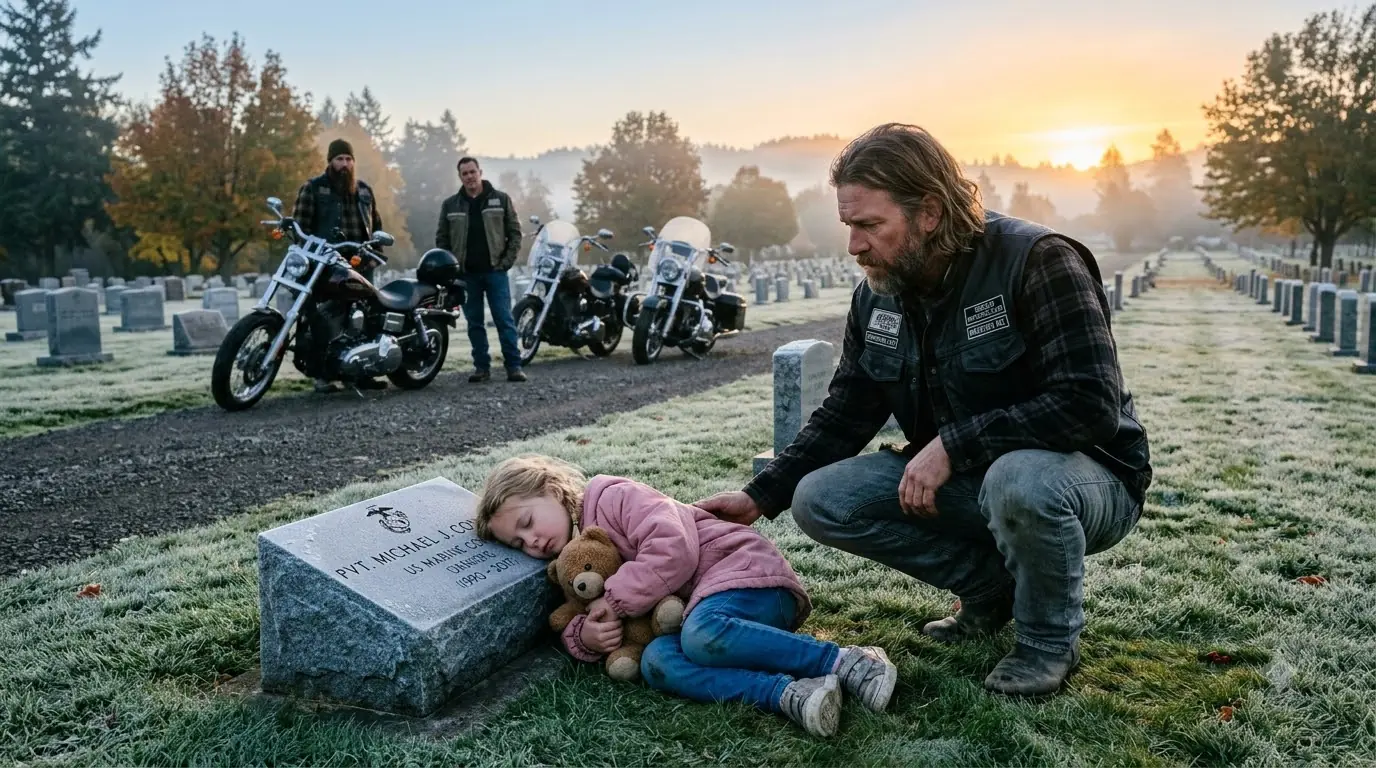
Duke had seen plenty during his forty-three years riding with the Angels. He had witnessed fights, funerals, brotherhood, loss, and men trying to hide fear behind loud voices. But a seven-year-old child camped in a cemetery as though she were waiting for a bus was something entirely new.
What she had said made it stranger.
Duke had pulled into Medford Memorial Cemetery by accident. His motorcycle chain had begun making an expensive-sounding noise three miles earlier, and when he noticed the cemetery gates standing open, he decided the quiet driveway was as good a place as any to inspect it away from traffic. April nights were still cold enough to turn his breath into pale clouds, and the moon was only a silver sliver behind the Douglas firs.
He killed the engine and let the silence settle. That was when he heard the humming—a child’s voice, soft and steady, drifting from somewhere among the rows of headstones. Duke was not easily frightened, but something about that lonely melody made the skin along his arms tighten.
He grabbed a flashlight and started walking. His boots crunched across the gravel as he passed rows of marble and granite, plastic flowers, memorial wreaths, and small American flags stiffened by frost. The humming grew clearer as he moved deeper into the cemetery.
Then he saw her.
Her blonde hair was divided into two untidy braids. She wore a pink jacket three sizes too large and sat on a flat headstone as though it were a park bench, her legs swinging while she hummed what might have been a lullaby.
“Why are you sitting out here alone, kid?” Duke called, keeping his voice low so he would not frighten her.
She stopped humming and turned.
Her eyes were too calm and knowing for such a young face.
“You knew my daddy,” she said.
Duke stepped closer and directed the flashlight toward the stone beneath her.
COLE BENJAMIN MERCER
1985–2024
BELOVED SON, FATHER, AND BROTHER
Beneath the dates was the eagle, globe, and anchor of the United States Marine Corps.
“I didn’t know your father well, sweetheart,” Duke said carefully. “But I can tell he must have been a good man if he raised someone brave enough to sit out here alone.”
“I’m not alone,” the girl replied. “He’s right here.”
Something tightened inside Duke’s chest.
He had buried friends and club brothers. He knew what grief looked like when adults tried to hide it beneath anger, alcohol, or silence. What he saw in this child was different—grief so innocent that it had built its own unbreakable logic.
“What’s your name?”
“Lily Mercer.”
“Where’s your mother, Lily?”
“She died three years ago. Car accident.”
Duke lowered the flashlight.
“Where’s your grandmother? Is anyone looking for you?”
Lily shrugged as if the question hardly mattered.
“Grandma Donna knows I come here. She tries to stop me, but I’m really quiet. I always get home before breakfast.”
“How long have you been doing this?”
“Every night since Daddy died. Six weeks.”
Six weeks meant forty-two nights.
For forty-two nights, this seven-year-old girl had been leaving home and crossing town to sit beside her father’s grave.
Duke crouched until he was level with her.
“Why do you keep coming here when it’s freezing and dangerous?”
“Daddy promised he would always protect me,” she explained. “He said even when I couldn’t see him, he would still be there. So I stay close, so he doesn’t have to work too hard.”
The reasoning was perfect in the way only a child’s reasoning could be.
Duke swallowed against the pressure building in his throat.
“Come on,” he said gently. “Let’s get you home.”
“I don’t want to go.”
“I know. But your grandmother is probably terrified.”
Lily considered that, then nodded. She slid off the headstone, brushed the dirt from her jeans, and placed her hand in Duke’s as though she had known him her entire life.
They walked through the cemetery without speaking. When they reached his motorcycle, Lily stopped and stared at the patch on the back of his jacket.
“You ride with the Angels.”
It was not a question.
“Yeah. How did you know?”
“Daddy told me about you. He said you were his brothers. He said if I ever needed help and he wasn’t there, I should find someone wearing that patch.”
“Your father rode with us?”
Lily shook her head.
“No. He fixed motorcycles at Miller’s Garage. You guys came in all the time. He said you were good people, even though other people were afraid of you.”
A memory surfaced.
Miller’s Garage. A tall mechanic with patient eyes who never overcharged anyone. A man who once let Duke pay for a major repair in installments after his divorce emptied his bank account.
Cole.
Duke remembered him now.
“I did know your daddy,” Duke said quietly. “Not as well as I should have, but I remember him. He was a good man.”
Lily smiled for the first time.
The sight nearly broke Duke.
He gave her a slow, careful ride through the empty streets of Medford. She directed him toward a small house on Maple Street with peeling yellow paint and a porch light burning against the darkness.
The front door flew open before they reached the walkway.
“Lily!”
A woman of about sixty rushed outside wearing a bathrobe and slippers. Her gray hair was disordered, and her face held relief, anger, fear, and exhaustion in equal measure.
“Grandma Donna,” Lily said calmly, “this is Duke. He knew Daddy.”
Donna Mercer stopped when she saw the huge biker holding her granddaughter’s hand. Fear flickered across her face, but it quickly gave way to gratitude.
“Thank you,” she said, her voice shaking. “Thank you for bringing her home.”
“She was at the cemetery,” Duke told her.
“I know.”
Donna’s shoulders sagged.
“She goes every night. I’ve locked the doors and windows. I’ve hidden her shoes. She always finds a way out. I don’t know what to do anymore.”
“I just want to be with Daddy,” Lily said.
“Baby, Daddy isn’t there. Not really. He’s—”
Donna’s voice broke.
“He’s gone.”
“He’s not gone,” Lily said fiercely. “He promised.”
Donna looked helplessly at Duke.
“What am I supposed to do? She won’t listen, and she won’t stop. The school called yesterday because she fell asleep during reading. They’re asking questions, and I’m afraid they’ll decide I can’t take care of her.”
Duke did not know what to say.
He barely knew them. He had only the fragments Lily and Donna had given him, yet something in his instincts told him that this mattered. He felt as though he had arrived at that cemetery for a reason he did not yet understand.
“I’ll come back tomorrow,” he heard himself say. “Maybe I can talk to her, if that’s all right.”
Donna studied him for several seconds before nodding.
Duke rode home while dawn began breaking over the Cascades. He had never had children and had never wanted the responsibility. Yet Lily’s face—and the certainty with which she had said, “You knew my daddy”—had settled beneath his skin.
The following afternoon, he returned to the yellow house carrying a box of doughnuts and no real plan. Donna let him inside, looking as though she had not slept at all. Lily sat at the kitchen table attempting to do homework, but her eyes kept drifting shut.
“Hey, kid,” Duke said.
Her face brightened.
“You came back.”
“I said I would.”
He sat across from her.
“Why are you having trouble staying awake at school?”
“I’m fine.”
“You’re not fine,” Donna said from the doorway. “You’re exhausted. You’re seven years old, baby. You need to sleep in your own bed.”
“I can’t.”
“Why not?” Duke asked.
Lily looked at him as though the answer should have been obvious.
“Because Daddy’s alone out there. He didn’t like being alone. When I was little and got scared at night, he stayed in my room until I fell asleep. Now I stay with him.”
Again, the logic was heartbreaking and complete.
Duke rubbed a hand across his face.
“Your father wouldn’t want you hurting yourself for him.”
“I’m not hurt.”
“You’re exhausted. You’re going to get sick, and your grandmother is terrified.”
“But if I stop, he’ll be alone.”
“What if he isn’t?” Duke asked carefully. “What if there were a way to make sure someone always remembered him, while you still slept safely at home?”
Lily narrowed her eyes.
“How?”
Duke did not have an answer yet.
But an idea was beginning to form—something wild, perhaps foolish, but possibly right.
“Let me make a few calls.”
That night, Duke sat inside his garage with a beer and stared at Rex Callaway’s number on his phone. Rex was president of the Medford chapter, a man who had survived three deployments overseas and returned with a Purple Heart and the belief that brotherhood was the only thing that truly mattered.
Duke had not spoken to him in six months. They had fallen out after a dispute involving another club member named Tommy, but this was not about Duke or Rex. It was about a little girl and a promise.
He dialed.
Rex answered on the second ring.
“Briggs, this had better be important.”
“It is. Do you remember Cole Mercer?”
There was a pause.
“The mechanic? Quiet guy, good with a torque wrench?”
“That’s him.”
“I heard he died. Cancer, right?”
“Yeah. He left a seven-year-old daughter. She’s been sleeping on his grave every night since he died.”
The silence lengthened.
“Say that again.”
Duke told him everything—the cemetery, Lily, Donna, the school’s concerns, and the threat no one had spoken aloud but everyone feared. Social services. Foster care. A system that might look at Lily’s grief and see only neglect.
When Duke finished, Rex remained quiet so long that Duke thought the connection had failed.
“What do you need?” Rex finally asked.
“I need brothers. I need to show this child that her father isn’t alone and that we look after our own, even after they’re gone.”
“Cole wasn’t a patch holder.”
“No, but he was one of us anyway. You know it, and I know it.”
Rex exhaled.
“This could look strange, Briggs.”
“I don’t care how it looks.”
“Neither do I. Give me two days. I’ll make some calls.”
Two mornings later, Duke’s phone rang at six.
“Parking lot at Miller’s Garage,” Rex said. “Noon. Bring the girl if her grandmother agrees.”
Donna answered the door in her bathrobe again when Duke arrived.
“I don’t think much frightens that child. I think she needs to see this.”
Donna went to get Lily.
The girl appeared wearing the oversized pink jacket and carrying a backpack shaped like a ladybug.
“Are we going to see Daddy?”
“Something like that,” Duke said.
They drove across town in his pickup. He refused to put Lily on the motorcycle again without proper protective gear.
When they entered the garage parking lot, Lily gasped.
Twenty motorcycles stood in the spring sunlight, chrome gleaming beside leather vests, denim, patches, weathered faces, and men and women whose eyes suggested long histories. Rex Callaway waited in the center with his arms crossed like a commander inspecting his unit.
Duke helped Lily out.
She stared at the bikers with her mouth open.
“These are the brothers I told you about,” Duke said. “They knew your father, and they wanted to meet you.”
Rex stepped forward and lowered himself onto one knee.
At six feet four inches, with tattoos climbing his neck and a scar running from his temple to his jaw, he could intimidate grown men without speaking. But when he addressed Lily, his voice was gentle.
“Why have you been keeping your father company every night?”
“Because he doesn’t like being alone.”
“That’s a brave thing to do,” Rex said. “But we were wondering whether you might let us help. What if we made sure somebody always remembered him, so you didn’t have to sit outside in the cold?”
Lily’s eyes widened.
“You would do that?”
“We take care of our own,” Rex said. “That includes you.”
Thomas, a biker with a gray ponytail, stepped forward.
“We’ll create a rotation. Every night, somebody will ride past the cemetery and make sure everything is all right.”
Ruby, a tall, serious woman wearing a chapter patch, joined him.
“We can leave flowers, flags, or whatever you choose.”
Lily looked at Duke and then back at Rex.
“So Daddy won’t be alone?”
“Never,” Rex promised.
For the first time since Duke met her, Lily’s composure collapsed.
She threw her arms around Rex’s neck and sobbed against his leather vest. Rex, a man who had buried friends and rarely displayed emotion, wrapped his arms around the small child and held her.
Duke turned away.
Several others did the same.
When Lily finally pulled back, she wiped her nose against her sleeve and looked around the group.
“Thank you.”
“You’re family now,” Rex said simply.
They remained at the garage for another hour. The bikers took turns telling Lily about the times Cole had repaired a machine without charging labor, lent someone money, or stayed late to help a stranded rider. Lily absorbed every story as though they were water in a desert.
For the first time, Duke saw the beginning of peace in her eyes.
As they prepared to leave, a silver sedan with government plates entered the parking lot.
A woman in her mid-thirties stepped out. She wore a sharp suit, carried a briefcase, and had the alert expression of someone who had seen every kind of difficult family situation.
“Ms. Mercer?” she called.
Donna went pale.
“That’s me.”
The woman approached.
“I’m Beth Harmon from Child Protective Services. I need to speak with you about Lily.”
Everything stopped.
The bikers became still. Lily, who had been laughing seconds earlier, moved against Duke’s leg.
“What about her?” Donna asked.
Beth’s expression softened slightly.
“I received a report from her school regarding excessive fatigue, difficulty concentrating, and changes in behavior. I need to conduct a wellness assessment.”
“She’s fine,” Donna said quickly. “She’s grieving. Her father recently died.”
“I understand. But I have a responsibility to ensure that she’s living in a safe environment. I’d like to conduct a home visit tomorrow.”
“What happens if I say no?”
“I obtain a court order.”
Beth’s voice was not cruel, but it was immovable.
“Ms. Mercer, I’m not here to take your granddaughter away. I’m trying to understand the situation, but I need your cooperation.”
Donna looked at Duke, panic filling her eyes.
“With respect,” Duke said, “this child has more people looking out for her than most. She’s grieving, but she isn’t neglected.”
Beth looked directly at him, taking in the patch, the beard, and the way he positioned himself between her and Lily.
“And you are?”
“A friend of the family.”
“I see.”
Beth handed Donna a card.
“Tomorrow at two. I’ll meet you at your home.”
She returned to the sedan and drove away.
The silence afterward felt suffocating.
“She’s going to take Lily,” Donna whispered. “They’ll say I can’t manage her. They’ll say I’m too old.”
“They’re not taking anyone,” Rex said, his voice like iron. “Not if we can prevent it.”
“You don’t understand,” Donna replied. “The system doesn’t care about good intentions. They see a child sleeping in a cemetery and a grandmother who can’t stop her. They’ll call it neglect.”
“Then we change what they see,” Duke said.
Everyone turned toward him.
“How?” Donna asked.
Duke did not yet have all the pieces, but he was beginning to understand the shape of the solution.
“We show them who Cole was. We show them what he meant to this town. Lily isn’t an abandoned child acting out. She’s keeping a promise to her father, and we’re going to keep our promise to him.”
“How?” Thomas asked.
Duke looked at Rex.
“We ride.”
Rex narrowed his eyes.
Then he smiled.
“Yes,” he said. “We do.”
That night, Duke sat in Donna’s kitchen while Lily slept in her own bed for the first time in weeks. Donna had promised that Duke would personally ride past the cemetery at midnight to check on Cole’s grave, and Lily had made him swear on his motorcycle.
“I don’t know whether this will work,” Donna admitted. “Beth will ask questions tomorrow that I don’t have good answers for.”
“Tell her the truth. Don’t hide anything and don’t make excuses. Tell her who Lily is and who Cole was.”
“And if that isn’t enough?”
Duke had no answer.
The following afternoon, Duke arrived at one-thirty and found Donna pacing like a trapped animal. Lily was still at school, leaving them half an hour before the appointment.
“I cleaned everything,” Donna said frantically. “Her room, the bathroom, the kitchen. I threw away expired milk. I filled the refrigerator. I vacuumed twice.”
“Donna, stop.”
Duke placed both hands on her shoulders.
“You’re not on trial.”
“Aren’t I?”
Her voice cracked.
“My son died two months ago. I’m sixty-two years old. I worked at the post office for thirty years and retired on a pension that barely pays the mortgage. I never expected to raise a child alone.”
She looked toward the hallway.
“Cole and Sarah raised Lily. Then Sarah died, Cole got sick, and suddenly it was me and a seven-year-old who kept escaping to sleep beside a grave. How does that look to someone like Beth Harmon?”
Duke could not answer because Donna was right.
On paper, the situation looked terrible.
“Where is Lily’s room?” he asked.
Donna led him down the hallway.
Butterfly and star stickers decorated the door. Inside, the walls were pink, the bed was unmade, stuffed animals covered almost every surface, and shelves overflowed with books.
Photographs were pinned to a corkboard.
Lily and Cole at the beach. At a carnival. Blowing out birthday candles.
Cole was smiling in every image—not the empty smile people offered cameras, but something genuine that reached his eyes.
Duke picked up a framed photograph from the nightstand. Cole wore Marine dress blues and held Lily as a baby.
“He enlisted straight out of high school,” Donna said from the doorway. “He completed two deployments in Afghanistan. He came home changed, but he never let what happened there poison him.”
She paused.
“Then he met Sarah, married her, and had Lily. He thought the hardest part of his life was behind him.”
“Until Sarah’s accident.”
Donna nodded.
“A drunk driver ran a red light. Cole was never the same after she died. Then he started having headaches and dizzy spells.”
“What did the doctors find?”
“Stage-four brain cancer. Inoperable. They gave him six months. He survived eight, mostly because he refused to die until he knew Lily would be safe.”
“Did he know she would live with you?”
“He made me promise.”
Donna’s voice thickened.
“On his deathbed, he opened his eyes and said, ‘Mom, I need you to take her. Love her the way I love her. Promise me.’ What else could I say?”
She looked toward the pictures.
“I promised. I just don’t think either of us understood how hard it would be.”
The doorbell rang.
Donna flinched.
Duke checked the time.
Two o’clock exactly.
Beth Harmon stood on the porch wearing another precise suit and carrying the same briefcase. Recognition flickered across her face when she saw Duke.
“You’re the biker from yesterday.”
“Duke Briggs. I’m staying to make sure this is handled fairly.”
“This isn’t a negotiation, Mr. Briggs. It’s a welfare assessment.”
“Then my presence shouldn’t interfere.”
Beth considered pushing back but chose not to. She stepped inside.
Donna waited in the living room with her hands clasped so tightly that her knuckles had turned white. Beth sat on the couch, opened a tablet, and began typing.
“How long has Lily been living with you?”
“Two months, since Cole died. Before that, she lived with him. He had full custody after Sarah was killed.”
“Are there any other relatives?”
“Sarah was an only child. Her parents died in a house fire when she was in college. On our side, it’s mostly just me.”
Beth continued typing.
“Tell me about the cemetery visits.”
Donna took a breath.
“It began the night after the funeral. I woke up and she was gone. I found her at Cole’s grave because she said she needed to make sure he wasn’t alone.”
“What happened after that?”
“I brought her home and locked the doors and windows. The next night she escaped through her bedroom window and climbed down the tree outside.”
“You allowed this to continue?”
“I didn’t allow it,” Donna said sharply. “I couldn’t stop it.”
She leaned forward.
“Do you have children, Ms. Harmon?”
“That isn’t relevant.”
“It is to me. Sometimes love looks like obsession. Sometimes grief looks irrational, but it’s still grief. Lily isn’t trying to harm herself or punish me. She’s trying to keep a promise to her father.”
“A promise that is damaging her education and health.”
“She isn’t failing.”
“She slept through part of a fire drill last week,” Beth said, reading from her tablet. “Her teacher had to wake her. She’s behind in reading, increasingly withdrawn, no longer playing with other children, and barely eating lunch.”
Donna’s face crumpled.
“I know. But her father hasn’t even been gone three months. Can’t she have time?”
“Time does not help if the environment remains unstable.”
Beth looked around the room.
“Is Lily taking any medication or seeing a therapist?”
“She met with a grief counselor twice and refused to return.”
“Why?”
“The counselor told her Cole was in a better place. Lily said that if he was in a better place, he wouldn’t need her to visit.”
Donna pressed one hand against her mouth.
“What am I supposed to do with that?”
Beth typed for a long moment.
“I need to inspect Lily’s room.”
They went down the hallway. Beth examined the closet, the drawers, the bed, and the window.
“This is how she leaves?”
“Yes.”
“Have you considered security bars?”
“I will not put my granddaughter in a cage.”
Beth did not respond. She added another note.
As they returned to the living room, the front door opened.
Lily entered with her backpack sliding from one shoulder. Her face lit up when she saw Duke, then immediately dimmed when she noticed Beth.
“You’re here,” she said to Duke.
“Hi, Lily,” Beth said gently. “My name is Beth. I work with families to make sure children are safe and healthy. May I speak with you?”
Lily looked at Donna.
Donna nodded.
They sat at the kitchen table. Duke remained in the doorway with his arms crossed while Donna hovered nearby, twisting her fingers.
“Why have you been so tired at school?” Beth asked.
“I’m fine.”
“Are you sleeping well?”
“Sometimes.”
“Where do you sleep?”
“My bed.”
“Every night?”
Silence.
Beth leaned forward.
“You aren’t in trouble, Lily. I’m trying to understand. Why do you go to the cemetery?”
“Because Daddy’s there.”
“His grave is there, but he isn’t physically there. He died.”
Lily’s eyes flashed.
“He isn’t gone. He promised he’d never leave me.”
“I’m sure he wanted to keep that promise.”
“He did keep it,” Lily said, raising her voice. “I can feel him. When I sit on his stone, I hear him telling me that he loves me and that he’s proud of me. If I stop going, he’ll think I forgot him.”
Beth was quiet.
“What if your father wanted you to be rested and healthy? What if he didn’t want you hurting yourself to visit him?”
“I’m not hurting myself.”
“You’re exhausted and falling behind in school. That is hurting you.”
Panic entered Lily’s face.
“I’ll sleep more,” she promised. “I’ll go to bed earlier and wake up on time. I won’t be tired anymore.”
“Baby, that isn’t the point,” Donna began.
“I’ll be good,” Lily cried. “I’ll be so good. Please don’t take me away from Grandma.”
Something inside Duke snapped.
“She isn’t taking you anywhere.”
Beth turned.
“Mr. Briggs, step back.”
“No.”
Duke moved closer.
“This child lost her father after losing her mother three years earlier. She’s terrified and trying to hold on to the last parent she had in the only way she understands. You’re making her believe she has done something wrong.”
“I’m doing my job.”
“Your job is to protect children who are in danger. Do you see danger here? The house is clean. There’s food in the refrigerator. Lily is fed, dressed, loved, and cared for.”
Beth stood.
“Mr. Briggs, if you do not leave this room, I will contact the police and have you removed.”
“Call them. Let the entire town hear how you threatened to remove a grieving child from the only family she has because she loves her father too much.”
“Duke.”
Donna’s voice was quiet but firm.
“Please.”
He looked at her.
The fear in Donna’s eyes was not fear of Beth. It was fear that Duke’s anger was making everything worse.
He stepped back.
Beth collected her belongings.
“Ms. Mercer, I will submit a report to my supervisor. A follow-up assessment will be scheduled within the week.”
Donna’s face lost its color.
“In the meantime, find a way to stop Lily from leaving at night. Improve the locks and take whatever reasonable precautions are necessary. If this continues, I may have to recommend temporary placement while we assess whether the home is safe.”
“You can’t do that.”
“I can if I believe Lily is at risk.”
Beth looked at the child, and for one brief moment, Duke saw sympathy in her expression.
“I know you love your father, sweetheart. But sometimes love means letting go.”
After Beth left, silence crushed the room.
Then Lily burst into tears—not quiet tears, but the loud, gasping cries of a child whose world no longer made sense.
Donna gathered her into her arms and began crying as well.
Duke stood nearby feeling useless, angry, and ashamed.
Finally, Donna looked at him.
“You need to go.”
“Donna—”
“Now, Duke. Please. I need to figure this out, and I can’t do it with you making the situation worse.”
The words struck him like a physical blow.
But she was right.
His temper, his mouth, and his need to solve the problem had all backfired.
He left.
Outside, the sun shone as though nothing had happened. Birds called from trees, and neighbors pushed lawn mowers across neat yards.
The world continued with complete indifference.
Duke got on his motorcycle and rode without deciding where he was going. Eventually, he found himself back at the cemetery.
Fresh flowers had already been placed beside Cole’s stone.
Rex had kept his promise.
Duke sat on the grass and allowed the quiet to settle around him.
“I’m ruining this,” he said aloud. “Your daughter is in trouble, and I’m making it worse.”
The wind moved through the trees.
“I don’t know what you want me to do, Cole. I don’t know if you can hear me, but I could use some help.”
Nothing answered.
Duke pulled out his phone and called Rex.
“We have a problem.”
He explained Beth’s visit, her threat, and Donna asking him to leave.
When Duke finished, Rex was silent.
“We need to move faster,” he finally said.
“On what?”
“The ride and the memorial. All of it. We were thinking six weeks, enough time to contact people. But if CPS is already involved, we don’t have six weeks.”
“What are you suggesting?”
“This weekend.”
“That’s four days. We cannot organize anything meaningful in four days.”
“We can if we call every favor we have. I’ve already contacted Medford, Ashland, Grants Pass, and Klamath Falls. The story is spreading.”
“And what is the plan? We arrive with a hundred bikers and intimidate a social worker?”
“No. We show her who Cole was. We show her that Lily is not isolated and Donna is not alone. This child belongs to a community, and that community supports her.”
It was risky and perhaps unreasonable.
But it was something.
“All right,” Duke said. “Let’s do it.”
“You start contacting people. I’ll handle the chapters. And Duke?”
“Yeah?”
“Do not lose your temper again. We need Donna to trust us.”
After the call, Duke sat beside Cole’s grave for several more minutes. Then he returned to Maple Street.
Donna opened the door with red eyes and an expression that suggested she might close it immediately.
“I’m sorry,” Duke said before she could speak. “I was out of line, and I made things worse. But I’m not giving up on Lily or you.”
Her expression softened slightly.
“What do you want?”
“To explain the plan.”
She let him inside.
Lily was sleeping on the couch, exhausted from crying.
Duke and Donna spoke quietly in the kitchen. He explained the ride, the memorial, and the idea of showing Beth—and the entire town—what Cole had meant to people.
“This could backfire,” Donna warned. “If Beth sees a hundred bikers arrive, she may think we’re trying to intimidate her. She might remove Lily immediately.”
“Or she may see what I see—a community that loves this child, a father who mattered, and a grandmother doing everything she can.”
Donna studied him.
“Why do you care so much? You barely knew Cole.”
Duke did not have a simple answer.
It was something in Lily’s face, something about promises, and something about the way the world often punished people whose grief did not fit acceptable shapes.
“Because she deserves better than what she’s getting,” he said. “And because I believe Cole would have done the same for me.”
Tears filled Donna’s eyes.
She nodded.
“All right. Let’s do it.”
The next three days became chaos.
Rex and other chapter presidents stayed on their phones constantly. The Medford chapter contacted riders throughout Oregon, Northern California, and Washington.
Social media spread the story through biker groups, veterans’ pages, neighborhood forums, and local organizations. Someone designed a flyer using Cole’s photograph beneath the words RIDE FOR A FALLEN BROTHER.
Duke barely slept.
He coordinated with local businesses, reserved the American Legion Hall for a gathering after the ride, arranged food, and obtained permission from the cemetery.
The cemetery manager was hesitant at first, worried that hundreds of motorcycles might damage the grounds. When Duke explained why they were coming, the man’s eyes filled with tears.
“You can use the property,” he said. “Just be respectful.”
Donna went through boxes in the garage.
She found photographs, medals, letters, and the folded Marine Corps flag presented to her at Cole’s funeral. She found his old work shirts from Miller’s Garage, still carrying a faint trace of motor oil.
She also discovered a journal from his deployments.
Inside were letters he had written to Lily, intending to give them to her when she was older.
Lily did not know the full plan. Donna only told her there would be a special event for her father.
On Friday night, Duke received a call from an unfamiliar number.
“Mr. Briggs?”
“Yes?”
“This is Principal Gardner from Lily’s school. I heard what you’re organizing tomorrow.”
Duke’s stomach tightened.
“How?”
“Small towns do not keep secrets. I’m calling to tell you I’ll be there, and I’m bringing a formal letter supporting Ms. Mercer.”
“You will?”
“Lily’s teacher, Mrs. Patterson, is worried, but she has also seen how hard Donna is trying. What Lily needs is not a different home. She needs time, grief support, and a stable community.”
The principal ended the call before Duke could properly thank her.
Ten minutes later, the owner of Miller’s Garage called.
“I’m closing the shop tomorrow. My employees and I are riding.”
Then came another call, and another.
A grocery store manager. A woman from Donna’s church. A veteran who had served with Cole and was driving twelve hours from Seattle.
By midnight, Duke’s phone would not stop vibrating.
Saturday dawned clear and cold.
Duke reached the yellow house at eight. Donna wore black slacks and a sweater and held Cole’s folded flag against her chest.
Lily wore her pink jacket. Her braids were freshly tied, and her eyes were wide with anticipation.
“Is it time?”
“Almost.”
At nine, motorcycles began gathering at Miller’s Garage.
Duke drove Donna and Lily there in his truck. When they entered the parking lot, Lily gasped.
Bikes filled the entire property.
Rows of chrome, flags, leather, and painted fuel tanks stretched around the building. Duke had expected perhaps a hundred riders.
There were closer to two hundred.
“How many?” Donna whispered.
“I don’t know. More than I expected.”
Rex approached.
Behind him, the crowd parted.
Duke recognized Thomas, Ruby, and the Medford riders, but there were also patches from Ashland, Klamath Falls, Eugene, Portland, Grants Pass, and communities farther north and south.
“They came,” Rex said.
Lily climbed slowly out of the truck.
Duke watched for fear.
Instead, she smiled.
An older rider with a gray beard and a NOMAD patch stepped forward carrying a small stuffed bear wearing a tiny leather vest.
“This is for you,” he said gruffly. “From all of us.”
Lily clutched it to her chest.
“Thank you.”
More riders approached.
A woman gave her a handmade card. A man offered her a pin shaped like angel wings. Another presented a bracelet engraved with Cole’s name.
Donna began crying again.
This time, the tears came from relief.
At ten, Rex raised one hand.
The parking lot fell silent.
“We ride for Cole Mercer,” he announced. “A Marine, a father, a mechanic, and a brother. He gave what he had to the people he loved. Today, we give something back.”
Two hundred voices answered together.
“Semper Fi.”
The engines came alive.
The sound rolled through Medford like approaching thunder. Windows trembled, dogs barked, and residents stepped onto porches to watch.
Rex led the procession.
Duke rode near the front. Donna and Lily traveled in his truck, positioned between two groups of motorcycles.
When Duke checked the rearview mirror, chrome and leather extended behind him for what seemed like miles.
Lily pressed her face against the window.
“There are so many,” she kept saying. “Daddy would love this. He would love it so much.”
Donna held Cole’s flag and cried silently.
The procession moved slowly along the main road so the group could remain together. People lined sidewalks holding phones, waving, and placing hands over their hearts.
At the corner of Third and Main, an elderly man wearing a Vietnam veteran cap stood at attention and saluted as the riders passed.
Duke’s phone vibrated repeatedly inside his pocket, but he ignored it.
When the procession turned onto Cemetery Road, two Medford police officers stood beside the open gates.
Duke’s stomach tightened.
He assumed they had come to stop the gathering.
As Rex reached the entrance, one officer stepped forward and saluted.
“Proceed,” he said. “We’re here to help with traffic.”
Rex nodded and entered.
Motorcycles occupied every designated area. Some riders parked carefully on sections of grass, avoiding every grave and memorial.
When the final engines stopped, the sudden silence felt immense.
Duke helped Donna and Lily out of the truck.
Lily held the stuffed bear tightly while hundreds of people walked quietly toward Cole’s grave.
No one shouted or played music.
They understood where they were.
Cole’s grave stood in a newer section beneath a large oak tree. Fresh flowers were already there.
Now more were added.
Roses, carnations, lilies, miniature American flags, a Marine Corps flag, and a polished motorcycle chain arranged respectfully near the base of the stone.
Lily approached with Donna on one side and Duke on the other.
She knelt and placed the small bear on the grave.
“Hi, Daddy,” she whispered. “I brought your friends.”
Duke turned away.
So did many others.
Rex stepped forward.
“Cole Mercer served two tours in Afghanistan. He returned home with a Purple Heart and a determination to live a life that mattered.”
His voice carried clearly through the gathering.
“He worked hard. He loved his daughter. He helped people even when he had little for himself. When he became ill, he didn’t ask for sympathy. He focused on making sure those he loved would be safe after he was gone.”
A low murmur moved through the crowd.
“We are here to make certain his daughter understands something. She is not alone, and she never will be. Cole was one of us, and we take care of our own.”
Someone began clapping.
Others joined until the sound resembled a standing ovation rather than a funeral.
Lily looked around, overwhelmed.
Then a voice came from the rear.
“I have a story.”
A man in his fifties wearing a faded Marine Corps jacket stepped forward.
Duke did not recognize him.
“My name is Martinez. I served with Cole in Helmand Province.”
He faced Lily.
“Our vehicle was struck during a patrol. Several of us were injured. Cole was unharmed and could have remained behind cover, but he returned to help us.”
Martinez paused as emotion tightened his throat.
“He pulled me and another Marine to safety. He saved our lives. He received a medal, but he never spoke about it.”
Lily stared at him.
“I didn’t know he had a daughter until I saw the memorial post. I drove nine hours because your father saved me, and the least I could do was make sure you knew what kind of man he was.”
Another voice rose.
“I have a story too.”
A woman in her early thirties stepped forward.
“My name is Sarah Chen. I manage the food bank on Riverside. Cole volunteered every Saturday for three years, even after he became sick.”
She looked at Lily.
“He said he wanted to teach his daughter that people must care for those who are struggling, because one day any of us might be the one who needs help.”
Then another person spoke.
A mechanic from Miller’s Garage described Cole repairing his motorcycle without charging him when money was scarce. A teacher said Cole had built shelves for her classroom.
A single mother remembered Cole changing her flat tire in heavy rain and refusing payment.
Story after story moved through the crowd.
Duke watched Lily’s expression transform.
Confusion gave way to pride and understanding. Her father had not belonged only to her; his life had touched all these people.
Donna sobbed openly.
“I didn’t know,” she kept whispering. “I knew he was good, but I didn’t know.”
“He never considered those things worth announcing,” Rex said gently. “That was who he was.”
The stories continued for more than twenty minutes.
When they ended, the silence felt sacred.
Principal Gardner stepped forward holding a folder.
“I’m Principal Gardner from Jackson Elementary. I am here in an official capacity to state that Lily Mercer is a student in good standing.”
She looked directly at Donna.
“Yes, Lily has been tired. Yes, she is grieving. But she is also kind, respectful, and loved by her teachers. Ms. Mercer is raising her under extraordinarily difficult circumstances, and I will submit a formal letter supporting that conclusion to Child Protective Services.”
Donna’s knees weakened.
Duke caught her arm.
“Thank you,” she managed.
“Thank your son,” Principal Gardner said. “He raised a daughter worth fighting for.”
Movement near the cemetery entrance drew Duke’s attention.
A silver sedan entered.
Beth Harmon stepped out.
She looked slowly across the gathering—two hundred bikers, veterans, families, flowers, flags, and a memorial ceremony conducted with complete respect.
Rex moved as though he intended to intercept her.
Duke stopped him.
“Let her see.”
The crowd opened a path.
Beth walked to Cole’s grave and stopped several feet from Lily. For a long moment, she examined the stone, the Marine Corps flag, and the mountain of flowers.
Then she looked at the child.
“I didn’t know,” Beth said softly.
“Nobody did,” Lily replied. “That’s why I had to tell them. That’s why I came every night. If I didn’t, people might forget, and Daddy deserves to be remembered.”
Beth crouched to Lily’s level.
“He does deserve to be remembered. I’m sorry I didn’t understand that.”
“Are you going to take me away from Grandma?”
Beth remained silent for several seconds.
“No,” she finally said. “I’m not.”
Relief swept through the crowd.
Donna gripped Duke’s arm.
“But I need you to make me a promise,” Beth continued. “You must start sleeping at home every night. No more sneaking out.”
Lily looked toward the grave.
“What about Daddy?”
“You can visit during the day. Your grandmother can bring you after school or on weekends. You can sit here when it is safe and warm, but at night you sleep in your own bed.”
Lily looked at Donna.
Hope illuminated her grandmother’s face.
“Deal,” Lily said.
Beth stood and entered a note into her phone.
“I’m closing the case with a recommendation for continued community support. Ms. Mercer, I’ll connect you with free grief counseling specifically designed for children.”
“Thank you.”
“I’ll check in monthly for a while, but that is support, not supervision.”
Donna suddenly hugged her.
Beth appeared surprised but returned the embrace.
Rex stepped forward.
“We are creating a fund for Lily’s education and for any necessary expenses. The brotherhood takes care of its own.”
Beth looked at him differently than she had in the garage.
“That’s good,” she said. “That’s very good.”
After her car disappeared, the crowd erupted into cheers and embraces.
Someone began chanting Lily’s name.
Soon, hundreds joined.
Duke lifted Lily onto his shoulders. She waved, and two hundred bikers waved back.
Then he noticed a man standing apart from the crowd.
The stranger was about thirty-five, clean-cut, and dressed in khakis and a button-down shirt. A camera hung from his neck, and he held a notebook.
Duke set Lily down and approached.
“Can I help you?”
The man offered his hand.
“Jason Torres. I’m a reporter with the Mail Tribune. Someone told me what was happening today.”
He looked toward the grave.
“This is remarkable. I would like to write about Cole, Lily, and the people who came here.”
“I need to ask Donna.”
Duke brought him over.
“I don’t want Lily exploited,” Donna said immediately.
“I understand. I’m not here to turn her grief into entertainment. I want people to know who Cole Mercer was and what this community did.”
Donna studied him.
“If I agree, I see the article before publication. If I believe it exploits Lily, it does not run.”
“Agreed.”
Jason spent the next hour interviewing Martinez, Sarah Chen, Principal Gardner, Miller’s Garage employees, Duke, Rex, and others.
He spoke briefly with Lily while Donna stayed beside her. When Lily became tired, Donna ended the interview.
As the gathering dispersed, people approached Donna one by one.
A bakery owner offered groceries, meals, or transportation. A contractor offered to repair the leaking roof at no charge.
A woman from the recreation center invited Lily to join art classes, sports, and youth programs whenever she wished.
By the time the final visitors departed, Donna held a stack of cards and telephone numbers several inches thick.
“I don’t understand,” she told Duke. “Most of these people never knew Cole. Why are they helping?”
“They know him now,” Duke answered. “That’s enough.”
Rex approached carrying his helmet.
“We need to discuss the fund.”
They moved away from Lily, who was speaking quietly beside the grave.
“I know someone who manages a nonprofit,” Rex explained. “He can create a proper charitable structure and educational trust. Donations will be documented and protected.”
“How much do you think people will give?” Duke asked.
“Ten or twenty thousand, perhaps. Enough to remove some pressure.”
“I can’t accept that,” Donna said. “It’s too much.”
“It isn’t for you,” Rex replied. “It’s for Lily’s education and future. Let us do this for Cole.”
Donna looked toward her granddaughter.
“All right.”
The group moved to the American Legion Hall that afternoon.
The building was packed. More townspeople had arrived after hearing about the ride.
A local restaurant donated food, and others brought drinks. It was not a party, exactly, but neither was it a funeral.
Duke found himself beside Martinez.
“Did you know Cole was sick?” Duke asked.
“Not at first. He didn’t want pity. I spoke to him several times during his final months.”
“What did he talk about?”
“Lily.”
Martinez looked across the room.
“He wasn’t afraid of dying as much as he was afraid of leaving her. He worried about who would teach her to ride a bicycle, how to stand up to bullies, and how to understand her own worth.”
His voice lowered.
“He made me promise to check on her if I ever had the chance. I failed him. It took me two months to learn where she was.”
“You’re here now,” Duke said. “That counts.”
Martinez nodded but did not look convinced.
The speeches began around three.
Rex explained the educational fund. Principal Gardner promised continued support from the school.
The owner of Miller’s Garage announced that one service bay would be renamed Cole’s Bay.
Then Donna stood.
She carried Cole’s folded flag to the front of the room.
“I don’t know most of you,” she began. “My son was a private man. He disliked attention, and if he saw all this, he would probably be embarrassed.”
Several people laughed softly.
“But he would also be grateful. Cole cared more than anything about making sure the people he loved were protected.”
Her voice began to shake.
“Today proves that his legacy is not only what he did while alive. It is what he taught people about loyalty, kindness, and showing up when doing so is difficult.”
She looked at Lily.
“My granddaughter asked me why her father had to die. I didn’t have an answer. Maybe I still don’t, but all of you are teaching us how to continue living without him.”
The room fell silent.
Lily, who had been coloring in a corner, stood and walked forward.
She pulled gently on Donna’s sleeve.
“Can I say something?”
Donna nodded.
Lily faced the crowd.
For a moment, Duke feared she would freeze.
She did not.
“Daddy told me family isn’t only the people you’re born with. Family is the people who show up when you need them.”
Her voice remained clear.
“Thank you for showing up.”
The applause was immediate and thunderous.
People stood.
Lily looked startled and then pleased.
After the room settled, Jason approached Duke.
“May I take a photograph of Lily beside the memorial sign at the garage?”
“I don’t think—”
“Wait,” Rex interrupted. “Not Lily alone. All of us.”
Ten minutes later, Lily stood in front of the newly named Cole’s Bay. Donna stood beside her, with Duke and Rex flanking them and fifty bikers arranged behind.
Jason took the photograph.
“This will be on the front page,” he said, checking the image. “I can feel it.”
He was right.
The article appeared Monday above the fold beneath the headline:
A DAUGHTER’S LOVE BRINGS A COMMUNITY TOGETHER
The photograph showed Lily smiling, surrounded by chrome, leather, and fiercely protective faces.
By Tuesday, the Associated Press had carried the story. By Wednesday, national news networks were reporting it.
The story spread online millions of times.
Duke’s phone rang constantly. Reporters wanted interviews, television producers wanted Donna and Lily to travel to New York, and someone from a film company asked about adaptation rights.
Donna declined nearly everything.
She agreed to one local television interview only because the station promised to focus on the memorial fund.
The fund grew rapidly.
Within two weeks, it reached fifty thousand dollars. Soon it passed one hundred thousand.
By the end of the month, it contained approximately two hundred fifty thousand dollars and continued growing.
Donations arrived from across the United States and other countries. A veteran in Australia contributed, along with a teacher in Maine, a mechanic in Texas, and a grandmother in Florida.
The money was placed into a protected trust for Lily’s education, professionally managed through the nonprofit Rex had recommended.
Donna refused to spend any of it on herself.
“It belongs to Lily’s future,” she said. “That is what Cole would have wanted.”
Yet the most meaningful change had little to do with money.
Lily began sleeping at home every night, keeping her promise to Beth. Donna took her to the cemetery each Saturday afternoon, where they spent an hour beside Cole’s grave.
Sometimes Duke joined them.
Sometimes other bikers arrived.
Occasionally, Lily and Donna were alone.
Lily gradually began smiling, laughing, and playing with children at school. Mrs. Patterson reported that she was catching up in reading, participating in class, and eating lunch again.
Donna began looking less exhausted.
The lines around her eyes remained, but they softened. She joined a grief-support group at church and began meeting other women at the bakery on Sunday mornings.
The Maple Street house changed as well.
Once isolated by sorrow, it became a gathering place. Neighbors brought casseroles, offered to mow the lawn, and invited Donna and Lily to barbecues.
The community that had barely noticed Cole’s illness now surrounded his family.
Duke spent increasing amounts of time at the yellow house. He repaired damaged steps, taught Lily to throw a baseball, ate dinner with Donna, and listened while she finally spoke openly about her son.
One evening in June, two months after the ride, Duke sat with Donna on the porch while Lily chased insects through the yard. The sunset painted the house and grass gold.
“I need to tell you something,” Donna said.
“What is it?”
“The day before Cole died, he was barely conscious. The medication and pain had taken almost everything from him.”
She watched Lily.
“But he opened his eyes and said something I didn’t understand.”
“What did he say?”
“He said, ‘The angels will come.’”
Duke looked at her.
“I thought he meant actual angels. I assumed he was seeing heaven.”
Donna’s voice thickened.
“But maybe he meant you. All of you. Somehow, he believed his brothers would come for Lily and that she wouldn’t be alone.”
“We’re not angels, Donna.”
“Maybe not,” she replied. “But you showed up, and that was close enough.”
The telephone rang inside.
Donna went to answer it while Duke remained on the porch, watching Lily chase fireflies in the fading light.
His phone buzzed.
Rex had sent a message asking whether he would attend the next chapter meeting.
Duke replied that he would.
Another message arrived from Martinez, who planned to return to California the following morning.
Cole would be proud of what you did for his daughter.
Duke watched Lily cup a firefly inside her hands and run toward Donna to show her.
He finally replied.
We kept a promise. That’s all.
But it was not all.
What began as one man helping a child in a cemetery had become a restored community, a protected family, and a legacy preserved.
Peace, however, did not last.
Three weeks later, Duke’s phone rang at midnight.
He almost ignored the unfamiliar number.
“Duke Briggs?”
“Who is this?”
“My name is Carolyn Mercer. Cole was my nephew. I am his father’s sister.”
Duke sat upright.
“What do you want?”
“I’m calling to inform you that I intend to file for custody of Lily.”
His grip tightened around the phone.
“What?”
“I only learned about Cole’s death last week. I have been teaching in South Korea. When I returned and heard what happened, I began asking questions.”
Her voice sharpened.
“Imagine my surprise when I learned my great-niece was being raised by Donna—a woman who could not even keep her son from dying alone.”
“That isn’t fair.”
“What isn’t fair is that no one contacted me. I am blood family, and I have rights.”
“You don’t know anything about Lily.”
“I know I’m a retired elementary school principal with a stable pension, a four-bedroom home in Portland, and no criminal record. I also know Oregon courts take biological relationships seriously.”
She continued without allowing him to respond.
“This entire situation has become a circus. Bikers, reporters, donations, and a seven-year-old displayed for public sympathy. That is not healthy.”
“You have no idea what you’re talking about.”
“I have already retained an attorney. We will file next week.”
Duke rose from the bed.
“Does Donna know?”
“She will tomorrow. I’m driving to Medford in the morning.”
Carolyn’s voice became cold.
“Since you have apparently appointed yourself some kind of guardian, tell Donna I will arrive at ten. I would like to meet my great-niece.”
She ended the call.
Duke stared at the phone while panic and anger fought inside him.
He called Rex.
Then he called Donna.
By the time he explained, Donna was struggling to breathe.
“She can’t take Lily. Lily doesn’t even know her.”
“Did Cole ever mention Carolyn?”
“Once or twice. They didn’t get along. Carolyn wanted him to attend college and opposed his decision to enlist.”
“How long were they estranged?”
“About fifteen years.”
“Then she has no meaningful relationship with Lily.”
“She is blood, Duke. Courts care about that.”
Rex joined the conversation on another line, calm and steady.
“Do not panic yet. Let’s see what she wants. She may be angry that she was excluded. People make terrible decisions while grieving.”
But Duke had heard Carolyn’s voice.
That was not grief.
It was control.
Duke reached Maple Street at nine-thirty the following morning. Donna paced the kitchen while Lily ate cereal and asked why everyone looked worried.
“Is it Grandma Donna’s birthday?” Lily asked.
“No, baby. We’re having a visitor.”
“Who?”
Before Donna answered, a black Mercedes entered the driveway.
A woman in her late fifties stepped out. Her gray hair was pulled into a severe bun, and her tailored pantsuit probably cost more than Duke’s motorcycle.
She approached the house as though she already owned it.
Donna opened the door before she knocked.
“Donna,” Carolyn said coolly.
“Carolyn.”
They did not embrace or shake hands.
Carolyn’s attention moved toward Lily. Her expression softened slightly.
“You must be Lily.”
The child looked uncertainly at Donna.
“Who are you?”
“I’m your great-aunt Carolyn. Your grandfather’s sister. I knew your father when he was your age.”
“Oh.”
Lily remained seated.
“Daddy never talked about you.”
Carolyn’s jaw tightened.
“I’m sure he didn’t. May I come in?”
Donna stepped aside.
Carolyn entered, her heels clicking against the linoleum. She examined the worn furniture, chipped paint, and water stain near the ceiling with open criticism.
“Cozy,” she said in a tone that meant the opposite.
“It’s home,” Donna replied.
Carolyn sat across from Lily.
“How are you doing, sweetheart? I heard about the bikers and news stories. That must have been overwhelming.”
“It was nice,” Lily said. “They came for Daddy.”
“I’m sure it seemed nice. But adults sometimes do things that feel exciting without considering whether they are healthy for a child.”
“I don’t know what you mean.”
Carolyn looked toward Donna.
“Has she been evaluated by a child psychologist?”
“She met with a grief counselor twice,” Donna said. “She refused to go back.”
“And you allowed a seven-year-old to make that decision?”
“Children don’t always know what they need,” Carolyn continued. “Adults are supposed to guide them.”
“I am guiding her.”
“By allowing cemetery visits and surrounding her with motorcycle clubs?”
“They are not a gang,” Duke said. “Many are veterans, business owners, and people Cole helped.”
Carolyn finally looked at him.
“You must be Duke Briggs—the biker who started all this.”
She examined him from boots to beard.
“What exactly is your relationship with my great-niece? From where I’m sitting, you are a stranger who inserted himself into the life of a vulnerable child.”
“I’m helping her family.”
“You are not family. I am.”
Carolyn stood.
“Donna, we should speak privately.”
“Anything you need to say can be said in front of Duke.”
Carolyn’s expression hardened.
“Fine. I’m filing for custody. My attorney is preparing the petition.”
Donna became still.
“I have a stable home, a pension, and excellent references from forty years in education. You’re sixty-two, living in a deteriorating house, surviving on a limited income, and depending on strangers.”
She glanced around the room.
“A judge will see a well-intentioned woman who is overwhelmed.”
“You don’t want Lily,” Donna said quietly. “You want to win.”
“I want what is best for her.”
“If you cared about what was best, you would have been here when Cole was dying. You would have visited after Sarah’s death.”
Donna’s voice strengthened.
“You would have been part of Lily’s life from the beginning. Instead, you cut Cole off and ignored him for fifteen years.”
Carolyn’s face flushed.
“I stopped speaking to him because he threw away his potential. He could have attended college and built a meaningful career. Instead, he enlisted, married the first woman he met, and repaired motorcycles in a forgotten town.”
“He did not need your version of success,” Donna replied. “He needed your support.”
“I tried to make him see reason.”
“You tried to control him because he refused to live the life you chose.”
“And look where his decisions led,” Carolyn snapped. “Dead at thirty-nine and leaving behind a traumatized child.”
A small sound came from the kitchen table.
Lily was crying silently.
“Get out,” Donna said.
“Excuse me?”
“Get out of my house.”
Regret briefly appeared in Carolyn’s eyes when she saw Lily.
Then it vanished.
“I’ll see you in court, Donna. And I will win.”
After she left, Lily began sobbing.
Donna rushed to hold her.
“Is she going to take me away?”
“No, baby. I won’t let that happen.”
But Duke heard fear inside Donna’s promise.
Rex arrived twenty minutes later with Patricia Owens, a family-law attorney in her forties. She wore jeans and a blazer and had sharp, observant eyes.
“I owe Rex a favor,” she explained. “Let’s determine exactly what we’re facing.”
Donna described Cole’s estrangement from Carolyn, the unexpected call, and the confrontation.
Patricia took careful notes.
“Has Carolyn contacted Lily at any point before today?”
“Never.”
“Birthday cards? Christmas gifts? Telephone calls?”
“Nothing.”
“That helps. Oregon courts consider biological relationships, but the central standard is the child’s best interest.”
Patricia looked at Donna.
“That includes stability, existing emotional bonds, continuity, and the child’s current support system. Lily knows and trusts you.”
“But Carolyn is right about some things,” Donna said. “I don’t have much money. The house is old, and I’m not young.”
“None of that disqualifies you. Can you provide food, shelter, medical care, education, supervision, and love?”
“Yes.”
“Then that is our case.”
Patricia looked at Duke.
“The biker community may actually help. It demonstrates that Donna has a strong support network.”
“What about Beth Harmon?” Duke asked. “She closed the CPS case.”
“That could be extremely important. If she confirms the home is appropriate and Lily is improving, it will carry weight.”
Patricia wrote another note.
“I’ll contact her. Donna, begin documenting everything—school attendance, medical appointments, therapy referrals, meals, homework, and daily routines.”
“When will we go to court?”
“Carolyn’s attorney will file, and we will respond. There may be an emergency hearing followed by a full hearing.”
“How long?”
“A month, perhaps three. Family courts move slowly.”
Donna repeated the words hollowly.
“Three months.”
“Use the time to strengthen the evidence. Do not argue with Carolyn, answer her calls, or let her into the home. Everything goes through attorneys.”
After Patricia left, Donna sat at the table with her head in her hands. Lily had retreated to her room, exhausted and frightened.
“I can’t fight her,” Donna whispered. “She has money and lawyers.”
“So do we,” Duke said.
Donna looked up.
“What?”
“The memorial fund is approaching three hundred thousand dollars. Some can cover necessary legal protection.”
“That money belongs to Lily’s education.”
“Lily’s future will change entirely if Carolyn removes her from this home. Protecting her is part of protecting that future.”
Donna hesitated.
Then she nodded.
The following weeks were brutal.
Carolyn’s attorney filed for emergency custody, alleging an unstable environment and poor judgment. Patricia responded with affidavits from Principal Gardner, Beth Harmon, Mrs. Patterson, and others.
When the community learned about the case, supporters gathered outside the courthouse carrying signs that read KEEP LILY HOME and FAMILY IS MORE THAN BLOOD.
The story returned to local and national news.
Carolyn hired a public-relations firm. In interviews, she described herself as a concerned relative trying to rescue her great-niece from instability.
She cited the cemetery visits, biker involvement, and media attention as evidence that Donna exercised poor judgment.
Duke watched with increasing fury.
Carolyn had ignored Cole throughout his adult life and had never met Lily. Now she was using expensive attorneys and television appearances to attack the only stable home the child had.
The preliminary hearing was scheduled for late July.
Duke rode to the courthouse with Rex and a dozen bikers. Patricia advised them not to enter as a group because it might be portrayed as intimidation.
Most remained outside with their engines silent.
Duke entered alone and sat behind Donna.
Carolyn sat on the opposite side beside an attorney in a tailored suit. Lily did not attend because the judge had ruled that her presence was unnecessary.
Carolyn’s lawyer spoke first.
He described neglect, instability, and questionable choices. He discussed Lily’s cemetery visits and the media attention.
Then he questioned Duke’s role.
“Mr. Briggs has no biological connection or legal standing,” he argued. “He also has a criminal record.”
Heat rose into Duke’s face.
He did have a record—an old driving offense and a bar fight from many years earlier. Neither involved Lily, but the facts sounded ugly inside a courtroom.
Patricia stood.
“Mr. Briggs’s distant past has no bearing on Donna Mercer’s fitness as guardian. His relationship with the child consists of supporting a grieving family.”
She presented their evidence methodically.
Beth Harmon testified that the home was safe and that Lily’s condition had improved. Principal Gardner submitted records showing stronger attendance, better grades, and renewed classroom participation.
Medical records confirmed Lily was healthy, properly vaccinated, and attending appointments.
Then Patricia called Donna.
Donna appeared terrified when she entered the witness stand.
But when Patricia asked about everyday life with Lily, the fear began fading.
She described preparing breakfast, packing lunches, helping with homework, reading bedtime stories, attending school meetings, and visiting Cole’s grave safely on Saturday afternoons.
“Do you love Lily?” Patricia asked.
“More than anything.”
“If the court allows her to remain with you, will you continue providing a safe and stable home?”
“I already am.”
Carolyn’s attorney cross-examined her about age, income, health, and the condition of the house.
Donna remained firm.
Then Carolyn testified.
She was polished and confident. She discussed her education career, pension, home, and ability to provide opportunities.
She made her request sound reasonable and even selfless.
During cross-examination, Patricia approached slowly.
“Ms. Mercer, during the last fifteen years, how many times did you attempt to contact Cole?”
“We were estranged.”
“That was not my question. How many times?”
“I don’t remember precisely.”
“Let me help. According to the phone records we obtained, the answer is zero.”
Carolyn’s jaw tightened.
“You did not contact him after his wife died. You did not contact him after his cancer diagnosis. You did not contact his mother after his death.”
“Cole made it clear that he did not want contact.”
“Did he, or did you assume that because he refused to live the life you planned?”
“Objection,” Carolyn’s attorney said. “Argumentative.”
“Sustained,” the judge replied.
But the question remained inside the courtroom.
Patricia continued.
“You claim to want Lily’s best interest, yet in seven years you never sent a birthday card, Christmas gift, or letter. Why?”
“I lived overseas.”
“You returned to the United States every summer.”
Patricia lifted a document.
“You were in Portland last August, approximately three hours from Medford. Did you visit Lily?”
Carolyn did not answer.
“Did you even know more than Lily’s name before Cole died?”
“I knew he had a daughter.”
“But you never met her, asked about her, or expressed interest in joining her life until the story became public and a substantial fund was created.”
“Objection.”
Carolyn’s attorney withdrew the objection before the judge ruled.
Patricia sat down.
The judge, a woman in her sixties with tired eyes, examined both sides.
“I will take the petition under advisement and issue a ruling within two weeks. Until then, Lily remains with Donna Mercer.”
The gavel fell.
Duke exhaled.
It was not yet a victory, but it was not a defeat.
Outside, nearly fifty bikers and community members waited. When Donna emerged, they cheered.
She managed a weak smile.
“What happens now?” she asked Patricia.
“We wait and trust that the judge recognizes the difference between financial comfort and emotional stability.”
Waiting became agony.
Donna barely ate or slept. She looked at Lily as though she were memorizing every expression in case the court took her away.
Duke spent more time at the yellow house. He repaired the leaking roof, painted Lily’s room, and fixed the damaged fence.
One evening, Lily sat beside him on the porch.
“Are you my family now?”
Duke looked at her.
“Why do you ask?”
“You’re always here. You help Grandma, and you keep your promises.”
She kicked her shoes gently against the step.
“Daddy said family means people who show up. You always show up.”
Duke felt his throat tighten.
“Then yes, kid. I guess I am.”
“Good. I like having you around.”
She leaned against his arm.
Duke remained completely still, afraid that moving would break the moment.
Donna watched through the window.
She was crying, but Duke believed they were good tears.
The ruling came on a Friday afternoon.
Patricia’s voice was tight with excitement.
“The judge denied Carolyn’s petition. Donna retains custody.”
Duke nearly dropped the phone.
“Say that again.”
“Lily remains with Donna. The court concluded that staying in her current home serves her best interest.”
“What does Carolyn get?”
“One supervised visit each month. No custody and no unsupervised access.”
Duke’s stomach tightened at the idea of visitation.
“It’s standard,” Patricia explained. “The judge wanted to leave a narrow path for a family relationship, but Carolyn cannot remove Lily or be alone with her.”
Duke called Donna immediately.
“We won.”
The sound Donna made was half laugh and half sob.
“We won?”
“You won. Lily is staying with you.”
He heard Donna explain to Lily.
Then Lily screamed with joy.
That night, the yellow house filled with bikers, neighbors, teachers, and friends. Rex brought drinks, someone brought a cake, and Lily ran through the rooms with frosting on her face.
Around nine, she became quiet.
Duke found her sitting on her bed, looking at the photograph of Cole in his dress blues.
“Why are you sitting alone?”
“I was telling Daddy the good news. I get to stay with Grandma.”
She touched the frame.
“I think he already knew. I think he watched the whole thing.”
“So do I.”
Lily looked up.
“Will you keep coming here, even though the scary part is over?”
“You think you can get rid of me that easily?”
She smiled.
“Good. Grandma needs help fixing the fence, and I need someone to teach me to ride a bicycle.”
“Your father was going to teach you?”
Lily nodded.
“I’ll teach you tomorrow.”
“Really?”
“Really.”
She hugged him suddenly and fiercely.
The next morning, Duke arrived with a pink bicycle purchased at a yard sale. Streamers hung from the handlebars.
Lily’s eyes widened.
“Is that for me?”
“Only if you want it.”
They spent the morning in the driveway. Duke ran beside her while she wobbled, laughed, fell, and climbed back on.
Donna watched from the porch, wiping her eyes.
By noon, Lily rode without assistance.
“Look!” she shouted. “Daddy, I’m doing it!”
Duke could almost believe that somewhere Cole was watching.
The first supervised visit with Carolyn took place at a family-services office.
Donna and Duke accompanied Lily.
Carolyn was already there, stiff and uncomfortable. She brought expensive gifts Lily barely noticed.
She asked about school and hobbies but seemed more focused on appearing interested than listening.
After an hour, Lily turned to Donna.
“Can we go home?”
The supervisor nodded.
As they prepared to leave, Carolyn stopped them.
“Lily, I’m sorry. I should have been there for your father, and I should have been there for you.”
Lily studied her.
“Okay.”
Then she took Donna’s hand and walked out.
In the parking lot, Donna sighed.
“I almost feel sorry for her. She missed so much, and now she’s trying to force a relationship that should have grown naturally.”
“She made her choices.”
“We all do.”
Donna watched Lily skipping toward the truck.
“I only hope I keep making the right ones.”
“You will,” Duke said.
As summer turned toward fall, life settled into something almost normal.
Then another storm arrived.
Late in September, Duke was repairing a carburetor when Martinez called.
“Get to Donna’s house.”
“What happened?”
“Just come now.”
Duke cleaned his hands, grabbed his keys, and rode faster than he should have.
Martinez’s truck stood in the driveway beside an unfamiliar car.
Angry voices came from inside the house.
Duke entered without knocking.
Donna stood in the living room, her face white, gripping Lily’s hand too tightly. Martinez positioned himself between them and an unfamiliar man.
The stranger appeared to be in his mid-forties. He wore an expensive suit and carried himself like someone accustomed to getting his way.
“Why are you in this house?” Duke demanded.
The man turned.
“I could ask you the same question.”
“Duke is family,” Lily said before anyone else could speak.
The man raised one eyebrow.
“Interesting, because I’m actual biological family. My name is Robert Mercer. Cole was my cousin.”
“What do you want?”
“I’m here to discuss the memorial fund established in my cousin’s name.”
Duke felt cold tension move through him.
“What about it?”
“For a start, I would like to know why I wasn’t informed that almost four hundred thousand dollars has been raised using my family name.”
“You aren’t Cole’s next of kin,” Donna said. “I am, and Lily is.”
“Genetically, I’m related to him as well.”
Robert smiled faintly.
“I believe a reasonable person would agree that such a large fund should be managed by someone with financial expertise, not a retired postal worker on a fixed income.”
“The money is held in a protected educational trust,” Duke said. “Donna does not manage it personally, and you cannot touch it.”
“Can’t I?”
Robert’s smile was not friendly.
“I have spoken with an attorney. Trusts can be challenged, especially when questions exist about how donations were solicited and managed.”
“There are no questions.”
“Was Donna authorized to accept donations? Were all disclosures proper? Did donors understand who controlled the money?”
“Leave the house,” Duke said.
“I have as much right to be here as you. More, in fact, because I am family and you are merely a biker Donna befriended.”
Martinez stepped forward.
“You need to leave now.”
Robert looked between the two men.
“This isn’t over. I will file a petition requesting a formal audit. If the court identifies even one irregularity, the fund could enter receivership.”
His eyes returned to Donna.
“Perhaps I’ll be appointed manager. Perhaps someone else will. But it will no longer be controlled by you.”
He left.
The silence afterward was suffocating.
“Who was that?” Lily asked.
“Nobody important,” Donna replied.
Her hands were shaking.
Duke called Patricia.
She listened, then muttered something under her breath.
“Can Robert do this?” Duke asked.
“He can file. Whether he succeeds is different. The trust was established legally, but an audit can be expensive and time-consuming.”
“What do we do?”
“I’ll contact the nonprofit and review every record. Do not engage with Robert. Give him nothing he can use.”
Duke ended the call and found Donna sitting on the couch, staring at her hands.
“I can’t keep doing this,” she whispered. “Every time I think it’s over, someone else arrives wanting something from Cole or Lily.”
“They won’t win.”
“You don’t know that.”
“We won’t let them.”
Duke sounded confident, but he did not feel it.
People like Robert often had money, attorneys, and connections. They could turn procedure itself into a weapon.
Robert filed the audit request two days later.
Patricia argued that he lacked standing and had no legitimate interest in the fund. The judge nevertheless approved an independent audit, reasoning that charitable donations required public confidence.
The audit could take months and cost thousands.
Rex called an emergency meeting at the American Legion Hall.
Fifty people attended—bikers, veterans, neighbors, and donors.
When Duke explained Robert’s challenge, anger filled the room.
“He wants to steal Lily’s money,” someone said.
“What can we do?” Sarah Chen asked.
Rex raised both hands.
“We fight intelligently. Everything remains legal and documented. No confrontations and no threats.”
“What if the audit finds a problem?”
“It won’t. We did everything correctly. The trust is clean.”
Yet Duke noticed worry in Rex’s eyes.
Even honest organizations could be made to appear suspicious if the wrong questions were repeated loudly enough.
Over the next several weeks, Robert became visible throughout Medford.
He attended town meetings, gave interviews, and described himself as a concerned relative protecting Cole’s legacy.
He never directly accused Donna of theft. He simply implied she lacked the experience to oversee a large fund.
Some residents began questioning whether he had a point.
The same slow poison of doubt spread again.
Duke wanted to confront Robert, but then Jason Torres published another article.
This time, the reporter investigated Robert’s background.
Public records revealed three failed businesses, a bankruptcy, and a civil lawsuit filed by investors who accused him of mismanaging funds.
There were no criminal convictions, but the evidence painted a very different picture of his supposed financial expertise.
The article spread quickly.
Robert stopped giving interviews.
Duke called Jason.
“How did you find all that?”
“Public records and a tip.”
“From whom?”
“Anonymous. But whoever contacted me knew exactly where to look.”
Duke suspected the answer.
He called Martinez.
“Did you send Jason information about Robert?”
“I don’t know what you’re talking about.”
There was a pause.
“I completed two deployments, Duke. You learn how to gather information. Sometimes the most effective tool isn’t force. It’s facts.”
“Thank you.”
“Thank the internet. People leave trails.”
The audit lasted three months.
Donna barely slept. Attorneys demanded documents, receipts, banking records, donation statements, governance papers, and correspondence.
Duke spent more nights at the yellow house than his own home. Martinez, Rex, and others created a rotation so Donna was never left alone with the pressure.
They prepared meals, helped Lily with homework, repaired the property, and accompanied Donna to meetings.
Lily sensed the tension without fully understanding the legal details.
She knew someone wanted something connected to her father.
“Can’t we just tell him no?” she asked Duke one afternoon while practicing on her bicycle.
“We are telling him no. Adults sometimes make simple things complicated.”
“Why?”
“Because some people believe money matters more than people.”
Lily considered that.
“That’s dumb.”
“Yes, kid. It really is.”
In December, Patricia called Duke.
“Clean,” she said.
“What?”
“The audit is completely clean. Every donation is documented, every expense justified, and the trust was established properly.”
Duke’s knees weakened.
“The auditor described it as one of the most professionally managed small charitable trusts he has reviewed.”
“So Robert gets nothing?”
“He gets a large legal bill and a damaged reputation. The judge is dismissing his petition with prejudice, meaning he cannot bring the same claim again.”
Duke shouted loudly enough that Rex, standing in the next room, hurried inside.
“We won?” Rex asked.
“We won.”
They told Donna together.
She cried, laughed, and then cried again.
“It’s over?”
“It’s over,” Duke assured her.
That night, the core group held a small celebration.
Lily stood on a chair holding apple juice in a plastic cup.
“To Daddy,” she announced, “and to everyone who keeps promises.”
Duke raised his drink.
“To Cole.”
Everyone repeated it.
The next surprise came in January, on what would have been Cole’s fortieth birthday.
Donna planned a small cemetery gathering with Lily, Duke, and a few close friends.
When they arrived, dozens of people already surrounded the grave.
Veterans, bikers, neighbors, and strangers who had read the story came to pay their respects. Someone brought a cake, while another person carried balloons.
The gathering was not somber.
It was a birthday celebration for a man who could not attend but whose presence was felt everywhere.
Lily walked through the crowd accepting hugs and thanking people.
She was no longer the frightened child Duke found six months earlier. She still missed her father and sometimes became quiet, but she was healing.
Martinez stood beside Duke.
“You did well.”
“I didn’t do anything. I showed up.”
“That is the point,” Martinez said. “Showing up is everything.”
He watched Lily.
“I think Cole believed people would come through for her.”
“Maybe he still had faith in people being decent.”
“Not many people have that faith anymore.”
“Cole did,” Duke replied. “And he was right.”
Before leaving, Lily asked for a moment alone beside the grave.
Donna hesitated, then agreed.
From a distance, Duke watched Lily kneel and speak quietly to the stone. He could not hear her words and did not need to.
When she returned, her eyes were red but she was smiling.
“What did you tell him?” Donna asked.
“That I’m okay. That I miss him every day, but I’m okay. And I’m going to keep making him proud.”
“You already do.”
They drove home at sunset.
Lily fell asleep in the back seat, her head against the window.
Duke followed in his truck and watched Donna carry her inside.
His phone buzzed with a message from Rex.
Meeting tomorrow night. We have something to discuss.
The following evening, Duke entered the clubhouse and found the entire Medford chapter waiting. Martinez, Patricia, Principal Gardner, and several familiar community members were there too.
Rex stood at the head of the table.
“We’ve been discussing Cole, Lily, and everything that happened.”
Duke looked around.
“What is this?”
“We realized this cannot be a one-time effort,” Patricia explained. “There are other children like Lily and other grandparents like Donna.”
Rex nodded.
“We want to establish the Cole Mercer Foundation.”
The room became still.
“It will support children who have lost parents in service-related circumstances and children being raised by grandparents,” Patricia continued. “Financial assistance, legal support, counseling resources, and community networks.”
“Everything we did for Lily,” Duke said.
“Except organized, accountable, and available to more families,” Martinez replied.
“That’s enormous.”
“It is necessary,” Rex said. “And we want you to help run it.”
Duke stared at him.
“I know nothing about foundations.”
“None of us knew how to help a child sleeping in a cemetery,” Martinez said. “We figured that out.”
Rex leaned forward.
“This began because you cared enough to stop. We need that.”
Duke looked around the table.
These people had become family during the most difficult year of their lives.
“All right,” he said. “Let’s do it.”
The Cole Mercer Foundation launched in March.
The response was overwhelming.
Donations arrived, volunteers offered professional services, and families began contacting the organization for assistance.
The greatest moment came in April, exactly one year after Duke found Lily in the cemetery.
The foundation organized the first annual Cole Mercer Memorial Ride.
More than one thousand bikers attended.
The route ran from Medford to the Oregon coast and back, covering approximately one hundred fifty miles. At each stop, volunteers collected donations, distributed information, and spoke with families needing support.
Lily rode with Duke wearing a properly fitted helmet and protective gear, smiling throughout the journey.
At the final gathering near the cemetery, Lily stood on a platform and spoke into a microphone.
“My daddy taught me that love doesn’t end when someone dies,” she said. “It changes shape.”
The crowd became silent.
“It becomes memories, stories, and the things we do to honor people. Thank you for honoring my daddy.”
Her voice remained clear.
“Thank you for showing me what love looks like when it changes shape.”
Few people remained dry-eyed.
Later, as the sun set and the crowd dispersed, Duke stood alone beside Cole’s grave.
The stone was covered in flowers, photographs, letters, and small tokens left by strangers.
“I kept my promise,” Duke said quietly. “She’s okay. Better than okay.”
He placed one hand against the top of the stone.
“She’s strong, and she has an entire community protecting her. You raised one remarkable child.”
The wind moved through the trees.
Duke turned and saw Donna standing nearby.
“You speak to him too?” he asked.
“Every week. I tell him about Lily, the foundation, you, and everything happening in our lives.”
She approached.
“He would be grateful for what you did. You showed up when nobody else knew we were drowning.”
“I wasn’t the only one.”
“No,” Donna agreed. “But you were the first. That matters.”
They walked toward the parking area.
Lily waited beside Duke’s motorcycle, talking animatedly with Martinez.
When she saw Duke, she ran toward him.
“Can we come back next week? I want to bring new flowers.”
“We can come whenever you want.”
“Good.”
She took his hand.
“Daddy likes it when we visit. I can tell.”
Duke looked at Donna.
She smiled.
“I think you’re right,” he told Lily.
Five years later, the Cole Mercer Foundation had assisted more than two hundred families.
The memorial ride became an annual tradition that grew each year.
Lily was twelve and thriving in middle school. She talked about becoming a lawyer like Patricia so she could help children remain with the people who loved them.
Donna’s hair had turned completely white, but she moved with more energy than she had in years. She co-chaired the foundation, delivered speeches, and became an advocate for grandparents raising grandchildren.
Duke still rode and worked on motorcycles at Miller’s Garage. His evenings, however, now belonged to foundation meetings, and his weekends were spent mentoring children who had lost parents.
His life had reorganized itself around a promise made to a little girl in a cemetery.
Martinez moved permanently to Medford. He said he had finally found a family worth staying for.
Even Carolyn softened over time.
The supervised visits became less difficult. She would never be especially close to Lily—too much time and trust had been lost—but she continued trying.
Sometimes trying was the beginning of something.
Robert disappeared from Medford. The last Duke heard, he was involved in another unsuccessful business venture in Nevada.
None of that mattered anymore.
One warm Saturday in June, Duke watched Lily place fresh flowers beside Cole’s grave.
She told her father about a mathematics test she had passed, an annoying boy at school, and an upcoming trip to the coast.
Normal things.
The details of a life moving forward.
When she finished, she stood and looked at Duke.
“Do you know what’s strange?”
“What?”
“I used to come here because I was afraid I would forget him. Now I come because I want to.”
She glanced at the grave.
“It feels good to tell him things. Does that make sense?”
“Perfect sense.”
They returned to the motorcycle.
Lily put on her helmet and climbed onto the passenger seat.
As Duke started the engine, she tapped his shoulder.
“Duke?”
“Yeah?”
“Thank you for everything. Thank you for keeping your promise to Daddy.”
His throat tightened.
“Anytime, kid.”
They rode out of the cemetery with Lily’s arms around his waist and the setting sun turning the sky gold.
Behind them, flowers moved gently around Cole Mercer’s grave.
Around them, an entire community had grown from one father’s love for his daughter and the decision of a stranger to stop when it mattered.
Family was not always defined by blood.
It was the person who found you at two in the morning.
It was the person who fought for you when you could not fight for yourself.
It was the community that transformed grief into purpose and pain into strength.
Cole Mercer died believing his daughter would somehow be safe.
Because Duke Briggs found her sleeping on a grave one cold April night and decided her story was not over, Cole had been right.
Lily was more than safe.
She was loved, protected, and becoming exactly the person her father hoped she would become.
In the end, that was all any parent could ask—that their child be surrounded by people who cared enough to show up and strong enough to keep their promises.
Duke kept his.
So did an entire community.
Because of them, a little girl who had lost almost everything discovered something her father could never have predicted.
She found a family built not only on blood, but on loyalty, love, and the unshakable belief that no child should ever face grief alone.