The rain had turned Fisherman Street into a sheet of dark glass when seven-year-old Maya Brooks stepped onto the yellow center line. The small Black American girl wore a pale pink raincoat that reached her knees, red rubber boots, and a hood that barely contained her wet black curls. She stretched both arms as wide as they could go while five hundred motorcycles thundered toward her beneath a sky heavy with storm clouds. Every headlight reflected against the pavement like a moving wall of fire.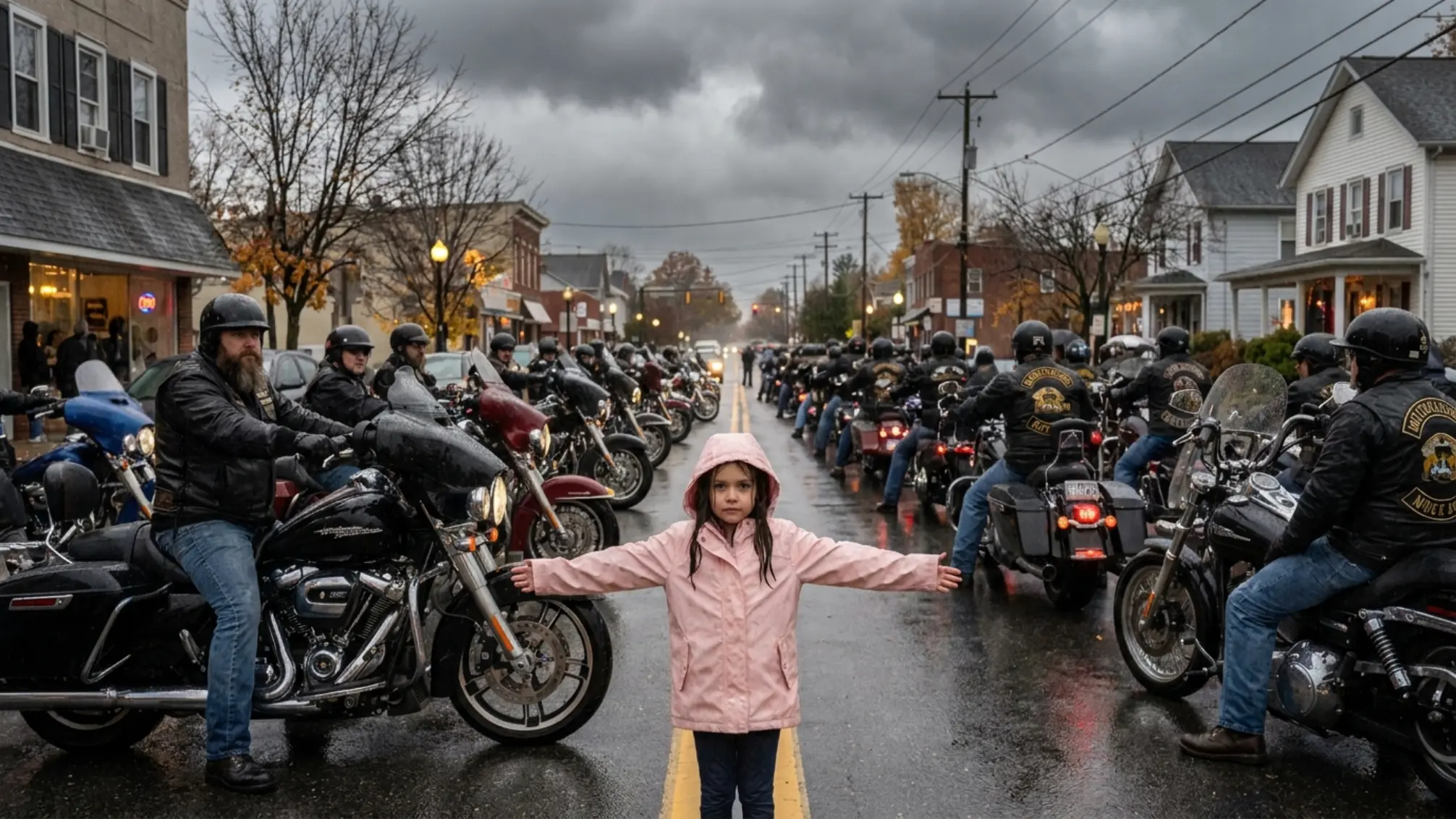
At the front of the formation rode Jack “Grizzly” Mercer, a forty-six-year-old white American biker with broad shoulders, a thick brown-and-gray beard, and pale blue eyes hardened by thirty years on the road. He saw Maya only seconds before reaching the intersection. His hand closed around the brake, his rear tire shifted slightly on the wet asphalt, and the enormous black motorcycle stopped less than twenty feet from her. Behind him, hundreds of riders slowed one by one until the deafening roar became a scattered rumble and then complete silence.
Five hundred leather-clad American bikers stared at one little girl.
Maya’s arms trembled, but she did not lower them.
“Don’t touch your bikes,” she called, her voice nearly disappearing beneath the rain. “Please come with me.”
Jack placed both boots on the road but kept his hands on the handlebars. “Why are you standing out here, sweetheart?”
Maya swallowed. “Because my daddy said bikers help people.”
Her lower lip began to shake.
“And my mommy won’t wake up.”
Jack shut off his engine.
The riders behind him did the same without being told. The remaining mechanical vibration faded from the street, leaving the hiss of rain against leather, chrome, and pavement. Jack stepped away from his motorcycle and approached slowly, careful not to frighten the child.
“Where is your mother?”
Maya pointed toward an abandoned four-story textile warehouse near the end of the block. Its upper windows were broken, its bricks were stained black by decades of weather, and plywood covered most of the ground-floor openings. A faded sign above the entrance still displayed the words MILLER TEXTILES, though the company had closed more than twenty years earlier.
“She’s inside,” Maya said. “But you can’t start the motorcycles again.”
“Why not?”
“The air smells wrong.”
Jack looked toward the warehouse. Even through the rain, he detected a faint chemical odor drifting from that direction. It was not ordinary smoke. It smelled like gasoline mixed with rotten eggs and hot metal.
“How many people are in there?” he asked.
Maya hesitated. “A lot.”
The answer changed Jack’s expression.
He turned toward the first rows of riders. “No engines. Nobody lights a cigarette. Boone, call emergency services and tell them we may have a gas leak with multiple victims. Doc, bring every medical kit we have.”
A massive white American biker named Boone Harrison lifted his phone immediately. Beside him, Dr. Samuel Reed, a fifty-eight-year-old Black American emergency physician who rode with the club on weekends, removed two bright red trauma bags from his touring motorcycle.
Jack crouched in front of Maya.
“Can you take us to your mother?”
The little girl nodded.
Jack offered his hand, but Maya looked past him at the sea of bikers filling the street.
“All of them have to come.”
Jack glanced over his shoulder. “Five hundred people cannot fit inside that building.”
“They don’t all have to go inside,” she said. “But they have to help.”
There was something in the certainty of her voice that prevented him from arguing. Jack stood and waved the first forty riders forward on foot. The others remained beside their silent motorcycles, waiting in the rain.
Maya led them toward the warehouse.
She slipped through a narrow opening between two plywood sheets covering a side entrance. Jack had to turn sideways to follow. Inside, the warehouse smelled stronger, and the darkness seemed to swallow the weak gray light from outside.
“Stay close to me,” he told her.
“I know the way.”
Maya moved through a hallway filled with broken furniture, old machinery parts, and blankets hung from exposed pipes. At first Jack assumed the building was empty except for the child and her mother. Then he saw a row of small shoes arranged beneath a staircase.
Children’s shoes.
A few feet farther, a hand-painted sign hung from a nail:
THE HARBOR — NO ONE SLEEPS OUTSIDE TONIGHT
Jack stopped.
“What is this place?”
“My mommy’s shelter,” Maya said.
The Harbor was not a legal shelter. It had no official sign outside, no government funding, and no professional staff. It was a hidden refuge created inside an abandoned warehouse by people who had nowhere else to go.
The first room contained twelve mattresses arranged across the concrete floor. Women and children lay beneath donated blankets, some unconscious and others too weak to stand. A portable heater hissed near the wall, connected to several damaged propane cylinders through a web of old rubber hoses.
Dr. Reed immediately covered his mouth with his sleeve.
“Everybody out,” he said. “Possible carbon monoxide and propane exposure.”
Maya ran toward a Black American woman lying beside the far wall. Thirty-two-year-old Lena Brooks wore a faded blue sweater and had one arm wrapped protectively around an infant who was not her own. Her eyes were closed, and her breathing was shallow.
“Mommy!”
Maya dropped beside her.
Dr. Reed reached them first and checked Lena’s pulse. “She is alive.”
Maya began crying.
Jack knelt beside her. “We are going to bring her outside.”
“There are more upstairs,” she said. “Mommy went back for them.”
“How many?”
“I don’t know.”
A weak voice came from the nearest mattress.
“Forty-three,” whispered a white American woman with cracked lips and a bruised cheek. “Forty-three people were here last night. Maybe more came after midnight.”
Jack looked toward the staircase.
The warehouse had four floors, and the chemical odor grew stronger near the center of the building. Rainwater dripped from the ceiling onto exposed wires. Somewhere below them, metal groaned.
Jack raised his radio.
“Boone, we have at least forty-three people inside, possibly more. Shut down the entire block. No vehicles, no flames, no electricity. Send teams to every exterior exit.”
The answer came immediately.
“Already moving.”
The first bikers carried Lena, the infant, and the other unconscious residents toward the side entrance. Outside, hundreds of riders removed their leather jackets and spread them across the wet ground so the rescued people would not have to lie directly on the cold pavement.
Others formed lines from the warehouse entrance to the far side of the street. Medical supplies, blankets, bottled water, and flashlights passed from hand to hand. Riders who had arrived expecting an afternoon charity ride suddenly found themselves organizing the largest emergency rescue the town had seen in decades.
Jack carried Maya through the entrance and placed her beside Lena.
“Stay here.”
Maya grabbed his vest. “No. There is a baby upstairs who cries when the lights go out.”
Jack looked at Dr. Reed.
The doctor was already fitting an oxygen mask over Lena’s face. “You cannot take a child back into that building.”
“I can show you the room,” Maya insisted. “The hallway is blocked.”
Jack crouched again. “Tell me how to reach it.”
Maya wiped rain from her eyes. She described a rear staircase behind the old dyeing machines, a hallway painted green, and a door with a yellow blanket hanging over it. Jack repeated the directions until she confirmed he understood.
Then he returned inside with twelve bikers.
They found the main stairwell partially collapsed. The wooden steps had absorbed years of moisture and gave way beneath the weight of the first man. Jack redirected the team through the machinery room, where rusted metal looms stood like enormous skeletons.
The propane odor became almost unbearable.
On the second floor, they found nine people. Three were awake but disoriented, while the others had collapsed near a boarded window. Two bikers broke through the plywood from the inside, allowing fresh air to enter.
One of the conscious women told Jack the heaters had begun failing during the night.
Lena had tried to shut them off, but the outside temperature was close to freezing. Many residents had children, and they feared sleeping without heat. When the first people became sick, Lena carried them toward the windows and sent Maya outside to find help.
“Why didn’t anyone call an ambulance?” Jack asked.
“They were afraid.”
“Of what?”
“Police. Child services. Immigration questions. Arrest warrants. Losing their kids.”
Every person in the building was American, but fear did not always care about facts. Some had fled abusive homes, some had outstanding debts, and others had been threatened so often that any uniform represented danger. Lena had promised that The Harbor would be a place where no one was forced to explain their pain before receiving a bed.
That promise had saved people during the winter.
Now the illegal heaters were killing them.
Jack’s team reached the third floor.
The hallway was painted green.
At the end hung a yellow blanket.
Behind it, they found a young Asian American mother unconscious beside a crib assembled from wooden shipping pallets. Her premature baby lay wrapped in towels, crying weakly in the cold room.
The sound struck the bikers harder than any order could have.
One rider named Anthony Vale removed his leather vest and wrapped it around the child. Anthony was a forty-year-old Latino American mechanic who had lost a newborn daughter twelve years earlier. His hands shook as he lifted the baby.
“She is breathing,” he whispered.
The mother had a pulse but did not respond. Jack and another biker carried her while Anthony held the infant against his chest.
The floor shifted beneath them.
A deep cracking sound echoed through the warehouse.
“Move!” Jack shouted.
The team hurried toward the stairs as a section of plaster collapsed behind them. When they reached the second floor, smoke had begun creeping through a service corridor.
It was not a large fire yet, but something electrical had ignited near the old propane lines.
Jack radioed the warning.
Outside, Boone ordered everyone farther back from the building. The bikers moved the rescued residents toward a church parking lot two blocks away. They carried mattresses, blankets, and people who could not walk.
Volunteer firefighters arrived, followed by ambulances from three neighboring towns. The street was too crowded for emergency vehicles, so the five hundred bikers pushed their motorcycles by hand into side roads, never starting a single engine.
Maya had been right to warn them.
The smell in the air came from leaking propane collecting near the warehouse’s lower level. A spark from an engine, cigarette, or damaged electrical system could have caused an explosion.
Firefighters entered with breathing equipment while Jack’s teams continued bringing people out through the side opening. By then, thirty-eight residents had been accounted for.
Five were still missing.
Lena regained consciousness inside an ambulance. The first word she spoke was Maya’s name. When she saw her daughter sitting beside the stretcher, she tried to rise despite the oxygen mask.
Maya climbed into the ambulance and wrapped both arms around her.
“Mommy, the bikers came.”
Lena looked through the open doors at the hundreds of leather-clad riders carrying blankets, directing traffic, comforting children, and helping paramedics.
“How many?”
“Five hundred.”
Lena stared as if the number belonged to a dream.
Jack approached the ambulance. His beard was wet, and soot darkened one side of his face.
“We found thirty-eight,” he told her. “We need to know where the others are.”
Lena struggled to focus. “Basement laundry room. Mr. Ellis and four boys. He took them down there when the heater started making noise.”
Jack’s expression changed. “The propane is coming from the basement.”
Lena gripped his arm. “Please.”
Jack turned before she could say anything else.
Firefighters had blocked the main basement entrance because gas readings were dangerously high. The rear delivery ramp had collapsed years earlier, but one biker remembered seeing a maintenance tunnel behind the warehouse.
The tunnel entrance was buried beneath weeds and scrap metal.
Dozens of riders cleared it with their bare hands.
Firefighters entered first with detection equipment, followed by Jack and Dr. Reed. The concrete passage led beneath the warehouse and opened near the old boiler room. Visibility was poor, and every breath carried the sharp taste of chemicals even through protective masks.
They heard banging from behind a steel door.
Jack and a firefighter forced it open.
Inside, sixty-eight-year-old Mr. Ellis lay over four boys, using his own body to shield them from debris falling through the ceiling. The elderly Black American man was conscious but barely breathing.
“Take the children first,” he whispered.
Jack knelt beside him. “Everyone leaves together.”
Two firefighters carried the youngest boys. Jack lifted Mr. Ellis while Dr. Reed guided the others toward the tunnel. Behind them, flames reached the damaged propane lines.
The explosion was smaller than firefighters feared, but powerful enough to shake the building and send bricks falling into the alley. The maintenance tunnel filled with dust.
Outside, Maya screamed when she saw smoke burst from the roof.
Then the first firefighter emerged carrying a child.
Another followed.
Jack appeared last with Mr. Ellis across his shoulders.
The street erupted in cheers.
Every person had been rescued.
The warehouse burned for nearly three hours. Firefighters prevented the flames from reaching neighboring homes, but The Harbor was destroyed. Mattresses, donated clothing, food supplies, photographs, and the few possessions its residents owned disappeared beneath the collapsing roof.
Lena sat beneath a blanket in the church parking lot and watched the smoke.
“I failed them,” she said.
Jack stood beside her.
“You kept forty-three people alive before we arrived.”
“I put them inside an unsafe building.”
“You gave them somewhere to go when no one else did.”
“And now they have nothing.”
Jack looked across the parking lot.
Five hundred bikers stood among the displaced families. Some held children in their arms. Others spoke quietly with women who had not trusted men for years. Anthony still carried the premature baby beneath his vest while paramedics treated her mother.
Jack raised his hand.
The bikers became silent.
“We came to town for a memorial ride,” he told them. “We planned to cross three counties, eat lunch, and go home. Instead, a seven-year-old girl stood in front of us because she believed bikers help people.”
He looked toward Maya.
“She was right.”
The riders listened.
“There are forty-three Americans here who have no beds tonight. Their shelter is gone. Their food is gone. Some have no shoes except what they wore out of that building.”
Jack removed his wallet.
He took every bill inside and placed the money in an empty motorcycle helmet.
“This is not charity,” he said. “This is a debt. That little girl trusted us before she had any reason to.”
Boone stepped forward and added his money.
Dr. Reed followed.
Then the helmet moved through the crowd.
By sunset, the bikers had collected more than eighty thousand dollars in cash, checks, and digital donations. Club chapters contacted hotels, restaurants, medical providers, lawyers, and construction companies throughout the state.
Every displaced resident had a room that night.
The story spread before morning. Images of Maya standing in her pale pink raincoat before five hundred motorcycles appeared across American news broadcasts. Reporters focused first on the spectacle, but the deeper story soon emerged.
The Harbor had existed because the town’s official shelter closed two years earlier after losing funding. Lena, once a social worker, began helping one family at a time. She rented rooms until her savings disappeared, then quietly moved the operation into the abandoned warehouse.
Local officials knew homeless families were sleeping in unsafe locations.
They had done little.
The bikers refused to let the attention disappear.
Jack organized a nonprofit called Maya’s Harbor, placing Lena in charge of services while accountants and attorneys handled the finances. Riders with construction experience found an abandoned elementary school owned by the county. It had solid walls, working plumbing, a commercial kitchen, and enough classrooms to create private family rooms.
The county initially refused to sell.
Five hundred bikers attended the next public meeting.
They did not shout or threaten. They sat silently while Lena described the people rescued from the warehouse. Maya sat beside her wearing the same pale pink raincoat.
The county approved the transfer that night.
For six months, bikers traveled from across the country to renovate the school. Electricians replaced wiring. Plumbers repaired bathrooms. Carpenters built beds, doors, and storage cabinets. Artists painted walls in warm colors so the building would not feel like an institution.
Anthony constructed the nursery.
He placed a small plaque above the door honoring the daughter he had lost. The premature baby rescued from the warehouse became the first child to sleep there.
Dr. Reed established a free medical clinic inside the former library. Local teachers volunteered to tutor children. Attorneys helped residents secure identification, benefits, protective orders, and employment.
The Harbor no longer had to hide.
One year after Maya stopped the motorcycles, five hundred riders returned to Fisherman Street. This time, the weather was clear, and the motorcycles remained parked around the new shelter.
Maya stood on the front steps in a pale pink coat that was already becoming too small for her. Lena stood beside her, healthy and smiling.
Jack handed Maya a brass key.
“This building belongs to the people who need it,” he said. “But you are the reason the doors opened.”
Maya looked at the hundreds of bikers gathered before her.
“Do I get to make a rule?”
Jack smiled. “One rule.”
She thought carefully.
“Nobody gets turned away because they look scary.”
The crowd laughed, but Jack’s eyes filled with tears.
“That is a good rule.”
Maya’s Harbor helped more than four hundred families during its first year. Some stayed for one night, while others remained for months. The shelter offered privacy, safety, counseling, medical care, and time to rebuild without being judged.
Mr. Ellis became the night caretaker.
Anthony visited the nursery every Sunday.
The young mother whose baby he carried from the warehouse eventually became a certified nursing assistant. She named him as the child’s godfather.
Lena continued running the shelter, but she no longer carried the responsibility alone. A board of social workers, residents, and bikers protected the mission. Financial reports were public, safety inspections were frequent, and every heater met modern standards.
Jack kept Maya’s faded raincoat photograph inside the clear pocket above his motorcycle’s speedometer. Whenever another rider complained that helping one person could not change anything, he pointed toward the image.
One small girl had stopped five hundred motorcycles.
She had not used strength, authority, or fear.
She had stood in the rain and trusted the right people.
Years later, Maya was asked whether she had been afraid that day. She admitted that she had been terrified. The motorcycles were louder than anything she had ever heard, and the riders looked like giants beneath their helmets and leather.
“Then why didn’t you move?” the reporter asked.
Maya looked toward Jack.
“Because my mommy told me courage means being scared and standing where someone needs you anyway.”
Jack lowered his head, unable to hide his emotion.
The five hundred bikers had believed they were the ones who rescued Maya’s family and the people inside the warehouse. They had carried bodies, broken doors, raised money, and rebuilt a shelter.
But the truth was more complicated.
A seven-year-old girl had stopped them in the middle of the road and reminded them what their strength was for.
She asked them not to touch their motorcycles.
Then she led them somewhere their engines could never have taken them—toward forty-three forgotten people waiting for someone to see them as worth saving.